Drive Golf Club Membership Sales: Your 2026 Growth Guide
Most advice on golf club membership sales starts in the wrong place. It tells clubs to run more ads, push harder on social media, or offer a sharper joining incentive.
That can create activity, but activity is not the same as growth.
At GolfRep, we see the same pattern repeatedly across UK clubs. Enquiries come in, then they sit in an inbox, get forwarded between staff, or rely on one person remembering to call back when the office is quiet. By the time anyone responds properly, the prospect has already compared options, lost momentum, or booked a round somewhere else. The issue usually isn't demand. It's the system that sits behind demand.
The Real Reason Your Membership Sales Are Stalling
The biggest mistake in golf club membership sales is assuming the top of the funnel is the problem.
For most clubs, it isn't. England alone has approximately 1,735 affiliated golf clubs and around 730,000 club members nationwide, which gives you a clear sense of the scale and competition in the market (England Golf data via GCMA). There is demand in the market. There is also choice. That means clubs don't win merely by collecting more forms. They win by handling interest better than the club down the road.

The leaky pipeline problem
A club can generate enquiries and still have weak membership growth. That usually happens for three reasons:
- Lead quality is poor: Broad campaigns attract people who like the idea of golf, not people ready for membership.
- Qualification is weak: Staff can't quickly tell who is a serious prospect, who needs nurturing, and who is only price checking.
- Follow-up is inconsistent: Leads receive different experiences depending on who is on shift, who is on leave, or who remembered to respond.
That is a leaky pipeline. It doesn't look dramatic from the outside. The diary still has viewings. The website still gets forms. The committee still hears that marketing is active. But sales stall because too much intent leaks out between first enquiry and first meaningful conversation.
A club rarely has a marketing problem in isolation. It has a conversion system problem.
Many managers borrow the wrong lessons from other sectors. A useful way to think about it is how online brands boost online sales effectively by improving the journey after interest is shown, not just by buying more traffic. Golf clubs are no different. The prospect journey matters.
Why manual handling breaks down
Manual follow-up feels personal, but in practice it's often patchy. One staff member sends a warm email. Another sends a one-line reply. A third plans to call back later and never gets to it. No one has full visibility. No one can say which leads booked a tour, which went cold, and which source produced members.
That is why clubs need systems, not heroics.
If your current process depends on inbox monitoring, handwritten notes, or someone "keeping an eye on it", your sales operation is already fragile. We've written more about that in why most golf club marketing fails, because the marketing itself often isn't the true point of failure.
Targeting High-Value Golfers Instead of Chasing Volume
Low-quality enquiries create extra admin and false confidence. They make the pipeline look busy while giving staff more people to chase who were never likely to join.
Strong golf club membership sales start with tighter targeting.

What a high-value lead actually looks like
A high-value lead is not just someone within a certain age bracket or postcode. Those details help, but they don't tell the full story. The better questions are:
- Playing intent: Are they actively looking for a place to play regularly?
- Lifestyle fit: Does your club suit how they want to use golf, whether that means weekend competition, midweek flexibility, or social play?
- Commitment level: Are they comparing annual membership seriously, or just browsing after a one-off round?
- Commercial value: Are they likely to stay, spend, and become part of the club community?
When clubs ignore these signals, they end up paying for attention from people who never had the right fit.
Precision beats reach
The most useful case study here is Astbury GC. Expert methodology built around quality over volume can achieve conversion rates of approximately 30% from enquiry to member, and at Astbury GC a precision-targeted campaign generated 71 leads, 21 conversions, and £25,000 in new revenue (Astbury GC case study).
Those numbers matter because they show what happens when a club stops optimising for quantity and starts optimising for relevance.
Broad targeting usually produces familiar problems:
| Approach | Likely outcome |
|---|---|
| Broad audience targeting | More casual interest, more filtering work, weaker sales conversations |
| Narrow, relevant targeting | Fewer wasted enquiries, better-fit prospects, cleaner follow-up |
Practical rule: If staff keep saying "we're getting plenty of leads but not the right ones", the targeting is too loose or the offer is attracting the wrong person.
Build your member profile before you spend
Before launching any campaign, define the member you want. That profile should include:
Typical usage pattern
Frequent weekday golfer, younger flexible player, returning golfer, retiree, family household, or social member with occasional golf.Motivation
Competition, convenience, community, course access, wellness, or structured progression back into the game.Likely barriers
Price sensitivity, uncertainty around commitment, concern about fitting in, or confusion around categories.Best first offer
Tour, taster round, conversation with the membership team, or a flexible entry point rather than a hard annual decision.
If you want a stronger framework for this, how to improve lead quality is the right starting point.
Building Your 24/7 Lead Capture and Qualification System
Clubs still lose members while the office is closed.
That sounds obvious, but many sales processes still behave as if prospects only enquire during office hours and are happy to wait for a reply. They aren't.
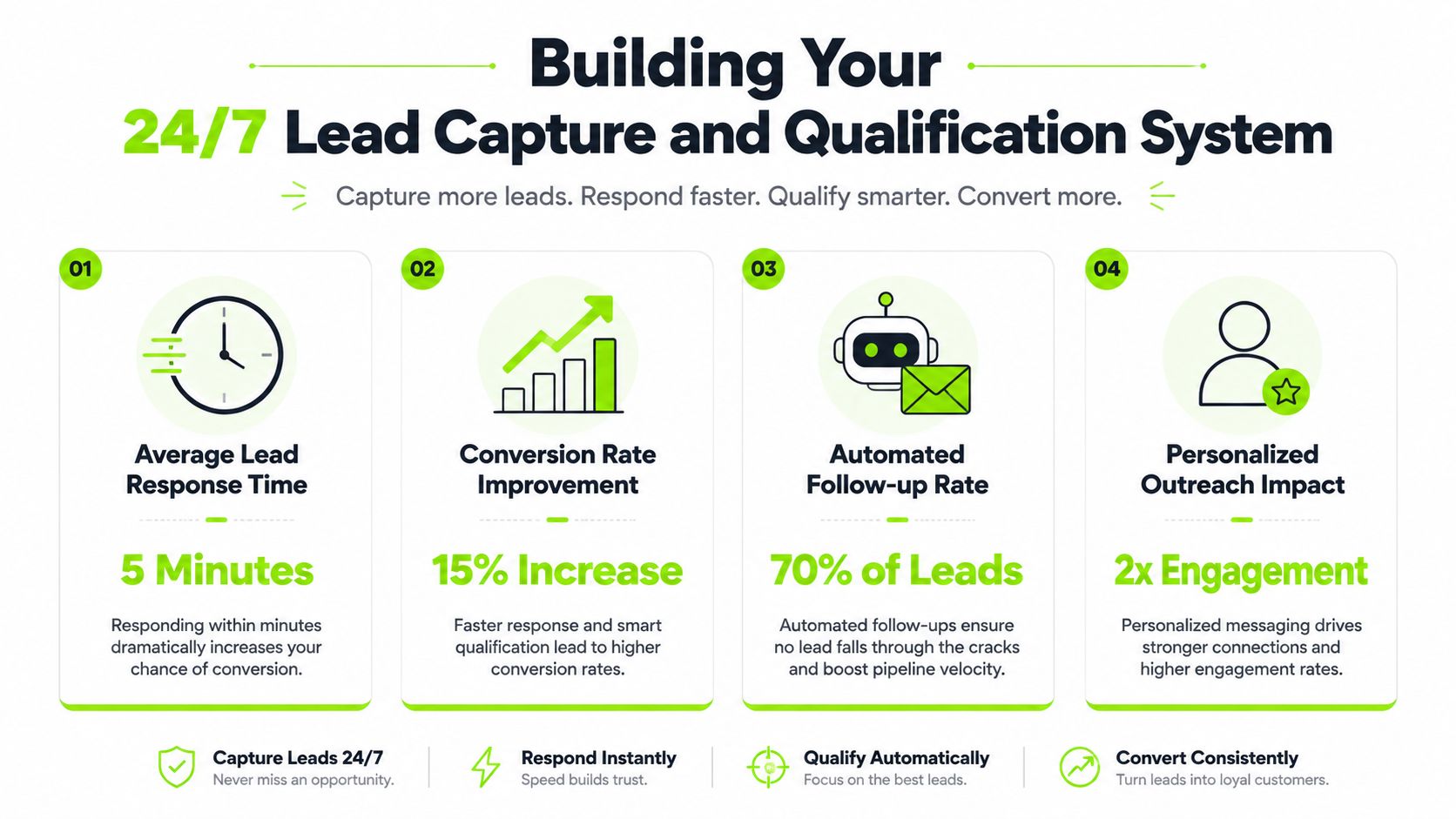
A critical benchmark in UK golf club sales is response speed. The average enquiry response time is 47 hours and 32 minutes, and leads that receive a response within one hour are five times more likely to convert (GolfRep analysis of golf course revenue management). That gap is too large to ignore.
Why speed changes everything
A membership enquiry is a moment of intent. The prospect has moved from passive interest to active consideration. If the club responds quickly, it keeps that momentum alive. If the club waits, the prospect starts shopping around, second-guessing the cost, or moves on.
Fast acknowledgement does three jobs at once:
- It reassures the prospect that the club is organised.
- It protects the lead from going cold overnight or over the weekend.
- It creates operational visibility because the enquiry enters a system rather than disappearing into email.
Clubs often overvalue creative output and undervalue process. A polished video and a cinematic social media strategy can help attract attention, but once someone enquires, response infrastructure matters more than aesthetics.
What the system should do immediately
A proper lead capture and qualification system should trigger actions the moment the form is submitted.
At minimum, it should:
- Acknowledge instantly: Send a professional response by email or text straight away.
- Collect useful qualification data: Ask the right questions at form stage, not three days later.
- Assign ownership: Make it clear who handles the lead next.
- Track progression: Show whether the lead was contacted, nurtured, booked, toured, or lost.
That removes guesswork from the process.
The questions that improve qualification
Most forms are too vague. "Interested in membership? Enquire here" gives the club a name, an email address, and not much else.
A better form asks a small number of practical questions such as:
| Form question | Why it matters |
|---|---|
| What type of membership are you considering? | Signals fit and buying intent |
| When are you looking to join? | Separates active buyers from general browsers |
| How often do you currently play? | Helps shape the sales conversation |
| Would you like to arrange a visit or call? | Creates the next step immediately |
The point of qualification isn't to create friction. It's to help staff have the right conversation first time.
Automation is not the same as impersonality
Some clubs resist automation because they think it feels robotic. In reality, poor manual follow-up feels far less personal. Prospects don't judge your process by whether a human typed the first acknowledgement. They judge it by whether the club was responsive, clear, and easy to deal with.
Tools vary. Some clubs use a standard CRM with custom workflows. Others use sector-specific systems. GolfRep is one option for clubs that want lead capture, qualification, and nurture built around golf club membership workflows rather than a generic sales pipeline. The wider point is simpler. You need a system that works when your team is busy, not just when they are available.
For clubs exploring this in more detail, AI lead qualification for golf clubs is worth reviewing.
Designing a CRM-Powered Nurture Workflow
A membership enquiry is rarely a same-day sale. Prospective members need reassurance, context, and a reason to take the next step.
That is why a CRM-powered nurture workflow matters. It bridges the gap between initial interest and a booked visit without relying on staff to remember every follow-up manually. It also respects the reality that joining a club is a considered purchase. The average annual sum for golf club membership in England is currently £901 (membership pricing reference). For most prospects, that isn't an impulse decision.
What a good nurture sequence does
A good nurture workflow doesn't just repeat "are you still interested?" in different formats.
It should:
- Reduce uncertainty by answering common questions before the prospect has to ask.
- Reinforce fit by showing what membership looks like in practice.
- Create momentum by making the next action obvious.
- Keep the club visible during the decision window.
The most effective sequences combine email and text in a measured way. Email carries the detail. Text provides immediacy and reminds the prospect to act.
Sample 14-Day Membership Nurture Sequence
| Day | Channel | Action / Content |
|---|---|---|
| 0 | Instant acknowledgement, confirm enquiry received, explain next steps | |
| 0 | SMS | Short thank-you message with clear contact point |
| 1 | Membership overview with category options and simple explanation of who each suits | |
| 3 | Course highlights, clubhouse experience, member benefits, practical reasons people join | |
| 4 | SMS | Prompt to book a call or club visit |
| 6 | Answer common objections such as time, category fit, and how the joining process works | |
| 8 | Share member experience, club atmosphere, and what a first visit involves | |
| 10 | SMS | Reminder that visit slots or calls are available |
| 12 | Clear invitation to book a tour or speak with the membership contact | |
| 14 | Final check-in with a simple response option and low-friction next step |
Keep the tone useful, not pushy
Most nurture sequences fail because they sound like campaigns rather than conversations.
Avoid:
- Repeated sales pressure: It creates resistance too early.
- Generic brochure language: It doesn't answer real buying questions.
- Long gaps: Interest fades when the club goes silent.
- Too many messages: Relevance matters more than volume.
Use the sequence to remove doubt. Tell the prospect what to expect on a visit. Explain how categories work. Show them they won't be left to decode club language on their own.
If someone is considering a recurring annual spend, they need confidence in the club's process as much as confidence in the course itself.
Build it once, improve it over time
The benefit of CRM-led nurture is consistency. Every lead gets a professional journey. Every message can be refined. Every outcome can be tracked.
That lets the club answer useful questions later. Which message prompts visits? Which category produces the best tour attendance? Where do prospects stall? Those answers are hard to find when follow-up lives across personal inboxes and memory.
Mastering the Membership Sales Conversation
By the time a prospect reaches a call or club visit, the sales job has changed.
You are no longer trying to create interest. You are testing fit, building trust, and helping someone make a confident decision.
A better way to open the conversation
The weak version of a membership conversation sounds like a brochure. Staff list categories, mention the course, point to the bar, and hope the prospect fills the silence.
The stronger version starts with questions.
A useful opening might sound like this:
“Before I talk you through options, tell me a bit about how you play now and what you're looking for from a club.”
That changes the dynamic immediately. Instead of delivering a rehearsed pitch, the club starts diagnosing the prospect's needs.
What consultative selling looks like on a tour
A good membership tour is guided, but not rigid. Staff should listen for cues and adapt.
If the prospect says they struggle to play every weekend, focus on flexibility and convenience. If they mention wanting to meet people locally, talk about competitions, roll-ups, or social touchpoints. If they are returning to golf after time away, remove intimidation and explain how members settle in.
A simple structure works well:
Start with their current situation
Where do they play now, how often, and what is missing?Match needs to the right category
Do not default to the highest package. Recommend the right fit.Show, don't just tell
Walk them through the spaces and routines they would use.Address concerns directly
If they raise cost, time, or confidence, answer it plainly.
Handling objections without getting defensive
Price objections are often really value objections.
If someone says membership feels expensive, the wrong response is to justify every facility in the clubhouse. The better response is to narrow the discussion:
- Are they comparing against pay-and-play?
- Are they unsure how often they would use it?
- Are they worried about joining the wrong category?
That lets staff answer the actual issue.
For example, if the concern is commitment, you can explain the entry route that best suits their likely usage. If the concern is culture, describe what onboarding looks like and how new members get introduced. If the concern is budget, explain the value clearly without dropping into reactive discounting.
End every conversation with a next step
Too many tours end with "have a think and let us know".
That sounds polite, but it puts all the momentum back on the prospect.
A better close is specific and easy to act on. Offer to send the most relevant membership option. Invite them back for a follow-up visit. Agree a time for a call next week. Keep the process moving without pressure.
Staff do not need to become hard sellers. They need to become competent guides. That shift alone improves golf club membership sales because it makes the club easier to buy from.
Structuring Your Pricing and Membership Offers
Pricing is not separate from sales. It is one of the main reasons sales either move smoothly or stall.
When clubs struggle to convert, they often react by reaching for discounts. That can produce a short burst of interest, but it also trains the market to wait, weakens perceived value, and creates awkward questions from existing members.
Start with fit, not price cuts
The better approach is to build offers around how different golfers want to use the club.
Traditional annual subscriptions still suit many clubs, particularly where regular play, competition, and community are central to the proposition. But a single all-in model won't suit every prospect who likes the club.
A stronger pricing structure usually includes a few clearly defined pathways:
| Membership model | Best suited to | Main trade-off |
|---|---|---|
| Traditional annual membership | Regular golfers who want full belonging and routine use | Can feel like too much commitment for lighter users |
| Flexible or credit-based option | Prospects who want lower-commitment access | Needs careful rules to protect full-member value |
| Tiered access categories | Different usage patterns across age, schedule, or availability | Can become confusing if categories multiply |
Where flexible models fit
Some clubs now need an answer for golfers who want access without a full traditional commitment. That is where flexible or credit-based structures can help, if they are designed carefully.
The risk is obvious. If the flexible option is too generous, it cannibalises full membership. If it is too restrictive, it becomes an unattractive halfway house that nobody chooses.
The practical balance usually comes from controlling:
- Access windows: Off-peak access can widen appeal without creating pressure on premium times.
- Booking rules: Priority can remain with full members.
- Included value: The flexible product should solve a real problem, not mimic the core offer too closely.
Joining fees and incentives need context
Joining fees can work well when the club explains what they support. Framed properly, they are not a penalty. They are part of entering and sustaining the club.
Temporary incentives can also have a place, but they should be targeted and strategic, not permanent and visible in every campaign. If you make the same "limited offer" every month, the market stops believing it is limited.
Clubs protect long-term pricing power when they design relevant offers, not when they race to the bottom.
Simplicity helps conversion
A prospect should be able to understand your categories quickly.
If your pricing sheet requires a committee member to explain six exceptions, seasonal caveats, and three legacy rates, the sales process becomes harder than it needs to be. Clarity converts. Confusion delays.
The strongest offer structure supports the wider sales system. It gives marketing a clear message, helps staff qualify properly, and makes it easier for prospects to say yes without feeling boxed in.
Measuring Success and Equipping Your Team
Many clubs focus on website visits, form fills, and social engagement because those figures are easy to pull into a report. They are useful for marketing visibility, but they do not show whether your membership process is converting interest into revenue. Sales usually stall later in the pipeline. Enquiries sit too long, tours are not booked quickly enough, follow-up is inconsistent, and good prospects drift off.
That is why post-enquiry management deserves more attention than top-of-funnel volume.
The broader market still rewards clubs that run a tighter system. The UK golf club market is projected to reach USD 280.7 million by 2027, with a 2.5% CAGR according to UK golf club market projections. Steady growth helps clubs with a disciplined process more than clubs that rely on occasional campaigns and hope.
Track the pipeline, not just the top line
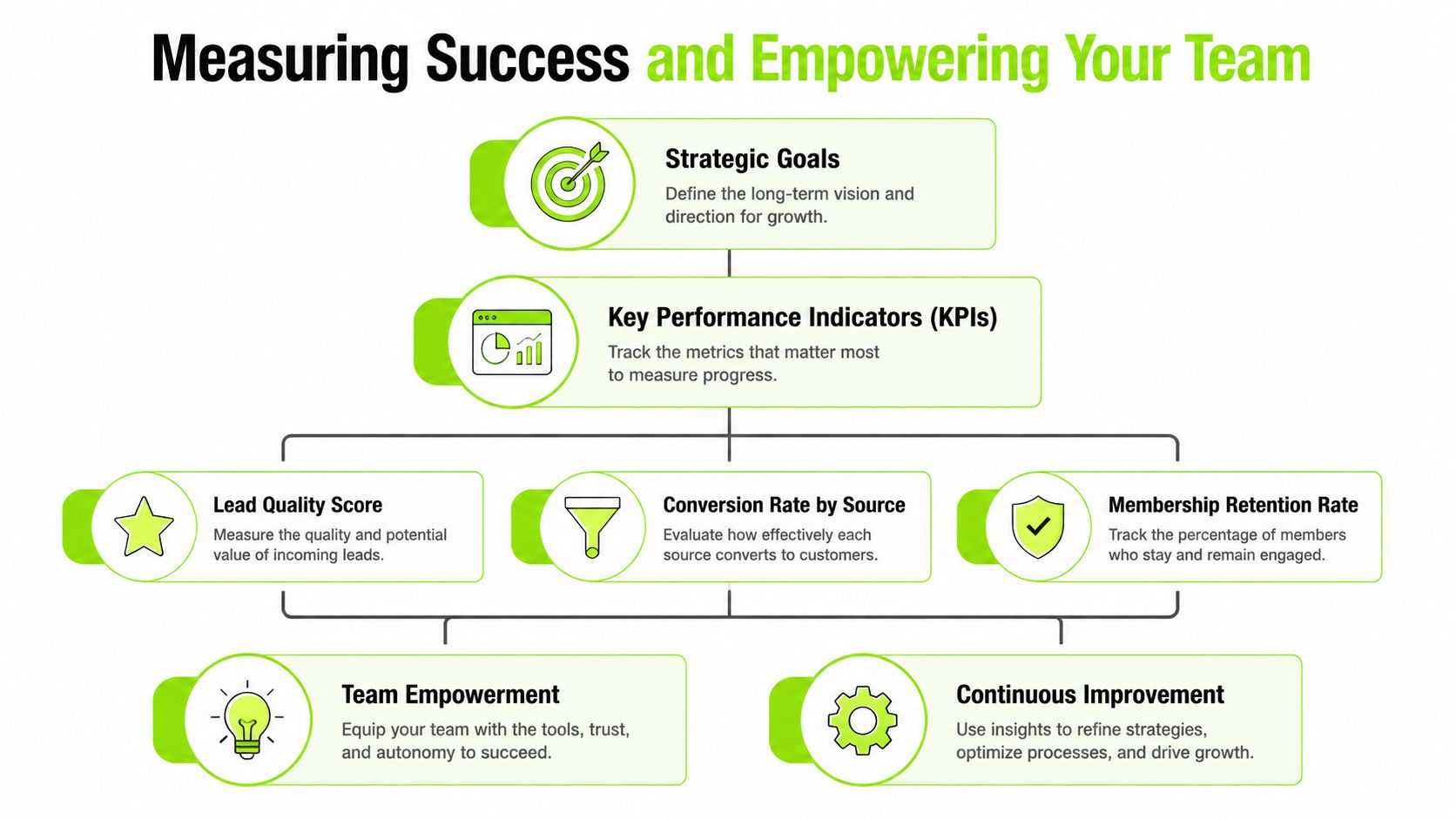
The most useful KPIs expose delay, inconsistency, and weak handoffs.
Focus on measures such as:
- Lead-to-tour rate: Are qualified prospects getting to a visit, or are they dropping out before the club experience is presented properly?
- Tour-to-member conversion rate: Are strong-fit prospects seeing enough value to join?
- Response performance: How fast is the first response, and how often does follow-up happen on time?
- Conversion by source: Which channels produce serious buyers instead of admin-heavy low-intent enquiries?
- Stage visibility: How many leads are new, contacted, booked, toured, proposed, won, or lost?
These metrics make diagnosis easier. If lead volume holds up but tours fall, the issue is usually speed to contact or weak qualification. If tours are happening but membership sales are flat, review the tour quality, the sales conversation, and whether staff are presenting the right membership category.
Give staff a process they can follow
A CRM does not fix poor habits by itself. Clubs get results when the system supports clear behaviours and management checks them.
That usually means four things:
Clear ownership
Every enquiry needs a named person responsible for the next action.Simple operating standards
Staff need clear rules for response times, notes, follow-up steps, and escalation.Practical training
Train for real membership scenarios. Handling inbound calls, running tours, recording objections, and scheduling next steps inside the CRM matter more than generic software walkthroughs.Regular review
Managers should inspect the pipeline weekly, not wait for an end-of-month total and wonder why conversion slipped.
The best sales systems improve the effectiveness of good staff and make busy staff more consistent.
Build accountability into the routine
Committee-run clubs often treat membership sales as a campaign problem. In practice, it is a management problem. If nobody reviews ageing leads, missed callbacks, cancelled tours, and lost reasons, the same leaks stay in place for months.
A better rhythm is simple. Review the pipeline, identify where prospects are slowing down, coach the team on one or two specific behaviours, and check the numbers again next week. That is how clubs improve conversion without relying on more advertising every time sales soften.
If your club wants a more reliable approach to golf club membership sales, GolfRep helps build the underlying system that most clubs are missing. That means lead generation combined with structured follow-up, CRM visibility, and automated nurture so enquiries don't go cold between first contact and membership sign-up.
Ready to tap into our proven growth system?