Golf Club Marketing Trends: Strategies for 2026

The most important golf club marketing trend isn't a new ad platform. It's speed.
UK golf clubs take an average of 47 hours and 32 minutes to respond to membership enquiries, according to GolfRep's analysis of club sales processes. At that pace, many clubs don't have a marketing problem at all. They have a follow-up problem. The enquiry arrives, interest is real, and then the prospect hears nothing while another club replies first.
That matters even more in a market that's already growing. Nearly three-quarters of UK golf clubs reported positive membership growth in 2023, continuing a run where over 70% of clubs achieved growth in each of the previous three years, as covered in Hillier Hopkins' review of changing fortunes for clubs. Demand exists. Attention exists. The clubs that benefit are usually the ones with a system to capture and convert it.
Most discussion around golf club marketing trends still focuses on visibility. Better social content. Better ads. Better websites. Those things matter, but only if they feed a structured process that tracks every enquiry, triggers fast responses, and gives managers visibility over what happens next.
Introduction to Golf Club Marketing Trends
Golf club marketing performance is increasingly shaped by a metric many clubs still do not track closely enough. Time to first response.
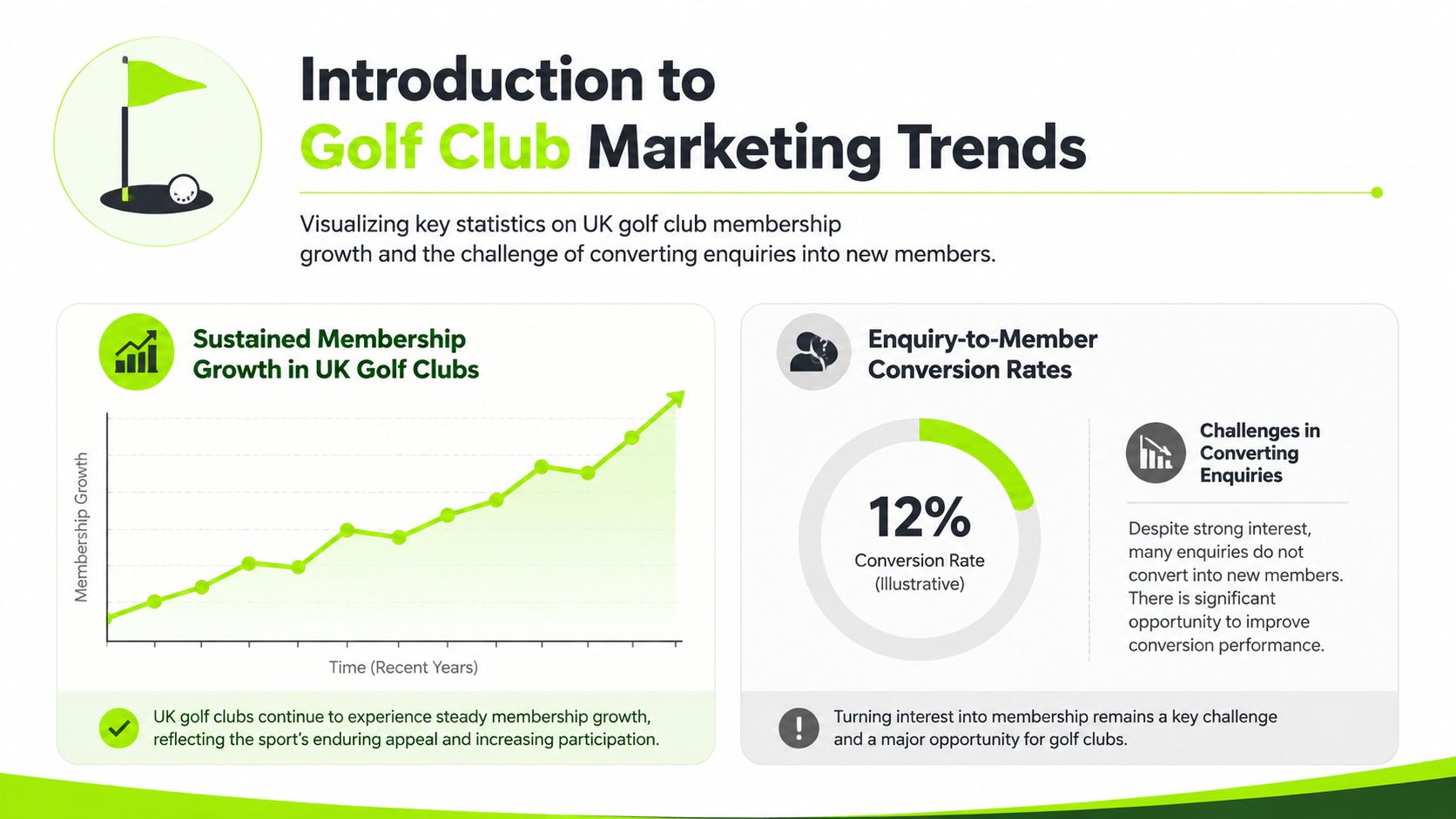
The reason is straightforward. Demand has returned for many UK clubs, but demand alone does not produce memberships. A prospect who clicks an ad, fills in a form, or asks about a trial package only becomes commercially valuable if the club records the enquiry, replies quickly, and moves that person toward a visit or conversation. Clubs that study their golf club membership funnel usually find the same weakness. Marketing generates interest, then manual follow-up slows conversion.
Growth has raised the bar for operations
Recent industry reporting has already shown that many UK clubs are growing. That changes the marketing standard. In a growth market, weak administration is easier to hide on paper because enquiries keep arriving. It still shows up in conversion rates, diary gaps, and inconsistent new-member intake across months.
That distinction matters for committees and general managers. Visibility metrics such as impressions, website sessions, and social engagement show whether a club is attracting attention. They do not show whether prospects were contacted, whether tours were booked, or which channels produce members rather than just leads.
GolfRep addresses that operational gap with data capture and automation built around the speed of enquiry handling. Instead of leaving sales staff to monitor forms, inboxes, and notes across separate systems, the platform records the source, timestamps the lead, automates the first response, and gives managers a live view of pipeline movement. That changes the question from "How many enquiries did we get?" to "How many qualified enquiries reached first contact within target, booked a visit, and converted?"
Referral-led demand still needs digital infrastructure
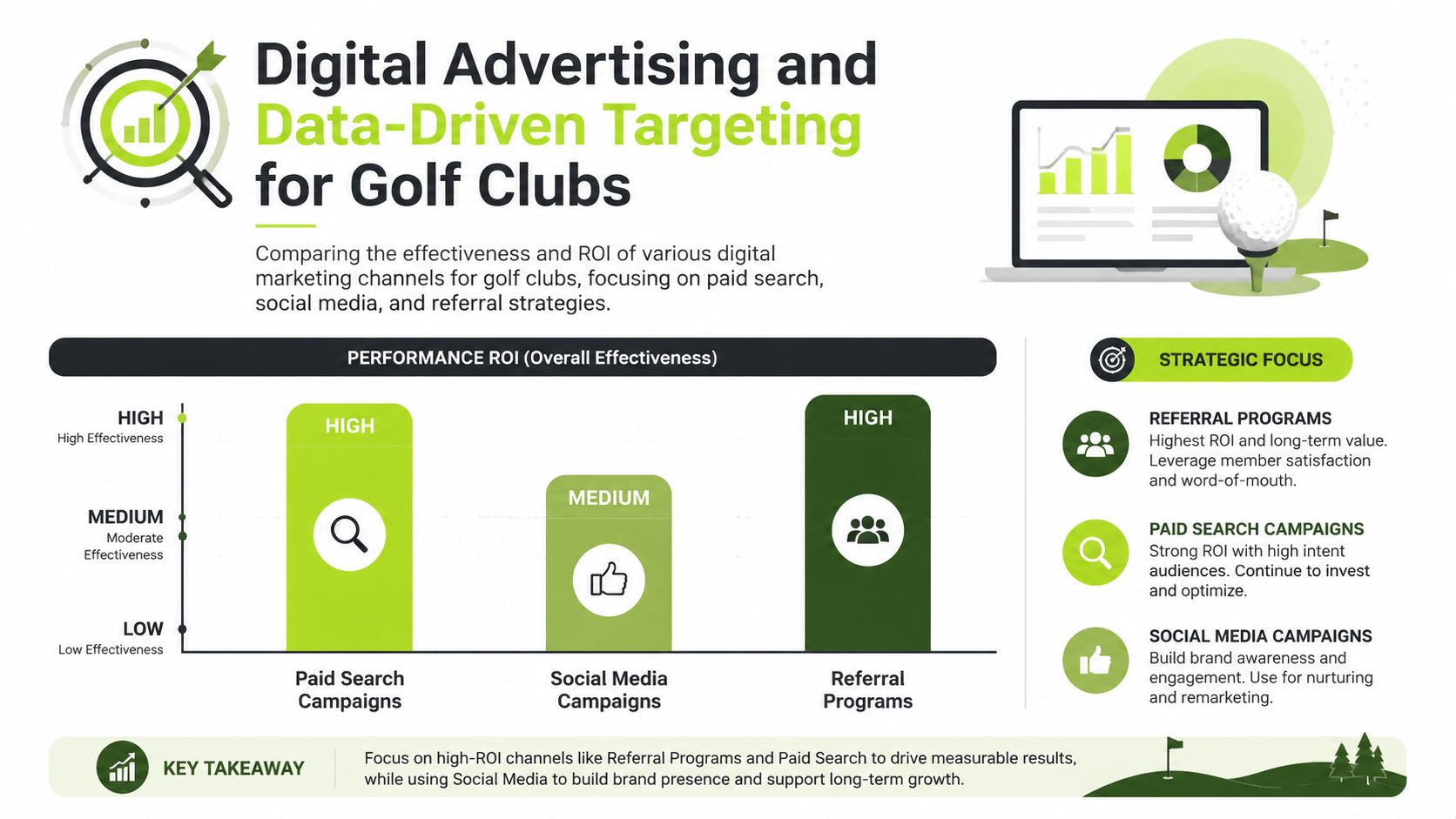
Industry surveys continue to show that referrals remain one of the strongest acquisition channels for golf clubs, ahead of several paid tactics noted elsewhere in this article. The conclusion is not that digital channels matter less. It is that digital marketing works best when it preserves the trust that already drives club selection.
A referred prospect often arrives with higher intent and more specific questions. They want subscription details, waiting-list rules, competition access, or a clear sense of club culture. If that person receives a delayed or generic reply, the club wastes the advantage the referral created. Fast, structured follow-up protects the value of word-of-mouth demand.
That is why modern marketing trends in golf are converging around connected systems. The website, ad account, CRM, call handling process, and sales workflow need to operate as one process rather than as separate tasks handled when staff have time. Some clubs are also extending the membership proposition through community and experience tools such as identity-based networking for clubs, because social connection influences referrals, retention, and upsell potential as much as acquisition.
The clubs gaining ground treat marketing as a conversion system
The strongest operators no longer judge marketing only by lead volume. They judge it by response speed, booking rate, show rate, and conversion to membership category. That is the practical shift behind current golf club marketing trends.
GolfRep's work with clubs reflects that shift. Automation handles immediate acknowledgement, routing, reminders, and follow-up sequences. Data shows which campaigns create serious membership intent, which landing pages produce low-quality forms, and where prospects stall between enquiry and visit. For a private members' club, that can mean identifying whether open-day leads convert better than paid social traffic. For a multi-site operator, it can mean comparing response times by venue and standardising the process that produces the best close rate.
The result is more disciplined growth. Traffic still matters. Creative still matters. The clubs that convert consistently are the ones that connect promotion to CRM KPIs and respond while interest is still active.
Core Concept of Integrated Marketing Funnels
Clubs can buy clicks, fill forms, and still miss revenue if the enquiry path breaks after submission. The commercial question is not whether marketing created attention. It is whether the club turned that attention into a booked visit, a tour, and a membership decision while intent was still active.
That is why an integrated funnel matters. It connects media, website capture, CRM workflow, and sales response into one system with clear ownership at each step. Without that connection, clubs measure activity at the top of the funnel and guess at results lower down.
Why disconnected systems underperform
The response delay noted earlier explains the problem well. A prospect who submits a form on Monday and hears nothing until midweek is no longer a warm lead. In many cases, they have already enquired elsewhere, compared options, or lost interest. Marketing did its job. The club failed at handoff.
Integrated funnels reduce that loss by defining what happens after the enquiry, not just how the enquiry arrives. That includes source tracking, immediate acknowledgement, task assignment, follow-up timing, and stage reporting inside one CRM process.
A practical funnel usually includes six linked steps:
Traffic source
Interest starts through referrals, search, paid social, open days, local partnerships, or organic website visits.Capture point
The enquiry is recorded through a form, chatbot, landing page, tracked call, or event registration.CRM entry
Contact details, source, campaign, membership interest, and timing are stored in one record rather than scattered across inboxes.Immediate response
The prospect receives confirmation quickly, along with relevant information and a prompt to book the next step.Sales action
Staff see who needs a call, who is ready for a visit, and which enquiries have stalled.Pipeline measurement
Managers can review progression from enquiry to contact, booking, tour, application, and membership.
The difference is operational, but it changes marketing economics. A campaign with modest lead volume can outperform a high-volume campaign if the first group is answered quickly, booked efficiently, and tracked properly through the CRM.
The funnel works as a control system for conversion
Many clubs still treat the funnel as a reporting diagram. In practice, it is the control system for membership growth.
Managers need answers to questions that sit between marketing and sales:
- Which source creates enquiries that book visits
- How many leads are waiting for first contact
- Which membership offers create the highest show rate
- Where prospects stall between enquiry and tour
- Whether campaign spend turns into applications, not just form fills
GolfRep addresses that gap by combining data capture with automation. Enquiries are routed into a central CRM, tagged by source and intent, acknowledged immediately, and assigned for follow-up based on rules the club sets. That gives teams a faster first response and a cleaner record of what happened next.
The useful effect is not just speed. It is accountability.
For example, a private members' club can compare whether open-day registrants progress to booked tours at a higher rate than paid social leads. A multi-site operator can see whether one venue converts more enquiries because its team calls within hours while another waits until the next day. Those are marketing decisions and sales process decisions at the same time. That is the point of integration.
For clubs reviewing their current setup, this guide to a golf club membership funnel shows how each stage should move from first enquiry to closed membership rather than stopping at lead generation.
What strong integration looks like
An integrated funnel usually shows up in a few visible ways:
| Funnel element | Weak setup | Strong setup |
|---|---|---|
| Lead capture | Enquiries land in shared inboxes | Enquiries enter a central CRM with source tracking |
| Follow-up | Staff respond when available | Automated acknowledgement and task-based follow-up |
| Reporting | Managers count leads manually | Managers track stage progression and conversion points |
This is why current golf club marketing trends are shifting toward joined-up systems. Clubs that connect campaign performance to CRM KPIs can improve response speed, booking rate, and conversion by source. Clubs that keep marketing and enquiry handling separate usually end up buying traffic they cannot convert.
Digital Advertising and Data Driven Targeting
Digital advertising works best in golf when it is treated as a route into a tracked sales process, not as a visibility exercise. Clubs can buy reach easily. The harder and more valuable task is identifying which campaigns produce enquiries that book visits, answer follow-up, and convert inside the CRM.
Follow conversion quality, not just audience size
As noted earlier, referrals remain a stronger trust signal than paid promotion for many clubs. That changes how advertising budgets should be assessed. Paid media has a role, but its job is usually to reach prospects who are close to action and give the membership team a clear opportunity to respond fast.
That is why the better comparison is not cost per click versus impressions. It is source-to-tour rate, tour-to-application rate, and speed-to-contact by channel. A campaign that generates fewer leads can still outperform if those enquiries arrive with clearer intent and the club responds while interest is still high.
A practical review usually starts with three questions:
- Which campaigns produce booked visits rather than form fills
- Which audience segments match the club's actual membership model and price point
- Which sources receive a fast, consistent response from staff
Those questions connect ad spend to operating discipline. They also expose waste quickly.
Where digital ads produce the best return
Paid search often performs best when someone already knows what they want. That includes prospects searching for local membership options, beginner coaching pathways, flexible categories, or visitor-to-member routes. Meta campaigns tend to be stronger higher up the decision process, especially when the offer is specific and the creative helps the prospect understand the club fit, not just the course quality.
Clubs get better results when each campaign is tied to a defined next step. A waiting-list enquiry, an academy registration, or a tour booking creates a cleaner handoff than a generic “learn more” form. For teams building that kind of campaign structure, this guide to golf club Meta ads is useful because it focuses on audience, offer, and conversion path rather than vanity metrics.
The club's commercial model should shape every part of the campaign. A private members' club selling exclusivity should not run the same message as a flexible operator focused on accessibility and trial. Targeting, creative, landing page copy, and follow-up workflow need to reflect the same proposition or the enquiry quality drops before the sales team even makes contact.
First-party data improves targeting accuracy
The best targeting inputs usually come from the club's own records, especially once marketing data and CRM outcomes are connected.
| Data source | What it tells the club | Marketing use |
|---|---|---|
| Website forms | Which offers trigger action | Build campaigns around proven intent |
| CRM notes | What prospects ask before joining | Improve ad messaging and landing pages |
| Tour bookings | Which audience segments progress | Prioritise audiences that move beyond enquiry |
In practical terms, GolfRep adds value. It captures the source of the enquiry, routes it into a structured pipeline, and lets clubs compare response times and conversion rates by campaign. That matters because the winning audience is not always the cheapest one to reach. It is often the segment that receives a fast reply, gets booked onto a visit, and progresses through the funnel with fewer delays.
A multi-site operator can use that data to compare whether flexible-membership Meta leads in one location convert better than paid search leads in another. A private club can test whether open-day campaigns generate more booked tours than broad membership ads, then adjust budget based on actual progression rather than headline lead volume. Those are stronger decisions because they connect media performance to sales outcomes.
Key takeaway: If a club cannot track a campaign from click to enquiry, first response, booked visit, and membership outcome, it cannot judge advertising quality properly.
The same standard should apply to referrals and organic enquiries. Every source should be tagged, reviewed, and measured against CRM KPIs, because traffic only has value when the club can convert it.
CRM Automation and Nurture Flows
The fastest way to improve marketing performance is often to improve what happens in the first few minutes after an enquiry arrives.
GolfRep's lead response analysis notes that responding within 5 minutes can increase conversion chances by up to 100 times compared with waiting 30 minutes. That's why automation matters. It doesn't replace the membership team. It protects the moment when interest is highest.
Build the first response layer
A strong CRM workflow begins with immediate acknowledgement. The prospect shouldn't wonder whether the enquiry went through.
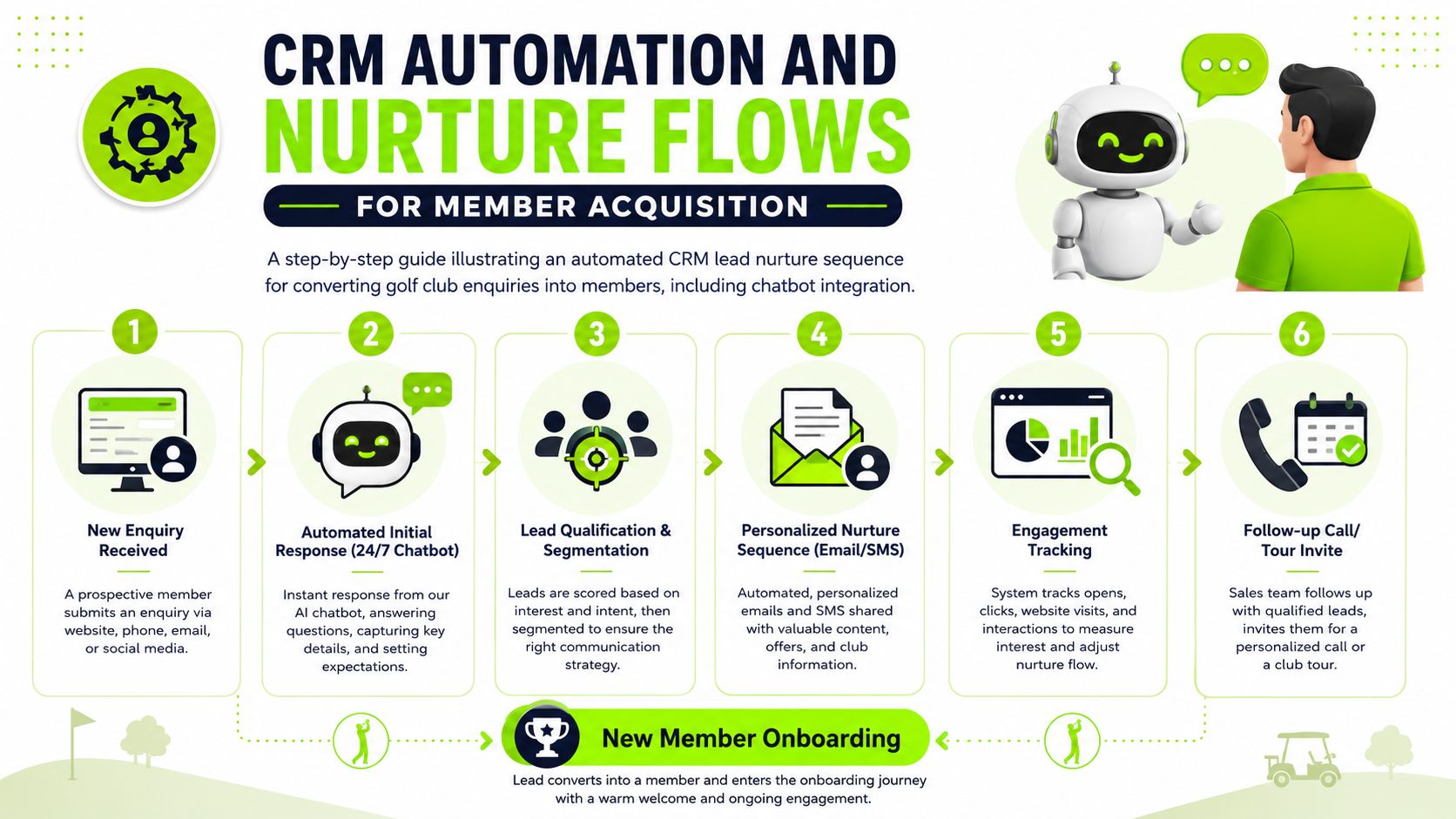
That first layer usually includes:
- Instant confirmation: email or message confirming receipt and setting expectations
- Basic qualification: simple prompts that identify membership type, timeline, and interest level
- Task creation: an alert for the right staff member with clear ownership
- Calendar action: where suitable, a prompt to book a call or visit
Many clubs regain lost ground effectively because even if a human reply comes later, the prospect has already received a professional response and a clear next step.
Add a structured nurture sequence
Not every prospect is ready to join on day one. Some are comparing clubs, discussing finances, or waiting for the season to change. A nurture flow keeps the conversation active without relying on manual chasing.
A simple sequence can work like this:
Day zero
Confirm the enquiry, share key membership information, and invite a visit.Follow-up message
Answer common objections such as flexibility, playing opportunities, or pathway for beginners.Staff contact
Trigger a call task for warm leads or anyone who engaged with the previous message.Visit invitation
Offer a tour, trial round, or meeting with the membership team.Re-engagement
If the lead goes quiet, send a timed check-in rather than letting the record sit untouched.
What matters isn't complexity. It's consistency.
Track behaviour, not just volume
Automation becomes useful when it creates visibility. Clubs should know which leads opened messages, clicked booking links, replied, or stalled.
That lets staff focus on the prospects showing real buying intent.
| Stage | What to track | Why it matters |
|---|---|---|
| Enquiry received | Source and timestamp | Shows where speed issues begin |
| First response sent | Time to first contact | Protects high-intent leads |
| Nurture engagement | Opens, clicks, replies | Helps prioritise follow-up |
| Visit booked | Progress to sales conversation | Separates interest from action |
The main lesson in current golf club marketing trends is simple. Better campaigns help, but better response infrastructure changes outcomes faster.
AI and Community Experience Marketing
AI is now part of the golf marketing conversation, but most clubs should treat it as an operational layer, not a strategy in itself.
The strongest use of AI is usually practical. It helps clubs reply faster, segment leads more clearly, and keep communication moving. The club's actual value still comes from the member experience, the social atmosphere, the course, and the sense of belonging.
Use AI where speed and consistency matter
Current trend coverage puts a lot of attention on chatbots, dynamic pricing, and segmentation for women and juniors. The limitation is that there's no UK-specific data showing which personalisation tactics drive retention among female and junior members, as noted in this review of golf marketing trends for 2025.
That lack of evidence is useful in its own way. It means clubs shouldn't assume that adding personalisation software will solve retention.
A better approach is controlled testing:
- Start with one segment such as junior families or women returning to golf
- Use AI to support response quality through faster acknowledgements and cleaner follow-up
- Test messages around clear offers such as academy pathways, social events, or hosted introductions
- Review actual engagement in the CRM rather than relying on assumptions
Clubs exploring this route can learn from approaches to AI lead nurture for golf clubs, especially where automation needs to support staff rather than replace them.
Community still drives the strongest outcomes
The most durable marketing asset in golf is still community. That's consistent with the earlier referral pattern. Members bring in members because they can describe the experience credibly.
AI can support that by making communication more timely and more relevant. It can't create it.
Useful community-led marketing often includes:
- Hosted open events that let prospects meet real members
- Custom fitting days that position the club around improvement and service
- Beginner-friendly social formats that reduce perceived barriers
- Family or junior touchpoints that make the club feel accessible rather than intimidating
There's also a commercial angle here. IndexBox market analysis indicates that Direct-to-Consumer sales account for an estimated 20 to 30% of new golf club purchases by 2025, and that 40 to 50% of premium iron and driver acquisitions in the UK include a formal launch-monitor fitting session. For clubs, that suggests service-led experiences can help differentiate the venue from pure retail competition.
Clubs should use AI to make human follow-up faster and cleaner, then use in-person experiences to give prospects a reason to trust the club.
That balance matters. Too much automation feels impersonal. Too little automation lets promising leads fade out before a relationship begins.
Case Examples from Private Clubs and Operators
The clearest proof of these trends comes from clubs that changed their process, not just their promotion.
Bidston Golf Club is the strongest example. The club overhauled its enquiry workflow and rebuilt the path from first interest to membership decision. Instead of relying on fragmented follow-up, the team moved to a structured pipeline with clearer lead handling. The result was dramatic enough to change the club's trajectory, with more than double membership and six-figure recurring revenue.
Addington Palace shows a different pattern. The challenge wasn't limited to generating awareness. It was building a steadier pipeline from campaign activity. By aligning social campaigns with CRM scoring and lead tracking, the club created better visibility over who was engaging, who needed contact, and which enquiries were worth immediate attention. That kind of discipline matters more than campaign noise because it gives the club control over next actions.
Macdonald Hotels & Resorts illustrates the operational case at group level. Multi-site operators face a harder version of the same problem. Leads come into different venues, staff handle them differently, and central management struggles to compare results. Automating follow-up across multiple courses gave the group a more consistent response model. It reduced delays, created a shared reporting structure, and helped local teams act on live opportunities instead of stale lists.
These examples point to the same conclusion.
The clubs and operators growing most predictably aren't necessarily the loudest in the market. They're usually the ones that connect marketing to a live sales process. They know where enquiries come from, who owns each lead, and what happens after the first contact.
That's why the strongest golf club marketing trends are operational as much as promotional. Better demand capture, faster follow-up, and visible conversion stages produce results that generic awareness activity rarely can.
Measuring Impact and Tracking Key KPIs
Marketing gets judged too loosely in many clubs. Managers ask whether enquiries feel busier, whether social posts look better, or whether the website has had more traffic. Those signals can be useful, but they don't explain whether the club is converting demand into memberships.
A tighter KPI set does.
Track the pipeline, not just the inbox
The best reporting starts with movement through stages. A lead isn't valuable because it exists. It's valuable if it progresses.
The most useful KPI set for clubs usually includes response speed, lead visibility, stage conversion, and pipeline value. For managers building dashboards, broader reading on Fame's B2B marketing insights can help frame which commercial measures matter and which vanity metrics to ignore.
Here is a practical model.
| KPI | Definition | Target Metric | Recommended Tool |
|---|---|---|---|
| Enquiry response time | Time between enquiry arrival and first reply | As fast as operationally possible, with immediate automated acknowledgement | CRM with workflow automation |
| Lead visibility rate | Share of enquiries logged in one trackable system | Full visibility across all channels | Central CRM |
| Stage conversion rate | Movement from enquiry to contact, visit, and membership | Stable improvement over time | CRM pipeline dashboard |
| Pipeline value per month | Estimated membership revenue sitting in active opportunities | Clear month-by-month trend | CRM reporting and finance review |
Notice what's absent. Likes, impressions, and vague reach numbers don't sit at the centre. They can support diagnosis, but they don't run the club.
Review KPIs on a fixed rhythm
A strong measurement routine is simple and regular.
- Weekly review: open leads, delayed follow-ups, booked visits, and stalled opportunities
- Monthly review: source quality, campaign performance, and pipeline progression
- Quarterly review: whether the club's membership proposition and response system still match market demand
This rhythm gives managers something committees often lack. Shared visibility.
Use KPI reviews to challenge assumptions
Good reporting often reveals uncomfortable truths.
A club may discover that referrals convert best, but referred leads still sit unanswered over weekends. Another may find that social campaigns generate plenty of enquiries, but very few receive a phone call. A third may learn that staff are working hard, yet no one can see where prospects drop out.
That's why systems beat effort alone. Hard work without visibility creates activity. Hard work with KPIs creates control.
Board-level question: Can the club name its response time, contact rate, visit rate, and membership close rate without guessing?
If the answer is no, the next improvement shouldn't be another campaign. It should be better tracking.
The wider lesson from golf club marketing trends is that modern growth comes from joining three disciplines together: demand generation, fast follow-up, and honest measurement. Clubs that do all three build a pipeline they can manage.
GolfRep helps golf clubs build predictable pipelines by combining lead generation, fast follow-up, and CRM-led conversion systems. If you want a clearer view of where enquiries are being lost and how to turn more of them into members, explore GolfRep.
Ready to tap into our proven growth system?