Golf Club Membership Tiers: How to Design Them Well

You're looking at a waiting list for full membership, and a golfer who plays twice a month is about to walk away because the only other option is a vague discount with no clear rules. That golfer isn't refusing the club. The club hasn't offered a product that matches how they play.
At GolfRep we treat golf club membership tiers as bundles, not a price list. Each tier combines access rules, a price, and a set of obligations. Change one of those three and you've changed the product, even if the name on the form stays the same.
A 2023 survey of more than 100 UK golf clubs found that women made up 18% of membership, up from 15% in 2022, while juniors accounted for 9%. 64% of members were aged 51 or older. Clubs averaged 94 new members in 2023, and 46% still had waiting lists, down from 52% the year before. The average list held 51 people, against 61 previously. 95% of clubs planned to raise fees in 2024. Those figures are why a single adult subscription can't carry the club. Different ages, diaries and levels of commitment need different rights, or the waiting list stays full while quieter tee times stay empty.
Golf Club Membership Tiers at a Glance
Labels travel badly between clubs. One club's "flexible" membership is a points card. Another's is a weekday pass with a weekend guest rate. Read the policy, not the badge on the website.
| Tier | Typical access | Likely buyer | UK evidence or example |
|---|---|---|---|
| Full seven-day | All playing times and competitions | Committed regular golfer | General description: the core high-frequency product most clubs still lead with |
| Five-day or weekday | Monday to Friday | Golfer who plays mainly midweek | Penrith's 2025 policy prices weekday access separately from affiliation |
| Country | Playing rights tied to where the member lives | Golfer whose home is outside a set radius | Gosforth sets eligibility by a mileage rule rather than promised frequency |
| Junior | Age-based, fixed by a qualifying date | Young golfer, often with a parent | Burghill Valley publishes separate prices for ages 13 to 17 and under 12 |
| Ladies or women's | Access set by the club's category rules | Women golfers | General description: a defined category with its own playing rules |
| Social | Clubhouse and community, limited or no golf | Non-playing or occasional member | General description: built for engagement rather than unrestricted play |
| Flexible or points-based | Rounds bought in points or time allowances | Time-poor golfer | Betchworth Park sells credit points rather than unlimited golf |
| Trial or academy | Short introductory access | New or returning golfer | General description: a test period, with an end date and a route onto a playing tier |
| Corporate | A pre-agreed package for a company's staff | Business buyer | General description: named users, a booking window and a renewal date written into the agreement |
Read the last column carefully. The named-club rows (Penrith, Gosforth, Burghill Valley, Betchworth Park) are published policies you can verify. The rows marked "general description" are common category patterns, and treating them as evidence would overstate what a committee actually knows.
Use that table as a checklist before the next fee meeting. For every tier you already sell, write down three things: the access it gives, the person most likely to buy it, and the evidence behind the price. That evidence belongs in the fourth column. If you can't fill the fourth column with a named UK policy or a written rule of your own, the price is a guess.
A tier with a friendly name and no written access rule is just a discount waiting to be argued over in the pro shop.
Why Access Rules Matter More Than Headline Price
Two passengers on the same flight can hold very different tickets. One can change the booking and board early. The other sits further back and pays to pick a seat. The aeroplane is the same. The product isn't.

Membership works the same way. A full seven-day subscription sells high-frequency access to the best playing times. A restricted tier sells something narrower: weekdays, off-peak hours, or a points pot that runs out. The difference members feel is when they can play, not the gap between two numbers on a fee sheet.
England Golf's 2018 survey found that seven-day membership was still the most widely offered category, while growth sat with bespoke formats: flexible points plans, corporate packages, academy or trial memberships, and student or intermediate offers. That is capacity segmentation. Full-access members pay for the busy sheet. Restricted tiers pick up golfers who won't buy the standard rate, without handing them Saturday mornings by default.
The same survey put average adult membership at £901, and senior and intermediate prices rose by roughly £50 without an apparent deterrent effect. Fit and access can matter as much as the headline.
Before you approve a tier, ask three questions.
- When can this member play? Name the days, the hours and any booking window.
- How often? State rounds, points, or "unlimited within these hours".
- What do they give up? Competition entry, voting, guest rights or peak booking, in return for the lower fee.
If the answers aren't on the application form, staff will invent them at the counter.
Junior, Age-Banded and Family Tiers
Junior and age-banded tiers are how younger golfers get into the club. They also create the moment people leave, which is the jump into adult fees.
Burghill Valley Golf Club shows the size of that jump. Juniors aged 13 to 17 are listed at £130, and under-12s at £50. The five-day adult category sits at £930, and Country at £715. A golfer moving from £130 to £930 at 18 has a plain reason to stop. An intermediate band for the first two or three years of adulthood, priced between the junior rate and the adult rate, gives that golfer a step rather than a cliff.
Fix the qualifying date
Penrith defines a Junior Member as someone under 18 on 1 January of the subscription year. One date is easier to administer than a birthday scattered through the season. The same policy says golfers under 14 should be supervised by a parent or a DBS-checked person, and some off-peak categories carry restricted playing rights and no voting rights. Those rules belong in the tier table. "Junior" on its own doesn't tell a parent what Saturday looks like.
| Club | Who qualifies | Price shown | Operational rule |
|---|---|---|---|
| Burghill Valley Golf Club | Ages 13 to 17, and separately under 12 | £130 (13 to 17); £50 (under 12) | Published age bands, with a large step into adult categories |
| Penrith Golf Club | Under 18 on 1 January of the subscription year | Set in the annual policy, not assumed from the junior label | Under-14s supervised by a parent or DBS-checked person; some off-peak categories restricted and without voting rights |
Clubs with an ageing membership base, which we look at in how an ageing membership changes the commercial job, can't treat the junior book as a side note. It is the pipeline into the adult tiers.
Before you publish a junior or family tier, confirm each of these.
- Qualifying date: one date the office can apply without a debate.
- Age bands: what happens at 12, 18, and any intermediate years.
- Supervision: who must be with a younger junior, and how that's checked.
- Tee-time access: which sessions are open, and which stay with full members.
- Governance: voting, competition entry and handicap rights, written down.
- Second adult: how a parent in the same household is charged.
- Step-up: the next tier, the price, and the date it starts.
Flexible, Points-Based and Country Tiers
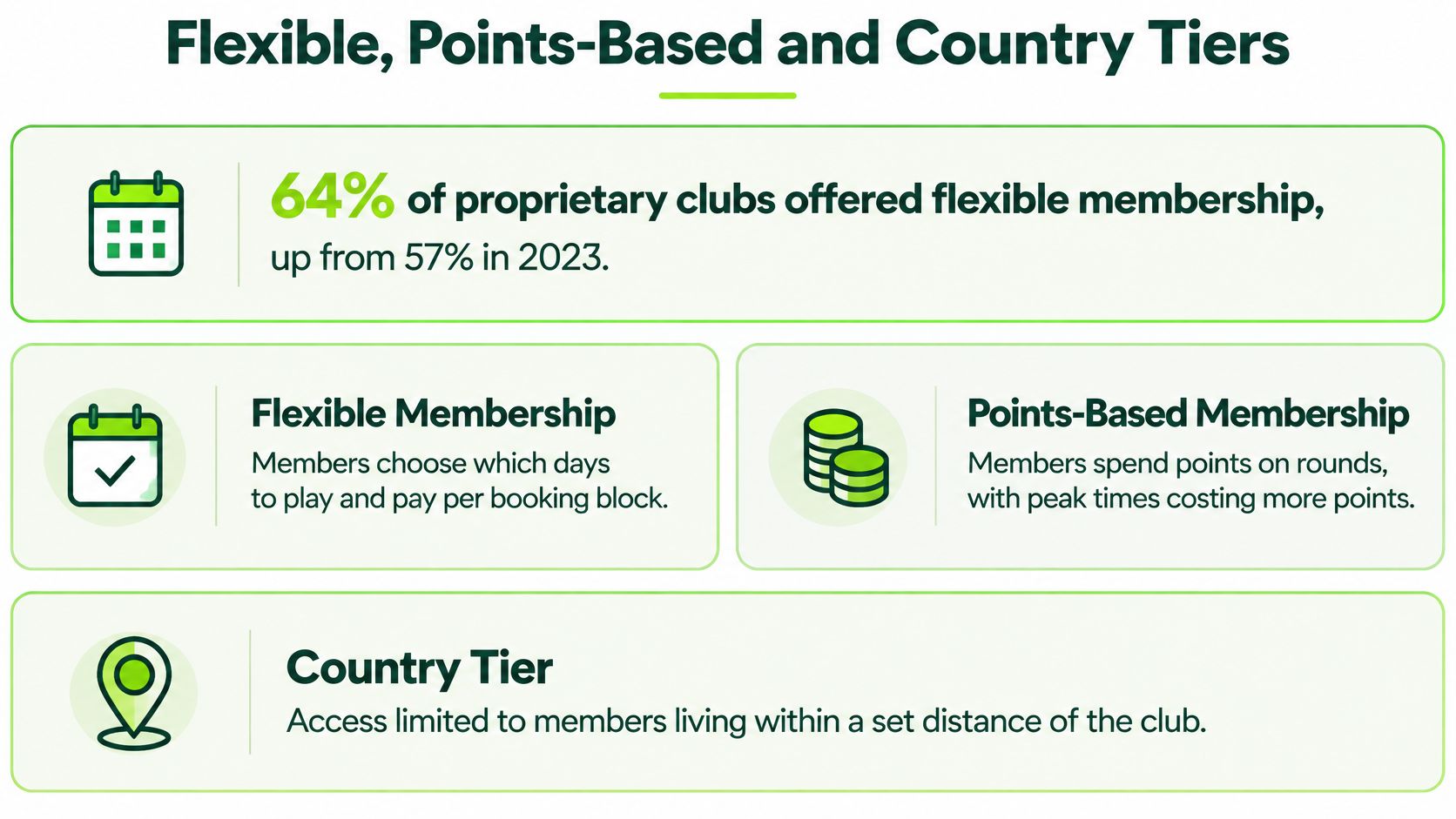
Flexible tiers have moved from a side offer into the mainstream of club economics. The 2024/25 Members' and Proprietary Golf Clubs' Survey reported that 64% of proprietary clubs offered flexible membership, up from 57% in 2023. The same report put gentlemen at 73% of membership at members' clubs, ladies at 18% and juniors at 9%, with average new joiners of 75 (50 gentlemen, 8 ladies and 17 juniors). 21% of members' clubs had more than 100 social members. The ladder is already there. The question is whether the rules are written tightly enough to protect the full tier.
Two clubs, two different restrictions
Betchworth Park's Associate Membership gives 600 golf credit points, seven-day access to the course and club facilities, and unlimited practice ground and range balls. Rounds depend on when the associate plays, so the club can charge more points at busy times. Members must register at the Pro Shop before playing, including after an online booking. Further points can be bought up to £100, equal to 110 points, in one subscription year. Associates may enter most competitions but not knockout events or club matches. That is an operating model: access, booking, consumption, top-ups and competition rights are all defined.
Gosforth Golf Club uses geography instead of points. Country membership requires the member's primary home to sit outside a 60-mile radius. Five-day membership is listed at £661 and Country at £297, a £364 gap, and an £18 England Golf and county affiliation fee applies to every category except Social. Eligibility is where the golfer lives, not how often they promise to play. Someone has to check the address and say whether affiliation sits inside the advertised price.
Price alone doesn't keep a flexible member off a congested Saturday. The booking rule does.
Write these down before you launch either tier.
- Access hours and any days that stay with full members.
- Booking method, including whether a shop check-in is still required.
- Points cost by time of day, if you use points.
- Top-up limits for the subscription year.
- Competition rights, including what is excluded.
- How eligibility is checked, especially for a country or distance rule.
- Whether affiliation is inside the advertised price.
Joining Fees, Instalments and First-Year Cost
The annual subscription is rarely what a new member pays in year one. Affiliation, a joining fee and any credit back into the club all sit on top of, or beside, the headline figure. A golfer comparing clubs sees one first-year sum, so the committee should price it as one sum.
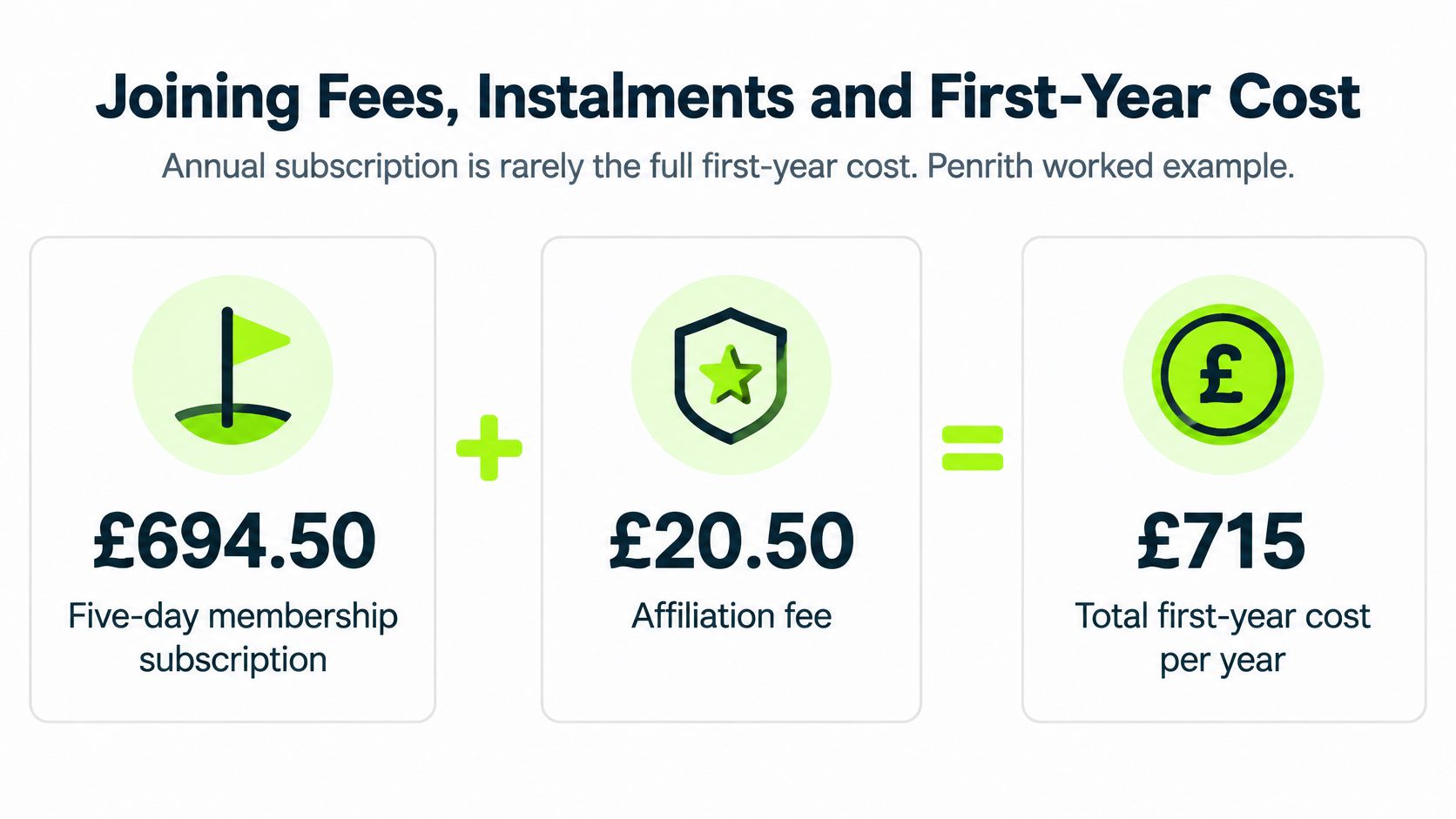
Penrith's 2025 policy is a clean worked example. Five-day membership, Monday to Friday, is £694.50 plus a £20.50 affiliation fee, so £715 for the year. New members also pay a £200 joining fee, and £100 of that fee comes back as credit on the member's EPOS card, the till account used for bar and shop spending inside the club.
Walk the first-year sum
£715 plus £200 is £915 gross in year one. Take away the £100 credit and the member's net cost is £815. Record that credit as food, drink, retail or professional-shop revenue. Folding it into the membership line hides both the true subscription and the bar or shop takings.
Scale that example up and the spread across clubs is wide. The Hillier Hopkins 2025/26 survey puts joining fees between £75 and £6,200, averaging £1,830, and found 62% of members' clubs let new joiners spread payment, typically over two or three years. For annual subscriptions at those same clubs, the average was £1,760 and the full range ran from £200 to £3,870. More than half sat above £1,612, the ceiling on yearly membership cost for a club holding Community Amateur Sports Club (CASC) status and the tax reliefs that come with it. 69% charged more than £1,000 for standard playing membership. How you present golf club membership fees matters as much as where you set them.
Three rules keep the ladder honest.
- Separate the lines. Subscription, affiliation, joining fee and any in-club credit each get their own figure on the offer.
- Model instalments as cash timing. The subscription stays the same. The money arrives later.
- Watch cancellation exposure. A member on a two-year plan who leaves in month four has used peak access you can't resell at the same yield.
How to Design a Tier Ladder Step by Step
Build the ladder in one order. Access first, then price, then the paperwork a new member can actually compare.
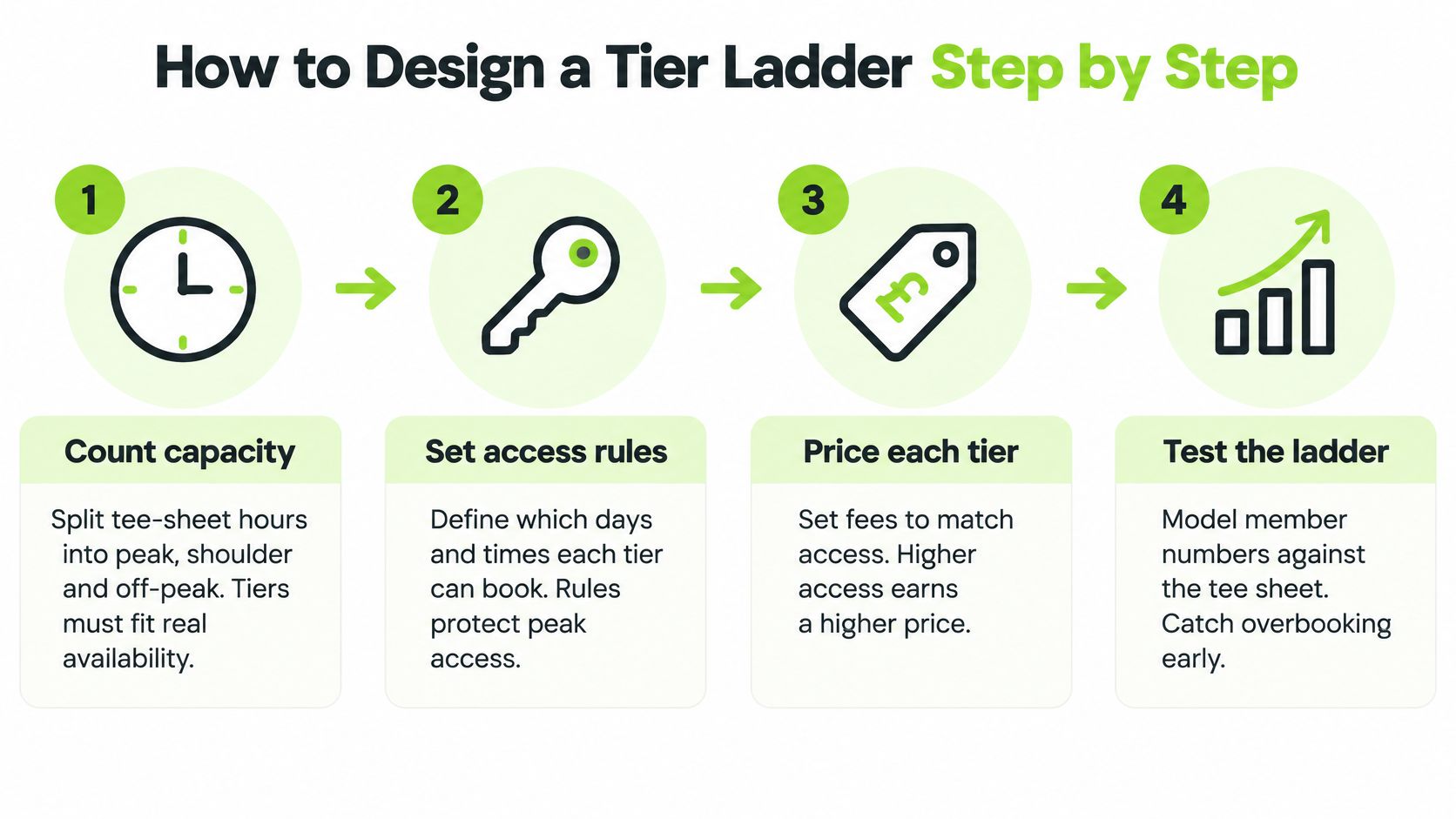
- Count capacity before you count members. List tee-sheet hours for an average week in each season, split into peak, shoulder and off-peak. A club open 10 hours a day on an 8-minute interval has 75 starts (600 minutes divided by 8). Every later decision draws on that kind of count, not on last year's membership total.
- Define the full tier first. State what it guarantees, including the weekend booking window, and protect that promise. If full members can't get the times they paid for, the top of the ladder stops being worth the fee.
- Build restricted tiers around the gaps. Weekday, off-peak, points or a geographic rule should point at hours the full tier doesn't fill. They shouldn't be a cheaper route into the same Saturday wave.
- Price from use, not from headcount. Expected rounds, contribution after direct costs, and the chance of an upgrade should set the fee. A tier that fills quiet afternoons can be cheaper. A tier that sits on peak times shouldn't.
- Write the rules in one place. Booking windows, competition rights, handicap eligibility, visitor privileges, rollover and qualifying dates. Use the flexible-tier list from the previous section as the template so nothing is left to the starter.
- Show first-year cost on every tier. Subscription, affiliation, joining fee and any credit, on separate lines, so a twice-a-month golfer can compare fairly with a seven-day member.
- Pilot one change for a season. One new band, or one tighter booking window. Measure rounds, peak share and upgrades before you rewrite the rest of the card.
Decision rule: if a lower tier takes more than the share of peak times the committee agreed, tighten its booking rules before you raise the full-member fee. Putting the price up on members who already can't get a tee time doesn't fix the leak.
Ask the committee to sign the ladder off as a single document. Same headings on every tier: who qualifies, when they play, what they pay in year one, what they can't do, and how they move up.
Measuring Each Tier and Deciding What to Change
A single membership total hides the tier that's causing the problem. Track these five measures separately for each tier you sell.
| Metric | How to calculate | What a weak result suggests |
|---|---|---|
| Tier utilisation | Rounds played by the tier ÷ rounds available to it | Restriction too tight, or the price is high for the access given |
| Peak share by lower tiers | Peak bookings by lower tiers ÷ all peak bookings | Access rules are leaking into prime playing times |
| Upgrade rate | Members moving up within 12 months ÷ members in the tier at the start | The entry tier isn't leading to full membership |
| Tier retention | Members renewing ÷ members at the start of the year, by tier | Weak value or weak onboarding in that tier |
| Revenue per member | Subscriptions, fees and in-club spend ÷ members in the tier | The headline price is hiding low spend |
Three decisions, not a general review
If the upgrade rate is low, the entry tier is a destination rather than a step. Test a clearer step-up, with the next price and the extra access written on the renewal note, before you cut the entry fee. A cheaper flexible product that never moves anyone up will keep absorbing golfers who might have bought full membership.
If lower tiers take a large share of peak times, the booking window is the problem, not the full-member price. Shorten how far ahead a restricted member can book Saturdays, or raise the points cost of those times. Do that before you ask full members to pay more for a sheet they no longer control. This sits alongside the wider golf club pricing strategy: scarcity has to show up in the rules, not only in the fee.
If a restricted tier renews poorly, look at what the member really received and how they were brought in. A points member who never understood registration at the shop, or a country member who was never told about competition limits, will blame the price. Fix the explanation and the first-month contact before you assume the fee is wrong.
Change one rule per season. Measure rounds, peak share, upgrades and renewals for that tier. Then move to the next constraint. Rewriting five tiers in April means you won't know which change did the work.
We build tier campaigns around a club's brand, pricing and goals, so the offer a prospect sees matches the ladder the committee has signed. If the bottleneck is how a tier is explained and sold, rather than how many people have heard of the club, that's a sales and pathway problem, and it's one you can see in the five measures above.
GolfRep works with UK clubs on membership pathways that keep access, price and obligations in one ladder, from the first offer through to renewal. If your tiers are a list of prices rather than a set of rules the tee sheet can enforce, we can map where capacity, conversion or retention is the real constraint. Visit GolfRep to talk it through.
Ready to tap into our proven growth system?