Master Golf Club Marketing: Drive Member Conversions

Most advice on golf club marketing starts in the wrong place. It tells clubs to post more on social media, spend more on ads, or launch another offer to generate fresh interest.
That sounds productive, but it usually avoids the core issue. Most clubs don't have an enquiry problem. They have a conversion problem.
At GolfRep, we see the same pattern repeatedly across UK clubs. Marketing brings attention. Golfers click, browse, and enquire. Then the process slows down. The message sits in an inbox. A staff member plans to reply later. Follow-up depends on who is in the office, how busy the day is, and whether the prospect gets remembered. By the time the club responds, the golfer has often moved on.
That gap between interest and action is where growth gets lost. Good golf club marketing isn't just about creating demand. It's about building a system that captures intent, responds quickly, and keeps the conversation moving until a visit is booked and a membership decision is made.
The Real Problem in Golf Club Marketing
The popular assumption is simple. If membership growth is slow, the club needs more leads.
In practice, that isn't usually where the bottleneck sits. In the UK golf sector, the primary barrier to membership growth is not low enquiry volume but slow response times, and analysis of UK clubs shows that the first club to reply to an enquiry typically wins the member because prospects expect speed rather than a delayed reply when the office opens, as noted in this analysis of UK golf club response behaviour.
More leads won't fix a weak process
A club can run Facebook campaigns, improve its website, and rank better on Google. None of that solves the core issue if enquiries disappear into a manual process.
That's the trap. Committees and managers often assume the top of funnel needs work because that's what they can see. Traffic is visible. Clicks are visible. Enquiries landing in the inbox feel like progress. What they don't see clearly is everything that happens after that first contact, or more accurately, what fails to happen.
Practical rule: If a club can't track who enquired, who replied, who followed up, and who booked a visit, it doesn't have a marketing problem. It has a pipeline visibility problem.
Manual follow-up breaks under normal conditions
Most clubs aren't ignoring leads on purpose. They're busy. Front-of-house staff are juggling calls, members, visitors, competitions, and administration. Committee-run clubs have even less capacity because responsibility is spread across volunteers.
That creates inconsistency. One prospect gets a quick, thoughtful reply. Another gets a short answer two days later. A third receives nothing beyond an automatic form receipt, if that.
What works is system-led follow-up, not good intentions. The clubs that convert more interest into membership usually do three things well:
- They respond fast: The prospect gets acknowledgement and next steps while interest is still high.
- They keep visibility centralised: One place shows every enquiry, stage, and action due.
- They follow a structured process: The club doesn't rely on memory to chase, invite, or re-engage.
Golf club marketing becomes far more effective when the club stops treating enquiries as one-off messages and starts treating them as active opportunities moving through a pipeline.
Define Your Club Before You Market It
A lot of golf marketing fails because the message is too broad. "Join our club" doesn't mean much if the golfer can't see where they fit, what they get, or why your club suits their life better than the alternatives.
Clubs need sharper positioning before they spend more on promotion. That starts with deciding who the club is for.
Most growth sits outside traditional membership
In the UK, only approximately 33% of golfers belong to a golf club, leaving 2.6 million non-members who play but lack club affiliation. That means 67% of the golfing population is the primary target for growth, according to UK golf participation data reported by The Social Golfer.
That should change how clubs think about golf club marketing. The target audience isn't only golfers comparing one membership category against another. It's also regular players who haven't yet seen a club model that feels flexible, clear, and worthwhile.
Position the club for real buyer groups
A strong message comes from segmentation, not from trying to appeal to everyone at once.
Three groups often matter most:
- The active non-member golfer: They already play. They don't need to be sold on golf. They need a reason to see membership as more useful than staying casual.
- The lifestyle-led local golfer: This person may care as much about routine, wellness, and social connection as handicap or competition access.
- The returning golfer: Often familiar with club life, but cautious about cost, commitment, or whether the club still feels relevant.
A club that markets itself the same way to all three usually sounds generic to all three.
Clarify the offer before writing the ad
Before any campaign goes live, the club should be able to answer these questions in plain English:
| Question | What a good answer looks like |
|---|---|
| Why join this club? | A clear membership value, not vague heritage language |
| Who is it ideal for? | A defined local golfer profile, not "everyone" |
| What happens next? | A simple route to enquire, visit, and understand options |
Golfers don't enquire because a club used the right slogan. They enquire when the offer feels relevant and easy to explore.
Clubs also need to avoid a common mismatch. Their website often speaks mainly to visitors, societies, or tee times, while their real growth priority is membership. If membership matters, the club's messaging should make that obvious.
The strongest positioning isn't clever. It's clear. It tells the right golfer, quickly, "this club fits how you want to play."
Attracting the Right Golfers to Your Club
Traffic on its own isn't useful. Golf club marketing only works when the club attracts golfers who are realistically capable of joining, visiting regularly, and seeing value beyond a discounted round.
That's why channel choice matters less than targeting and landing experience. A Google Ads campaign, a Facebook campaign, and strong local SEO can all work. They just need to point towards membership intent, not bargain hunting.
Mobile decides whether intent becomes an enquiry
Mobile-first optimisation is essential because over 60% of UK golf-related searches occur on phones, which means clubs need website loading times under three seconds and simple enquiry forms visible on every key page to capture that traffic effectively, as outlined by the GCMA summary of England Golf data and club strategy implications.
If a golfer taps an ad and lands on a slow page with a cluttered menu, the campaign hasn't failed because the ad was bad. It has failed because the path from curiosity to action was too awkward.
Use channels according to intent
Different channels do different jobs. Clubs often mix them together and then wonder why results feel inconsistent.
Google works well for active intent
Google is useful when a golfer is already searching for membership, lessons, local clubs, or a place to play regularly. The intent is there. The club's job is to match it with a clear page and an easy route to enquire.
Paid social creates local demand
Facebook and Instagram are effective when the club wants to put an offer, membership pathway, open event, or local lifestyle message in front of golfers who may not be searching today but are open to joining the right club.
Local SEO supports credibility
Google Business Profile, local pages, reviews, and consistent location signals help the club appear established and nearby. That's especially important for prospects comparing several clubs within a practical driving radius.
What attracts better enquiries
A qualified enquiry usually starts with a better message, not a bigger budget. Clubs tend to improve lead quality when they focus on:
- Membership relevance: Show who the membership suits and how it fits real playing habits.
- Ease of next step: Use short forms, visible buttons, and a clear invitation to book a visit or ask a question.
- Local context: Mention access, convenience, atmosphere, and playing experience in terms local golfers care about.
The first job of golf club marketing isn't to get everyone to click. It's to get the right golfer to raise a hand.
The System That Converts Enquiries into Members
Most clubs lose momentum after the enquiry arrives. That's where the difference sits between marketing that looks busy and marketing that produces membership growth.
A workable conversion system does not need to be complicated. It does need to be organised, fast, and visible to the people responsible for follow-up.
Speed changes the outcome
Responding to a golf club enquiry within 5 minutes makes conversion rates 98% higher than replying after that window, while new leads are 10 times less likely to respond after 5 minutes have passed. Separate research also found that responding within 5 minutes can increase conversion chances by up to 100x compared to waiting 30 minutes, according to Anthill's breakdown of lead response time and conversion.
Those numbers matter because they expose a common operational mistake. Clubs often measure campaign performance weekly or monthly, but prospects make their decision much faster than that. If the first response is slow, the lead can be lost before anyone reviews the marketing results.
The core stages that need to happen
A proper membership conversion process usually contains five connected steps:
Capture the enquiry
Every form fill, call-back request, and message needs to enter one central system. If some sit in email, some in a spreadsheet, and some in someone's head, follow-up becomes unreliable.Acknowledge instantly
The prospect should receive a quick confirmation with useful next steps. That doesn't replace a personal reply. It buys the club time while signalling that the enquiry has been seen.Qualify the lead
Not every enquiry is the same. Some are researching. Some want flexible options. Others are ready to book a tour. Qualification helps staff prioritise properly.Nurture with structure
A single reply rarely closes a membership. The club needs scheduled follow-up that keeps the conversation moving.Book the visit and guide the decision
The goal of follow-up isn't endless email. It's to get the prospect on site, answering their questions and helping them compare options confidently.
A club doesn't need more admin around enquiries. It needs fewer gaps between one action and the next.
Systems beat memory every time
Spreadsheets and shared inboxes can hold data, but they don't manage a pipeline. A CRM does more than store contact details. It shows status, assigns responsibility, triggers follow-up, and gives managers visibility into what is stuck.
For clubs reviewing their follow-up setup, this golf club follow-up system guide outlines the sort of structured process that closes the gap between enquiry and booked visit. GolfRep is one option clubs use when they want lead capture, CRM tracking, and automated nurture handled within one golf-specific growth system.
The key point is simple. If follow-up depends on people remembering what to do next, conversion will stay inconsistent.
Building Your Predictable Membership Sales Funnel
A membership funnel should feel simple from the golfer's side and disciplined from the club's side. The prospect shouldn't experience internal delays, handover confusion, or silence between messages. The club should know exactly where each enquiry sits.
That predictability matters because the golf club sector faces a flat conversion rate despite rising enquiries, and evidence suggests 7-9 touchpoints are required for membership conversion, a gap that is rarely met without automation that qualifies and nurtures leads consistently, as discussed in this analysis of membership marketing trends and conversion systems.

What the funnel looks like in practice
Consider a typical local golfer. They see a membership advert on Instagram, click through, browse the membership page on their phone, and submit a short form asking about flexible options.
If the club is organised, the next steps don't rely on chance.
Awareness becomes interest
The initial message attracts the golfer because it speaks to a real need. Not "join a prestigious club", but something more practical. Flexible membership. A welcoming route in. Regular golf without the friction of ad hoc booking.
The website then does its job. It confirms the proposition, answers common questions, and gives the golfer an easy next step.
Interest becomes consideration
The enquiry triggers an immediate acknowledgement. A staff member or automated workflow then follows with useful information, an invitation to visit, and answers specific to the golfer's likely concerns.
At this stage, most clubs under-communicate. They assume silence means the lead wasn't serious. Often, it just means the prospect is busy, comparing options, or waiting for a clearer reason to act.
Operational note: If a club only follows up once, it hasn't tested demand properly. It has only tested whether the prospect was ready at that exact moment.
Consideration becomes decision
A structured sequence helps the golfer move forward. That might include a reminder to book a tour, a short explanation of membership categories, and a personal prompt from the club when interest is still warm.
A booked visit is the turning point. Once the prospect is on site, the club can answer objections properly and make membership feel tangible rather than abstract.
Funnel discipline beats isolated effort
The funnel doesn't need flashy language. It needs continuity.
Here's where many clubs break the chain:
- Awareness is strong, but landing pages are weak
- Enquiries arrive, but no one owns follow-up
- Staff reply once, then stop
- Visits happen, but there is no post-visit sequence
A predictable funnel fixes those disconnects. Each stage has a clear purpose, and each touchpoint moves the golfer towards a decision instead of leaving the next step undefined.
Creating Long Term Value Through Retention
Membership growth isn't only about acquisition. A club can work hard to generate demand and still stall if it doesn't hold onto the members it already has.
That is why retention should sit inside the same growth system as marketing and sales. When acquisition data and member engagement data live separately, clubs miss patterns they could act on much earlier.

Retention is a visibility issue too
UK golf club membership experienced a resurgence in 2025, rising to 750,071, and 86% of survey respondents were already members, up from 84% in 2024, while only 2% stopped their membership, indicating stronger retention alongside acquisition growth, according to reported 2025 membership figures and survey findings.
That's encouraging, but it shouldn't make clubs complacent. Retention improves when clubs communicate consistently, identify quiet members early, and make renewal feel managed rather than left until the last moment.
What a retention system should actually do
A useful CRM doesn't stop working after a prospect joins. It should support the full member lifecycle.
Early onboarding
New members need a structured welcome, not a one-off email. They should know who to contact, how to get involved, and what to do in their first few weeks.
Engagement monitoring
If a member goes quiet, the club should notice. That doesn't require intrusive tracking. It requires enough visibility to spot reduced activity, missed events, or a drop in participation signals.
Renewal communication
Renewal reminders shouldn't arrive as a rushed admin task near the deadline. Clubs do better when they communicate value clearly and early.
For clubs thinking about this side of the pipeline, this golf club member retention article is a practical reference for building communication around renewals, re-engagement, and long-term member value.
Acquisition and retention should inform each other
The strongest clubs use retention insight to sharpen their marketing. If members join for flexibility, community, wellness, or convenience, those themes should shape acquisition messaging too.
That creates a healthier loop:
- Marketing attracts better-fit prospects
- Sales follow-up sets clear expectations
- Onboarding reinforces the buying decision
- Ongoing communication reduces preventable drop-off
Golf club marketing works better when it doesn't end at the point of sale.
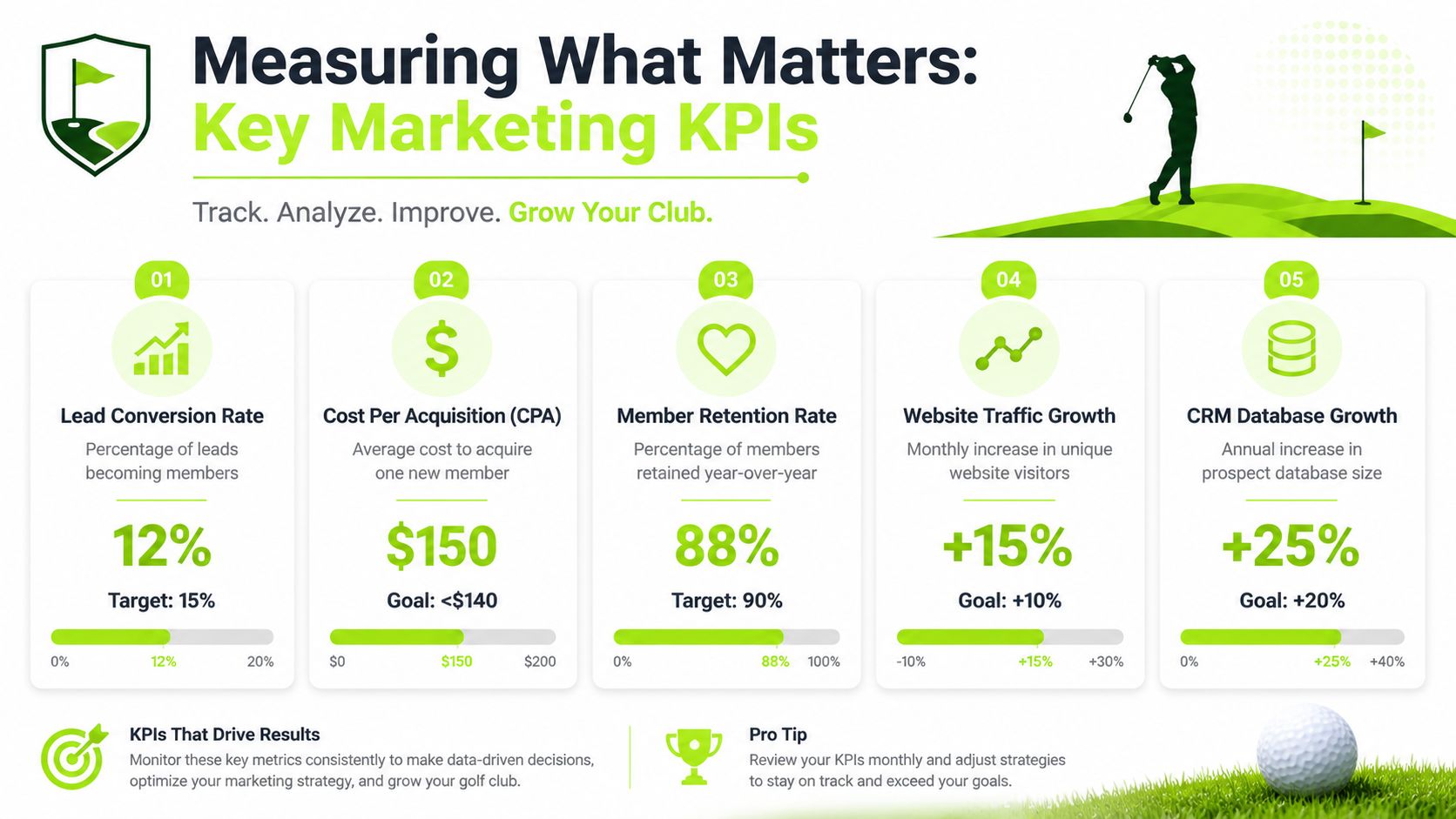
Measuring What Matters Key Marketing KPIs
Many clubs still judge marketing by surface activity. Website visits go up. Social posts get likes. An advert receives attention. None of that tells a committee whether the club is building a reliable membership pipeline.
The important metrics are the ones that connect spend to movement through the funnel and, ultimately, to joined members.
Ignore vanity metrics first
Traffic matters only if the right people enquire. Enquiries matter only if they progress. Even booked visits matter only if the club can link them back to the original source and follow-up process.
A more disciplined KPI set usually includes:
- Cost per enquiry: What did it cost to generate a genuine membership lead?
- Cost per booked visit: How much spend was required to turn interest into an on-site conversation?
- Cost per new member: This is the clearest acquisition number for most clubs.
- Lead-to-visit conversion: Useful for diagnosing whether follow-up is working.
- Visit-to-member conversion: Useful for spotting issues in sales conversations, pricing clarity, or club presentation.
Track pipeline movement, not just outcomes
A club can miss its monthly target for very different reasons. One month might suffer from weak ad targeting. Another might have strong lead volume but poor response handling. Without stage-by-stage tracking, those problems look identical.
That's why CRM visibility matters. It shows where enquiries stall and which source produces the best-fit prospects.
A practical way to frame the finance side is to use a wider ROI lens like this guide for small business marketing ROI, then adapt it to golf club realities such as tours booked, members joined, and retention value over time.
Use one reporting view that a committee can understand
Most clubs don't need more dashboards. They need one clean view that answers a few basic questions.
| KPI | Why it matters |
|---|---|
| Enquiries by source | Shows where serious interest starts |
| Response status | Shows whether the club is acting fast enough |
| Visits booked | Shows whether follow-up is converting |
| New members joined | Shows actual business impact |
| Retention trend | Shows whether growth is sustainable |
For a more detailed breakdown of how golf clubs should think about attribution, conversion, and commercial return, this article on the real ROI of golf club marketing is a useful reference point.
The point of measurement isn't to produce impressive charts. It's to help the club make better decisions sooner.
Your First Steps to Building a Growth System
Most clubs don't need a complete overhaul on day one. They need an honest diagnosis.
The fastest route to improvement is to stop asking, "How do we get more leads?" and start asking, "What happens to every lead we already generate?" That shift changes the whole conversation around golf club marketing.
Start with three checks
Audit your response speed
Submit a real enquiry through your own website. Check what happens next. Does the club acknowledge it quickly? Is the next step clear? Would a prospective member feel looked after or ignored?
Map the current follow-up process
Write down each stage from enquiry to joining. If the process depends on inboxes, memory, or one staff member who knows how it all works, that's the first weakness to fix.
Review the member journey
Look at the path from first click to first month of membership. Are there clear invitations to enquire, book a visit, ask questions, and get welcomed properly after joining?
Clubs rarely lose growth because nobody cared. They lose growth because no system made the right action happen at the right time.
Build from process, then technology
Software won't rescue a confused process. But once the club knows its desired journey, the right tools make consistency possible.
That means centralised lead capture, visible pipeline stages, automated acknowledgement, scheduled follow-up, and reporting that shows what moved and what stalled. If you're reviewing how to assess that more broadly, Trackingplan's insights on marketing effectiveness offer a helpful way to think about measurement discipline before adding more channels or spend.
The clubs that grow predictably usually aren't doing mysterious things. They are managing the middle of the funnel better than their competitors.
If a club fixes response time, follow-up structure, and pipeline visibility, a lot of its existing marketing starts working harder without any increase in budget.
If your club wants a clearer view of where enquiries are being lost and what a structured conversion system should look like, GolfRep helps UK golf clubs build practical pipelines that connect lead generation, follow-up, CRM visibility, and member growth.
Ready to tap into our proven growth system?