Golf Club Management Software: A Practical Guide for Clubs

UK golf clubs are still losing enquiries because the response chain is too slow. In one source set, clubs were reporting an average of 47 hours and 32 minutes to respond to membership enquiries, which is not a technology problem so much as a conversion problem, and it is exactly where good golf club management software should earn its keep (Golf Rep CRM article). If a system does not help a club answer faster, track follow-up, and keep every lead visible until the member joins, it is just a cleaner version of the same old admin drag.
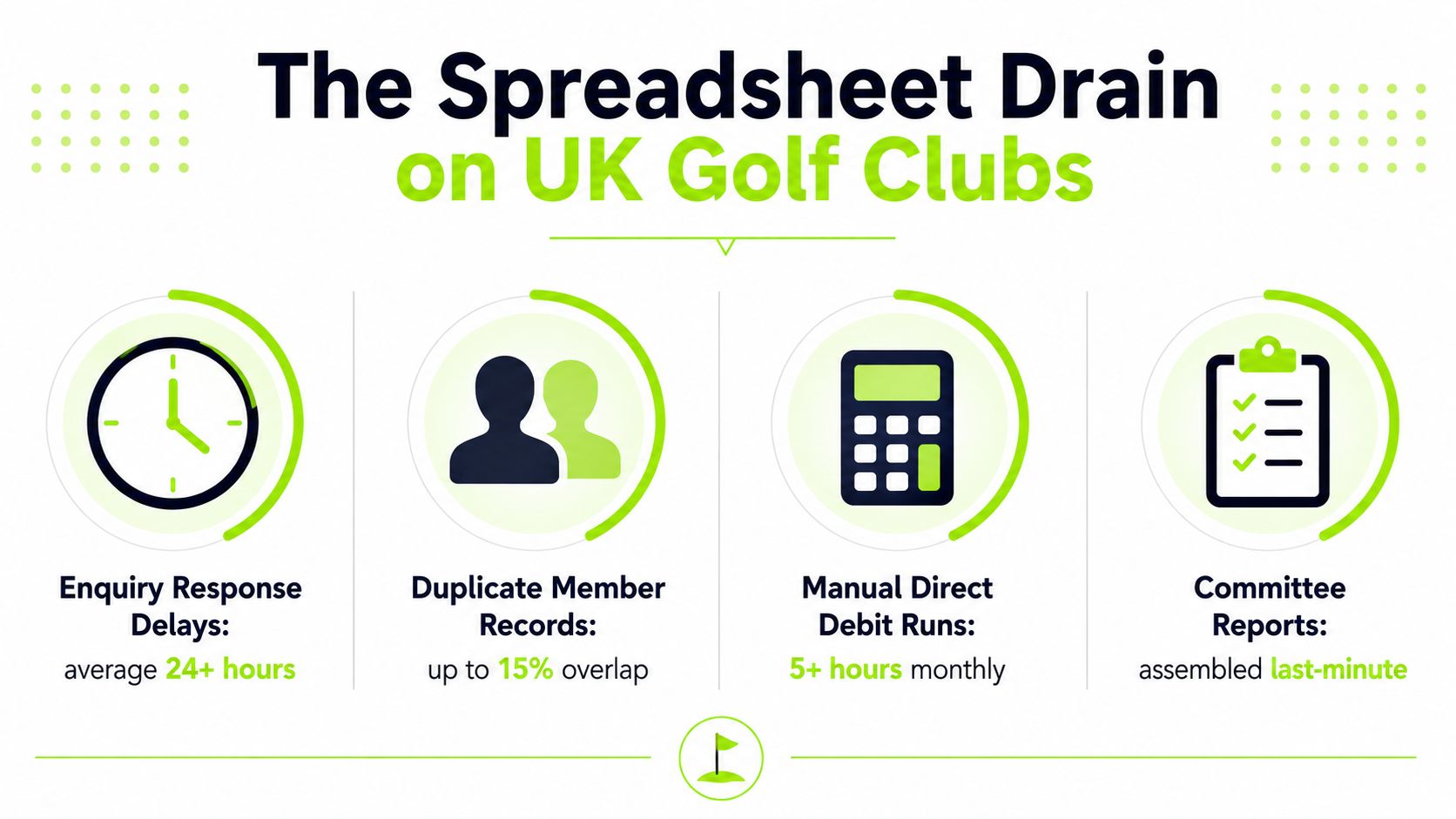
The clubs that get this right stop treating software as a back-office purchase and start treating it as a front-end conversion tool. That means less chasing paper, fewer duplicate records, and a much tighter handover between enquiry, booking, and membership follow-up. It also means asking better questions than vendors usually want to answer.
A useful comparison point is how scheduling software in other sectors lives or dies on the quality of the workflow, not the length of the feature list. For a clean example of that logic, see Heyline's scheduling software guide, which shows how process design matters more than flashy demos.
Related reading on data structure and member visibility is worth keeping close, too, especially when clubs are replacing spreadsheet sprawl with a single system. GolfRep's database guide is a helpful reference point for clubs trying to sort out messy records before they buy anything.
Why Golf Clubs Are Replacing Spreadsheets and Paper
Spreadsheets and paper fail in golf clubs for one simple reason. They depend on memory, handovers, and one or two people who know where everything lives. Once that person is away, the whole admin chain slows down, and the club starts reacting instead of running a process.
The pressure points are easy to spot. Enquiries sit in inboxes, tee bookings live in a separate diary, member records are copied into another sheet, and finance still has to reconcile payments by hand. By the time the secretary or office manager has stitched all of it together, the opportunity to convert a prospect has often passed.
The hidden cost is operational fragility
This is why many clubs move away from spreadsheets after one bad season, one resignation, or one committee handover. Manual systems look cheap until they break. Then staff spend their time reconciling records rather than serving members or following up prospects.
The club software decision should start there, not with a shiny list of modules. If the system does not reduce duplication and make the next action obvious, it is not solving the right problem.
Practical rule: if a lead can disappear between first enquiry and first follow-up, the club does not have a marketing problem, it has a process problem.
The broader operational pattern is already visible in UK golf. In the 2025 UK&I survey commissioned by GCMA, the Scottish Golf Club Managers Association, UK Golf Federation, the Club Management Association of Ireland, and The Golf Club Secretary, 134 golf club managers were surveyed, and 66% said they were exploring alternative software solutions for managing club operations (GCMA research project). The same report found that the top priorities were Accounts & Reports, Membership, and Competitions & HCPs, which tells you where the pressure sits, on core administration and member service, not gimmicks.
If you want a plain-language test, ask whether the current setup helps the club answer this question quickly, who owns the lead, what happens next, and when was it last chased. If the answer takes a meeting, the system is already failing.
What Golf Club Management Software Actually Does
Good software is not one tool, it is a connected operating layer. The point is to keep one member record moving through bookings, enquiries, payments, reporting, and integrations without forcing staff to retype the same information in three places. When that works, the club stops behaving like a set of disconnected departments.
| Core modules of golf club management software | What it does operationally | Risk it removes |
|---|---|---|
| Tee sheet and bookings | Manages timed tee intervals, waitlists, visitor slots, and booking rules | Double-bookings, missed demand, messy diary control |
| CRM for enquiries and members | Stores lead history, follow-up tasks, and member contact records | Leads going cold, no ownership, lost history |
| Payments and Direct Debits | Handles fees, instalments, refunds, and payment status | Manual chasing, failed collections, finance errors |
| Memberships and subscriptions | Tracks categories, renewals, joining fees, and status changes | Incorrect billing, lapsed members, poor visibility |
| Reporting and committee dashboards | Produces clean reports for AGM packs, finance, and retention review | Hand-built reports, inconsistent numbers, late decisions |
| Integrations | Connects accounting, handicap, marketing, and partner systems | Duplicate entry, broken data flow, fragmented operations |
What each module needs to do in practice
The tee sheet should do more than show tee times. It should support the way your club books golf, including intervals, visitor flow, and waitlist handling. If staff still need a separate note pad to manage exceptions, the booking system is only half-built.
The CRM should keep enquiries and members in one place, with visible status and ownership. That matters because one club can't afford to lose track of who has asked about membership, who has booked a trial round, and who needs a follow-up email tomorrow. A tidy member database only helps if it drives action.
Payments and membership rules matter just as much. Joining fee instalments, Direct Debits, renewal dates, and category changes all need to sit in one process. A system that makes the finance team export and re-import files is not integrated, it is just digitised admin.
Useful test: if you need to ask two people and open three systems to answer one member question, the platform is too fragmented.
The value sits in the links between the modules, not in any single feature. That is also why an all-in-one platform can outperform a stack of separate tools, even when each separate tool looks stronger on its own.
Benefits, ROI, and What Realistic Gains Look Like
A club should expect software to save time, tighten control, and make follow-up more disciplined. It should not expect miracles. If the pricing is wrong, the committee is disengaged, or the course experience is poor, software won't fix that.
The clearest gains usually show up in four places. The secretary's office spends less time reconciling data. The membership pipeline becomes easier to track. Finance gets cleaner payment handling. The committee gets reports that don't need a weekend of formatting.
What improvement looks like in real terms
The strongest internal case is usually not a big headline number, it is a stack of small, measurable wins. Fewer manual corrections. Faster response to enquiries. Less time lost to repeating the same member details. More time spent on genuine member care.
For a practical reference on CRM-led golf operations, see GolfRep's golf club CRM software article. The core point is simple, the system should make follow-up visible and repeatable, not leave it to whoever happens to be at their desk.
| Realistic ROI figures for golf club management software | Typical Year 1 gain | Notes |
|---|---|---|
| Enquiry handling | Faster response and clearer ownership | Best when the system forces task assignment and reminders |
| Office admin | Less time spent reconciling records | Usually felt first by the secretary or office manager |
| Membership conversion | Better conversion from enquiry to visit or join | Depends on disciplined follow-up, not software alone |
| Finance admin | Cleaner collections and fewer manual checks | Strongest when payments and membership data are linked |
| Committee reporting | Faster preparation of board and AGM packs | Most useful when reports can be exported cleanly |
A simple payback case to a finance sub-committee should compare the annual software cost plus setup, training, migration, and support against the hours reclaimed and the revenue protected by quicker follow-up. That is the honest version. Anything more ambitious than that starts to sound like vendor marketing.
How to Choose the Right Platform for Your Club
Choose software with a scorecard, not a demo-day mood. Most clubs get distracted by polished screens and forget to test the workflow that matters, which is the path from enquiry received to first structured follow-up.
Build a weighted shortlist
Score each vendor on enquiry-handling speed, tee sheet reliability, payment depth, member self-service, reporting, integration openness, UK-based support hours, and total five-year cost. Include exit clauses in that cost, because switching later can be expensive in time as well as money. Shortlist three or four vendors only, then run reference calls with clubs that look like yours, not a random list of happy customers.
Ask direct questions. How many hours a week does the secretary still spend on manual work? How easy is data export if you leave? Who is the named account manager in the UK? If the answers are vague, move on.
Test the real workflows
Do not accept a curated demo. Create a fake enquiry and see how the task is assigned. Attempt a refund. Generate a committee report. Book a tee time with a restriction in place. The vendor that wins should make the shortest route between a lead arriving and a proper follow-up being logged.
Red flags are usually obvious once you know what to look for.
- Unclear data export: if the vendor can't tell you exactly how you get your own data out, that's a problem.
- No named UK contact: support shouldn't depend on a ticket queue in another time zone.
- Hosting without clarity: if hosting location and safeguards are fuzzy, the conversation isn't finished.
- Long lock-in terms: terms that trap pricing for too long make future change harder than it needs to be.
GolfRep's own CRM sits in this category of tool, a system for receiving, qualifying, assigning, and progressing membership enquiries in one place. That's useful if your club needs a structured lead pipeline, but it should still be judged against the same scorecard as everyone else.
If a platform looks impressive but cannot prove it shortens the response chain, it is the wrong platform for a club that wants more members.
Security, Hosting, and UK GDPR Considerations
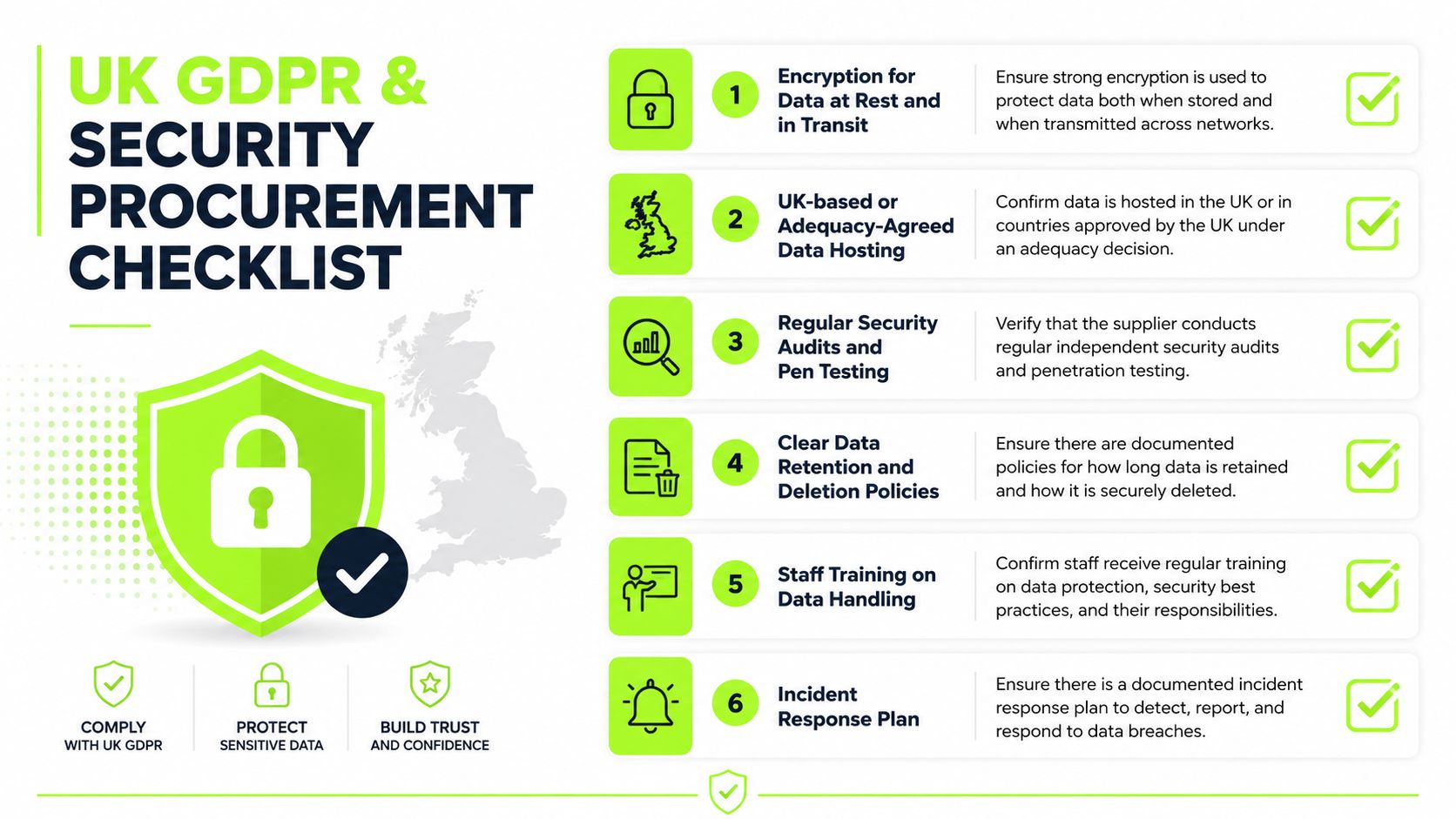
Security is part of procurement, not an IT tidy-up for later. Golf clubs hold payment details, medical flags, contact data, enquiry histories, and membership records, so a weak setup creates compliance and reputational risk fast.
The Golf Rep membership management guide is right to push UK-hosted or EEA-hosted data infrastructure and clear UK GDPR alignment. Member records, payment data, and enquiry histories are personal data, so the storage location and processing terms matter at buying stage.
What to require before signing
Ask for evidence, not reassurance. You need a Data Processing Agreement that matches UK GDPR, confirmation of data residency, a written incident notification commitment, and clear ownership of the data if the contract ends. If the vendor cannot show a clean export path, you do not control your own records.
Check the operational basics too. Ask how often security is tested, what backup retention looks like, and whether card handling sits inside the platform or through a compliant gateway. If the answer is vague, keep pressing.
Secure follow-up matters just as much as secure storage. For clubs also thinking about member communication, Golf Rep's WhatsApp lead follow-up article is a useful reminder that response workflows need governance, and so does any secure auth layer such as lightweight 20MB Docker auth.
A supplier should answer one simple question plainly. If there is an incident, how fast will they tell you, who takes responsibility, and what happens next? Vendors that handle that conversation well are usually safer bets than those selling features and avoiding the hard questions.
Implementation and Migration Roadmap
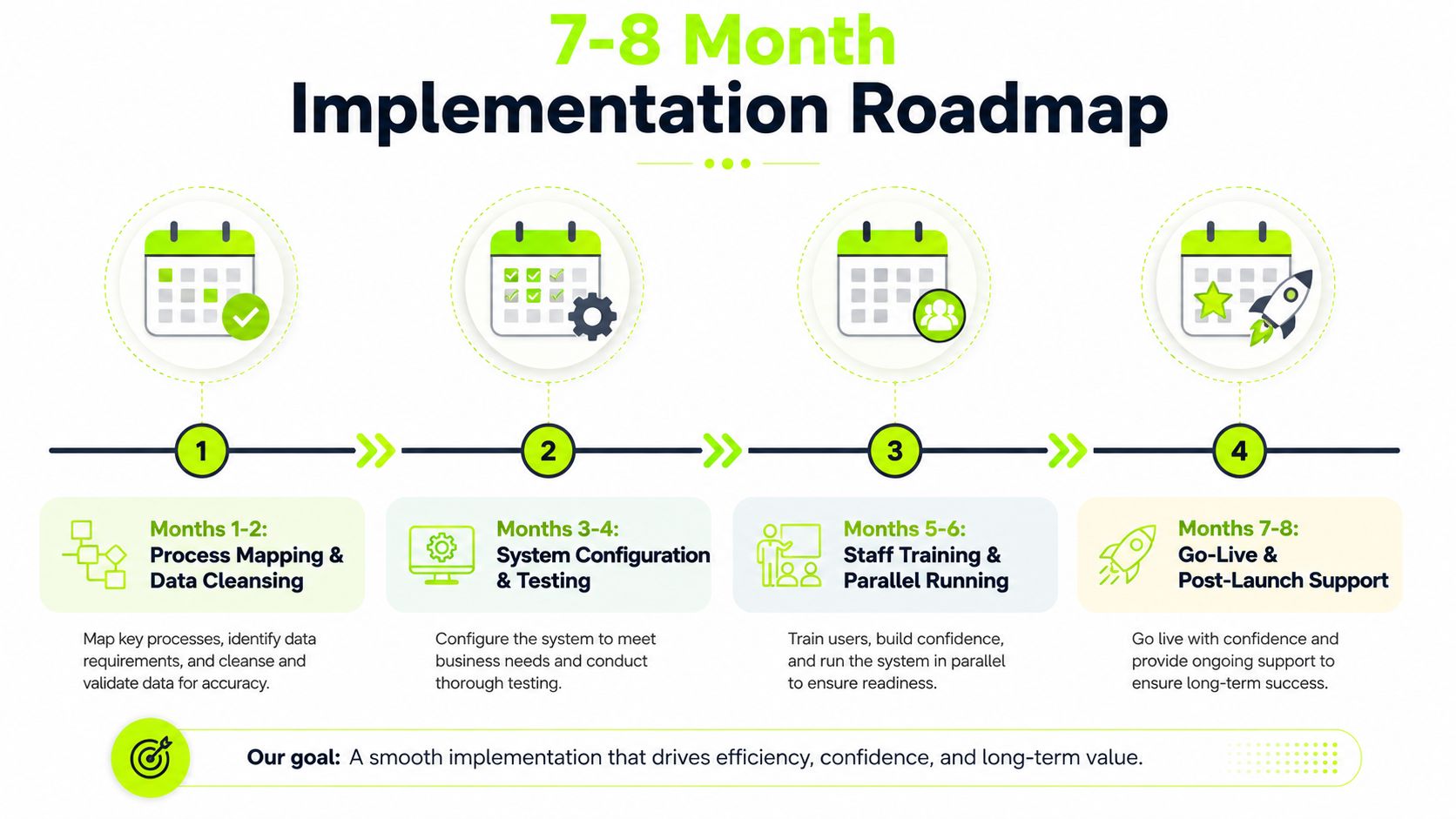
Most clubs should plan for seven to eight months from decision to settled use, because data cleaning, training, and parallel running take time. The biggest mistake is trying to rush the switch and expecting people to adapt while the old spreadsheet still sits open on the next screen.
A workable sequence
Months one to two should be about process mapping and data cleanup. That means identifying where enquiries live, which member records are duplicated, what reports matter, and how success will be measured. If you do not define enquiry response time and admin hours at the start, you won't know if the project helped.
Months three to four are for procurement and project setup. Choose the vendor, agree the contract, and appoint one named club lead plus one vendor implementation manager. Months five to six are for configuration, test migration, training, and building payment and accounting integrations. Keep the training role-specific, because the secretary, committee, and office staff do not need the same workflow.
Cutover without chaos
Month seven should be a parallel run, with both systems checked daily. Month eight is full cutover, legacy spreadsheets retired, and a 30-day stabilisation review. If that sounds cautious, good. Clubs get into trouble when they assume one weekend is enough to change how the whole operation works.
Common failure points are predictable. Dirty data slows everything down. Committee members skip training and then block adoption later. Old spreadsheets stay alive in the background and staff revert to them when pressure rises.
Non-negotiable: do not go live until the migration is clean, training is signed off, and rollback steps are written down.
UK Club Examples and What Changed After Switching
A private club with about 600 members moved from inbox-led admin to a proper CRM and booking workflow. Enquiry response time fell from three days to under four hours, and trial-membership conversion rose by a third within a season. The change did not come from the software alone, it came from forcing each lead into a visible process with ownership and reminders.
A busier municipal-style club with high visitor traffic linked its tee sheet, payments, and tills into one system. Reconciliation, which had taken two days a week, dropped to under an hour because staff were no longer stitching together separate records by hand. That saved time at exactly the point where manual admin used to interrupt service.
A smaller members' club finally brought retention, society income, and food and beverage figures into committee-ready reports. Before the switch, reports were assembled late and debated with incomplete data. After the switch, the committee had one version of the truth and could stop arguing about which spreadsheet was right.
| Before vs After: Measurable Change at Three UK Clubs | 600-member private club | High-visitor club | Small members' club |
|---|---|---|---|
| Enquiry handling | Faster follow-up and visible ownership | Not the main focus | Not the main focus |
| Reconciliation | Less manual office chasing | Much quicker daily reconciliation | Cleaner committee reporting |
| Reporting | Better tracking of trial membership | Better visibility across transactions | Committee-ready figures |
| Main process change | Structured follow-up | Connected operational data | Centralised reporting |
The pattern is consistent. Software mattered only where the club changed a process, usually follow-up discipline or data handling. If the club kept working the old way, the platform stayed underused.
Practical Next Steps and a Starting Checklist
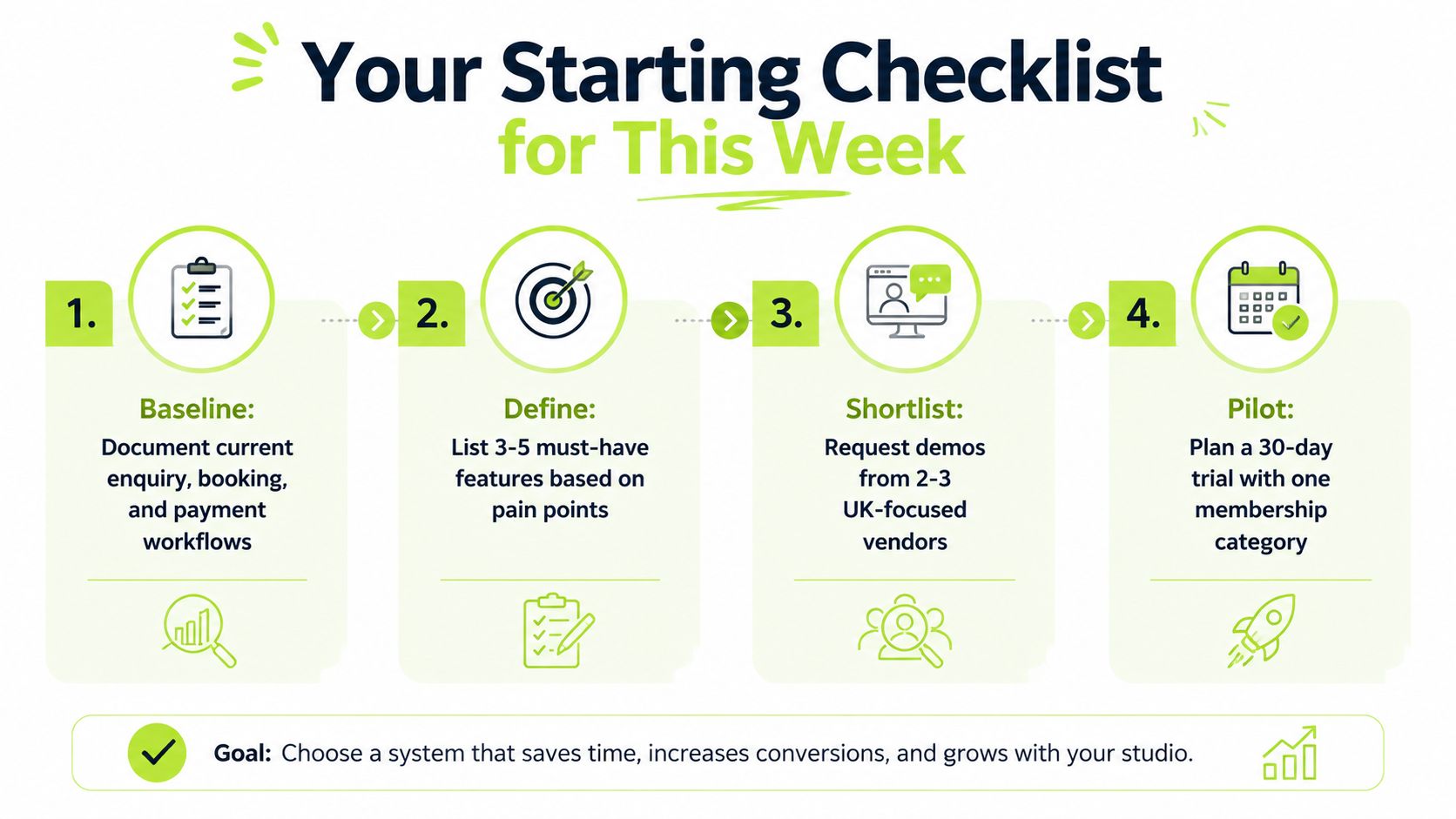
Start this week, not next budget cycle. Baseline the current process, define the outcome you want, score a small shortlist, and set a fixed decision window with one person accountable for the call. That keeps the project from drifting into another committee discussion with no end date.
A four-stage decision framework
- Baseline the current process. Record how enquiries, bookings, and payments move today.
- Define essentials. List the few outcomes that matter, especially response time and reporting.
- Shortlist and score. Compare two or three UK-focused vendors against the same criteria.
- Pilot with purpose. Test one membership category or one workflow before you commit fully.
The best next step is simple. Capture enquiry response times for a fortnight. Write down the three reports the committee really reads. Identify the one place where data disappears between departments. If you can't see the leak, you can't fix it.
The first investment is process, not procurement. Once the club knows how quickly it answers, how clearly it follows up, and how confidently it reports, the software choice becomes much easier.
GolfRep helps golf clubs build a tighter path from enquiry to membership by combining lead generation with structured follow-up and CRM visibility. If your club is still relying on spreadsheets, inboxes, and memory to manage growth, visit GolfRep and look at how a more disciplined pipeline can be built around your existing operation.
Ready to tap into our proven growth system?