Golf Club Database: Convert Leads & Drive Growth
The most common advice around a golf club database is also the least useful. Clubs are told to build a bigger list, buy more traffic, collect more contacts, and push harder on lead generation. In practice, that usually solves the wrong problem.
Most clubs already have interest coming in. It arrives through website forms, social messages, phone calls, visitor bookings, fitting enquiries, and conversations at the bar after a society day. The issue isn't that nobody is enquiring. The issue is that those enquiries are handled inconsistently, stored in too many places, and rarely tracked from first contact to outcome.
A secretary reads an email, intends to call later, then gets pulled into member admin. A manager takes a phone enquiry and writes a note on paper. A committee member asks for an update and nobody can say which prospects are still active. That isn't a traffic problem. It's a systems problem.
Search results don't help much either. There isn't much solid UK-specific foundational data on "golf club database" in the usual results, and the available material is fragmented rather than practical for club growth decisions. That's exactly why clubs need a usable operating system for enquiries, not another static spreadsheet.
Your Club's Problem Is Not a Lack of Enquiries
A spreadsheet can hold names. It can't run a membership pipeline.
A proper golf club database should tell you five things at any moment: who enquired, what they wanted, where they came from, who owns the follow-up, and what happens next. If it can't do that, it isn't helping you convert interest into revenue.
What usually breaks
The failure points are rarely dramatic. They're ordinary.
- Enquiries land in separate places. Email inboxes, phone logs, paper notes, direct messages, and website forms all sit apart.
- Follow-up depends on memory. If one person is busy or away, the lead goes cold.
- No one sees the pipeline clearly. The club knows enquiries are happening, but not which ones are moving towards a visit or application.
- Reporting is based on impressions. People say, "We've had a fair bit of interest lately," but can't tie that interest to memberships sold.
Practical rule: If a lead can exist outside your main system, that lead can be missed.
What a growth database actually is
A growth database isn't just a contact list. It's a structured record of commercial intent.
That means every enquiry has fields, status, timestamps, assigned actions, notes, and a visible next step. It also means the system can trigger actions automatically instead of waiting for someone to remember.
The shift is simple to describe but important in practice:
| Static list | Growth database |
|---|---|
| Stores contact details | Stores contact details plus behaviour, status, and history |
| Relies on manual chasing | Triggers reminders and follow-ups automatically |
| Hard to filter meaningfully | Easy to segment by interest, source, and stage |
| Gives little revenue visibility | Shows pipeline movement and conversion points |
Clubs often think better marketing is the answer. Better handling is usually the faster win. When a club can see every open enquiry, respond quickly, and follow up consistently, the same volume of interest becomes far more valuable.
Designing Your High-Performance Database Schema
Most golf clubs don't need a complicated database. They need a disciplined one.
If your current setup only captures name, email, and telephone number, you're forcing staff to do the hard work manually. They have to remember context, rewrite notes, and guess priority. A strong schema removes that friction. It makes the right action obvious.
The fields that matter most
The structure below is the foundation we look for in a workable golf club database.
| Field Name | Data Type | Example | Purpose |
|---|---|---|---|
| Full Name | Text | James Walker | Identifies the enquiry clearly |
| Email Address | Text | james@example.co.uk | Primary email contact and automation trigger |
| Mobile Number | Text | 07xxx xxxxxx | Enables calls, SMS, and quick follow-up |
| Preferred Contact Method | Dropdown | Phone | Helps staff contact the prospect in the way they're most likely to answer |
| Enquiry Source | Dropdown | Website form | Shows which channels produce serious interest |
| Enquiry Type | Dropdown | Membership | Separates membership from societies, events, lessons, or visitors |
| Membership Category Interest | Dropdown | Flexible membership | Lets you tailor follow-up and offers |
| Lead Status | Dropdown | Awaiting call | Shows exactly where the prospect sits in the pipeline |
| Assigned Staff Member | Dropdown | Membership Manager | Creates accountability |
| Last Contact Date | Date | 14/04/2026 | Prevents leads from going stale |
| Next Action Date | Date | 18/04/2026 | Drives task management |
| Tour Booked | Yes/No | Yes | Marks movement towards sale |
| Notes | Long text | Interested in weekday access, partner may join too | Captures context that improves conversations |
| Consent Status | Dropdown | Marketing consent given | Supports compliant communications |
| Tags | Multi-select | High intent, local, came via Facebook | Allows flexible filtering and segmentation |
A schema like this isn't glamorous, but it changes how the club works. Staff stop hunting for context and start acting on it.
Why each field exists
Some fields are administrative. Others are commercial.
Enquiry Source matters because it tells you where serious demand starts. If you don't track source, you can't tell the difference between a channel that creates noise and one that creates tours.
Lead Status matters because it turns a vague contact list into a live pipeline. "New enquiry", "contacted", "tour booked", "application sent", and "closed lost" are more useful than a notes column full of guesswork.
Last Contact Date and Next Action Date are the fields that protect revenue. Without them, enquiries drift. With them, the club knows who's overdue for follow-up today.
A database field should exist for a decision, not for decoration.
Keep the status structure simple
Clubs often make the mistake of creating too many statuses. That sounds organised, but it usually slows staff down. If people can't choose the right status in seconds, they stop updating the system properly.
A practical status flow looks like this:
- New enquiry
- Attempted contact
- Contact made
- Tour booked
- Application sent
- Joined
- Closed lost
- Nurture
That gives enough detail to manage the journey without creating admin clutter.
Build for automation, not just storage
The database should support action the moment a record is created or updated. That only happens when fields are structured consistently.
For example, if one staff member types "flexi", another writes "flexible", and another writes "points membership", your reporting and automation become messy. Dropdown fields solve that. Standardised options are what allow a CRM to trigger the right email, assign the right task, and filter the right audience.
A good schema also separates permanent facts from temporary observations. "Membership category interest" is a field. "Asked whether husband and wife rate applies" belongs in notes. That distinction keeps the data clean.
GDPR needs to be built in from day one
A golf club database has to be commercially useful and properly governed.
That means:
- Consent must be recorded clearly so staff know who can receive marketing communication.
- Data should have an owner inside the club, even if several people use the system.
- Form fields should collect what is necessary, not every detail you might want one day.
- Deletion and update requests need a process, not a scramble through inboxes.
Most GDPR problems in clubs don't come from bad intent. They come from scattered records and unclear ownership. A central database reduces that risk because the club has one place to review, update, and manage contact data properly.
Sourcing and Capturing High-Quality Membership Enquiries
A database only works if good information gets into it consistently. That's where many clubs struggle. They capture some enquiries well, miss others completely, and leave too much detail sitting in inboxes.
The aim isn't to collect the highest volume of names. It's to capture high-intent membership enquiries in a format the club can act on immediately.

Your best enquiry sources are usually already in front of you
Most clubs don't need exotic acquisition channels. They need reliable capture points.
The strongest sources tend to be:
- Website enquiry forms that ask the right questions and feed directly into the database
- Phone calls from local golfers who want pricing, availability, or a look around
- Walk-ins and visitor conversations where interest starts casually but is commercially real
- Social lead campaigns aimed at golfers in a realistic catchment area
- Open day and fitting event registrations where intent is easier to qualify
The mistake is treating each source differently. A phone enquiry should enter the same system as a website lead. A walk-in should create the same kind of record as a paid social form. If one source bypasses the database, visibility disappears.
What your forms should ask
Shorter forms usually convert better, but shorter doesn't mean vague. You need enough information to route and prioritise the lead.
A practical membership form should usually capture:
- Basic contact details so the club can respond properly
- Membership interest such as full, flexible, intermediate, beginner, or trial
- Timing so staff know whether the person wants to join soon or is still researching
- A free-text question box for specific context
- Consent preferences for compliant follow-up
That creates enough structure to automate the first response and brief the staff member who makes contact.
If you're reviewing your wider process, this guide to golf club lead management is worth reading alongside your database setup.
Stop relying on "we'll add it later"
Good leads tend to go missing.
A club gets a call. Someone says they'll put it into the system later. Later never quite arrives, or the notes are incomplete, or the person who took the call isn't the person who follows it up. By the time anyone acts, the prospect has gone cold or joined elsewhere.
The quality of a database is decided at the point of capture, not at month-end when someone tries to tidy it up.
Why generic golf databases don't help with membership growth
There are databases in golf, but many have nothing to do with member acquisition.
For example, the USGA Informational Club Database is built around equipment compliance, not local golfer demand. That's useful in its own context, but it doesn't help a club understand which enquiries are live, which prospects need a call, or which campaigns are producing joiners. That gap matters even more when England Golf reported a 2.3% net decline in adult male members in 2024-25 in the context cited in the same source material.
What works is a capture process tied directly to commercial outcomes. Every form, call, event registration, and visitor conversation should feed one central system. That gives the club a cleaner pipeline, faster response, and far less reliance on memory.
Connecting Your Database to Automated CRM Workflows
A database without workflow is storage. A database connected to a CRM is operational.
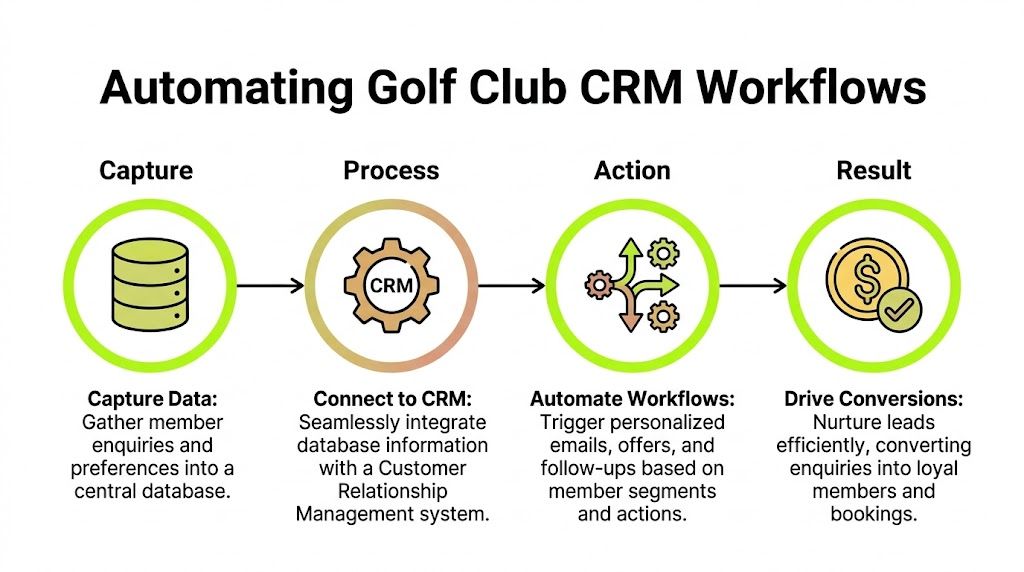
Clubs transition from merely recording enquiries to properly managing them. The moment a new lead enters the system, the CRM should decide what happens next. No waiting for someone to spot an email. No hoping a staff member remembers to follow up after a busy Saturday morning.
The first five minutes matter most
When a prospect submits a form or is added after a call, the CRM should trigger a short chain of actions immediately.
A sensible workflow looks like this:
Confirmation goes out instantly
The prospect receives a personalised email or message confirming the enquiry was received.An internal task is created
A staff member gets assigned the lead with a due date for personal follow-up.The record is categorised automatically
Source, interest, and status fields are applied based on the information captured.A nurture sequence is prepared
If the person doesn't book a visit right away, the system schedules useful follow-up content.
That doesn't replace human contact. It protects it. Staff can spend their time speaking to live prospects instead of sorting inboxes.
What a practical workflow looks like
Take a typical membership enquiry from a local golfer.
They fill in a website form on a Tuesday evening asking about flexible membership. The CRM creates a new record, tags the lead correctly, and sends a confirmation message straight away. The membership manager sees a task in the system the next morning with the prospect's details, notes, and stated interest already attached.
If the manager calls and books a tour, the status updates to "Tour booked". That single change can trigger the next actions automatically:
- A confirmation email with visit details
- A reminder task for staff before the appointment
- A post-visit follow-up if no application is received within a set period
If the manager can't reach the prospect, the system can place them into a lighter nurture track instead of allowing the lead to disappear.
Automation works best when it handles the routine
Clubs sometimes worry that automation feels impersonal. In practice, poor follow-up feels more impersonal than a prompt, relevant response.
The right use of automation is narrow and useful:
- Acknowledging enquiries quickly
- Assigning ownership clearly
- Scheduling follow-up without manual chasing
- Keeping records current
- Making sure no lead sits untouched
It should not produce robotic over-communication or generic promotional spam. A CRM isn't there to flood inboxes. It's there to make the club reliably responsive.
Operational view: Automation should carry the process. Staff should carry the relationship.
Choose workflow logic your team will actually maintain
The best CRM setup is not the one with the most branches. It's the one your club can keep accurate.
For most clubs, the essential workflows are enough:
| Trigger | CRM action | Why it matters |
|---|---|---|
| New enquiry created | Send confirmation and assign task | Stops delays at the top of the funnel |
| Status changed to contacted | Start follow-up reminders | Keeps momentum after first touch |
| Tour booked | Send visit details and prep task | Improves attendance and staff readiness |
| No response after contact attempts | Move to nurture sequence | Preserves value from undecided leads |
| Application sent | Create check-in reminder | Prevents late-stage drift |
Many clubs also benefit from connecting their golf club database to a broader golf CRM system so lead handling, visibility, and reporting all sit in one place rather than being split across inboxes and spreadsheets.
What doesn't work
Three patterns usually undermine CRM adoption.
First, clubs automate messages but don't enforce task completion. The result is quick emails and slow human follow-up.
Second, they build workflows around poor data. If fields are incomplete or inconsistent, automation fires at the wrong time or not at all.
Third, they leave the pipeline ownership vague. If everyone can follow up, nobody really owns the outcome.
A CRM only improves conversion when the database, workflow, and staff responsibilities all line up. When they do, response times improve, lead visibility improves, and management gets a far clearer picture of future revenue.
Using Advanced Segmentation to Maximise Conversions
Once your database starts filling up, generic communication becomes expensive. Not always in ad spend. Often in missed opportunity.
A golfer who asked about beginner membership last autumn shouldn't receive the same message as a low-handicap player who enquired about joining after a fitting event. Both are prospects, but they need different conversations. Segmentation is what lets a golf club database reflect that reality.

The simplest segmentation is often the most valuable
Start with commercial relevance, not complexity.
The segmentation framework highlighted by RD Marketing's golf clubs and courses database guidance focuses on three dimensions that matter in practice: geographic location, club type differentiation, and past engagement metrics. For UK golf clubs, that means recognising that private, public, and resort environments don't respond the same way. The same source notes that failing to segment and track these patterns can produce response rates 30-40% lower than data-driven alternatives.
That principle applies inside an individual club too. Different enquiry groups need different treatment.
Useful segments inside a club database
A practical segmentation model might include:
By membership interest
Full membership, flexible membership, beginner pathway, academy, corporate, or trial.By stage in the journey
New enquiry, toured but undecided, no response, application sent, lapsed opportunity.By source of enquiry
Website form, referral, social campaign, visitor round, event registration, phone call.By recency
Contacted this week, inactive for a month, untouched for too long, long-term nurture.By local fit
Lives nearby, works nearby, second-home owner, weekend-only golfer.
Each of those segments supports a different message and a different call to action.
What relevant messaging looks like
Segmentation matters because relevance improves response.
A prospect who toured the club and didn't join may need a follow-up focused on timing, objections, and next steps. A prospect who only downloaded membership information may need a softer invitation to visit. Someone who asked specifically about flexible membership shouldn't receive a message built around full seven-day access.
Here is the trade-off. Generic campaigns are quicker to send, but they flatten important differences between leads. Segmented campaigns take more thought, but they allow the club to speak to actual intent rather than guessed intent.
Clubs don't need more messages. They need messages that match the prospect's last known behaviour.
Segmentation only works if the database is disciplined
Often, clubs fail in this aspect. They create segments once, send one campaign, and then stop maintaining the fields that made the segment possible.
For segmentation to keep working:
- Statuses must be updated consistently
- Source data must be captured cleanly
- Notes should be meaningful but not replace structured fields
- Old leads need a nurture route, not silent abandonment
You can also use qualification logic to improve the quality of these segments before a staff member even picks up the phone. This article on AI lead qualification for golf clubs outlines how clubs can sort high-intent enquiries from lower-priority ones more efficiently.
A good segment should change what staff do next
That's the test.
If a segment doesn't alter the message, task, timing, or offer, it isn't commercially useful. The point isn't to build a clever audience list. The point is to help the club follow up better.
The best golf club database setups use segmentation to answer practical questions quickly:
- Who needs a call today?
- Who toured but hasn't progressed?
- Which prospects are still interested in flexible access?
- Which sources produce the most serious conversations?
- Which dormant leads should receive a reactivation message?
Those are conversion questions, not marketing theory. When a club can answer them easily, communication becomes tighter and sales activity becomes more deliberate.
Enriching Your Database for Deeper Member Insight
The most useful golf club database doesn't stop at the enquiry stage. It keeps getting smarter after someone joins.
That matters because revenue doesn't only come from new members. It also comes from retention, coaching, fittings, retail spend, guest introductions, and long-term satisfaction. If your database only knows a member's contact details and renewal date, you're missing a large part of the picture.
Add data that improves service, not just reporting
Useful enrichment often starts with information the club already touches but doesn't connect.
That can include:
- Coaching participation such as beginner programmes, junior development, or regular lessons
- Playing habits like weekday use, weekend use, competition play, or social golf
- Retail and fitting context including club specifications or product interest
- Club visit behaviour such as event attendance or repeat guest activity
The key is relevance. Add data that helps staff make better decisions or deliver a better member experience. Don't collect details because the system has space for them.
Equipment and performance data can be more valuable than clubs realise
Many clubs have an untapped advantage, especially if they already run fittings or use launch monitor technology.
According to Clippd's analysis of golf analytics, launch monitors provide standardised data such as Club Speed and Attack Angle, and the ShotLink database captures approximately 1.5 million professional shots annually for benchmarking. The same source highlights a common gap: clubs often fail to connect this kind of data with amateur member progression. Advanced clubs can track member-equipment relationships to predict satisfaction and tenure based on how well equipment fits the player's game.
That creates a practical opportunity.
If a member has gone through a fitting, started lessons, and is showing clear progress, the club can shape communication differently than it would for a member whose activity has dropped away. Equipment data on its own isn't the answer. Connected to coaching, usage, and communication history, it becomes useful.
A richer database helps staff spot patterns earlier. Better patterns lead to better conversations.
Keep the enrichment model grounded
This doesn't require turning your club into a data lab. It requires linking systems that already exist.
A sensible approach is to create a small number of additional fields or tags that answer operational questions:
| Enriched data point | Why track it |
|---|---|
| Fitting completed | Identifies retail and coaching follow-up opportunities |
| Coaching active | Signals engagement and likely progress |
| Equipment category | Supports more relevant product communication |
| Playing frequency band | Helps identify highly engaged and drifting members |
| Guest referral activity | Highlights socially influential members |
The strongest insight often comes from combinations. A member who plays regularly, has recently completed a fitting, and is engaged with coaching is on a very different path from a member who hasn't played in weeks and ignored renewal prompts.
When the database reflects that difference, the club can respond before dissatisfaction turns into churn.
From Data Collection to Predictable Club Growth
A golf club database should make the club easier to run. If it creates more admin without improving decisions, it's the wrong setup.
The clubs that grow predictably usually aren't the ones chasing every new marketing tactic. They're the ones that know how to capture enquiries properly, route them into a CRM, follow up without delay, segment intelligently, and keep learning from the data they already hold. That is what turns scattered interest into a manageable pipeline.
This also applies beyond the first sale. Static information rarely produces commercial benefit. A connected system does. As noted in Club Up Golf's discussion of loft charts and personalised fitting data, generic loft charts often miss UK regional variation, while data-driven clubs that integrate launch monitor information into CRM nurture flows have seen sign-ups increase by 40% in the source's cited example at Macdonald Hotels. The wider lesson is clear. Better data becomes more valuable when it drives a better process.
Most clubs don't need more complexity. They need one central operating system for enquiries and member insight.
That means replacing scattered manual handling with a database that shows what is happening now, what should happen next, and where revenue is likely to come from. Once that system is in place, growth becomes less dependent on memory, chance, and whoever happens to be on shift.
If your club wants a better way to turn enquiries into booked visits, applications, and long-term members, GolfRep helps build the systems behind that growth. That includes lead capture, CRM workflow design, follow-up automation, and the visibility clubs need to manage pipeline properly rather than guessing.
Ready to tap into our proven growth system?