Golf Club Loyalty Programme: Structures That Keep Members

A committee member has spotted a neighbouring club's points scheme and wants to know why your club hasn't got one. The manager is looking at quiet weekday tee times, the professional wants more golfers involved in coaching, and the secretary is concerned about members who haven't played since summer. They're discussing the same programme, but trying to solve different problems.
A golf club loyalty programme should connect a golfer's behaviour with something they value, while improving a specific commercial outcome for the club. At GolfRep, our recommendation is to identify that outcome before choosing the rewards. Spare capacity, weak participation and poor renewal rates need different responses.
Four Loyalty Structures and Where Each One Fits
The neighbouring club's points scheme might suit its tee sheet perfectly. Copying it won't tell your committee whether it suits yours. A programme that encourages additional weekday play could be useful at a club with empty afternoon slots, but frustrating where members already struggle to book.
Think of loyalty as a set of rules linking what golfers do with what they receive. The structure should reflect available capacity, existing membership categories and the golfers you want to serve.
Four loyalty programme structures compared
| Structure | How value reaches the member | Best for | Main risk |
|---|---|---|---|
| Prepaid points | Points are spent on rounds, buggy hire or range tokens | Clubs with spare off-peak capacity | Unclear point values lead to disputes |
| Tiered membership ladder | Each tier unlocks more access, guest allowances or competition entry | Clubs with several distinct membership types | Tiers blur when benefits overlap |
| Behaviour-linked benefits | Benefits are triggered by quieter tee times, events, guests or competition entry | Clubs with under-used tee times | Benefits reduce yield if not capped |
| Progression route | Visitors receive taster rounds, coaching or invitations that lead to a membership product | Clubs with strong pay-and-play or junior demand | Pressure makes golfers disengage |
Prepaid points make sense when golfers want commitment without unrestricted access. A tiered ladder is more appropriate when the main challenge is matching different playing habits to clearly differentiated products. When designing golf club membership tiers, make the access differences meaningful rather than adding benefits that nobody uses.
Behaviour-linked benefits offer more control over the action being encouraged. For example, an introductory roll-up invitation can help a new member find playing partners, while an off-peak range benefit can encourage use of quieter facilities. Neither requires a permanent subscription discount.
What prepaid points look like in practice
QHotels Collection's Fairway membership starts at £295 a year with 100 points, which can provide up to 50 weekday rounds at the member's home club; points can also be used for buggy hire and driving-range tokens. It is a prepaid access model, not a reward for spending.
The useful commercial detail is that redemption value follows the product, location and playing time. A club can therefore make quieter inventory attractive without promising unrestricted access to its busiest tee times. The trade-off is complexity: golfers must understand what their balance buys before paying.
Before choosing a structure, write down answers to these questions:
- Capacity: Where do we have room for additional play or facility use?
- Membership: Which existing categories already meet different golfers' needs?
- Missing golfers: Who isn't progressing into a suitable relationship with the club?
Choose the structure that addresses those answers, not the one with the most impressive-looking rewards screen.
Why Member Experience Keeps Members Longer Than Rewards
A member receives a points statement but nobody asks why they stopped playing. Their balance looks healthy; their relationship with the club doesn't. An unused reward won't resolve the feeling that they've never found their place.
Work highlighted by Manchester Metropolitan University and England Golf identified six retention factors, and a participating club introducing a structured retention and recruitment strategy increased membership by more than 8% over two years, while reducing its average member age.
Assess the experience members actually receive
The factors provide a useful management checklist:
- Enjoyment and engagement: Do members have activities they want to return for?
- Distinctive club ethos: Can staff and members explain what makes belonging worthwhile?
- End-to-end experience: Are booking, payment, communication and problem resolution consistent?
- Warm welcome: Does someone help a new member become involved?
- Inclusive participation: Can golfers of different abilities find suitable opportunities?
- Long-term involvement: Can members stay connected as their circumstances change?
These are operational responsibilities, not tasks to hand entirely to whoever manages promotions. The professional, office team, captain and committee each influence whether a member feels included.

A practical welcome could include a named contact, an introductory round and a check-in after six weeks. Those are suggested service standards, not an industry benchmark. Build them into your new-member onboarding process, with someone responsible for confirming they happened.
A loyalty programme measures the whole member relationship, not the balance in a rewards account.
Give advocacy a deliberate place
Retention has an economic purpose: avoid spending to replace relationships the club could have maintained. It also creates opportunities for members to introduce people who may fit the club's culture and playing habits.
The historical evidence is substantial: GolfRep's member referral guide reports that, in a 2016 survey, 90% of members' clubs used referrals, while 72% judged them their most successful marketing method.
Ask for introductions after a successful first season, an enjoyable member event or a guest round, rather than sending an untargeted request when subscriptions are due. Recognition should feel appreciative, not like a commission arrangement.
Score each experience factor from one to five against your current member journey. Record an example supporting each score, then start with the lowest. A committee's confidence that the welcome is excellent isn't enough if nobody can explain who delivers it.
Rules to Settle Before Your Programme Launches
Vague rules create avoidable disputes at the desk. A member believes points cover a guest's weekend round, the booking team disagrees, and the professional is asked to make an exception while other golfers wait.
Settle those decisions before promoting the scheme. The rulebook must work for the person handling a booking, not just the committee approving the concept.
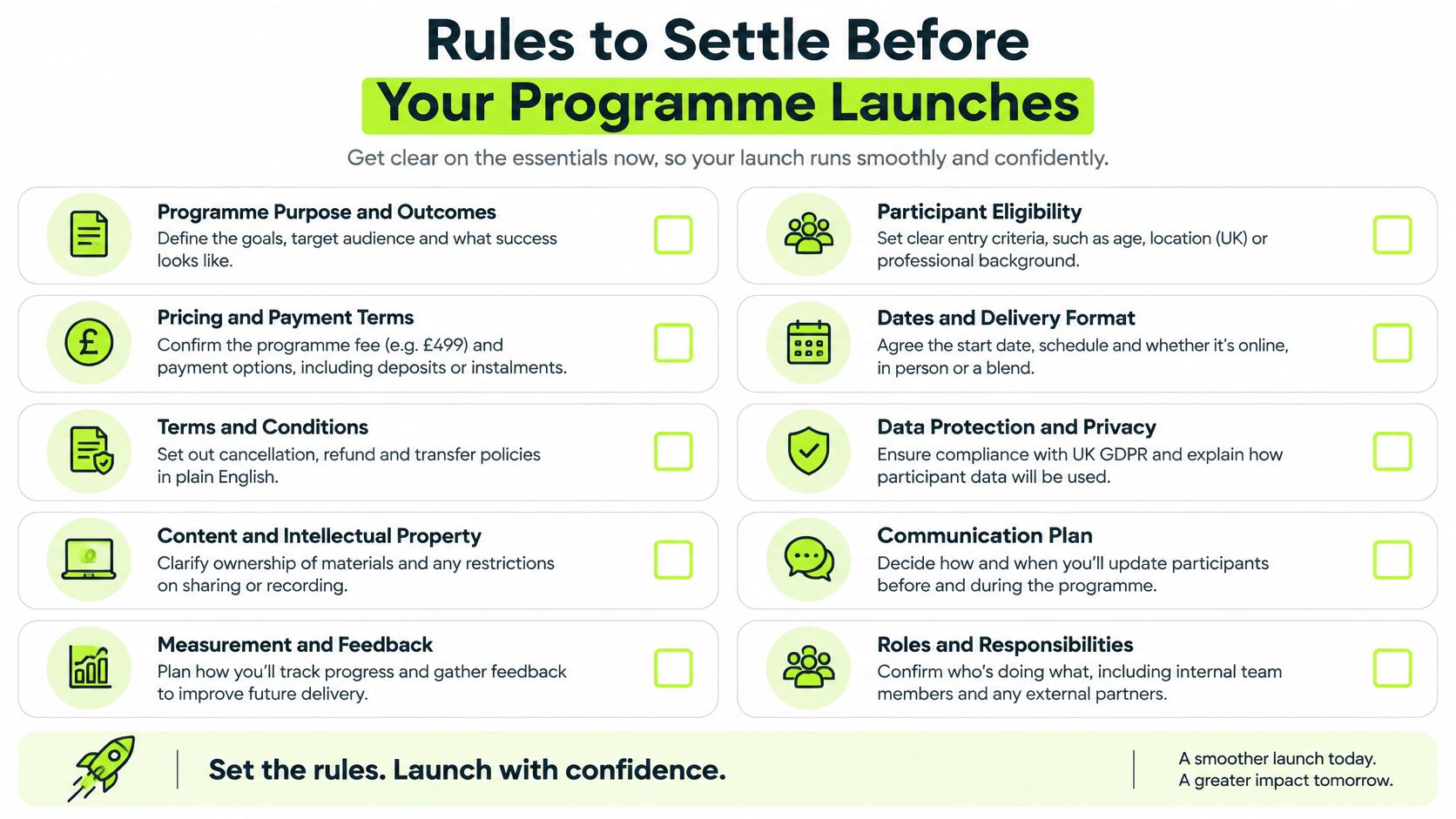
The committee's launch checklist
Eligibility. Name the qualifying membership categories. State whether benefits apply only at the home club or across a group, and what happens when someone changes category.
Access level. Specify eligible days, tee times and facilities. Explain whether competition entry, buggy hire and practice facilities are included or charged separately.
Guest limits. Define how many golfers a booking can cover, whether the account holder must play and how staff identify eligible guests.
Cardholder rules. Decide who can spend from an account. If household sharing is permitted, explain the evidence required and whether cardholders receive separate booking access.
Point value and expiry. Publish a redemption schedule and expiry terms. Include the treatment of cancellations, unused balances, renewals and suspended memberships.
Peak-time exclusions. Identify protected periods explicitly. Don't leave staff to explain that a popular time is unavailable because it feels too busy.
Exception approval. Name the role authorised to approve exceptions. Record the reason, benefit granted and financial effect so an isolated decision doesn't become an unwritten entitlement.
Specific terms prevent inconsistent decisions
The QHotels Fairway membership terms restrict members paying less than £375 at renewal to points use at their registered home club, allow a booking to cover up to four golfers' green fees, and permit two cards with a 300-point non-corporate purchase only where both cardholders live at the same address.
The lesson isn't to copy those thresholds. It's to make account access and sharing deliberate decisions. Household use can be legitimate without allowing an account to circulate among an unrestricted group.
Desk test: If two staff members would give different answers to the same booking request, the rule needs rewriting.
Draft a one-page member-facing rulebook supported by an internal exception log. Test it against three real scenarios from your membership, such as a shared household account, a guest cancellation and a peak-time booking request. Ask the office and professional shop to resolve each scenario independently before launch.
Turning Casual Golfers into Members
England Golf participation figures reported by National Club Golfer show 12.6 million adults played some form of golf in the previous 12 months, while 750,071 were club members in 2025; more than 24,000 iGolf subscribers have progressed into membership, including 9,600 in 2025.
That's a reason to build a progression route, not to assume every casual golfer wants full membership. The club's job is to recognise readiness and offer a suitable next step.
Follow the golfer's interests
Say a pay-and-play golfer books four weekday rounds in a month. That's a hypothetical trigger worth testing, not proof they want to join. Rather than sending a joining-fee offer, invite them to a taster evening where they can meet other weekday golfers and discuss access options.
The progression starts with recognition. Bring together booking, lesson, competition and clubhouse activity where the club can reliably identify the golfer. Don't treat an incomplete record as evidence of inactivity.
Next comes a low-risk experience: a taster round, coaching pathway or suitable junior programme. Only present a membership product when the golfer's interests and availability suggest a sensible fit. A flexible option may be more appropriate than full membership, even when the latter produces a larger initial sale.
Behaviour signals and suggested club responses
These are suggested prompts for staff judgement, not automatic qualification rules.
| Behaviour signal | What it may indicate | Suggested first response |
|---|---|---|
| Four or more rounds within a season | Regular play and possible readiness to join | Invite to a membership information evening |
| Lesson booked with a PGA professional | Interest in improving and possible commitment to the club | Offer a coaching pathway with membership options |
| Entry into a club competition as a visitor | Enjoys the club's competitive side | Invite to join a league or a society |
| Clubhouse food and drink use without a round | Values the social side of the club | Invite to a members' social event |
| Enquiries about weekday or flexible membership | Limited availability for playing | Share flexible membership details |
Check eligibility before offering competition or league access. Where a junior golfer is involved, keep the parent or guardian appropriately involved in membership conversations.
The pressure test is relevance. An invitation should answer an interest the golfer has already demonstrated, rather than feel like a sales call after an isolated visit. Staff should also record a preference to remain pay-and-play, so the golfer doesn't keep receiving unsuitable membership messages.
List the pay-and-play and junior golfers who used your facility during the last twelve months. Choose three signals to track first, check whether your records capture them consistently, and assign someone to review suitable invitations.
Spotting Disengagement Before Renewal Day
Consider a member who played twice a month for three years, then played once in spring and hasn't answered an email about autumn fixtures. That hypothetical change deserves a conversation, not an automatic discount.
The 2025/26 Hillier Hopkins survey of 79 UK members' clubs recorded average member rounds falling from 32,000 to 30,000, with 17% of clubs reporting more leavers than joiners; it also identified complimentary golf, induction programmes and free coaching among the most common ways clubs welcomed new members.
Separate low usage from dissatisfaction
Fewer rounds can reflect injury, work commitments or caring responsibilities. It can also reflect difficulty finding a suitable tee time, an unanswered complaint or frustration with committee responsiveness. The booking record tells you something changed, but not why.
Combine usage with feedback. Record open complaints, booking difficulties and promised responses alongside participation, rather than assuming every quiet member needs the same incentive. A golf club member survey can identify wider patterns, while an individual conversation establishes what matters to that person.

Use an intervention ladder, but move directly to service recovery where there's an unresolved complaint:
- Welcome-back invitation: Offer a relevant roll-up, coaching session or social activity.
- Booking support: Help the member find suitable availability within their entitlement. Don't displace other members or override access rules.
- Service-recovery conversation: Ask the manager or captain to address an open complaint and agree a specific response.
- Pre-renewal check-in: Schedule a personal conversation around sixty days before renewal, inside a suggested ninety-day renewal tracking window.
Resolve the reason before adding a reward
If the member can't obtain suitable tee times, complimentary range balls won't fix access. If they're waiting for a committee response, another promotional email can make the club appear less attentive.
Experiential benefits are useful when they remove a barrier to participation. Free coaching might help someone regain confidence, but it shouldn't substitute for answering their complaint.
Produce a monthly list of members whose rounds have fallen by a third, using that as a starting trigger rather than a proven risk threshold. Compare equivalent seasonal periods, check for known absences, assign each name to an owner and record the conversation's outcome. A completed contact task isn't the same as a resolved problem.
Measuring Loyalty and Choosing Where to Start
The 2024/25 Hillier Hopkins survey recorded an average of 105 joiners and 82 leavers per members' club, producing 23 net additional members, compared with 76 the previous year. Acquisition activity can look healthy while departures absorb much of the gain.
Use a simple hypothetical calculation. A club averaging 800 members across the year and losing 90 has annual churn of 11.25%, calculated as 90 divided by 800. If it recruits 100 members, its net growth is 10. Those example figures illustrate the calculation, not an industry target.
Track outcomes before reward activity
Points issued, programme registrations and visits are useful diagnostic measures. They don't establish whether the club retained more members or improved commercial contribution.
Loyalty programme KPIs with calculations
| KPI | How to calculate it | Review cadence |
|---|---|---|
| Net member growth | Joiners minus leavers in the period | Monthly |
| Annualised churn | Leavers over the year divided by average membership | Quarterly |
| Reactivation rate | Lapsed members who rejoin divided by lapsed members contacted | Quarterly |
| Renewal conversion | Members who renew divided by members due to renew | Monthly, from 90 days before renewal |
| Average revenue per member | Total membership and linked spend divided by members | Quarterly |
| Gross contribution per playing hour | Revenue minus direct cost for each booked hour | Quarterly |
The review timings are a suggested reporting framework. For gross contribution per playing hour, divide the relevant revenue less direct costs by booked playing hours, and keep the definition consistent between periods.
Separate renewal conversion for new members, established members and returning lapsed members. Their reasons for leaving may differ, and an overall improvement can conceal weak performance within a particular group. Compare completed renewal cohorts rather than treating members who haven't yet reached their due date as failures.
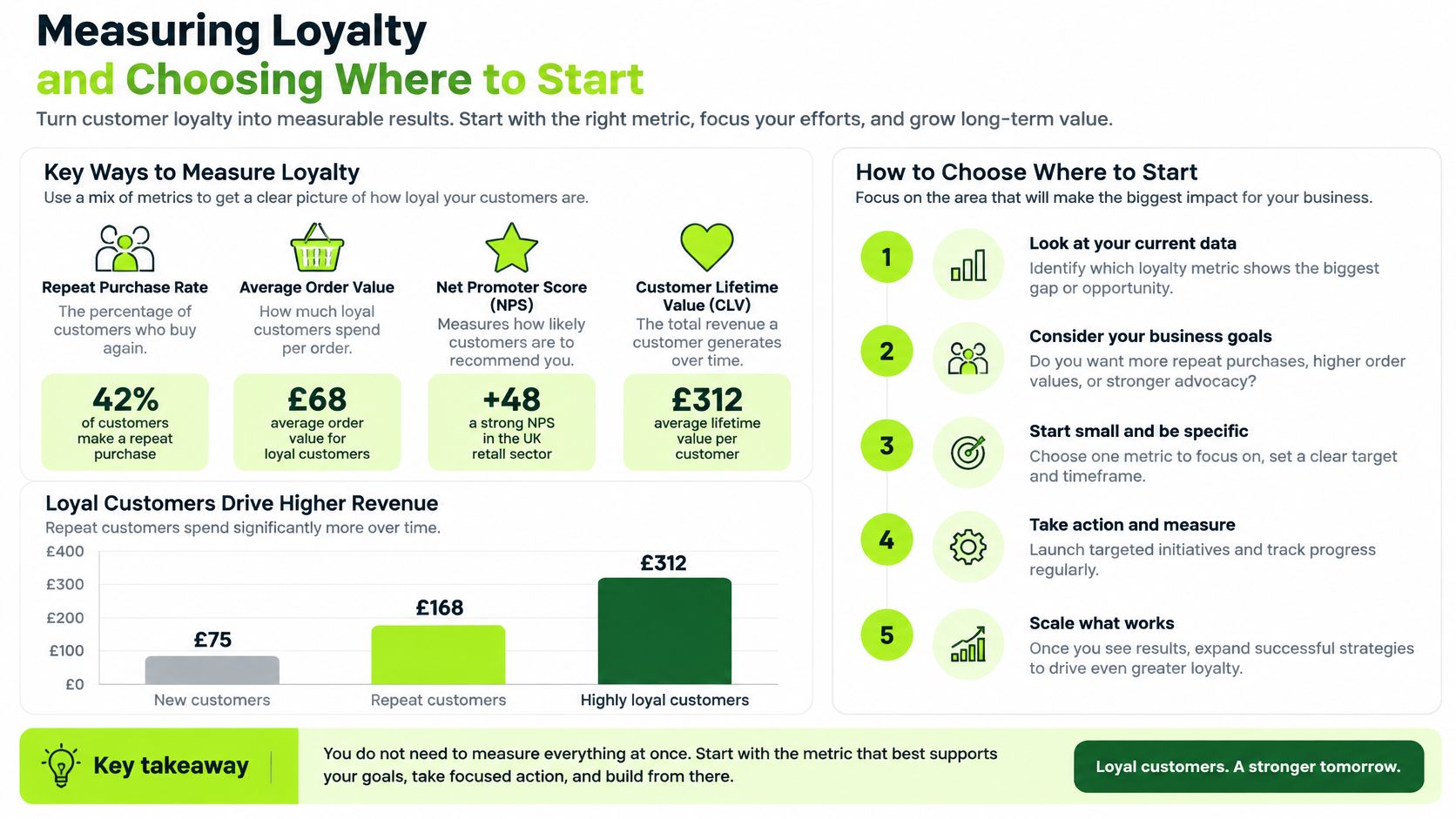
Record a baseline before launch. Give the general manager a one-page monthly dashboard showing outcomes, segment differences, reward costs and unresolved member issues. Hold a quarterly committee review against the equivalent prior-year period, noting subscription changes, course closures or other factors that could distort the comparison.
Choose a pilot the club can evaluate
Identify the constraint. Review the last twenty-four months of membership movements, visitor activity and renewals. Decide whether the immediate problem is too few new members, too few visitors progressing or too many departures.
Select one structure. Match it to that constraint and available capacity. Don't launch a points scheme, tier overhaul and referral incentive together, because you won't know which change influenced the result.
Approve the rules. Confirm eligibility, access, redemption and exceptions with the staff who will administer them. Include the cost of delivering each benefit.
Record the baseline. Capture net growth, churn and renewal conversion, then add the measure most relevant to the pilot. An off-peak scheme also needs contribution reporting; a progression route needs membership conversion tracking.
Run a ninety-day pilot with one segment. Treat this as a practical test period, not a promise of conclusive retention results. If renewals fall later, assess delivery and engagement first, then follow the cohort through its renewal date.
Expand only after measurable improvement. Tie each change to a number and an owner. If participation rises but contribution falls, adjust eligibility or benefit cost before extending the programme.
Commercial check: A benefit is successful when it changes a worthwhile behaviour at an acceptable cost, not merely when members redeem it.
The committee should finish with a decision, not just a dashboard: continue, amend or stop the pilot, with the reason recorded. GolfRep, a UK revenue and growth partner for golf clubs, can help map this sequence.
GolfRep provides the system, strategy and partnership to help clubs grow membership, increase enquiries or stabilise retention, with campaigns built around each club's brand, pricing and goals. To assess which loyalty structure fits your membership journey and tee-sheet capacity, visit GolfRep and discuss where to establish your baseline and pilot.
Ready to tap into our proven growth system?