Golf Club Member Survey: Questions That Predict Renewal

23% of UK golf clubs reported that more members were leaving than joining, even though the average club still recruited 70 new members in 2022, down from around 90 in each of the two previous years (Golf Magic report on the 2022/23 UK club membership survey). Recruitment was working. Retention was undoing it. That gap is exactly what a well-built survey is for.
Ask a committee how the club is doing and someone will quote the satisfaction score. Ask how many members are undecided about renewing and the room tends to go quiet. In Golfshake's published picture of membership health, 19% of members were undecided about renewal against just 4% who said they would not renew, and 31% of members whose fees increased said the club never explained why (Golfshake membership health coverage).
Those two figures sit in the part of the report most clubs never publish. The undecided group is the commercial opportunity: nearly five times the size of the group that has already decided to leave, and still reachable. The unexplained fee rise is the cheapest thing in the whole document to fix.
Treat the golf club member survey as an early-warning system rather than a scorecard. What follows covers the ten questions worth asking, the sample size that makes the answer trustworthy, the mistakes that wreck the result, the UK benchmarks worth comparing against, and how to turn a spreadsheet into a call list the team can work before renewals open.
Sample Questions That Show Where Members Stand
Ten questions earn their place in a golf club member survey because each one changes what the committee does next. Twenty questions depress the response rate and bury the decision in a report nobody reads twice. Ten, answered on a five-point scale, take most members under eight minutes and give you a clean trend line year after year.
| Module | Sample question | Answer scale | What it reveals |
|---|---|---|---|
| Overall satisfaction | How satisfied are you with your membership overall? | Five-point scale, very dissatisfied to very satisfied | Current sentiment, tracked year on year |
| Renewal intent | How likely are you to renew at your next renewal date? | Five-point scale, very unlikely to very likely | Retention risk, split by tenure |
| Governance | How effectively is the committee or board running the club? | Five-point scale | Governance signal linked to loyalty |
| Responsiveness | How well does the club respond to suggestions from members? | Five-point scale | Whether members feel heard |
| Course condition | How satisfied are you with the greens, fairways, bunkers and winter playability? | Five-point scale for each element | Operational priorities by element |
| Tee-time access | How easy is it to book a tee time at times that suit you? | Five-point scale | Booking friction and capacity |
| Value for money | How well does your subscription reflect the value you receive? | Five-point scale | Price perception before renewal |
| Fee explanation | Were the reasons for any fee change explained to you clearly? | Yes, no or unsure | Communication gap behind price complaints |
| Usage | How many times did you play or use the clubhouse in the last 12 months? | Number bands | Whether low use links to renewal risk |
| Open comment | What one change would most improve your membership? | Free text | The reasons behind the scores |
Satisfaction and renewal intent sit first because they answer different questions, and the committee will ask for both. A club can post a strong satisfaction score and a soft renewal intention across the same membership. When that happens, the cause is usually price perception, low usage or poor communication rather than the golf course. The reverse combination, unhappy members who fully intend to stay, is a service recovery job rather than a repositioning one.
Governance and responsiveness earn their own rows because they move loyalty in a way a general satisfaction question cannot capture. England Golf and Players 1st analysed more than 70,000 member responses collected since 2021 and found that the effectiveness of the board or management committee, and how well it responds to member suggestions, materially influence the member experience and loyalty (Golf Business News on the England Golf and Players 1st member insight programme). Cross-tabulate those two scores against renewal intent. If governance scores sag among members who are unsure about renewing, the answer is consultation and a communication calendar, not a discount.
Course condition has to be asked surface by surface. Carr Golf's 2026 survey of UK club members found course conditioning was the deciding factor for 55% of respondents, ahead of value for money and tee-time availability at 39% each and price at 22% (Golf Business News report on course quality and membership decisions). One broad question about "the course" gives a greenkeeping team nothing to work with. Separate scores for greens, fairways, bunkers, drainage and winter playability point straight at where the money should go.
The fee explanation item is the one most clubs leave out, and it's the cheapest to act on. A yes, no or unsure answer separates members who understand an increase from members who resent it. Usage belongs in bands rather than an exact figure, because nobody remembers precisely how many times they played; bands are enough to show whether low use coincides with low renewal intent.
Close with a single open question on the one change that would most improve membership. Free text explains the scores, it doesn't replace them, and it shouldn't be coded by whoever holds the strongest opinion. Keep the core questions identical every year and rotate a single diagnostic module, food and beverage one year, practice facilities the next, so the trend stays comparable while priorities stay current.
Sample Size and Response Rate for a Reliable Result
Say a 700-member club gets 60 replies. That's 9% of the membership, and presenting it as member opinion gives the committee a decision built on noise. Sample size is what separates evidence from anecdote, and it's the one part of survey design that can be calculated exactly before anyone is invited.
| Club members | Response rate needed |
|---|---|
| 150 | 73% (about 109 replies) |
| 300 | 56% (about 169 replies) |
| 600 | 39% (about 235 replies) |
| 900 | 30% (about 270 replies) |
| 1,200 | 24% (about 292 replies) |
The 300-member club is the awkward case. It needs roughly 169 replies, which means 56% of the membership has to respond before the result carries a margin of plus or minus 5 percentage points at 95% confidence. A 1,200-member club needs about 292 replies, roughly 24%, because a larger population dilutes the effect of each individual answer. Smaller clubs therefore have to work harder for a usable result, and that work is reminders rather than incentives.
For any other size, divide 384 by one plus 383 divided by the number of members, then round up to the nearest whole reply. It takes ten seconds in a spreadsheet and settles the argument about whether the survey is worth running.
Roehampton Club's 2022 member survey shows what a properly reported result looks like: 1,302 responses, a 36% response rate, a stated 95% confidence interval of plus or minus 2.2 percentage points, and 94% saying the club met their overall expectations (Roehampton Club 2022 member survey report). Publishing the interval next to the headline score is what separates a survey from a straw poll.
Non-response bias is the trap that survives a healthy sample. Members who are unhappy, disengaged or halfway out of the door are the least likely to reply, so a 40% response rate can flatter a club with a real retention problem. Before reporting anything, compare respondents with the full membership file by age band, membership category, tenure and playing frequency. If the over-65s are over-represented by 15 points, the satisfaction score is a score for that group, not the club.
Practical rule: send from a neutral address, keep the whole thing under ten minutes, and allow two reminders across three weeks. Three touches is a survey; six is a nuisance, and a nuisance gets ignored next year.
Record the invitation list size and the response rate on the cover of every report. Without those two numbers nobody, including the committee, can judge how much weight the result deserves.
Common Mistakes and a Pre-Send Checklist
Most member surveys fail before the first reply lands, and they fail in the same handful of ways. None of the fixes below is expensive. All of them require a decision before the survey goes out, not after the results arrive.
Six failures worth naming
- Surveying only the people who turn up. An invitation list drawn from the clubhouse regulars measures the happiest slice of the membership. Pull it from the full membership file instead, including members who rarely play and members who have drifted away. The people least likely to open the email are the ones the survey most needs to hear from.
- One satisfaction question for the whole club. Course, clubhouse, staff and value are separate businesses inside the same membership. Folding them into one number produces a score nobody can act on.
- Rewriting the questions each year. A new question set resets the baseline, so the committee ends up comparing this year's wording with last year's different wording. Keep the core fixed and add one module.
- Reporting the average and nothing else. A 3.8 average can sit on top of a large group scoring one or two. Show the distribution, then the average.
- Leading questions. "How much do you enjoy our championship course?" invites a compliment, not an answer. "How satisfied are you with the condition of the greens?" invites information.
- Acting on the loudest voices. The members who buttonhole the secretary are not a sample. Weight decisions by segment size and renewal intent, not by volume.
Practical rule: members answer candidly on an independent platform with a clear anonymity statement. If a member suspects a governance answer can be traced back to them, you'll get a polite response and learn nothing.
The pre-send checklist
- Confirm the invitation list and record its size, with the send date, so the response rate can be calculated accurately.
- Lock the core questions and choose the one rotating module for this year.
- Set the sample target and the reminder schedule before the first email goes out.
- Agree the segment cuts and decision rules in advance. If the governance score falls among undecided members, who does what, and by when?
- Name an owner and a publication date for the results. A survey with no owner becomes a document with no decisions attached to it.
GolfRep works with clubs across membership, visitor, society and event revenue, and can help identify which commercial constraint is limiting growth before any campaign spend is committed. That work starts with knowing what members think, which is why the survey comes first.
Benchmarks to Compare Your Results Against
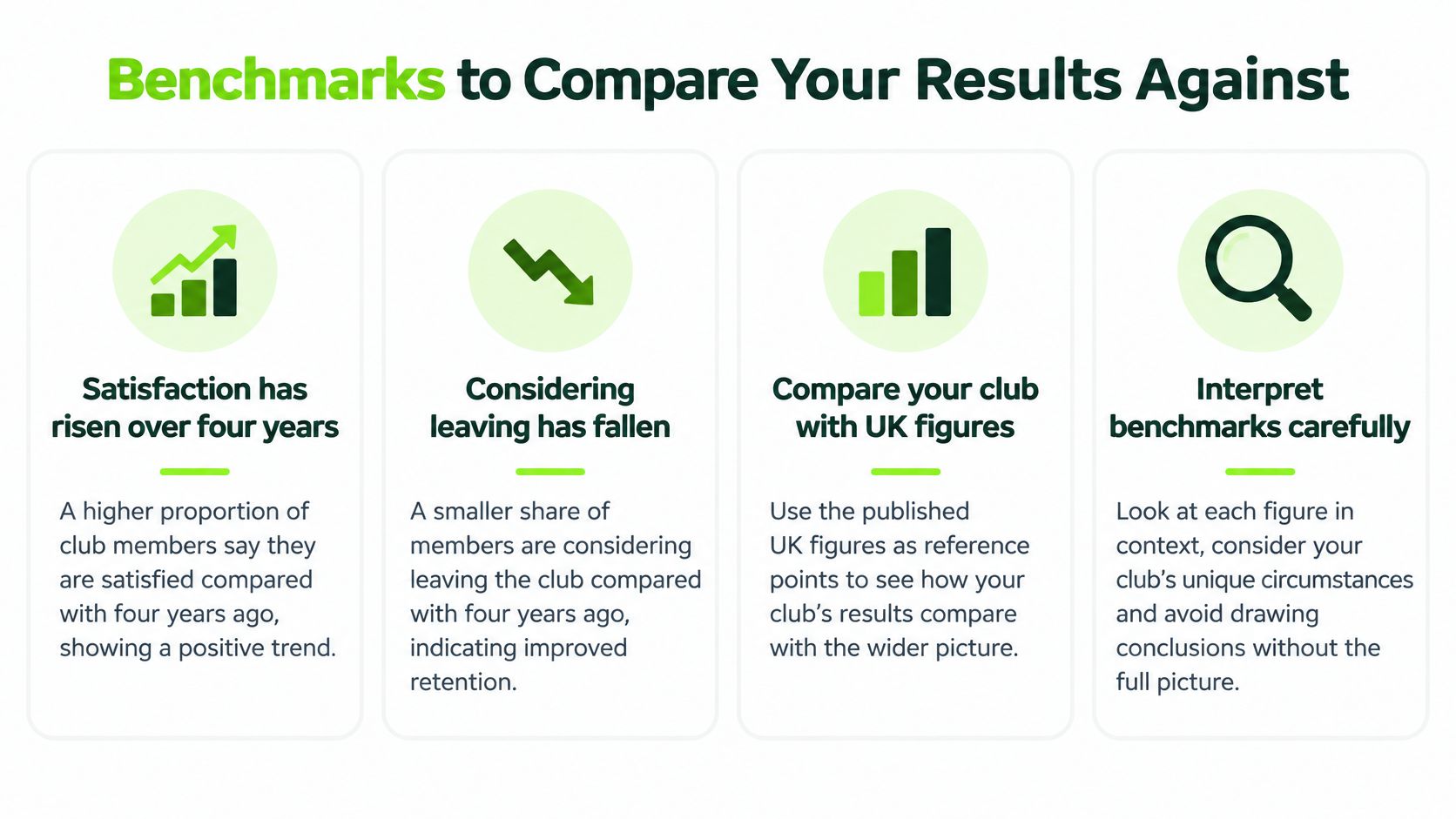
A benchmark is only useful when it's read in the right direction. Golfshake's 2023 survey gathered responses from 3,500 golfers, 67% of whom were club members in 2022. Among those members, 89% said they were happy with their current club and 11% were considering cancelling, against roughly 77% satisfaction and 23% considering leaving in 2019 (Golfshake 2023 membership survey). The direction matters more than either number: satisfaction up, cancellation intent down.
| Measure | Published figure | Source | How to use it |
|---|---|---|---|
| Members happy with their club | 89% in 2023, up from about 77% in 2019 | Golfshake 2023 | Compare your satisfaction trend, not a single score |
| Members considering cancelling | 11% in 2023, down from 23% in 2019 | Golfshake 2023 | Track as a separate renewal question |
| Members satisfied with the course | 78% satisfied or very satisfied | Carr Golf 2026 | Benchmark your course questions against this |
| Members expecting good or excellent course conditioning year round | 88% | Carr Golf 2026 | Set your standard for winter playability |
| Net Promoter Score for a private club | 42 | Roehampton Club 2022 | Compare only with similar private clubs |
| Members undecided about renewal | 19% | Golfshake membership health coverage | Treat as your priority segment |
| Members whose fee rise was not explained | 31% | Golfshake membership health coverage | Test your own communication against this |
The course rows explain why a satisfied score isn't the finish line. Most members reported satisfaction with their course, but a noticeably larger share expected good or excellent conditioning throughout the year. Winter playability belongs beside the satisfaction question, not behind it, because that's where the expectation gap sits.
Net Promoter Score is calculated by taking the percentage of members scoring 9 or 10 and subtracting the percentage scoring 0 to 6. The Roehampton figure in the table is a private-club reference point, not a national average, so put it only beside clubs of similar size, fee level and model.
The bottom two rows are the ones worth reading first. Neither the undecided group nor the members who never received a reason for their fee rise usually appears in a club's own report, which is why so many reports look calm while your golf club churn rate is climbing.
External benchmarks tell you whether you're out of line with the market. Your own trend over two or three years tells you whether you're getting better. Record your results beside each benchmark in the same format, so the comparison is automatic rather than remembered.
Spotting Renewal Risk Before Members Leave
The output of a good survey isn't a report. It's a call list, ranked by commercial risk, with a name and a reason against each entry.

Four segments carry most of the risk, and each needs a different response.
- Low renewal intent plus low governance or responsiveness scores. These members are unhappy with how the club is run, and a discount won't touch that. Route them to a committee member or the manager for a conversation about process and consultation.
- The undecided group. It's larger than the group that has decided to leave, and it's the one a club can still move. Ask what would settle the decision, rather than assuming the answer is price.
- Satisfied members who haven't used the club in twelve months. They're drifting rather than disappointed. A usage conversation and an invitation back into a competition or social event does more than a survey follow-up call about satisfaction.
- Members who answered no or unsure on fee explanation. The remedy is a written explanation of what the increase pays for, delivered before the renewal letter rather than after it.
None of this works on a whole-membership view. Split every score by tenure, age band, membership category and playing frequency. England Golf's 2018 questionnaire, covering 426 clubs, found membership among golfers aged 65 and over had increased by 13%, which is precisely why an age split belongs in the model (The Golf Business report on the England Golf club membership questionnaire). A rising total can hide a membership that renews well today and stops renewing in five years.
Practical rule one: if governance scores fall among undecided members, prioritise consultation and communication before any price change.
Practical rule two: if course scores are high but renewal confidence is low, investigate value and usage. The course isn't the problem.
Then check the survey against behaviour. Match answers to actual renewals and cancellations six to twelve months later. When the low-intent group turns out to have left at three times the club average, the questions have earned their place, and golf club membership retention stops being a debate about opinion.
Keep the first call list no longer than the team can work through in a month. A list of 300 names with no owner is a spreadsheet. A list of 40 with names, reasons and assigned callers is a retention programme.
How to Act on Survey Findings in Four Steps
Results sitting in a folder for three months teach members the survey was theatre. The process below gets the findings published, owned and closed off inside one renewal cycle.
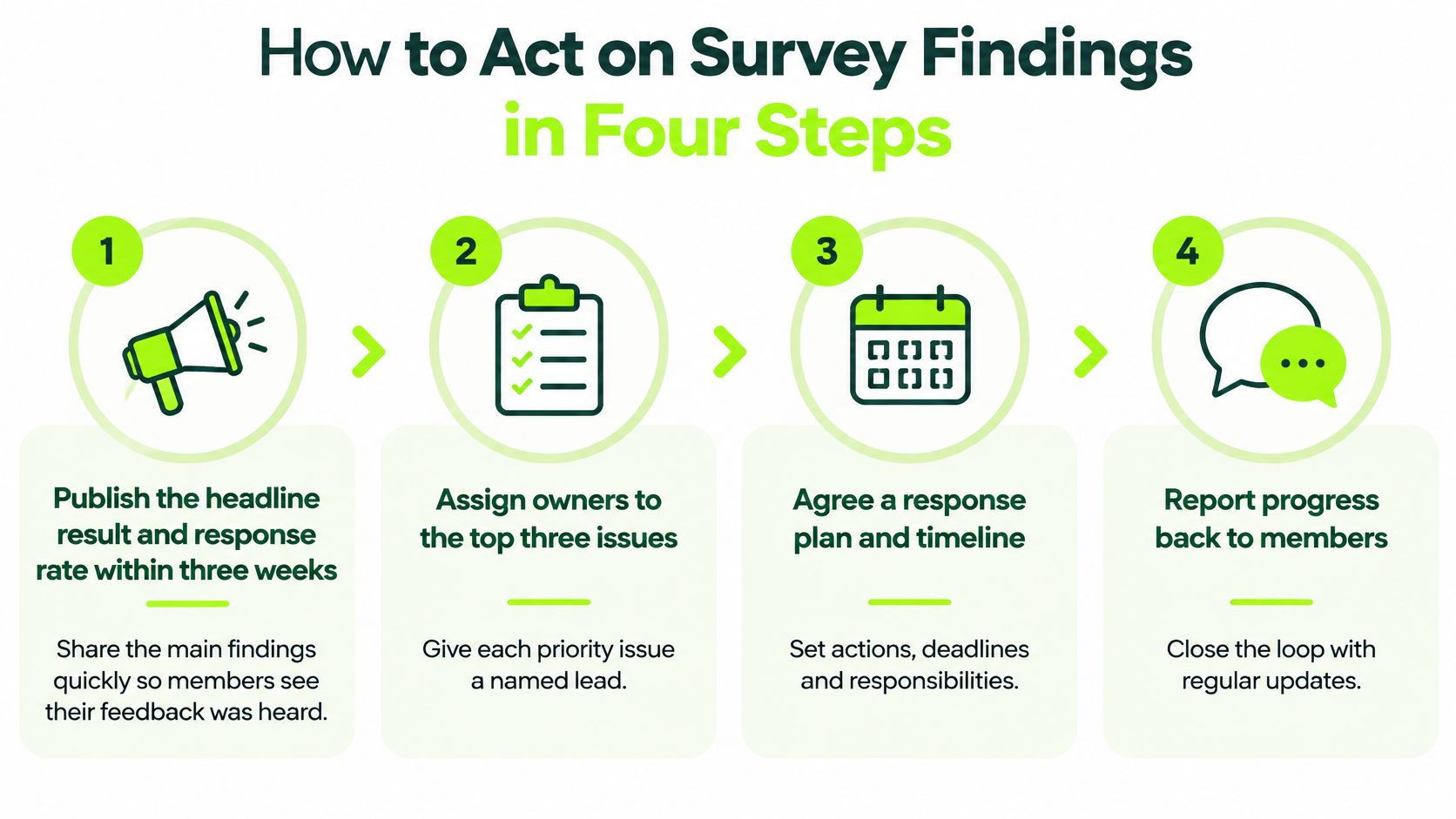
- Publish the headline result and response rate within three weeks of closing. Members who see their feedback landed are more likely to complete next year's survey, and that response rate is what makes the trend credible. Silence costs you the sample.
- Rank the three lowest-scoring issues that affect renewal intent. A weak score for car parking may cost nothing at renewal; a weak score for fee explanation may cost you members. Ranking by commercial impact keeps the committee's time on the findings that change behaviour.
- Give each issue one owner and one measurable target. A club might aim to lift the fee explanation score from 2.8 to 3.5 out of five within twelve months, or halve the undecided group by the next renewal date. Set the number from your own baseline. A target borrowed from another club isn't a target.
- Close the loop in writing. Reply to the members who raised concerns, state what has changed and what hasn't, and re-ask the core renewal question at the next survey. This turns a survey into evidence that the club listens, which is what the governance scores measure in the first place. If members have already gone, the same discipline applies to winning back lapsed members with a specific reason to return rather than a generic offer.
The one-page committee report
Give the committee a single page with four numbers on it: overall satisfaction, renewal intent, response rate, and the top three actions with owners and dates. Put the previous survey's figure beside each one so the direction is visible without commentary. Full crosstabs and free-text themes go in an appendix for the manager, not into the meeting.
Work one constraint at a time. Fix the fee explanation gap, measure it at the next survey, then move to the next constraint. Clubs that try to act on fifteen findings at once usually finish the year having acted on none, and the members who were undecided in March are still undecided in December.
A survey tells you where members stand; it does nothing to bring new ones in or move enquiries towards a decision. GolfRep builds that side of the pipeline for UK golf clubs: data-led advertising aimed at golfers matching your ideal member profile, 24/7 enquiry qualification, CRM-enabled nurture that keeps the club front-of-mind, and tracking from first enquiry through to signed member. Visit GolfRep to discuss your membership pipeline.
Ready to tap into our proven growth system?