Golf Club New Member Onboarding: A 180-Day Plan

The average UK members' club recorded 75 new joiners in 2024, up only slightly from 73 in 2023, while the same clubs averaged 63 leavers, up from 56 the year before. 22% of members' clubs had more leavers than joiners, and the most common welcome gestures were a complimentary round and an introduction to the club professional, according to a UK golf club benchmarking survey.
Recruitment can look tidy on a committee paper and still leave the club smaller in playing terms. Golf club new member onboarding is where that gap is won or lost.
Why New Member Onboarding Decides Whether They Stay
A paid subscription is not the same thing as a member who plays, knows who to call, and expects to renew. The joining offer gets someone through the door. The first months decide whether they build a habit.
Hospitality and integration are not the same result. Among people who joined a UK club during the pandemic period, 95.9% said they had been made to feel welcome, yet only 12.8% had been introduced to a buddy or another person who could help them settle in. 72% intended to stay, 26% were unsure, 2% did not plan to remain, and 46% had received a joining discount, as reported in an England Golf participation and membership survey.
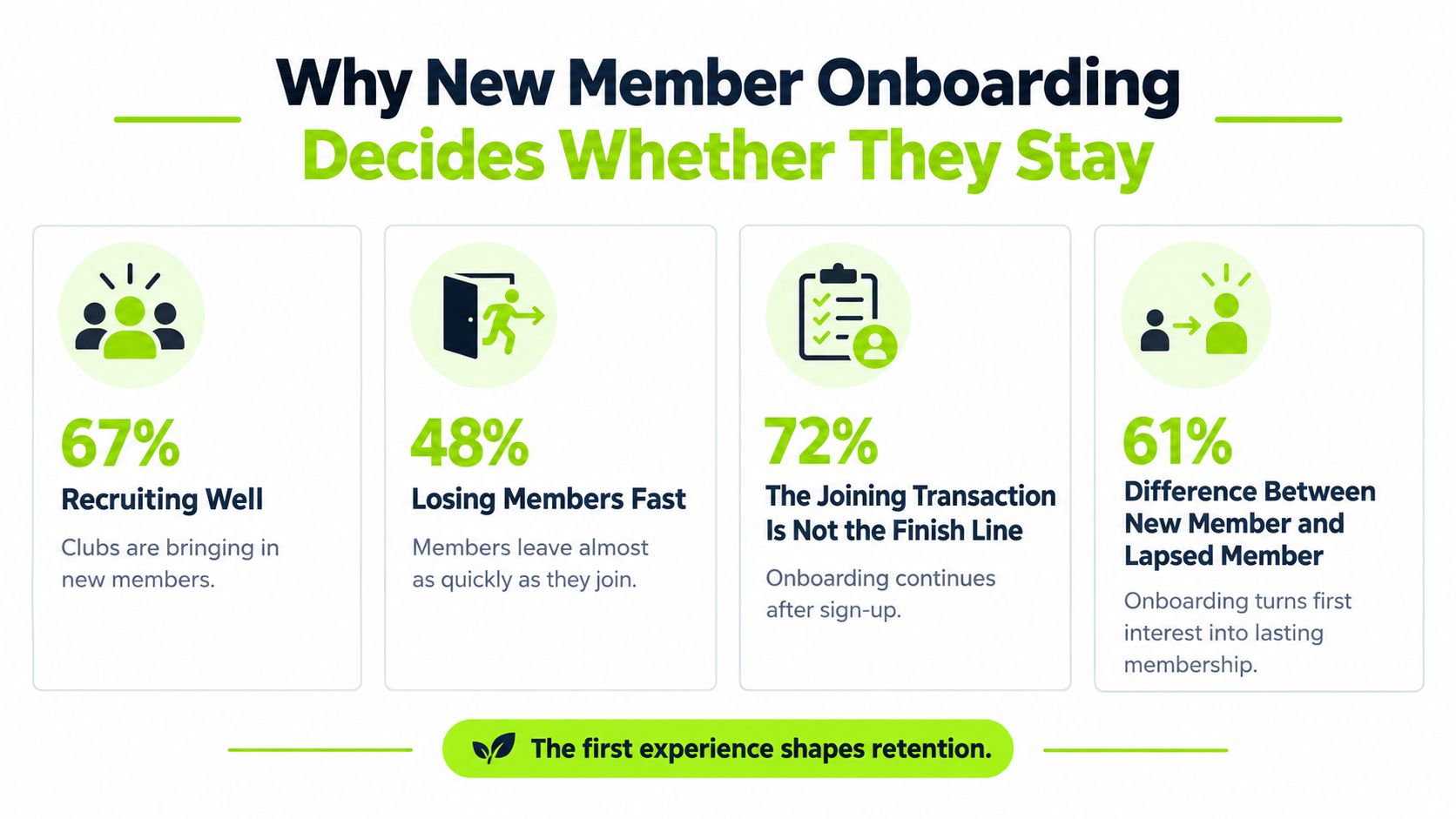
Nearly everyone felt welcome. Hardly anyone was given a person. That is a retention risk, not a hosting failure. A discount can fill a category without creating a Saturday fourball or a reason to enter the next roll-up.
What onboarding can and cannot fix
Onboarding will not repair a course that is consistently slow, a bar that closes when people finish, or a waiting list that was sold as easy access. It can stop the quieter failure: a new member who is polite on day one and absent by month three.
Treat it as a usage-and-integration journey, managed like any other commercial process. Record whether they have played, met someone, and understood how the club works. The path runs from honest expectations before payment, through the first month, across 180 days, and into a renewal conversation that is based on behaviour rather than hope.
Practical rule: If the only proof of onboarding is that a welcome email went out, the club has completed a transaction, not an introduction.
Setting Expectations Before the First Payment
Most early resignations start as expectation failures. The member paid for a picture of the club that the tee sheet cannot support. Say the awkward part before the money moves.
England club membership rose from 730,602 in 2024 to 750,071 in 2025, a 2.66% rise and the highest level reported in at least 13 years. Separate club-survey coverage found that 48% of members' clubs had a waiting list in 2024/25, as set out in reporting on a high-demand period for English clubs. Growth at that pace protects nothing by itself. It squeezes medal times, roll-ups, and the patience of people who already belong.
What to say about access
Before payment, put the actual booking picture in writing.
- Preferred times: State which days and hours fill first, and which windows a new member can realistically get in month one.
- Competition entry: Explain handicap gates, ballot rules, and whether a new player can enter as a guest of a member or must wait.
- Category differences: Spell out how full, flexible, junior, country, and hotel-linked memberships are prioritised, so nobody discovers a second-class rule after they have paid.
- Phased access: Where the sheet is full, offer a published plan: coaching slots, twilight, a named roll-up, or a guaranteed first round with the professional, rather than a vague promise to "see how it goes".
A phased plan is fairer than pretending every new name can have Saturday at 8am. Existing members notice when a recruitment drive steals their tee times. New members notice when the brochure and the booking screen disagree.
Capture routing detail on the form
An England Golf club case study describes a tighter application form, a welcome pack, induction events, and member feedback feeding course and clubhouse plans. The form should ask about handicap status, usual playing days, appetite for competitive golf, interest in coaching, and anything that might stop them turning up, such as childcare, shift work, or nerves about pace of play.
That information is useless if it stays on the form. Someone has to route a social player toward a roll-up and a beginner toward coaching, not toward the monthly medal.
Handicap steps and when you take the fee
The World Handicap System was adopted in the UK on 2 November 2020, with England Golf administering handicaps nationally. A new golfer without a handicap needs a defined process, not a shrug.
Richmond Park Golf Club's published procedure requires three 18-hole-equivalent rounds, 54 holes in total, played as medal or stroke play over 18 or 9 holes. Each card must be marked by someone with a live handicap. The rounds must be finished within six months, not necessarily in consecutive weeks. The club will consider a handicap of 54 or better when the player records no more than 120 shots on either course, and it delays the entry fee and annual subscription until the rounds are done and the handicap is set. Other clubs set different marks. Yours should still name the steps, the marker rule, the deadline, and the payment trigger.
If a new golfer cannot explain, in their own words, when they can play and when they will be charged, the briefing is not finished.
Managing the First 30 Days of Membership
The first month is a sequence of named jobs, not a feeling that the club is friendly. Four contacts matter: a personal welcome call, a clubhouse orientation, an introduction to the professional, and a named member who has agreed to play or meet them.

Rules and etiquette are part of the job
Players 1st research found that an introduction to the rules and etiquette scored 75 out of 100 among golfers new to the game, and it was still the touchpoint that mattered most to their overall experience. In the peak churn period of 2022, 63% of new members aged 18 to 30 were considered at risk of leaving within a year, while 68% of members aged 66 and over were expected to continue, as reported in analysis of recruitment feedback and early retention.
A general retention figure can hide that split. Younger joiners need the social introduction earlier, not after they have already drifted.
Cover pace of play, how to book, dress, competition etiquette, how a handicap is used on the day, and the name of the person to ask when something goes wrong. Record that the conversation happened. Pair it with a first game or a roll-up, because a lecture without a tee time does not create a habit.
Where a quiet leaver slips through
Take a member who pays in April, plays one solo round, and is gone by June. The welcome call in week one would have confirmed they knew how to book. The orientation would have put a face to the office. The professional introduction would have offered a lesson or a starter game before that lone round became the only round. A named contact would have meant someone noticed the silence in May, which is exactly the gap the low buddy rate points to.
Confirm these points within 30 days
- First booking or first round is on the system, not assumed.
- Named contact has been introduced, and both sides know it.
- Rules briefing is marked complete, including whom to ask for help.
- Next invitation is already in the diary, such as a roll-up, a lesson, or a social.
If none of those four is true at day 30, the office should intervene that week. Waiting for the member to "find their feet" is how April joiners become June resignations.
Building a 180-Day Onboarding Journey
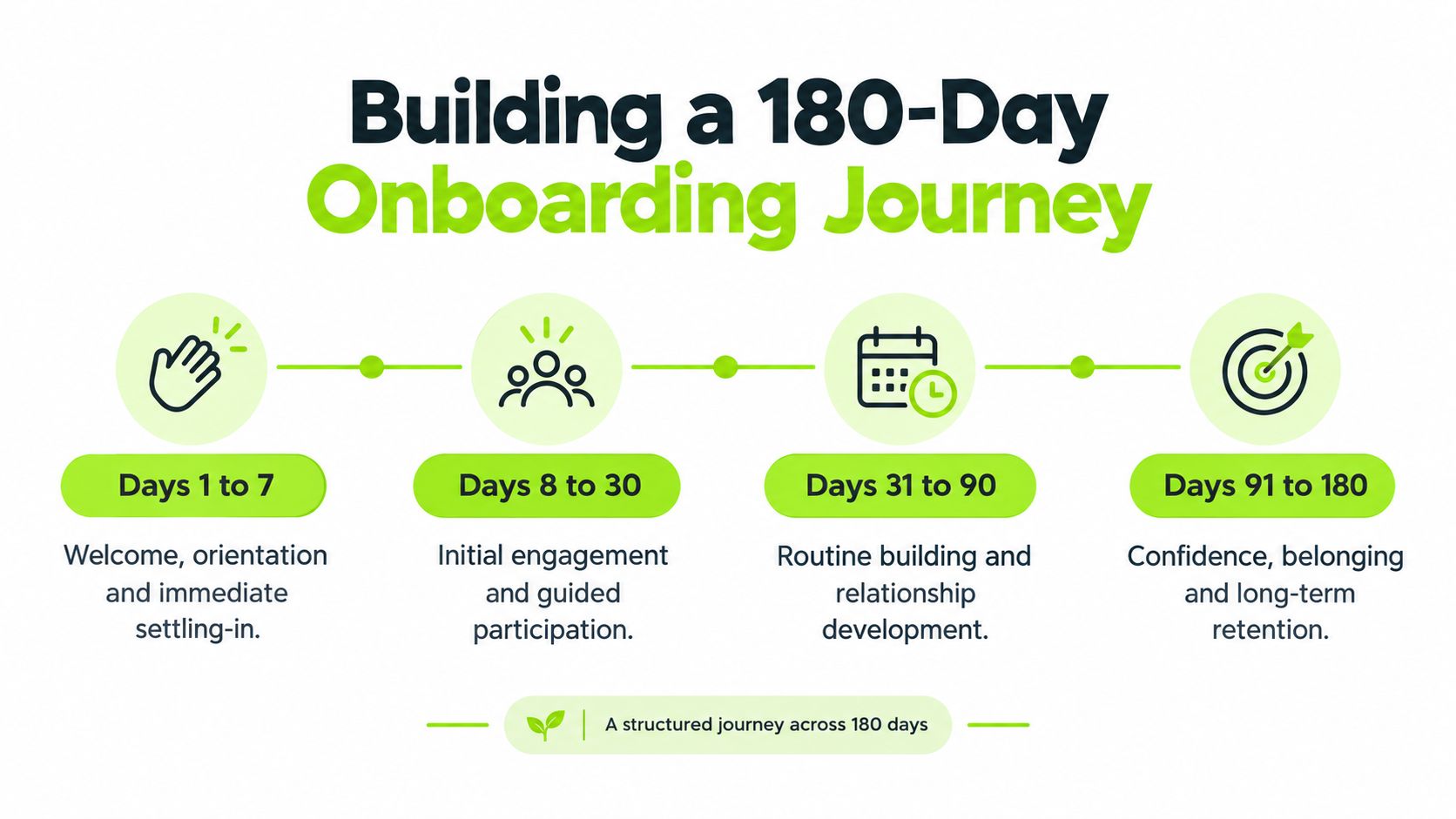
The first month starts the relationship. It does not finish it. Treat onboarding as a usage-and-integration journey across the whole first season: a member who has played, met people, and entered a competition by autumn is on the way to staying, while one who paid and vanished needs intervention long before the renewal letter arrives. The Golf Club Managers' Association recommends welcoming new members, introducing them to others, and giving them reasons to play, as set out in guidance on golf club membership retention.
A strong first fortnight can still fade if nobody invites the member back in month three.
Four checkpoints and what to record
Days 1 to 7 cover the welcome call, orientation, a named contact, and a plain explanation of how to get on the course. Record the call, who hosted the orientation, and whether the booking rules landed. If nothing is logged by day seven, make the call that week. A late hello still beats silence.
Days 14 to 30 are about proof of play. Check that a round or a booking exists and arrange at least one suitable playing introduction. No round and no booking by day 30 means the office phones that week, in person rather than by another generic email.
Days 60 to 90 move the member from a hosted start into club life. Invite them to a competition they can enter, a roll-up, or a social. Record who attended, because an invitation accepted and never used still counts as a miss. If the file shows no social connection at day 90, assign a named person to create one.
Days 150 to 180 are the renewal rehearsal. Review rounds played, events attended, and whether the member intends to stay. Falling usage before the renewal letter warrants a direct conversation about what would keep them playing.
Why the first season still needs management
A 180-day window exists because habits take longer than a welcome week to form. The member who has played regularly, met people, and learned how competitions work is on the way to being retained. The member who paid in spring and stopped booking is still at risk in autumn, even if the summer looked fine on paper.
When tee times and competition entries are under pressure from rising membership, these checkpoints also protect the existing club. Every roll-up place and reserved induction round costs a full member something, so each stage has to justify itself. You are checking that the access you promised was used, and stepping in while there is still a relationship worth saving.
Measuring Whether Your Onboarding Is Working
Most clubs discover a failed onboarding when the resignation arrives. By then the complimentary round is a memory and the professional introduction never became a second game. A small dashboard, reviewed monthly, shows the risk while there is still time to act.
Track join date, membership category, first booking, first round, event attendance, introductions, communications, and renewal outcome. Add first-90-day utilisation, unsuccessful booking attempts, and renewal intent. Failed bookings matter as much as rounds played. They show whether the member tried and could not get on, which is an access problem, not a motivation problem.
| Checkpoint | What should happen | Intervention trigger |
|---|---|---|
| Day 7 | Welcome call, orientation, named contact, booking rules explained | No welcome logged |
| Day 30 | First booking or round, plus one playing introduction | No play and no booking |
| Day 90 | Invitation accepted to a competition, roll-up, or social | No social connection recorded |
| Day 180 | Usage, satisfaction, and renewal intent reviewed | Usage falling before renewal |
Use a survey, then read it by segment
England Golf's Players 1st programme treats the welcome, personal attention, and integration as the onboarding touchpoints that count. Across participating English clubs, the average Member Experience survey response rate was 59%, from more than 28,000 responses collected since the programme began in May 2021, as noted when England Golf and Players 1st renewed their retention support.
Ask new members, after the first month and again before renewal, about first contact, introductions, competition access, and whether club services made sense. Compare the answers with what you promised before payment. A healthy club-wide score can still hide trouble among younger members or flexible categories, which is the same pattern that shows up in early golf club churn.
A monthly habit a small team can keep
Once a month, the manager or secretary should sit with whoever owns membership and look at three lists: joined in the last 30 days with no round, joined in the last 90 days with no introduction, and coming up to renewal with falling use. That meeting needs an owner and a date, not a new software project.
The same discipline that finance teams use when aligning sales and finance reporting applies here. If the office, the professional, and the committee are looking at different versions of "how new members are doing", you do not have a measure. You have three opinions.
Turning Onboarding Into a Repeatable System
Goodwill onboarding works until the professional is teaching, the secretary is in a committee meeting, and the new member's name lives in someone's head. The member does not experience "we meant to call". They experience silence.
Two ways clubs actually run this
Informal goodwill relies on memory. The pro knows a few new faces. A captain says hello on a Saturday. Nobody can say, on a Tuesday, which April joiner has not played. It feels personal, and it fails as soon as volume rises or a key person is off.
A recorded system logs join date, category, first round, introductions, and check-ins, then prompts the next action when a date passes. The welcome can still be human. The memory is not.
The failures we see most often are ordinary. The welcome email is treated as the whole process. Nobody checks that the first round happened. Every category, from junior to country member, gets the same journey even though their barriers are different. Staff are busy, so the second and third contacts never leave the to-do list.
A workable setup does not need a large commercial team. It needs one place where a new member's record shows the next action, and a rule for who acts when that action is overdue. GolfRep's golf club CRM approach is one way clubs do this: interests captured at application, follow-up prompts through the early months, and the same record used after sign-up that was used to win the member. Other clubs build the same checkpoints in the system they already run, provided someone owns the overdue list.
A process that depends on one person remembering is not a process. It is a favour the club hopes will be repeated.
Acquisition without this record creates a joining spike and a resignation spike. Retention work that starts only at renewal misses the months when the habit was supposed to form.
Making Onboarding a Retention Advantage
Every club in that benchmarking picture worked to win its joiners. The clubs that keep them are the ones that manage what happens after the payment, especially when the tee sheet is already under pressure.
The journey is straightforward once it is written down. Set access and handicap expectations before the fee is taken. In the first month, make the call, do the orientation, introduce the professional, and name a contact. Across 180 days, check play, make a social or competitive invitation, and review renewal readiness against actual use. Measure it monthly, by segment, so a comfortable average does not hide the members who are already halfway out.
This week, list everyone who joined in the last 90 days. Mark who has a recorded first round and who has a named contact. Anyone with a blank against either name is the intervention list, and it will be shorter and more useful than another debate about welcome gifts.
The same logic that sits behind longer client relationships in other sectors, which AI Optimization Services explains agency loyalty as a pattern of staying because the work keeps being useful, applies to members. People stay when the club keeps giving them a reason to come back, not when the joining pack was handsome. That is the commercial point of retention marketing for a golf club: the second and third years are where the cost of winning the member is repaid.
GolfRep works with golf clubs on acquisition, follow-up, and retention as one commercial system, including how new members are tracked after they join rather than only before they pay. If you want to see where members drop out in the first season and what to change first, start with GolfRep.
Ready to tap into our proven growth system?