How to Run a Golf Club Member Referral Programme

Member referrals were already used by 90% of members' clubs in the 2016 survey of UK members' and proprietary golf clubs, and 72% of members' clubs judged referrals the most successful marketing method in that same survey. That long history matters. You're not asking members to adopt a new behaviour, you're formalising one they've always had, then protecting your joining fee, your subscription and your renewal rate while you do it. A golf club member referral program should therefore be judged like any other acquisition route, on paid joiners, first-year contribution and retention, not on the number of names a member mentions at the bar.
Why Referrals Need a Commercial Design
Referrals are normal in UK clubs. What's missing in most clubs isn't goodwill, it's a record the office can trust.
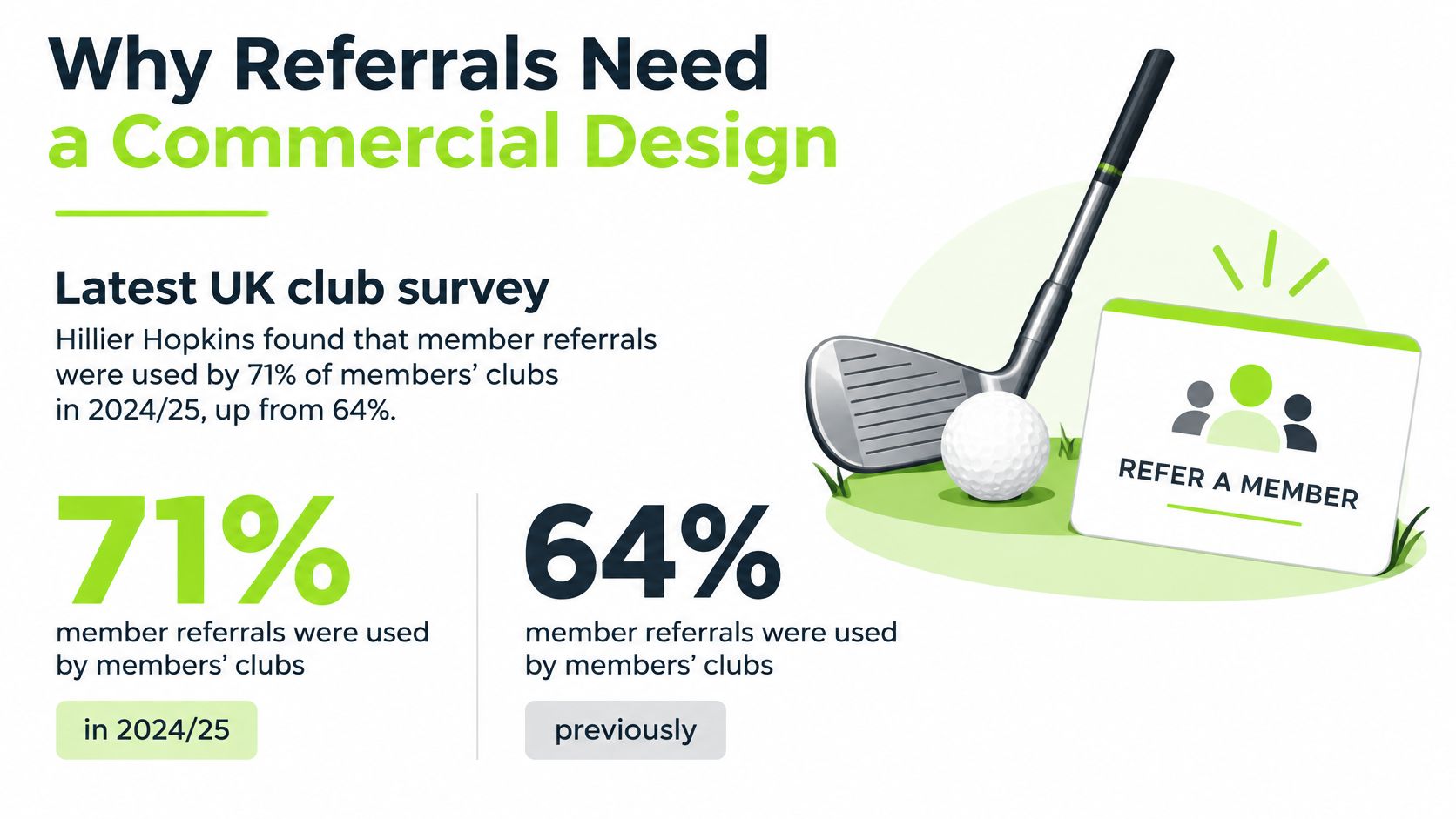
The Hillier Hopkins 2024/25 golf clubs report found that member referrals were used by 71% of members' clubs in 2024/25, up from 64% in 2023, making them the most utilised marketing activity. That makes referrals mainstream, not experimental. If your club has no structured scheme, you're not avoiding referral marketing. You're running it informally, with no control over who gets thanked, who gets followed up and which introductions turn into income.
Joiners Alone Don't Prove Growth
The same 2024/25 report recorded an average of 75 joiners per members' club in 2024, broadly similar to 73 in 2023. It also reported that 59% of members' clubs had more than 600 playing members, compared with 56% in 2023. Read those figures together and the lesson is clear. A healthy joiner count doesn't guarantee growth if leavers rise, if new members don't renew, or if your waiting list isn't being worked properly.
That report also found an average of 21 people per club moved from waiting lists into membership at the last renewal. A referred golfer who can't join today isn't a failed referral. He's a pipeline name for the next renewal window, provided someone keeps the relationship warm and the record accurate.
Practical rule: If the office can't pull up the referrer, the date, the visit and the decision in one place, you don't have a programme. You have a rumour.
What a Commercial Design Actually Means
A commercial design turns a friendly introduction into five logged events. A named referrer makes a dated introduction. The prospect gives consent, books a visit, makes a joining decision and either reaches or misses first renewal. Each stage has an owner in the office, not just in the locker room.
That structure protects three things committees care about. First, price, because the reward is defined before anyone negotiates at the counter. Second, fairness, because the earliest logged referrer wins and staff don't have to arbitrate disputes from memory. Third, value, because you can separate a member who introduced a playing partner who stayed for five years from a member who supplied a list of casual contacts.
Digital tools can support that discipline without changing the principle. Even outside golf, a well-run chatbot platform referral program shows the same basic mechanic worth borrowing, a tracked link or code tied to one referrer and one qualifying outcome. For a golf club, the equivalent is simpler, a short office form, a named card or a tracked landing page that feeds one CRM record.
Don't launch with a poster. Launch with a one-page set of rules your secretary, professional and bar team can all apply the same way. The reward, the exclusions and the review date come first. Promotion comes after.
Reward Triggers and Rules That Protect Joining Fees
The reward decision determines everything else. Get the trigger wrong and you'll either discount golfers who would've joined anyway or create disputes your office can't settle.
The question to answer first is whether you reward acquisition, retention or both. The Hillier Hopkins Golf Clubs Survey Report 2025/26 found that member referrals were the most successful marketing method for 55% of UK members' clubs in the 2025/26 survey, while members' clubs averaged 81 joiners in 2025. Success at the front door still doesn't tell you whether the referred member stays active, renews, or would have joined without an incentive. That's why a milestone model beats a flat sign-up discount.
| Model | Pays when | Published example | Price protection |
|---|---|---|---|
| Category voucher | After the contract is complete and all joining fees are paid, form must pre-date joining | Celtic Manor membership referral offer gives £500 and six guest passes for a Twenty Ten Membership, £200 and six guest passes for a Championship Membership, or £100 and six guest passes for a Young Adult, Country or Health Club Membership | Expires in 3 months, not cash, cannot pay subscriptions or joining fees, no juniors or discounted offers |
| Staged clubhouse credit | £100 when the application is approved and the first payment is made, £150 after renewal is confirmed and the first renewal payment is in | Crondon Park Golf Club membership referral scheme, referrer must already have 6 months' membership | EPOS balance only, written referral before application, earliest referrer wins |
| Milestone playing benefit | After a completed taster, then after paid membership, then at 6 or 12 month renewal | Guest passes or clubhouse credit sized below that product's annual value | No reduction in joining fee or subscription |
| Sign-up discount only | When the joining form is signed | A reduced joining fee or a free month | Weakest protection, pays for golfers who may have joined anyway |
What the Published Terms Teach You
Celtic Manor's strength is precision by category. A premium product carries a larger voucher because its annual value justifies it, and a lower value category carries a smaller one. The referral has to arrive through the official form before the new member joins and it can't be backdated. Only paid full annual memberships or memberships paid by Direct Debit count, junior memberships and discounted offers are excluded, and benefits activate only after the contract is complete and joining fees are paid.
Copy that discipline even if your values are smaller. Define the qualifying products in writing. State that vouchers aren't cash, can't be set against subscriptions or joining fees, and expire on a fixed date. If you're reviewing your wider tariff at the same time, align the scheme with your position on golf club membership fees so the referral reward never becomes a second price list.
Crondon Park adds the retention trigger most schemes lack. The first reward lands as clubhouse balance only after approval and initial payment. The larger second reward waits until renewal is confirmed and the initial renewal payment has been made. The referral must be in writing before the prospect applies, the prospect must name the referrer during the application, and if several members claim the same person the first referral received qualifies.
That structure changes member behaviour in a useful way. The referrer has a reason to keep playing with the new member, introduce them to a group and check they're settling in. You're no longer paying solely for a signature. You're sharing a modest part of the value only when the club has banked it.
Don't discount the joining fee to buy introductions. Pay in guest passes, range credit or clubhouse balance after the money has cleared, and keep the published tariff intact for everyone.
Our Recommendation for Most Private Clubs
Use three milestones and keep the values modest.
- Completed taster: Thank the referrer with a guest pass or a small clubhouse credit once the prospect has played. This rewards a real visit, not a name on a list.
- Paid membership: Pay the main reward only after the joining fee and first subscription payment have cleared. Size it by category, with full playing membership at the top and flexible membership capped lower.
- Six or twelve month retention: Hold back part of the reward until renewal or a defined retention point. That's the element that turns a golf club member referral program into a profit and retention scheme.
Avoid a straight joining fee discount. It trains members to wait for a deal, annoys members who paid in full last season, and gives away margin before you've seen a single round played. A low-cost playing or social benefit often does more good because it gets the new member onto the tee sheet and into the clubhouse earlier, where belonging is built.
Referrals Beyond Your Own Members
Keep society organisers, coaches and corporate contacts outside the member scheme. Their incentives, tax position and relationship with the club are different, and mixing them into one set of terms invites argument.
If you do use third party introducers, copy the discipline in the Golf Sherpa referral terms, which pay £50 for bookings involving six to 15 golfers and £100 for bookings involving 16 or more, per completed booking rather than per golfer. Under those terms a referral qualifies only when the customer is new, the introduction happens before contact or booking, the booking is fully paid and the trip or event has taken place. Cancelled, shortened, incomplete or unpaid bookings don't qualify, and self-referrals and existing clients are excluded.
That's the right commercial instinct for membership too. New means new. Recorded before the sales conversation means recorded before. Paid means paid, not promised.
Exclusions to Approve Before You Ask Anyone
Put these on the one page your committee signs.
- No self-referrals: The prospect can't refer himself, and a spouse joining from the same household should be treated under one household rule.
- No open enquiries: Anyone already in an active membership conversation, on a trial or on the waiting list isn't a new referral unless the manager agrees an exception in writing.
- No backdating: If the form arrives after the application, it doesn't count. Say so plainly and enforce it for the captain as firmly as for a new member.
- One reward per new member: The earliest logged referrer wins. Multiple claims don't split the reward.
- No payment for failed business: Cancelled visits, unpaid joining fees and lapsed Direct Debits pause or cancel the reward.
- Category limits: State whether juniors, trial memberships, discounted offers and flexible categories qualify, and at what cap.
- Staff and committee clarity: Decide whether employees and committee members can earn rewards, and record the decision before launch.
Ask the committee to approve this page before a poster goes up in the clubhouse. It's much easier to defend a rule that was agreed in advance than to invent one during a dispute in the pro shop.
How to Launch a 90-Day Referral Pilot
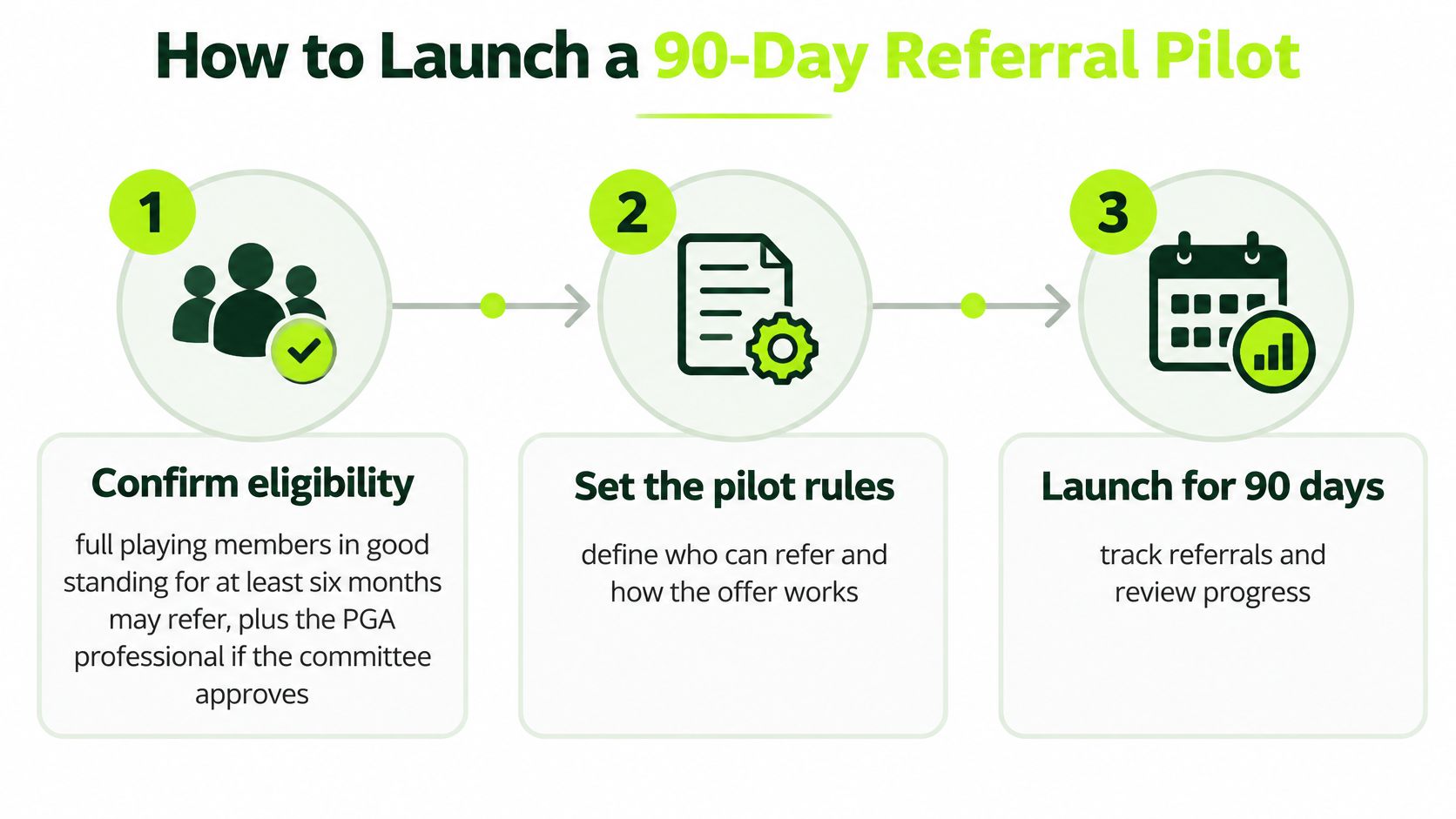
Run a pilot, not a permanent scheme. A defined 90 day test with one incentive and one review date gives your committee evidence instead of opinions.
The Seven Steps in Operating Order
- Confirm eligibility: Limit referrers to full playing members in good standing with at least six months' membership, plus the PGA professional if the committee agrees. The prospect can never be his own referrer. Six months matters because a settled member introduces people who fit the club, not people he met last week.
- Choose who to ask first: Start with regular competition players, socially active members and members who joined in the last two years and still remember why they chose you. Ask after a strong round, a competition or a visitor fourball, when goodwill is high. A blanket email to the whole membership produces polite silence.
- Issue one tracked route: Use a named card or a short office form, not three different routes. Log the referrer, prospect, date and consent the same day. A simple record inside your CRM for golf clubs beats a notebook behind the bar because the follow-up owner and next action stay visible.
- Get explicit consent: Don't store or pass on a prospect's phone number or email until that golfer has agreed to be contacted. The member should warn his friend first, or better, let the friend complete the form himself and name the referrer.
- Book the visit before discussing reward: The office owns the next contact and offers a taster or introductory round at a specific time. Talk about the course, the group he'll play with and where to park. The voucher conversation can wait until he's visited.
- Pair the prospect with a person: Give him a Golf Buddy or a named member for the first round, an introduction to a suitable roll-up or group, and one invitation to a club event. Integration starts before the joining form, not after it.
- Run one incentive against a comparison: Keep the same reward for the full pilot and compare referred joiners with joiners who arrived by other routes. Review monthly on introductions, visits, joiners and reward cost, then judge the whole pilot at day 90.
Integration Is Part of the Offer
England Golf's Golf Buddies guidance describes volunteer Golf Buddies as a way for clubs to welcome new golfers and help them integrate with existing members. That relationship-led approach does work a discount can't do. A newcomer learns how to book, where competitions are posted, which group suits his standard and what happens in the clubhouse afterwards.
Design the pilot for golfers who don't already resemble your confident core membership. Pair beginners, women returning to golf, juniors, disabled golfers and socially hesitant prospects with a buddy for the first visit. Say plainly whether loan clubs are available, whether a handicap is needed, what to wear and who'll meet them on arrival. For juniors, route everything through your safeguarding process with a parent or guardian involved from the first contact.
Track those prospect types separately in the pilot log. You'll quickly see whether your golf club member referral program reaches beyond friends of existing members or recycles the same social circle.
A waiting list name shouldn't be dropped because he can't join this month. Keep him on the list, invite him as a guest where your rules allow, and contact him first at renewal. For a beginner, a supported first session with the professional usually matters more than any discount.
The pilot ends with a contribution test, covered in the numbers below. Don't extend it by default just because members enjoyed the guest passes.
Numbers That Show Whether Referrals Pay
Scale the scheme only when two conditions hold. The referred cohort must show a positive first-year contribution after reward cost, and it must retain at least as well as non-referred joiners. If either test fails, fix the weak stage before you increase the incentive.
That rule keeps the committee conversation honest. A busy pilot with plenty of introductions can still lose money if the visits don't convert, the rewards are too generous for the category sold, or the new members drift away before renewal. Volume is the easiest number to produce and the least useful on its own.
| Measure | What to record | How to read it |
|---|---|---|
| Introductions | Referrer, date, consent and prospect type | Volume alone is not a success |
| Visits | Taster or introductory round booked and attended | Shows the introduction was real |
| Paid joiners | Product, joining date and fees cleared | Count only memberships that have been paid |
| Reward cost | Amount due and amount already paid | Include liability that has not been claimed yet |
| Cost per joined member | Reward cost divided by paid joiners | Compare with the club's other acquisition routes |
| Time to join | Days from the logged introduction to cleared fees | A long gap may be a waiting list, not a failed ask |
| First-year retention | Still a member at renewal, set against non-referred joiners | Scale only if retention is at least as strong |
| Early activity | Playing or visits at 30 and 90 days | Early fade means fix onboarding before raising the reward |
How to Build the Monthly Record
For every referral, capture the referring member, the product asked for, the first contact date and the time to first reply. Add whether the visit happened, the joining date, and whether the new member was active at 30, 90 and 365 days. A clean spreadsheet works for a pilot if one person owns it and updates it weekly.
Read the table from left to right as a funnel. Introductions tell you whether members are willing to ask. Visits tell you whether those introductions were genuine. Paid joiners tell you whether the membership conversation and the product itself are doing their job. Reward cost, including amounts earned but not yet claimed, tells you what the cohort really cost.
Divide total reward cost by paid joiners to get cost per joined member, then compare it with your other routes, open days, visitor conversion, and paid advertising. Having a proper view of customer lifetime value helps, since a slightly more expensive referred member who renews for years is worth more than a cheap joiner who leaves at the first renewal.
Time to join needs careful reading. A long gap can mean weak follow-up, but it can also mean the golfer sat properly on a waiting list or waited for the new subscription year. Separate those cases in the record so you don't blame the scheme for your own capacity rules.
When the Numbers Point Away From a Bigger Reward
If the join rate is healthy but 90 day activity is weak, don't enlarge the voucher. Spend the effort on the first round, the buddy introduction, a place in a suitable group and early-season contact from the office or professional. A bigger incentive would pay more for members who still fade.
That order is supported by Manchester Metropolitan University's England Golf-linked research on retaining golf club members, which identifies member experience, club ethos and engagement as central retention mechanisms, and reports one participating club growing membership by more than 8% over two years after improving its retention approach. Belonging keeps members. A voucher only thanks the person who introduced them.
Don't use a national adoption figure as your conversion target. It tells you how many clubs run referrals, not how many of your referred visitors should join. Your own baseline comes from your last two seasons of visitor and enquiry conversion, read alongside this pilot.
A one-page monthly pack is enough. Four counts, introductions, visits, paid joiners and leavers from the referral cohort, plus reward liability still to fall due.
Give that pack to the manager and the committee on the same date each month. When a referred member doesn't renew, record the reason in the same place and feed it back to the referrer profile. Some members consistently introduce golfers who fit and stay. They're the members to ask again next season.
Approve One Category and Review at Day 90
The decision in front of your committee is narrow. It isn't whether referrals are a good idea in principle. It's whether one defined scheme, on one membership category, brings in suitable members at a cost that leaves the joining fee and subscription intact, and whether those members are still playing after the first renewal.
A large sign-up discount can make a board report look busy while giving away margin on golfers who were going to join anyway. It also teaches your membership to wait for the next deal and devalues what loyal members paid. A milestone golf club member referral program avoids that trap because the club only shares value after a visit has happened, fees have cleared and, ideally, a renewal has been banked.
The Work for the Coming Month
- Pick one category: Start with full playing membership, or the category where you have genuine capacity and the clearest capacity to absorb new members well.
- Write three reward points: Set the benefit for a completed taster, for paid joining and for the first renewal, sized to that category's annual value.
- Approve the exclusions: No backdating, no self-referrals, no open enquiries, earliest referrer wins, one reward per household.
- Diary the review: Put the day 90 review in the calendar now, with the monthly pack as the only evidence required.
If new members fade before they settle, spend the next quarter on the handoff rather than on a louder poster. We recommend that handoff includes a welcome sequence, a member buddy if your club uses one, and clear touchpoints at 30, 60 and 90 days. A clean transfer from the membership conversation to the member experience protects retention and makes the original introduction feel professionally managed by everyone involved, including the referrer who put his name to it.
Referrals won't replace visitor golf, open days or your other demand routes, and they shouldn't be asked to. They work best as one disciplined channel inside a wider system that attracts, nurtures, converts and retains. Different clubs have different bottlenecks, and the honest question is whether referrals are yours.
GolfRep works only with golf businesses, on acquisition through to retention. A conversation is worth having when an outside view of whether referrals, visitor golf or the membership conversation is your current constraint would change a decision you're about to take. If it wouldn't change anything, run the pilot first and let your own numbers speak.
If you'd like help designing a referral pilot that protects your joining fees and proves its value at renewal, GolfRep offers a proven growth system for UK golf clubs and invites you to book a call to see if we're a good fit. Visit GolfRep to start that conversation and map where referrals sit alongside your membership, visitor and society income.
Ready to tap into our proven growth system?