Building a Golf Club Follow Up System That Converts
You've had the enquiry. The website form came in, the phone rang after lunch, and a member mentioned a friend who's interested in joining. By Monday morning, the details are scattered across inboxes, a notebook, and someone's memory, and the lead that looked promising on Friday is already cooling.
That's the issue for most clubs. It's not a lack of interest, it's a lack of ownership, speed, and visibility. A proper golf club follow up system turns every enquiry into a tracked process, so the club knows who owns it, what happened next, and whether it moved any closer to a booking or membership conversation.
Why Follow Up Is the Main Bottleneck for UK Golf Clubs
Most UK clubs do not lose prospects because the enquiry was weak. They lose them because no one takes charge quickly enough, especially when a message lands on a Friday evening, a bank holiday, or during a busy shift in the office. GolfRep's guidance is blunt on this point, responding within five minutes can increase contact rates exponentially, and clubs should track lead contact rate and pipeline velocity so they can see how long a new enquiry takes to convert.
That matters because most clubs still receive interest through several channels at once. A phone call gets logged by one person, a web form lands in another inbox, and an email sits unread until the next working day. If there is no shared workflow, the enquiry is technically received but operationally invisible.

Defining a follow up system
A follow up system is not just a sequence of emails. It is a repeatable operating process that acknowledges every enquiry, assigns it to someone, and triggers the next action without waiting for a person to remember it later. GolfRep describes the core logic clearly, immediate acknowledgement, internal ownership, and no delay between the enquiry and the next step.
Practical rule: if an enquiry can sit in an inbox without a named owner, it is not in a system yet.
The first questions every enquiry should answer straight away are simple. What does the prospect want? Where did they come from? What can we send them? What should happen next? If your club cannot answer those four questions within minutes, the enquiry handling process is leaving money on the table.
That is why follow up matters more than more spend in many clubs. You can generate more names, but if the response is slow, fragmented, or inconsistent, the extra interest just increases the amount of leakage. A basic CRM, like the one described in GolfRep's CRM system overview, only helps if someone owns the next step and uses it properly.
A club also needs to connect the operational process to the outcome it cares about. If the aim is to improve conversion, the team should look at the same kind of funnel discipline used in this sales funnel optimization guide and apply it to phone calls, emails, and web forms. The problem is rarely a lack of interest. It is a follow up process that depends too much on memory, availability, and whoever happens to be on shift.
The Core Components of a Modern Follow Up Stack
A strong golf club follow up system starts at capture and ends at booking, with nothing left to chance in between. GolfRep's model breaks the stack into four connected parts, lead capture, CRM, communication tools, and operational booking systems (GolfRep on automated follow up). That order matters, because if the capture step is messy, everything downstream becomes harder to trust.
Start with capture, not clever messaging
The first job is to make sure enquiries land in one place, with the right details attached. That means web forms, phone notes, email enquiries, and even walk-in follow ups should all feed into the same shared workflow. If a club still relies on a single inbox and a few paper reminders, it will always be one busy day away from dropping something important.
The next layer is the CRM, because that's where the club decides what each lead is and what happens next. GolfRep's framework classifies by intent, source, sales stage, and consent status, then routes the enquiry into email, SMS, or task automation. That makes the enquiry visible to the team and stops every prospect from getting the same generic treatment.
Then connect communication and booking
Communication tools should not sit apart from the CRM. Email and SMS need to be triggered by the lead's status, not by someone manually remembering to send a message later. Booking systems matter because the end point is rarely “send a nice email”, it's a visit, call, lesson, society enquiry, or membership conversation.
For a good reference on how pipeline thinking works outside golf, the sales funnel optimization guide is useful because it reinforces the same principle, the process needs visible stages, not guesswork.
A club CRM guide such as GolfRep's CRM system article is worth reading alongside this because the follow up stack only works when the data model and the workflow are aligned. If the CRM is tidy but the handoff process is vague, staff still end up chasing leads by memory.
One shared workflow beats three separate inboxes every time, because it gives the club one version of the truth.
Segmentation That Stops Sounding Generic
The quickest way to make follow up feel lazy is to send the same message to everyone. A visitor round enquiry, a membership prospect, and a society organiser do not need the same next step, because they're not looking for the same outcome. The simpler the club's database is, the easier it becomes to speak in a way that feels relevant instead of automated.
Segment by intent, source, and stage
The most useful fields are the ones staff can maintain. Intent tells you whether the lead wants membership, a visitor round, lessons, or a society day. Source tells you whether they came through paid search, referral, social, or organic traffic. Stage tells you whether the enquiry is new, in nurture, booked, or post visit.
GolfRep's segmentation advice is practical because it focuses on what the club needs to know, not on collecting data for its own sake (GolfRep on market segmentation). The aim is not to build a giant scoring model on day one. It's to stop mixing up different types of prospects and sending them down the same path.
Keep the rules simple enough to run
A general manager or membership secretary can usually maintain three broad tracks without needing a marketing department. New leads get fast acknowledgment. Warm leads get a follow up task and a light nurture sequence. Booked prospects get confirmation and reminder messages.
The mistake is not under-segmenting. It's over-segmenting before the club has enough volume, which creates admin without improving the conversation.
Consent also sits inside segmentation, because clubs can only send certain types of messages to certain contacts. That means the database needs to distinguish between someone who asked a question and someone who agreed to receive marketing. If that distinction is blurred, the club's communication gets messy very quickly.
The cleanest clubs keep their segmentation rules short, written down, and visible to the people who use them. Once those rules are clear, the messages become easier to write and the follow up stops sounding like it was sent to a crowd.
Designing the First Forty Eight Hours After an Enquiry
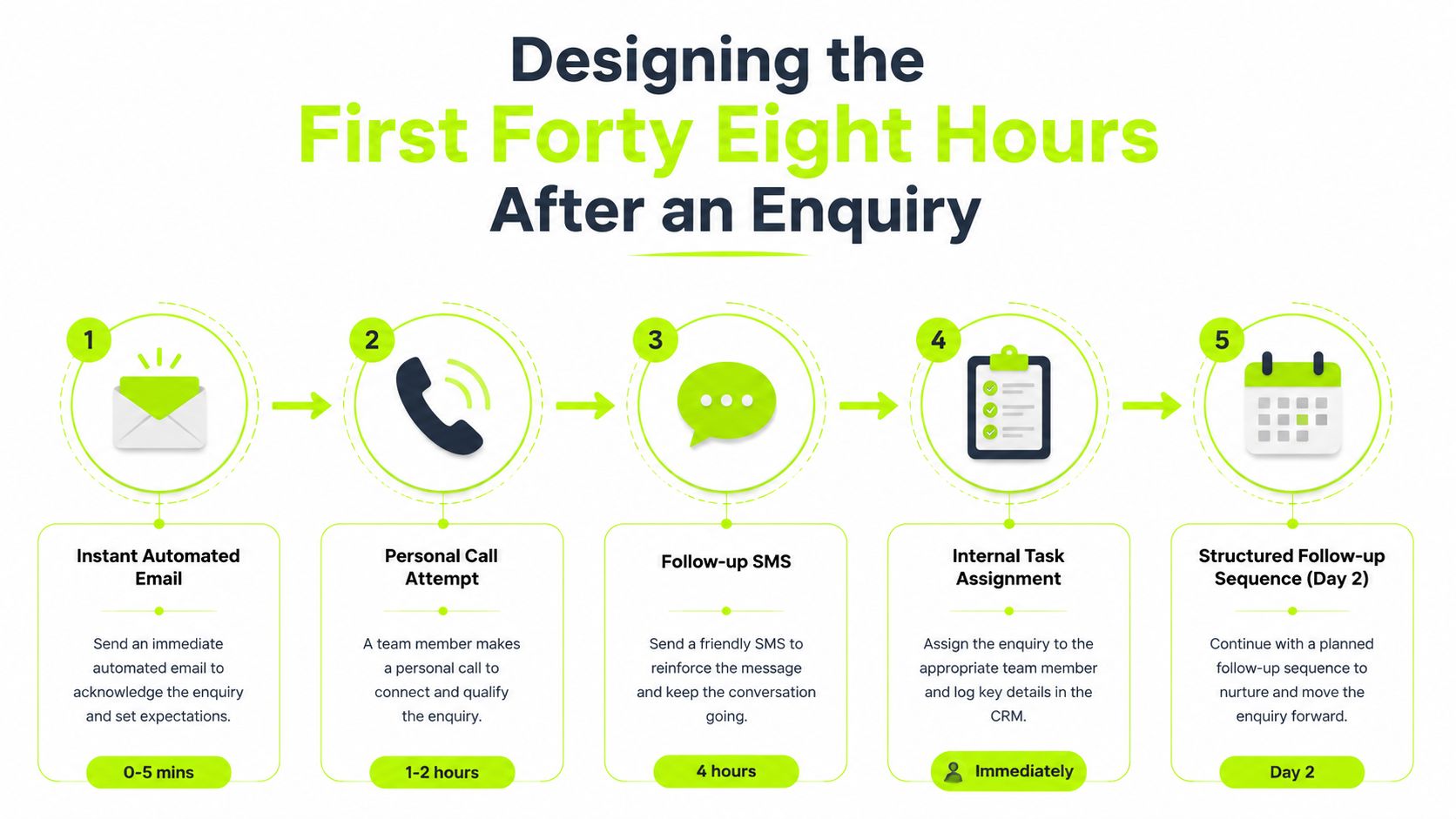
A strong enquiry journey feels calm to the prospect, even though a lot is happening behind the scenes. They submit a form, get an immediate response, then hear from a real person before the lead goes cold. GolfRep's speed to lead guidance is the right benchmark here, because early contact is where most clubs either create momentum or lose it (GolfRep on speed to lead for golf clubs).
A realistic enquiry sequence
A visitor round enquiry comes in at 7.30 pm on a Thursday. The club's system sends a short acknowledgement straight away. It should sound like the club, not a sales page.
Instant email example:
Thanks for getting in touch. We've received your enquiry and a member of the team will review it shortly. If you'd like to add any detail in the meantime, just reply to this email and we'll make sure it's passed on.
If the prospect has opted in, a short SMS can reinforce the message and let them know a person will follow up. The purpose is not to chase aggressively, it's to reassure them that the enquiry hasn't vanished into a black hole.
What the human handoff should look like
The next morning, a named staff member should see the lead, know what it is, and have a task attached. That task might be to call before lunch, send a brochure, or check tee-time availability. A thoughtful follow up email can then carry the conversation forward, and Breaker's article on tips for follow-up emails is a useful external reference for tone and clarity.
The key is that automation should support the handoff, not replace it. A club feels personal when the first human response uses the prospect's actual enquiry context, not a recycled template.
What happens out of hours
Out-of-hours enquiry handling needs to be written in advance. If nobody is in the office, the system still has to acknowledge the lead, create the task, and queue the next step for the next working slot. Weekend behaviour matters too, because that's when a lot of club research happens.
The best systems don't promise instant human contact every time. They promise immediate acknowledgement, clear ownership, and a sensible next action. That's enough to stop the enquiry from going cold before staff are back at their desks.
Compliance Consent and Keeping the Database Clean
A follow up system only works if it's defensible. Clubs that ignore consent, suppression, or privacy basics usually end up with a database they don't trust, and staff stop using it properly. The fix is not complicated, but it does need discipline.
Separate enquiry handling from marketing
Under UK GDPR and PECR, clubs need to be clear about what a contact agreed to receive. An enquiry response is not the same as ongoing marketing. A person asking about membership can be replied to about that enquiry, but that doesn't automatically mean they've agreed to receive general promotional emails or SMS.
That's why web forms should capture consent in plain language and store it alongside the enquiry record. The club should also keep a privacy notice that explains how data is used, and it should make unsubscribing easy in every marketing message.
Keep evidence, not assumptions
The most useful records are the simplest ones. Date of capture, what the person agreed to, how consent was obtained, and whether they later unsubscribed. If a committee member asks why a contact is in a nurture list, the club should be able to answer without searching through scattered inboxes.
A practical guide on how to get SMS consent can help teams understand how explicit consent works in text messaging, which is an area many clubs handle too loosely. The principle is straightforward, if the club cannot show clear permission, it should not send the message.
Clean data keeps the system usable
Suppression lists matter because they stop the club from contacting people who've opted out. Inactive records also need regular review, since old or incomplete data makes reporting less reliable and increases the chance of errors. If the database is messy, segmentation and automation both become less trustworthy.
Rule of thumb: if staff don't trust the records, they won't trust the follow up process either.
Committee-led clubs often get stuck here. One person assumes another is checking consent, and no one is really doing it. A short monthly audit is usually enough to expose gaps before they become a problem.
Measuring Whether the System Is Working
A golf club follow up system should be measured on outcomes, not activity. Open rates can be useful context, but they do not show whether the club is moving people towards a conversation, a booking, or membership. The commercial signals are simpler than most reports make them look.

The four metrics worth watching
Speed to lead shows how quickly the first response goes out. For a golf club, that matters because enquiries often arrive by phone, email, and web form at different times of day, then sit until someone has a spare minute. Contact rate shows how many leads are reached. Booking rate shows how many of those contacts become a visit, lesson, or next step. Pipeline velocity shows how fast leads move through the stages.
A useful extra check is how long it takes a new enquiry to convert. That highlights where the system slows down. If contact is fast but conversion is still weak, the problem is usually in the message, the offer, or the handoff rather than the first reply.
What good looks like in practice
The point is not to chase vanity numbers. It is to see whether the system keeps losing interest at the same point each month. If speed to lead is strong but bookings are weak, the follow up script or the offer may be off. If bookings are fine but pipeline velocity is slow, the team may be leaving too much time between touches.
Club managers can review these metrics weekly, then use the pattern to decide where to intervene. If one enquiry source converts better than another, the response path can be adjusted. If one staff member gets more replies, their language is worth copying into the rest of the process.
The single metric that usually matters most
When a club is struggling, the fastest improvement usually comes from cutting delay in the first response. That one change exposes every other weakness in the process, because it forces ownership, timing, and routing to become visible.
The strongest systems are not the ones with the most reports. They are the ones where a manager can open a dashboard and see, at a glance, whether enquiries are moving or stalling.
Rolling Out the System in Thirty Days
A working rollout does not need a full rebrand, a huge software project, or a new team. It needs a clear order of operations and one owner who is responsible for keeping it moving. Clubs usually fail here because the work gets spread across too many people, then paused while someone waits for committee sign-off.
Week one to week two
Start by mapping where enquiries currently arrive and where they get lost. Clean up the contact fields, define the enquiry categories, and decide who owns each type of lead. Then configure the CRM so every new contact is tagged and visible in one place.
The next step is to write the acknowledgement messages, the follow up task rules, and the handoff logic. Keep the language warm and specific to the club, not generic or over-polished.
Week three to week four
Once the structure is set, launch with one enquiry source first. That might be web forms, membership interest, or visitor bookings. A controlled rollout lets the team test whether the messages, timings, and tasks are working before the whole system goes live.
A short weekly check-in is usually enough during rollout. One person reviews the leads, another checks the responses, and the manager looks for missed steps or duplicate touches. That rhythm keeps the system practical rather than theoretical.
The usual reasons clubs stall
Changeover in committee roles can stop a rollout midstream. So can unclear ownership, reluctance to tidy the database, and the habit of treating follow up as a side job. If nobody is accountable for the process, the process disappears.
GolfRep's role in this kind of work is to help clubs build a predictable pipeline by combining lead generation with structured CRM follow up, rather than leaving enquiries to manual handling. For clubs that want a system they can run, the priority is not more noise. It's a clear workflow that every lead enters, every staff member understands, and every manager can measure.
If you want a practical review of how your club handles enquiries, GolfRep can help you map the current process, identify where leads are going cold, and build a follow up system that fits the way your team works. Visit GolfRep to see how structured follow up and CRM-led workflows can support steadier membership growth.
Ready to tap into our proven growth system?