Golf Club CRM Explained: Features, Costs and Rollout
A familiar pattern plays out in clubs across the UK. A membership enquiry sits in a shared inbox, the visitor history lives in the tee-sheet system, renewals are recorded in a spreadsheet that only one person fully understands, and the committee receives a report assembled manually before each meeting. Everyone is working, but nobody has the same view of the customer.
That's the point at which a golf club CRM becomes an operational decision rather than another software purchase. The right system should connect the full relationship, from first enquiry and waiting-list status to onboarding, renewal and possible resignation. This guide explains what a golf club CRM should do, how much of the implementation work sits with the club, which vendor questions matter, and how to judge whether the system is improving commercial performance.
Why Golf Clubs Outgrow Spreadsheets and Inboxes
The spreadsheet usually starts for sensible reasons. A club secretary needs somewhere to record prospective members, a manager wants a list of people to call, and a committee member creates a second sheet to track renewals. For a small club, that can appear perfectly workable.
The trouble begins when the same person appears in several places with different information. One record might show an enquiry as “open”, while an email thread suggests the golfer already visited. A member may have changed category, but the renewal sheet still shows the old status. Another prospect may be interested in joining when a waiting-list place becomes available, yet nobody has set a reminder.
The commercial cost of disconnected records
A spreadsheet can store information. It can't reliably manage responsibility, timing and next action across a team. An inbox can receive a message. It won't tell the membership secretary whether somebody else has replied, whether the prospect booked a visit, or whether the contact has already been approached by phone.
That distinction matters because clubs have several overlapping customer journeys:
- Prospective members need a clear path from enquiry to conversation, visit and application.
- Waiting-list contacts need relevant updates without being treated like cold prospects.
- Current members need onboarding, useful communication and renewal attention.
- Visitors and society organisers may become repeat customers or future members.
- Lapsed members need a reason to reconsider the club before the relationship goes cold.
These journeys often cross systems. The tee sheet knows that somebody played. The payment platform knows that an invoice was settled. The inbox knows that a question was asked. Unless those records connect, the club sees isolated transactions rather than a relationship.
Practical rule: If a staff member leaving the club would take important customer knowledge with them, the club doesn't have a reliable system of record.
A CRM won't solve every commercial problem. A weak membership proposition, poor course experience or unsuitable pricing still needs management attention. Its job is more specific. It gives the club one place to record the journey, assign ownership, trigger actions and report what happens between interest and recurring revenue.
The decision isn't whether spreadsheets are morally wrong. It's whether the club can still manage its customer base confidently with the systems it has. If staff spend time reconciling lists, chasing internal updates or rebuilding reports, the club has probably outgrown its current arrangement.
What a Golf Club CRM Actually Is
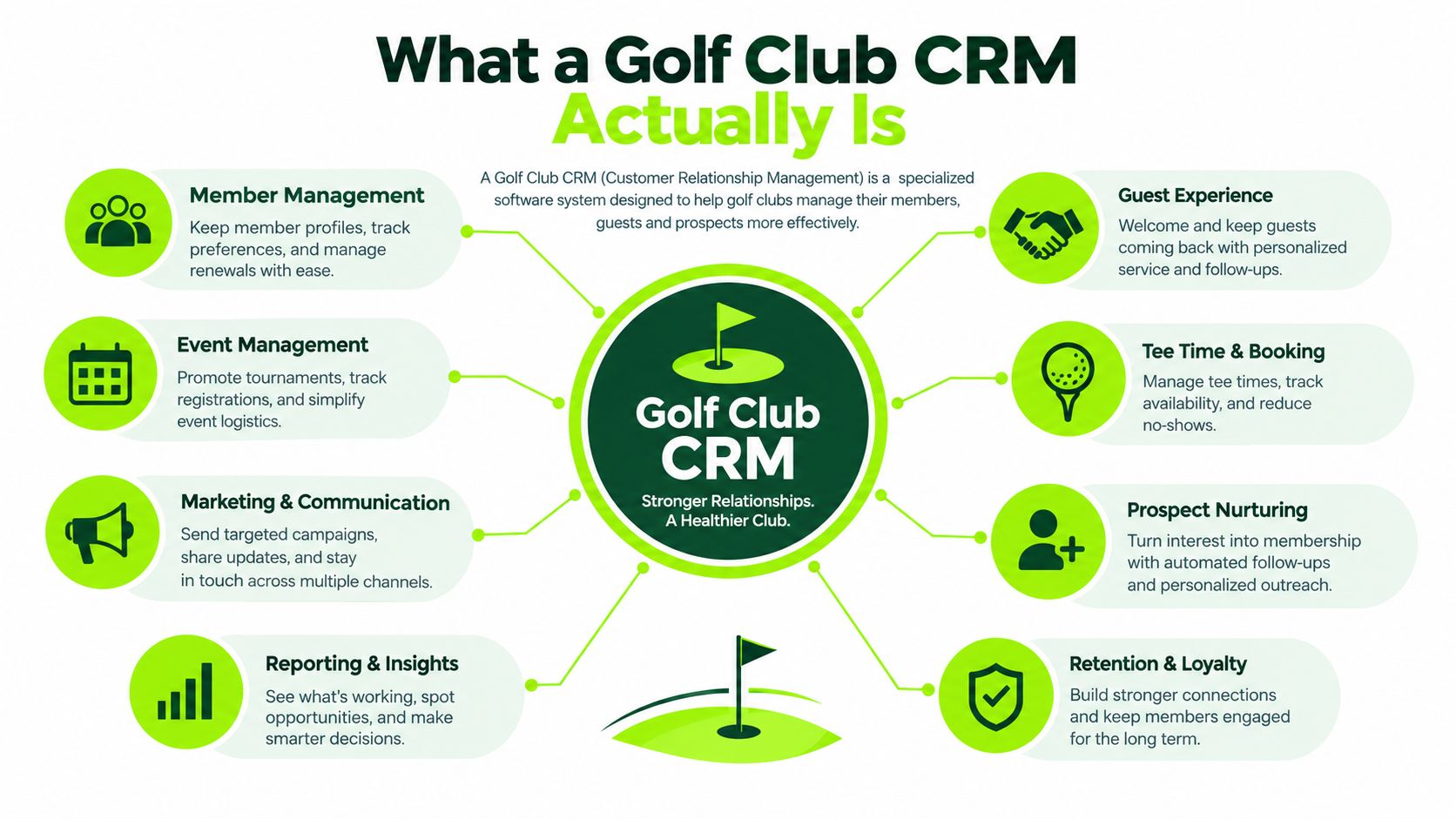
At 8.30 on a Saturday, the front desk may be handling arrivals, membership questions and a prospective member's visit at the same time. Staff need the customer's history, purpose, previous conversations and agreed next action without searching several inboxes or asking colleagues to reconstruct the story. A golf club CRM provides that shared operational memory across the club.
It is the system of record for a relationship from first enquiry through joining, participation, renewal, resignation or reactivation. That makes it more than a sales database. Used properly, it supports the full customer lifecycle, including waiting-list decisions and early signs that a member may not renew.
What it isn't
A contact database stores names, email addresses and perhaps a few notes. A CRM should show the relationship's current status, last interaction, next task, consent position and commercial outcome. Without those fields, staff still have to interpret the record themselves.
A tee-sheet system manages bookings and availability. It may contain useful customer information, but booking software alone does not manage a membership pipeline, waiting-list follow-up or renewal risk. The tee sheet and CRM should exchange data, not force staff to copy it between systems.
An email marketing platform sends campaigns and may report engagement. It does not, by itself, assign ownership of a sales stage, create a task for a membership visit or connect a prospect with a completed join. Treating campaign software as the club's operating system leaves important work outside the record.
The practical definition is straightforward:
- Capture the relationship wherever it starts, including website forms, referrals, telephone calls and conversations at the club.
- Organise the journey with statuses, tasks, notes and named ownership.
- Connect operational records such as bookings, payments, membership categories and renewals.
- Trigger appropriate action while leaving staff room for judgement.
- Report the outcome from enquiry source through to join, renewal or churn.
The operational case for golf club CRM systems is strongest when communications, bookings, payments and member activity sit in one connected view rather than separate spreadsheets.
A committee should be able to approve the purchase in one sentence: “This system gives us an accurate, shared view of every important customer relationship and the next action required.” “It sends emails” or “It stores members” describes a tool that is too narrow for the club's commercial job.
Core Features and Integrations That Matter
A vendor's feature list is less useful than a list of jobs the club must complete. Start with the work, then test whether the software supports it without excessive manual handling.
The minimum operational set
Membership management should cover categories, joining dates, dependants where relevant, renewal status, payment information and communication history. It should also handle waiting lists as active segments, not as a static document. When a place becomes available, the team should be able to identify suitable contacts, see their previous interest and record the outcome.
Pipeline management should make stages visible. A sensible starting structure is new enquiry, contacted, booked, visited and joined. Clubs may need separate pipelines for membership, societies, events and coaching, but each should have an owner and a defined next step.
Tee-sheet integration prevents staff from asking customers to repeat information the club already holds. If a prospect books a visit or plays as a visitor, the CRM should make that activity visible alongside the contact record. The integration doesn't need to replace the tee sheet. It needs to stop the tee sheet and CRM becoming competing versions of reality.
Payments and renewals matter because a commercial relationship doesn't end when somebody joins. The system should show the relevant membership plan, payment status, renewal date and outstanding action. Where self-service booking, competition entry, account top-ups or renewals are available, integration can reduce administration and make transactions easier for members, as outlined in UK golf's move towards connected club systems.
Automation should handle predictable actions, not replace judgement. An acknowledgement, appointment reminder or renewal prompt can be automated. A sensitive resignation conversation should remain with a person.
| Feature | What It Does for the Club | Commercial Outcome |
|---|---|---|
| Membership records | Keeps categories, status and history together | Fewer renewal errors and clearer member ownership |
| Waiting-list segmentation | Separates interested future members by readiness and eligibility | Better use of renewal-period opportunities |
| Pipeline stages | Shows where each enquiry or application sits | More reliable forecasting and prioritisation |
| Tee-sheet integration | Connects visits and bookings with contact records | Better visibility of customer value and intent |
| Payment integration | Links transactions and renewal actions to the relationship | Less administration and fewer avoidable gaps |
| Consent controls | Separates service messages from promotional communication | Safer multi-channel contact and cleaner records |
| Reporting | Connects sources, stages, joins and renewals | Decisions based on outcomes rather than anecdotes |
Compliance is part of the design
A service email confirming a booking or acknowledging an administrative request isn't the same as a marketing email promoting a membership offer. The CRM must make that distinction obvious, with consent fields and rules that staff can understand.
Sector guidance on golf club marketing automation and consent highlights the practical requirement. Operational messages should be able to go out when needed, while promotional communications use the correct consent position. Don't bolt this on after implementation.
For clubs reviewing their process, lead management CRM software is a useful comparison point, but the buying test should remain grounded in golf operations. Ask the vendor to demonstrate a real enquiry, a waiting-list update, a booked visit, a renewal reminder and a resignation risk record. A polished dashboard means little if those journeys require workarounds.
Implementing a CRM Without the Shelfware Trap
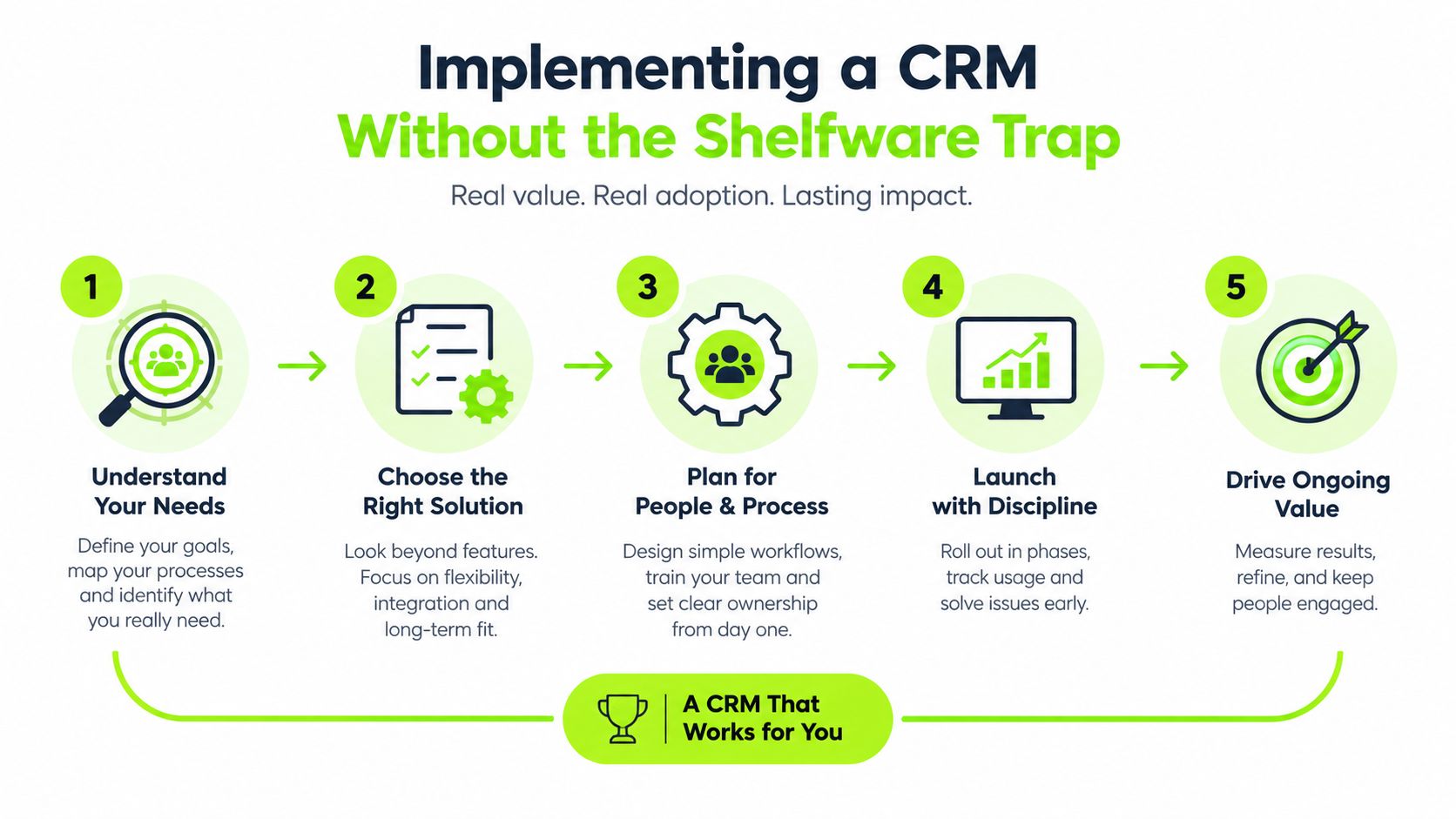
The club doesn't create value by signing the contract. It creates value by agreeing how people will use the system every day.
Start with a short data audit. Gather the membership list, enquiry spreadsheet, waiting-list records, relevant inbox exports, visitor information and renewal records. Remove duplicates, mark incomplete records, identify conflicting statuses and decide which fields the club needs. Importing every historic note creates noise and gives poor data a permanent home.
Build the process before configuring the screens
Agree the stages before asking a supplier to customise the system. For a membership pipeline, the core sequence might be:
- New enquiry, with source and consent position recorded.
- Contacted, with the responsible person and next action.
- Booked, when a visit, call or playing opportunity is arranged.
- Visited, with notes on suitability and interest.
- Joined, with membership category and joining date.
- Not proceeding, with a reason and possible reactivation date.
The stages should describe meaningful commercial events, not internal activity. “Email sent” is a task. “Booked” is a stage.
Assign ownership clearly. In a committee-led club, responsibility may sit with the secretary, manager, PGA professional or membership volunteer. That's fine, provided the record shows who owns the next action. A shared responsibility usually becomes no responsibility.
Make adoption a management decision
Choose one internal champion who can answer questions, check data quality and keep the process moving. Give staff a short working session based on actual club scenarios, not a generic software tour. Show them how to record a phone call, reassign a task, update a renewal status and find a waiting-list contact.
Set a response standard that the CRM can measure. It might apply differently to membership, societies and events, but it must state who acts, what counts as a response and when escalation happens.
A CRM that only stores contacts is an expensive spreadsheet. Log touchpoints, track response times and manage stages, or don't expect commercial insight.
Run the new process with a small, important workflow first. Membership enquiries are often a sensible starting point, but a club may have a bigger immediate constraint in renewals, society bookings or event enquiries. Migrate the relevant records, test the workflow, review adoption, then expand.
The committee should receive a simple implementation report: records cleaned, staff trained, stages in use, outstanding data issues and the first operational improvement observed. That keeps the conversation focused on behaviour and outcomes rather than licence features.
How to Choose a Vendor and Migrate Safely
The longest feature list rarely identifies the right system. The right system fits the club's current constraint, existing technology and ability to maintain the process.
A club with poor renewal visibility needs different evidence from a multi-site operator that needs shared reporting. A committee-led club may value simple ownership and clear tasks more than complex configuration. An indoor facility may prioritise bay bookings, coaching and repeat visits. Start there.
| Selection criterion | Question to ask | Evidence required |
|---|---|---|
| Existing integrations | Does it connect with the current tee sheet and payment provider? | A live demonstration using the club's likely workflow |
| Consent management | Can staff separate service and marketing messages? | Clear fields, permissions and example communications |
| Reporting | Can a committee understand the dashboard without technical support? | Sample reports for joins, renewals and pipeline stages |
| Support | Are UK-relevant support hours and ownership available? | Written support arrangements and escalation route |
| Total cost | What are the licence, migration, training and integration charges? | A complete written proposal, not a headline price |
| Flexibility | Can the club add categories, pipelines and custom fields sensibly? | Configuration demonstration with realistic club examples |
| Data access | Can the club export its own records? | Export format, ownership terms and exit process |
Ask for proof using your data
Don't accept a generic demonstration. Give the vendor a realistic scenario: a prospect joins the waiting list, receives an update, books a visit, becomes a member and approaches renewal. Ask the vendor to show every record, task, message and report created along the way.
Consent deserves its own test. Ask what happens when a contact can receive service messages but not promotional email. If the answer depends on staff remembering a manual workaround, the design is unsafe.
A migration should follow a controlled sequence:
- Export: obtain the legacy data in a usable format.
- Map: match old fields to the new system and agree definitions.
- Clean: remove duplicates and resolve contradictory statuses.
- Test: run enquiry, joining, payment and renewal workflows.
- Train: give each user role-based tasks to complete.
- Parallel run: use old and new systems together for an agreed period.
- Sign off: compare critical records before retiring the old process.
The club should also review relevant GolfRep case studies when assessing how commercial systems are applied in real golf businesses. The decision rule remains straightforward: choose the system that addresses the club's most expensive current constraint, not the one with the most impressive demonstration.
The KPIs That Show Whether Your CRM Is Working
A CRM report earns its place in the committee pack only when it changes the next action. Activity totals alone create noise. The useful report follows the member lifecycle, from first enquiry through waiting-list contact, joining, engagement and renewal risk.
Start with the pipeline. Track new enquiries, the stage of each active contact, response time and the share progressing to a visit or application. Set targets against the club's capacity and proposition. Compare movement between stages, rather than congratulating the team on a large enquiry total that produces few joins.
The measures that belong in the monthly pack
Response time shows whether staff act while interest is still current. UK golf industry reporting puts average membership-enquiry response time at 47 hours and 32 minutes, and reports that a lead answered within one hour was five times more likely to convert than one left for 24 hours. The figures appear in UK golf club CRM guidance on response and conversion. Treat that evidence as a prompt to measure your own process, not as a promise that every club will achieve the same result.
Enquiry-to-join conversion by source separates productive channels from channels that merely generate attention. Show the source, enquiries, visits, applications and joins together. A high-volume source with few joins needs a review of its message, qualification and follow-up before the club increases spend.
Waiting-list conversion needs its own measure because a waiting list is an active commercial pipeline, not a filing cabinet. The 2024/25 Hillier Hopkins survey reported that 59% of clubs kept waiting-list contacts informed, while an average of 21 members at each club moved from the waiting list into membership at the last renewal. The findings are discussed in UK golf club membership and waiting-list analysis. The CRM should record who was contacted, when, under which status and with what outcome.
Renewal and resignation indicators should combine member status with behaviour. Fewer rounds, reduced interaction or unresolved service issues can signal a member who needs a personal conversation. The system can flag the pattern, but staff must establish the reason and record the outcome.
Revenue per member connects activity to commercial value. Include membership revenue and, where reporting is reliable, relevant secondary spend. Use the measure to compare member groups, categories and journeys, not to rank individual members.
A committee-friendly report
Present one page each month:
- New opportunities and current stages.
- Response time and overdue tasks.
- Joins, resignations and renewal position.
- Waiting-list contacts becoming eligible.
- At-risk members needing personal action.
- Revenue movement by membership category or source.
- Data-quality exceptions, including missing owners or consent fields.
Channel data should inform the operating plan. UK survey commentary covers referrals, social media, email campaigns and direct mailings as routes clubs use to attract members. The mix should prompt a review of how each channel supports follow-up and retention, not an automatic decision to send more emails. A CRM is working when the committee can see the constraint, assign an owner and verify whether the action improved the next stage.
Real Club Use-Cases and Pitfalls to Avoid
Scale changes the operational problem. A major UK multi-site golf operator adopted CRM in 2018 and, within four years, centralised 160,000 contacts across nine golf courses, alongside 5,500 members, more than 100,000 unique visitors per year, over £14 million in revenue and nearly four million marketing emails sent in 2022. The documented example is described in this UK golf course data case study.
The lesson isn't that every club needs a multi-site platform or a comparable volume of communication. It's that CRM can become the operating system for sales, marketing and retention when separate venues, customer groups and activity records need one view.
A single private members' club has a different opportunity. Its waiting-list contacts may be dormant rather than numerous. Segment them by eligibility, original enquiry, last contact and likely fit. When renewal creates available places, staff can identify the people who are ready for a direct conversation instead of searching through old email threads.
Four failures that repeat
- Nobody owns the system: The club buys software but doesn't appoint a process owner.
- Dirty data enters unchanged: Duplicate members and inconsistent categories make reports untrustworthy.
- Consent is treated as an admin detail: Staff can't tell which messages are operational and which are promotional.
- The club expects automation to replace management: Software can create a task, but someone still needs to make the call and record the outcome.
The Nucleus Research CRM Technology Value Matrix reported an average return of $8.71 for every $1 spent on CRM, described as a 771% return, in its 2023 analysis. The figure is not golf-specific and should be treated as a commercial benchmark, not a forecast for an individual club. Its relevance is the underlying principle: value comes from disciplined use, not from owning a licence. The source is available through the Hillier Hopkins golf clubs report.
A golf club CRM should therefore be judged on conversion, renewal and retention performance. It must show the club where relationships stand, what staff should do next and whether members remain engaged. GolfRep works with clubs to build these connected acquisition, sales and retention systems.

GolfRep helps golf clubs map their customer lifecycle, select or improve CRM processes, and connect acquisition, follow-up, conversion and retention reporting. If you want a practical view of where your club is losing visibility between enquiry, joining and renewal, visit GolfRep to start the conversation.
Ready to tap into our proven growth system?