Why Golf Clubs Lose Members and How to Fix It

UK golf clubs are not usually losing members because they have stopped attracting interest. In Hillier Hopkins' survey, clubs reported an average of 48 leavers per club in 2022, up from 35 in 2021, and 50% of clubs had more leavers than joiners overall. That is a retention problem, not a demand collapse, and it gets sharper when clubs still have enquiries coming in but can't keep members once they arrive. Hillier Hopkins' 2022/23 Members' and Proprietary Golf Clubs Survey
Many clubs are still trying to solve churn with more promotion, even though the actual leak occurs within the membership journey. Prospects go cold, new joiners drift away, and existing members reduce usage long before they resign. If the club can't see that pattern, it keeps chasing the wrong fix.
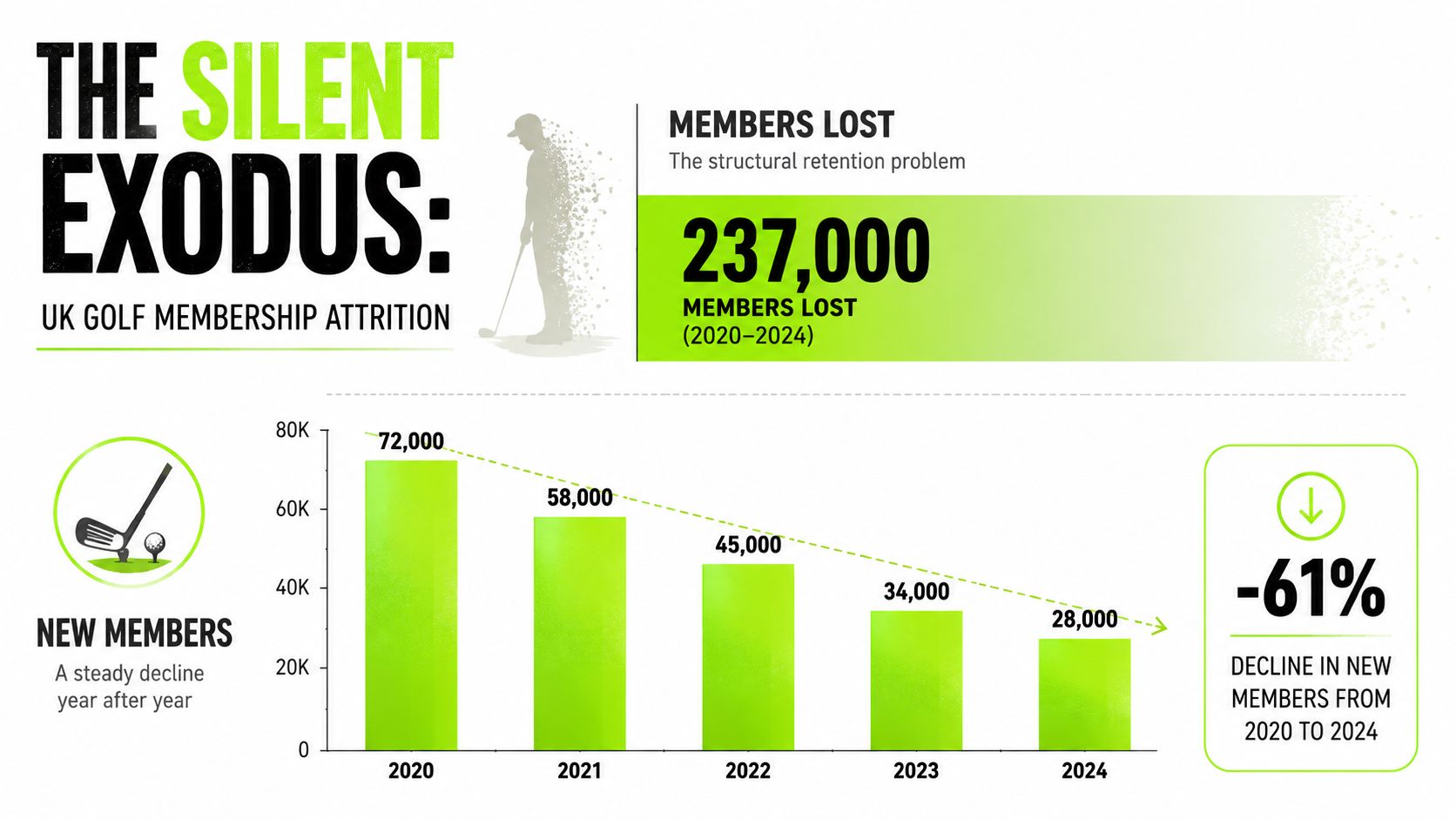
Understanding the Scale of Membership Attrition in UK Golf
The scale of the issue is bigger than a few isolated resignations. One UK industry source says there are now 150,000 fewer club members than in 2004, while another notes membership numbers had already fallen by about 6,000 at the start of 2023 and that the decline had steepened as conditions worsened. That is the backdrop every committee should hold in mind before it starts talking about “more marketing” as if that alone will repair the problem. Club Insure's overview of golf club diversification pressures
Waiting lists used to hide the problem, because they gave clubs a buffer when members resigned. More than 90% of surveyed clubs were planning to increase fees in 2023, and the share of clubs with waiting lists fell from 60% to 52% in the same reported period. That means replacement is slower, less predictable, and more sensitive to price. The club can no longer assume a queue of eager applicants will absorb losses without strain. Club Insure's overview of golf club diversification pressures
Practical rule: if leavers outpace joiners for even a short stretch, the club is not looking at a sales issue alone. It is seeing a lifecycle failure that starts with acquisition and ends with renewal.
The recent UK survey cycle makes that point even more clearly. It reported that 24% of member clubs still had more leavers than joiners, even though average joiners edged up from 70 in 2022 to 73 in 2023 and average leavers rose from 48 to 56. Hillier Hopkins' 2022/23 Members' and Proprietary Golf Clubs Survey That is the pattern clubs need to diagnose properly. The front of the funnel may still be functioning, but the back end is leaking faster than the front can refill it.
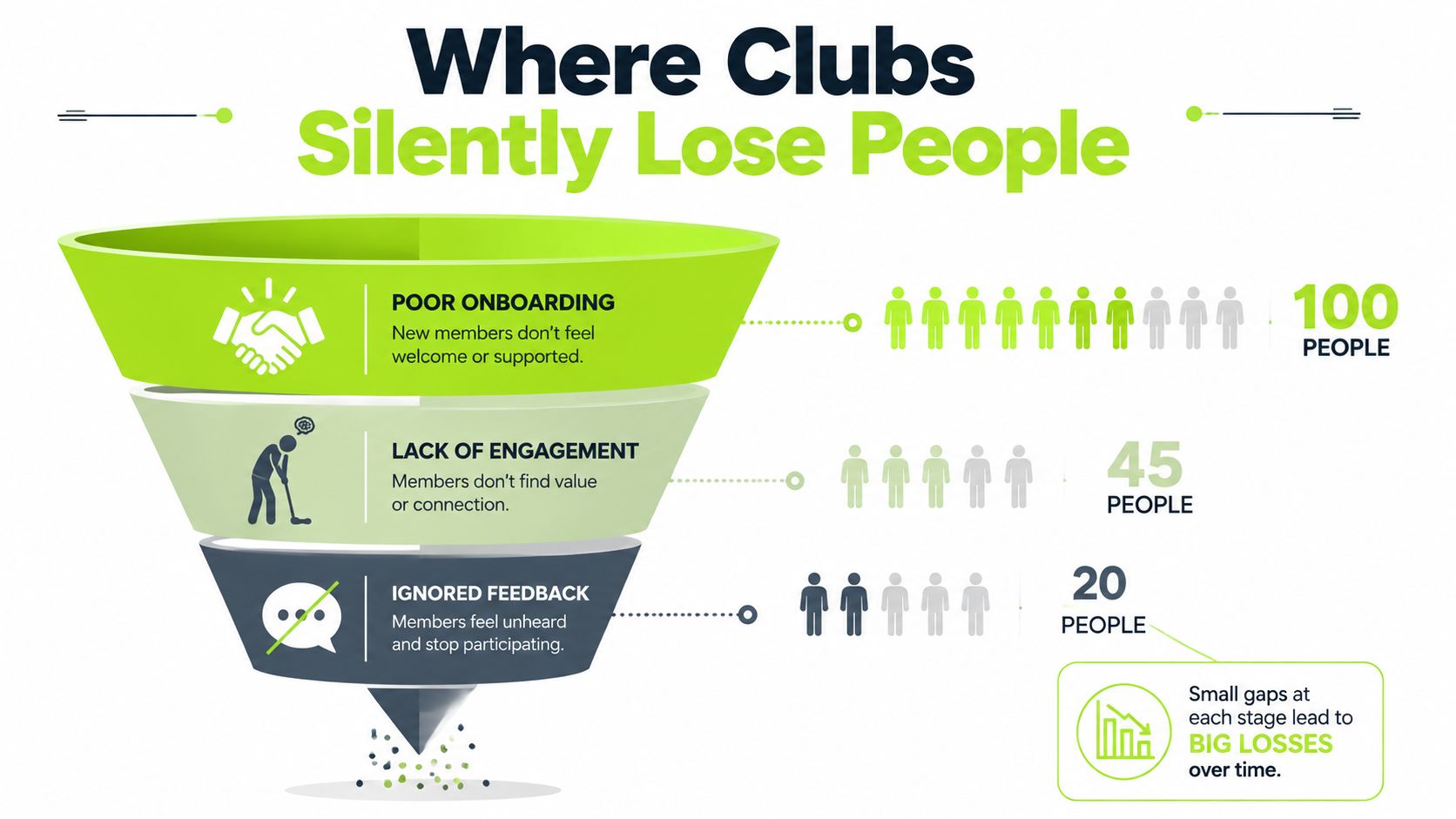
Where Clubs Lose People Before Resignation
Most clubs only study the resignation date. That is too late. By then the member has already disengaged, and the practical loss happened weeks or months earlier through ignored enquiries, weak onboarding, or falling usage. GolfRep's own retention guidance is built around that reality, because the warning signs show up well before a member formally leaves.
The first leak is the enquiry that never gets handled properly
A prospect submits an enquiry, gets no meaningful response, and moves on. That sounds obvious, yet clubs still treat the enquiry inbox like an admin task instead of a sales pipeline with ownership, timing, and follow-up discipline. Without lead visibility, staff cannot tell which enquiries were replied to, which ones booked a visit, or which ones disappeared after the first contact.
Manual process breaks down here. A spreadsheet can record that someone asked for details, but it will not show whether they were contacted promptly, whether they opened the follow-up, or whether they stalled at a specific stage. A CRM does that work because it gives the club a live view of the pipeline instead of a list of names that might be active or already lost.
The second leak is the new member who never feels properly integrated
GolfRep notes that up to 25% of new members can leave in the first year if they are not properly integrated into club life, and that definition of churn is central to understanding the problem. New joiners often need structured introductions, welcome touches, and social proof that they made the right decision. If those early weeks feel transactional, the member has not joined a community. They have bought access.
The warning signs are practical, not abstract. Booking frequency drops. Event participation fades. Emails go unanswered. Those are the behaviours to track because they appear before cancellation, not after it. Clubs that wait for a resignation letter have already missed the intervention window.
The third leak is the member whose usage slips without anyone noticing
Clubs often fool themselves by assuming an active course means healthy membership. But BRS Golf data cited by GCMA showed the 1,500 clubs using its services recorded about 5.6 million member rounds in the first quarter of the year, yet collectively lost around 6,000 members over the same period. Activity and retention are related, but they are not the same thing. GCMA insights on BRS Golf club membership figures
The lesson is straightforward. If the club cannot see behaviour at member level, it will not spot disengagement early enough to act. Clubs need clear ownership for follow-up, visible lead stages, and a way to flag declining use before the member drifts out of the habit.
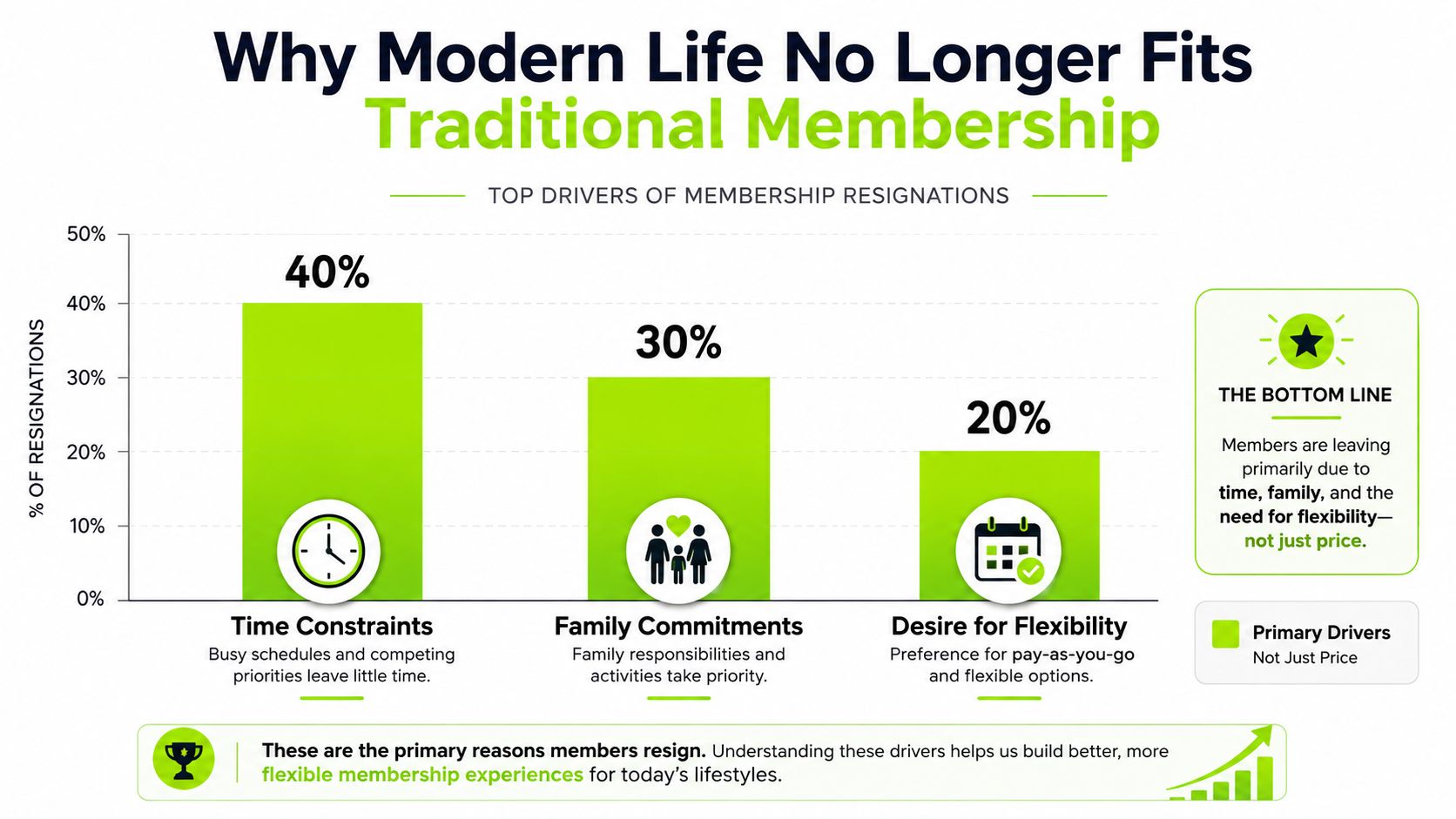
Why Modern Life No Longer Fits Traditional Membership
The main reason clubs lose members isn't always price. It's the mismatch between a fixed membership product and a golfer's actual life. Independent attrition research found the most common resignation drivers were change in residential location at 24% in the NSW report and 27% in the Golf Queensland report, time constraints at 19% and 26%, and increasing family commitments at 25% and 25%, while value for money was smaller but still material at 5% and 13%. NSW Golf Association attrition and retention report
The product often asks for more commitment than members can give
That data points to a structural fit problem. People move, commute differently, have children, or lose the ability to use the club enough to justify a rigid full-membership model. Once usage drops below perceived value, resignation becomes rational, even when the person still likes the club and the staff.
Clubs make the situation worse when they assume the answer is to “sell harder”. If the offer itself only works for golfers with predictable free time and easy access, then a large share of the market will always sit outside it. That's especially true now that golfers have more flexible alternatives in front of them, including pay-and-play and simulator-based options that fit fragmented schedules better than a traditional annual commitment.
What works in practice is fit, not pressure. When a membership product matches how people actually play, renewals become easier because the decision feels aligned with daily life.
Price still matters, but it's rarely the full explanation
The value question shouldn't be ignored, but it usually arrives after usage has already fallen. A member who is too busy to play doesn't need a cheaper annual fee. They need an offer that reflects their reality, or they'll compare the cost of membership against the number of rounds they play.
That's why clubs that rely on one standard membership category tend to lose people at life-stage changes. They force a binary choice where a flexible pathway would keep the golfer inside the club. The more rigid the product, the more likely the member is to drift away when work, family, or travel changes their routine.
The best clubs treat membership as a portfolio, not a single box. They keep the core offer strong, but they also recognise that modern golfers don't all behave the same way, and they don't all need the same level of commitment.
How to Measure and Diagnose Member Churn
You can't fix a retention problem you can't see. The first step is to define churn properly and stop relying on guesswork. GolfRep's churn guidance defines annual churn rate as members lost during the year divided by members at the start of the year, multiplied by 100, and retention rate as members kept during the year divided by members at the start of the year, multiplied by 100. GolfRep's churn-rate guide
The core KPIs to track
A club that wants control needs a small dashboard, not a sprawling spreadsheet. The important measures are the ones that show whether people are moving through the pipeline or falling out of it.
| KPI | Formula or Definition | Why It Matters |
|---|---|---|
| Annual churn rate | Members lost during the year divided by members at the start of the year, multiplied by 100 | Shows the size of the retention problem |
| Retention rate | Members kept during the year divided by members at the start of the year, multiplied by 100 | Balances the churn view with a positive measure |
| Enquiry response time | Time from enquiry to first meaningful response | Reveals whether the club is losing prospects before contact is made |
| Lead conversion rate | Share of enquiries that become visits, trials, or sign-ups | Shows whether the follow-up process is working |
| First-year drop-off | New members who leave in year one | Highlights onboarding failures |
| Booking frequency trend | Whether member use is rising, flat, or falling | Flags disengagement before resignation |
| Event participation level | Attendance at socials, competitions, and welcome events | Measures integration into club life |
If you want a useful external reference for the broader logic of churn analysis, SigOS on client churn is a good reminder that churn only becomes manageable when it's broken into measurable stages. That same principle applies in golf, especially where enquiry handling and renewal behaviour sit in different systems.
Move the tracking out of manual hands
Spreadsheets are fine for snapshots, but they're weak at monitoring behaviour over time. They don't easily show which enquiries are untouched, which members are slipping into inactivity, or where the bottleneck sits between first contact and conversion. A CRM gives the club a single operational record, which matters because retention problems usually cross departments.
If the secretary, membership team, and office staff all keep separate records, the club doesn't have data. It has versions of the truth.
A practical setup needs ownership at every stage, visible status changes, and regular review. That's the difference between reacting to resignations and managing churn.
Retention Tactics That Actually Reduce Churn
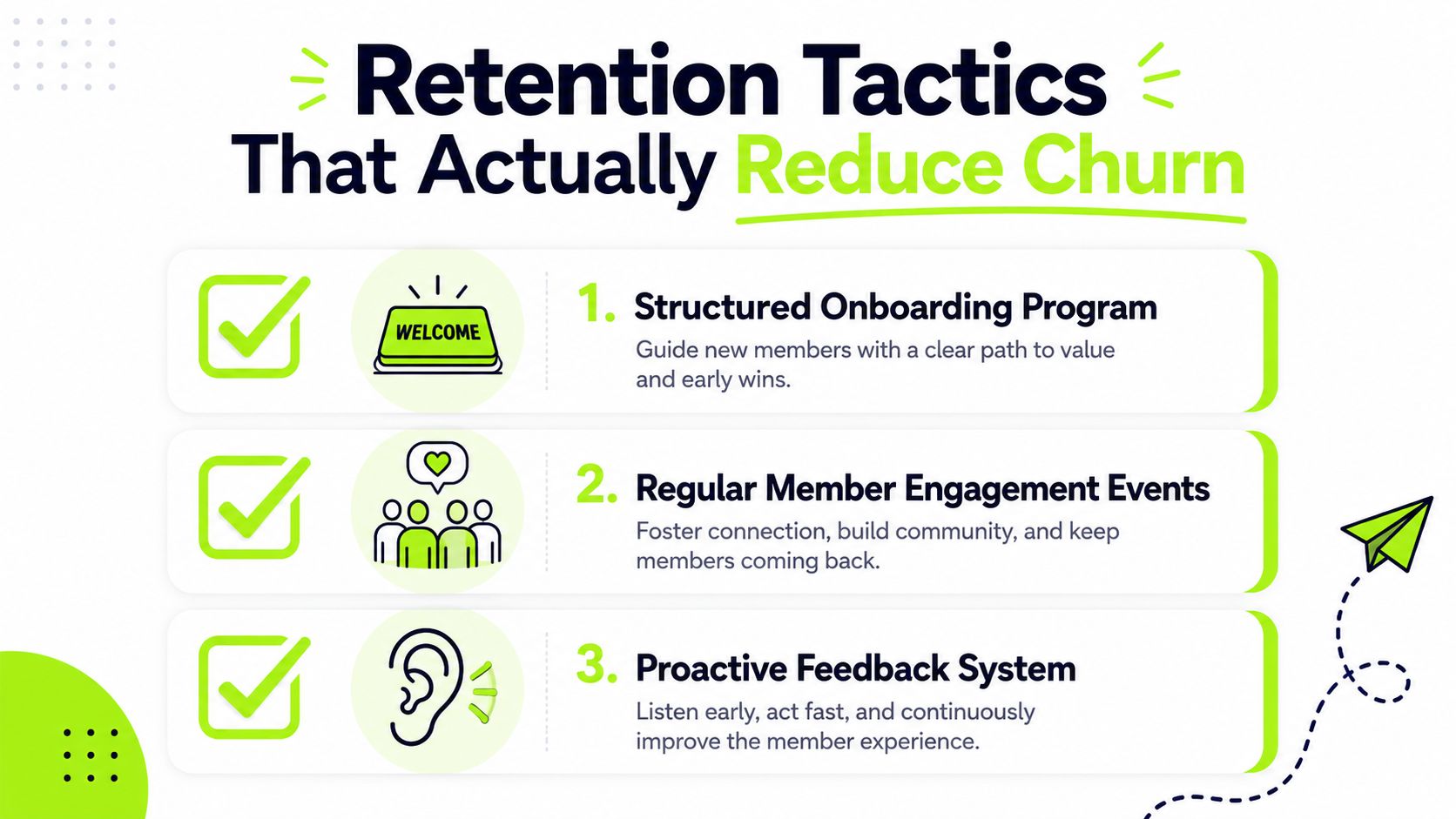
The clubs that reduce churn don't usually start with a flashy campaign. They start by tightening the basics, then they build a system around them. GolfRep's member-retention workflow focuses on onboarding, usage checks, event invitations, feedback collection, and intervention for low engagement because those are the moments that shape whether a member stays connected. GolfRep's customer retention guide
Structured onboarding beats a friendly welcome alone
A welcome letter is not onboarding. New members need a sequence that helps them use the club, meet people, and understand how to participate in club life. That means a clear first-touch process, a follow-up after the first visit, and a reason to come back before enthusiasm fades.
The first 90 days matter most because they shape habit. Clubs that leave the new member to figure things out on their own create unnecessary friction, especially in larger or committee-led environments where nobody owns the journey end to end. If the member doesn't form a social connection early, the club becomes easy to ignore.
Flexible membership tiers protect value without discounting the brand
Discounting can feel active, but it often just trains people to wait for a cheaper offer. A better answer is to design membership types that reflect how golfers spend their time. That could mean pathways for time-poor golfers, shorter-commitment options, or access models that keep the member inside the club even when full annual use isn't realistic.
Otter A/B's retention guidance on increasing LTV is useful here because it reinforces a simple commercial truth. Retention grows when the offer fits the customer's behaviour and the club keeps contact meaningful after the first sale. The same logic applies in golf membership, where the objective is to keep golfers active for longer, not just to sell the next renewal.
Follow-up systems matter more than follow-up intentions
A team can be well-meaning and still miss enquiries every week if there's no process. Every enquiry should have an owner, a status, and a next action. Clubs that build that discipline into a CRM stop relying on memory, which is where most leakage starts.
This is also where GolfRep fits naturally as one option among others. Its role is to combine lead generation with structured follow-up and CRM-based nurture, so enquiries don't disappear between interest and visit. That matters because a stronger pipeline is only useful if the club manages it.
Governance and visibility determine whether fixes stick
Thin surpluses make clubs cautious, but caution becomes a problem when it stops them from adjusting the product or reinvesting in the member experience. The issue is sharper when board performance is reviewed informally, because weak visibility allows problems to linger. If the club doesn't review usage, conversion leakage, and first-year drop-off regularly, the same issues keep repeating.
The best retention work is boring in the best possible way. It is consistent, visible, and owned.
Club Case Studies Showing Predictable Growth
Theory only matters if clubs can see it working in practice. GolfRep's case-study archive includes examples of what changes when a club replaces ad hoc follow-up with a proper growth system. The January and February sales case study is a good reference point for how structured processes affect membership momentum.
The common thread is not more noise, it's better control
Bidston Golf Club is the clearest illustration. The club was revived from near-closure to more than double its membership and six-figure recurring revenue by rebuilding the growth process around predictable systems. That kind of recovery doesn't come from one campaign. It comes from making sure people are contacted, nurtured, and moved through the pipeline in a disciplined way.
Addington Palace followed a similar pattern, building a steadier flow of new members through consistent follow-up and CRM-driven nurture. Downes Crediton launched a rapid and profitable membership campaign that did the same job in a shorter window. The lesson in both cases is that conversion improves when the club treats every enquiry as a process, not a one-off interaction.
Multi-site operators need consistency more than creativity
For larger groups, the challenge is different but the principle stays the same. Macdonald Hotels and Resorts used centralised CRMs and automated follow-ups to manage growth at scale, which matters because multi-site operations need one standard of visibility across locations. Without that, every club ends up running its own version of the same process, and leadership loses the ability to compare performance properly.
The practical gain is simple. Once the club can see enquiry stages, response timing, and conversion points in one place, it can spot where the leak starts. That makes the next decision easier, whether the fix is onboarding, follow-up, product design, or a change in the way the membership team handles at-risk members.
Clubs often assume growth depends on a larger audience. These cases show something more useful. Predictability comes from owning the journey already in front of you.
Building Your Retention and Re-Recruitment Playbook
Start with an audit of the last year's membership movement. Look at joins, resignations, first-year drop-off, and which enquiry sources convert. Then map the journey from first contact to renewal so you can see where people stall, disappear, or passively disengage.
The next step is structural. Put enquiry handling, onboarding, and renewal tracking into one visible system, then assign clear owners for each stage. After that, review usage signals and member feedback regularly, so at-risk members can be contacted before they resign.
Re-recruitment matters too. Members who left because life changed are often easier to win back than strangers are to convert, provided the club has kept the relationship warm and can offer a more suitable membership path. That's how clubs stop treating churn as an unavoidable cost and start treating it as a management problem.
If you want help turning this into a more predictable membership system, visit GolfRep to see how structured follow-up, CRM tracking, and retention-led campaigns can work for your club. If your club is losing members, we can help you find the leak, fix the process, and build a pipeline that doesn't rely on guesswork.
Ready to tap into our proven growth system?