Lead Management CRM Software for UK Golf Clubs

Most advice about lead management CRM software starts in the wrong place. It begins with dashboards, integrations, pipeline stages and feature comparisons, while the commercial problem is usually simpler: what happens in the first few minutes after a membership enquiry arrives?
Golf clubs rarely lose prospective members because they lack another spreadsheet column. They lose them because nobody owns the enquiry, the first response arrives too late, or the follow-up stops after one polite email. A CRM can expose and fix those failures, but only when the club designs its operation around response speed and disciplined progression.
At GolfRep, we look at CRM as part of a predictable membership pipeline, not as a software purchase. The right system should capture every enquiry, route it immediately, record every meaningful interaction and make the next action obvious. Anything less is an expensive contact database.
Why Most Golf Clubs Do Not Have a Lead Generation Problem
The popular assumption is that a club needs more advertising whenever membership numbers disappoint. That diagnosis is often convenient, but it isn't necessarily accurate. England Golf reported 750,071 club members in 2025, with membership increasing 2.66% year on year and junior membership rising by more than 34% in the same reporting. England Golf participation data is summarised in this UK golf club report.
That doesn't mean every club has a full waiting list or that every enquiry is high quality. It does mean the market contains genuine demand. The more important question is whether clubs handle that demand with enough speed and consistency to turn interest into a visit, an application and eventually a membership.
The first operational question isn't “How do we generate more leads?” It's “Who is responsible for the lead we already have?”
Independent UK research found an average lead response time of 47 hours, while only 7% of companies respond within five minutes and 78% of customers buy from the first company to respond. The UK lead response research points to a serious gap between enquiry capture and human action.
A golf club enquiry is particularly vulnerable during that gap. A prospective member may have submitted forms to several clubs, asked about playing rights, compared joining fees, or acted during a short burst of enthusiasm. If the club replies after the prospect has moved on, better advertising won't repair the missed opportunity.
The hidden cost of manual chasing
Manual processes create three predictable failures:
- No clear owner: The enquiry lands in a shared inbox, on a receptionist's desk or with a committee member who assumes someone else will respond.
- Poor visibility: Managers can't see whether the prospect received a call, booked a visit or went quiet after asking about membership.
- Inconsistent follow-up: One lead gets several helpful contacts, another receives a single generic reply and disappears.
A lead management CRM software platform won't create demand by itself. It will, however, make gaps visible and give the club a repeatable way to act on demand. That shift from acquisition thinking to operational control is where many membership programmes should begin.
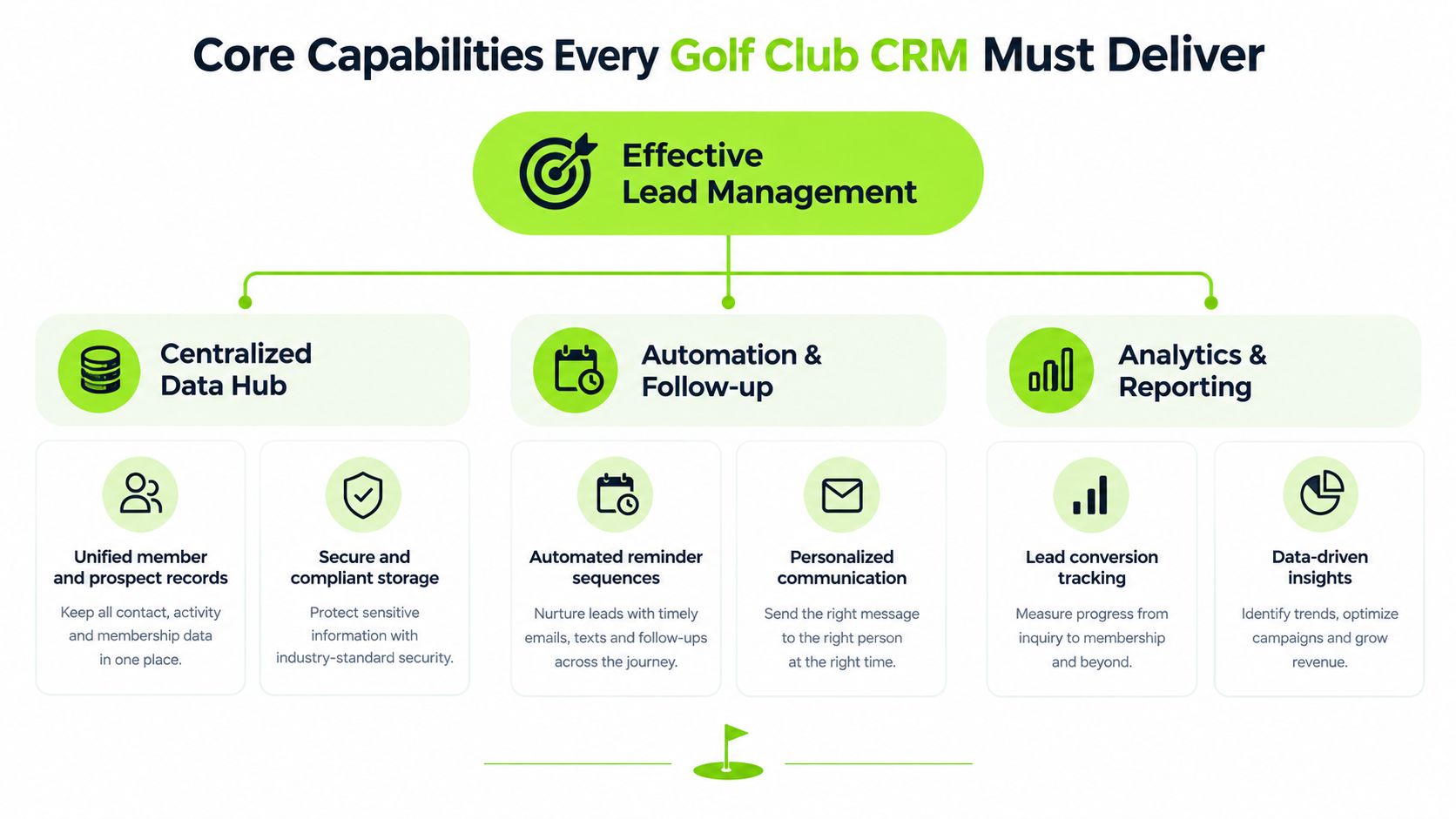
Core Capabilities Every Golf Club CRM Must Deliver
A golf club doesn't need every feature offered by a large sales technology vendor. It needs a system that removes delay, protects context and makes conversion measurable. UK CRM buying guidance commonly assesses platforms on lead capture, pipeline tracking, reporting depth, automation and attribution quality, rather than brand recognition alone. This UK CRM comparison highlights reporting depth and traceable sales records.
Capture and route every enquiry
The CRM should pull enquiries from website forms, landing pages and relevant advertising sources into one record. The record needs the prospect's contact details, source, enquiry type, preferred contact method and any qualifying information they supplied.
Routing matters just as much as capture. A membership enquiry should reach the person who can answer membership questions, while a society booking or coaching enquiry may need a different owner. Assignment rules should also create a task, set a due time and escalate an untouched enquiry instead of leaving the next step to memory.
Show the real pipeline
A useful pipeline reflects the club's buying journey, not a generic sales template. Stages might include new enquiry, contacted, qualified, visit booked, visit completed, application pending and joined. Every stage should have a clear definition, so a lead isn't marked as qualified just because someone sent an automated email.
The system must record lead source, response time, owner, last contact, next task and outcome. Without those fields, a dashboard can look busy while the club still can't answer which campaigns produce booked visits or where prospects stop progressing.
Automate the routine, preserve the relationship
Automation should handle speed and consistency, not replace judgement. A well-designed workflow can send an immediate acknowledgement, ask a qualifying question, notify the membership team and schedule a follow-up task. It can also nurture a prospect who isn't ready to join without forcing staff to remember every future contact.
Reporting then closes the loop. Managers should be able to compare enquiries with visits, applications and memberships, while keeping a traceable record of manual and automated communication. A UK review of lead CRM tools identifies Salesforce for scalable CRM, HubSpot for inbound lead management and Ruler Analytics for multi-touch attribution, showing how different platforms solve different operational problems. The UK lead CRM review discusses these practical distinctions.
Comparing Leading CRM Platforms for Golf Club Use
Golf clubs shouldn't select a platform because it has the longest feature list. They should select it because staff can use it during a busy membership campaign, because managers can trace the journey from first contact to outcome and because the system supports the club's structure.
The table below is a practical editorial comparison, not a claim that every platform behaves identically in every configuration.
| Platform | Best For | Automation Depth | Attribution Quality | Multi-Site Support |
|---|---|---|---|---|
| Salesforce | Clubs or groups with complex processes and dedicated administration | High, with substantial configuration | High when correctly implemented | Strong |
| HubSpot | Inbound enquiry management and teams that value accessible workflows | Medium to high, depending on setup | Good for connected marketing and sales journeys | Good |
| Ruler Analytics | Clubs prioritising channel and multi-touch attribution | Complements a CRM rather than replacing one | Strong for connecting acquisition to conversion | Depends on the connected CRM |
| Pipedrive | Smaller teams wanting clear pipeline ownership | Medium | Basic to moderate unless extended | Moderate |
| Zoho CRM | Clubs requiring flexible fields, workflows and custom processes | High, with configuration effort | Moderate to high when reporting is designed properly | Good |
| GolfRepOS CRM | Golf clubs needing membership enquiry routing, qualification and follow-up in one operational layer | Designed around structured nurture and task creation | Built around tracking the journey to booked visits and membership outcomes | Suited to centralised club and group operations |
Salesforce is the serious option for a complex group with multiple sites, teams and bespoke rules. Its strength is scalable customisation, but that strength becomes a weakness if the club lacks implementation capacity. A committee-led club may buy more system than its staff can maintain.
HubSpot is often easier for inbound lead management. It suits clubs that want forms, email journeys, lifecycle stages and a clear user experience. Pipedrive can be a sensible alternative where the priority is pipeline visibility and staff need a straightforward view of who owns the next action.
Zoho offers broad customisation for clubs with unusual processes or several operational teams. Ruler Analytics is valuable where the main question is not merely “How many leads did we receive?” but “Which combination of channels helped produce the membership outcome?”
Make the platform fit the operating model
A large resort group needs central rules with local ownership. A private club needs simple handoffs between the secretary, membership manager and professional team. A daily-fee facility may need to separate visitor enquiries from membership opportunities without creating unnecessary complexity.
For a fuller discussion of club-specific systems, see GolfRep's guide to the best golf club CRM approach. The recommendation is straightforward: test the system using a real enquiry journey, not a polished vendor demonstration.
Ask a vendor to show what happens when a form arrives outside office hours, when two sites receive similar enquiries, when a prospect misses a visit and when a committee member changes ownership. Those scenarios reveal more than a list of integrations.
Real-World CRM Workflows for Different Club Types
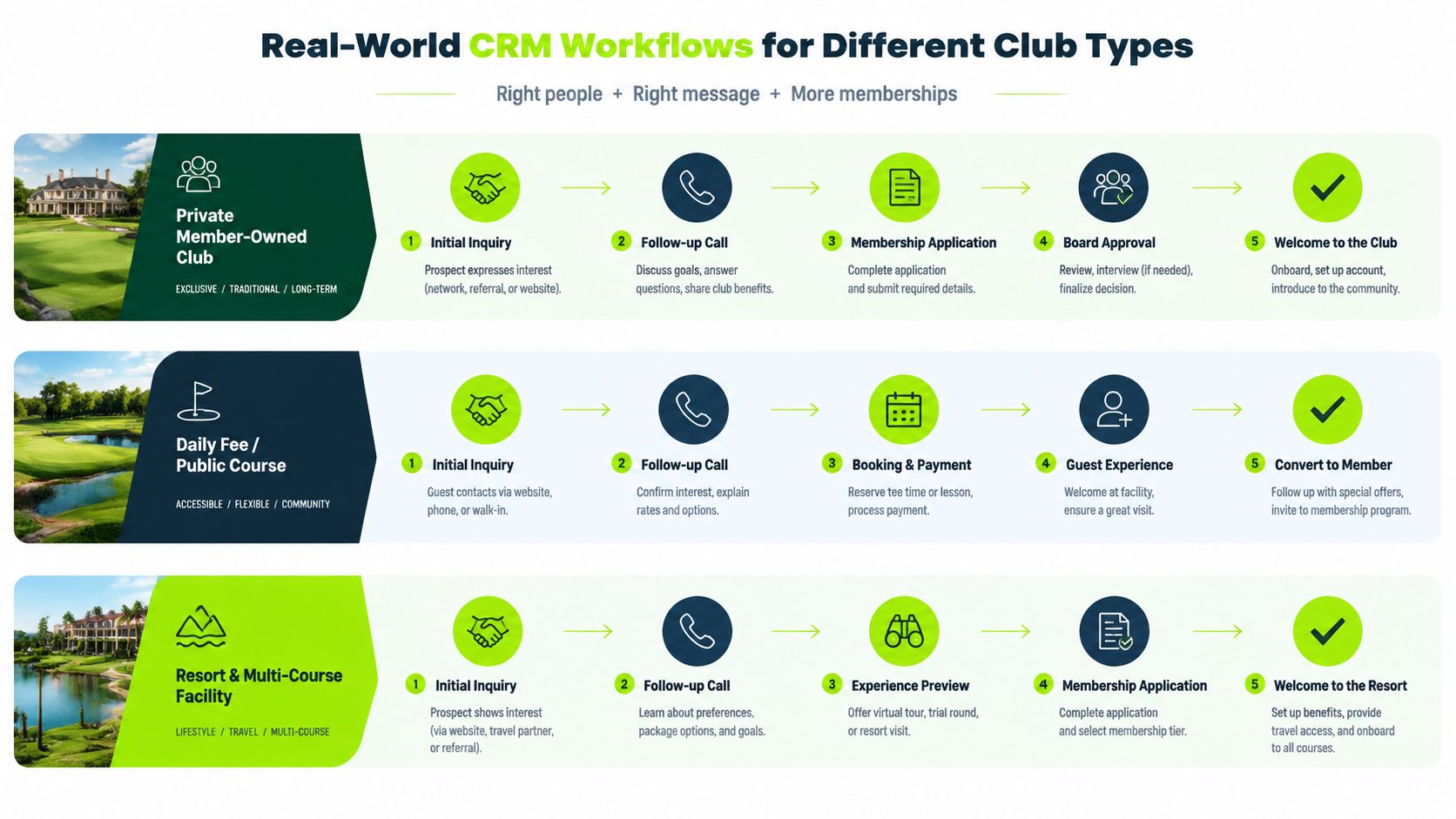
A CRM workflow should match how the club operates. A volunteer-run club needs dependable simplicity. A proprietary club with a large membership base needs capacity and accountability. A resort group needs central control without making every local team follow an unworkable process.
Committee-led private club
The first workflow should be deliberately short:
- The website form creates a lead record.
- The CRM sends an immediate acknowledgement with the next practical step.
- The membership secretary receives ownership and a follow-up task.
- The prospect receives a personal call or message.
- The system records whether a visit or conversation has been arranged.
The committee doesn't need a complicated scoring model if nobody has time to maintain it. It needs one shared record and an agreed rule about who responds when the secretary is unavailable. A simple escalation path is more valuable than a powerful dashboard that nobody checks.
Larger proprietary club
A larger proprietary club may need separate workflows for membership categories, waiting lists and high-volume campaigns. UK golf club survey data shows that 55% of proprietary clubs surveyed had more than 600 playing members, while membership growth and waiting lists were both rising. The Hillier Hopkins report provides this UK club operating context.
Here, the CRM should qualify enquiries early. A prospect interested in full membership shouldn't enter the same nurture path as someone asking about academy access or flexible playing rights. The membership team should see urgency, category, preferred visit date and the last completed action immediately.
Resort and multi-site group
A resort group needs a central data model. Each lead should carry a location, source, enquiry category and assigned team, while local staff retain responsibility for the relationship. Automated messages should follow group-level brand standards, with local details inserted where appropriate.
A useful rule is to centralise reporting and governance, but decentralise the human conversation. That prevents one site from responding in a completely different tone or losing history when a prospect asks about another venue.
For clubs coordinating events, bookings and participation across teams, EventUploader sports club use cases offers useful context on how structured digital workflows can support sports organisations. GolfRep's own operational approach is outlined through GolfRepOS CRM, where the focus is moving an enquiry from first contact towards a booked visit and a clear outcome.
How to Evaluate and Select the Right CRM for Your Club
The buying committee should score the system against the club's real operating conditions. A platform that works beautifully for a sales team can fail at a golf club if the secretary can't update it quickly, the membership system can't exchange essential data or no one owns the workflow.
Begin with the enquiry journey. Write down every step from website submission to membership outcome, including who handles the lead, what information they need and what happens if the prospect doesn't reply. Then ask each CRM provider to demonstrate that exact journey.
Score operational fit, not presentation quality
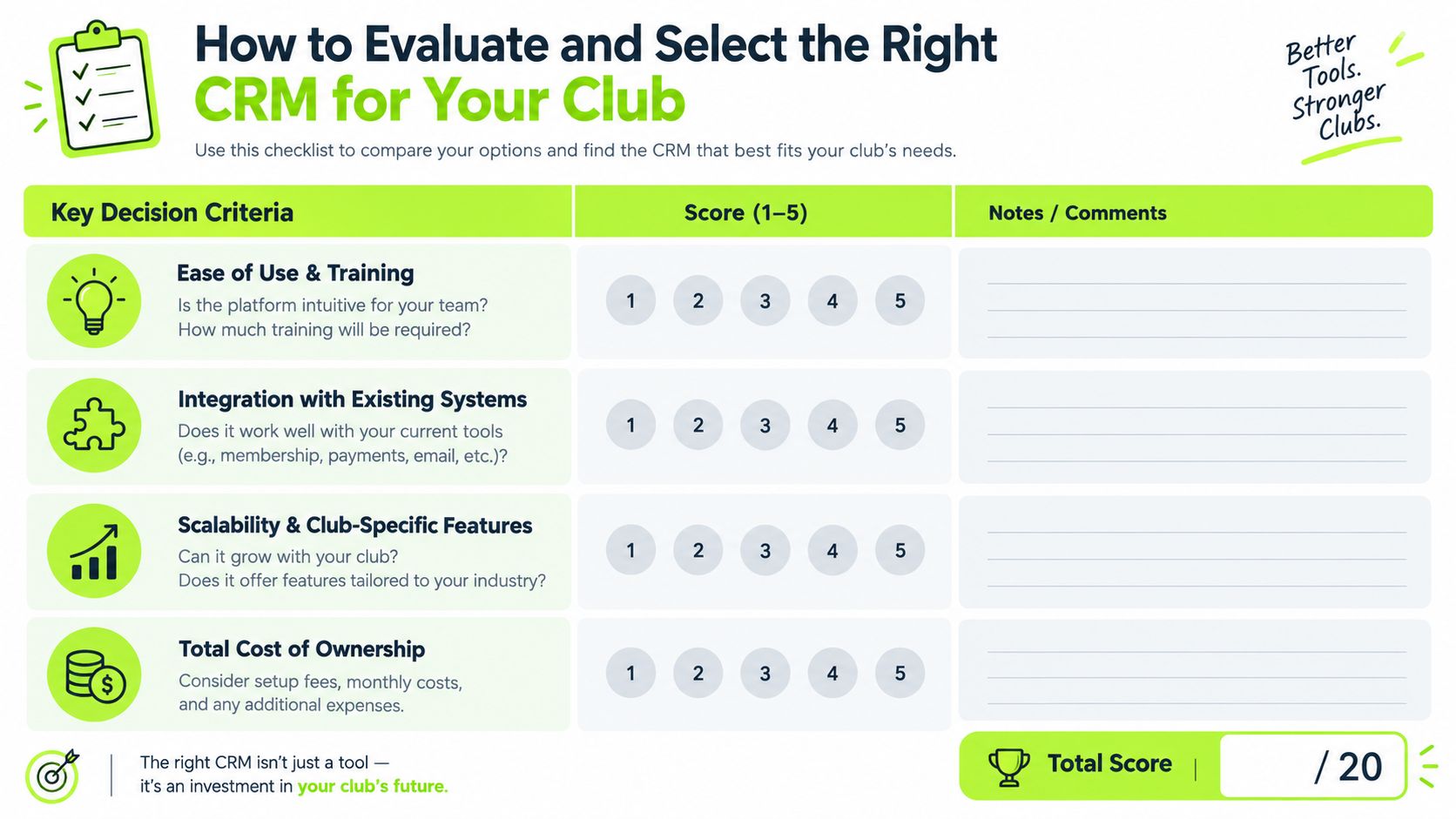
Use a simple scoring matrix, with each criterion rated from one to five:
| Decision criterion | Question to ask |
|---|---|
| Ease of use and training | Can a new administrator understand the next action without technical support? |
| Integration with existing systems | Can the CRM connect sensibly with membership, booking, website and communication tools? |
| Club-specific scalability | Can it handle multiple membership categories, sites, owners and reporting views? |
| Total cost of ownership | What will implementation, training, maintenance and future configuration require? |
| Governance and data quality | Can the club control duplicates, permissions, consent and record ownership? |
| Response-time accountability | Can managers see whether enquiries were contacted and followed up promptly? |
The UK CRM market is mature, but usage remains the problem. Research cited by B2B Marketing found that only 40% of CRM systems are used effectively, which makes implementation discipline as important as platform choice. The UK SME CRM implementation research explains this adoption gap.
Watch for these red flags
A vendor should be able to explain data ownership, user permissions, integration limitations and export options in plain English. Be cautious if the demonstration focuses on dashboards but avoids response-time rules, task assignment or missed follow-up.
Also question a system that requires every staff member to become a power user. The best configuration is the one the club will maintain during winter, peak season, staff absence and committee turnover. If the workflow collapses when one person leaves, the club hasn't built a system. It has built a dependency.
Why Software Alone Will Not Fix Your Conversion Problem
Buying a CRM doesn't create follow-up discipline. It can place every enquiry in one system, but the club still has to define who acts, how quickly they act and what happens after the first conversation.
A UK-focused analysis reports that businesses replying within five minutes are 21 times more likely to qualify a lead than those waiting 30 minutes. The UK lead response analysis makes the commercial implication clear. Speed isn't a cosmetic service improvement. It affects whether the club gets a meaningful conversation at all.
Build accountability into the workflow
A club should set an internal response standard, assign every new lead automatically and review exceptions. The process might include an immediate acknowledgement, a staff task, an escalation if the task remains incomplete and a nurture sequence for prospects who aren't ready to visit.
The manager's dashboard should answer practical questions:
- Which enquiries arrived today?
- Which have no owner?
- Which have no completed first action?
- Which prospects are waiting for a visit?
- Which leads have gone quiet despite clear interest?
- Which sources produce applications rather than superficial contact volume?
A separate UK mystery-shopping study of universities found that one in four enquiries received no reply at all, while only one in six received any follow-up after the initial response. The enquiry conversion study concerns universities rather than golf clubs, but the operational lesson transfers directly. Capturing an enquiry is only the beginning.
A lead isn't being managed because it exists in the CRM. It's being managed when someone owns the next action and completes it.
Committee-led clubs face a further risk because several people may contact the same prospect. Set permissions, record notes immediately and establish one source of truth. The system should protect a consistent brand tone while allowing the membership secretary or club manager to have a natural conversation.
For a candid look at the operational reasons enquiries stall, read why golf club leads don't convert. The answer is rarely a lack of enthusiasm from the prospect. More often, the club hasn't made the next step reliable.
Clear Recommendations for Every Club Situation
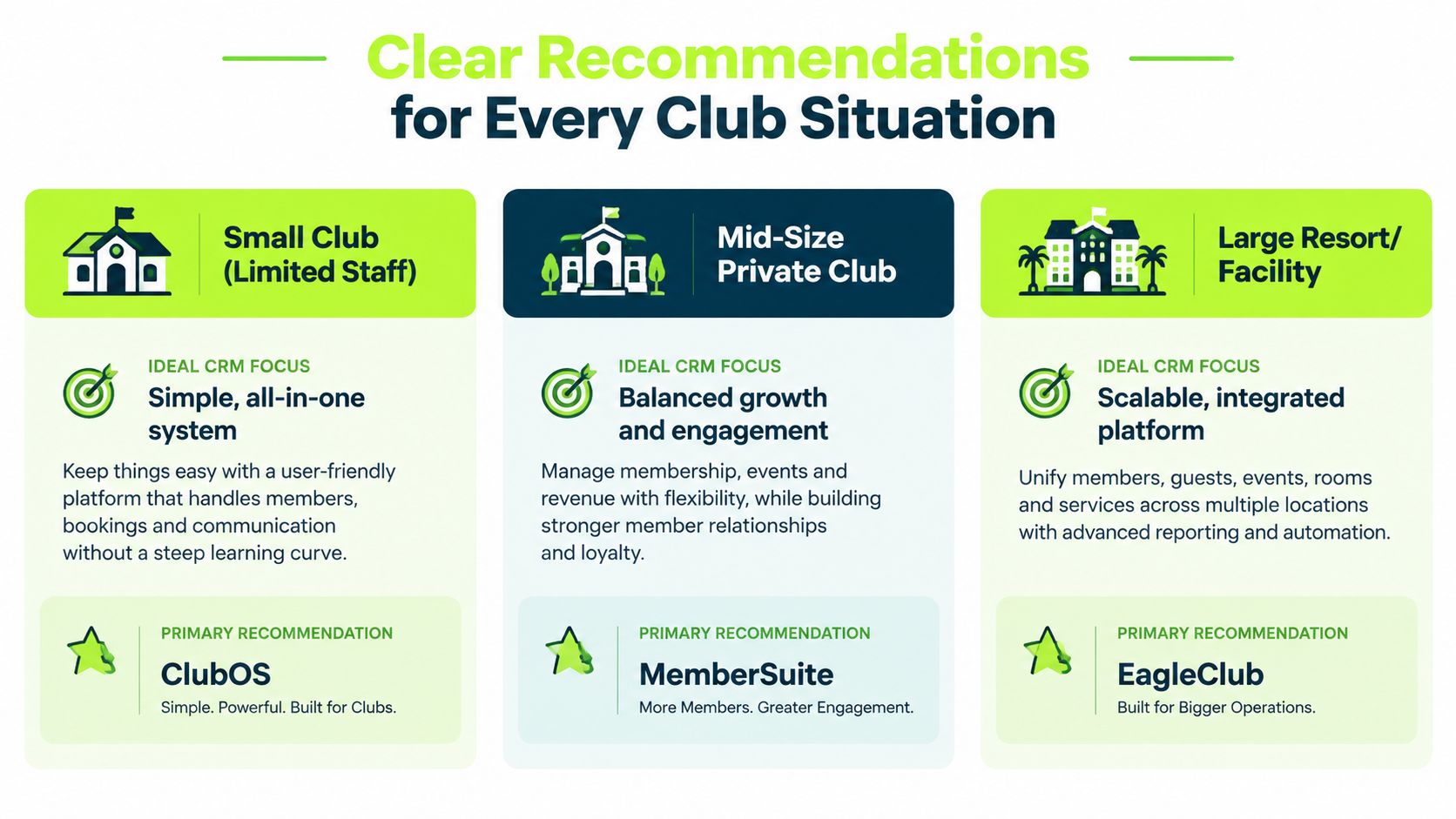
The right recommendation depends on the club's operating model, not its ambition.
Small committee-led club: Choose a simple CRM with web capture, automatic assignment, task reminders, email templates and a small number of clearly defined stages. Don't buy enterprise complexity before the club has agreed who owns membership enquiries and how absence is covered.
Growing private club: Prioritise structured qualification, automated nurture, response-time reporting and integration with existing membership or booking tools. The club should separate membership categories and measure progress to visits and applications, not merely count contacts.
Large resort or multi-site operator: Use a centralised CRM with location-level ownership, group reporting, permission controls and consistent communication templates. Local teams should handle personal conversations, while the central team maintains data quality, attribution and workflow standards.
GolfRep works with clubs to combine lead generation with structured follow-up, CRM-enabled routing and nurture systems. That is the correct role for a growth partner. The partner should help define the workflow, implement the system, train the people using it and review whether enquiries are moving towards booked visits and memberships.
Ask potential partners who will own implementation, how they handle missed responses, what they report each month and how they protect the club's pricing and brand position. A provider that only talks about generating more leads hasn't addressed the main commercial risk.
GolfRep helps UK golf clubs build predictable membership pipelines by combining lead generation, instant enquiry qualification, structured follow-up and CRM visibility from first contact to outcome. Visit GolfRep to discuss the workflow your club needs, the gaps currently costing you enquiries and the practical system required to turn more interest into booked visits and memberships.
Ready to tap into our proven growth system?