Golf Club Event Marketing: A Practical Playbook

A club manager can have a calendar packed with captains' days, charity opens, corporate scrambles and social competitions, yet still struggle to explain which events produced worthwhile commercial results. A busy tee sheet looks positive, but attendance alone doesn't tell you whether the club gained members, generated corporate opportunities, increased clubhouse spend or merely delivered another well-organised day at cost.
Effective golf club event marketing starts with a different question: what commercial job must this event perform? GolfRep works backwards from that answer, choosing the audience, offer, channels, booking process and measurement around a defined outcome rather than treating the annual calendar as fixed tradition.
Choosing Events That Earn Their Place on the Calendar
The first task is a calendar audit, not a promotional plan. List every event, then record its direct income, staffing requirement, food and beverage contribution, secondary sales, audience and follow-up opportunity. An event that fills spaces but consumes substantial staff time may be less valuable than a smaller event with a clearer route to membership or repeat corporate business.
The UK market is large enough to support different event objectives. The R&A's UK golf participation account reported that 4.2% of adults in England played at least once in the previous four weeks in 2019, equivalent to 1,919,316 regular golfers, while 9.6% played at least once in the previous 12 months, equivalent to 4,327,200 occasional golfers. That addressable audience can support open days, taster events, corporate days, charity tournaments and membership conversion campaigns, but each format needs a distinct commercial purpose.
Start with the outcome
Assign one primary objective to every calendar slot:
- Member retention: create reasons for current members to play, bring guests and use the clubhouse.
- New member acquisition: give prospective golfers a credible experience of the course, people and atmosphere.
- Corporate pipeline: create a useful setting for organisers, local businesses and decision makers.
- Ancillary revenue: increase food and beverage, coaching, buggy, room hire or pro shop income.
- Community goodwill: strengthen local relationships where the club has a clear strategic reason to do so.
Then ask three blunt questions: who pays, who returns, and what gets measured? If the answer is unclear, reshape the event before spending on design or advertising.
Practical rule: An event should have a hypothesis, a target metric and an exit criterion before it earns a permanent place on the calendar.
A private members' club might discover that two traditional open days produce modest entry income but little membership interest. Removing them could release budget and operational capacity for a premium corporate day with better hospitality, clearer organiser outreach and a structured rebooking process. The point isn't that every open day should be cancelled. It's that the club should compare formats by net commercial contribution, not by how familiar they are.
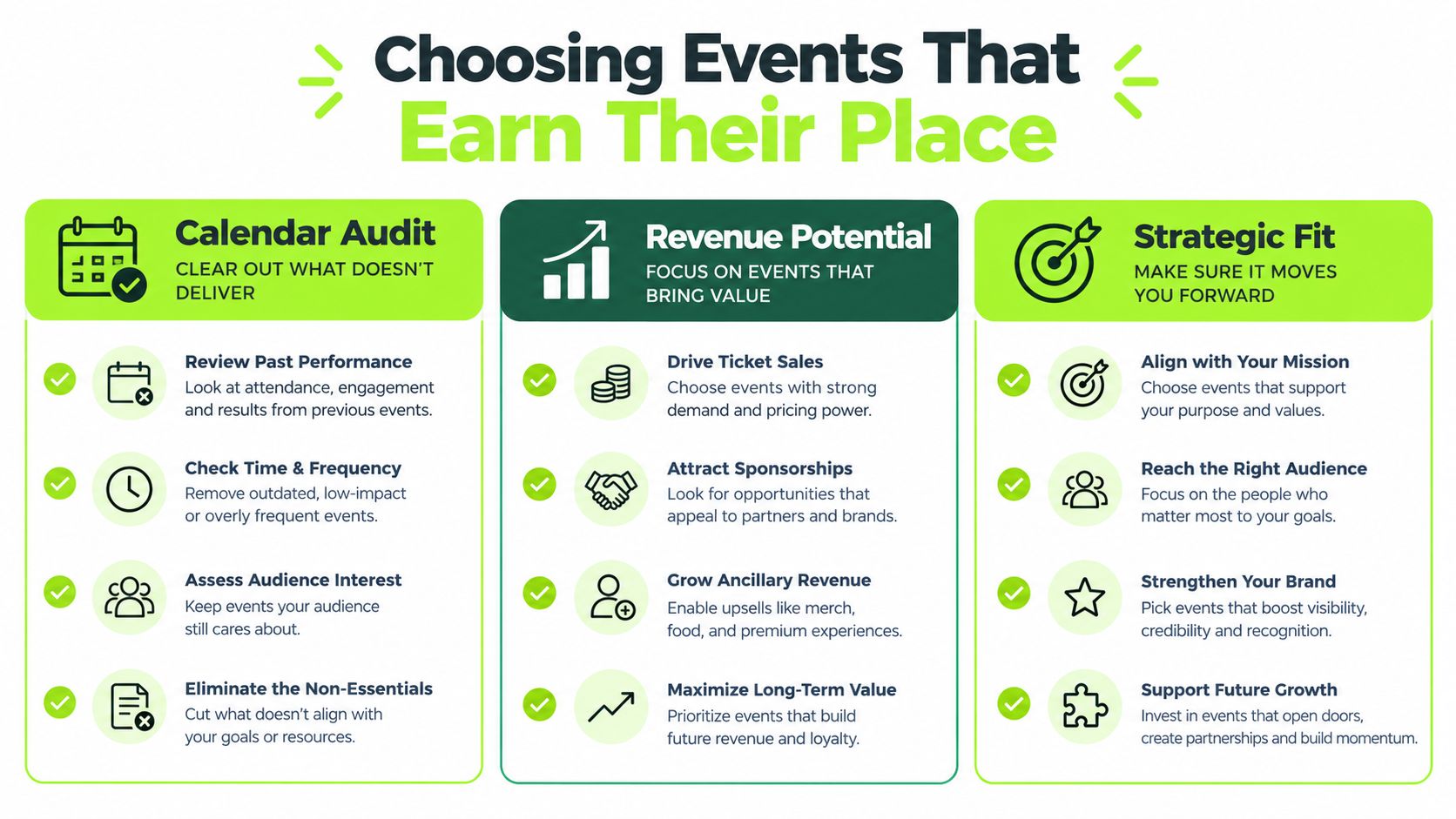
For each proposed event, set an exit criterion such as insufficient registrations by an agreed review point, weak margin after direct costs or no credible follow-on offer. This protects the calendar from events that survive only because someone has always run them.
Knowing Who You Are Actually Trying to Attract
A single generic open day usually asks too much of one message. A lapsed member wants reassurance that the club feels welcoming again. A corporate organiser wants confidence in timings, hospitality, parking, catering and professionalism. A prospective member needs to understand whether the club suits their ability, schedule and social expectations.
Segmentation is not just labelling people by age or postcode. It means identifying what an attendee needs to believe before booking. That belief determines the offer, creative, channel and follow-up.
| Segment | Trigger to attend | Offer that converts | Main booking barrier |
|---|---|---|---|
| Existing members | A reason to play or bring someone new | Member-guest format, competition or hosted social event | Low perceived novelty |
| Lapsed members | A personal invitation or change at the club | Relaxed hospitality taster with a named welcome | Concern that the old experience hasn't changed |
| Corporate bookers | A client, team or networking requirement | Structured golf and networking package with clear logistics | Uncertainty over value and organisation |
| Prospective members | Curiosity about membership or local golf | Guided trial round, coaching-linked taster or open evening | Fear of not fitting in or being good enough |
| Tourists and society organisers | A group trip, annual day or destination search | Transparent package with food, scoring and booking support | Price, availability and organiser workload |
Match the event to the job
For lapsed members, the conversion task is emotional and practical. Show the people, clubhouse atmosphere and flexible ways to return. A personal invitation from a familiar professional can outperform a polished general advert because it answers the question, “Will I be comfortable going back?”
Corporate events need a different structure. The organiser is buying reliability as much as golf, so the booking page should make the day easy to approve internally. Include arrival, format, catering, networking space and named support rather than relying on scenic course photography.
Prospective members often need a low-pressure first step. Coaching-linked tasters, short formats and hosted introductions can reduce anxiety better than a competitive open competition. For society organisers, the offer should reduce administration through clear pricing, availability, food choices and a straightforward contact route.
England's participation base has expanded materially. The R&A's account records an increase in England's estimated regular participation rate from 2.5% to 4.2%, with 820,316 more estimated regular golfers than in its 2016 report, so clubs have an opportunity to build programmes for different types of golfer rather than forcing every audience into the same event.
Building the Event Marketing Plan From Brief to Booking Page
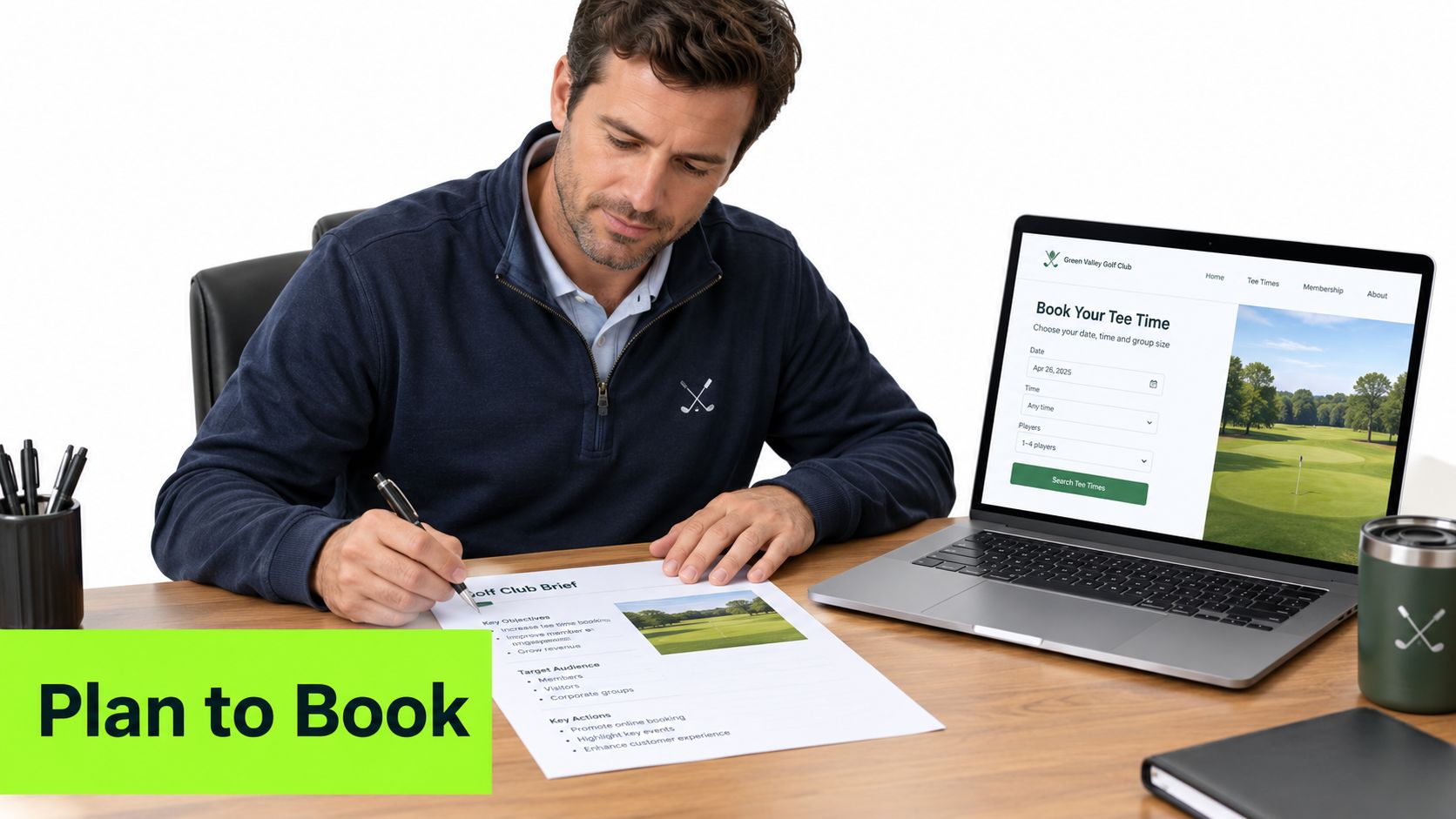
The event brief should fit on one page. If the team can't state the proposition clearly there, a landing page won't rescue it.
Write down the commercial objective, audience, capacity, price point, date, inclusions, booking deadline and success metric. Add the event owner and the next offer attendees will receive. A membership taster might lead to a trial membership or guided visit, while a corporate day might lead to a sales conversation and annual rebooking proposal.
Build the booking path first
The booking page should live on a recognisable club domain or within the club's existing booking environment. Keep the form limited to information needed to fulfil the booking and qualify the opportunity. Name, email, phone, attendee or team details and any relevant preference are usually more useful than a long questionnaire that creates friction.
Capture payment or a deposit at the point where the commitment is made. Make the cancellation terms, dress code, arrival instructions, parking, format and food arrangements visible before the visitor submits the form. Confirmation should trigger immediately and include a calendar invitation, contact details and a clear route for questions.
Use a short asset list:
- Hero image: show the relevant experience, not just an empty fairway.
- Social video: use a brief course, clubhouse or attendee-led clip.
- Email creative: lead with the audience benefit and booking action.
- Clubhouse flyer: include a QR code and a concise reason to attend.
- Proof points: use genuine attendee feedback or approved photographs.
A UK club rebuilding a corporate day page would sensibly test the proposition, form length, deposit process and proof together. Don't claim success from a prettier page alone. Track the page's enquiry and booking behaviour against the previous version, then keep changes that improve commercial performance without lowering lead quality.
The clubhouse itself is part of the event experience. For open houses, a coordinated staff appearance, signage or small branded items can help attendees identify hosts and remember the club. A useful external reference for planning that detail is this guide to custom apparel strategy for open houses, but the club should choose apparel that feels appropriate to its brand rather than turning a welcoming event into a trade-show stand.
For the wider operational sequence, GolfRep's clubhouse event marketing strategy provides a relevant commercial reference. The principle is simple: the booking page, staff briefing, confirmation message and post-event offer must be designed as one connected journey.
Selecting Channels That Fit Each Event Type
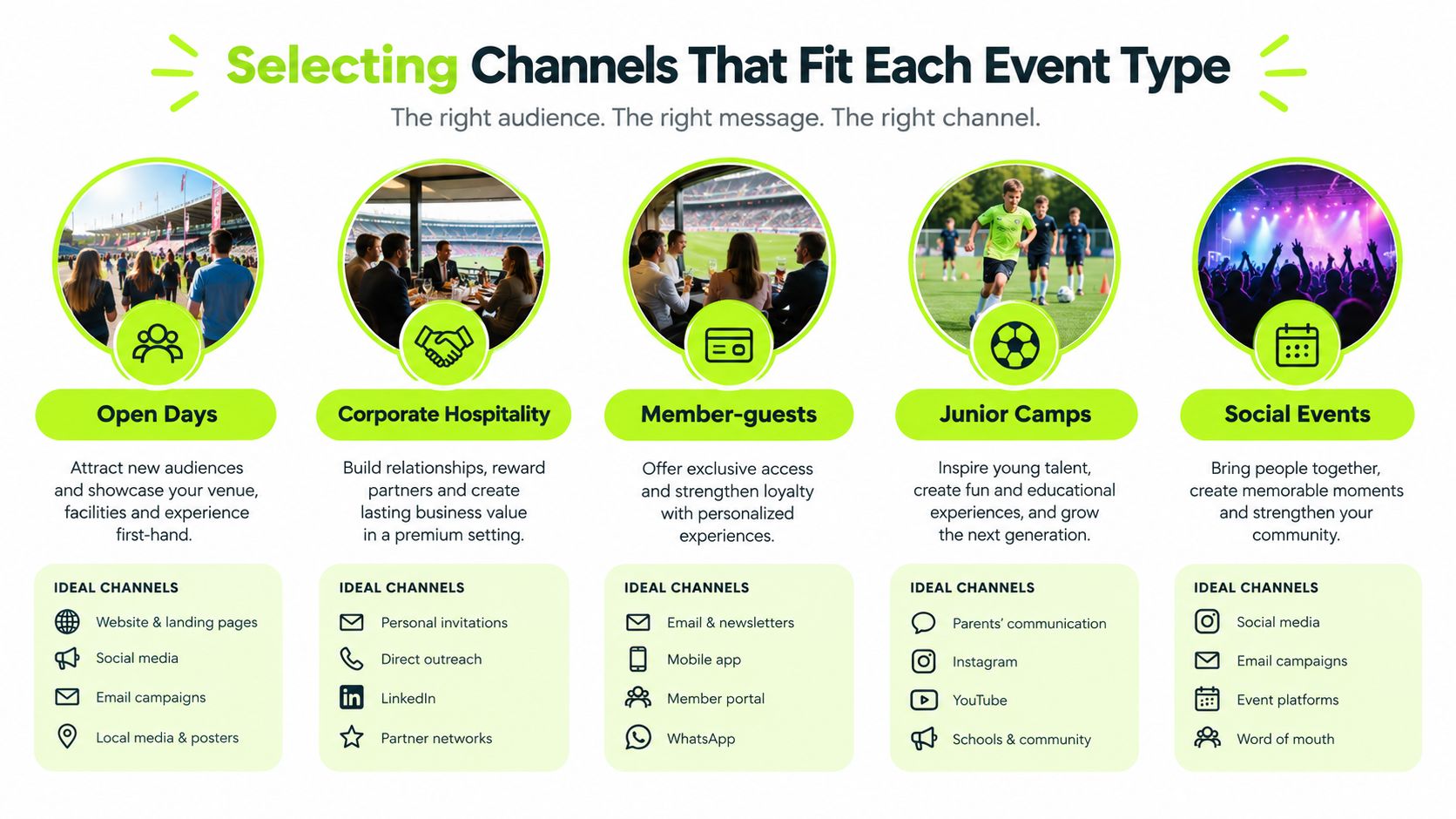
Channel choice should follow the buyer, not the habit of the person managing the club's social account. A junior camp, corporate hospitality day and member-guest competition may all use email and social media, but they need different emphasis, creative and booking routes.
Give every channel a defined role
Email is the direct-response channel for known audiences. Segment existing contacts by playing frequency, previous event attendance, membership status and relevant spend where the data is available. A lapsed member should receive a re-entry invitation, not the same message sent to a regular competition player.
Social media creates awareness and validation. Use short videos of the course, previous events, member testimonials and visible clubhouse activity. Send people to a dedicated landing page rather than asking them to find booking information through a series of posts. Social can support a final reminder, but it shouldn't carry the entire conversion burden.
Local paid activity captures active intent. Google Search can target searches related to golf days, venues, lessons or local events. Geo-targeted Meta activity can introduce an open day or social format to nearby people who haven't yet joined the database. Keep the audience and landing page aligned, otherwise the club pays for attention that doesn't translate into a relevant booking.
Partnerships extend reach through trust. Hotels, PGA professionals, county unions, nearby businesses and destination partners can share event information with audiences that already have a reason to visit the area. Agree the asset, deadline and booking route so cross-promotion doesn't become a vague promise to “share something soon”.
A useful planning discipline is to map audiences and pick channels before producing creative. The same exercise works well for golf clubs because it forces the team to separate awareness, intent and direct response.
Match the mix to the format
An open day normally benefits from segmented database email, local search, social proof and community partnerships. Corporate hospitality should lean more heavily on direct organiser outreach, LinkedIn connections, local business networks and personal invitations. A member-guest event should begin with the member database, while a junior camp needs parent-focused local activity, school relationships and clear safeguarding information.
The channel report should record source, registrations, attendance and downstream outcome. If a channel creates views but no qualified bookings, change its job or reduce its budget.
Following Up Faster Than the Next Club Down the Road
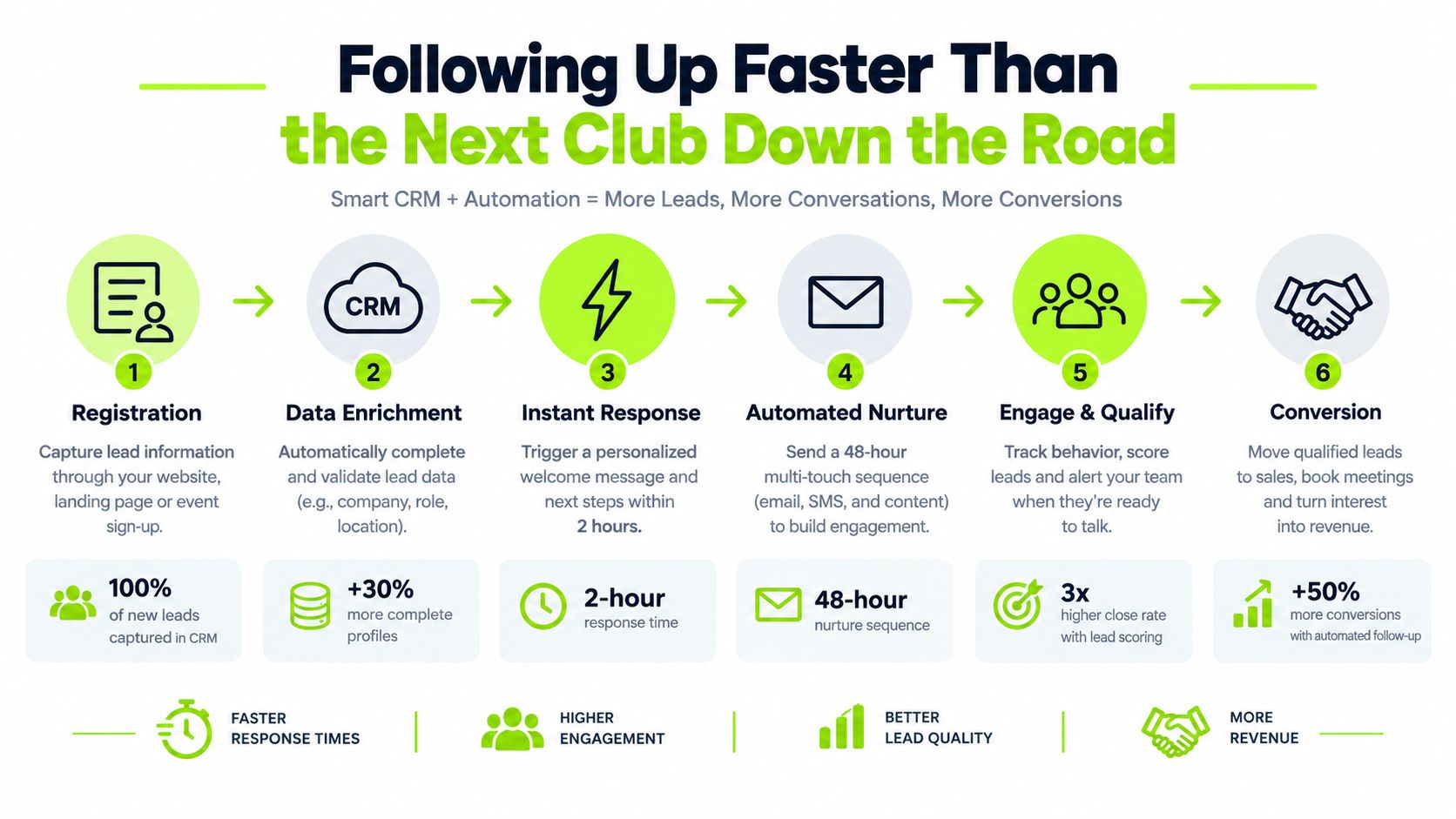
An event registration creates a commitment, but it doesn't guarantee attendance or future value. The club needs a sequence that reassures the attendee, reduces uncertainty and gives staff a clear point at which personal contact matters.
Set the flow before promotion starts
A lightweight setup can use Mailchimp for email, a basic CRM for contact ownership and a booking form that passes registration data into both. Larger clubs may connect an integrated club management system with membership, tee-time and event records. GolfRep can be included as one option where a club needs connected advertising, CRM and automated nurture across the event journey.
Use these stages:
- Registration: create or update the contact, record the event, source, attendee type and next action.
- Immediate confirmation: send booking details, calendar information, payment status and contact instructions.
- Same-day personal reply: a named club contact responds within four working hours, particularly where the booking signals membership or corporate potential.
- Reminder sequence: send reminders seven, three and one day before the event, each adding useful information rather than repeating the same invitation.
- Attendance update: mark attended, cancelled or no-show on the day.
- Post-event branch: move attendees and no-shows into different follow-up tracks.
The automation should remove uncertainty. It shouldn't remove the human welcome.
A high-value corporate enquiry deserves a personal call, even if the automated confirmation has already arrived. Staff should know who owns the contact, what the organiser wants to achieve and when the next conversation is due.
Adaptable message templates
Confirmation
Thanks for booking [event name] at [club]. Your place is confirmed for [date]. Please arrive by [time] for [briefing or welcome]. You'll find parking, dress code and the day's format below. Add the event to your calendar here: [link]. If you have a question, contact [named person] on [details].
Personal reply
Hello [name], I'm [staff member] from [club]. I wanted to introduce myself before [event name] and check whether you need anything arranged, particularly around [golf format, catering or guests]. I'll be available when you arrive and will make sure you know where to go.
Reminder
[Event name] is coming up on [date]. Please arrive at [time], use [parking instruction] and bring [relevant item]. We've attached the running order and catering details. If your plans have changed, reply to this email so we can help.
Post-event attendee follow-up
Thank you for joining us at [event name]. Based on what you enjoyed, we'd suggest [trial membership, lesson package or next event]. Would you like [named contact] to arrange a short visit or talk through the options?
Post-event no-show follow-up
We missed you at [event name]. If the date didn't work, we can offer [alternative date or different format]. Reply with what would suit you and we'll recommend the most suitable next step.
The GolfRep follow-up system is relevant for clubs formalising ownership, timing and branching. The important point is not the software brand. It's that every registration receives a planned next action.
Measuring What an Event Actually Returned
Attendance is a useful operating measure, but it's a poor commercial verdict on its own. A full event can still fail if the club carried excessive direct costs, attracted people with no realistic route to return or neglected the follow-on offer.
The club should report two types of measure. Leading indicators show whether promotion and booking are working while there's still time to adjust. Lagging indicators show what the event contributed after the day has finished.
Report the funnel before the event
Track:
- Enquiry-to-registration conversion rate, separated by channel where possible.
- Cost per registration by channel, including paid media and meaningful production costs.
- Email open and click rates, treated as engagement signals rather than revenue proof.
- Landing page drop-off, especially at the form and payment stages.
- Registration pace against capacity, so the team can change the message or channel mix before the deadline.
A UK-focused benchmark cited in golf club marketing guidance reports website visit-to-lead conversion at about 5.13%, lead-to-opportunity conversion around 13%, and approximately 6% of opportunities converting to sale, with roughly 84 days to opportunity and 18 more days to sale. These figures are reported in the Hillier Hopkins golf clubs survey. They shouldn't become a target for every event, but they do underline why a registration needs a defined commercial journey rather than a thank-you email and silence.
Close the loop after attendance
The post-event review should include attendance rate, on-day spend, membership trials started, memberships closed within thirty days, lesson packages sold, corporate leads passed to sales and net revenue after direct event cost. If the event has a community or retention purpose, record that objective separately instead of pretending every outcome is a membership sale.
| KPI | Stage | Target Bench |
|---|---|---|
| Enquiry-to-registration conversion | Promotion | Set by event type and previous club baseline |
| Cost per registration | Promotion | Below the approved acquisition allowance |
| Landing page drop-off | Promotion | Investigate every major form or payment abandonment |
| Attendance rate | Event day | Compare with registration quality and reminder activity |
| On-day spend | Event day | Track by attendee and event package |
| Membership trials started | Post-event | Agree before launch for acquisition events |
| Memberships closed within thirty days | Post-event | Report by source and attendee segment |
| Corporate leads passed to sales | Post-event | Record owner and next action |
| Net revenue after direct cost | Thirty-day review | Positive contribution or documented strategic reason |
| Repeat booking or rebooking | Thirty-day review | Measure for societies and corporate formats |
Run the reporting in three stages. Use a live dashboard during promotion, complete a same-day operational wrap and hold a thirty-day commercial review. The final review should decide whether to repeat, reshape, pause or remove the format.
For practical guidance on post-event reporting tips, focus on recording decisions as well as results. A report that says attendance was strong but doesn't identify the next action leaves the club with information and no learning system.
GolfRep's guidance on golf club event revenue follows the same commercial principle. Compare events on contribution, audience quality and future value, then reinvest in the formats that earn their place.
GolfRep helps golf clubs connect event marketing with acquisition, sales processes, CRM, follow-up, conversion and retention, so each event has a clear route from booking to revenue. If you want to identify which formats are producing value and where the commercial process is leaking, visit GolfRep to discuss a practical growth plan.
Ready to tap into our proven growth system?