A Guide to Using a Golf CRM System for Club Growth
For many UK golf clubs, things look good on the surface. The tee sheets are packed, the course is buzzing, and membership enquiries keep rolling in. But despite this activity, genuine, sustainable growth often feels just out of reach. The problem for most clubs is not a lack of interest; it's the operational chaos that kicks in the second an enquiry lands.
The Hidden Growth Problem Facing Every UK Golf Club
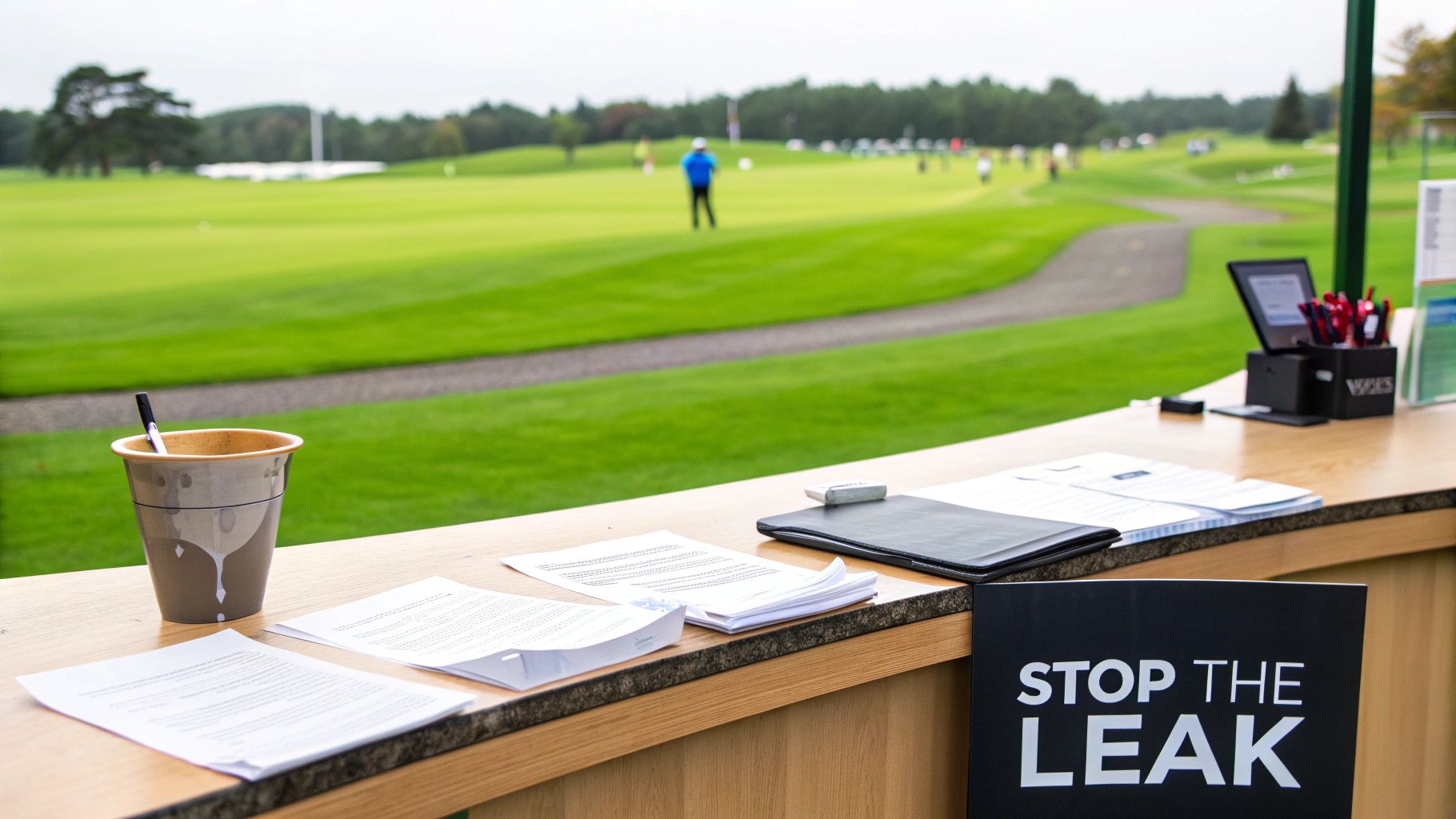
Imagine your new member pipeline is a bucket. All your marketing and advertising efforts are pouring water, new enquiries, into it. But if that bucket is full of holes, you will lose water faster than you can fill it, no matter how much you pour in. This "leaky bucket" is the single biggest thing holding clubs back.
These leaks are not marketing failures. They are operational gaps, created by manual processes and outdated systems that simply cannot keep up. Every potential member you lose is a direct consequence of these internal issues.
Where Your Club Is Losing Revenue
The most common leaks are often hiding in plain sight, brushed off as just "how things are" for a busy club. Sound familiar?
- Slow Response Times: A potential new member sends an enquiry but does not hear back for hours, maybe even days, because staff are tied up with on-site duties. By the time you reply, their initial spark of interest is gone, or worse, they have already had a conversation with a rival club down the road.
- Lack of Lead Visibility: Enquiries are all over the place. Some are in one person's inbox, others are scribbled on a notepad, and a few are buried in voicemail. There is no single, clear view of every potential member, where they are in the process, or what needs to happen next.
- Inconsistent Follow-up: With no real system in place, following up is hit-and-miss. That person who asked for a tour never gets a reminder, and a great chat with a prospective member is forgotten in the daily rush.
This operational drag means that even clubs seeing a boom in play are leaving a serious amount of money on the table. The demand for golf has never been higher. In the third quarter of 2023, Great Britain saw a 7% increase in total rounds played compared to 2022. That works out to over 10 extra rounds per course, every single day, stretching club resources to breaking point. You can read more about the recent surge in UK golf participation to get the full picture.
This is not about working harder; it is about working smarter. The solution lies in building a system that captures, nurtures, and converts the interest you are already generating.
Plugging these leaks is the essential first step to building a predictable pipeline of new members. It means shifting from reactive, manual tasks to a structured, organised approach. A golf CRM system is the tool built specifically to fix this problem, turning that leaky bucket into a secure reservoir of future revenue.
What Exactly Is a Golf CRM System?
When club managers hear “CRM”, they often picture some overly complex corporate software that feels completely out of place at a golf club. But let’s clear that up. A Customer Relationship Management (CRM) system is really just a simple tool built to do one job well: manage all your club’s conversations with prospective and current members.
Forget the tech jargon for a moment and think of it as your club’s central memory. It’s the one place that remembers every single enquiry, phone call, email, and tour. Instead of having that crucial information spread thin across different staff inboxes, scribbled on notepads, or buried in a messy spreadsheet, a golf CRM system brings it all together in one organised, easy-to-access hub.
Suddenly, you have a single, reliable source of truth for your entire membership pipeline. At its heart, a CRM replaces chaos with clarity.
Moving Beyond Spreadsheets and Sticky Notes
For years, clubs have got by with manual methods for tracking membership leads. A spreadsheet seems good enough on the surface, but it is a completely passive tool. It cannot ping you with a reminder to follow up, it cannot log your communication history automatically, and it certainly cannot show you which prospects need a nudge at a glance.
This is exactly where those operational leaks we talked about earlier come from. That forgotten follow-up email or the phone number lost on a sticky note is not just a small mistake, it is a genuine missed opportunity for predictable revenue.
A proper golf CRM is built to be an active part of your team. It is an engine designed to methodically guide an enquiry from a casual website visit all the way to becoming a fully paid-up member. It provides the structure that was missing before.
A CRM does not just store contact details; it manages the entire relationship-building process. It ensures every potential member receives the right communication at the right time, turning sporadic interest into a predictable pipeline.
Core Concepts Explained Simply
The easiest way to get your head around a golf CRM is to break it down into its core functions. These are the practical, day-to-day tools that bring order and predictability to your membership growth efforts.
- Lead Tracking: This is where the system catches an enquiry from any source, your website contact form, a social media message, a walk-in, or a phone call, and instantly places it into an organised pipeline. You get immediate lead visibility, which means no potential member can ever fall through the cracks again.
- Communication History: Every email you send, every phone call you log, and every note you make is automatically attached to a prospect's file. This gives anyone on your team the complete backstory, making sure every follow-up is personal, relevant, and timely.
- Pipeline Management: This gives you a clear, visual overview of where every potential member is in your sales journey. You can see at a glance who is a brand-new enquiry, who has been sent a brochure, who has a tour booked, and who is on the brink of joining.
By putting all this information in one place, a CRM shifts your approach from being reactive and inconsistent to proactive and structured. It’s the difference between hoping for new members and building a system that reliably creates them.
Manual Tracking vs a Golf CRM System
The limitations of traditional methods become starkly clear when you compare them directly against the capabilities of a modern CRM.
As you can see, relying on manual systems leaves too much to chance. A CRM provides the automation and organisation needed to build a professional, consistent, and ultimately more successful membership recruitment process.
Core Features That Drive Predictable Club Growth
A golf CRM system is more than just a piece of software; it is the engine that powers a repeatable, reliable process for growing your membership. While different platforms offer all sorts of bells and whistles, a handful of core features are absolutely essential for turning sporadic enquiries into a predictable revenue pipeline.
These are the tools that solve the most common, and frustrating, bottlenecks that UK golf clubs face every day.
The most fundamental feature is automated lead capture. Think about it: when a potential member fills out an enquiry form on your website, where does it go? Too often, it lands in a busy inbox or gets jotted down on a notepad, only to be forgotten. A good CRM instantly and automatically creates a new contact profile for them, meaning you never miss a single opportunity.
This simple, hands-off process gives you complete lead visibility. Every prospect is accounted for, creating a single, organised pipeline that your team can actually manage.
Instant and Intelligent Communication
Once a lead is in the system, the speed and quality of your response is everything. This is where a golf CRM really starts to flex its muscles. An effective system can be set up to send an instant, personalised email or SMS response the second an enquiry lands, day or night, weekend or weekday. This immediate reply tells the prospect you’re on the ball and that their interest matters.
But it goes much deeper than just a quick confirmation. The real power is in automated follow-up sequences. You can program the CRM to send a series of timed, relevant messages over several days or weeks, nurturing that initial spark of interest.
For example, a typical sequence might look like this:
- Day 1: An instant confirmation email with a link to your digital brochure.
- Day 3: A friendly follow-up from the club manager, offering to answer any questions.
- Day 7: An invitation to book a tour of the facilities.
These intelligent sequences ensure no prospect ever falls through the cracks. They keep your club front-of-mind without your staff having to lift a finger, freeing them up to focus on what they do best: building relationships with people who are genuinely ready to talk.
By combining automated lead capture with structured follow-up, a golf CRM system ensures every enquiry is handled with professional consistency, transforming your club’s approach from reactive to proactive.
Centralised Data and Actionable Reporting
A powerful golf CRM becomes your club's command centre for every prospect interaction. It gives you a single, unified view of every potential member, tracking everything from their original enquiry to a complete history of all communications and their current stage in your membership pipeline (e.g., "New Enquiry," "Tour Booked," "Decision Pending").
This central hub brings much-needed clarity and accountability to your growth strategy. Any member of your team can pick up a conversation and have the full context instantly.
Better yet, all this data fuels powerful, actionable reporting. At a glance, you can track essential metrics like your average response time, your conversion rate from enquiry to club visit, and the total value of your membership pipeline.
This level of insight has never been more important. In the first half of 2025, England saw a record 11.83 million scores submitted to the World Handicap System, a 16% jump from the previous year. This surge represents a massive opportunity for clubs to convert a new wave of golfers into paying members, a task made far easier with a data-driven CRM. You can discover more insights on the growth of golf participation and what it means for clubs.
Together, these core features create a robust system that does not just manage contacts, it actively drives predictable growth.
How a CRM Brings Your Membership Pipeline to Life
It is one thing to read about the features of a golf CRM, but it is another thing entirely to see it in action. So, let's step away from the theory and look at how this technology actually works day-to-day.
We will follow the journey of two very different enquiries, a prospective new member and a high-value corporate event, to see how a central system can turn scattered interest into a reliable growth engine. These examples show the real-world difference between scrambling with manual methods and adopting a structured, system-driven approach to growing your club.
From a Facebook Ad to a Signed-Up Member
Let's start with a common scenario. Imagine a potential member, we will call her Sarah, spots a targeted Facebook ad for your club's new flexible membership. Intrigued, she clicks through, lands on your website, and fills out a short enquiry form.
Without a CRM, that lead probably lands in a general email inbox, where it could easily get lost in the shuffle for hours, or even days. With a golf crm system in place, the entire sequence changes.
- Instant Capture: The second Sarah hits 'submit', the CRM springs into action. It automatically creates a new contact record for her and places her into the "New Membership Enquiry" pipeline. No manual data entry, no risk of her enquiry being overlooked.
- Immediate, Automated Welcome: Within 60 seconds, Sarah receives a personalised email. It thanks her for her interest and includes a link to download the membership brochure. This instant reply makes a fantastic first impression and shows you are on the ball.
- Intelligent Nurturing: The system does not stop there. Three days later, it sends a follow-up email from the club manager, checking in to see if she has any questions. A few days after that, another automated message invites her to book a tour of the club through a simple online calendar link.
- Seamless Booking & Follow-Up: Sarah clicks the link and books a tour for Saturday afternoon. The CRM immediately notifies the right member of staff, blocks out the time in their calendar, and sends Sarah a confirmation email, followed by a friendly reminder the day before.
- Closing the Deal: After a great tour, the staff member updates Sarah's status in the CRM to "Membership Offered." This simple action triggers one last automated email, this time with a direct link to the online sign-up form.
Every single interaction is logged. Every step is guided by the system. This ensures a consistently professional experience that methodically turns a flicker of interest into a committed member, all while freeing up your team's valuable time.
This diagram shows you exactly how this flow works, moving from capturing a lead to nurturing them towards conversion.
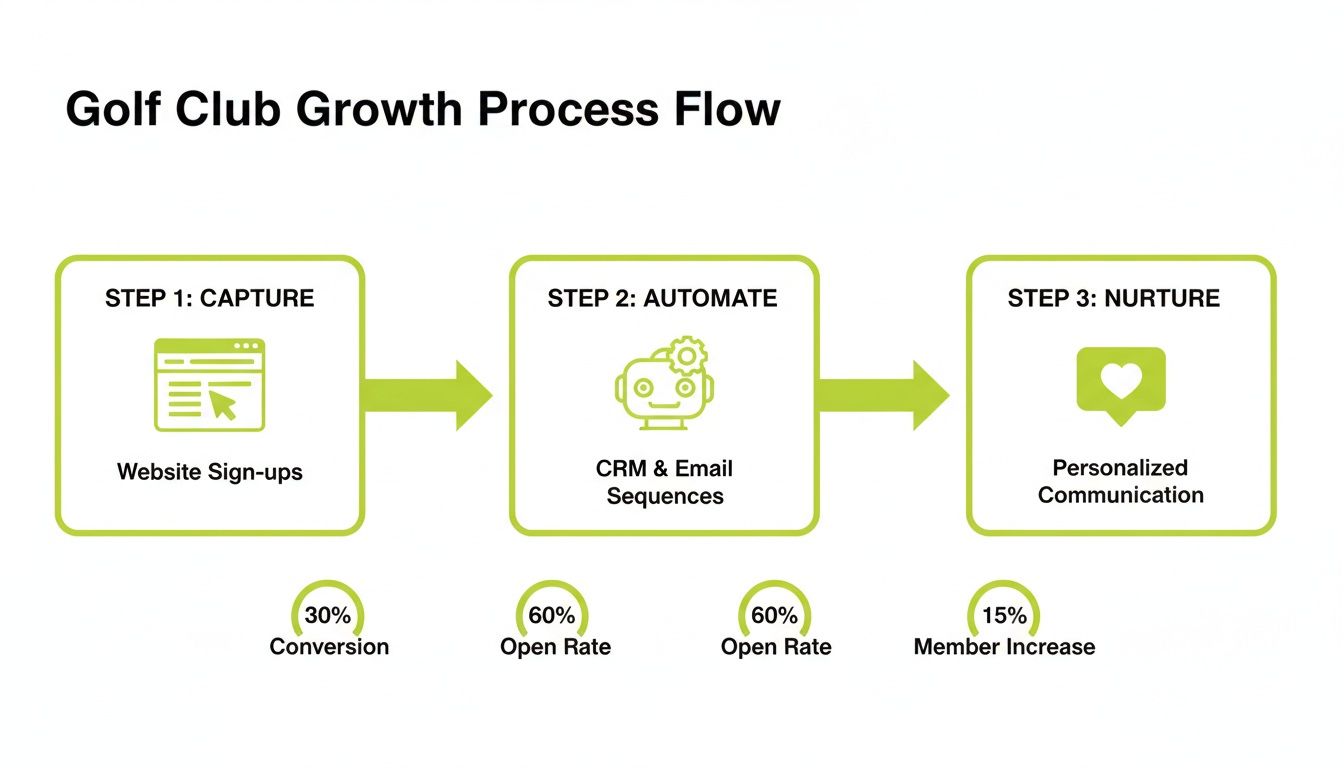
This systematic approach makes sure no lead ever falls through the cracks, guiding every prospect smoothly from A to B.
Managing High-Value Corporate and Society Bookings
Now for a higher-stakes situation: a corporate events manager gets in touch about a society day for 40 guests. These bookings are a massive revenue driver, but they come with a lot more complexity than a single membership.
The UK golf tourism market is projected to hit USD 6.9 billion by 2035, and corporate golf makes up a huge 35% share of that pie. To get a piece of this action, you need more than a spreadsheet. You need a sophisticated way to handle these high-value leads.
A CRM provides the structure you need to manage these deals without dropping the ball.
A golf CRM gives you complete visibility over your future revenue pipeline. It transforms high-value group bookings from one-off events into a predictable, repeatable source of income by ensuring professional and timely follow-up.
When the corporate enquiry comes in, the CRM logs it and instantly notifies your events manager. They can then use a customised "Society Bookings" pipeline to track the deal through every stage, from "Initial Enquiry" and "Proposal Sent" to "Negotiation" and "Confirmed Booking." Every email, quote, and contract is stored in one central place.
But here’s the most important part. After the event is over, the CRM can automatically create a task for your manager to follow up in nine months to secure a repeat booking for next year. This proactive, system-driven approach is the secret to building long-term relationships and predictable income streams. The ability to manage your leads effectively is a critical part of building a stronger online presence for your golf course.
Implementing Your First Golf CRM System

Bringing in new technology can feel daunting, but the right approach makes all the difference. Implementing a golf CRM system is not about flipping a switch and hoping for the best. It is a carefully managed process, designed to build momentum and deliver real value right from the start. Think of it as turning a powerful concept into a practical tool that fuels your club's growth.
The whole journey begins with getting crystal clear on your objectives. Before you even look at the software, you need to define what success looks like for your club. Vague goals like "get more members" just will not cut it. You need specific, measurable outcomes that the CRM is there to help you hit. This gives the project a real sense of purpose and a benchmark for success down the line.
Setting Clear Goals and Priorities
Your implementation goals should be a direct answer to your club's biggest headaches. Look at the operational gaps we have talked about and set firm targets to close them.
Here are a few examples of strong, clear-cut goals:
- Reduce average lead response time to under five minutes.
- Increase booked club tours by 20% within six months.
- Achieve a 95% follow-up rate on all new membership enquiries.
Targets like these give you a clear brief for setting up the CRM and provide your team with something tangible to work towards. This ensures you are building a system that actually solves problems, not just adding another piece of software to your plate.
A successful CRM implementation is less about the tech and more about the process. When you focus on your goals and how your team works first, you ensure the system is built to serve your club, not the other way around.
Migrating and Organising Your Data
Once your goals are set, it’s time to get your data in order. For many clubs, this means pulling together contact information from all over the place: old spreadsheets, forgotten email inboxes, maybe even dusty filing cabinets. This is your chance for a clean slate, a perfect opportunity to tidy up your contact lists and make sure everything is accurate and organised.
The migration itself involves importing all those contacts into your shiny new CRM. A good partner, like GolfRep, will walk you through this process, making sure your data is mapped correctly. This allows you to segment your audience for targeted marketing from day one. It is a foundational step that is often rushed, but getting it right is absolutely critical for the system's long-term success. The right systems are a key part of what makes an effective golf marketing agency partnership work.
Customising Your Pipeline and Training Your Team
Finally, it’s time to mould the CRM to fit your club’s unique membership journey. This means building a sales pipeline with stages that mirror your real-world process, like "New Enquiry," "Tour Booked," "Proposal Sent," and "Member Joined." Customising it this way makes the system feel natural and intuitive for your team.
Training is the final piece of the puzzle. The focus here should be on practical, day-to-day use. Show your staff how the CRM makes their jobs easier and helps them hit their targets. We always recommend a phased rollout, starting with core features like lead capture and automated follow-ups. This lets the team build confidence without feeling overwhelmed, ensuring a smooth transition and rapid adoption. It’s how your club starts seeing a return on investment almost immediately.
Measuring Success with Metrics That Matter
A new system is only as good as the results it delivers, and a golf CRM system finally gives you the power to measure what actually matters. It is time to stop chasing vanity metrics like website clicks or social media likes and start focusing on the Key Performance Indicators (KPIs) that directly impact your club's health and growth. Without solid data, you are flying blind, making critical decisions based on gut feelings rather than hard evidence.
Think of a CRM dashboard as your club's control centre. It pulls all the crucial numbers into one place, giving managers and committees the clarity they need to steer the ship with confidence and make strategic decisions that lead to predictable results.
Key Performance Indicators to Track
Instead of drowning in spreadsheets, your CRM should shine a spotlight on the handful of metrics that tell the most important stories about your membership pipeline.
Here are the essential KPIs every golf club should be watching:
- Lead Response Time: How long does it take your team to follow up with a new enquiry? A quick response is one of the single biggest factors in capturing a prospect's interest. A slow one is a guaranteed way to lose them to a rival club down the road.
- Enquiry-to-Visit Conversion Rate: What percentage of people who enquire actually book a tour of the club? This number tells you exactly how effective your initial follow-up process is at getting people through the door.
- Visit-to-Member Conversion Rate: Of those who visit, how many become fully-fledged members? This metric is a direct reflection of your on-site experience and your team's ability to sell the value of your club.
Tracking these KPIs gives you an honest, clear-eyed view of your pipeline's strengths and weaknesses. If your enquiry-to-visit rate is low, you know your initial follow-up needs a rethink. If your visit-to-member rate is lagging, it’s time to analyse and improve the tour itself.
Understanding Your Pipeline Value
Perhaps the most powerful metric your CRM can give you is the total value of your membership pipeline. This is not guesswork; it is a live calculation of the potential annual revenue sitting within all the prospects currently in your system.
By assigning a value to each stage of your sales process, you can begin to forecast future revenue with a surprising degree of accuracy. This is how you turn membership growth from a hopeful ambition into a predictable financial outcome.
For example, your data might show that prospects who book a tour have a 30% chance of joining. If you have ten prospects at that stage, and your average membership is £1,500, you can confidently forecast £4,500 in future revenue from that group alone.
This data-led approach is at the heart of effective golf course management. It gives the committee the concrete evidence needed to justify marketing budgets and proves the tangible return on investment from your growth efforts, reinforcing our commitment to performance-led partnerships.
Your Questions About Golf CRM Systems Answered
It’s only natural to have questions when considering a new system, even when the benefits seem clear. For club managers and committees exploring a golf CRM system, these questions usually circle around the practicalities, the cost, the learning curve, and how it will play nicely with the software you already use.
Let's clear up some of the most common queries to show you how a CRM can slot into your club's operations and deliver real, tangible results.
Is a CRM Too Complicated for a Small Club Team?
Not at all. A modern golf CRM is built to make your life easier, not harder. Its entire purpose is to take over the repetitive, time-consuming jobs like sending initial replies to enquiries or chasing up with follow-up messages.
Think of it this way: the system handles the admin, freeing up your team to do what they do best, building relationships. They can spend their time on high-value interactions, like giving personal club tours or talking to genuinely interested prospects.
We make sure the system is set up for your club's specific needs, focusing on the most important functions first. With guided setup and proper training, your team will be up and running from day one, without ever feeling bogged down by features they don’t need.
How Is a Golf CRM Different from Tee Sheet Software?
This is a really important distinction to make. Your tee sheet software is fantastic for day-to-day operations. It is all about managing member play and bookings, serving the people who are already part of your club.
A golf CRM, on the other hand, is a growth engine. It is laser-focused on one thing: turning prospective members into paying members.
Tee sheet software manages the present: who is playing today. A CRM manages the future: building a pipeline of members for tomorrow.
While some tee sheet systems might include a basic contact list, they just do not have the tools needed for growth. They lack the automated follow-ups, lead nurturing sequences, and pipeline tracking that create a predictable stream of new revenue. The two systems are designed to be perfect partners, each fulfilling a vital but separate role for the club.
What Is the Typical Return on Investment for a CRM?
The return is measured in new, predictable revenue that you simply would not have captured otherwise. When you ensure that every single lead is followed up systematically, you directly increase your membership conversion rate. It is a simple numbers game.
Often, converting just two or three extra members who would have previously slipped through the cracks pays for the entire system for the year, many times over.
Beyond that, the CRM gives you crystal-clear data on which of your marketing efforts are actually working. This means you can invest your budget more wisely, stop spending money on what is not delivering, and generate a significant, measurable return that secures the club's financial health for the long term.
At GolfRep, we build predictable growth systems that combine intelligent marketing with the power of a dedicated golf CRM. If you are ready to stop losing leads and start building a reliable membership pipeline, let's talk.
Ready to tap into our proven growth system?