Facebook Ads for Golf Courses That Convert Enquiries

You've probably seen the pattern already. A club boosts a Facebook campaign, a handful of enquiries come in, everyone feels encouraged for two days, then the trail goes cold. Nobody can say which lead was contacted, who owns the follow-up, whether a visit was booked, or if any of it turned into a member.
That's why most Facebook ads for golf courses disappoint. The issue usually isn't the advert. It's the gap between the enquiry arriving and the club responding properly.
At GolfRep, we treat Facebook as a pipeline input, not a magic fix. Facebook still matters in the UK because Meta's ad tools estimated 38.3 million UK Facebook users in early 2025, equal to 55.2% of the total population and 64.6% of people aged 13+, with 69.6% of UK adults aged 18+ using the platform according to DataReportal's Digital 2025 UK report. The audience is there. The question is whether your club has the systems to convert that attention into booked visits and membership conversations.
Why Facebook Ads Fail Golf Clubs Without a Follow Up System
Most clubs blame targeting too early. They say the leads were poor, the area was wrong, or Facebook doesn't work for golfers. In many cases, the lead didn't fail. The process did.
A useful reality check comes from UK lead-response data. 78% of customers buy from the first company to respond to their enquiry, while UK businesses average 47-hour response times and only 7% reply within five minutes, according to Visionary Marketing's lead response time statistics. If your club takes half a day to answer a Facebook form, that's not a marketing problem. That's a sales process problem.
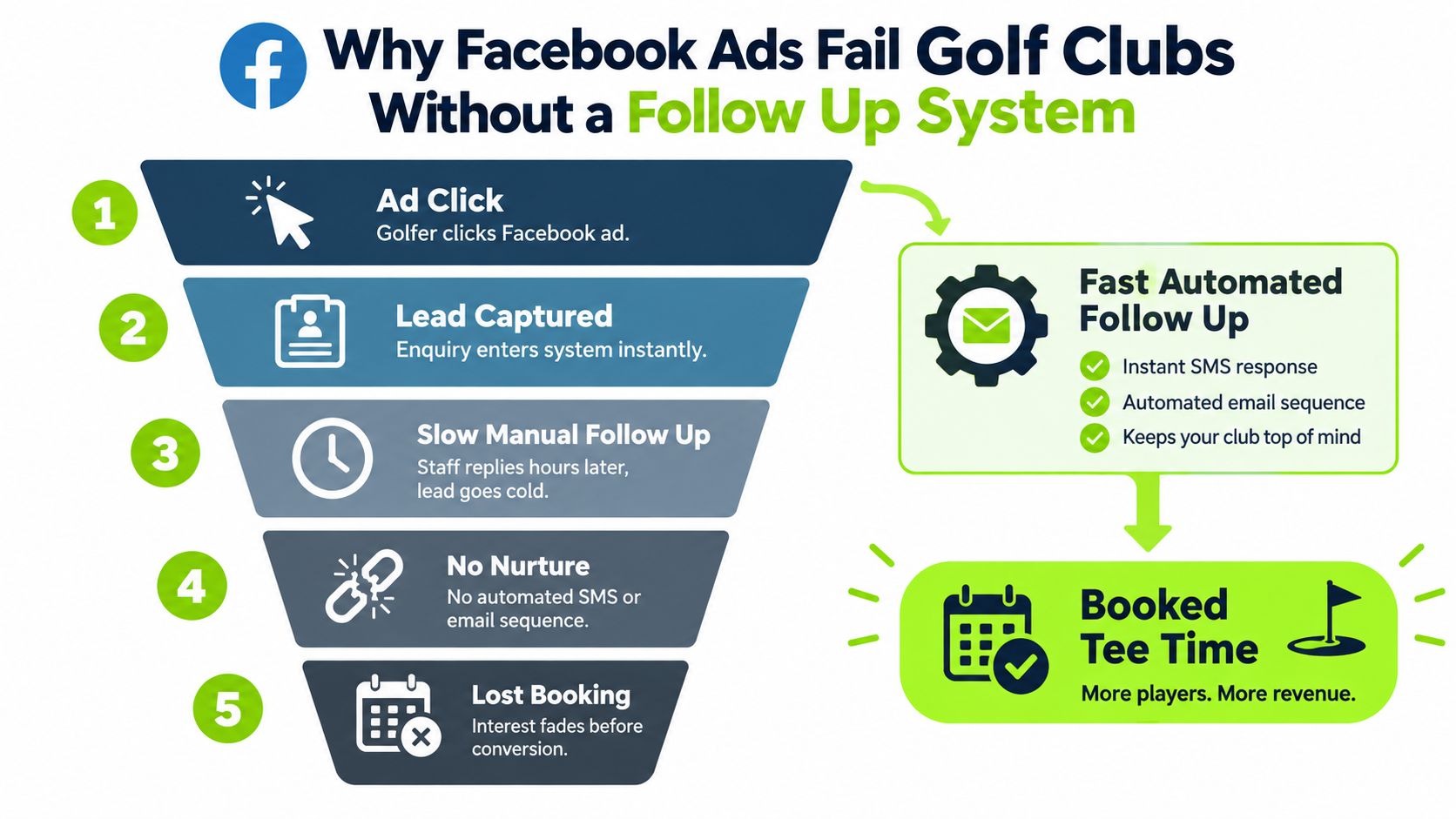
Enquiries go cold because clubs still handle them manually
Many golf clubs still route membership interest through a shared inbox, a contact form, or a front-office process built for admin rather than sales. Independent UK golf contact handling research shows that membership enquiries are commonly pushed through named emails, forms, or office contact routes instead of instant live sales handling, which is why lead visibility and process control matter so much, as noted in Survey Booker's lead response study.
That setup creates four predictable failures:
- No instant acknowledgement: The golfer submits the form and hears nothing back.
- No clear ownership: Staff assume someone else has picked it up.
- No qualification path: The club can't tell member prospects from casual browsers.
- No tracking: Committees end up debating ad spend without knowing what converted.
Practical rule: If a lead can sit unseen in an inbox, your Facebook ads are feeding admin, not growth.
The same issue shows up outside club membership too. Golf Problems reports on coach survey highlights how golf businesses continue adapting to digital channels, but using social media is not the same as having a system that turns incoming interest into revenue. Clubs need the second part.
More leads won't fix a weak pipeline
The wrong response to poor conversion is often “let's increase spend”. That usually makes the mess bigger. You don't need more names in a spreadsheet if the first batch wasn't worked properly.
A better way to judge Facebook ads for golf courses is simple:
- How quickly was the enquiry acknowledged
- Who followed up
- Was a conversation booked
- Did the golfer visit
- Did the visit convert
If you can't answer those five questions, don't scale. Fix the handover first.
For clubs trying to improve that handover, our view is the same as in this guide to a golf club follow up system. Response speed, lead ownership, and visibility across the pipeline matter more than squeezing one more interest into an audience setting.
How to Structure Facebook Campaigns for Membership and Visitor Growth
Clubs often cram everything into one campaign. Membership, society days, visitor green fees, open days, flexible offers. That's lazy account structure, and it makes reporting almost useless.
Facebook ads for golf courses need separate campaign architecture for separate business goals. A full membership prospect is not the same as a casual visitor. They shouldn't see the same message, land on the same page, or enter the same follow-up flow.
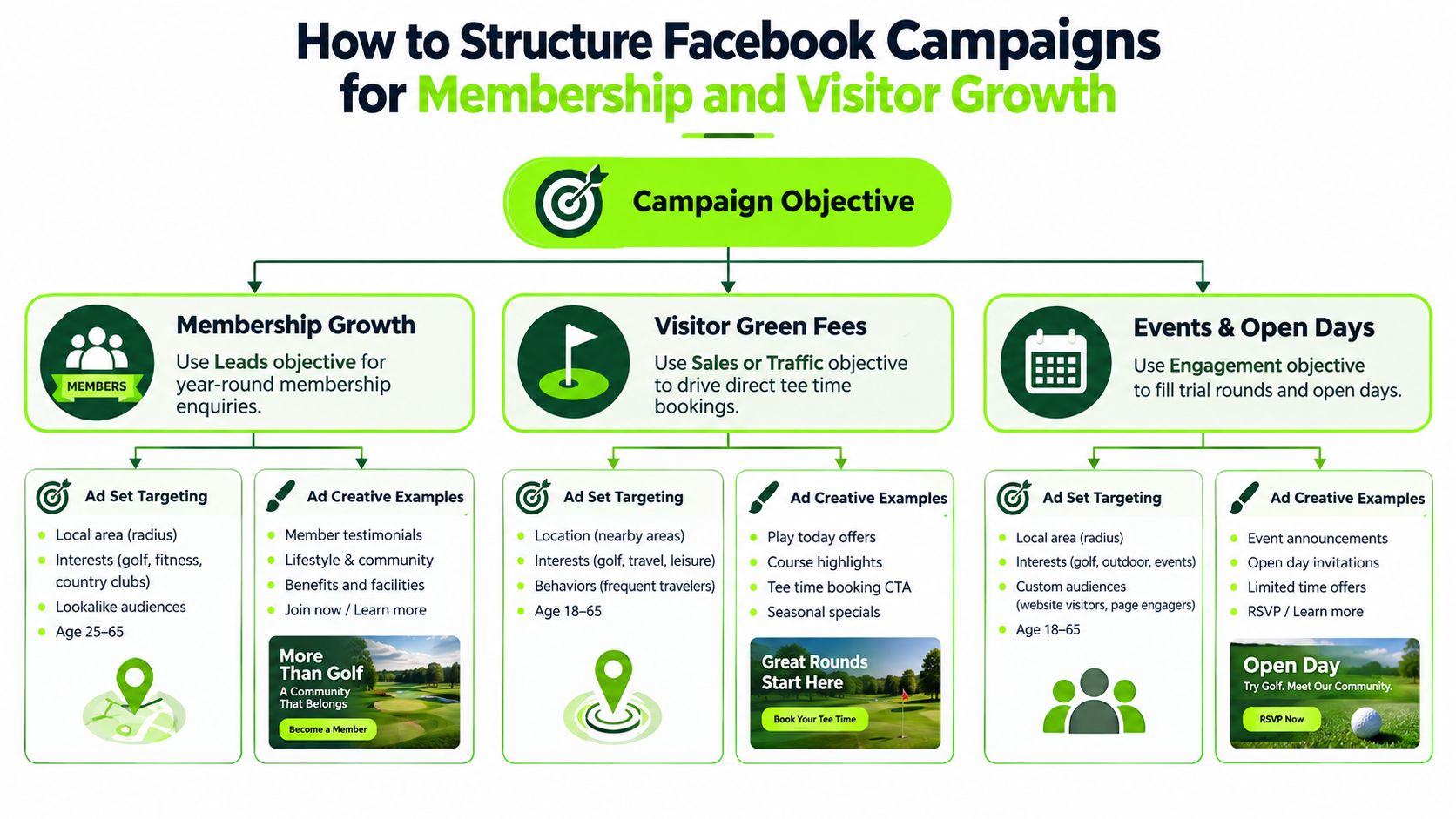
Build campaigns around offers, not around the platform
Use Meta objectives based on what you want the golfer to do next.
| Campaign type | Best fit | What the club should optimise for |
|---|---|---|
| Membership growth | Full, flexible, junior, or category-specific membership enquiries | Qualified leads and booked conversations |
| Visitor green fees | Direct tee time demand | Completed booking actions |
| Events and open days | Trial rounds, discovery events, academy taster days | Registrations and attendance |
That separation gives you cleaner reporting and cleaner follow-up. It also stops one strong offer masking the poor performance of another.
Keep each campaign narrow and accountable
A sound structure for most clubs looks like this:
- Membership campaign: One campaign dedicated to year-round member acquisition. Use lead forms or a focused landing page.
- Visitor campaign: A separate campaign pushing direct booking intent for local golfers and guests.
- Event campaign: Open days, trial days, or membership evenings should sit in their own campaign with their own deadlines.
Then split ad sets by meaningful variables, not random guesswork:
- Distance from club: Nearby villages and commuter zones often behave differently.
- Intent level: Retargeted site visitors should not be mixed with cold local audiences.
- Offer type: Flexible membership needs different messaging from a seven-day category.
Clubs get better results when they stop asking one campaign to do three jobs.
Use naming conventions that a committee can understand
If your reporting reads like internal Meta jargon, nobody at board level will trust it. Use plain labels. For example:
- Membership | Cold | Within local catchment
- Membership | Retargeting | Website visitors
- Visitors | Green Fees | Midweek booking
- Open Day | Local | Registration
That sounds basic, but it matters. Managers need to know where budget is going without needing an ad-platform translator.
A 2024 UK golf-club survey found social media was used as a marketing activity by 60% of members' clubs, while advertising was used by 38%, according to the Hillier Hopkins Golf Clubs Report 2024-25. That tells you something important. Advertising is still only one part of the acquisition system. It works best when email, referrals, and follow-up carry the prospect forward after the initial click.
Match every campaign to a specific next step
Don't send all traffic to the homepage. That's where intent goes to die.
Each campaign should have its own destination and process:
- Membership ad goes to a membership enquiry page or native lead form.
- Visitor ad goes straight to a relevant booking path.
- Open day ad goes to a registration page with date, value, and confirmation.
The simpler the handoff, the easier it is to measure what happened next.
Targeting Local Golfers Who Are Most Likely to Convert
Audience targeting is where clubs often become either too broad or too clever. Both are expensive. Broad targeting wastes spend outside your practical catchment. Over-complicated targeting narrows delivery before Meta has enough room to find likely responders.
The right approach is to match audience type to the offer. Not every golfer within reach of your club is a membership prospect, and not every membership prospect is ready for a full category straight away.

Four audience types and when to use them
Here's the simplest way to think about targeting.
| Audience type | Best used for | Watch-out |
|---|---|---|
| Radius targeting | Local membership and visitor demand | Too wide and you pay for people who won't travel |
| Interest targeting | Cold prospecting when local volume is limited | Interests alone don't prove buying intent |
| Customer list based audiences | Reaching people similar to known members or visitors | Poor source data creates poor audience quality |
| Retargeting | Recovering warm traffic and form starters | Small audiences need fresh creative and quick rotation |
Radius targeting should be the default starting point for most clubs. A golf club sells local convenience as much as golf itself. Travel time matters. Midweek use matters. Family routine matters. If the journey feels awkward, the enquiry won't convert.
Interest targeting has a place, but don't romanticise it. “Golf” as an interest is broad. It can include casual viewers, holiday players, equipment shoppers, and people who clicked on a tournament video six months ago. That doesn't mean they want membership at your club.
Segment by golfer intent, not just by demographic
The UK Facebook audience is broad enough to support this. Meta's ad tools estimated 38.3 million users in the UK in early 2025, and the platform's UK audience skewed slightly female at 52.8%, according to DataReportal's UK digital overview. That matters because clubs still default to male-coded creative too often, especially for beginner, family, and flexible categories.
A better segmentation model looks like this:
- Committed golfer: Responds to full membership and playing rights messaging.
- Time-poor local player: More likely to engage with flexible or points-based access.
- Beginner household: Often needs trial, academy, or beginner-friendly offers first.
- Lapsed visitor: Better suited to retargeting and a direct return-to-play prompt.
Good targeting starts with the offer. If the offer is wrong, no audience setting will save the campaign.
Retargeting is where clubs usually leave money on the table
Most clubs spend all their attention on cold prospecting, then ignore the people who already visited the site, watched a video, or engaged with an event ad. That's backwards.
Retargeting gives you a second chance to answer the questions people already have. Is this club welcoming? Is it good value? Can I play around work? Is there a low-friction way to try it first?
Creative for retargeting should feel like a continuation, not a repeat. If the first advert promoted full membership, the retargeting ad might offer a visit, a call, or a low-commitment introduction route instead.
Ad Creative Copy and Landing Pages That Turn Interest Into Bookings
Most golf club adverts are bland. A scenic drone shot. A line about stunning fairways. A vague invitation to join now. That's not enough.
Golfers don't enquire because the grass looks tidy. They enquire when the offer fits their stage of interest and the next step feels easy.

Good creative answers practical questions fast
A membership advert should make one thing obvious. Why should this golfer take the next step now?
That might mean:
- Flexible membership: Suitable for golfers who want access without a traditional full commitment.
- Trial route: A visitor round, open event, or membership discovery day.
- Lifestyle fit: Midweek play, short-format access, beginner-friendly environment, or family relevance.
Weak ad copy talks about the club. Strong ad copy talks about the golfer's decision.
For example, compare these two approaches.
| Weak angle | Better angle |
|---|---|
| Join our prestigious golf club today | Looking for a local club you'll actually use midweek and at weekends |
| Stunning course and first-class facilities | Flexible playing options for local golfers who want regular golf without friction |
| Enquire now for more information | Book a visit and see whether the membership category fits how you play |
Match the advert to the page
If the ad promises flexibility, the page must explain the flexible option clearly. If the ad promotes an open day, the landing page should lead with the date, what's included, and how to register. Don't make people hunt.
Many clubs lose intent. They send traffic to a generic membership page full of committee wording, policy detail, and downloadable PDFs. That's not a landing page. It's a filing cabinet.
A useful page usually includes:
- A clear headline that mirrors the ad.
- A short explanation of who the offer is for.
- A simple form with only the fields needed to start a proper conversation.
- A clear next step such as book a call, request details, or arrange a visit.
For clubs reviewing this part of the journey, this guide on how to improve website conversion is the right place to start.
The best landing pages don't try to close the membership sale online. They make the next human step easy.
Use forms to qualify, not just collect names
Cheap leads are often unworkable leads. A form with no context creates admin. A form with one or two smart qualification prompts creates sales visibility.
Useful questions might include:
- Playing intent: Looking for full membership, flexible golf, or just visitor information
- Timescale: Ready now or exploring options
- Playing pattern: Weekday, weekend, mixed, beginner, returning golfer
That sort of filtering matters because independent UK Meta lead-gen guidance shows headline lead costs can look attractive, but qualified lead economics rise materially once intent and fit are assessed, as outlined in White Hat SEO's UK Facebook advertising guide.
The thank you page is part of conversion
After form completion, most clubs show a dead-end confirmation. That wastes momentum. The thank you page should set expectations and reduce drop-off.
Use it to do three things:
- Confirm what happens next: Tell them when and how the club will respond.
- Offer a booking route: If appropriate, let them schedule a visit or conversation.
- Reinforce trust: Show the offer details again so there's no disconnect.
If no-shows are a problem in your current process, practical reminder workflows matter. There are useful ideas in this article on how to reduce no-shows with ViralRef, especially around keeping intent warm after the first action.
Budget Bidding Tracking and Optimisation That Protects ROI
Most clubs either underfund Facebook or judge it by the wrong metric. They run a small test budget, get erratic results, then conclude the platform is unreliable. Usually, the setup never gave Meta enough data to stabilise.
UK Meta lead-generation guidance indicates campaigns generally need at least 50 conversions per ad set per week to exit learning, which usually implies around £50 to £100 per day to generate enough optimisation data, according to White Hat SEO's guidance on Facebook advertising in the UK. If your budget sits well below that and you split it across too many audiences, delivery often stays volatile.
What to measure instead of vanity metrics
Clicks matter, but only as an early signal. Cheap clicks don't pay subscriptions, staff wages, or course maintenance. Clubs should judge Facebook ads for golf courses by what happens further down the funnel.
Use this benchmark table as a sanity check for lead-generation campaigns in the UK.
What Good Looks Like for UK Golf Club Meta Lead Campaigns
| Metric | Healthy Range | What It Signals |
|---|---|---|
| CTR | 0.8% to 2.0% | Whether the offer and creative are earning attention |
| CPC | £0.80 to £3.50 | Whether traffic is being bought efficiently |
| Headline CPL | £15 to £80 | Cost to generate raw leads before quality filtering |
| Qualified lead cost | Roughly £40 to £200 | More realistic cost once intent and fit are assessed |
Those ranges come from independent UK Meta lead-gen benchmarks summarised in White Hat SEO's Facebook ads guide. The practical point is simple. Cost per booked visit or membership conversation matters more than raw CPL.
Budget allocation needs discipline
Don't spread modest spend across five campaigns and eight ad sets. Concentrate budget where the club has a clear offer and a functioning follow-up path.
A sensible routine looks like this:
- Start narrow: One offer, one cold audience, one retargeting audience.
- Test creative before scaling: Change message and format before blaming the audience.
- Scale only after lead handling is proven: More spend without better processing usually means more waste.
If your campaign is producing leads but not booked visits, don't ask Meta for more volume. Ask your team for better handling.
Tracking must continue past the lead form
Committees often lose trust in paid social. They can see enquiries arrive, but they can't see revenue attribution clearly. That gap creates the usual objections about quality, spend, and whether marketing is just generating noise.
Tracking needs four layers:
- Platform tracking through Meta Pixel and Conversions API where relevant.
- Source tagging so every enquiry shows campaign origin.
- CRM status tracking to show contact, qualification, visit, and outcome.
- Revenue attribution so management can see which campaigns produce actual members.
If your club doesn't yet have that infrastructure, this practical guide to conversion tracking setup will help you map it properly.
Optimise weekly, not emotionally
One good day doesn't prove a winner. One expensive week doesn't prove failure. Review campaigns on a fixed schedule and make controlled decisions.
Check:
- Lead quality by source
- Speed of follow-up
- Booked visits per campaign
- Creative fatigue
- Landing page drop-off
Independent UK golf reporting suggests demand is there. Club membership rose from 730,602 in 2024 to 750,071 in 2025, a 2.66% increase, according to GolfRep's analysis of golf club Facebook ads and membership demand. The bigger operational question is whether your club can process that demand before interest fades.
Turning Facebook Enquiries Into Members With CRM and Nurture
A Facebook lead is not a result. It's the start of a process. Clubs that treat it as the end point usually end up complaining about quality. Clubs that treat it as the first tracked stage of a pipeline usually learn what converts.
The system should be straightforward. Every enquiry goes into one central CRM. The golfer gets an instant acknowledgement by email or WhatsApp. A task is assigned to a named person. Follow-up continues until the club gets a clear outcome.
The pipeline that clubs actually need
For most clubs, the post-enquiry workflow should include:
- Instant confirmation: The prospect knows the form worked and what happens next.
- Named ownership: One staff member owns the next action.
- Structured nurture: Email and message follow-up continues if the lead isn't ready immediately.
- Booked visit workflow: The club moves the golfer toward a conversation, a tour, or a round.
Slow handling is common across UK businesses. A survey of 132 surveying firms found only 9.8% replied within five minutes, 37.1% replied within one hour, and 15.9% never responded at all, according to the Made Smarter report on poor lead response. Golf clubs aren't immune to the same operational drift.
Nurture fixes the leads that aren't ready on day one
Not every golfer enquires ready to join this week. Some need a nudge, some need clarity, and some need a reason to visit. That's where nurture earns its place.
A useful nurture sequence can include:
- Immediate response confirming receipt and next step
- A short follow-up with relevant membership or visitor information
- An invitation to visit or speak with the club
- A final re-engagement prompt if there's no reply
That process should sit inside a proper system, not in someone's memory. One option clubs use is GolfRep, which combines lead capture, CRM routing, source tracking, and automated follow-up so clubs can see which enquiries were contacted, booked, and converted.
Fast response gets attention. Structured nurture turns attention into action.
A quick audit for managers and committees
Ask these questions this week:
- Can we see every Facebook enquiry in one place
- Does each lead get an immediate acknowledgement
- Is one person responsible for next contact
- Can we track booked visits back to campaign source
- Do we know where leads are stalling
If the answer to two or three of those is no, your club doesn't have a Facebook ads problem. It has a pipeline problem.
Facebook can absolutely work for golf clubs. The platform is large enough, local enough, and flexible enough. But the clubs that win don't just run adverts. They build a predictable system from click to conversation to conversion.
GolfRep helps UK golf clubs build that system properly. We combine Facebook lead generation with CRM setup, response automation, nurture flows, and clear tracking so managers can see what turns into booked visits and real membership growth. If you want a more predictable pipeline instead of another batch of unworked enquiries, visit GolfRep.
Ready to tap into our proven growth system?