How to Improve Website Conversion for Golf Clubs

Most advice on how to improve website conversion starts in the wrong place. It tells golf clubs to chase more traffic, spend more on ads, or push harder on social media.
That misses the actual issue.
For most UK clubs, the problem isn't a lack of interest. It's what happens after someone shows interest. An enquiry comes in, sits in an inbox, gets forwarded, gets missed, or gets answered far too late. By then, the golfer has already spoken to another club.
At GolfRep, we see this pattern repeatedly. Clubs often think they have a marketing problem but their real problem is a conversion process problem. Better conversion starts with faster response, clearer ownership, stronger follow-up, and a website built to move people to the next step without friction.
The Real Reason Your Club Is Losing Members
Many clubs assume growth comes from generating more leads. Sometimes it does. But often, the bigger win is converting the enquiries you already have.
In the UK, 70% of consumers expect a response to their enquiry within one hour, and 40% will abandon the process if they wait longer, according to Coveo's summary of UK customer response expectations. For a golf club, that means a prospective member who fills in your form on Tuesday morning may be visiting another club by Tuesday afternoon.
That changes the conversation. Website conversion isn't only about page design. It's about whether your club can respond while intent is still high.
Practical rule: If your club replies the next day, you're often not following up on a warm lead. You're trying to revive a cold one.
This is why we challenge the usual advice. More traffic won't fix a weak process. If your website generates interest but your team handles enquiries through scattered inboxes, handwritten notes, or delayed callbacks, you don't need more leads first. You need fewer leaks.
That's also why membership decline is often misdiagnosed. Clubs look at seasonal trends, local competition, or pricing before they look at the handover between enquiry and visit. In practice, that handover decides a lot more than people think. If you want a broader view of that issue, GolfRep covered it in more detail in why golf clubs lose members.
The clubs that improve conversion usually do three things well:
- They respond quickly: Someone owns the first reply.
- They track every lead: No enquiry disappears into email chains.
- They move prospects to a clear next step: Usually a visit, tour, or conversation.
That's what a predictable pipeline looks like. Not more noise. Better handling.
Establish Your Baseline and Define Success
Before changing headlines, forms, or calls to action, get clear on your starting line. A club can't improve conversion if it doesn't know where prospects are dropping out.
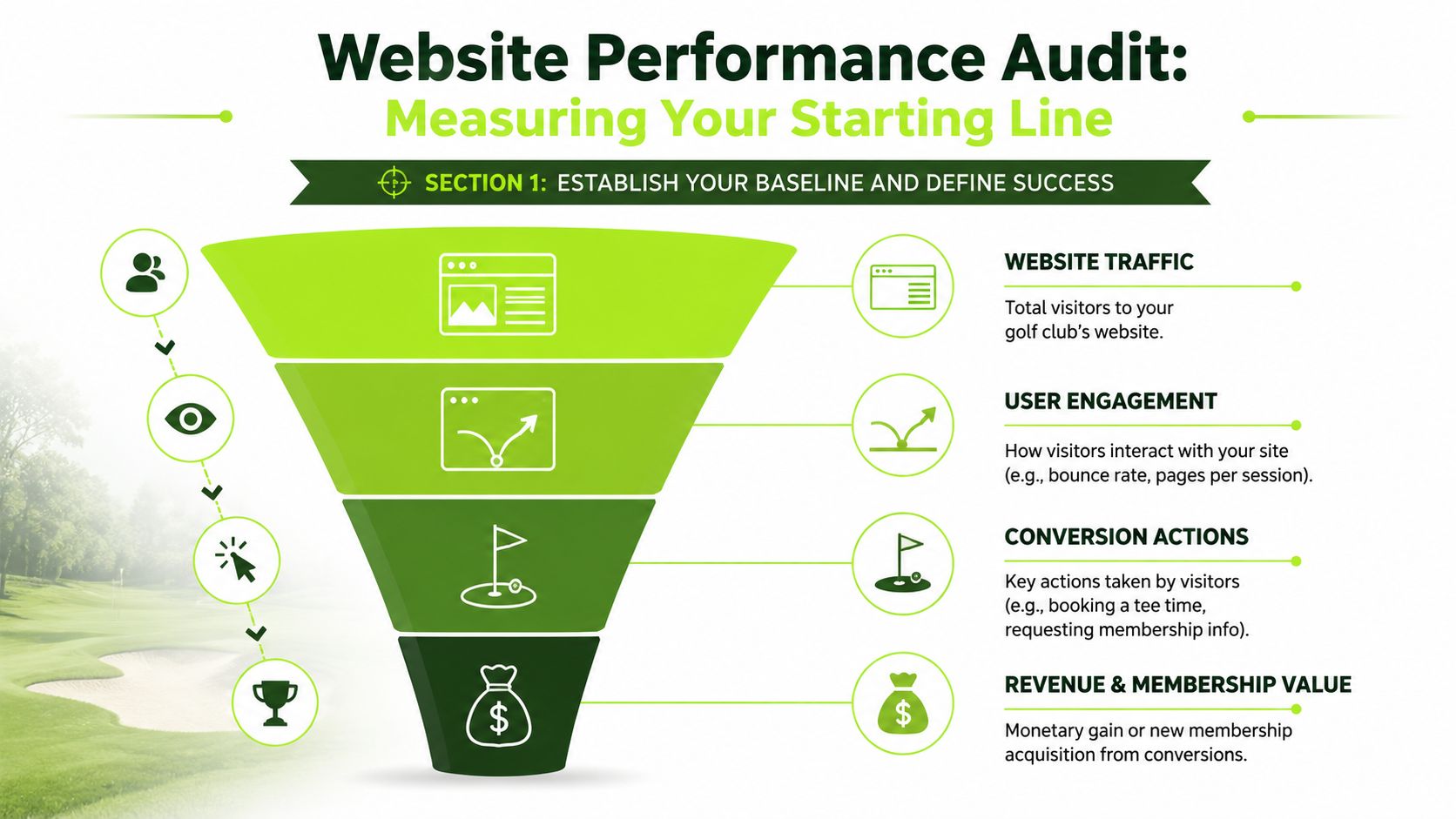
A lot of clubs still look at website traffic as the main scorecard. Traffic matters, but it's a weak measure on its own. What matters more is whether the right visitors take the next action, and whether your club can track that journey properly.
According to HubSpot's published guidance referenced here, conversion tracking is absent in 55% of UK small and medium leisure businesses. The same source states that clubs with full tracking can improve marketing spend efficiency by 45% and grow membership revenue by an average of 22% over 12 months. If you can't see which page, form, phone call, or campaign produced a real member, you can't make sound decisions.
Audit the funnel, not just the homepage
Use a tool such as Google Analytics 4 and map the main path a prospective member takes:
- Landing page visit
- Membership page view
- Enquiry form start
- Enquiry submitted
- Visit booked
- Membership closed
That sequence will look slightly different for each club, but the principle is the same. You need to know where people stop.
A simple review should answer questions like:
- Which pages attract membership intent: Not all traffic has the same value.
- Where do people leave: The membership page, the pricing page, or the form?
- What counts as a real conversion: Form submission, phone call, booked visit, or all three?
The best clubs don't report “we had more visitors this month”. They report “we improved enquiry to visit rate” and “we know which pages create qualified conversations”.
Define success in club terms
For a golf club, success usually isn't a generic website metric. It's operational.
Track outcomes your team can act on:
| KPI | What it tells you |
|---|---|
| Visit to enquiry rate | Whether your page persuades visitors to act |
| Enquiry to booked visit rate | Whether your follow-up process works |
| Booked visit to membership rate | Whether your sales conversation is effective |
| Response time to new enquiry | Whether intent is being handled while fresh |
This is also where outside reading can help sharpen your thinking. If you want a broader marketing perspective on how website structure influences action, DiviMode has a useful piece on how to boost your website sales. The key is to translate those ideas into a golf club funnel, not copy generic ecommerce advice.
Start with one clean baseline
Don't build a huge reporting system on day one. Start with a clean monthly snapshot:
- Traffic source
- Membership page visits
- Form submissions
- Calls from the website
- Booked club visits
- Membership joins
That baseline tells you where to work first. If lots of people reach the form but few submit, simplify the form. If plenty enquire but few book a visit, the issue isn't your page. It's your follow-up process.
Optimise Your Landing Pages and Calls to Action
A membership landing page has one job. It should help the visitor understand the offer, trust the club, and take the next step.
Most clubs make this harder than it needs to be. They bury the main call to action, open with vague welcome copy, or fill the top of the page with generic course imagery that looks nice but doesn't guide action.
Analysis from Natural Sourcing's UK CRO report found that 63% of UK golf site visitors abandon pages where the primary CTA is not above the fold. The same analysis reports that clubs using above-the-fold optimisation with a fast-loading site see an average conversion uplift of 24%. That should change how you structure the page immediately.
Get the top of the page right
When someone lands on your membership page, they should see three things without hunting:
- A clear headline: What membership is available and who it suits
- A visible CTA: Such as Book a Visit or Request Membership Information
- A trust signal: Testimonial, review, or image showing a real club experience
If your main button sits halfway down the page, you're already losing people. The visitor shouldn't need to scroll to work out what to do next.
A strong top section for a golf club often includes:
| Page element | What it should do |
|---|---|
| Headline | State the membership value clearly |
| Short supporting copy | Explain the benefit in plain English |
| Primary CTA | Give one obvious next action |
| Social proof | Reduce doubt quickly |
| Relevant image | Show the club in use, not just empty scenery |
Use trust where interest peaks
One of the most effective ways to improve website conversion is to place proof close to decision points.
The data in the verified research is clear. Sites featuring user-generated content show a baseline conversion rate of 3.2%, compared with a general industry average of 2.35%. When visitors scroll to the point where they encounter that content, their likelihood to convert increases by 102.4%. A HubSpot study cited in that same body of research also noted that products with five reviews are 270% more likely to be purchased than products with none.
For golf clubs, that translates well into:
- Member testimonials beside the membership CTA
- Photos from real events instead of stock imagery
- Short member comments near enquiry forms
- Visible signs of club activity that make the place feel alive
A polished page helps. A believable page converts.
That's especially important in golf because people aren't only choosing a facility. They're choosing a culture, a routine, and a place where they expect to belong.
Match the CTA to the real buying journey
One mistake we see often is pushing too hard, too early. A first-time visitor may not be ready for “Join Now”. They may be ready for “Book a Visit” or “Speak to the Membership Team”.
That distinction matters. Membership is a considered decision, especially at private clubs. Your page should guide the next realistic step, not demand the final one immediately.
This is the same principle we apply when reviewing golf club websites and conversion paths through online golf course positioning and page structure. The page needs to reduce uncertainty, not create pressure.
Good landing pages don't try to say everything. They answer the next question and make the next action obvious.
Simplify Your Booking and Enquiry Forms
A form is often the point where interest turns into action, or disappears. If the form feels long, awkward, or unnecessary, people delay it. Many never come back.
Golf clubs often ask for too much too soon. Full address, handicap details, preferred membership category, current club, phone, email, dates, comments, and sometimes several internal-use questions that the prospect has no reason to answer on first contact.
That creates friction.
Ask for what you need now
For an initial membership enquiry, you usually only need enough information to start a conversation properly.
A lean first form might ask for:
- Name: So the reply feels personal
- Email or phone: So you can respond
- Area of interest: Membership, society, visitor booking
- Optional message: For any specific question
Fields that often belong later, not first:
- Full postal address
- Date of birth
- Current handicap
- Employer details
- Preferred playing frequency
- Detailed membership preferences
The test is simple. If your team doesn't need that detail to make the first reply or book a visit, it probably shouldn't be mandatory.
Every extra field asks the visitor to do more work before your club has earned the right to ask.
Make the form feel easy to complete
Clarity matters as much as length. Use plain labels, avoid internal club language, and make mobile completion straightforward.
Good practice includes:
- Clear field labels rather than vague placeholders.
- Helpful validation so errors are shown immediately.
- One primary action button at the end, not multiple choices.
- A clear next-step message after submission.
If someone submits a form, don't leave them wondering what happens next. Tell them when they'll hear back and what that contact will involve.
Use progressive profiling
If you need more detail, gather it later.
That's where progressive profiling helps. In simple terms, it means collecting the essentials first, then learning more over time through follow-up emails, phone calls, or a second form when the prospect is more engaged.
For example, a first form can capture interest in membership. A later conversation can cover playing habits, preferred membership type, family usage, and budget fit. That sequence respects the prospect's time and keeps the first conversion easy.
Website conversion isn't just about persuading people; it's about removing avoidable effort. Clubs that make the first yes easy usually create more opportunities for meaningful conversations afterwards.
Implement Systems for Lead Management and Follow-Up
A submitted form is not the finish line. It's the hand-raise.
What happens next determines whether that enquiry becomes a visit, a conversation, or another missed opportunity. Many clubs underperform here, not because staff don't care, but because the process relies on memory, inboxes, and good intentions.
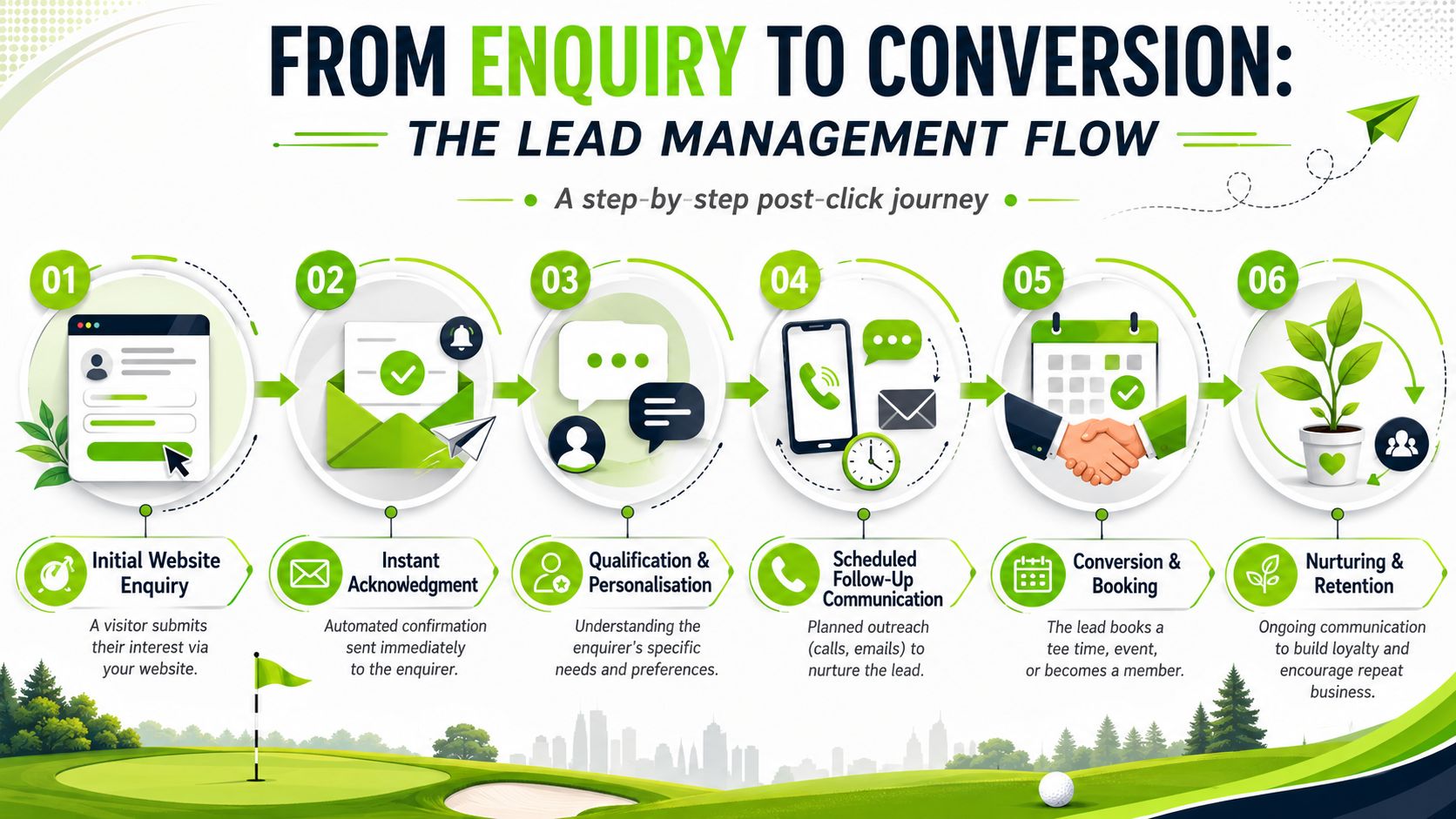
Research summarised by Ironistic states that lead visibility drops by 60% when managed via email instead of a CRM. The same source reports that UK leisure organisations using a CRM see a 30% higher conversion rate from enquiry to booked visit than those using manual methods. That's a systems issue, not a copywriting issue.
Why manual follow-up breaks down
Manual email chains create predictable problems:
- No clear owner: Staff assume someone else replied
- No central record: Notes sit in inboxes, not in one pipeline
- No follow-up rhythm: Leads get contacted once, then forgotten
- No visibility for managers: Nobody can see where prospects are stuck
In committee-led or busy operational clubs, this gets worse fast. Enquiries arrive outside office hours, during events, or when the right person is off site. Without a structured handover, good leads go stale.
There's also a second issue. Over-automation can damage trust in a private club setting. Verified UK golf sector data shows that some members respond poorly when the whole early journey is handled only by automated CRM flows. The practical answer isn't no automation. It's using automation for speed and consistency, then adding a real human touch at the right point.
Build a simple lead management flow
A workable system for a golf club should look something like this:
Instant acknowledgement
The prospect gets an immediate confirmation that their enquiry has been received.Lead captured in one place
Every enquiry sits in a CRM, not a shared inbox.Assigned ownership
One person owns the next action.Structured follow-up
Email, call, and reminder sequence based on the type of enquiry.Clear next milestone
Usually a booked visit, tour, or membership call.Status tracking
Open, contacted, booked, no answer, not suitable, closed.
The strongest clubs don't “try to remember” who enquired last week. They open a pipeline and see it.
A practical setup might use tools such as HubSpot, Pipedrive, or a golf-specific workflow layered into a club's existing systems. GolfRep also supports this kind of process through structured tracking, automated first response, assignment, and nurture inside a golf-focused pipeline, but the underlying principle matters more than the platform name. The club needs one source of truth.
If you want a deeper look at how that process works in golf specifically, GolfRep has outlined it in golf club lead management.
Don't confuse quick response with discount-led conversion
A fast, organised process does more for sustainable growth than desperate offers. That matters because private clubs face a real trade-off with discounting.
Verified sector data shows that 68% of UK golf clubs that relied heavily on limited-time discount offers experienced a 35% higher churn rate within the first 12 months compared with clubs using value-based nurturing. It also found that 72% of UK golf club committee members view aggressive discounting as a threat to brand equity, while 89% of general CRO guides still recommend flash sales as a primary tactic.
For clubs, the better route is usually clear value, fast response, and thoughtful follow-up. That protects both conversion and retention.
Test and Measure with Disciplined A/B Testing
Most clubs already have opinions about what works on their website. The problem is that opinions don't tell you whether a headline, button, or layout improves conversion.
That's what disciplined A/B testing is for.
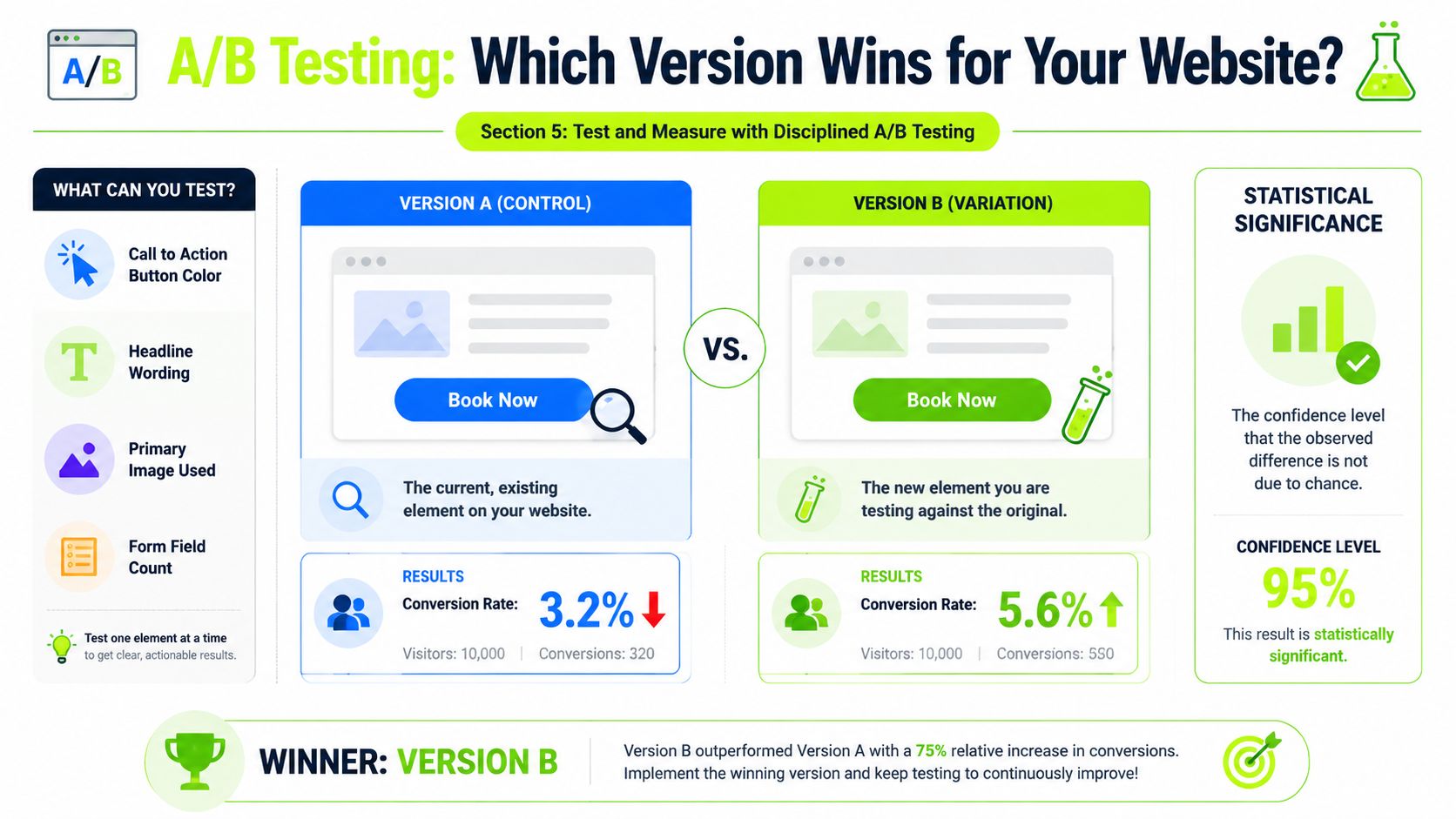
According to Leading Edge's 2024 report, a 4-step A/B testing methodology run for at least 14 days is critical, and 78% of UK marketers fail to run tests long enough, which leads to false positives that can reduce conversion rates over time. In plain terms, many teams stop a test too early, declare a winner, and make the site worse.
Use a proper testing process
For a golf club membership page, keep the process strict:
Form a hypothesis
Example: changing the button from “Enquire Now” to “Book a Visit” may lead to more qualified actions.Isolate one variable
Don't change the headline, image, and form at the same time.Run the test long enough
The benchmark here is at least 14 days so the test covers a proper weekly cycle.Judge the result carefully
Keep the winner only if the result is reliable, not just a short-term fluctuation.
Good tests for golf clubs
Useful website tests tend to be practical, not dramatic:
- CTA wording such as Book a Visit versus Request Information
- Hero image choice such as active member scene versus scenic course shot
- Form length with fewer required fields
- Trust placement such as testimonial above or below the form
A/B testing works best when it solves a specific question. “Which version gets more completed membership enquiries?” is a strong question. “Can we redesign the whole page and hope it improves?” isn't.
Test what affects decisions, not what satisfies internal preference.
Avoid the common trap
Many clubs run informal tests without meaning to. They change a page, wait a few days, and judge performance based on a handful of enquiries. That isn't testing. That's guesswork with a website attached.
The discipline matters because conversion improvement is cumulative. One better button, one shorter form, one clearer trust signal, one better follow-up sequence. Over time, those gains stack into a healthier pipeline.
Your Website Conversion Checklist for Sustainable Growth
Improving website conversion isn't a design project in isolation. It's an operating system for how your club handles interest from first click to booked visit.
That's why the most effective changes usually sit across the whole journey. Better tracking. Cleaner landing pages. Shorter forms. Faster response. Clear lead ownership. Regular testing. Each piece supports the next.
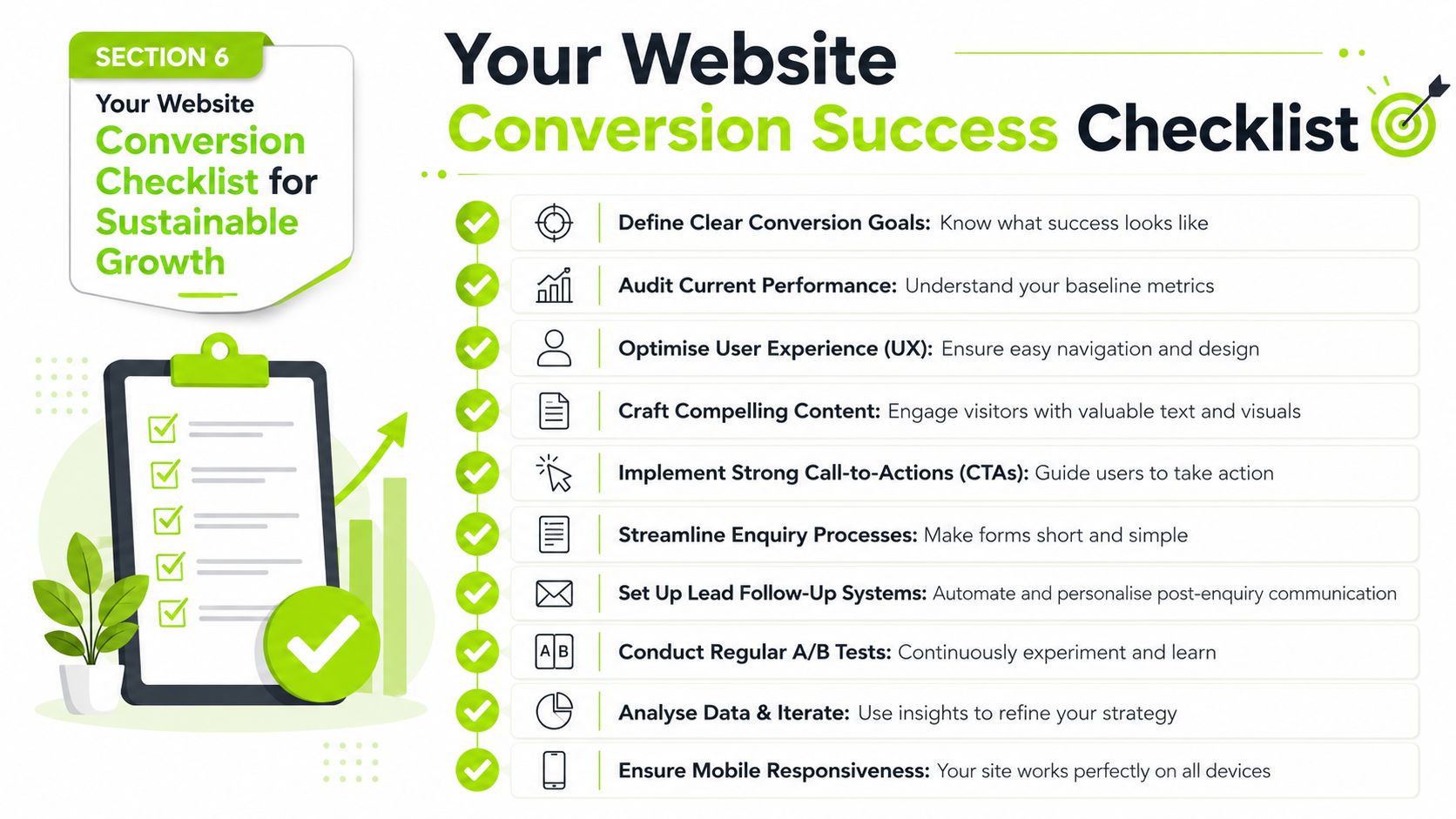
Use this as a practical review list for your club:
The essentials to check this month
- Track real conversions: Measure form submissions, calls, visit bookings, and membership outcomes.
- Review your membership pages: Make the main CTA visible quickly and remove distractions.
- Add trust near action points: Use genuine member testimonials and real club imagery.
- Cut form friction: Ask only for what your team needs to start the conversation.
- Set a first-response process: Every new enquiry should receive an immediate acknowledgement and a clear next action.
- Move leads into one pipeline: Don't manage membership enquiries through scattered emails.
- Assign ownership: One person should always know who needs contacting next.
- Follow up with structure: Use reminders, calls, and email sequences that support a visit.
- Test one change at a time: Run changes long enough to judge them properly.
- Protect long-term value: Don't lean on discounts if they weaken retention and club perception.
What good looks like
A strong conversion system is simple to describe. A golfer lands on the right page, understands the offer, trusts what they see, submits an easy form, gets a prompt response, and is guided towards a club visit by a process your team can manage.
That's how to improve website conversion in a way that lasts. Not through isolated tweaks, but through a system that turns interest into action consistently.
If your club is getting enquiries but not enough visits or memberships, GolfRep helps build the process behind conversion: tracking, follow-up, CRM visibility, and the structured journey from first enquiry to signed member.
Ready to tap into our proven growth system?