Facebook Ads for Golf Clubs: A Practical Growth Playbook

The popular advice about Facebook ads for golf clubs is usually wrong. Most clubs are told to improve targeting, refresh creative, or increase the budget. Those things matter, but they won't rescue a campaign if enquiries sit in an inbox, nobody owns the next action, and prospective members wait days for a reply.
A lead isn't a membership. It's only an opportunity to start a conversation. GolfRep approaches paid social as one part of a wider growth system, connecting local advertising with qualified lead handling, CRM visibility, structured nurture, and conversion tracking. The question isn't just how many people completed a form. It's how many booked a visit, attended, joined, and produced recurring membership revenue.
Why Most Golf Club Facebook Ads Fail Before the First Click
The first click is rarely the point where a golf club's Facebook campaign fails. The bigger risk comes after the enquiry, when staff respond inconsistently, rely on personal inboxes, or lose track of who needs a call.
Meta can report impressions, clicks, and form submissions, but it cannot book the visit, host the tour, arrange a trial round, or complete the membership conversation. Those actions determine whether paid attention becomes recurring membership revenue.
Practical rule: Judge an advert by the membership pipeline it creates, not by the number of names it adds to a spreadsheet.
The UK context helps explain why this gap remains common. A 2016 England Golf membership questionnaire reported by Bunkered's coverage of social media adoption found that 75% of 602 surveyed English golf clubs used social channels such as Facebook, Twitter, and Instagram for promotion. 25% lacked a social media presence, while website use stood at 89%. Social adoption had risen by 15 percentage points compared with the previous 2014 survey, yet many clubs were still building their digital foundations.
Paid promotion cannot compensate for an unclear route from advert to conversation. GolfRep has explained why boosting Facebook posts doesn't grow golf clubs when the promotion is not connected to a defined audience, relevant offer, useful landing experience, and owned follow-up process.
The leak sits after the form
A campaign can attract golfers interested in membership, open days, flexible packages, junior programmes, or changing clubs. If each enquiry arrives in an unattended email account, the club has paid to create demand without assigning responsibility for the response.
The commercial value of a lead depends on what happens next. A UK golf-marketing case documented by GolfRep recorded 46 qualified leads from £120 of Facebook ad spend, approximately £2.61 per lead in its golf club Facebook ads analysis. That result matters only when the club can distinguish qualified enquiries, record contact attempts, and see which prospects move towards a visit or membership.
A workable process gives every enquiry an owner, a status, a next action, and a visible history. The CRM does not need to be complicated, but it must show whether someone has been called, what they asked for, and when the next contact is due.
Without that structure, better targeting can produce more unworked opportunities. The hidden bottleneck is conversion discipline, not the ability to generate another form submission.
Building Local Audiences That Attract Qualified Golfers
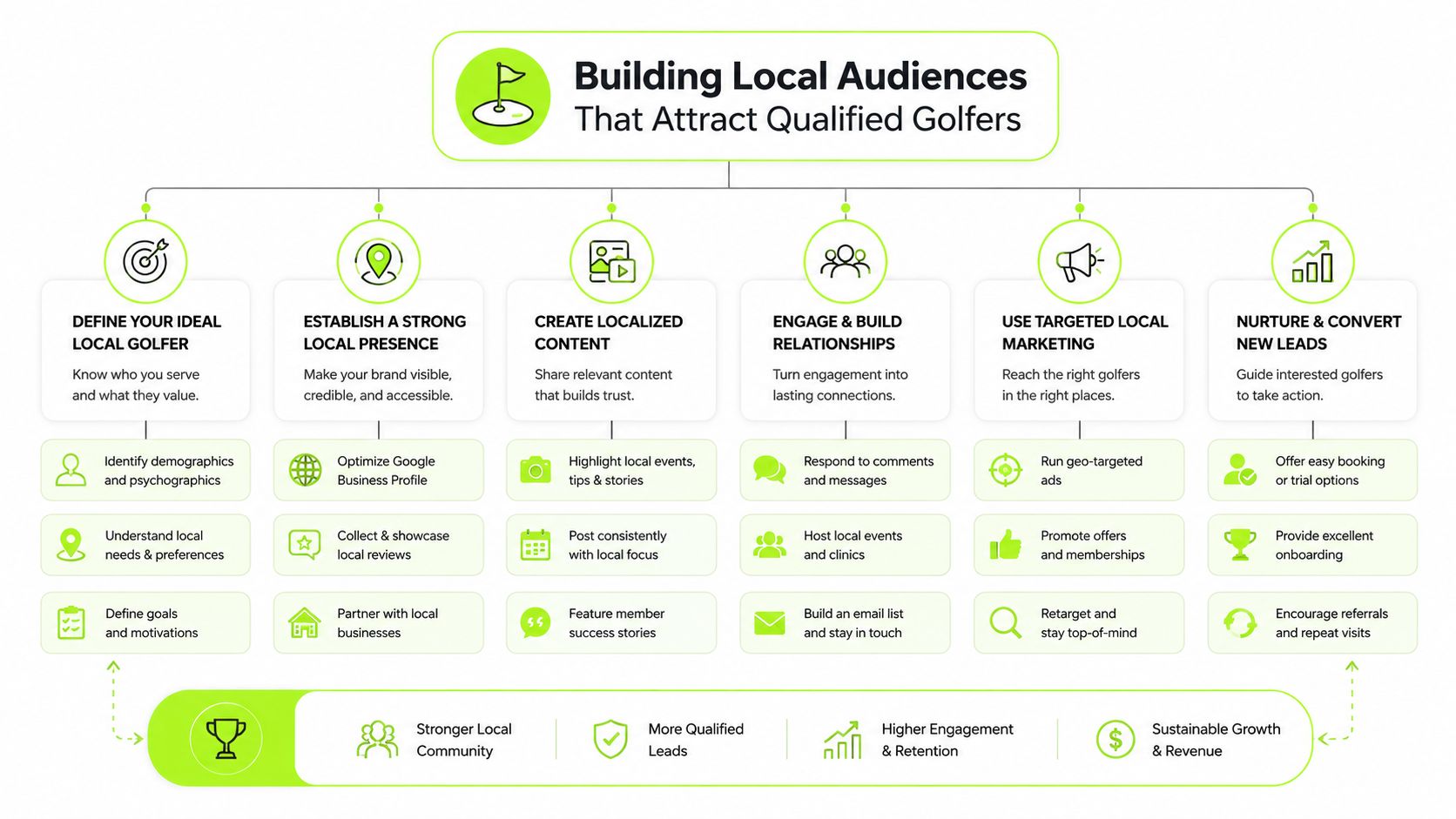
Local targeting works best when it reflects how golfers choose a club. A radius around the course provides the foundation, but it shouldn't be the whole strategy. GolfRep starts with the club's catchment area, then layers audience signals around the membership offer and the people most likely to value it.
A practical setup looks like this:
Start with geography. Use a sensible local area around the club, then review where existing members live. A broad audience may create reach, but the club should know which locations produce realistic travel times and genuine enquiries.
Separate membership motivations. A family looking for junior coaching needs different messaging from a golfer seeking competitive play. Build distinct campaigns for junior programmes, social membership, flexible access, midweek play, or a full seven-day package where the club offers them.
Use age and life-stage signals carefully. Local residents approaching retirement may respond to community, wellbeing, and daytime playing opportunities. Families may care more about safe coaching, accessible facilities, and activities that involve more than one generation.
Create warm audiences. Website visitors, people who engage with a club video, and previous form users can receive follow-up messaging. They already know the club, so an advert showing a membership guide or visit invitation may be more relevant than an introduction.
Build lookalike audiences from useful member data. A list of current members can help Meta find people with similar characteristics, provided the data is handled lawfully and the source audience reflects the type of membership the club wants to grow.
Exclude poor-fit audiences. Existing members shouldn't keep seeing acquisition adverts. Recent enquirers may need nurture or booking messages instead. Exclusions protect budget and make reporting easier to interpret.
Layering beats generic interest targeting
Interest categories can help, but “golf” alone is too broad to define a good membership prospect. A local golfer may be interested in equipment, televised tournaments, coaching, or holiday resorts without wanting to join a club.
Layering makes the campaign more accountable. Match the audience to the offer, then write the advert for the reason that segment might act. A lapsed golfer may need a low-pressure invitation to rediscover the course. A family may need clarity about coaching and participation. A nearby older resident may care about community and accessible playing times.
GolfRep's own experience is that audience quality improves when clubs connect local relevance, a clear membership proposition, and a specific next step. The advert should make it easy for someone to understand why the club suits them and what happens after they enquire.
Choosing Ad Formats and Creatives That Convert Local Golfers
A polished aerial shot can earn attention without answering the questions that determine membership: Will I fit in? What does membership include? Can my family participate? Is the club active beyond the fairways? Creative needs to address those concerns clearly, then make the next action straightforward.
Choose the format for the decision it must support:
Lead forms suit membership guides, open-day invitations, and callback requests because they reduce friction. They can also attract weaker intent, so ask sensible qualification questions and connect every submission to a prompt follow-up process.
Landing-page campaigns give the club space to explain inclusions, access, pricing structure, facilities, and next steps. The extra effort can filter casual interest and reveal who has considered the offer properly.
Carousels can present the course, clubhouse, practice areas, social calendar, coaching, and junior facilities in a deliberate sequence. Each card should answer part of the membership decision, not function as an unrelated photo gallery.
Video tours build familiarity. A short walkthrough led by a recognisable club professional or manager can make the venue feel more approachable than a purely branded advert.
Testimonials handle objections that club copy often misses. Use genuine member experiences, identify the type of golfer represented, and avoid claims the club cannot support.

Test the proposition, not just the colour
Testing becomes difficult to interpret when the audience, offer, format, and message all change together. Keep the audience and offer stable, then compare meaningful variations. A course-led message might compete with a community-led message, or a member testimonial with a professional welcome.
GolfRep's own experience shows that campaign structure and audience relevance influence response more than creative polish alone. That principle matters because a strong advert still produces little business value if enquiries sit unanswered or move into an untracked inbox. Record the source, offer, response time, booking status, and eventual membership outcome in the club's CRM or a controlled follow-up log.
Use small business Facebook ads software to organise creative production when the club needs several video or image variations. It can support a testing routine, but it cannot supply a credible offer, accurate local detail, authentic footage, or prompt sales follow-up.
A quiet advert that produces qualified visits can outperform a popular advert that generates curiosity without a booking. Judge creative by the quality of conversations and booked visits it helps create, not reactions alone. Guidance on golf club Meta ads can support campaign setup, while the club's own enquiry and membership records should decide which creative earns more budget.
Budget Planning and Seasonal Timing for Golf Club Campaigns
A golf club's Facebook budget should follow membership decision windows and the team's capacity to handle enquiries, rather than an arbitrary monthly figure. Interest often rises before the main playing season, but disappearing during quieter months leaves fewer warm prospects when demand returns. The practical distinction is planned seasonal weighting, supported by a follow-up process, instead of turning campaigns on whenever the committee wants more members.
GolfRep's UK commentary describes clubs working from an annual Facebook budget of around £6,000, with 70% allocated to the first half of the year. Treat that as market context, not a universal recommendation. The right budget depends on the club's catchment area, membership value, available capacity, and ability to respond promptly and consistently.
A committee-friendly planning method
Start with the membership target and work backwards through the commercial process. Estimate how many qualified conversations are needed, how many visits those conversations should produce, and how much paid traffic is required to create those opportunities. Record each assumption, then replace estimates with campaign and CRM data as results accumulate.
A practical allocation can look like this:
| Period | Budget Allocation | Campaign Focus | Expected Outcome |
|---|---|---|---|
| Early membership decision window | Higher share | Membership enquiries, visits, open days | A fuller pipeline of qualified prospects |
| Main playing season | Controlled share | Course experience, social proof, flexible membership | Continued local demand and remarketing audiences |
| Quieter period | Lighter always-on share | Brand familiarity, content engagement, future interest | Warm audiences for later campaigns |
| Offer or event bursts | Reserved test budget | Open days, taster experiences, junior activity | Short-term enquiry and booking opportunities |
The table avoids fixed percentages because the correct split depends on capacity and commercial goals. A campaign that produces more enquiries than staff can contact is wasting part of its budget, even if the platform reports a low cost per lead. Reduce or pause spend when lead quality or response consistency deteriorates, not only when advertising costs rise.
Scaling without losing control
Daily budgets give the club tighter control over spend and lead volume. Lifetime budgets suit defined open-day campaigns with fixed start and end points, provided someone monitors delivery and enquiry handling throughout.
Scale gradually when advertising produces qualified conversations and booked visits, not merely cheap form completions. Record every budget change, check the resulting lead quality, and confirm that staff can maintain the agreed response standard before investing more. The committee should approve the budget alongside an operational commitment, naming who owns new enquiries, where they are recorded, and how conversation quality and membership outcomes will be reported. This connection between spend and follow-up is what prevents a seasonal campaign from producing a busy inbox but little membership growth.
Converting Enquiries Through Structured Follow-Up Systems
The Facebook ad is only the handover point. A club that responds quickly, records each interaction, and offers a clear next step can convert a smaller enquiry flow more effectively than one that buys more leads and manages them manually.
GolfRep reports an average response time of 47 hours and 32 minutes for membership enquiries at UK golf clubs. Responding within one hour made leads five times more likely to convert than waiting 24 hours, as documented in its Facebook lead-generation commentary. The commercial lesson is direct: advertising creates the opportunity, while speed, ownership, and follow-up keep it alive.
The wider UK lead-response evidence points to the same operational problem. UK businesses average 47-hour response times, only 7% achieve responses within five minutes, and 78% of customers buy from the first company to respond, according to the UK lead response crisis report from Made Smarter. These figures are not golf-specific, but they show why response handling affects revenue rather than merely service quality.
Replace inboxes with a visible pipeline
Manual handling breaks down in familiar ways. A secretary forwards an enquiry to a professional, a volunteer replies from a personal account, or a busy weekend delays action until the prospect has moved on. With information scattered across email, spreadsheets, and memory, staff cannot reliably see which leads need attention.
A CRM gives the club one shared record and a defined stage:
- New: the enquiry has arrived and needs an owner.
- Contacted: a documented first response has been made.
- Qualified: the prospect's needs, location, playing interests, and timing are understood.
- Visit booked: the club has secured a concrete next step.
- Decision pending: the prospect has visited but has not joined.
- Joined or closed: the outcome is recorded for reporting and future learning.
Automation should acknowledge the enquiry immediately, deliver the information promised in the advert, and create a task for the responsible team member. Follow-up messages can answer recurring questions about joining, facilities, playing access, social life, and visits. They should support a human conversation, not imitate one.
GolfRep's golf club follow-up system sets out this operating principle: every enquiry needs visibility, a clear owner, a manageable task list, and a recorded outcome. That structure exposes where leads stall and gives the club a practical way to connect Facebook activity with signed memberships.
Tracking Performance and Proving Return on Ad Spend
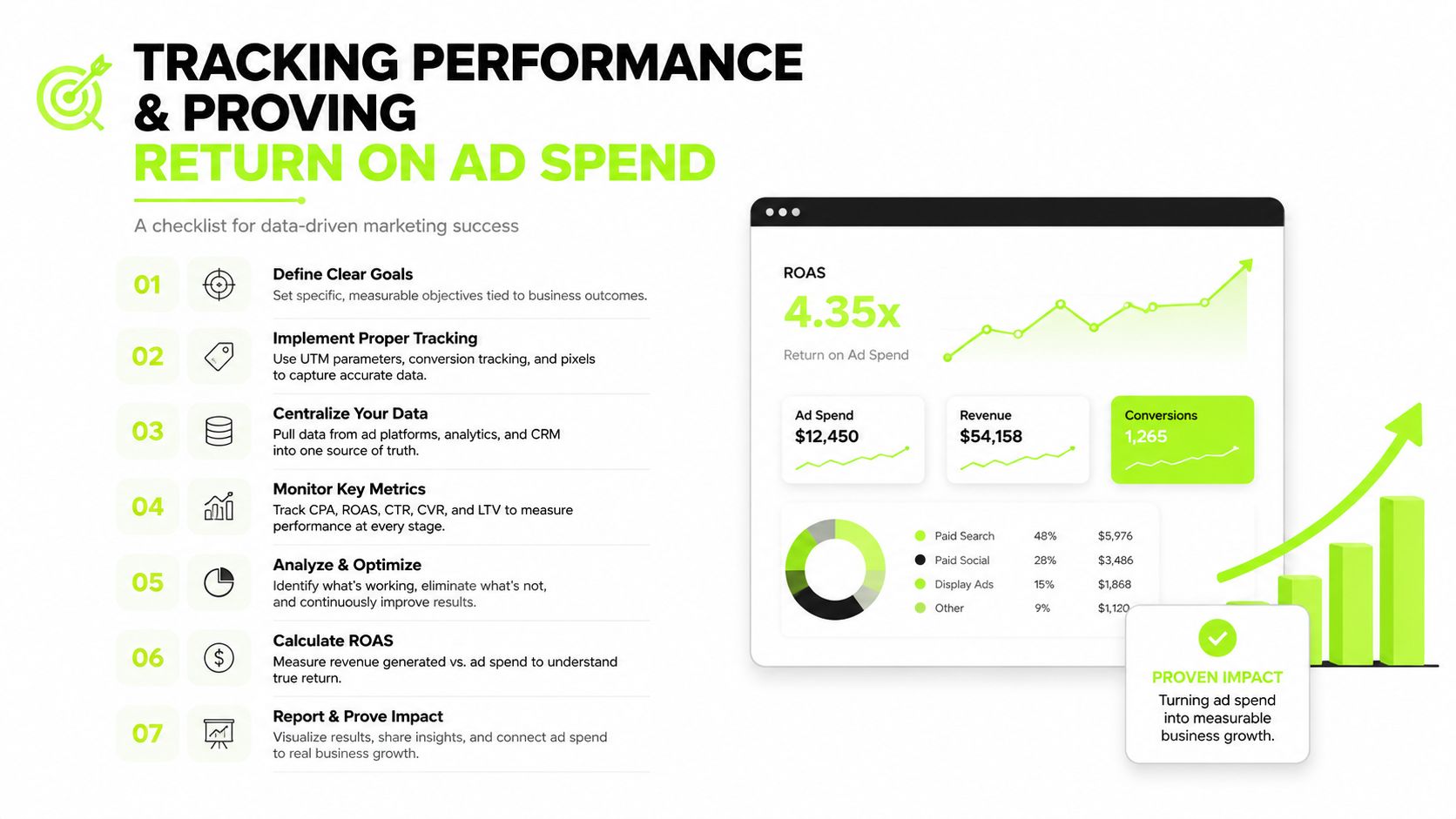
Committees don't need more screenshots of reach. They need a report that connects ad spend, qualified enquiries, visits, signed memberships, and revenue. That requires measurement outside the basic lead count.
Meta Ads Manager allows advertisers to view conversions from campaigns, ad sets, and ads, with the actions selected through the Columns menu. The platform's conversion tracking guidance explains the practical reporting mechanism, but the club still has to define what counts as a meaningful conversion.
Build the measurement chain
Start with the website and the enquiry route. Meta's own Pixel implementation guidance explains that standard events are tracked through fbq('track') calls in the Pixel implementation. In practical terms, the club needs correctly installed events for actions such as a form submission, a booking request, or another defined membership step.
Then connect those events to the CRM. A form submission should create a lead record, preserve the campaign information, and allow the team to update the prospect's status. A signed membership should be recorded against the original source wherever the system permits, so the club can compare acquisition cost with actual commercial value.
The response clock also needs a consistent definition. Lead-management guidance from LeanData recommends measuring from the moment a lead is created in the CRM to the first documented representative touchpoint, separating processing delay from human follow-up delay in its lead response time guidance. That distinction helps a manager identify whether the problem sits in integration, notification, ownership, or staff capacity.
Report the numbers that change decisions
Cost per lead remains useful as an early diagnostic, but it shouldn't be the final score. The more important measures are cost per qualified lead, cost per booked visit, cost per signed member, and membership revenue attributed to the campaign.
One UK case study reported 644 leads at £1.97 per lead from Meta activity, while another reported £13,000 in membership revenue from £500 spend, implying a 26:1 ROAS in the published golf-club social advertising case study. These figures demonstrate what can happen when offer, creative, and follow-up align. They don't remove the need to validate lead quality or assume every club will reproduce the same outcome.
Another independent benchmark cited by GolfRep places average UK Facebook CPL at about £17.60, while a golf campaign generated 71 qualified leads from £225 spend at £3.20 per lead in the referenced UK golf marketing analysis. The gap is precisely why committees should ask what happened after the form, not celebrate low CPL in isolation.
Building a Predictable Membership Growth System
Predictable growth comes from connecting five operating parts: a relevant local audience, creative that explains the club's value, seasonal budget control, immediate structured follow-up, and measurement that reaches signed membership.
Clubs at an early stage should first make enquiries visible and assign ownership before increasing spend. Clubs with a functioning CRM can improve qualification, nurture, and conversion tracking. More mature teams can test audiences and creative systematically, then allocate budget towards the campaigns that produce qualified visits and members rather than inexpensive names.
The first 90 days should expose operational weaknesses. Check every enquiry route, document response ownership, install and verify conversion events, agree the stages in the pipeline, and review outcomes with the people who handle visits and membership conversations. Don't scale a campaign while staff can't explain where its leads are or what happens next.
A club can manage the work in-house when someone has the time, authority, and technical access to maintain the whole process. Specialist support becomes useful when advertising, CRM setup, automation, reporting, and follow-up need to operate as one system. GolfRep combines local lead generation with AI-driven response workflows, CRM-enabled nurture, and reporting designed to show the path from first click to membership revenue.
The practical standard is simple. A Facebook ad should create a traceable, owned, and timely membership opportunity. Anything less is activity, not growth.
GolfRep helps UK golf clubs connect Facebook advertising with qualified lead handling, CRM visibility, automated nurture, and membership conversion tracking. Visit GolfRep to see how a structured growth system can turn local enquiries into booked visits and signed members.
Ready to tap into our proven growth system?