“Why Boosting Facebook Posts Doesn’t Grow Golf Clubs”

The most common advice in club marketing is also one of the least useful. If a post is doing reasonably well on Facebook, you're told to boost it. It feels sensible, quick, and low risk. For many clubs, it's become the default move when membership needs attention.
That's the problem.
If you want to understand “Why Boosting Facebook Posts Doesn't Grow Golf Clubs”, start with what clubs have been doing. England Golf's 2023 Club Healthcheck found 68% of UK clubs use Facebook boosts for acquisition, yet in the same period, average membership growth was -2.1% year-over-year, with boosted campaigns delivering just 4.7 leads per £1,000 spent.
That isn't a creative issue. It isn't because your course photography is poor or because the copy needed another line about your clubhouse. It's a system issue. Clubs are using a tool built for lightweight engagement and expecting it to produce one of the highest-consideration purchases in local sport and leisure.
Membership growth doesn't come from more likes. It comes from a predictable pipeline. That means attracting the right local golfers, capturing their enquiry, responding quickly, following up properly, and measuring what turns into visits and sign-ups.
Most clubs don't have a lead problem first. They have a conversion handling problem that starts with weak advertising and gets worse after the click.
Introduction The Cost of a Single Click
A boosted post looks cheap because Facebook makes it feel cheap. You click a button, choose a budget, select a local area, and the platform promises more reach. That simplicity is exactly why so many clubs keep using it.
But simple isn't the same as effective.
The issue with boosted posts isn't just wasted spend. It's that they train clubs to focus on the wrong signals. A membership post gets reactions, a few comments, perhaps some shares from existing members, and it creates the illusion that marketing is working. Meanwhile, the membership pipeline remains thin, inconsistent, and difficult to forecast.
What clubs are really buying
When you boost a post, you're not building a structured acquisition campaign. You're paying for extra distribution of a piece of content that was never designed as a full-funnel system.
That matters because golf membership is rarely an impulse decision. Prospective members compare clubs, think about location, price, flexibility, playing opportunities, social fit, and whether they can justify the commitment. A casual Facebook interaction doesn't move that process very far.
A club manager should ask a harder question than “did people see the post?”
Ask this instead:
- Who saw it: Were they local, relevant, and realistically in-market?
- What happened next: Did they enquire, book a visit, or disappear?
- Who followed up: Was there a clear owner of the lead?
- What was measured: Can the club link spend to actual membership outcomes?
If those answers aren't clear, the post wasn't marketing. It was exposure.
Practical rule: If you can't track a post through to enquiry, visit, and sign-up, you can't call it a growth channel.
The real cost isn't the budget
A low-budget boost can still be expensive. Not because of the amount spent, but because it consumes time, attention, and confidence. It encourages committees and managers to repeat a tactic that feels active while producing very little operational value.
That's why “Why Boosting Facebook Posts Doesn't Grow Golf Clubs” isn't really a debate about Facebook alone. It's about whether your club wants reactive activity or a system that produces measurable membership opportunities.
Why the Boost Button Is Built to Fail Your Club
The boost button isn't a simplified version of proper advertising. It's a different tool with a different purpose.
Facebook designed boosting to make distribution easy. That's useful if your goal is broader visibility for a post. It's poor if your goal is member acquisition. Those are not the same job.
Engagement is not intent
Boosting usually pushes a post towards more lightweight interaction. That tends to reward content people can react to quickly. Nice course photos. Team updates. Event reminders. General club atmosphere.
None of that tells you who is considering a membership.
In the UK, Facebook's average post engagement rate is 0.15%, while boosted golf-related posts achieve 0.21% click-through rates, with up to 70% of impressions wasted on non-local or irrelevant audiences despite basic targeting. That's the core weakness of boosted promotion in one sentence. It reaches people, but not enough of the right people, and not with enough intent.
Boosting is broad by design
Think of a boosted post as standing in a busy town square with a loudspeaker. Plenty of people hear you. Some glance over. A few nod. Most carry on walking.
A structured campaign works differently. It acts more like a list of personal invitations sent to people who match the right profile, have shown relevant behaviour, and can be followed through a proper sales process.
That difference shows up in several practical ways:
| Area | Boosted post | Strategic campaign |
|---|---|---|
| Primary aim | More engagement on a post | More qualified enquiries |
| Targeting depth | Basic interests and location | Layered audience logic and exclusions |
| Optimisation | Engagement-focused | Lead-focused |
| Creative control | Usually one existing post | Multiple tailored ads |
| Measurement | Surface metrics | Conversion visibility |
A club doesn't need more people casually noticing a membership offer. It needs more of the right local golfers taking a meaningful next step.
The metrics that distract clubs
Vanity metrics are dangerous because they're visible. Reach, reactions, comments, and shares appear quickly and look reassuring in committee reports. They're easy to screenshot. They create momentum around the wrong outcome.
A post with plenty of engagement can still produce no members at all.
More activity on Facebook doesn't automatically mean more activity in your membership pipeline.
That's why the boost button often keeps underperforming clubs trapped. It gives just enough positive feedback to justify repeating a tactic that isn't built for conversion.
Why clubs keep using it anyway
There are understandable reasons:
- It feels low effort: A manager can launch it in minutes.
- It appears affordable: The spend is usually modest at the start.
- It avoids complexity: No need to enter Ads Manager or build a campaign properly.
- It creates visible movement: Existing members react, which makes the post look successful.
Those are convenience benefits, not growth benefits.
If your aim is a predictable flow of membership enquiries, boosting is usually the wrong starting point. It optimises the wrong thing, shows you the wrong numbers, and leaves you with very little usable data once the spend ends.
The Hidden Costs of Low-Effort Marketing
The damage from boosting isn't limited to poor targeting. It also affects how Meta's delivery system works behind the scenes.
That matters because Facebook advertising only becomes efficient when the platform has enough conversion data to learn. Without that learning, costs rise and quality drops.
Learning limited means the system never improves
Meta's algorithm needs enough conversion volume to optimise effectively. Meta's algorithm requires 50+ conversions per week to learn effectively. Boosts, being single-post runs, often stall in a “Learning Limited” status, resulting in 40-60% higher CPMs (£4.50-£7.20) compared to properly structured campaigns (£2.80-£4.50).
That's a technical point, but the practical meaning is simple. The platform doesn't gather enough useful feedback to improve delivery. So the club keeps paying more to reach weaker audiences.
Low-effort marketing becomes expensive in this scenario. This happens not because Facebook charges a dramatic upfront fee, but because the delivery mechanism never gets smart enough to improve.
Cheap clicks can be the most expensive spend
A click has no value on its own. A lead has limited value on its own. A membership enquiry only becomes commercially useful when someone handles it well and moves it towards a visit or sign-up.
Boosted campaigns tend to leave clubs with scraps of attention rather than sales-ready interest.
Consider the difference between these two outcomes:
- Surface interaction: Likes, comments, and a few messages with no process behind them
- Commercial intent: An identifiable prospect with a recorded enquiry and a follow-up path
Only one of those can be forecast, managed, and improved.
Reality check: Low-budget promotion is still waste if it produces work for staff but no visibility on whether that work leads anywhere.
Waste also shows up in staff time
This part is often missed by committees.
A boosted post can generate scattered messages, ad hoc comments, and unstructured enquiries. Someone then has to monitor the inbox, reply manually, remember to chase, and work out whether the person was serious. There's no clean handover, no qualification, and usually no central view of lead status.
That creates hidden operational cost:
- Admin drag: Staff answer the same basic questions repeatedly
- Slow response: Enquiries sit waiting when the office is busy
- Poor follow-up: Prospects go cold after the first interaction
- No reporting: Managers can't see where leads stall
A proper campaign should reduce friction. A boost often creates more of it.
Why clubs misread the outcome
The spend feels justified because the club can point to something visible. The post “performed”. People commented. Existing members shared it. The committee saw positive online activity.
But membership growth doesn't care how busy the comments section looked. It responds to targeting quality, speed of response, lead ownership, and consistent nurture.
When those pieces are missing, the club isn't building momentum. It's buying interruption and then hoping interest turns into revenue by itself.
The Strategic Alternative A Predictable Growth System
There is a better option than boosting, but it isn't “run ads instead”. The shift is from isolated promotion to a predictable growth system.
That system starts with structured campaigns in Meta Ads Manager, but it doesn't end there. The campaign is just the front door. The club still needs a route from click to conversation, from enquiry to visit, and from visit to membership decision.
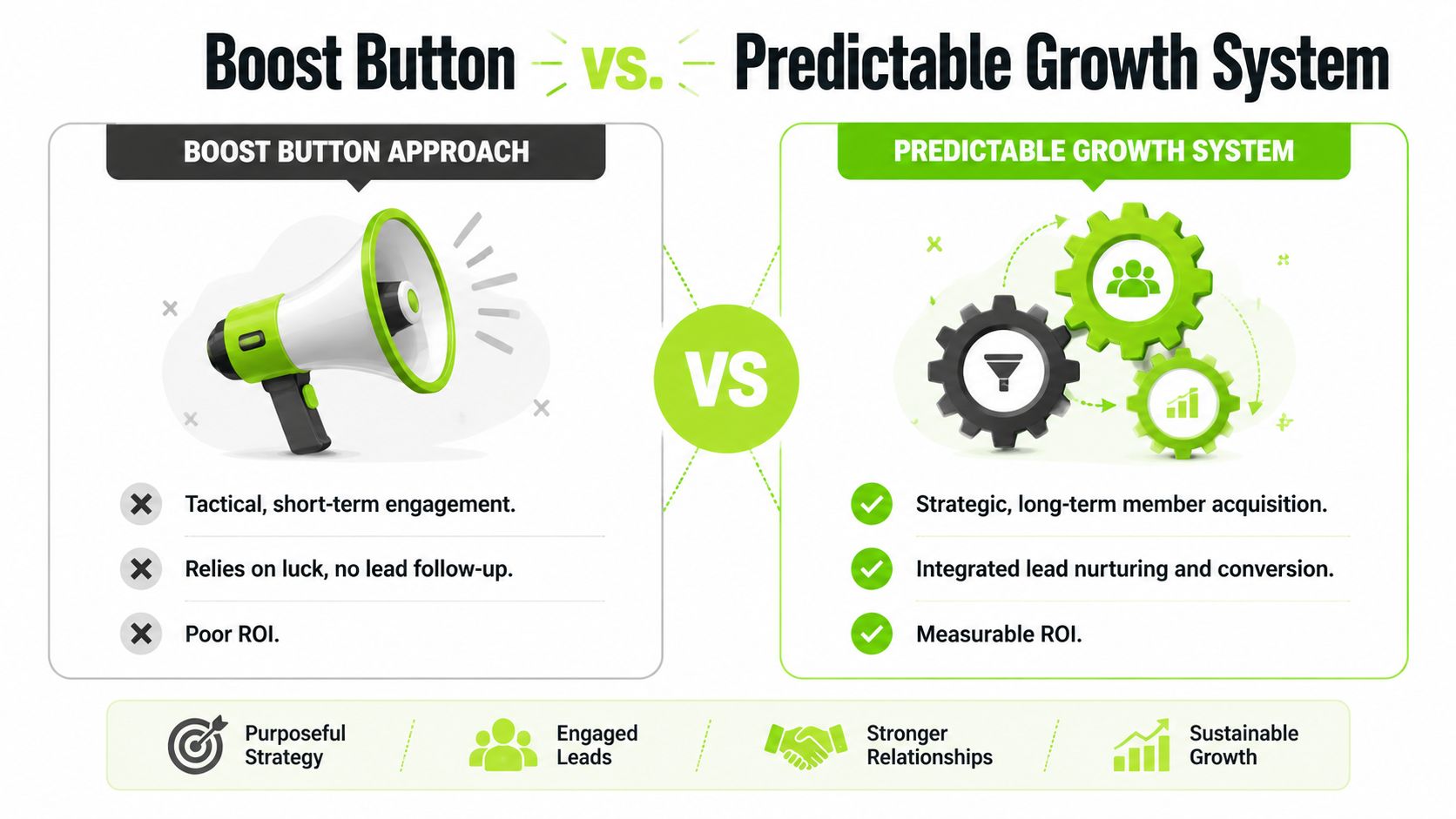
What changes when campaigns are built properly
A strategic campaign uses different logic from a boosted post.
It doesn't ask Facebook to find people who might react. It asks Facebook to find people who are more likely to become leads. It gives the platform stronger inputs, clearer objectives, and more room to test what works.
That kind of gap changes how a club should think about marketing. The point isn't to publish a better post and add budget. The point is to build a campaign around member acquisition from the start.
A useful comparison
Here's the practical difference.
| Component | Boost button approach | Predictable growth system |
|---|---|---|
| Audience | Broad and basic | Built around intent and relevance |
| Goal | More engagement | More qualified enquiries |
| Creative setup | One post, lightly promoted | Tailored ads with testing |
| Follow-up path | Usually manual or unclear | Planned and trackable |
| Reporting | Reach and clicks | Lead flow and conversion progress |
That final row matters most. If your reporting stops at clicks, you're managing advertising in isolation. If your reporting continues into enquiry handling and conversion, you're managing growth.
Strategy beats convenience
The clubs that improve consistently usually stop asking, “should we boost this?” and start asking, “what campaign are we running, what audience is it for, and how will we handle the enquiries?”
That's a healthier operating question.
For clubs that want a clearer view of how proper campaign structure differs from casual promotion, this guide on golf club Facebook ads is a useful next read. It helps frame Facebook as one part of a broader acquisition setup, not a standalone answer.
There's also value in looking outside golf for ideas on response automation. This resource on Facebook Messenger automation for e-commerce brands is aimed at a different sector, but the operational lesson is relevant. If inbound interest isn't acknowledged and routed quickly, even strong ad performance gets diluted.
A campaign becomes profitable when the club can control what happens after the click, not just before it.
The mistake clubs make after improving ads
Many clubs stop too early. They move from boosting to better campaigns and assume the problem is solved.
It isn't.
Better advertising can generate better enquiries. It cannot fix slow follow-up, missing lead ownership, or poor visibility on what happens once someone raises their hand. That's why campaign quality is only half the answer.
Beyond the Ad The Real Challenge Is Converting Enquiries
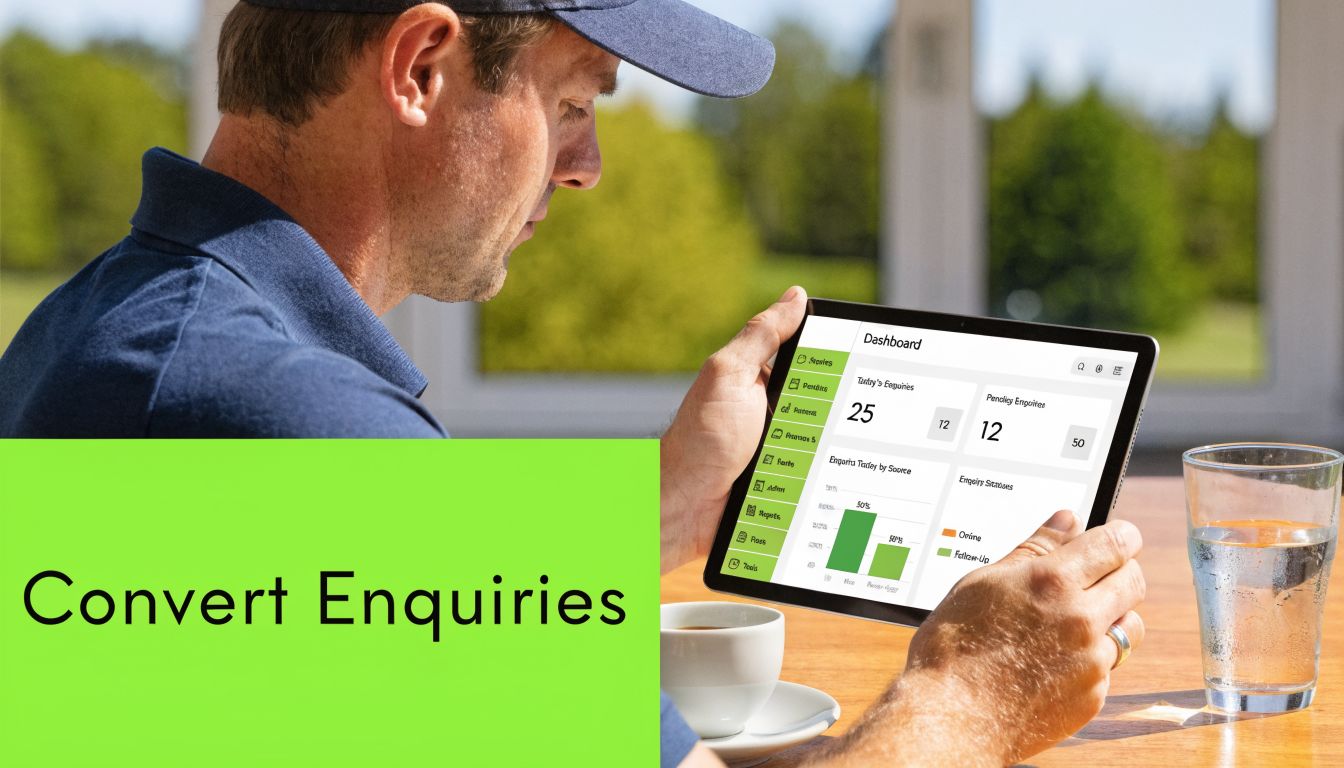
A club can improve its advertising and still fail to grow membership.
That sounds counterintuitive until you look at what happens inside most clubs after an enquiry arrives. Someone submits a form, sends a message, or requests information. Then the process depends on whoever happens to be available, what day it is, and whether anybody remembers to follow up.
That isn't a marketing problem anymore. It's an operational one.
Enquiries leak when nobody owns the process
Think of your lead flow as a bucket. Advertising fills it. Weak follow-up punches holes in it.
Most clubs don't lose prospects because nobody was interested. They lose them because the response was late, generic, inconsistent, or invisible to the wider team. If one staff member is off site or busy, the lead can sit untouched. If the first reply goes out and there's no structured second step, the prospect drifts.
The club often labels these as poor-quality leads. In reality, many were unmanaged.
Questions every club should answer honestly
A manager should be able to answer these without guesswork:
- Response ownership: Who replies first when a membership enquiry comes in?
- Speed: How quickly does that first response happen in practice?
- Qualification: How do you separate casual interest from serious intent?
- Follow-up cadence: What happens if the prospect doesn't reply the first time?
- Visibility: Can leadership see every live enquiry and its current status?
If those answers live in one person's inbox or memory, the club doesn't have a system.
The biggest gap in club growth is rarely ad reach. It's what happens in the hours and days after someone enquires.
Why manual follow-up breaks down
Manual follow-up sounds manageable until enquiry volume becomes uneven. A quiet week is fine. A busy spell exposes everything. Messages come in from different channels. Notes are incomplete. One prospect gets called, another gets emailed, and a third receives nothing because nobody logged them properly.
That's where clubs need to think like operators rather than promoters.
This is also why broader sales resources can be helpful. The thinking behind diagnosing sales funnel friction points applies closely to membership sales. Friction usually sits in handoff, follow-up, and visibility rather than in top-of-funnel activity alone.
A better question than lead volume
Instead of asking “how many enquiries did we get?”, ask “how many enquiries did we work properly?”
That shift changes management behaviour.
A club that tracks lead handling can spot bottlenecks quickly:
| Friction point | What it looks like in a club |
|---|---|
| Slow first response | Prospect loses urgency and keeps searching |
| Unclear ownership | Two people assume the other replied |
| No nurture process | “Maybe later” leads disappear completely |
| No reporting | Committee sees spend, not outcomes |
If you want a more structured view of this issue inside the club environment, this piece on a golf club follow-up system is worth reading. It puts the focus where it belongs. Not just on generating attention, but on handling demand properly once it exists.
A strong ad can open the conversation. Only a reliable process can finish it.
How to Build Your Club's Growth Engine
A club's growth engine is not one tool. It's a connected set of moving parts that support each other. If one part is weak, the whole system becomes less reliable.
That's why clubs that rely on occasional posting and manual inbox management struggle to produce consistent membership results. The engine needs structure.
Start with data-led advertising
The first job is to replace casual promotion with proper campaign architecture.
That means using Meta Ads Manager to build around the outcome you want, not the post you happen to have published. Creative should be designed for specific audiences. Offers should be clear. Landing points should make it easy to express interest without confusion.
The campaign must also generate usable data. If the platform can't see meaningful actions, it can't improve delivery. If the club can't see where leads came from, it can't make sound decisions about budget.
Good advertising should produce more than attention. It should produce identifiable opportunities.
Add instant qualification
Many clubs still underperform in this area, even after improving ad setup.
Enquiries don't arrive neatly between office hours, and prospective members don't wait patiently while the team catches up. If someone expresses interest in the evening or at the weekend, they need an immediate acknowledgement and a sensible next step.
That doesn't mean replacing staff. It means removing avoidable delays.
A strong system qualifies the enquiry early. Is the person interested in full membership, flexible options, a trial route, or a visit? Are they comparing clubs? Do they want pricing, availability, or a conversation? Early qualification saves staff time and improves the quality of follow-up.
Build nurture flows, not one-off replies
Most clubs reply once and hope for the best. That isn't nurture.
Many membership enquiries are not ready to commit immediately. They may need more context, reassurance, or timing. If the club has no structured follow-up, those people vanish from view.
CRM-led nurture matters here. A proper system keeps track of who has enquired, what they asked, what stage they are at, and what communication should happen next. That creates continuity instead of relying on memory.
The value of centralisation becomes even clearer at group level. For multi-site operators, centralised CRM integration can boost ROI by 5.7x through automated nurture flows, and recent benchmarks show AI-driven Ads Manager campaigns outperform boosts by 320% in lead quality for UK golf clubs.
That's important for resorts and groups, but the principle applies to single-site clubs too. Better lead quality only helps if the club has a process that can keep pace.
Operational standard: Every enquiry should have an owner, a status, and a next action.
Measure the full journey
Clubs often measure the earliest step because it's easiest. Clicks, form fills, and messages are visible. Membership outcomes take more discipline to track.
But those later stages are where the truth sits.
A useful reporting view should answer questions like:
- Channel contribution: Which campaigns are creating qualified demand?
- Lead progression: Which enquiries move to visits or calls?
- Pipeline visibility: Where are prospects stalling?
- Revenue accountability: Which activity links to actual membership outcomes?
Without this, a club can't tell whether the issue is ad quality, enquiry handling, pricing conversation, or internal speed.
Keep the system connected
This is the difference between random marketing and a growth engine.
Advertising attracts interest. Automation acknowledges and qualifies it. CRM nurture keeps the conversation alive. Reporting shows what turned into revenue and what needs attention. Each part strengthens the others.
For clubs reviewing how social fits into that wider model, this article on social media for golf offers a useful perspective. Social should support a measurable pipeline, not operate as a disconnected activity stream.
When clubs make that shift, marketing becomes easier to manage. Not because there's less work, but because the work is organised. Staff know what happens next. Managers can see where leads stand. Committees get clearer answers than “the post did well”.
That's what a growth engine should do. It should turn interest into process, and process into predictable opportunities.
Conclusion From Reactive Tactics to Predictable Growth
Boosting a Facebook post feels like progress because it is visible, quick, and familiar. For golf clubs, that convenience often masks the underlying issue. The tool isn't built to create a dependable membership pipeline, and the club usually doesn't have the internal system needed to convert the interest it does generate.
That's why the debate shouldn't stop at boost versus campaign.
A proper campaign is better than a boost because it targets more intelligently, optimises for lead generation, and gives you clearer control. But even that only solves the front end. If enquiries arrive into a slow, manual, fragmented process, the club still loses momentum where it matters most.
The clubs that grow more predictably tend to make one important shift. They stop treating marketing as a series of isolated tasks and start treating it as an operating system. Advertising, response speed, qualification, follow-up, and measurement all need to work together.
That's the actual answer to “Why Boosting Facebook Posts Doesn't Grow Golf Clubs”.
It doesn't grow clubs because it encourages reactive thinking. It favours visibility over intent, activity over structure, and short-term convenience over long-term control. Membership growth asks for the opposite. It needs a system that can attract the right prospects, handle them properly, and show the club exactly what is and isn't working.
For managers, owners, and committees, the choice is straightforward. Keep relying on low-effort tactics that produce uneven outcomes, or build a process that gives the club a clearer path to sustainable growth.
If your club wants a more reliable way to turn marketing into membership revenue, GolfRep helps golf clubs build structured pipelines with data-led advertising, automated follow-up, and CRM systems that give you full visibility from enquiry to sign-up.
Ready to tap into our proven growth system?