Club Membership Software: 10 Options for UK Golf Clubs
Why do so many clubs buy club membership software to tidy up renewals, then discover six months later that nobody can agree which record is the true one, which category a member belongs in, or why the treasurer's figures don't match the office list? That's usually the decision in front of the committee. You want one reliable answer on member records, subscriptions and renewals. The market gives you golf-specific suites, general club platforms and app-led products that look similar in a demo but differ sharply on CRM depth, automation and reporting.
This guide puts ten options through five practical tests. Can it run membership administration cleanly? Does it handle enquiries and follow-up, or only people who've already joined? What does it automate without staff chasing it? Will a committee get reporting it can use? And is it built for a golf club, with tee times, competitions and handicaps in mind, or adapted from something else?
Pricing matters to the budget case, so we've highlighted it clearly throughout. Some suppliers publish rates you can model today. Others quote only after a demo, which slows comparison and puts the burden on you to pin down licences, modules and transaction fees in writing. Don't treat a missing price as a minor detail. If you can't cost it, you can't compare it.
1. ClubV1 from Club Systems International
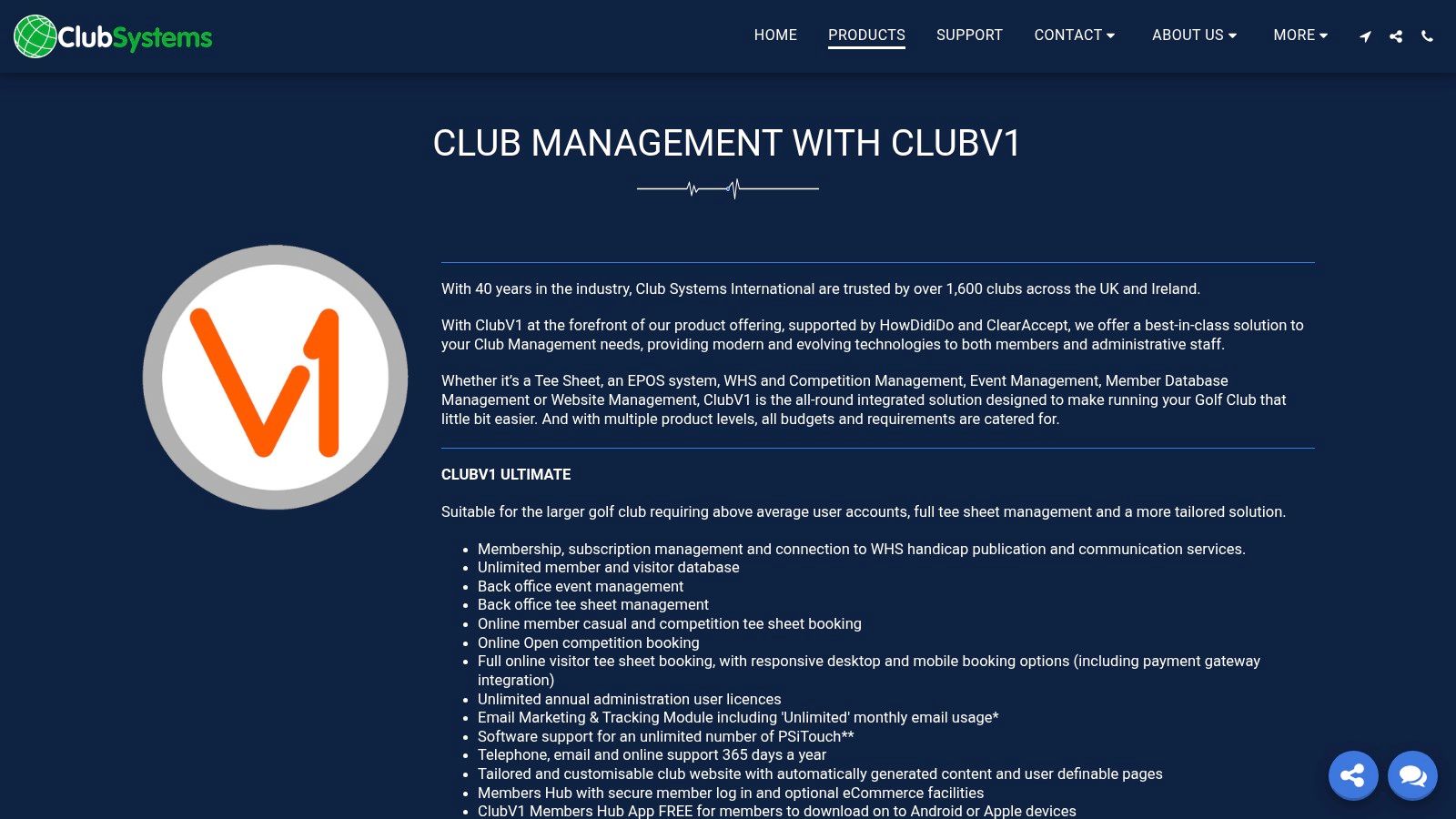
Start here if you want an established UK golf supplier rather than a general database. ClubV1 from Club Systems International covers member records and subscription management alongside competition and handicap workflows, including WHS service links. That's a sensible combination for a members' club where the office, competitions secretary and treasurer all touch the same member record during the week.
Where It Fits Best
- Connected operations: Links to tee booking, EPOS, payments, websites and member communications reduce separate lists.
- Admin on the move: The ClubV1 Admin app covers membership, billing and competition functions away from the desk.
- Support: The supplier advertises support 365 days a year, which matters on competition mornings.
The trade-offs are commercial, not functional. Pricing is quote-based, so you can't build a budget case from the website. Confirm which capabilities need separate products or licences, because a broad connected range can price very differently from the core system. A small club with simple categories may also find it more system than it needs.
Our verdict: Shortlist it if you're an established club wanting golf-specific depth and you're prepared to work through a quoted proposal line by line.
2. BRS Golf Memberships
If your members already live in BRS for tee times, adding memberships there is the obvious conversation. BRS Golf Memberships is designed to sit alongside BRS tee booking, its booking site and app, so members see bills where they already book golf. That familiarity helps adoption more than most suppliers admit.
The billing flexibility is the strongest point. You can run monthly, annual, rolling or custom subscription cycles, build custom membership schemes, and use staged subscriptions to move someone from an introductory offer onto a standard category without recreating their record. Online billing and payments are published through the club website and app, which suits clubs trying to cut paper renewals and phone payments.
Practical rule: If a platform's main advantage is an ecosystem you don't use, score it as a new ecosystem purchase, not as a membership add-on.
That's exactly the catch here. The case weakens if you're not using, or don't want, the wider BRS ecosystem. Public pricing wasn't available, so confirm licence and transaction costs before committee stage. Also be clear about scope. This is membership administration tied to tee booking, not a complete prospect-marketing CRM for enquiries that haven't joined yet.
Our verdict: The natural first call for existing BRS clubs. For everyone else, price the whole ecosystem change, not just this module.
3. intelligentgolf

intelligentgolf positions itself as a cloud-based, integrated platform rather than a standalone member list. It brings together membership and club administration, online tee-time booking, competitions, a member-facing app and club communications. For committees, the reporting is a key part of the pitch, and vendor testimonials point to reporting and integration as valued outcomes.
That integrated claim is worth testing hard, because it's also where clubs get caught. Ask the supplier to show one member moving through joining, payment, a competition entry and a committee report without data being rekeyed. If you're weighing this kind of joined-up system against narrower tools, our guide to golf course management software and how the pieces fit together sets out the operational differences.
What to Pin Down Before You Commit
- Modules: Confirm exactly which membership, payment, reporting and integration functions are in your package.
- Migration: Ask how historic records, consent and payment evidence transfer from your current system.
- Member adoption: Check what support members get when logins, apps and booking habits change.
Pricing isn't published, so the quote needs the same discipline.
Our verdict: A credible shortlist option for clubs that want one golf-specific platform and will invest properly in migration and member onboarding.
4. Official Golfing
Budgeting gets easier with Official Golfing, because it publishes annual pricing and a defined price for additional courses. For a treasurer trying to compare options before demos begin, that's a genuine advantage over quote-only rivals.
The product is app-led. It combines membership handling, including Direct Debit, with tee times, competitions, score entry, live leaderboards and knockouts. Members also get a directory, notifications, in-app payments and wallets, and there are optional bar and kitchen functions for the clubhouse. The supplier says it supports WHS and Dot Golf synchronisation and membership payments by card or Direct Debit, so the core golf workflows are covered in one place.
Check the transaction economics before you fall for the headline price. In-app card payments carry a stated processing fee, and at renewal volumes that changes the annual cost. Model it on your actual subscription income, not on the licence alone.
You'll also need to verify integrations and migration against your existing setup, and plan staff and member onboarding carefully if the platform is less familiar to your membership than the long-established names.
Our verdict: Shortlist it if published pricing and an all-in-one member app matter most, and model payment fees on a full renewal cycle before deciding.
5. Tuvabook
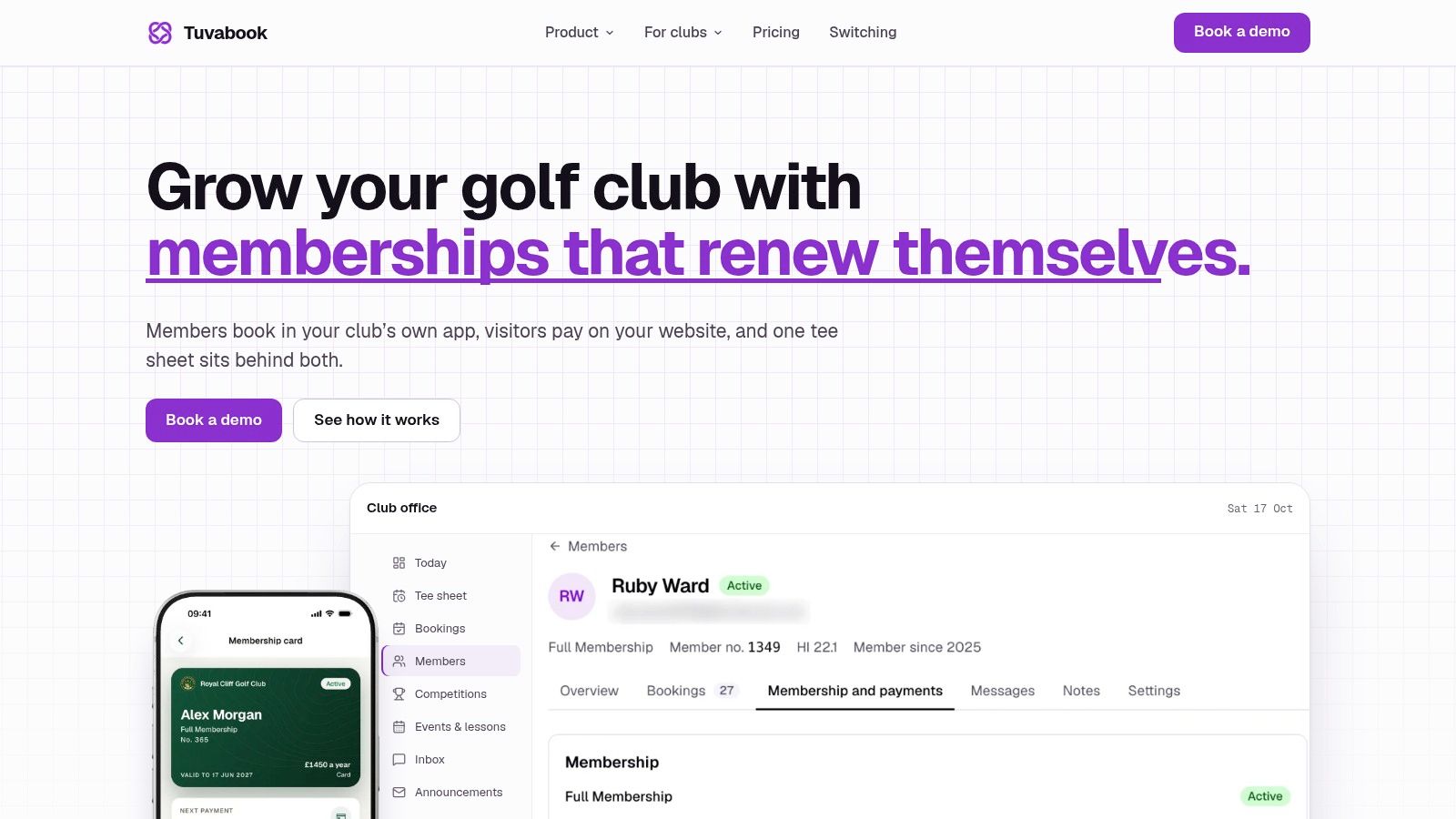
Tuvabook covers a wide operational spread for a golf venue. Membership and tee-sheet management sit alongside competitions, lessons and payments, with a club app and online booking. Clubs running coaching alongside membership will notice the lesson functions, which many pure membership tools ignore.
Two details stand out. First, it describes distinct workflows for member clubs and pay-and-play courses, which matters if your venue mixes both or might change model. Second, it highlights membership categories with pricing rules and automated renewals by card or Direct Debit. Automated renewals are where software earns its keep, because they remove the annual scramble of forms, cheques and manual chasing.
If booking workflows are central to your shortlist, it's also worth sense-checking your requirements against the wider Rankozo guide to booking software before demos, so you know which scheduling features are standard elsewhere.
The gaps are about evidence. Pricing wasn't available in the material reviewed. Ask for references from comparable UK clubs, insist on a demonstration of your own categories and renewal rules, and verify compatibility with your handicap, payment and booking systems in writing.
Our verdict: Worth a demo for mixed member and pay-and-play venues, provided references and integrations check out.
6. Golf Club Software
Transparency is the headline here. Golf Club Software presents UK-facing pages with published plans, so you can compare recurring costs without a sales call. For a committee that wants numbers early, that speeds up the first sift considerably.
Functionally, membership sits inside a wider golf operations product. You get membership categories, renewal dates and subscriptions, tee-sheet and online booking functions, and payment collection alongside general club operations features. That's the right shape for a club that wants membership and the tee sheet under one roof rather than bolting systems together. If you're still deciding how wide your replacement should go, our overview of golf club management software options and scope will help you frame that decision.
The Checks That Matter
- UK package: Confirm which features are live for UK clubs and which are still evolving.
- Fees: Verify payment fees and any booking-related charges on top of the plan price.
- Maturity: Compare migration support, operational track record and local references with established providers.
Published pricing gets a supplier onto your shortlist faster. It doesn't remove the need to test migration with your messiest real records.
Our verdict: A sensible budget-first comparison point. Prove UK support and references before treating it as equal to longer-established golf suppliers.
7. Paralo
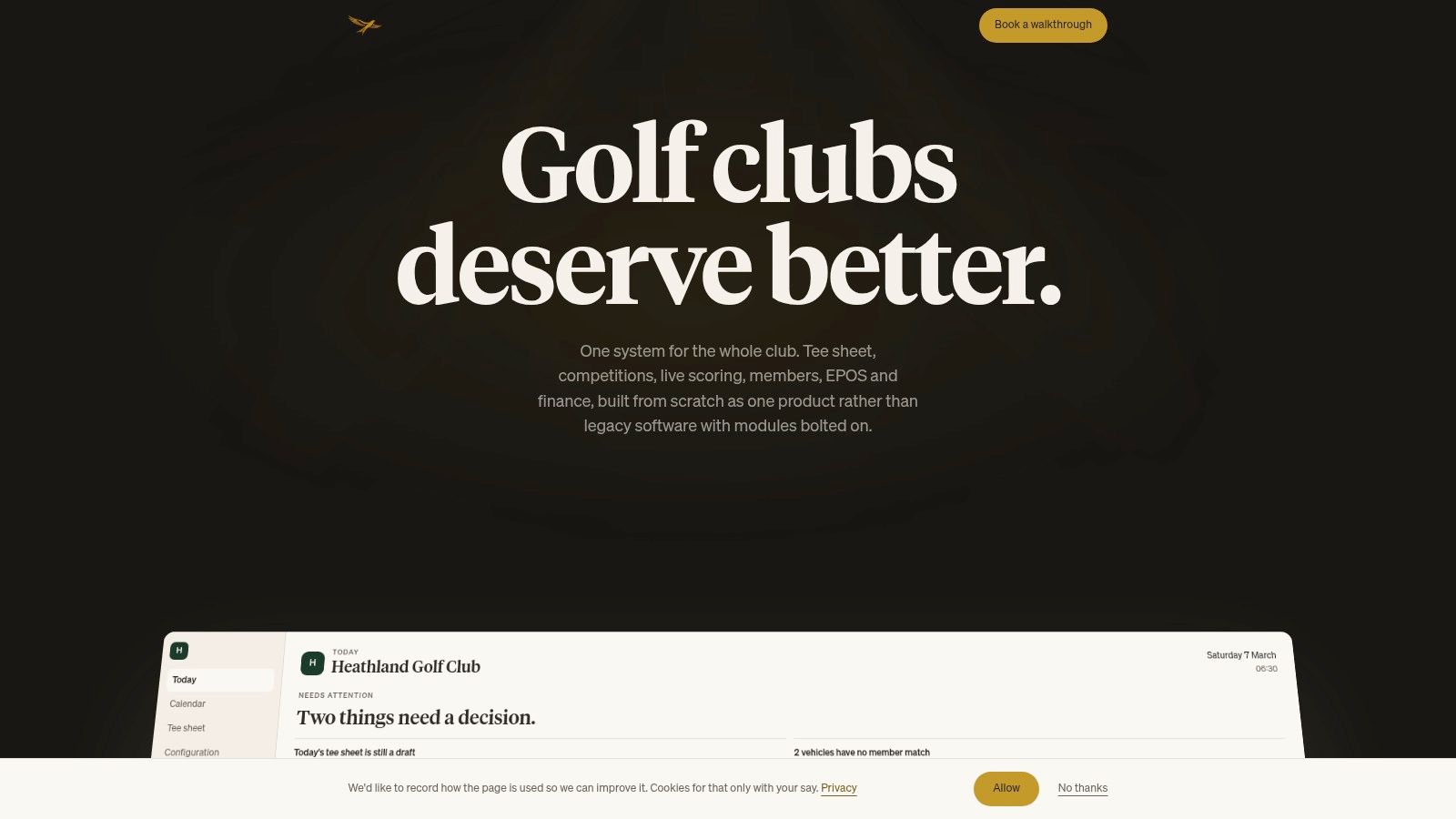
Paralo aims at the broad operational system end of the market. It brings together membership with a member app, tee sheets, competitions and live scoring, plus EPOS and finance capabilities. For a club tired of reconciling a bar till, a tee sheet and a membership spreadsheet that never quite agree, that single-platform argument has real appeal.
It's designed around UK golf-club operations, and combining membership with revenue functions means a member's spending and playing activity can sit in one environment. Used well, that gives management a fuller picture of revenue per member than subscription income alone. Used badly, of course, it just centralises inconsistent data faster, so process discipline still decides the outcome.
Availability needs confirming before you invest committee time. Pricing wasn't available in the material reviewed, and the vendor says its Android app is in progress, so check current mobile support against your membership's actual devices. Ask for references, integration details and a written implementation plan, including who cleans your data and who trains the bar and office teams.
Our verdict: Consider it if you want membership, EPOS and finance together and you're willing to verify product maturity and mobile coverage first.
8. ClubPlaces
Not every club needs to replace everything. ClubPlaces focuses on membership and club administration and can sit alongside your existing tee-time system. If your booking works and members like it, keeping it while fixing membership admin is often the lower-risk move.
The feature set is practical. You can set up membership categories with different fees and fields, run automatic subscription collection and renewals, manage competition and event sign-ups with capacity and pricing, and handle member communications and payments via Stripe. For a club whose pain is renewals, categories and event entries rather than the tee sheet, this covers the daily work.
The pricing model is different and easy to model. The vendor states there's no subscription or per-member fee. Instead, a 1% platform fee applies to payments, in addition to Stripe processing fees. Run that against your annual subscription and event income. Low transaction volumes favour this model. High volumes may not.
Be clear on limits. It doesn't replace tee-time booking software, and you should test whether reporting and integrations meet committee and treasurer needs.
Our verdict: A clean, low-commitment option for clubs keeping their tee sheet and fixing membership payments and renewals first.
9. Manage My Club
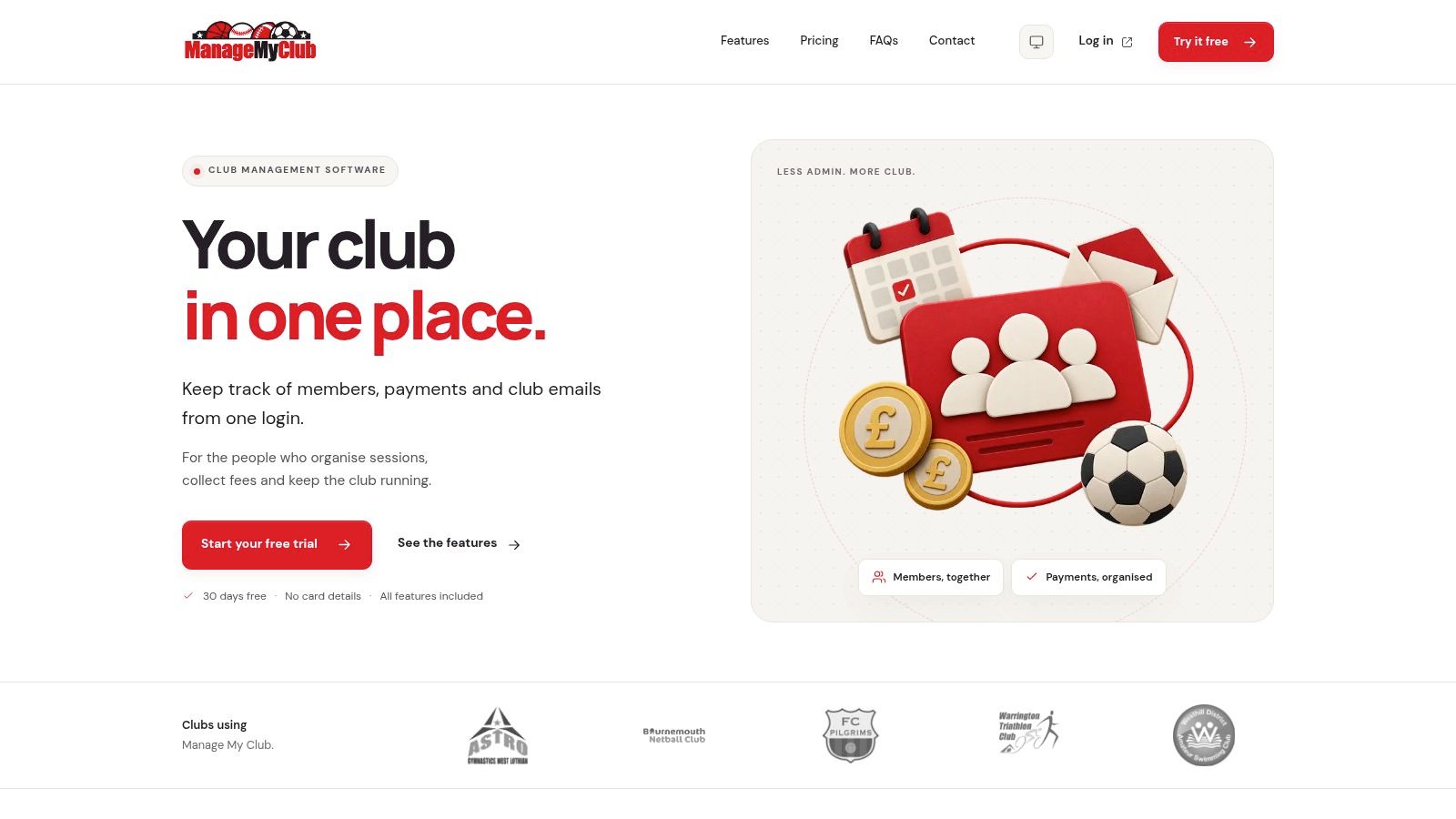
Manage My Club is the honest generalist on this list. It's a general-purpose club platform, not a golf suite, built around a member database and contact records with browser access and CSV or Excel import. Optional modules add invoicing, online payments and Direct Debit, plus a calendar, events, attendance and communications.
For a smaller or volunteer-run club, that modular approach has logic. You buy the administration you need instead of a full golf operations suite, there's a published low entry price, and the vendor advertises a 30-day trial without card details. If your immediate problem is a chaotic spreadsheet and manual invoicing, our guide to membership management software in the UK and what smaller clubs actually need covers that starting point in more detail.
Know what you're not getting. There's no full golf tee sheet, competition or handicap platform, so those stay elsewhere or stay manual. Optional modules increase the monthly cost, so price the configuration you'd really run, not the entry tier. Check integration with your existing golf systems too, or you'll create two member lists.
Our verdict: A sensible low-cost starting point for volunteer-run administration. Not a replacement for golf-specific operations software.
10. ClubSpark
ClubSpark comes from the wider sports-venue world, and that shapes its strengths. It combines membership and contact management with CRM features, a club website, coaching modules, and bookings, events and discounts on higher tiers. A golf facility with a significant coaching operation or wider venue activity may find that mix more useful than a traditional members' club would.
Commercially, it's straightforward to assess. It publishes UK prices, offers a 30-day trial, and its tiered plans scale toward larger clubs and multi-venue operators. You can model costs before speaking to anyone, which several golf-specific rivals don't allow.
Where Golf Clubs Should Probe
- Golf depth: It isn't a specialist golf system, so verify competition and handicap requirements in detail.
- Total cost: Payment processing and Stripe fees sit on top of the subscription.
- Contract: Annual plans carry a 12-month contract according to the pricing page, so trial properly first.
Our verdict: Relevant for golf facilities with coaching and venue needs beyond membership. Traditional members' clubs should only shortlist it after proving competition and handicap workflows work their way.
Club membership software options at a glance
| Option | Golf-specific | Published pricing | Best suited to |
|---|---|---|---|
| ClubV1, Club Systems International | Yes; golf-club administration, competitions and handicap workflows | Quote-based; not published | Established clubs seeking connected golf operations software |
| BRS Golf Memberships | Yes; membership integrated with BRS tee booking | Not found; confirm licence and transaction costs | Clubs using or adopting the BRS ecosystem |
| intelligentgolf | Yes; membership, tee bookings and competitions | Not published in reviewed sources | Clubs seeking an integrated golf administration platform |
| Official Golfing | Yes; membership, tee times, competitions and handicaps | Annual pricing published; payment processing fees apply | Clubs wanting a combined member app and golf operations platform |
| Tuvabook | Yes; membership, tee sheets, competitions and payments | Not found in reviewed sources | Member clubs and pay-and-play venues seeking joined-up operations |
| Golf Club Software | Yes; membership, tee sheets and golf operations | Plans published; verify current package and fees | UK clubs comparing transparent golf operations plans |
| Paralo | Yes; membership, tee sheets, competitions, EPOS and finance | Not found in reviewed sources | UK clubs seeking a broad operational platform |
| ClubPlaces | Yes; golf-club membership, events and payments | No subscription or per-member fee stated; 1% platform fee plus Stripe fees | Clubs focused on membership administration alongside existing tee-time software |
| Manage My Club | No; general club-management platform | Low entry price published; optional modules may add cost | Smaller or volunteer-run clubs needing basic member administration |
| ClubSpark | No; broader sports-venue platform | UK prices published; payment processing fees apply | Golf facilities with wider venue, coaching or multi-site needs |
How to Decide, Trial and Implement Without Disrupting the Club
Plan this as a change programme, not a purchase. The GCMA golf club software technology report found membership management had the widest gap between importance and satisfaction of any software area among 134 surveyed managers, and that introducing new systems typically takes seven to eight months. A timeline that long rules out any go-live near your renewal peak.
Run the five tests against every shortlisted option, in the same order, with the same scenarios: membership administration, CRM and enquiry handling, automation, committee reporting and golf-specific fit. Score what you see working in the room. A roadmap promise earns nothing.
Insist on a live demonstration built around your own membership categories and renewal cycle. Include the awkward cases: a mid-year joiner, a category change, a failed Direct Debit and a lapsed member returning. Then check migration support with at least one reference club of similar size, and ask directly what data failed to transfer cleanly. The software trial advice from KeenVerdict covers how to structure that evaluation properly.
Then separate two jobs suppliers often blur. Most options above administer current members competently. Far fewer handle enquiry capture, follow-up and pipeline reporting for golfers who have not joined, which is where commercial growth sits. The scale justifies the attention: UK analysis reported in our golf club CRM software guide put England Golf affiliated membership at 762,742 in 2023, with 98% of those golfers belonging to more than 1,800 affiliated clubs. At that scale, small conversion and retention gains are worth serious money.
Retention deserves the same rigour. A UK golf club membership analysis reported annual retention of 92% to 94%, equivalent to 6% to 8% annual churn. At 600 members, that is roughly 36 to 48 memberships to replace before you grow at all. Your software should flag declining visits, record resignation reasons and report retention by joining cohort, so the committee can tell an onboarding problem from a pricing problem.
On the pipeline side, your CRM should show where each prospect sits, what action is due and which stage is stalling. GolfRep sets New to Contacted conversion at 90% or above for a well-run pipeline, and advises source-level reporting over raw enquiry counts, so you can see which channels produce members who stay rather than enquiries that flatter a monthly report.
Your Action Checklist
- Define requirements: List the workflows your club depends on and who owns each one.
- Shortlist three: Match them to your club type rather than feature counts.
- Demo with real data: Use your categories, awkward cases included.
- Check references: Speak to a similar club about migration and support.
- Agree the migration plan: Confirm data cleaning, training and go-live dates in writing.
- Review after one season: Test reporting against the decisions your committee makes.
If you want to know where the biggest commercial constraint sits in your club, from enquiry handling through to renewal and retention, GolfRep can help map the pipeline and the systems behind it. GolfRep works with UK golf clubs to build systems that turn enquiries into members and keep them, from first contact through to retention. Visit GolfRep to see how that approach would apply to your club.
Ready to tap into our proven growth system?