Choosing Golf Course Management Software for 2026
Most advice on golf course management software starts in the wrong place. It starts with tee sheets, POS functions, or a long checklist of features.
That misses the core issue facing many UK clubs.
For most committees, managers, and secretaries, the problem isn't getting interest. It's what happens after interest arrives. An enquiry lands in a shared inbox. Someone means to reply. A spreadsheet gets updated later. A follow-up depends on who is on shift, who is on leave, or whether the committee meeting happened this week. By the time anyone responds properly, the golfer has already toured another club or made a decision elsewhere.
That is why golf course management software matters. Not as an IT upgrade. Not as a booking convenience. As the system that stops demand leaking out of the club.
Your Club's Real Growth Problem Is Not What You Think
The common assumption is simple. If membership growth feels difficult, the club must need more leads.
That sounds sensible until you look at how many clubs already have demand in front of them. Our analysis shows 59% of UK members' clubs now have over 600 playing members and 48% maintain waiting lists, yet the primary bottleneck in growth is not generating enquiries but failing to convert them due to slow responses, manual spreadsheets, and lack of automated follow-up (GolfRep analysis).

Where clubs actually lose revenue
A club secretary rarely loses a member enquiry because they don't care. They lose it because the process is fragile.
One person holds context in their inbox. Another keeps notes in a spreadsheet. The membership chair has a separate view. Tour bookings sit in a diary or on email threads. Nobody has full visibility. That means no one can answer a basic question with confidence: which enquiries are active, who needs a reply, and what happened next?
Practical rule: If your club can't see every enquiry and next action in one place, it doesn't have a sales process. It has admin activity.
That distinction matters. Admin activity feels busy, but it doesn't produce predictable outcomes. A system does.
Why software is really a conversion tool
The best golf course management software gives the club a structured way to handle demand. It captures the enquiry, routes it properly, triggers follow-up, records interaction history, and shows the committee what is and isn't converting.
That changes the conversation in the boardroom. Instead of asking, "How do we get more leads?" the better question becomes, "How do we respond faster, follow up properly, and stop good enquiries going cold?"
Clubs that solve that problem usually don't need more complexity. They need fewer moving parts, clearer ownership, and software that supports the process rather than relying on memory.
What Is Golf Management Software Really For
At its best, golf management software acts as the club's central nervous system. It connects enquiries, bookings, payments, member records, communication, and reporting so that staff aren't jumping between disconnected tools.
Without that central system, clubs end up with a familiar patchwork. Outlook or Gmail for enquiries. Excel for prospect lists. A separate booking platform. Card payments handled elsewhere. Committee reports assembled by hand. Each tool does one job, but none of them gives a complete picture of the member journey.
From disconnected admin to one operating system
The practical job of golf course management software is to create continuity.
A prospect enquires about membership. The system records it. A tour is booked. Notes are stored against the person, not buried in an inbox. Follow-up happens on time. If they visit as a guest first, that activity can inform future communication. Once they join, the same record supports onboarding, billing, booking behaviour, and renewal conversations.
That continuity is what most clubs are missing.
Good software doesn't just store data. It gives staff and committees a reliable view of what needs attention today.
The same principle applies well beyond golf. If you're interested in how a connected platform can unify sales, service, reporting, and operations, how Dynamics 365 transforms UK businesses is a useful reference point because it shows what happens when organisations stop treating systems as separate islands.
The strategic purpose committees often overlook
Committees sometimes evaluate software as though they're buying a digital diary. That's too narrow.
A strong system should help the club answer questions such as:
- Lead visibility: Which enquiries came in this month, and where are they stuck?
- Conversion tracking: How many prospects booked a visit, attended, and joined?
- Operational handover: If a volunteer or staff member changes role, does the process survive?
- Commercial clarity: Which membership pathways, visitor segments, or follow-up sequences produce revenue?
Those are growth questions, not just software questions.
The clubs that get value from golf course management software are the ones that buy it to improve decisions and response quality, not just to replace paper. If the software only digitises old habits, the club stays slow in a more modern-looking format.
Core Features That Drive Growth Not Just Operations
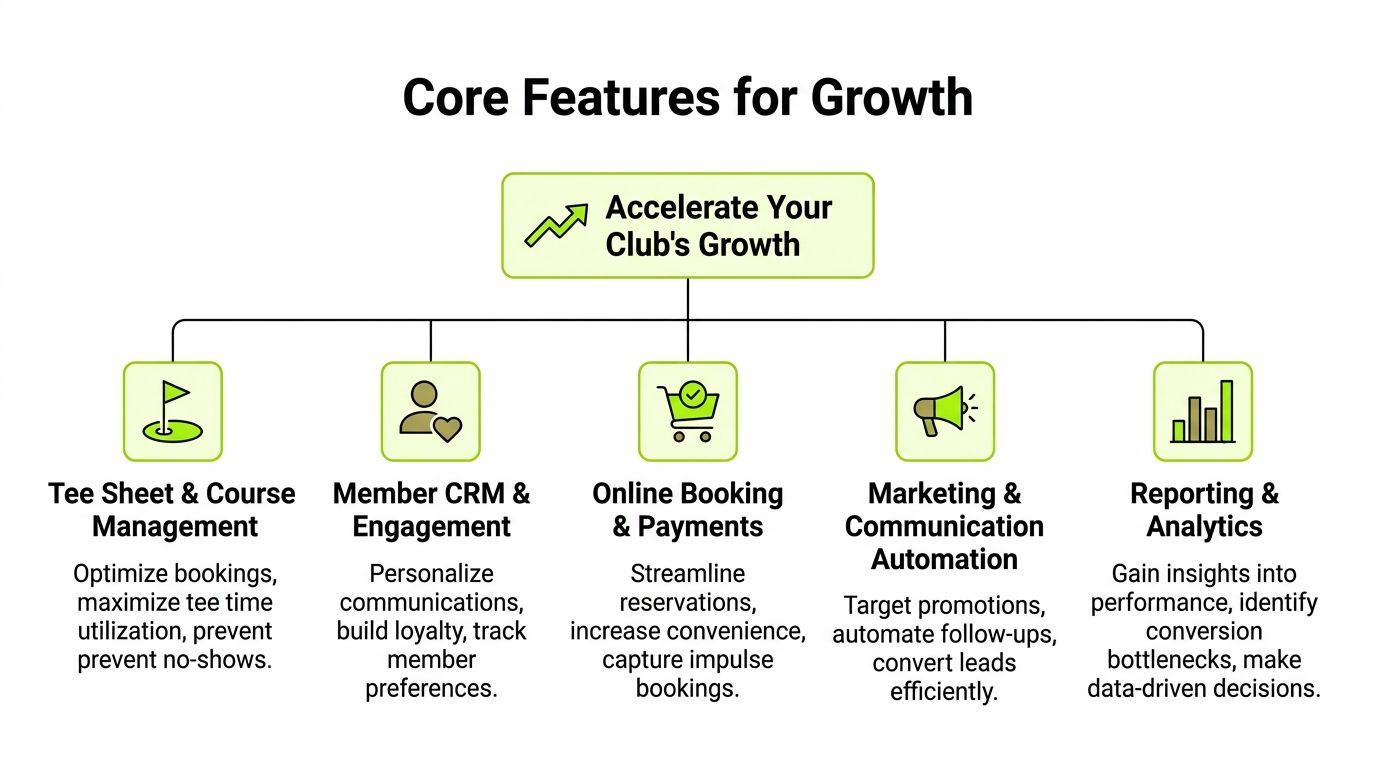
Feature lists often blur together. Every provider claims bookings, payments, CRM, reporting, and communication. The better question is simpler. Which features directly help the club respond faster, follow up consistently, and convert more of the enquiries it already has?
That is where the primary value sits.
CRM and lead visibility
A proper CRM is not optional if the club wants control over membership growth. It should show every open enquiry, the last contact, the next step, and who owns it.
Without that, leads disappear into individual inboxes and staff memory. With it, the club can manage prospects like a pipeline rather than a pile of messages.
For a deeper look at how this works in practice, golf club CRM software is worth reviewing alongside any vendor demo.
Automation that removes delay
Automation gets misunderstood. It isn't about replacing people. It's about removing the dead time between tasks.
If someone submits a membership enquiry at 9:30 pm, the system should acknowledge it immediately, assign it correctly, and trigger the next step. If a prospect books a tour but doesn't attend, the system should prompt follow-up. If a visitor plays twice in a short period, the club should be able to start a personalized membership conversation without relying on someone to notice manually.
Approximately 71% of newly implemented golf management systems are now cloud-based. This shift is essential for enabling real-time reservations and 24/7 automation needed to handle enquiries effectively, though around 41% of smaller clubs face budget limitations for these advanced tools (global market data on golf course software).
That trade-off is real. Smaller clubs may hesitate on cost, but manual delay has a cost too. It just doesn't appear on a software invoice.
Booking and payment tools that reduce friction
Online booking and integrated payments are often framed as convenience features. They are, but they also affect conversion.
If a prospect wants to book a trial round, reserve a tour, pay a joining fee, or secure an event place, every extra email and every manual step creates drop-off. Good software reduces that friction. It lets people act while intent is still high.
A useful way to judge this is to test the journey yourself:
| Stage | Weak setup | Strong setup |
|---|---|---|
| First enquiry | Generic inbox form | Structured capture into CRM |
| Visit booking | Email exchange | Self-serve or assisted online scheduling |
| Payment step | Manual phone call or bank transfer | Integrated secure payment flow |
| Follow-up | Depends on memory | Tasked and automated sequence |
Reporting that committees can actually use
Analytics matter, but only if they answer practical questions. A dashboard full of charts won't help if nobody can explain whether tour bookings are rising, whether follow-up is happening, or where prospects are being lost.
The right reports should be simple enough for a committee pack and clear enough for operational staff to act on. If reporting only tells you how many members you have, it is descriptive. If it shows where conversions stall, it becomes useful.
The best reporting doesn't impress the committee. It helps the club change behaviour next week.
How Software Benefits Different Types of UK Clubs
The right setup depends on the type of club. Generic reviews rarely reflect that. Most software reviews focus on single-site clubs, overlooking the fact that 32% of UK golf clubs are part of multi-venue groups. There is a lack of analysis on how centralised CRM and automation serve multi-site operators like Macdonald Hotels, a key angle for this underserved market (research on multi-venue golf operators).
A private members' club and a multi-site resort group do not need the same operating model, even if they use some of the same tools.
Private members' clubs and committee-run operations
For a committee-led club, software should create transparency and reduce dependence on individuals.
That means a new membership lead shouldn't live with one volunteer, one captain, or one office administrator. The process should stay visible even when committee roles change. Notes, status, communication history, and follow-up tasks should all sit in one place so that the club can hand over responsibility without losing momentum.
Many clubs also need a more joined-up golf club booking system, not just for visitors and members, but for tours, trial rounds, and other conversion moments that often sit outside the main membership process.
A committee should also ask whether the reporting is understandable by non-technical board members. If the club can't produce clean, simple updates on open enquiries and outcomes, software will become another source of confusion rather than control.
Multi-site operators and resort groups
Multi-site groups need something different. They need standardisation.
An enquiry shouldn't be handled brilliantly at one property and poorly at another because local staff happen to be stronger. A central CRM, shared rules, and consistent follow-up give head office visibility across all venues while still allowing local teams to manage the relationship on the ground.
For resort groups, the key gains usually come from:
- Central oversight: Head office can see lead flow and follow-up across properties.
- Consistent handling: Prospects receive a similar standard of response regardless of site.
- Cross-property opportunity: A golfer who doesn't fit one site may still suit another.
- Cleaner reporting: Revenue conversations become less anecdotal and more accountable.
A multi-site operator doesn't just need software that works at each venue. It needs software that works between venues.
That distinction is what many software comparisons miss.
Your Evaluation Checklist for Choosing the Right System
Committees often compare software by looking at logos, screenshots, and headline features. That usually leads to the wrong decision.
A better process starts with the club's bottlenecks. If the main pain is missed follow-up, slow response time, weak reporting, or fragmented member records, the system has to solve those problems first. Fancy extras can come later.
The questions that matter most
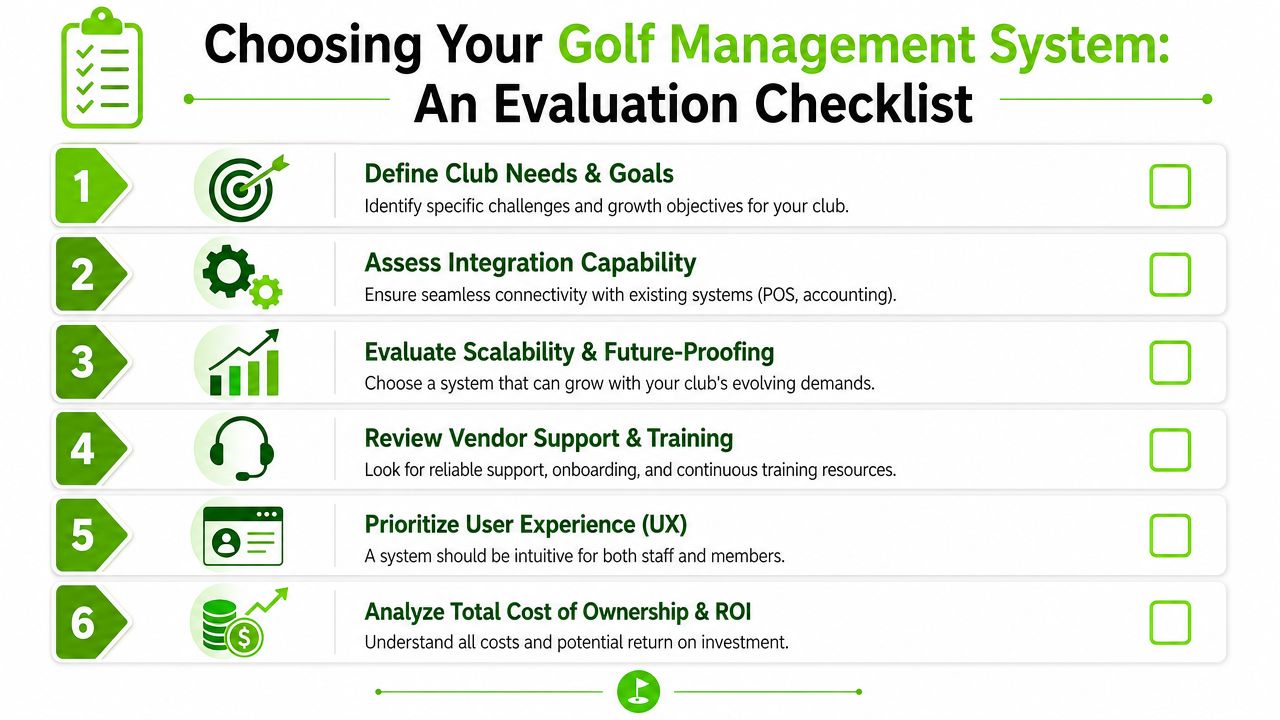
Use this checklist in demos and vendor conversations.
Can it capture and track every enquiry properly
Ask to see what happens from first form submission to final outcome. If the answer involves manual exports, shared inboxes, or separate spreadsheets, the club still has a visibility problem.
Does it support follow-up without relying on memory
The software should create tasks, reminders, and automations around key points such as new enquiries, booked tours, no-shows, and unconverted visitors.
Will committee members understand the reporting
A strong system should make it easy to review pipeline status, conversion stages, and unresolved enquiries without technical interpretation.
How well does it connect with the rest of the stack
Booking tools, payments, website forms, accounting processes, and communication workflows should work together. If they don't, staff end up rekeying data and errors creep in.
What to test in the demo
Don't let the provider control the narrative with a polished walkthrough. Give them scenarios.
- New member scenario: Show how a membership enquiry is captured, assigned, and followed up.
- Lapsed action scenario: Show what happens if nobody responds or a prospect goes quiet.
- Committee reporting scenario: Show the report a board would receive before a meeting.
- Handover scenario: Show how another staff member picks up the conversation mid-process.
That approach quickly reveals whether the system is operationally sound or just visually neat.
Cost, support, and future fit
Price matters, but headline price is only one part of the decision. Some systems charge by user, some by module, some by broader package. The key question is what the club needs to buy to run the process properly, not what gets it through the door cheapest.
Support and onboarding deserve the same scrutiny. If the vendor can install the tool but can't help the club structure a workable process, adoption usually stalls.
For committees reviewing options in this area, membership management software in the UK adds useful context around what a robust member journey should include.
Buy for the process you need to run, not the feature count you hope to grow into.
Measuring Real-World ROI from Your New System
Committees don't need abstract promises. They need evidence inside their own operation that the system is improving outcomes.
The clearest place to start is speed. For UK golf clubs, the average response time to membership enquiries is 47 hours. However, a lead that receives a response within one hour is five times more likely to convert than one that waits 24 hours, making speed the most critical factor in capturing revenue (GolfRep on golf course revenue management).
That single gap explains why software ROI often appears faster than expected. When the club cuts delay, it doesn't need to manufacture demand from scratch. It stops losing people who were already interested.
The metrics that actually matter
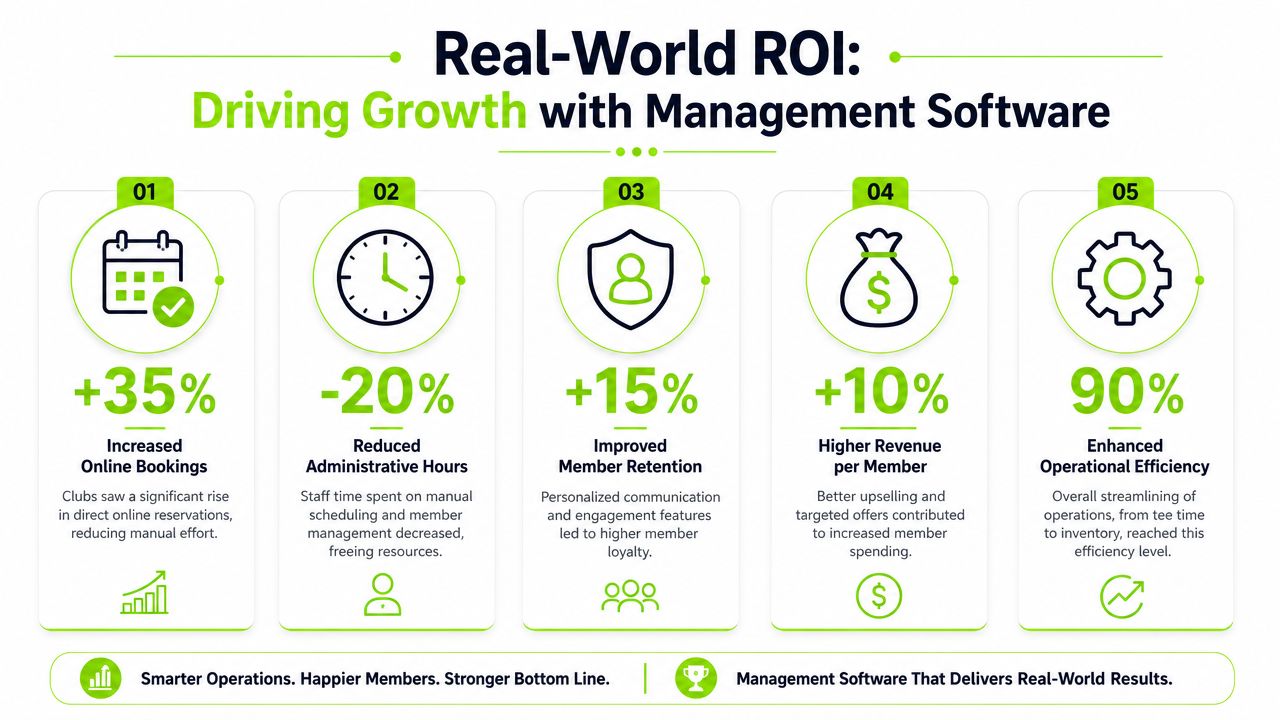
A committee should measure software impact using a short list of operational and commercial indicators:
- Response speed: Are new enquiries being acknowledged and assigned immediately?
- Tour progression: Are more prospects booking and attending visits?
- Follow-up discipline: Is every prospect getting the next action on time?
- Admin load: Are staff spending less time chasing information across systems?
- Conversion clarity: Can the club now see where leads are won or lost?
These measures are practical because they connect directly to day-to-day behaviour.
What improvement usually looks like
In real club environments, the first gains often come from basic control rather than dramatic reinvention. An organised CRM view reduces lost leads. Automation stops enquiries sitting untouched overnight or over the weekend. Standardised follow-up gives less experienced staff a process they can execute consistently.
That improvement tends to show up in three ways.
First, the office gets calmer. Staff stop searching across inboxes, spreadsheets, and handwritten notes.
Second, the pipeline becomes visible. The club can finally distinguish between "we're busy" and "we're converting".
Third, revenue decisions improve. The committee can see whether poor performance is a lead generation issue, a response problem, or a follow-up failure.
The return on golf course management software isn't just administrative efficiency. It is the value of turning interest into action before it goes cold.
Conclusion From Operations Tool to Growth Engine
Golf course management software is often sold as an operations product. That undersells it.
For a modern UK club, it is one of the clearest levers for improving enquiry handling, response speed, staff visibility, and conversion control. Those are the areas that shape revenue most directly. Not because software is magical, but because a club without systems will always depend too heavily on memory, goodwill, and manual effort.
Committees should stop asking whether they need more software features and start asking whether they have a dependable process for converting demand. If the answer is no, the right system is not a nice-to-have. It is a core part of the club's financial stability.
The clubs that grow predictably are rarely the clubs doing the most admin. They are the clubs with the cleanest process.
If your club wants a clearer pipeline from first enquiry to signed member, GolfRep helps UK golf clubs build the systems behind that growth, combining lead generation, CRM structure, and disciplined follow-up so enquiries don't get lost between the inbox and the committee room.
Ready to tap into our proven growth system?