What Is Tee Time: Tee Time Explained

Most advice on what is tee time treats it as a golfer's diary entry. Pick a slot, turn up, play golf.
That definition is too small for any General Manager trying to run a healthy club.
A tee time is a customer commitment, a pricing decision, an operations constraint, and a lead signal all at once. If you only see it as today's booking, you'll manage it day by day. If you see it as a system, you can build predictable revenue from it.
At GolfRep, we look at the tee sheet the same way strong operators look at any scarce asset. Not as a static calendar, but as the control point where demand, staffing, pricing, visitor experience, and future membership growth all meet. That changes the question from “how do we fill empty times?” to “how do we turn tee time demand into repeatable commercial outcomes?”
The Tee Time From Two Critical Perspectives
For a golfer, a tee time is simple. It's the scheduled start time for a round, used to organise player flow and keep the course moving properly. In UK operations, intervals are typically 8 to 10 minutes, with the GB&I Pace of Play guidance recommending at least 8 minutes for two-balls, 10 minutes for three-balls, and 11 to 12 minutes for four-balls to avoid congestion and protect pace of play on course (GB&I pace guidance reference).
That basic definition matters because many clubs still deal with avoidable confusion. New golfers often think tee time means arrival time. It doesn't. It means start time.
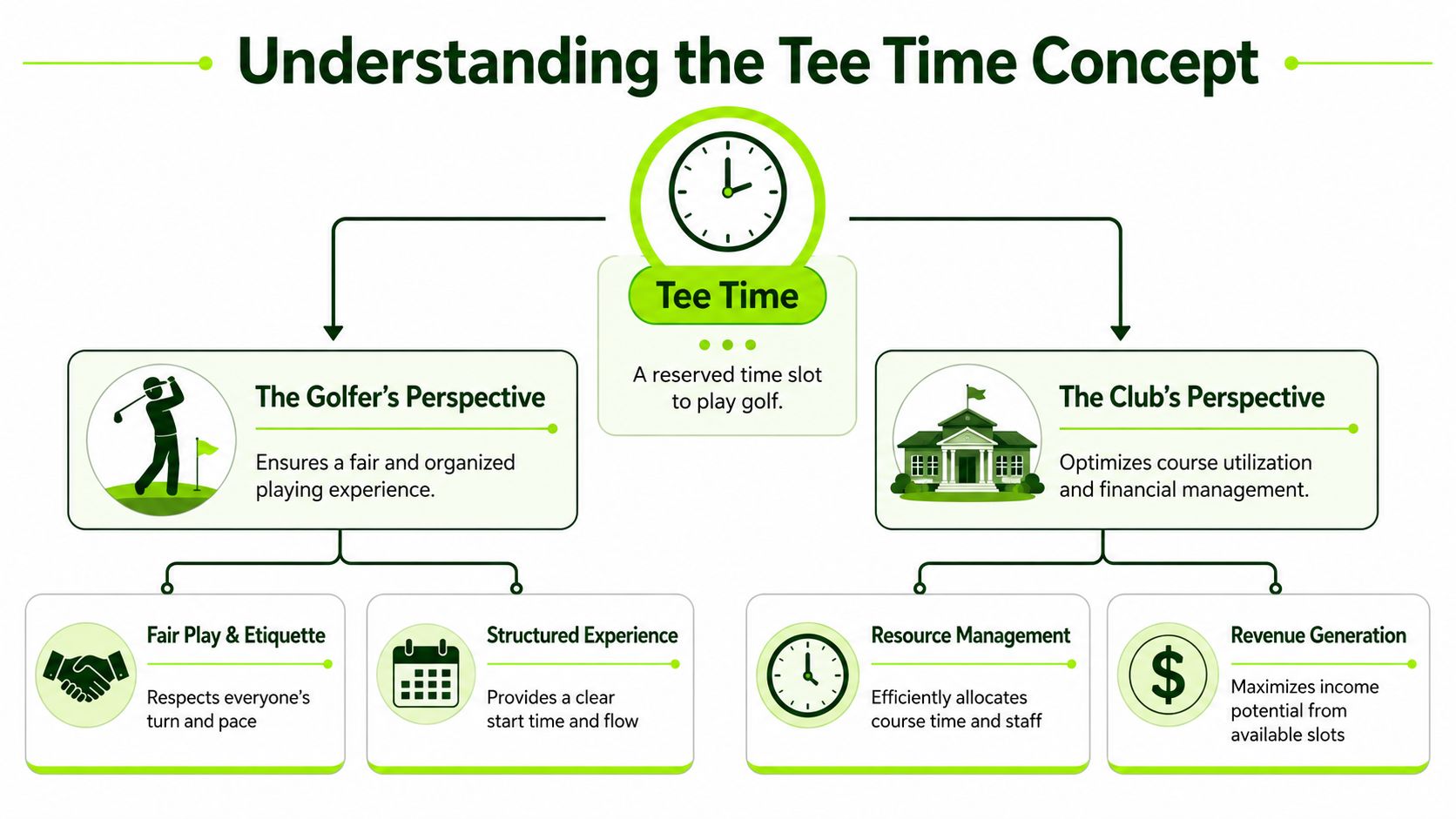
The golfer's view
From the player's side, the tee time does three jobs:
- Protects fairness: Everyone knows when their group is due away.
- Creates order: The first tee doesn't become a negotiation.
- Supports pace: Sensible spacing between groups reduces backups across the course.
Practical rule: The tee time is the moment play begins, not the moment the golfer walks through the clubhouse door.
When clubs explain this clearly, the first-tee experience improves immediately. Staff face fewer rushed check-ins. Starters deal with fewer awkward rearrangements. Members don't feel that visitors are disrupting the flow.
The manager's view
For a manager, that same tee time is something else entirely. It's your most perishable unit of inventory.
If the 9:20 slot goes unused, you can't store it and sell it tomorrow. It disappears. The same is true if the slot is filled badly, priced badly, or handed to a process that captures no useful customer data.
A useful way to think about it is this:
| Perspective | What a tee time means |
|---|---|
| Golfer | A reserved start to the round |
| Club operations | A pacing and staffing decision |
| Club commercial team | A revenue opportunity |
| Club growth system | A lead and behaviour signal |
That last line is the one many clubs miss. Every booking tells you something. Who booked. When they prefer to play. Whether they came direct, by phone, through the club site, or through an app. Whether they returned. Whether they later enquired about membership, lessons, or a society day.
If your tee sheet only records occupancy, you're running the course. If it records intent and follow-up as well, you're running a business system.
The Hidden Economics of Your Tee Sheet
Most clubs still discuss tee sheets operationally. Are we busy on Saturday? Can we squeeze in another four-ball? Is the afternoon soft?
That's useful, but incomplete. The tee sheet is also a financial dashboard.
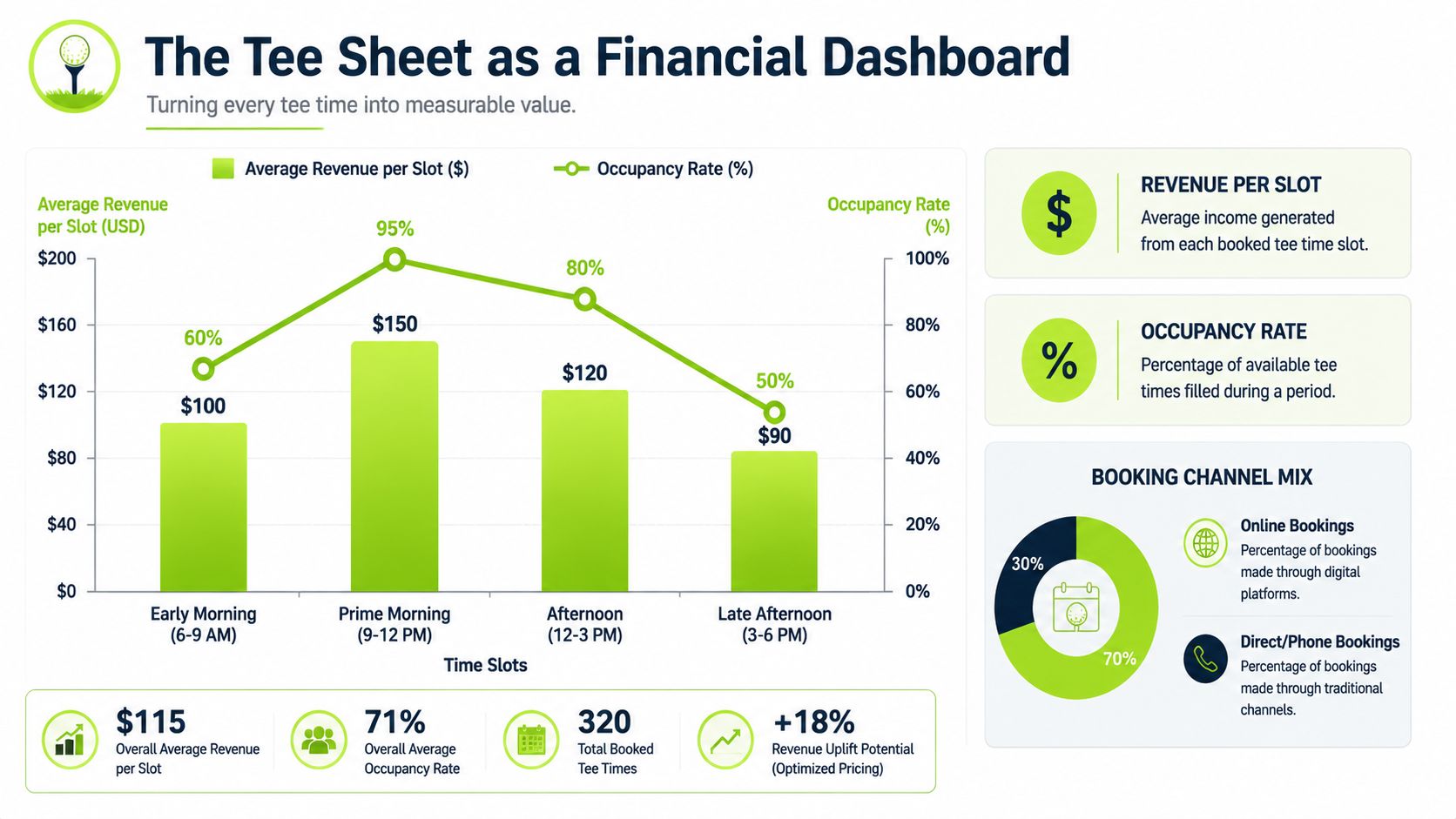
Not all slots are equal
In the UK, tee times between 8am and 12pm are the most popular slot, and the average green fee at a top 100 UK course reached £220 in 2024, up 9.6% from 2023, which shows how strongly prime-time access and pricing now move together (UK tee time demand and top 100 green fee data).
That single fact should change how a manager reads the sheet.
The 10:00am slot and the 3:40pm slot may look like two blank spaces in a diary, but commercially they aren't the same product. One sits inside the strongest demand window in the market. The other may need a different pricing, packaging, or marketing approach to move properly.
The metrics that matter
Most clubs monitor bookings. Fewer monitor yield.
A practical tee sheet review should ask:
- Utilisation: Which periods fill consistently, and which don't?
- Value per slot: Are your best-demand times carrying the pricing they should?
- Channel quality: Which bookings produce repeat play, member enquiries, or higher secondary spend?
- Displacement: Are low-value bookings blocking better commercial uses of the same window?
A full sheet can still underperform if the best inventory is sold without strategy.
That's where many clubs get trapped. They celebrate occupancy but don't examine the composition of that occupancy. Prime tee times can inadvertently subsidise weak process decisions elsewhere.
The tee sheet as a weekly revenue model
Strong operators stop looking at isolated bookings and start reading patterns by day part.
The shift in working week play matters here. If you want more context on how clubs are adapting commercial strategy around booking behaviour, it's worth reviewing these observations on tee time books and demand patterns.
The management question isn't “did we fill Friday morning?” It's “did we allocate Friday morning in a way that balanced member access, visitor revenue, and future pipeline value?”
That means your tee sheet needs three layers of thinking:
Operational layer
Keep groups flowing and staff the course properly.Commercial layer
Protect premium inventory and avoid treating all time bands the same.Pipeline layer
Identify which rounds are one-off transactions and which should trigger follow-up.
Once a club starts thinking this way, the tee sheet stops being a booking ledger. It becomes the cleanest live view of how demand turns into money.
Evaluating Your Club's Booking Technology
A booking system can look modern and still create commercial blind spots.
That's the mistake many clubs make. They assume that if golfers can book online, the technology is doing its job. In practice, a lot of systems are just digital calendars with payment attached. They confirm a reservation, but they don't help the club understand, segment, or convert the person behind it.
Calendar or commercial system
The easiest test is to ask what happens after the booking.
Can your system show whether that golfer has played before? Can it identify whether they came from a paid campaign, a direct search, a referral, or a third-party app? Can your team follow up automatically if they abandon the booking, enquire by phone, or visit as a guest more than once?
If the answer is no, you don't have a growth system. You have an appointment tool.
That distinction matters because the biggest commercial opportunities often sit around the booking, not inside it. A visitor round can become a lesson enquiry. A guest round can become a membership conversation. A society organiser can become repeat annual business. But only if your technology captures those signals.
Where booking systems create confusion
The customer experience isn't as clean as many operators think. UK courses report significant confusion around app-based booking, and 54% of beginners on Reddit confuse booking a player slot with joining a group, which leads to no-shows and miscommunication that damages tee sheet optimisation (discussion of tee time booking confusion).
That sounds like a beginner issue. It isn't. It's a systems issue.
If a golfer books incorrectly, arrives with the wrong expectation, or doesn't understand whether they're joining others, the club pays for that confusion through staff time, first-tee disruption, and wasted inventory.
What to assess in practical terms
A sensible review of booking technology should cover these points:
- Data capture quality: Does the system collect useful customer information or just take payment?
- CRM connection: Can bookings and enquiries flow into one record?
- Visibility: Can management see the path from first click to booked round?
- Follow-up capability: Can the club trigger messages based on behaviour, not just transactions?
- Staff dependency: Does the process collapse when one team member is off?
For managers comparing systems beyond golf, it can be useful to look at how other sectors define structured booking infrastructure. This overview of reservation systems for tour operators is useful because it frames reservation technology as an operational and revenue tool, not just a calendar.
If you're reviewing whether your current setup supports lead visibility rather than merely slot management, this guide to a golf club booking system is a practical place to start.
A booking platform should reduce friction for the golfer and increase clarity for the club. Too many systems only do the first half.
Why Your Enquiry Handling Process Is Leaking Revenue
Many clubs still talk as if the main commercial problem is generating interest.
That isn't usually the bottleneck.
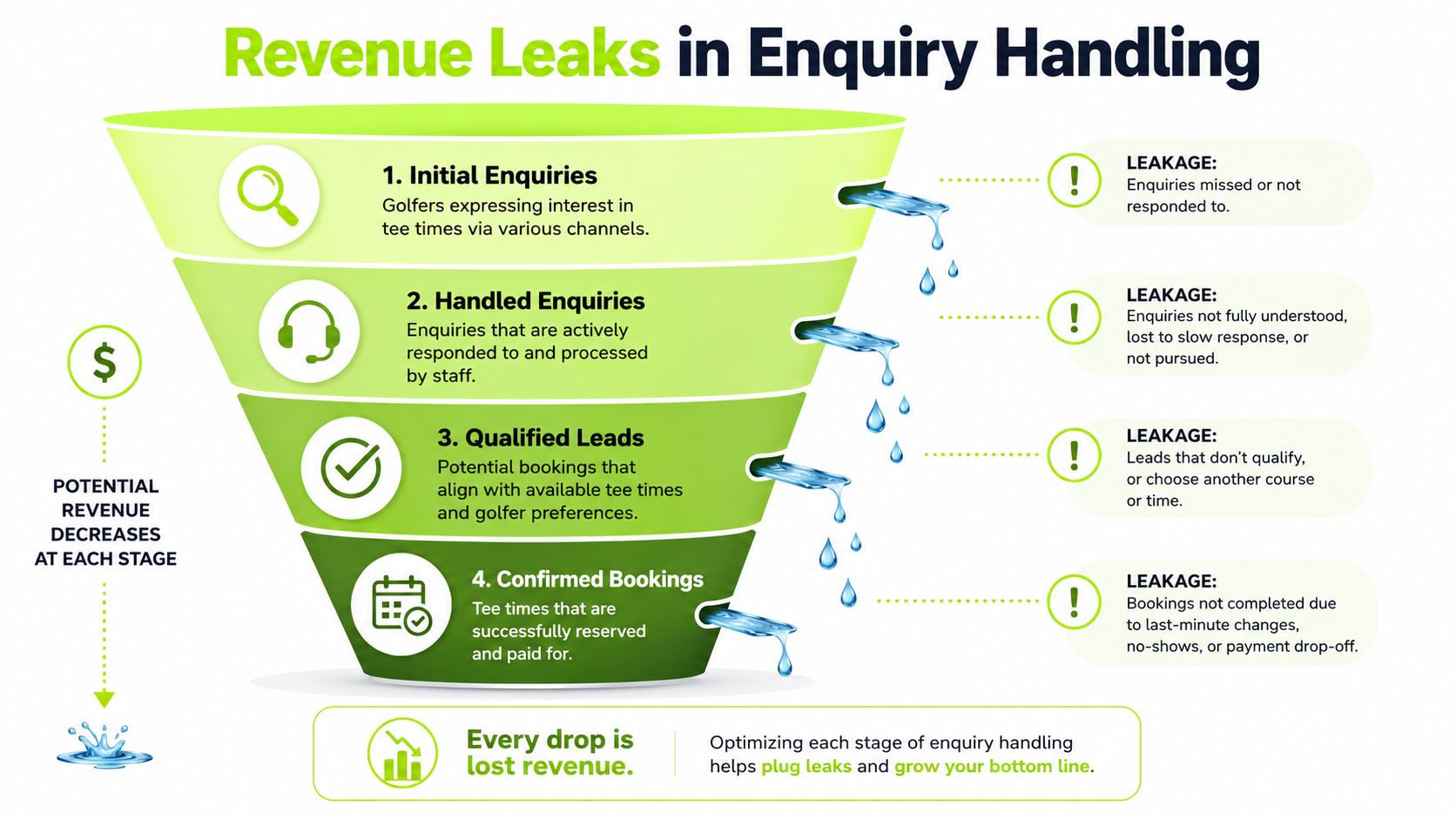
The availability problem has eased
In the UK, 74% of golfers now find it easy to book their preferred slot, which means the bigger issue is no longer simple access. It's what clubs do with the enquiries that come in around bookings, visitor interest, membership questions, and follow-up opportunities. The same data point becomes more serious when paired with response speed, because a lead that receives a response within one hour is five times more likely to convert (UK booking ease and response speed conversion data).
That's the commercial fault line.
A club can spend money driving traffic, collecting form submissions, taking calls, and creating demand. Then it loses value because nobody replies until the next morning, or because the enquiry sits in a shared inbox, or because the pro shop staff are too busy dealing with check-ins to call back properly.
Manual process creates silent losses
This is what revenue leakage usually looks like in real life:
| Enquiry stage | What often goes wrong |
|---|---|
| Visitor asks about a tee time | Email sits unread for hours |
| Guest calls while staff are busy | No structured callback |
| Golfer starts but doesn't complete booking | No follow-up at all |
| Repeat visitor plays twice | Nobody flags membership potential |
None of those failures look dramatic on their own. Together, they weaken conversion every week.
“Fast response beats perfect response.” Clubs don't need a polished sales script first. They need a reliable first touch.
Systems beat heroics
Committee-led clubs and lean teams often rely on good people making extra effort. That's admirable, but it doesn't scale.
The clubs that handle demand best usually have a few things in place:
- Centralised enquiry capture: Phone, form, email, and booking interest feed into one place.
- Clear ownership: Someone is responsible for response, not just “the office”.
- Speed rules: New enquiries are handled quickly, not when the team gets a chance.
- Follow-up sequences: If a golfer doesn't convert on day one, the conversation doesn't disappear.
If you want to tighten that process, this framework for golf club inquiry management is worth reviewing.
The key point is simple. Most clubs don't have an enquiry problem. They have a handling problem. Once you accept that, the tee sheet starts to look less like a bookings board and more like the front end of your sales process.
Actionable Strategies for Tee Time Optimisation
The clubs that manage tee times well don't treat every gap the same, and they don't market the whole week with one message.
That matters more now because there has been a 350% increase in the volume of tee times booked during the working week in the UK, which signals a real shift in demand and makes broad, one-size-fits-all promotion far less effective (working week tee time booking growth in the UK).
Segment the week properly
Start by splitting your tee sheet into decision bands, not just hours.
A practical structure looks like this:
Protected premium windows
These need disciplined allocation. Don't waste them on low-yield patterns if they can support stronger visitor revenue or premium member value.Flexible shoulder periods
These are often ideal for targeted campaigns, guest recovery offers, lesson-linked play, or lighter-touch visitor promotions.Working week opportunity bands
Midweek demand has changed. Retired golfers, flexible workers, visitors, and local casual players don't all need the same message.
A club that markets “tee times available this week” across everything usually gets a weak result. A club that markets specific value to specific demand pockets gets cleaner bookings.
Use last season's behaviour, not instinct
Many tee sheets are still managed by memory.
The better approach is to review historical booking behaviour and ask:
- Which periods fill without help?
- Which periods only move with staff intervention?
- Which visitor types return?
- Which time bands lead to secondary revenue such as food, range use, or member enquiry?
That exercise doesn't require a complex model. It requires discipline. Most clubs already hold enough information to make better decisions, but it sits in separate systems or never gets reviewed together.
Operator's note: If your strategy depends on staff “knowing the busy times”, you're still managing by habit.
Balance member access and commercial yield
At this stage, optimisation gets political.
Push too hard for visitor income in strong periods and members get frustrated. Protect members too rigidly and the club leaves value on the table. There isn't a universal answer, but there is a better process.
Use a simple decision framework:
| Question | Why it matters |
|---|---|
| Is this a core member access period? | Protects retention and satisfaction |
| Is this a premium visitor period? | Supports yield |
| Does this slot help long-term pipeline value? | Creates future membership and repeat revenue |
| Can this demand be moved elsewhere with a better offer? | Improves whole-sheet utilisation |
The important point is that tee time optimisation isn't just about squeezing more play into the day. It's about assigning the right commercial purpose to the right inventory.
From Tee Sheet Data to a Predictable Growth Pipeline
A tee time enquiry starts small. Someone wants to know what's available on Thursday, whether visitors are welcome, or if they can bring a guest next month.
Handled casually, it stays small. Handled systematically, it becomes the first step in a growth pipeline.
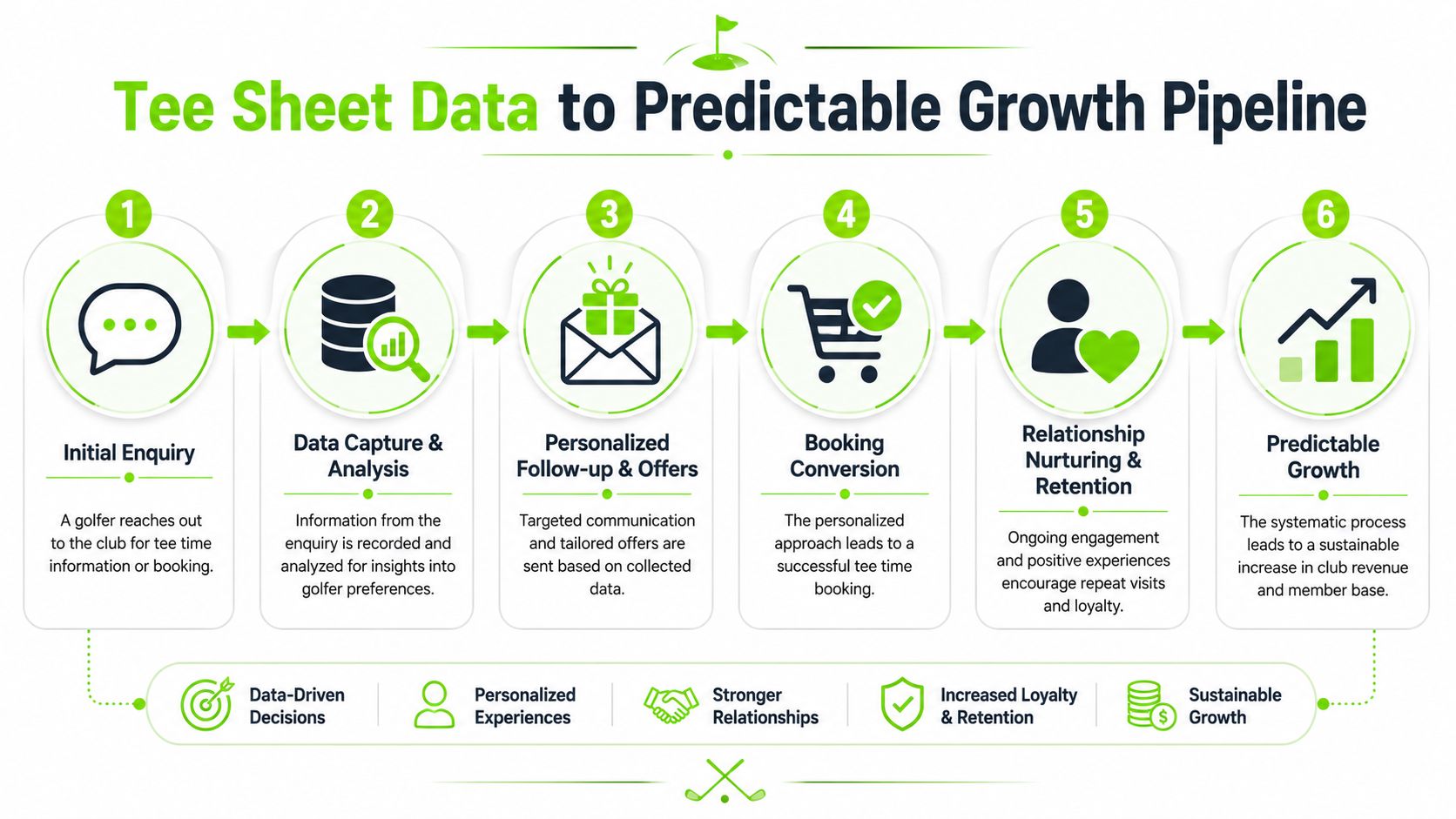
What a connected system changes
When tee sheet activity connects to a CRM and structured follow-up, the club stops relying on memory and isolated staff effort.
The process becomes much clearer:
- A visitor enquires or books.
- Their details are captured properly.
- Their playing pattern is visible.
- Follow-up happens based on behaviour.
- The club can identify whether that person is a one-off guest, a likely return visitor, a lesson lead, or a membership prospect.
That's how the tee sheet moves from operations into growth.
A practical example
Take a common scenario. A golfer books a weekday round, enjoys the course, and comes back again a few weeks later.
In a manual setup, nothing happens. The second visit is just another booking.
In a connected setup, the club can recognise repeat play, trigger a relevant follow-up, invite the golfer to a member-for-a-day style visit, or start a better-timed conversation about joining. The point isn't to push a hard sale. The point is to avoid wasting a clear buying signal.
Predictability comes from visibility
Predictable growth doesn't mean every enquiry converts. It means the club can finally see the journey.
You can track:
| Stage | What management should know |
|---|---|
| Enquiry | Where it came from and what it asked for |
| Booking | Whether it converted and for which slot |
| Repeat activity | Whether the golfer returns |
| Commercial outcome | Whether that behaviour leads to membership, lessons, or repeat visitor revenue |
Without that visibility, clubs tend to overestimate the importance of promotion and underestimate the importance of follow-up.
The strongest tee sheet isn't the one that looks busy for a day. It's the one that feeds a system that keeps producing bookings, visits, and membership conversations over time.
That's the answer to what is tee time for a club manager. It's not just a reservation. It's the start point of a measurable commercial process.
If your club wants to turn tee time demand into a more predictable pipeline of bookings, visits, and membership growth, GolfRep helps golf clubs build the systems behind it. That means lead generation tied to structured follow-up, CRM visibility, and conversion tracking, so enquiries don't disappear into inboxes or rely on manual chasing.
Ready to tap into our proven growth system?