8 Golf Tournament Marketing Ideas for Private Clubs in 2026
Your tournament date is close. Posters are up, a few member emails have gone out, and the tee sheet still has too much space on it.
That situation usually points to a process problem, not an event problem. Clubs often generate interest, then lose it between the first enquiry and the first real follow-up. A visitor asks about a team place, a local business clicks through to the event page, or a guest attends on the day, and no one owns the next step. The event gets treated as a diary item instead of a lead source.
That gap matters because tournaments attract people with clear commercial value. They bring in visiting golfers, local companies, and guests who are willing to spend time at the club before they ever talk seriously about membership. The clubs that get the best return do not stop at registrations. They capture the enquiry source, route each contact into the CRM, assign follow-up tasks, and measure who progresses from event interest to visitor round, sales meeting, or membership discussion.
I see the same trade-off in club marketing again and again. Filling the field can feel like the urgent job, so follow-up gets pushed into admin for later. Later is usually too late. Response time drops, lead quality gets harder to judge, and staff end up relying on memory rather than a record of who attended, who asked for details, and who showed buying intent.
These golf tournament marketing ideas are built for execution at club level. Each one includes the CRM process behind it, sample messaging your team can adapt, and the KPIs that show whether the campaign is producing revenue or just activity. Where relevant, they also connect to a wider golf club membership campaign system, so tournament demand feeds a pipeline your team can effectively manage.
1. Membership Referral Programmes with Structured Incentives
A tournament gives your members a natural reason to invite the right people. That's why referral programmes work well around event periods. You're not asking members to “sell the club”. You're asking them to bring a friend to something worth attending.
The mistake is making referral schemes vague. If a member has to ask reception for the process, wait for someone to log it manually, and then chase the reward later, the idea dies quickly. Keep it simple. One QR code on tournament signage, one short form, one automated confirmation.

Build the referral path into your CRM
GolfRep's view is straightforward. If a referral isn't attached to a contact record and assigned an owner, it isn't a programme. It's a hope.
Use your CRM to record:
- Referring member: Full name, member ID, and preferred reward
- Referred guest: Name, email, mobile, and event attended
- Next action: Call booked, visitor round offered, membership pack sent
- Reward trigger: Reward issued only when the referred guest attends or progresses
A practical route is to tie the tournament sign-up page to your golf club membership campaign system so every referred guest enters the same nurture flow as any other prospect.
Practical rule: Reward the behaviour you want first, then reward the outcome. Give a small thank-you for the referral, then a stronger benefit if the guest books a visit or joins.
Sample follow-up and KPIs
A useful first message to the guest:
Hi James, thanks for joining us through David's invitation to the Spring Pairs. We'd love to show you more of the club while your visit is still fresh. If you'd like, we can arrange a relaxed follow-up round and send over current membership options.
A message to the member:
Thanks for referring James to the Spring Pairs. We've booked him into our follow-up sequence and will keep things moving from here. Your referral credit will be added once he attends.
Track:
- Referral-to-attendance rate: How many referred guests play
- Attendance-to-enquiry rate: How many ask about membership
- Enquiry-to-visit booked rate: Whether follow-up creates a real next step
- Referrer activity: Which members repeatedly bring strong prospects
What works is frictionless entry and fast processing. What doesn't work is a committee spreadsheet and delayed reward decisions.
2. Targeted Local Search and Google Business Profile Optimisation
Many tournament enquiries start before someone visits your website. They search your club name, check your photos, read reviews, and decide whether the place feels current or neglected. If your Google Business Profile is out of date, your tournament marketing is leaking trust before a prospect ever clicks.
This is especially important in regions with deep golf demand. Scotland accounts for about 38% of total sales in the U.K. Golf Club Market, according to Credence Research on the UK golf club market. For clubs in competitive areas, local visibility isn't a side task. It shapes whether your event gets considered at all.
What your profile should say during tournament season
Don't leave your profile in “general club” mode when an event is approaching. Update it around the tournament.
Use:
- Fresh photography: Current course conditions, clubhouse arrivals, prize table, practice ground
- Clear descriptions: Private club, visitor policy, event availability, contact route
- Active review management: Especially from visitors, societies, and guests
- Current contact details: Phone, email, booking page, opening times
Your profile should also connect to a review process. A club that asks happy players for reviews consistently looks busier, more trusted, and more alive than one with silence on its listing. GolfRep usually advises clubs to trigger a review request after an open event, visitor day, or society booking, then route any high-intent responders into a membership nurture path through stronger Google reviews for golf clubs.
A neglected profile doesn't just reduce visibility. It lowers confidence before your team ever gets the enquiry.
Sample messaging and KPIs
A simple post-event review email:
Thanks for joining us at the club this weekend. If you enjoyed the course and the day as a whole, we'd really appreciate a quick Google review. It helps other golfers decide whether to visit, and it helps us keep improving the experience.
A quick reply to a profile enquiry:
Thanks for getting in touch about our upcoming tournament. We've received your enquiry and will reply shortly with availability, format details, and the best next step if you'd like to visit the club.
Track:
- Profile enquiries: Calls, direction requests, website clicks, message enquiries
- Review volume and recency: Especially during the event promotion window
- Enquiry response time from profile messages: Slow replies waste local intent
- Visit bookings from local search leads: The metric that matters more than impressions
What works is treating your profile as a live sales asset. What doesn't work is uploading new images once a year and assuming that's enough.
3. Event-Based Marketing and Open Day Campaigns
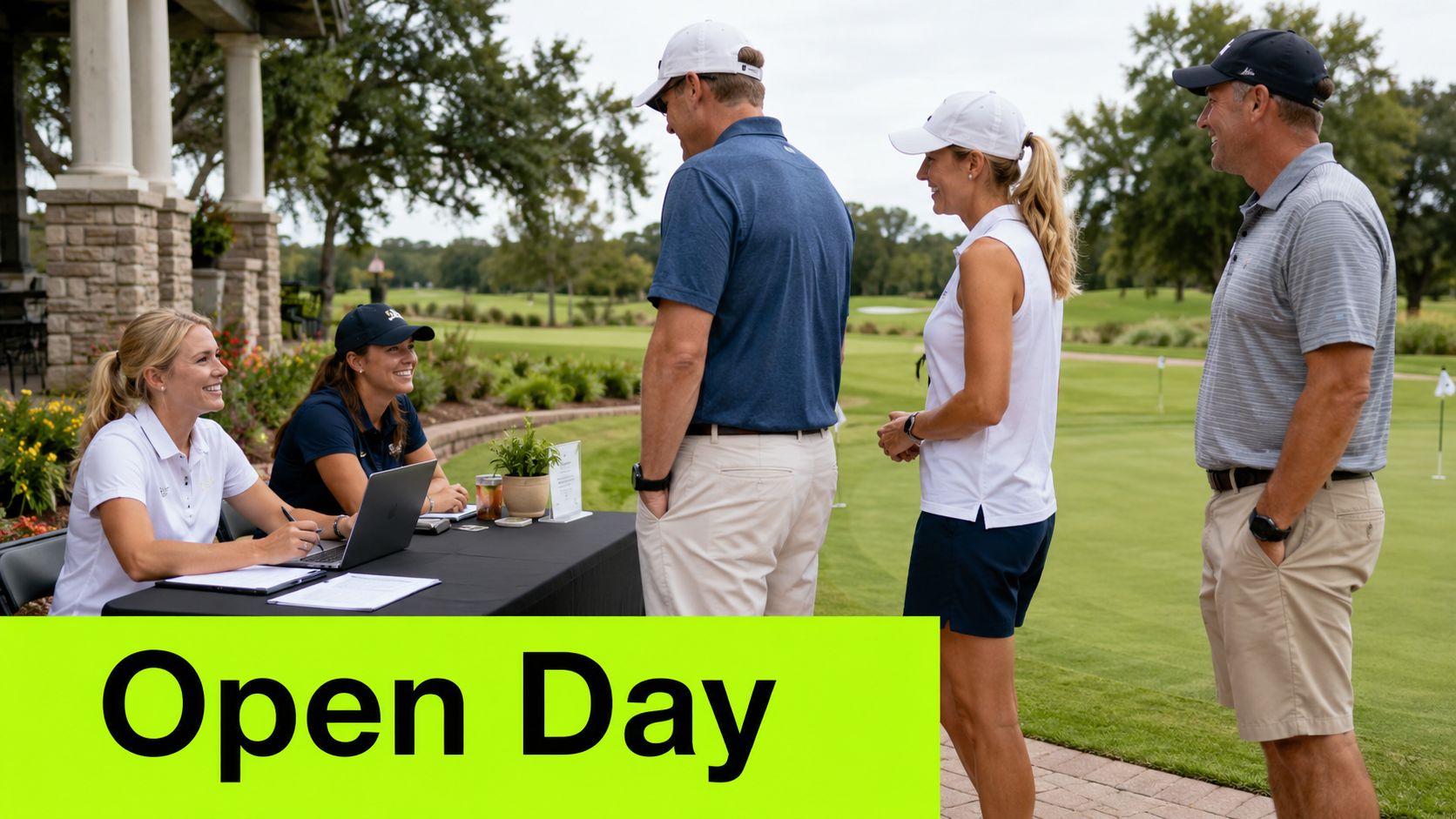
The easiest tournament to market is the one that gives non-members a reason to say yes without pressure. That's why open formats work. A tournament open day, mixed invitation event, ladies' taster competition, or family-friendly short-format day lowers the social risk and creates a warmer first visit.
There's also a strong age signal here. The UK Golf Trust's 2024 report found that 59% of UK golfers under 30 prefer social formats such as 9-hole social roll-ups or family-friendly specials, while only 22% of tournament marketing resources offer guidance specific to these formats. UK POS data also found that clubs implementing youth-focused, non-discounted tournament formats saw a 41% increase in first-time under-30 attendees within 12 months. For clubs trying to widen the top of the funnel, format matters as much as promotion.
Run the event like a conversion campaign
Most clubs are capable of hosting a good day. Fewer clubs capture the data properly.
For tournament open days, collect:
- Who attended: Not just player names, but email, mobile, and membership status
- Who showed interest: Asked about membership, coaching, family access, or business use
- What they attended: Main event, clinic, post-round social, prizegiving
- What happens next: Visit invitation, membership pack, coaching call, second event
If you're promoting a club event to local prospects, pair the campaign with a clear open day marketing process for golf clubs. That gives your staff one structure instead of a pile of ad hoc follow-up.
You can also strengthen the experience itself with details like welcome packs, sponsor-supported prizes, or high-quality custom apparel for volunteers and event teams so the day feels organised and premium.
Sample messaging and KPIs
Post-event message for an attendee who hasn't enquired yet:
Thanks for joining us at Saturday's event. We hope you enjoyed the course and the atmosphere. If you'd like to come back for a follow-up round or see membership options in more detail, reply here and we'll arrange it.
For under-30 events, keep the tone lighter:
Great to have you at the 9-hole social. If you want to come back with friends or see flexible membership routes, we can send over the options and book a relaxed visit.
Track:
- Registration-to-attendance rate
- Attendance-to-membership enquiry rate
- Time from attendance to first staff response
- Visit bookings generated within the first week after the event
What works is an event built for a specific audience. What doesn't work is trying to make one tournament appeal equally to every segment.
4. Content Marketing and Educational Website Resources
A tournament campaign usually sends people to your website before they contact anyone. If the website only contains fixture news and a downloadable PDF from last season, you're forcing interested golfers to do too much work.
Good content reduces uncertainty. That's its primary job. Prospects want to know whether they'll fit in, whether the course suits them, whether the atmosphere is formal, and whether joining after an event is realistic.
Publish the pages people actually need
The strongest tournament-related content isn't abstract. It answers buying questions in plain English.
Useful assets include:
- Membership pathway pages: What happens after a visitor event or open tournament
- Beginner-friendly guides: Dress code, handicap expectations, who can enter
- Corporate event pages: How businesses can use tournaments for guests and staff
- Member stories: Why existing members first came through an event or invitation
This kind of content also supports search visibility and helps prospects move from curiosity to enquiry without needing a phone call straight away. If a club wants to extend the life of tournament assets, short video walk-throughs and event recap clips can work well too. A practical primer on video marketing for small businesses is useful here because golf clubs often sit on strong visual material and never repurpose it properly.
The clubs that publish helpful content usually sound more welcoming before a prospect ever speaks to staff.
Sample messaging and KPIs
If someone downloads a tournament guide or spends time on your membership content, send something useful rather than sales-heavy:
Thanks for taking a look at our tournament and membership information. If you've got questions about format, playing standard, or which membership route might suit you, reply here and we'll point you in the right direction.
Track:
- Page views on event and membership pages
- Form submissions from content pages
- Enquiries influenced by content downloads or video views
- Common questions asked after reading, which tell you what content is still missing
What works is content written from the prospect's point of view. What doesn't work is publishing only club-centred updates that existing members understand but visitors don't.
5. Paid Search Advertising with Lead Qualification Automation
Paid search is one of the cleanest ways to promote a tournament when you need intent, not just attention. Someone searching for local golf events, corporate golf days, membership opportunities, or open competitions is already closer to action than someone scrolling social media.
The trap is assuming the advert did the hard part. It didn't. The hard part starts after the click. In the UK golf sector, the average response time to membership enquiries remains 30 hours, and a lead that receives a response within one hour is five times more likely to convert than one that waits 24 hours, according to The Revenue Club on membership enquiry response times. That's why ad spend without speed-to-lead discipline often disappoints.
Build automation into the first response
Every paid campaign should trigger three things immediately:
- Instant acknowledgement: Confirm receipt and set expectation for reply timing
- Lead routing: Send the enquiry to one monitored inbox or CRM owner
- Qualification prompt: Ask one or two useful questions, such as preferred membership type or whether they'd like to visit
A simple auto-response works:
Thanks for your enquiry about our upcoming tournament and membership options. We've received your details and will reply within a few hours during business hours. If you'd like to speed things up, reply with whether you're interested in individual, family, or corporate options.
Then your team follows with a real reply, not another template.
KPIs and trade-offs
Track:
- Cost per enquiry
- Response time by campaign
- Visit booked rate from paid leads
- Member sign-up rate from paid leads
What works is a narrow campaign built around high-intent terms and quick staff response. What doesn't work is broad traffic, weak landing pages, and next-day callbacks.
A common trade-off is volume versus handling quality. Smaller clubs often try to drive more leads before fixing ownership. GolfRep usually advises the opposite. Tighten response handling first, then increase spend.
6. Social Media Engagement and Community Building
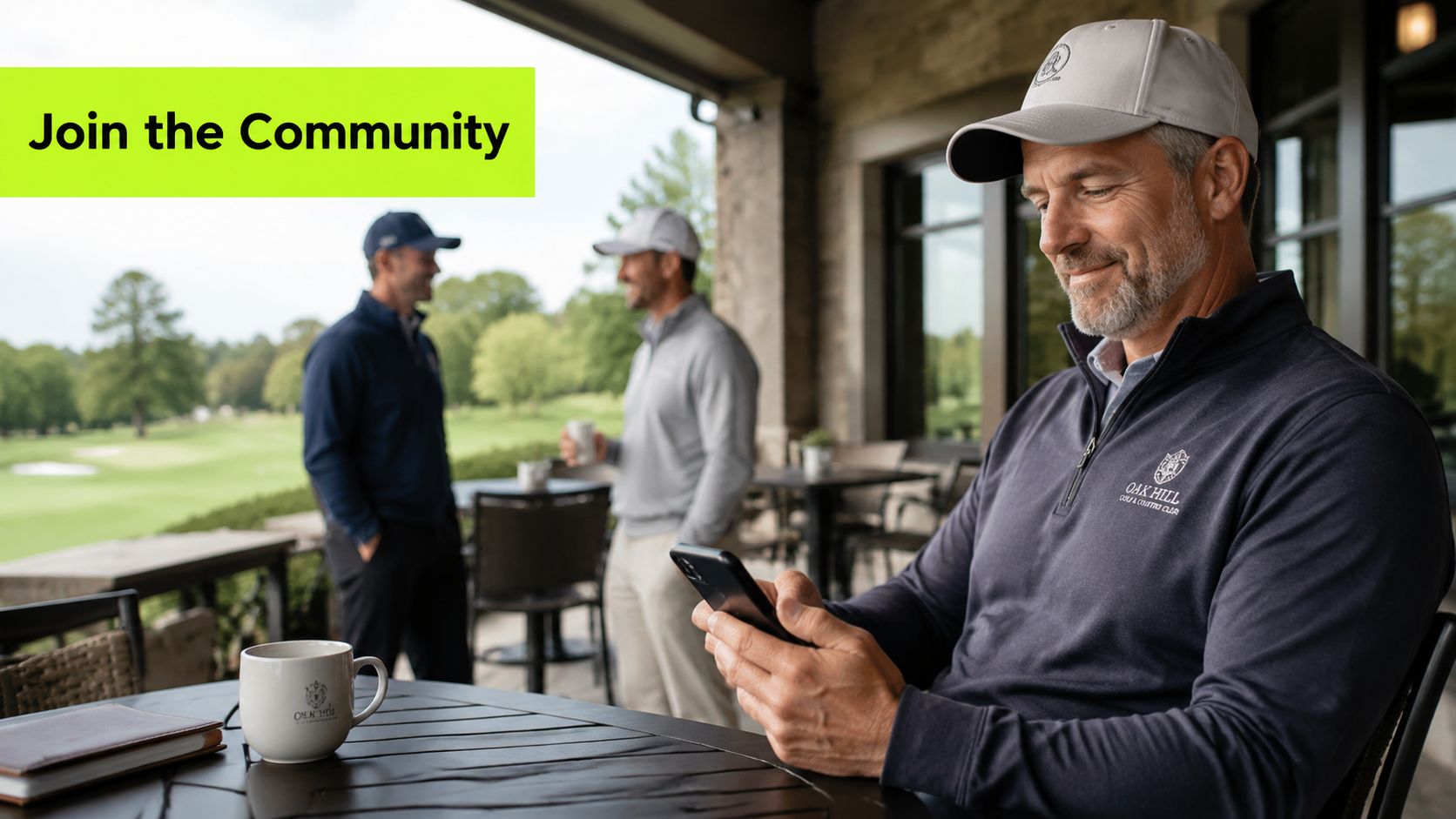
Social media rarely converts in the same way search does. It plays a different role. It gives potential entrants and future members repeated exposure to the club's atmosphere, people, standards, and style. That matters because private clubs are social decisions as much as sporting ones.
For tournament marketing, social works best when it shows real participation. Short clips from the course, behind-the-scenes setup, member introductions, junior activity, practice ground moments, and post-round clubhouse scenes all help a prospect decide whether they'd feel comfortable attending.
Give social a clear conversion path
Posting often isn't the same as marketing well. Every tournament-related post should point somewhere useful. That might be an event registration page, an enquiry form, or a DM workflow handled by one person.
There's also a speed issue here. During business hours, UK clubs can achieve a response time of two to four hours if channels are centralised to a single monitored point with clear ownership, according to Golf Rep on marketing analytics and response handling. If Instagram messages sit in one phone, Facebook comments on another, and website enquiries in a shared inbox, social becomes noise instead of a lead source.
Responding fast on social does more than answer a question. It signals that the club is organised.
Sample messaging and KPIs
A DM reply for tournament interest:
Thanks for your message. Yes, we still have space available. If you send your email and mobile, we'll send over the event details and next steps today.
A follow-up after someone engages repeatedly but hasn't enquired:
Thanks for following the event build-up. If you're thinking about joining us, we can send the entry details or talk through membership options if you'd prefer to visit the club first.
Track:
- Message response time
- DM-to-form completion rate
- Engagement on tournament-related posts
- Visits and enquiries attributed to social content
What works is community-led content with a clear next action. What doesn't work is treating social as a photo archive.
7. Corporate and Group Membership Campaigns
A local finance firm wants a client day in September. The managing director likes golf, the office manager needs clear pricing, and someone in finance will ask what the package includes. If your club sends a generic tournament flyer, the enquiry stalls. If you send a business-ready offer with a defined follow-up process, the conversation usually moves.
Corporate and group membership campaigns work because they tie tournament activity to a commercial use case. Companies are buying hosted time with clients, team access, and a reason to bring people together that feels more considered than another meal or meeting. Clubs that package this well tend to win business from firms that would not respond to standard membership advertising.
The offer needs to be easy to assess internally. That means fewer vague benefits and more operational detail.
Include:
- A packaged option: number of players, hospitality, food and beverage, branding options, and any tournament entry access
- A business use case: client hosting, staff reward, team day, networking, or seasonal entertaining
- A clear buyer path: enquiry, site visit, proposal, decision date
- A named contact: one person responsible for sales follow-up and diary management
- A CRM process: stages, reminders, and ownership after each touchpoint
Corporate leads often move slower than individual membership enquiries. More people are involved, diaries are tighter, and budget approval can delay a decision even when the interest is real. Clubs need to account for that. A seven-day follow-up gap is often enough for the prospect to default to a hotel venue or postpone the event entirely.
Set the CRM up around the buying cycle, not around the club's convenience. A practical pipeline looks like this: new enquiry, qualified, site visit booked, proposal sent, follow-up due, verbal yes, contract pending, won or lost. Each stage should trigger a task and a message. If no site visit is booked within 48 hours of the first conversation, the contact should receive a short nudge. If a proposal is sent, schedule a call date at the same time rather than hoping they reply.
Sample messaging and KPIs
Initial outreach to a local business:
We're now planning this season's corporate tournament dates and a small number of group membership packages. If your team hosts clients or runs staff events, I can send over two options with pricing and availability. If helpful, we can also arrange a short club visit next week.
Follow-up after a site visit:
Thanks for visiting the club today. Based on your group size and how you'd use the space, I've put together the best-fit package with tournament access, food and beverage, and hosting details. I'll call on Thursday to talk through any questions and confirm whether you'd like us to hold a date.
Post-proposal follow-up if there is no reply:
Just checking you received the proposal. These bookings often need a few internal approvals, so if it helps, I can send a shorter summary for your finance or leadership team with the key costs, inclusions, and date options.
Track:
- Corporate and group enquiries created
- Qualified enquiry-to-site visit rate
- Site visit-to-proposal rate
- Proposal-to-close rate
- Average days from first contact to signed agreement
- Tournament bookings that convert into recurring group or corporate membership
- Revenue per corporate account
What works is a package a business buyer can explain internally, backed by a CRM sequence that keeps momentum without chasing too hard. What fails is treating corporate interest like a casual membership enquiry and waiting for the prospect to piece the offer together themselves.
8. Retargeting and Abandoned Enquiry Recovery Campaigns
Not everyone who looks at your tournament page is ready to enter. Not everyone who enquires is ready to book. That doesn't make them poor leads. It usually means they need another prompt, another piece of reassurance, or a better-timed follow-up.
Clubs frequently underutilize their potential for value. Existing content in the market tends to focus on one-off promotion, but the bigger opportunity is converting tournament interest into ongoing membership engagement. UK Golf data says 68% of UK private club members join tournaments to network with peers and reinforce club identity, while 74% of tournament marketing guides ignore membership conversion pathways. UK POS research also found that clubs with tournaments linked to membership nurture flows achieved 32% higher repeat participation than clubs using standalone promotion. That gap is exactly where recovery campaigns sit.
Recover interest with structure
Retargeting isn't just paid ads. It includes email, SMS, and staff follow-up sequences tied to behaviour.
Use segments such as:
- Page viewers: Looked at the event or membership page but didn't enquire
- Form starters: Began an enquiry but didn't complete it
- Attendees who went quiet: Came to the tournament but didn't take the next step
- Cold follow-ups: Asked for details, then stopped replying
Research in long sales-cycle environments similar to golf club membership shows that enquiries responded to within 3 hours convert at exactly three times the rate of those responded to after 24 hours, according to Coppett Hill on enquiry response time versus conversion. Recovery only works if the first response was fast and the later touches are deliberate.
Sample messaging and KPIs
For a form starter who didn't finish:
We noticed you were looking at our tournament and membership information but may not have had time to complete the enquiry. If you'd like the details sent directly, reply with the best email and we'll send them over.
For an event attendee who went quiet:
It was great to have you with us recently. If you're still considering another visit or a membership conversation, we can keep it simple and arrange the next step around your schedule.
Track:
- Recovered enquiries
- Re-engagement rate by segment
- Time to first response
- Membership conversions from previously inactive leads
What works is segment-specific follow-up. What doesn't work is sending the same generic reminder to everyone.
8-Point Golf Tournament Marketing Comparison
| Strategy | Implementation complexity | Resource requirements | Expected outcomes | Ideal use cases | Key advantages |
|---|---|---|---|---|---|
| Membership Referral Programmes with Structured Incentives | Medium, CRM integration and automation required | Moderate, reward budget, CRM, promotion time | Higher-quality, faster-converting leads and improved retention | Clubs with engaged memberships seeking organic growth | Lower acquisition cost; pre-qualified leads; stronger loyalty |
| Targeted Local Search and Google Business Profile Optimization | Low–Medium, setup plus ongoing maintenance | Low, listing management, photos, review management | Increased local enquiries and trust over 2–3 months | Clubs dependent on local search and walk-ins | Cost-effective local visibility; social proof via reviews |
| Event-Based Marketing and Open Day Campaigns | Medium–High, event logistics and CRM capture needed | High, promotion spend, staffing, venue prep | High trial-to-membership conversion when follow-up is timely | Driving trials (open days, clinics, corporate events) | Creates emotional connection; self‑qualified prospects; content assets |
| Content Marketing and Educational Website Resources | Medium, strategy, SEO, ongoing publishing | Moderate, writers, video production, SEO tools | Long-term organic traffic and trust; slow compounding conversions | Addressing prospect objections and improving discovery | Builds credibility; reduces pre-enquiry uncertainty; reusable assets |
| Paid Search Advertising with Lead Qualification Automation | Medium, campaign setup plus instant qualification systems | High, ad budget, landing pages, CRM automation, management | Immediate high-intent enquiries; measurable cost-per-acquisition | Rapid membership pushes and seasonal campaigns | Precise targeting; scalable; fast measurable results |
| Social Media Engagement and Community Building | Low–Medium, content calendar and engagement process | Moderate, content creation time, occasional ad spend | Improved brand familiarity and indirect enquiry uplift over time | Building club culture, member engagement, event promotion | Authentic community, user-generated content, repeated touchpoints |
| Corporate and Group Membership Campaigns | High, consultative sales and account management | High, dedicated reps, tailored collateral, event hosting | Higher average revenue per account and lower churn, longer sales cycle | Targeting businesses for recurring group revenue and events | Higher lifetime value; multi-user accounts; predictable revenue |
| Retargeting and Abandoned Enquiry Recovery Campaigns | Medium, tracking pixels and segmented automation | Moderate, ad/email creative, tracking, CRM segmentation | Better recovery of warm prospects; lower cost per conversion | Recovering site abandoners, unconverted attendees and form drop-offs | High ROI potential; personalised messaging to warm leads |
Putting It All Together
The best golf tournament marketing ideas don't fail because the concept is weak. They fail because the club treats marketing as promotion only, when the actual result depends on response handling, visibility, and follow-up.
That's the key shift. A tournament isn't just a date in the diary. It's a trigger for a sequence. Someone sees the event, checks your club, clicks through, asks a question, waits for a reply, attends, and then decides whether the relationship goes further. If any part of that chain breaks, the campaign underperforms and the club often blames the advert, the format, or the market.
Speed matters more than most clubs think. Research cited in the golf membership space shows a response inside one hour materially improves conversion odds versus waiting a day, and the broader lead response evidence is even more aggressive. Teamgate notes that responding within five minutes can sharply increase qualification outcomes and that waiting longer quickly reduces the chance of progressing the lead, as outlined in Teamgate's lead response time study. The practical lesson for clubs is simple. Don't spend time debating creative tweaks while enquiries sit untouched.
If you're planning your next tournament, pick two ideas from this list rather than trying to launch all eight at once. For many private clubs, the strongest combination is one traffic driver and one conversion system. That might mean an open event plus abandoned enquiry recovery, or paid search plus a referral programme, or local search improvements plus a corporate package campaign.
Then define the handover points clearly:
- Where the lead comes in
- Who owns the first response
- What automation happens immediately
- How many follow-up touches are scheduled
- Which KPI proves the idea is working
At GolfRep, we'd always rather see a club run a smaller, well-tracked tournament campaign than a big, messy one. Predictable growth comes from systems, not bursts of activity. When tournaments are tied into CRM workflows, response-time standards, and proper conversion tracking, they stop being isolated events and start becoming one of the most reliable membership levers a private club has.
If your club wants to turn tournament interest into a predictable membership pipeline, GolfRep helps build the system behind it. That includes lead generation, CRM-enabled follow-up, response-time visibility, and nurture flows that stop good enquiries going cold.
Ready to tap into our proven growth system?