Tee Time Books: The Club Growth Playbook for 2026

Most advice on tee time books starts in the wrong place.
Clubs are told to modernise by adding online booking, replacing paper sheets, and making it easier for golfers to reserve a round. That matters, but it isn't the commercial breakthrough many boards expect. A booking tool solves access. It doesn't solve growth.
The bigger issue sits around the booking, not inside it. How quickly do you respond when someone asks about membership after visiting? Can you see which visitor has played three times in six weeks? Does anyone follow up with a flexible membership offer, a society package, or a second-round incentive? In many clubs, that work still depends on staff memory, inboxes, spreadsheets, and whoever happens to be on shift.
That is why tee time books rarely deliver their full value on their own. They organise inventory. They don't automatically create a pipeline.
Clubs that want predictable revenue need a different lens. The job is not just to let people book. The job is to turn demand into tracked revenue, repeat visits, and member conversions through systems that run consistently every day.
Your Tee Time Book Is Not the Solution
The contrarian view is the right one here. A tee time book does not create growth. It records demand that already exists.
That sounds obvious, but plenty of UK clubs still buy booking software as if it will fix weak visitor retention, inconsistent membership sales, and flat midweek revenue on its own. It will not. It gives golfers a way to reserve a round. The commercial result depends on what the club does before the booking, after the booking, and in the days that follow.
A visitor can book online on Tuesday, play on Friday, spend £45 in the bar, mention they live ten minutes away, and disappear from the system by Monday. I see this pattern constantly. The club had interest, spend, and a clear membership signal, but no structured follow-up, no tagged customer record, and no trigger for the sales or membership team to act.
A filled tee sheet can hide a weak revenue system.
That is the problem with treating the tee time book as the answer. The software may handle availability well while the club still misses the higher-value opportunity around it.
In practice, a basic booking setup often leaves clubs exposed in three places:
- Visitor context: The booking shows a name and a tee time, but not whether that golfer is a local prospect, a lapsed member, a society organiser, or a visitor unlikely to return.
- Follow-up discipline: Staff know someone played, but no one owns the next step. There is no timed message, no call task, and no offer matched to that player's behaviour.
- Revenue visibility: Management can see rounds booked, but not which visitor segments come back, which enquiries progress to membership, or which campaigns produce profitable repeat play.
This is why some clubs look busy and still feel stuck. The diary fills in patches, green fee revenue comes in, and the board assumes the system is working. Then winter arrives, member recruitment misses target, and nobody can explain why a strong summer visitor season produced so little long-term value.
The fix is not another isolated booking feature. The fix is to turn the tee time book into the first data capture point in a wider revenue system. That means connecting bookings to CRM records, segmenting visitors by intent and location, triggering post-round follow-up automatically, and tracking whether those touches lead to a second visit, a trial membership, a society booking, or a full join.
Clubs that make that shift stop treating the tee sheet as an admin tool. They use it as the entry point for repeat revenue and membership growth.
That is where the return comes from.
Laying the Groundwork for a Growth System
The clubs that get the most from tee time books usually do less shopping and more planning first. They decide what the system must achieve before anyone starts comparing platforms.
Start with commercial outcomes
“Increase bookings” is too vague to guide a buying decision.
A better starting point is a small set of outcomes tied to real club economics. For most UK clubs, that means deciding how the tee time book should support visitor revenue, member retention, society business, and membership conversion.
A committee or management team should be able to answer questions like these:
- Visitor value: Are you trying to increase visitor rounds, increase spend per visit, or improve repeat play from local golfers?
- Membership pipeline: Do you want first-time visitors to receive structured follow-up toward trial, flexible, or full membership?
- Operational efficiency: Are staff spending too much time moving bookings, chasing payments, or answering the same questions by phone?
If those priorities aren't clear, the software conversation becomes muddled very quickly.
Segment the people using the system
Most clubs lump everyone into “bookers”. That hides important differences.
A member booking a Saturday medal, a hotel guest looking for a midweek round, a local golfer testing the club before a membership decision, and a society organiser all need different journeys. Their value is different. Their expectations are different. Their follow-up should be different too.
A simple segmentation model often works best:
| Group | What they usually need | What the club should track |
|---|---|---|
| Members | Fast access, fairness, convenience | usage patterns, slot demand, no-shows |
| Returning visitors | Simple repeat booking, relevant offers | frequency, preferred times, spend |
| First-time guests | Confidence, clarity, easy payment | source, location, repeat potential |
| Societies and corporates | Speed, coordination, clear terms | enquiry stage, organiser history, value |
This is not a technical exercise. It is a management exercise.
Map the real enquiry journey
Most clubs believe they know their process. Few have written it down end to end.
Follow one real enquiry from first click to final outcome. Include every handoff. Include every delay. Include what happens when the office is closed, when a payment fails, or when a visitor asks about joining.
Practical rule: If the club can't see who enquired, who replied, and what happened next, it can't improve conversion reliably.
A proper process map usually exposes the same friction points:
- Slow response times when messages sit in a shared inbox.
- Poor lead visibility when visitor data stays trapped in the booking platform.
- No standard follow-up after a round, especially for non-members.
- No conversion tracking for membership, visitor return rate, or society bookings.
Decide what good looks like
Before buying or changing any platform, set a short list of measures the team will review. Keep it practical.
Examples include:
- Tee sheet utilisation
- Revenue per round
- Visitor repeat booking rate
- Membership enquiry conversion
- Average response time to new enquiries
Once these are agreed, software selection gets easier. You stop asking which system has the longest feature list and start asking which one supports the way the club wants to grow.
Building Your Technology Stack
Clubs get into trouble when they buy a tee time book as if it were the finished answer. It is one part of the revenue system.
The booking layer should capture demand and payment. The CRM should keep the contact record, booking history, consent status, and sales context. Automation should handle reminders, post-round follow-up, and membership nurture. Reporting should show which channels produce profitable golfers, which staff response patterns convert, and where enquiries stall.
That setup changes how a club makes decisions. Instead of asking whether the diary is full, managers can ask which visitor segments return, which green fee products feed membership, and where staff time is being wasted.

What a modern stack must do
A workable stack for a UK club needs to do four jobs well. It has to sell inventory accurately, collect money without manual chasing, move data into the right records, and support follow-up after the round. If one of those breaks, the club feels it in revenue or admin.
A successful UK implementation can follow a structured path that includes requirement analysis, a stack such as .Net and ReactJS, Stripe integration for payments, and a central database built for GDPR and PECR adherence. In the verified case used for this article, that approach increased online bookings by 25 to 30% while ensuring 100% regulatory compliance, as described in GoodCore’s tee time booking system case.
The lesson is practical. Clubs gain from clean system design, not from adding more software.
A sound stack should cover five basics:
- Real-time availability: Golfers need to see live tee sheet data, especially during busy release periods.
- Integrated payments: Stripe or a similar gateway should collect deposits and fees automatically, with clear reconciliation for the office team.
- API access: Booking data must pass into a CRM, reporting layer, and sales workflow without manual exports.
- Mobile-first booking flow: Visitor demand often comes from phones, not desktops.
- Compliant data handling: Consent, retention, permissions, and communication preferences need to be managed properly.
Closed systems create expensive limits
The cost of the wrong platform rarely shows up in the demo. It shows up six months later.
A club wants to send a post-round offer to visitors who played twice in 60 days. The tee time system cannot push booking data into the CRM. Staff export spreadsheets, chase missing email permissions, and lose the timing. Another club wants to identify guests who only book low-demand slots and test a different price ladder. The reporting is too shallow, so pricing decisions stay guesswork.
That is why integration matters more than feature count. A platform that does fewer things but passes data cleanly is usually the better commercial choice.
For clubs reviewing suppliers, this premium tee time strategy guide is useful alongside the software checklist, because pricing flexibility and data flow need to be planned together.
| Decision area | Weak setup | Strong setup |
|---|---|---|
| Data flow | Booking data stays inside one platform | Booking data syncs to central CRM |
| Payments | Staff take calls and reconcile manually | Online payments feed directly into workflow |
| Visibility | Teams rely on inboxes and notes | Teams see contact history and booking activity |
| Flexibility | Changes need vendor workarounds | API-based connections support adaptation |
Build in stages, not all at once
A phased rollout works better than a big-bang project. Clubs that try to switch everything at once usually overload staff and end up blaming the software for process problems.
Start with the booking and payment journey. Get availability, deposits, confirmations, and basic reporting working properly. Then connect the CRM so visitor and member records are tagged correctly. Only after that should the club add automated reminders, post-play email sequences, lapsed visitor campaigns, and membership nurture.
Ownership matters here. If no one is responsible for data quality, automation becomes noise. I have seen clubs send joining offers to existing members and ignore high-value visitor signals because contact records were never reviewed after setup.
Technical resilience is a commercial issue
Peak demand exposes weak systems fast. Open competition entries. New season tee releases. A sunny spell after two wet weeks.
If the booking flow slows down, golfers abandon the basket. If concurrent requests are handled badly, staff spend the morning sorting payment issues and duplicate reservations. If records fail to sync, the sales team cannot tell whether a frequent visitor is a membership prospect or just another green fee booking.
Managers do not need to write code, but they do need to judge whether the stack can handle pressure, pass data cleanly, and support action after the booking is made. That is the difference between software that takes reservations and a system that produces repeat revenue.
Optimising Revenue with Dynamic Pricing Strategies
Static pricing feels tidy in a committee paper. It performs badly on a live tee sheet.
A 9:00am Saturday visitor slot in June and a 4:40pm Tuesday slot in November do not carry the same commercial value, and clubs that price them as near-equivalents usually create two problems at once. They undercharge for demand they already have, and they discount too broadly when occupancy softens.

Treat inventory like a perishable asset
Every unsold tee time expires. That makes pricing an inventory discipline tied to timing, demand, and buyer type.
The better-run clubs I work with do not chase volume with blanket offers. They protect high-value windows, recover weaker periods with intent, and keep the pricing logic close to actual booking behaviour. That only works if the booking engine, tee sheet, and follow-up comms are connected. Club Caddie notes that clubs using API-connected booking and tee sheet tools with dynamic pricing can see revenue boosts of 20 to 25%, while automated reminders can cut no-shows by as much as 40%, as outlined in Club Caddie’s guide to tee sheet software and booking engines.
The practical point is not the headline number. It is the integration. If pricing changes but reminders, deposits, rebooking prompts, and customer records sit in separate systems, the club captures only part of the gain.
What dynamic pricing looks like in practice
At a typical UK members' club, the simplest model is often the most profitable. Push rates up where demand is proven. Hold value where occupancy is already reliable. Use time-limited incentives only where the slot is at risk of going unsold.
That usually means three pricing jobs, not one.
Premium pricing for prime demand
Charge properly for the tee times golfers compete for. Early weekend mornings, visitor-friendly summer afternoons, and bank holiday starts should reflect demand, not habit.Protective pricing for windows that fill anyway
If Thursday visitor mornings are already busy, broad discounting just transfers margin back to the customer.Recovery pricing for weaker inventory
Short-notice gaps, shoulder periods, and poor-weather windows can justify a controlled offer, especially if the club can fill them from a local database quickly.Bundled value instead of fee cutting
In many cases, the better answer is a package. Add balls, breakfast, or a second-round incentive and keep the headline green fee stronger.
Clubs reviewing their rate architecture can also study GolfRep’s approach to premium tee time strategy, which is closer to how revenue-managed venues protect price without killing demand.
Keep the rules simple enough to sell
Overcomplicated pricing causes friction at the counter and doubt online. If staff cannot explain why one slot is £15 higher than another, golfers assume the club is making it up as it goes.
Use clear rules tied to visible conditions.
| Pricing situation | Better response | Poor response |
|---|---|---|
| Prime visitor slot is selling well | Hold or increase rate | Discount too early |
| Midweek shoulder times are underbooked | Add targeted incentive | Reduce all weekday pricing |
| Late cancellations create gaps | Trigger short-notice offer | Leave staff to call around manually |
| Repeat visitor shows strong interest | Offer relevant package or membership pathway | Keep selling one-off rounds only |
One caution. Dynamic pricing is not an excuse to train customers to wait for a deal. If Sunday afternoons always get cheaper on Friday, regular visitors will learn the pattern and delay booking. Margin slips, forecasting gets weaker, and the tee sheet becomes harder to manage.
Pricing is only part of the revenue job
The strongest pricing setup still loses money if booked golfers do not show, cancel late, or play once and disappear. Revenue control comes from the full sequence around the booking. Deposits, confirmations, reminders, cancellation rules, and post-round follow-up all affect the value of that slot.
A no-show is not just an empty space. It is lost green fee revenue, lower food and beverage spend, and one less chance to move a local visitor towards a repeat visit or trial membership.
That is why dynamic pricing should sit inside a broader revenue system. Price gets the first transaction. Automation and CRM decide how much value the club keeps after it.
Converting Visitors to Members with CRM Automation
A tee time booking is only the start of the commercial job.
The clubs that grow membership steadily do not treat a visitor round as a finished sale. They treat it as the first recorded signal of intent. If that signal never reaches the CRM, the club is left with a full tee sheet and a thin pipeline.
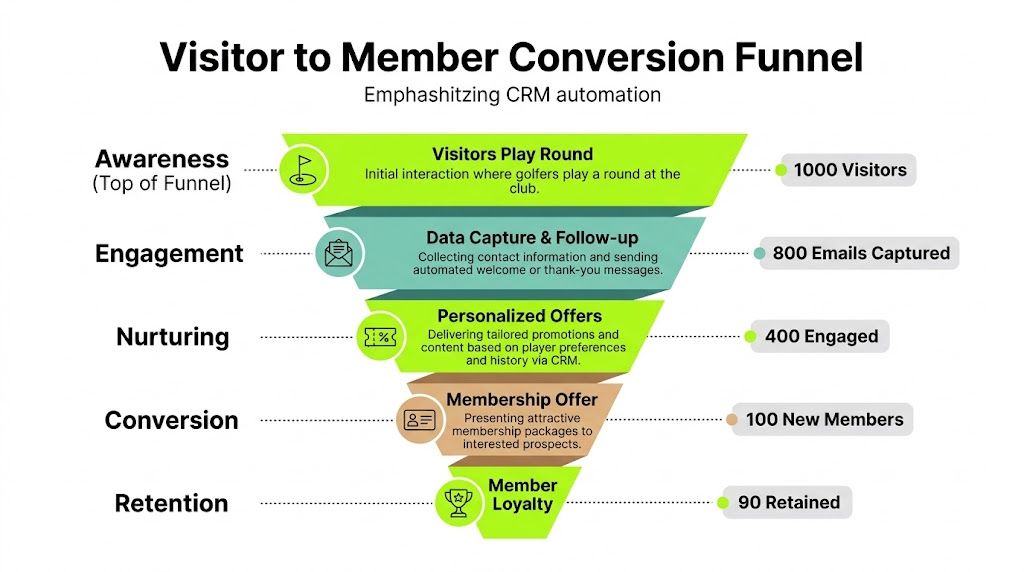
At many UK clubs, the pattern is familiar. A visitor books online, checks in, enjoys the course, maybe spends in the bar, then hears nothing afterwards. Staff might remember the name if the player was particularly friendly or asked about joining, but memory is not a system. Good demand gets wasted because nobody captures context, scores intent, or prompts the next action.
Booking data needs to become sales data
This is the point where basic tee time software stops being enough.
A booking record tells you a slot was sold. A CRM record should tell you who booked, whether they live within realistic joining distance, how often they have played, what time patterns they prefer, what they spent, and whether they have shown signs of membership interest. Without that handover, the club cannot separate a one-off society visitor from a local golfer trialling the venue before making a joining decision.
That distinction matters commercially. A local non-member who has played three times in eight weeks is not just green fee revenue. That golfer may be one conversation away from a flexible membership, points-based product, academy programme, or trial offer.
For clubs assessing systems properly, a dedicated golf CRM system should be judged on segmentation, automation logic, staff visibility, and how easily it turns playing behaviour into follow-up tasks.
What a workable automation flow looks like
Clubs often make this harder than it needs to be. The best setups are usually clear, timely, and tied to actual buying signals.
A practical visitor-to-member flow usually includes:
- Booking confirmation with clear arrival information, add-on options, and consent captured correctly.
- Pre-round reminder that reduces no-shows and gives staff one more chance to spot useful intent signals.
- Post-round follow-up asking for feedback while the visit is still fresh.
- Segmented nurture based on distance from the club, repeat play, spend, and preferred booking times.
- Staff alerts when a golfer meets conditions that justify human follow-up, such as multiple visits, a membership page view, or a direct reply.
The trade-off is simple. More automation without clear rules creates noise. Too little automation leaves staff chasing admin and missing live prospects. The right setup handles routine communication automatically and only asks staff to step in when there is a credible revenue opportunity.
Good nurture is specific
Generic membership emails rarely convert. Relevant ones do.
If a golfer from ten minutes away has played twice midweek and bought coffee both times, the club should not send a broad annual membership brochure and hope for the best. It should send a message that reflects likely behaviour. That could be a five-day membership option, a flexible points product, or an invitation to a quiet member introduction morning.
If a visitor travels two hours to play a well-known course, the membership pitch is probably weak. The better next step may be a return-visit package, a companion offer, or a prompt to book another shoulder-time round. CRM automation helps clubs stop treating every non-member as the same lead.
One simple test works well here.
If a local golfer can play your course several times, spend on site, open your emails, and still never enter a membership workflow, the issue is not lead volume. The issue is system design.
Automation improves follow-up discipline
Some managers worry that automation makes communication feel cold. In practice, poor follow-up is what feels careless.
Well-configured automation sends the message the club intended to send in the first place, at the right time, with the right context. It also gives the membership team a cleaner list to work from. Instead of calling every past visitor, they can focus on golfers with repeat rounds, local postcodes, strong engagement, or direct replies.
That is where the revenue lift comes from. Not from sending more messages, but from sending fewer, better ones and putting staff time against the visitors most likely to convert.
Scaling Operations for Multi-Site Venues
Adding a second or third site does not multiply revenue by default. It often multiplies admin, pricing inconsistency, and missed follow-up.
That shows up quickly in UK groups. One club has empty Tuesday morning tee times. Another has a waiting list for the same slot. One venue captures clean visitor data at booking. Another still relies on handwritten notes at reception and a staff inbox no one owns properly. The group may look bigger from the outside, but commercially it is still operating as separate businesses.
Centralise the customer record
Multi-site growth depends on one customer record across the portfolio.
A group needs to see where a golfer has played, what they have spent, which site they engage with most, and whether they are behaving like a green fee visitor, a society organiser, a coaching lead, or a membership prospect. Without that, cross-site marketing turns into blanket email sends and local teams end up arguing over lead ownership.
Verified data for this article states that UK golf resorts average 68% tee time utilisation on weekdays, and that centralised automation can lift this by 25% through cross-promotion and integrated CRM insights, especially for operators managing hybrid membership models, according to the referenced source assigned to this section.
The larger point matters more than the percentage. If one venue has spare inventory, the group should be able to sell it to golfers who already know the brand through another site. Clubs that already invest in digital marketing to fill tee times at their golf club get better returns when that demand can be redirected across the estate instead of trapped at one venue.
Set group rules, then allow local commercial control
Head office should not force every venue into the same rate card or membership pitch. That usually backfires.
The better model is standardised data and reporting, with local freedom on the offer. A resort course, a municipal site, and a private member club in the same group will attract different golfers and sell in different ways. What should stay consistent is the operating logic behind them.
| Group-wide standard | Why it matters |
|---|---|
| Shared CRM structure | Bookings, leads, and member prospects are recorded the same way |
| Common contact rules | Consent, suppression, and follow-up stay organised and compliant |
| Unified reporting | Head office can compare yield, repeat play, and lead progression by venue |
| Standard automation triggers | Visitors receive the right post-booking and post-play actions across the group |
Local teams can then adjust:
- rate strategy by demand pattern
- event promotion by venue calendar
- membership messaging by catchment and product mix
- on-site service by club type
That split keeps control where it belongs. Group leadership manages system discipline. Site teams manage local conversion.
Cross-promote based on behaviour, not brand hierarchy
Many operators get this wrong. They send generic group campaigns because the database is central, then wonder why response rates stay flat.
Useful cross-promotion starts with behaviour. A hotel guest who played the championship course during a weekend break may respond to a weekday replay offer at a sister venue near home. A golfer who repeatedly books range sessions and short-game practice at one site may be better suited to a flexible points membership at another. A society organiser who fills 24 places at one venue may also be the right lead for a winter package across the rest of the group.
That only works if the booking system feeds the CRM cleanly and the CRM passes signals back to the commercial team.
Multi-site growth comes from recognising one customer across several venues, then acting on that record with the right offer.
Remove admin from local sites
Standardisation also protects operating margin.
When each venue exports its own booking lists, updates its own mailing segments, and chases its own no-response enquiries, local managers spend time on clerical work instead of sales and service. I see this often in resort groups where the golf operation, hotel team, and membership office all hold different versions of the same guest record. The result is slow follow-up, duplicate messages, and weak accountability.
A connected setup fixes that. Booking data flows into one CRM. Reporting runs at group and site level. Automated follow-up handles the repeatable work. Local teams then focus on the parts that still need judgement: hosting prospects, closing higher-value enquiries, resolving service issues, and improving spend per visit.
For resort groups, hotel groups, and operators with mixed membership models, tee time books should feed one revenue system. Otherwise growth in site count creates more places for revenue to leak.
From Booking Tool to Predictable Growth Engine
Clubs usually don't need more enquiries first. They need a better system for handling the demand they already create.
That is the main lesson with tee time books. The booking layer matters, but it is only one part of the machine. Growth becomes more predictable when the club connects booking, pricing, follow-up, and reporting into one operating model.
The strongest setups tend to share the same characteristics.
The mindset shift that changes results
The first shift is from software thinking to systems thinking.
A club that buys a booking platform often expects improvement to follow automatically. In reality, improvement comes when the club defines who it wants to attract, how it will track them, what happens after they book, and which commercial actions follow from that data.
The second shift is from manual effort to managed process.
Manual processes can work when volume is low and one experienced staff member holds everything together. They fail when the club gets busy, when staff change, or when multiple channels feed demand into the same office.
The third shift is from reactive admin to measurable growth.
That means tracking more than rounds sold. It means watching response time, visitor repeat rate, membership lead progression, and the conversion path from first booking to long-term value.
A practical operating model
If a club wants tee time books to support real growth, the model is straightforward:
- Set commercial goals before selecting tools
- Choose a connected stack, not an isolated booking product
- Price inventory with more precision
- Move every relevant visitor into a visible CRM process
- Review results and refine the journey regularly
Clubs that do this stop relying on hope, memory, and staff heroics.
A useful next step is to think about how booking demand connects to the wider acquisition work described in using digital marketing to fill tee times at your golf club. Filling slots is one part of the equation. Converting that demand properly is the part many clubs still miss.
The tee sheet should inform decisions
A well-run tee sheet tells you more than availability. It tells you where demand is strongest, where no-shows are hurting, which visitors are returning, which times are underperforming, and where membership signals are appearing.
That information should shape staffing, pricing, campaign timing, and follow-up priorities. If the tee time book can't do that, or if the surrounding systems can't use the data, the club is still operating below its potential.
Tee time books aren't the destination. They are the entry point to a more organised commercial model.
If your club wants a clearer way to turn bookings and enquiries into measurable revenue, GolfRep helps golf clubs build the systems behind the demand. That includes lead visibility, CRM follow-up, automation, and practical growth infrastructure designed for UK clubs that want a more predictable pipeline.
Ready to tap into our proven growth system?