Golf Club Inquiry Management: The Complete Playbook for 2026

Most advice on membership growth starts in the wrong place. It tells clubs to buy more traffic, run more campaigns, post more on social media, and generate more enquiries.
That sounds sensible, but it misses the operational problem sitting in front of most clubs. The issue usually isn't enquiry volume. It's what happens after the enquiry arrives.
At GolfRep, we see the same pattern across private clubs, resorts, and committee-led operations. Leads come in through different channels, nobody owns them clearly, follow-up depends on who is on shift, and management only finds out something went wrong when the prospect has already joined somewhere else. Good golf club inquiry management fixes that. It turns scattered interest into a visible pipeline, and it gives the club a repeatable way to move people from first contact to booked visit to signed membership.
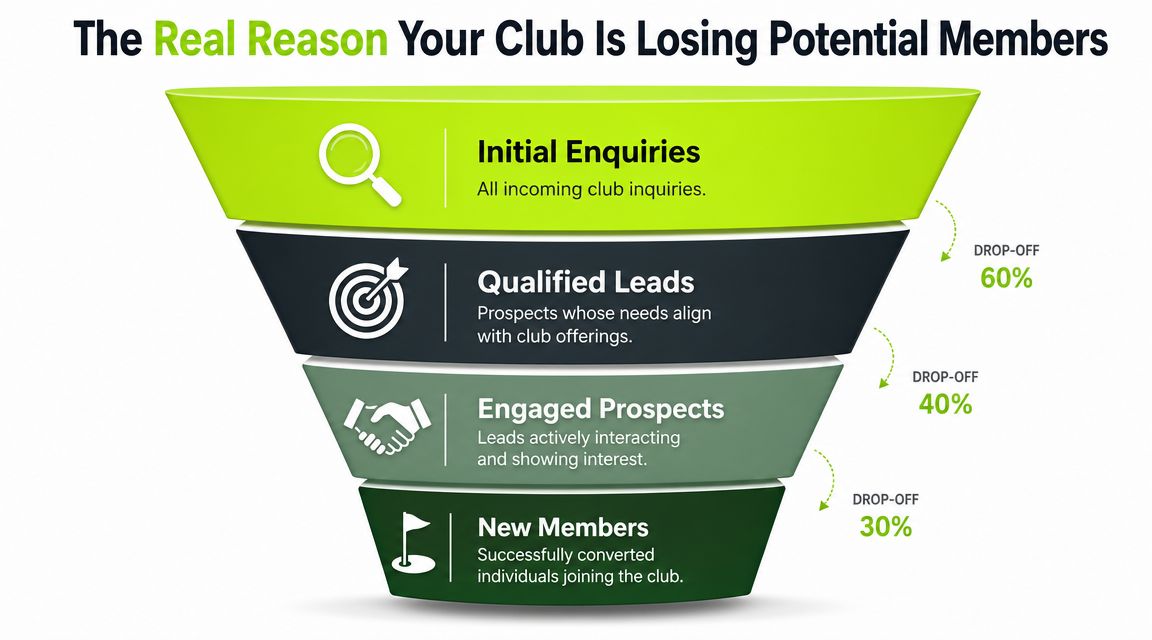
The Real Reason Your Club Is Losing Potential Members
Most clubs think they have a marketing problem. In practice, they often have a handling problem.
An enquiry lands through the website. Another comes in by phone. A third arrives through Facebook. Somebody scribbles a name on paper at reception. A prospect visits on a guest rate, mentions they may join, and nobody records it. By the end of the week, the club has had genuine buying intent from multiple people, but there is no clean record of who came in, who replied, what was said, or who needs chasing.
That is why clubs lose members before price, product, or positioning even become the issue.
More leads won't fix a broken process
Many clubs rely on fragmented channels such as website forms, email, phone calls, social messages, and walk-ins, which makes it hard to assign one owner, timestamp each enquiry, and track status from first contact to signed membership, as noted in GolfRep's analysis of why clubs struggle to track and convert enquiries. The biggest operational gap is the lack of a visible pipeline with clear stages like new, contacted, qualified, or visit booked.
That means clubs often can't answer basic management questions:
- Who still needs a reply
- Which prospects have booked a visit
- Which source produces serious buyers
- How many enquiries are drifting with no next action
- Who on the team owns each conversation
If you add more advertising spend into that environment, you don't create growth. You just increase waste.
One of the clearest explanations of this issue is in GolfRep's piece on how clubs lose enquiries without realising it. The point isn't just missed messages. It's the absence of a system.
Practical rule: If a manager can't open one screen and see every live enquiry by stage, owner, and next step, the club doesn't have a pipeline. It has a pile of conversations.
Visibility comes before optimisation
A proper enquiry pipeline is simple enough to understand at a glance. New. Contacted. Qualified. Visit booked. Proposal sent. Won. Lost.
Those stages matter because they make bottlenecks visible. If plenty of leads reach "contacted" but few ever become "visit booked", the issue is qualification or follow-up quality. If visits happen but few prospects convert, the sales conversation or membership offer may need work. Without pipeline visibility, clubs blame lead quality because it's the easiest explanation.
There's also a retention lesson here. The discipline that keeps prospects from slipping away is similar to the discipline that keeps members from disengaging. If you're reviewing broader lifecycle systems, this guide to preventing customer churn is useful because it frames growth as a process of reducing leakage, not just increasing top-of-funnel activity.
Golf club inquiry management starts with one uncomfortable conclusion. You probably don't need more chaos. You need a cleaner machine.
Laying the Foundation A Centralised Enquiry Hub
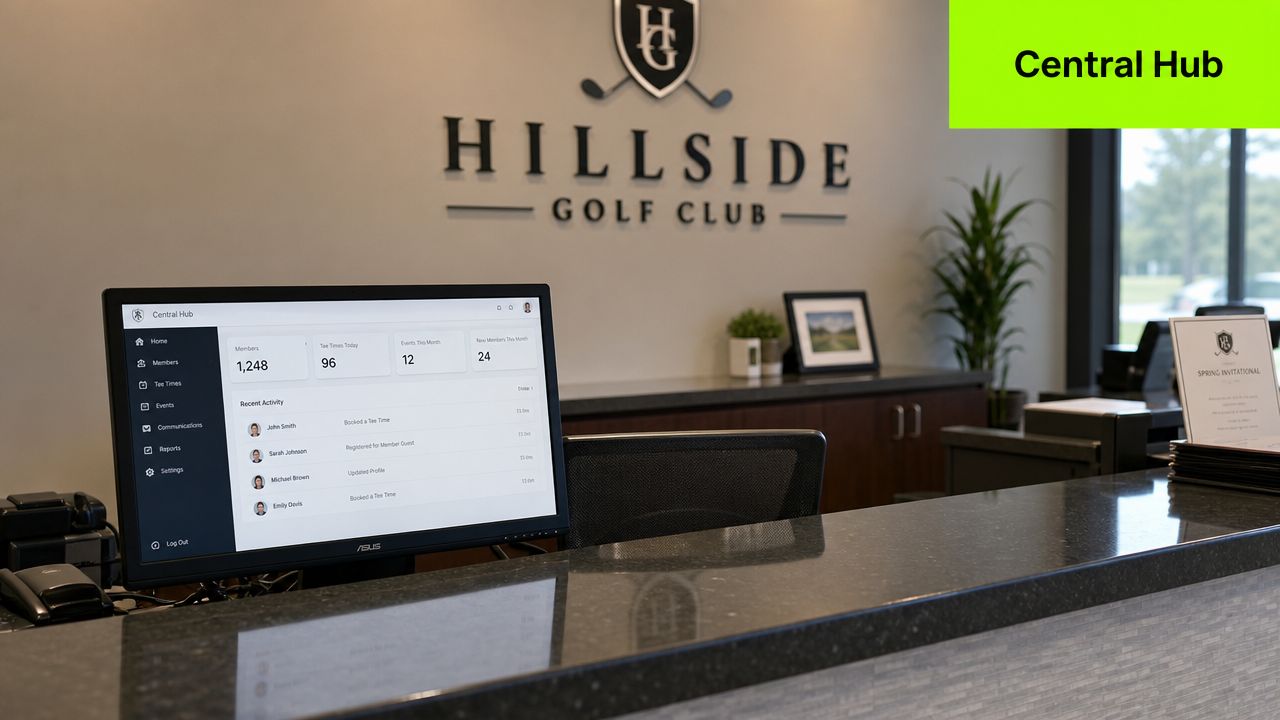
The first fix is rarely glamorous. It is centralisation.
A shared inbox feels workable until volume picks up. A spreadsheet feels organised until two people update it differently. A notebook at reception feels fine until the staff member who wrote it goes off shift. None of these tools gives the club a reliable record of ownership, timestamps, status, or next action.
The club needs one place where every enquiry lives.
What the hub must contain
At minimum, your central enquiry hub should capture:
- Source: Website form, phone, email, walk-in, social message, referral, open day, guest round.
- Owner: One named person responsible for the next move.
- Status: A clear pipeline stage, not a vague note.
- Timestamp: When the enquiry arrived and when somebody responded.
- Next action: Call, email, tour, proposal, reminder, or close-out.
- Lead details: Name, mobile, email, membership interest, preferred start timing, and relevant notes.
Clubs frequently underperform in this aspect. They collect contact details, but they don't collect useful operating data.
Effective enquiry handling requires treating first-response capture as a data-quality problem. Staff should identify whether a lead is a first-time visitor, a referral, or returning, and tag that status in the CRM or booking system, according to Lightspeed's guidance on golf course management review. That is what allows later follow-up to match intent rather than sending the same generic membership email to everyone.
How enquiries should flow into one system
Every channel should feed the same destination. The method can vary, but the rule doesn't.
For most clubs, that means:
- Website forms send directly into the CRM.
- Phone calls get logged immediately with outcome notes.
- Direct emails are forwarded or synced into the same record.
- Social media messages trigger manual logging if no integration exists.
- Walk-ins and reception conversations are entered before the shift ends.
- Guest and visitor interactions are tagged if joining intent is mentioned.
A club should never depend on somebody remembering to chase a prospect later. The system should tell the team what must happen next.
Telephony also matters more than many clubs realise. If calls are a major source of membership interest, clubs need a phone setup that supports accountability, call handling, and clear routing. For managers comparing options, this overview of call centre solutions for multi-channel response handling is a useful reference point.
Why spreadsheets fail in practice
Spreadsheets aren't bad because they are simple. They fail because enquiry management is not just storage. It is action.
A spreadsheet won't automatically remind the membership manager to call someone back tomorrow. It won't flag that a referral lead has gone quiet. It won't show that three open enquiries have had no response since Friday. It also won't help a GM stepping in to understand the current pipeline without reading rows of notes.
A CRM does that work far better because it structures the enquiry around workflow, not just record keeping. GolfRep is one option clubs use when they want a golf-specific setup that combines enquiry capture, pipeline visibility, and follow-up automation in one operating layer. The important point isn't the brand. It's that the system becomes the source of truth.
Once every enquiry lands in one place, the club can stop asking, "Did anyone get back to that prospect?" and start asking, "What is the next move to convert them?"
Building Your Automated Follow-Up Engine
Most clubs are inconsistent at the exact point where consistency matters most. The first reply may go out quickly, but then the sequence collapses. A staff member gets busy. A weekend intervenes. Someone assumes the prospect is no longer interested because they didn't respond to one email.
That is not follow-up. That is wishful thinking.
A stronger workflow is straightforward. Log every enquiry in a CRM, respond quickly, then schedule structured follow-ups at 2 weeks, 30 days, 60 days, and 90 days, using CRM-based tasking and tracking engagement such as email opens to refine the sequence, as described in best-practice follow-up guidance for membership enquiries.
The first response should do one job
The immediate response is not the full sales pitch. It is an acknowledgement and a bridge.
It should confirm that the enquiry has been received, set expectations for the next contact, and make the club look organised. That first touch can be automated. The next one should usually be personal.
A good first-response structure includes:
- Confirmation: The club has received the enquiry.
- Human next step: A named person will follow up.
- Low-friction option: A simple way to book a call or visit.
- Relevant tone: Friendly, specific, and not overloaded with attachments.
The next 14 days matter most
Most membership decisions are not made in one interaction. Prospects compare clubs, discuss costs at home, check location, think about playing opportunities, and weigh timing. The club needs a sequence that stays present without sounding desperate.
Here is a practical working model.
| Day | Channel | Action |
|---|---|---|
| Day 0 | Email or SMS | Send an immediate acknowledgement and confirm who will follow up |
| Day 1 | Personal email | Reply with tailored information based on the enquiry and invite a visit or call |
| Day 3 | Phone call | Try direct contact, answer questions, and qualify timing and interest |
| Day 5 | Send a useful follow-up such as membership options, club culture, or visitor experience | |
| Day 7 | SMS or email | Short check-in with a clear call to book a visit |
| Day 10 | Phone call | Second live attempt if no reply and update status based on outcome |
| Day 14 | Move into longer-term nurture if the prospect is still undecided |
This is not about bombarding people. It is about controlled persistence.
What works: changing the format and reason for contact.
What fails: sending the same "just checking in" email three times.
Multi-channel beats single-channel
The source guidance is clear that clubs should vary the communication channel, personalise by name and location, and use fresh content rather than relying on one message pattern. In real terms, that means email alone isn't enough.
Use each channel for what it does best:
- Email suits detail, membership options, and tour information.
- Phone uncovers objections quickly and helps book visits.
- SMS works well for short confirmations and reminders.
- Task reminders inside the CRM keep staff accountable.
If the team needs a more advanced structure, GolfRep's article on AI-supported lead nurture for golf clubs is a practical example of how clubs can automate parts of this process without losing the personal feel.
Script the sequence so standards don't drift
Clubs often resist scripting because they think it sounds robotic. In reality, scripts create consistency. A script doesn't mean every message is identical. It means the team covers the same essential points every time.
Build templates for:
- Initial acknowledgement
- Day-one personal follow-up
- Visit invitation
- No-response check-in
- Longer-term nurture handoff
- Lost enquiry close-out
The CRM should then trigger tasks, reminders, and handovers automatically. That is what turns follow-up from a personal habit into an operating system.
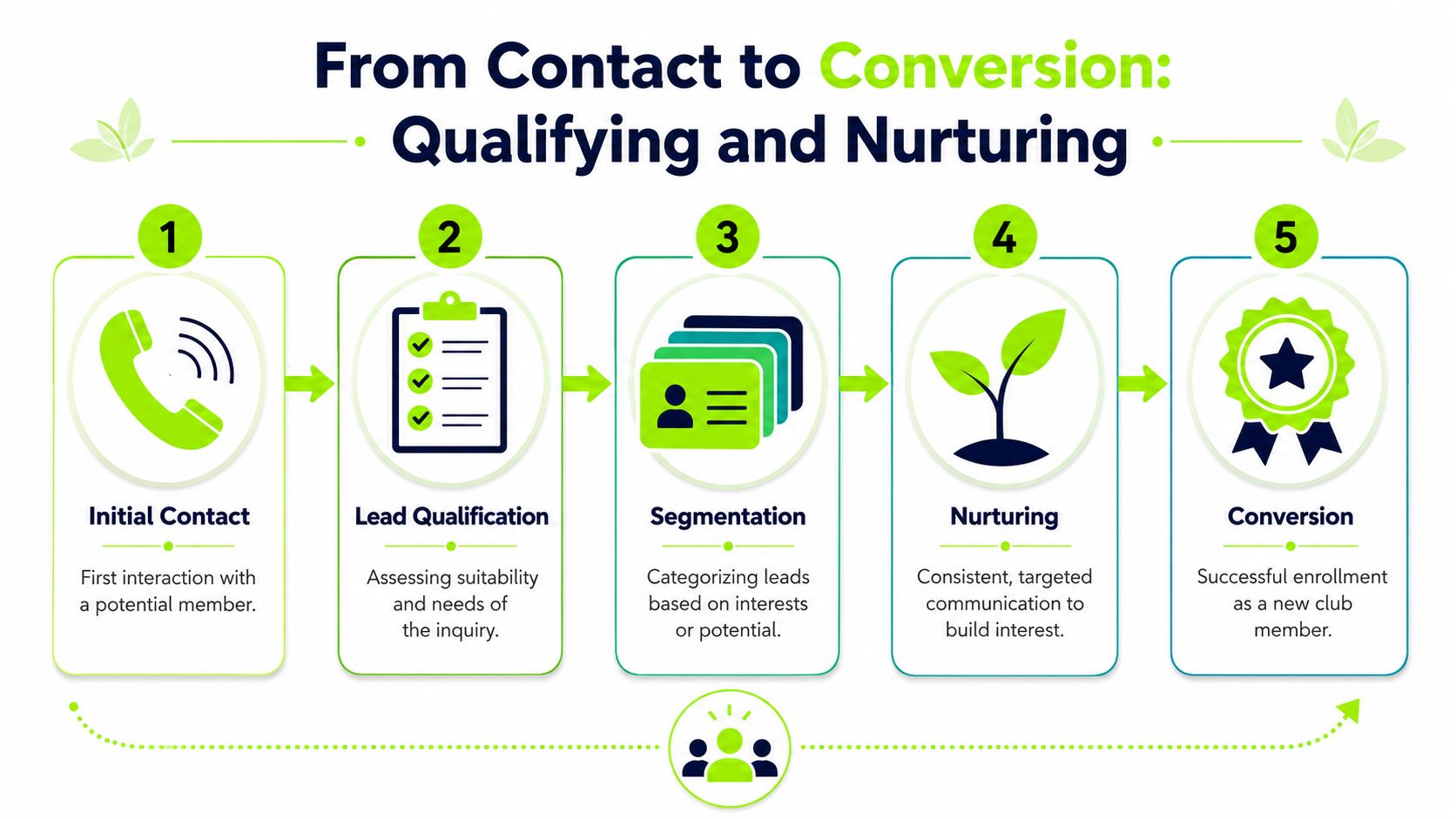
From Contact to Conversion Qualifying and Nurturing
Not every enquiry deserves the same treatment.
Some people want to join soon and need help choosing the right category. Others are comparing clubs for later in the season. Some are curious, but not yet ready. Clubs waste time when they push every prospect through the same sequence.
Qualify early with simple questions
Qualification does not need to feel aggressive. It just needs to help the club understand intent.
Useful enquiry fields often include:
- Joining timeframe: Soon, this season, later, or just researching.
- Playing pattern: Weekday, weekend, flexible, competitive, social.
- Current situation: Existing member elsewhere, returning to golf, beginner, relocating.
- Primary interest: Membership, trial, academy, society, visitor golf with future interest.
These fields let the club sort leads into practical categories such as immediate follow-up, active nurture, or low-priority watchlist. The language you use internally can be simple. The point is to match effort to buying intent.
Build different nurture tracks
A prospect ready to visit the club should not receive the same communication as someone who might join later in the year.
A sensible structure looks like this:
| Lead type | Main objective | Suitable follow-up |
|---|---|---|
| High intent | Book a visit quickly | Personal call, tour booking, membership discussion |
| Mid intent | Build confidence and reduce uncertainty | Email sequence with FAQs, club updates, event invitations |
| Low intent | Stay visible without pressure | Newsletter-style nurture, course improvements, social proof, seasonal prompts |
This is also where digital measurement matters. Modern club management requires measuring the percentage of website visitors who complete a key action, such as filling out an enquiry form, and using conversion-path data to improve follow-up rather than taking a set-and-forget approach, according to private-club website analytics guidance.
That changes how clubs think about lead quality. The website is not just producing traffic. It is producing signals. If one page creates stronger form completion and better-quality enquiries, that should shape both marketing and nurture.
Don't judge enquiry sources by volume alone. Judge them by what type of prospect they produce and how often those prospects move to the next stage.
Nurture should feel relevant, not salesy
The mistake many clubs make is treating nurture as repeated pressure. Good nurture is useful, timely, and specific.
That can include:
- Club news with context: Course work, practice improvements, or competition calendars.
- Member experience content: What the first months of joining look like.
- Visit prompts: Invitations to open events, trial rounds, or informal tours.
- Decision support: Clear answers on categories, pathways, and how to get started.
For a deeper view of how to structure these journeys, GolfRep's guide to lead nurturing best practices for golf clubs is worth reading.
The test is simple. Every message should answer one of the prospect's unspoken questions. Is this club right for me? Will I fit in? Can I justify the decision? What happens if I enquire now but join later?
When nurture does that well, conversion feels less like persuasion and more like momentum.
Measure What Matters Tracking Your Membership Pipeline
Most clubs already have data. What they lack is a disciplined view of the right data.
Committees often review broad numbers, membership totals, rounds played, green fees, perhaps website traffic. Those figures matter, but they don't tell management where enquiries are slowing down. For golf club inquiry management, the key question is not merely how many leads came in. It is how many moved forward, how quickly, and where they stalled.

Keep the dashboard tight
For UK golf clubs, effective management means focusing on a manageable number of KPIs, around 8 to 10, aligned to goals such as membership growth, rather than trying to track everything at once, as recommended in this guide to golf club KPI design. That is the right discipline for enquiry management too.
A useful membership pipeline dashboard should usually include:
- Lead response time
- Contact rate
- Qualified lead count
- Visit booked count
- Visit attended count
- Proposal or membership conversation count
- Won enquiries
- Lost enquiries with reason
- Source-to-outcome tracking
Not every club needs every metric on day one. But every club needs a visible pipeline that shows movement.
Focus on operating metrics, not vanity metrics
Clicks can be interesting. Followers can be flattering. Neither tells a manager whether the club is handling demand properly.
A stronger management conversation sounds like this:
| Question | Weak metric | Better metric |
|---|---|---|
| Are we attracting interest | Website sessions | Enquiries by source |
| Are we responding well | Inbox volume | Time to first response |
| Are we creating sales opportunities | Email sends | Visits booked |
| Are we converting demand | Form fills | Enquiry to member progression |
A club improves faster when the dashboard shows actions and outcomes, not just activity.
For multi-site operators, this matters even more. A centralised process lets head office compare pipeline stages across venues, spot local handling issues, and standardise follow-up without forcing every club into the same tone. One site may need better phone discipline. Another may need cleaner qualification. Without consistent reporting, both problems get hidden inside a general discussion about "lead quality".
The practical standard is simple. If the GM or committee can review the pipeline in minutes and identify where prospects are getting stuck, the system is doing its job.
Building Your Club's Growth Engine
Predictable membership growth rarely comes from one clever campaign. It comes from a system that keeps working when the office is busy, when staff change, and when enquiries arrive through five places at once.
That system has four parts. A centralised hub captures every enquiry. Structured follow-up makes sure nobody is forgotten. Qualification and nurture keep communication relevant. Measurement shows where the process needs tightening.
Most clubs don't need a more complicated strategy. They need stronger operational control.
That is why golf club inquiry management matters so much. It sits between marketing and revenue. If it is weak, the club spends money generating interest that never becomes a visit, a conversation, or a member. If it is strong, even a modest flow of enquiries becomes far more useful because every lead is visible, owned, and moved forward with intent.
The clubs that handle this well don't rely on memory or goodwill. They build a machine. Reception knows what to capture. Membership staff know what to do next. Managers can see the pipeline. Committees review facts instead of hunches.
That is a much better foundation for growth than chasing more leads while the current ones leak away.
If your club wants to build a cleaner membership pipeline, GolfRep helps golf clubs put the system behind the marketing, from enquiry capture and CRM setup to follow-up automation and conversion tracking, so managers can see exactly how prospects move from first contact to signed member.
Ready to tap into our proven growth system?