What Is Marketing Attribution: A Golf Club Guide

More enquiries aren't the same as more members. That's the most popular advice in golf club marketing, and it's incomplete. A club can celebrate a busy campaign, count every form submission, and still have no reliable idea which activity produced signed memberships.
Marketing attribution is often presented as a way to credit the advert someone clicked before converting. For golf clubs, that's only the beginning. The difficult measurement problem starts when the enquiry arrives, moves through a phone call or clubhouse visit, and eventually becomes a membership decision.
GolfRep looks at attribution as a practical operating discipline. It connects campaigns with response time, staff follow-up, CRM stages, visits, applications, and retention. Without that connection, a committee is reviewing activity, not growth.
The Real Attribution Problem for Golf Clubs
The objective isn't to generate the highest number of enquiries. It's to generate enquiries that the club responds to properly and converts into suitable, retained members.
Many clubs track form fills, phone calls, brochure downloads, and tour bookings. Fewer can answer what happened next. Did the prospect receive a prompt response? Did they book a visit? Did they attend? Did they apply? Which campaign started the journey, and which interaction helped them decide?
That gap creates bad budget decisions. A channel that reports plenty of submissions can appear productive because it captures demand at the bottom of the funnel. Meanwhile, a quieter source may introduce prospects who take longer to convert but become stronger membership candidates. If the club only records the final form or the last advert click, the committee sees a distorted version of performance.
The commercial question isn't “Which channel generated the enquiry?” It's “Which channel generated the member, and what happened between those two points?”
This matters particularly in committee-led clubs. Marketing decisions may be reviewed in monthly meetings, often by people who need a clear explanation rather than a complex analytics dashboard. The data has to show where money went, what it produced, and where the process lost potential members.
UK attribution guidance makes the operational requirement clear. Clubs need to capture calls, forms, chat interactions, and offline outcomes, because incomplete tracking can over-credit last-click channels and under-represent earlier sources. Mediahawk's UK guidance on marketing attribution tracking recommends consistent UTM tagging, call tracking, and CRM linkage so each lead can be connected to its originating campaign, keyword, and channel.
Golf membership demand also has a longer and more personal path than a typical online purchase. England Golf reported 750,071 club members in 2025, with membership up 2.66% year on year, while junior membership reached 61,483 after rising 34%. England Golf membership figures reported by The Golf Business underline why clubs need visibility beyond the first click. Growth creates an opportunity, but only clubs with organised follow-up can turn enquiries into dependable pipeline.
What Marketing Attribution Actually Means
Marketing attribution is the practice of assigning credit for a conversion to the marketing interactions that influenced it. In plain English, it helps a club work out which channels and touchpoints contributed to an enquiry, visit, application, or signed membership.
Take a prospective member who eventually joins. Their journey might look like this:
- A current member mentions the club.
- The prospect sees a paid social advert.
- They search Google for membership fees.
- They attend an open day.
- The secretary calls to answer questions.
- The prospect receives a follow-up email.
- They submit an application.
Attribution records those interactions and applies a set of rules to decide how much credit each one receives. It isn't the same as analytics. Analytics tells you what happened, such as a page visit or form submission. Reporting organises those events. Attribution adds a scoring philosophy, deciding which events deserve recognition when the final conversion occurs.
The basic models
A single-touch model gives all credit to one interaction. First-touch credits the source that introduced the prospect. Last-click credits the final tracked interaction before conversion. These models are simple, but each leaves important parts of a membership journey out.
A multi-touch model distributes credit across several interactions. Linear attribution treats each touchpoint equally. Time decay gives more weight to interactions closer to conversion. Position-based attribution gives greater weight to the first and last meaningful touches, while sharing some credit with the interactions between them.
An algorithmic or data-driven model uses available conversion data to estimate the contribution of different touchpoints. It can be useful, but it needs enough consistent data to produce a dependable result. Small clubs shouldn't pretend a fancy label makes weak tracking reliable.
For a fuller explanation of how attribution rules are structured, Tagada's attribution modelling guide provides useful background on the difference between models and the assumptions each one makes.
The practical promise is straightforward. Once the club agrees how credit will be assigned, the marketing budget becomes easier to defend. The committee can discuss not only how many enquiries arrived, but which activity supported visits, applications, and memberships.
Attribution Models Compared for Membership Journeys
A slow membership journey exposes the weaknesses of simplistic attribution. Last-click can award all the credit to a branded search that happened after weeks of consideration. First-click can overvalue an awareness advert that introduced the club but had little influence later. Neither model is automatically wrong, but each answers a narrow question.
| Model | How It Handles Multi-Touch | Strength for Clubs | Main Risk |
|---|---|---|---|
| Last-click | Gives all credit to the final tracked interaction | Easy to understand and useful for identifying closing actions | Usually over-rewards branded search, retargeting, or the final form |
| First-click | Gives all credit to the first marketing interaction | Shows which channels create awareness | Ignores follow-up, visits, and trust-building activity |
| Linear | Splits credit evenly across recorded touches | Recognises the whole journey | Treats a minor page visit like a decisive conversation |
| Time decay | Gives more weight to recent interactions | Can suit shorter consideration cycles | Undervalues early awareness and referral influence |
| Position-based or U-shaped | Prioritises the first and last touches, with credit shared across the middle | Balances introduction and conversion | Assumes the opening and closing moments are always most important |
| Algorithmic or data-driven | Estimates contribution from observed conversion patterns | Can reveal less obvious sources when data quality is strong | Needs consistent volume, clean stages, and reliable offline outcomes |
What each model gets wrong
Last-click is useful for a narrow operational question: what finally prompted the prospect to act? It's poor as the only budget model. A branded search may be the last step because earlier campaigns created the demand.
First-click helps assess awareness activity. It's valuable when the committee wants to know which channels bring new prospects into consideration, but it can make later follow-up appear irrelevant.
Linear attribution looks fair, yet equal credit isn't the same as accurate credit. A prospect may visit a pricing page several times, attend an open day, and have one important call with the membership manager. Treating those interactions identically can hide the moments that change the decision.
Time decay suits a shorter sales cycle where recent touches carry more influence. It's less useful when a prospect researches a club, pauses, visits months later, and then joins after a personal conversation.
Position-based attribution is a practical compromise. It recognises both the source that began the journey and the touchpoint nearest conversion. Algorithmic attribution can go further, but only when the club has enough trustworthy records for the model to learn from.
For most UK clubs, position-based attribution is the realistic starting floor, with a simple data-driven model considered later. If the club uses SMS in its follow-up sequence, YipSMS Inc.’s explanation of last-touch attribution for SMS is useful for understanding why a final message can look more valuable than the earlier work that created the opportunity.
Tracking Infrastructure Clubs Need in Place
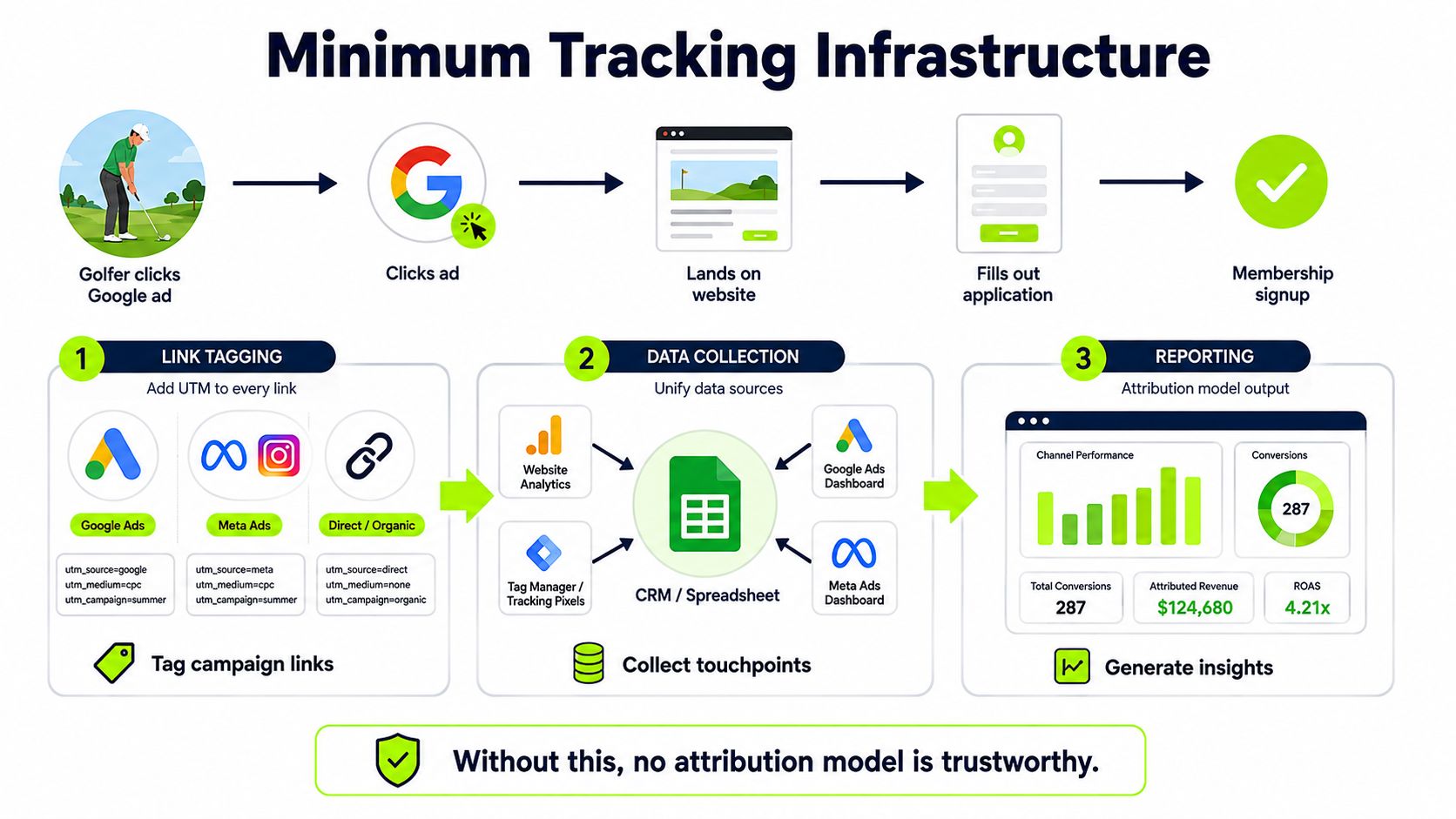
No attribution model can repair missing source data. Before choosing a model, a club needs a dependable route from campaign link to CRM record to membership outcome.
Start with campaign tagging. Every relevant link should carry a consistent UTM structure across Google Ads, Meta, email newsletters, partner websites, and organic campaign pages. The naming convention matters more than cleverness. If one person records “Facebook,” another enters “Meta paid,” and a third leaves the field blank, the committee will receive several versions of the same channel.
The CRM should capture the source at the point of enquiry. At minimum, record source, medium, campaign, first-touch referrer, enquiry date, staff owner, current stage, visit status, application status, and membership outcome. A self-reported “How did you hear about us?” field still matters because referrals, conversations, and offline exposure often won't appear in platform data.
Call tracking closes another major gap. A dedicated number or dynamic number insertion can connect a phone enquiry to the page or campaign that generated it. The club must protect its main number in directories and printed materials, and staff need a consistent process for recording the prospect's stated source.
Where the system usually fails
UTM parameters can disappear when links are copied into emails or redirected through other systems. Staff can forget to ask how a caller found the club. Call-tracking numbers can overwrite the main line in a directory if nobody manages the listings. A form can capture the first source but lose it when the prospect returns through a different device.
The most important step is the offline feedback loop. When a CRM record becomes a signed membership, that conversion should be imported back into Google Ads and Meta where appropriate. Hashed email matching can connect the offline event to an advertising platform, allowing the club to assess signed outcomes rather than relying only on online form completions.
UK/EEA implementations of GA4 Consent Mode v2 Advanced are described as capable of recovering up to 70% of lost attribution data through behavioural modelling, subject to sufficient traffic and consent thresholds, as outlined in White Hat SEO's UK attribution guidance. That modelling should support, not replace, first-party CRM records and offline conversion feedback.
For a practical example of the operational detail involved, see GolfRep's guide to golf club enquiry tracking.
A Practical Starting Plan for Clubs With No Attribution Today
A club starting from zero shouldn't spend months building a perfect dashboard. The right approach is a short build that produces one usable report and exposes the gaps staff need to fix.
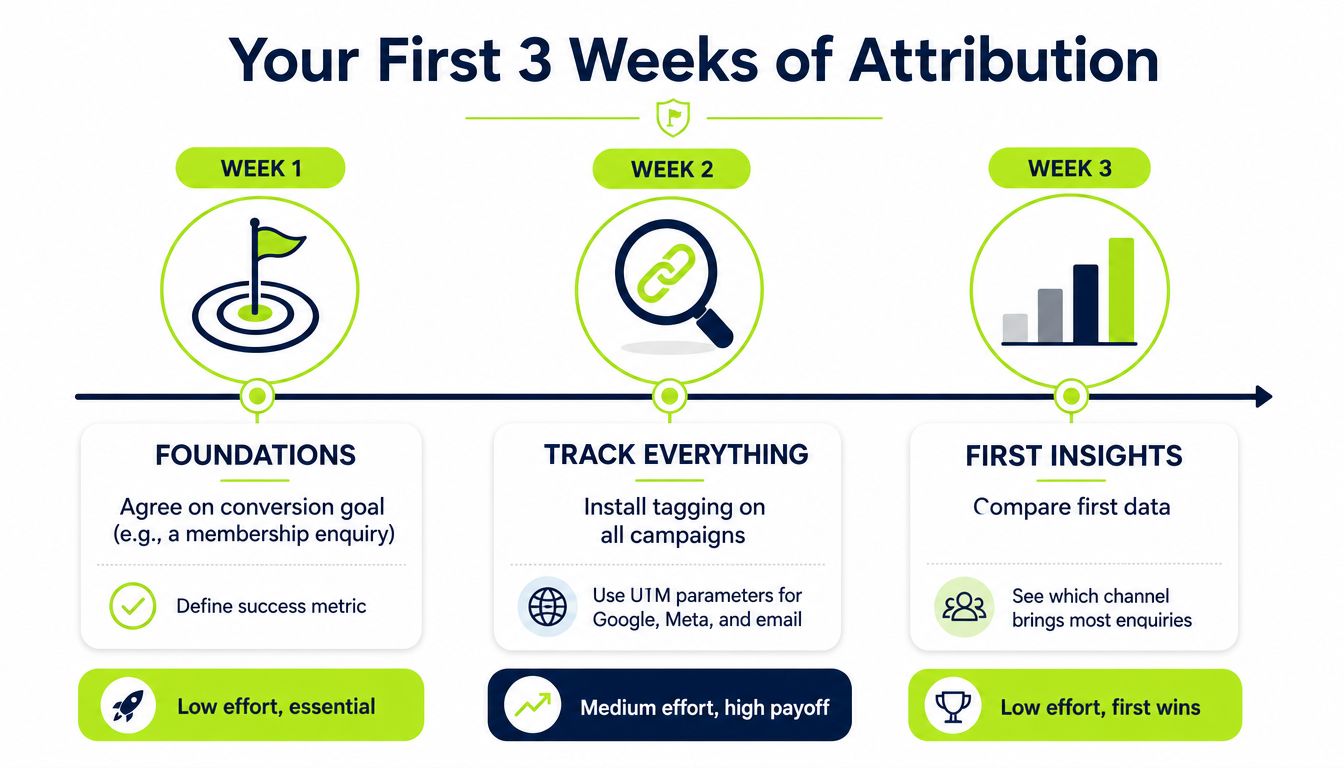
Week one, build the foundations
Agree the conversion that matters first. For most clubs, that means a qualified membership enquiry or a booked visit, with signed membership added as the commercial outcome.
Create a simple UTM taxonomy in Google Sheets. Define the approved names for source, medium, campaign, content, and landing page. Install call-tracking numbers on the website and key landing pages, then choose the CRM fields for source, medium, campaign, first-touch referrer, stage, and outcome.
The point isn't technical sophistication. It's consistency. Everyone entering or reviewing a record should understand what each field means.
Week two, capture the real journey
Train front-desk and membership staff to ask every new prospect how they found the club and record the answer immediately. Change enquiry forms so hidden source fields preserve campaign information, while a visible self-reported field captures referrals and offline discovery.
Reconcile the first set of enquiries against tagged campaigns. Look for obvious breaks, such as a high number of “unknown” records, duplicated channel names, or phone calls with no linked page or campaign.
Week three, close the loop
Export CRM records that progressed to a meaningful outcome and upload them as offline events into the relevant advertising platforms. Then run a first source-of-enquiry report showing enquiries, visits, applications, and signed outcomes by source.
Don't wait for perfect data. Label unknowns clearly, document the gaps, and produce a report the committee can use. The first report's job is to establish a repeatable process, not to deliver false certainty.
The first useful report is more valuable than the perfect dashboard that nobody maintains.
KPIs That Make Attribution Worth Doing
A committee doesn't need every available marketing metric. It needs measures that connect spend and staff time with membership outcomes.
Customer acquisition cost by source shows what the club spends to create a qualified opportunity or signed member. Cost per enquiry can be useful for diagnosing campaign efficiency, but it becomes misleading when one source creates many weak enquiries and another creates fewer, stronger prospects.
Lifetime value adds the retention perspective. A channel that produces a low-cost joiner may look efficient until the club compares how long those members remain active. The most useful commercial view is cost per retained member by source, even if the club initially has to build that picture manually.
Conversion rates should be separated by stage. Track enquiry to visit, visit to application, and application to signed membership. Combining everything into one overall rate makes it difficult to see whether marketing, response handling, the visit experience, or the joining process is causing the loss.
Response time belongs in the same report. The Lead Response Crisis report for UK SMEs states that 78% of customers buy from the first company to respond, while the average UK business response time is 47 hours and only 7% achieve sub-5-minute responses. The Lead Response Crisis report provides that benchmark. Golf clubs should measure their own response process rather than assume staff follow-up is fast enough.
| KPI | Why It Matters | Reliable Without Attribution? | Channel Action |
|---|---|---|---|
| Cost per qualified enquiry | Separates useful demand from raw volume | Partly | Improve targeting or reduce low-quality sources |
| Cost per signed member | Connects spend with acquisition | No | Shift investment towards converting channels |
| Cost per retained member | Includes membership quality and durability | No | Protect channels that produce suitable joiners |
| Enquiry-to-visit rate | Shows whether prospects take the next step | Only if source is captured | Improve landing pages, response, or booking flow |
| Visit-to-signing rate | Tests the commercial journey after marketing | Only with CRM stages | Improve tours, follow-up, and offer clarity |
| Time to first human contact | Exposes operational leakage | Yes, if recorded consistently | Automate acknowledgement and assign ownership |
Web sessions, social reach, and email open rates can help diagnose activity. They can't defend a budget on their own. GolfRep's guide to what marketing analytics means for golf clubs is useful background, but attribution only becomes commercially meaningful when those interactions connect to member outcomes.
A Club-Specific Attribution Walkthrough
Consider James, a 38-year-old prospective member who joins a representative UK club after a twelve-week journey. He first searches for “golf clubs near me” and sees a branded search advert. He doesn't enquire immediately, but the club's follow-up activity keeps the option visible.
James later watches a Meta retargeting video. He then books an open day through an email, returns to the pricing page after reading an organic blog article, and calls the secretary with questions. The secretary records the call as a general enquiry rather than noting the referral and campaign context. After the open day, the membership manager sends a WhatsApp follow-up, and James signs a seven-day membership.
The final message may have prompted the application, but it didn't create the entire decision. Last-click attribution would credit the WhatsApp or the immediately preceding tracked interaction. First-click would assign everything to the original search advert. Linear attribution would spread credit across the recorded touches, even though the open day and secretary's conversation may have mattered more than a passive video view.
A position-based model would give priority to the first search interaction and the final conversion moment, while recognising the open day, email, organic content, and phone call. An algorithmic model could eventually assess those interactions based on patterns across the club's wider records, provided the CRM stages and outcomes are recorded consistently.
| Touchpoint | Last-Click | First-Click | Linear | Time Decay | Position-Based | Algorithmic |
|---|---|---|---|---|---|---|
| Branded search advert | Closing credit only if final | Full credit | Shared credit | Lower early weight | Strong opening weight | Estimated from observed outcomes |
| Meta retargeting video | Full credit if final | No credit | Shared credit | Moderate weight | Middle credit | Estimated from observed outcomes |
| Open day booking email | Full credit if final | No credit | Shared credit | Higher recent weight | Middle credit | Estimated from observed outcomes |
| Organic blog and pricing visit | Full credit if final | No credit | Shared credit | Moderate weight | Middle credit | Estimated from observed outcomes |
| Secretary's referral call | Full credit if final | No credit | Shared credit | Higher recent weight | Middle credit | Only if CRM notes classify it properly |
| WhatsApp follow-up | Full credit if final | No credit | Shared credit | Highest recent weight | Strong closing weight | Estimated from observed outcomes |
The data breaks when the secretary logs “general enquiry” and the membership manager records only the final message. The club then loses the referral context and cannot distinguish a useful human interaction from a routine follow-up.
The minimum clean record includes UTM data on the email, CRM stage progression, the open day booking, call notes, and the eventual membership outcome. Attribution won't recover information that staff never capture.
Turning Measurement Into Membership Growth
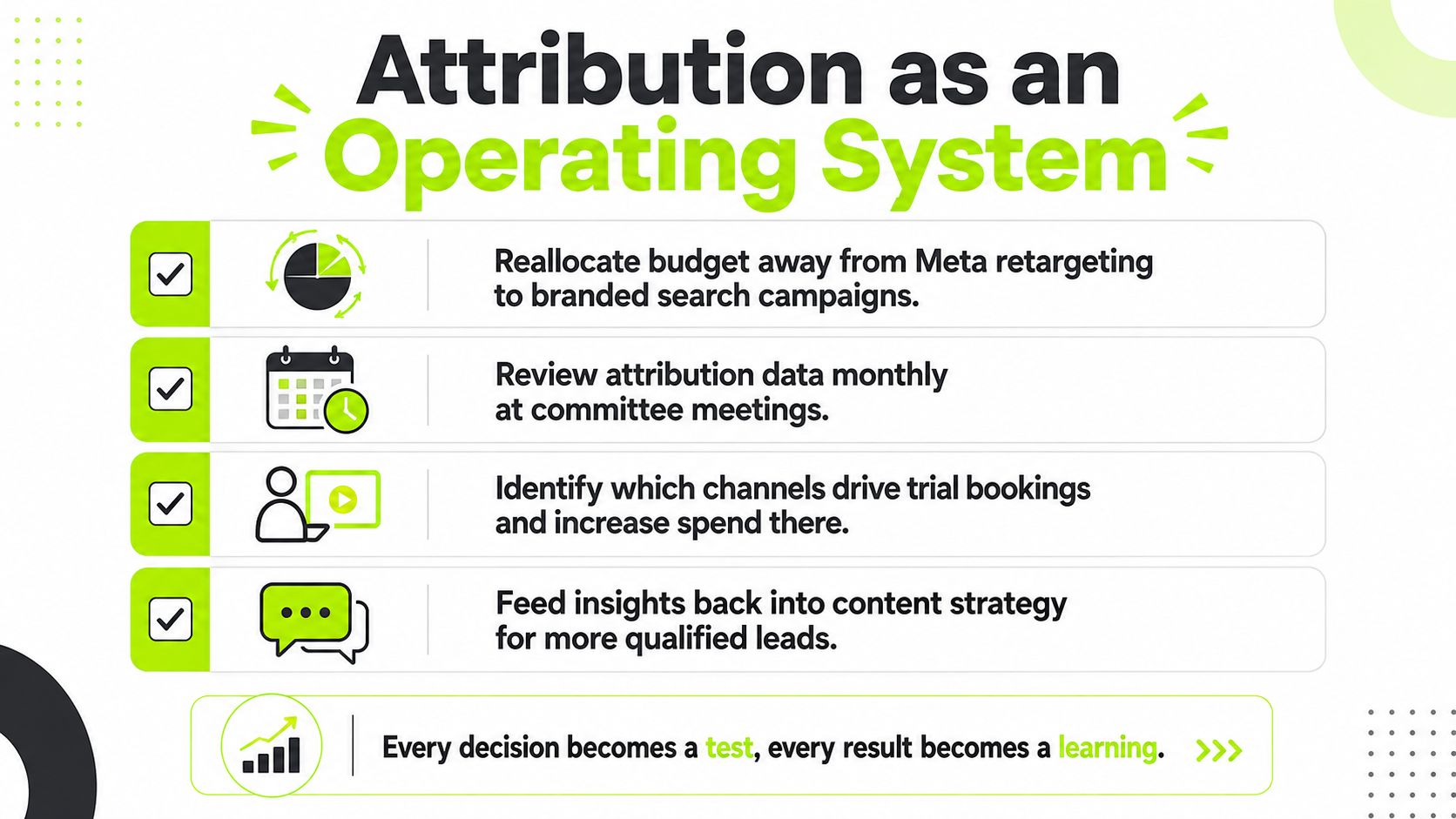
Attribution should run the membership pipeline, not decorate a dashboard. The output needs to change what the club funds, how quickly staff respond, which events it runs, and how the committee judges progress.
A monthly report might show that Meta retargeting creates plenty of visible activity while branded search produces more efficient signed outcomes. The committee can then test a budget shift rather than argue from preference. If open day attendance repeatedly appears near the point of conversion, the club can test greater frequency. If phone enquiries convert well but lack source data, the secretary's process needs changing before the club spends more.
The UK attribution environment has already moved beyond the question of whether measurement matters. A 2016 study across the UK, France, and Germany found that 79% of organisations were already using marketing attribution, while UK marketers identified fragmented technology stacks and data complexity as significant barriers, cited by 45% and 42% respectively. The UK, France, and Germany attribution study is historical, but its lesson remains practical: adoption without connected systems produces weak visibility.
A later UK market summary reported that by 2018, 66% of company respondents carried out attribution on all or some campaigns, while 24% relied on their media agency for attribution work. It also found that 32% were not very confident in agency impartiality and 44% were only quite confident. Econsultancy's UK attribution summary shows why clubs need an agreed internal view of the data, even when external partners support delivery.
GolfRep's perspective on golf club marketing ROI is simple. Every campaign should lead to a measurable next action, every enquiry should have an owner, and every signed outcome should feed back into the decision process.
GolfRep helps UK golf clubs connect lead generation with structured follow-up, CRM records, and membership outcome tracking, so committees can see what happens after an enquiry lands. Visit GolfRep to discuss a practical attribution and pipeline system for your club.
Ready to tap into our proven growth system?