What Is Lead Qualification and Why It Matters for Clubs
Lead qualification is the process of deciding which enquiry deserves fast, personal follow-up and which should be nurtured or filtered out. For golf clubs, it means using fit, intent, timing and practical routing to make sure the right prospects receive an answer within minutes, not days.
The urgency becomes clear when a UK golf club takes an average of 47 hours and 32 minutes to respond to a membership enquiry, as reported in GolfRep's analysis of golf club membership enquiries. By then, the prospect may have stopped checking their inbox, contacted another club, or decided that membership is too much effort.
Lead qualification isn't another administrative layer added to an already busy club office. It's the operating system that helps a secretary, manager or membership team decide who to call now, who needs useful information first, and who isn't suitable for the offer. That distinction matters because about 79% to 80% of marketing leads never convert into a sale, according to lead-generation benchmark data.
What Lead Qualification Means in Simple Terms
In plain English, lead qualification means assessing whether a prospect is a sensible opportunity for the club and deciding what should happen next. The assessment might include where they live, what type of membership they're considering, when they want to join, whether they're enquiring for a household, and whether the club can meet their expectations.
For a club secretary, the practical version is familiar. At the start of the day, a shared inbox contains a mixture of urgent membership enquiries, visitor-round requests, lesson questions, society bookings and vague requests for a brochure. Treating every message identically creates delay. Sorting them into call now, send information, and not a fit creates focus.
Practical rule: Qualification should determine the next action, not simply attach a label to a contact.
Generic sales frameworks often focus on budget, authority, need and timing. Those ideas can help, but a golf club needs to translate them into its own setting. Budget might mean whether the prospect is considering the right membership category. Authority might mean whether a spouse, household or family is involved. Timing might mean whether they want a tour this weekend or are researching for a future move.
This is why the process isn't a bureaucratic filter. It matches the speed and type of response to the prospect's likely intent. A family asking about a tour should not wait behind someone downloading a membership guide. A society organiser needs a package and availability response, not a standard membership email. Someone outside the club's practical travel area may need a polite alternative rather than repeated sales calls.
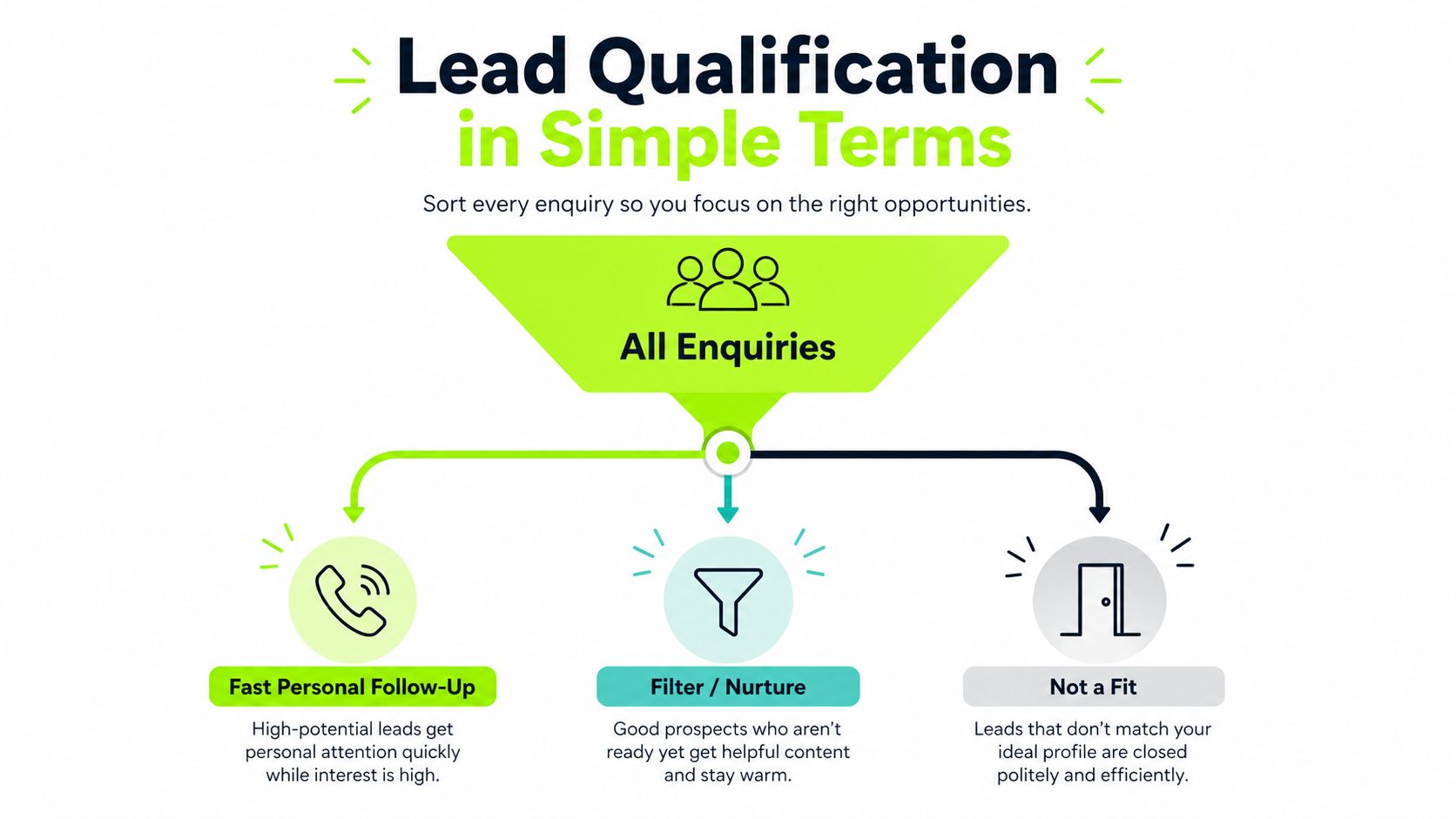
A useful qualification process therefore has three destinations:
- Fast personal follow-up: The enquiry shows clear fit and intent, so a named person calls or offers a booking.
- Nurture and education: The prospect may fit the club but hasn't shown enough urgency for a direct sales conversation.
- Filter or redirect: The enquiry doesn't match the club's membership, location, capacity or service offer.
Clubs wanting a broader sales explanation can use this practical guide on how to qualify sales leads, then adapt the principles to membership decisions. GolfRep also outlines the operational side in its guide to improving lead quality.
The rest of the system follows naturally. The club defines useful criteria, assigns scores to observable signals, routes records through a CRM, and uses automation to protect response speed. That approach can work for a single committee-led club as well as a multi-site operator, provided the rules reflect how people decide to join.
Why Generating More Enquiries Is Not the Problem
A club can increase website visits, advertising, referrals, event attendance and social activity, yet still see membership sign-ups stall. The constraint is often follow-up capacity and prioritisation. An enquiry that sits in a shared inbox, waits for a committee member, or receives an answer after the weekend is not being converted into a conversation.
More marketing then feeds the same weak process. The club may have genuine interest, but nobody owns the next action, the first reply misses the question, or the prospect cannot tell who will help them.
The wider benchmark is clear: around 79% to 80% of marketing leads typically never become customers, and only 25% of marketing leads qualify for direct sales engagement, as summarised by Email Vendor Selection's lead-generation statistics. For a golf club, that does not make most enquiries worthless. It shows why the club needs a practical way to distinguish casual curiosity from a credible membership opportunity.
The response gap has a commercial cost
Response time matters because an enquiry is usually a live decision, not a permanent entry in a database. A golfer may be comparing clubs, discussing options with a partner, or trying to arrange a visit. By the time someone replies, the household may already have chosen another club.
Research summarised by Copy.ai's summary of lead response-time research reports that leads contacted within 5 minutes are 21 times more likely to enter the sales process than leads contacted after 30 minutes, and 100 times more likely to make successful contact than when response is delayed further. Other summaries report a 60-fold increase in qualification likelihood when contact happens within five minutes rather than 24 hours.
The UK golf-club evidence makes the operational issue easier to see. An enquiry answered within one hour was five times more likely to convert than one left for 24 hours, according to GolfRep's UK golf-club response analysis. A separate review says contacting a new enquiry within five minutes can make it 98% more likely to convert, while new enquiry leads are 10 times less likely to respond after five minutes, as described by Anthill's enquiry response research.
The average 47-hour response gap highlighted earlier is therefore more than an administrative delay. It is time in which interest can cool, a family decision can move elsewhere, and a committee-led club can lose a member without realising it.
A manager should ask four practical questions:
- Who sees each enquiry first?
- How quickly does the right person respond?
- Can staff see what the prospect wants and what has already happened?
- What happens when the prospect is not ready today?
Qualification turns an overloaded mailbox into a workable queue. A high-intent membership enquiry receives a call, a visitor gets a booking route, a society organiser receives the correct information, and a quieter prospect enters a relevant nurture path.
The objective is to choose the right next action, not to reject people quickly.
The Core Components of a Qualification System
A useful starting point is the daily email sort. A club secretary might already separate messages into call now, send information, and archive or redirect. A qualification system makes that judgement consistent, visible and measurable, so it doesn't depend on one person remembering every conversation.
Start with fit
Fit describes whether the prospect's circumstances match what the club can provide. Relevant fields might include:
- Location and travel radius: Is the club practical for regular play?
- Membership interest: Are they asking about a category the club offers?
- Playing pattern: Do they want weekday, weekend, flexible or frequent access?
- Household details: Is the enquiry for one golfer, a couple, a family or a group?
- Access and preferences: Do they have questions about facilities, course format or accessibility?
- Joining timeframe: Are they looking to visit soon or gathering information?
A form shouldn't ask every possible question. Each field needs a clear purpose, and unnecessary friction can discourage genuine prospects. Collect enough information to route the enquiry, then let a human conversation uncover the detail that requires judgement.
Add intent and behaviour
Fit alone doesn't make someone ready for a conversation. A prospect who matches the club profile but has only requested general information should be treated differently from someone who has asked for a tour.
Behavioural signals might include a tour request, a preferred visit date, a response to an email, or repeated interest in membership information. The strongest models use historical CRM data to compare each signal's close rate with the overall lead-to-customer baseline. Attributes that outperform the baseline receive points, while assumptions that merely sound persuasive stay out of the model, as explained in Salesforce's lead-scoring guidance.
Separate MQL from SQL in club language
A Marketing Qualified Lead, or MQL, is an enquiry that fits the broad membership profile and has shown meaningful interest. It may be ready for a helpful follow-up, but the club hasn't confirmed that the person wants a sales conversation.
A Sales Qualified Lead, or SQL, is further along. The prospect has indicated a clear need or intention and is ready for a tour, taster round, callback or committee introduction. The handoff should be based on evidence, not just the fact that a form was completed.
| Signal | Points | Reason |
|---|---|---|
| Requested membership tour | 20 | Direct indication of visit intent |
| Join timeframe within the club's active sales window | 15 | Shows practical urgency |
| Selected a suitable membership category | 10 | Indicates basic offer fit |
| Valid local postcode or sensible travel area | 10 | Supports regular attendance |
| Household or group relevance | 10 | Reflects the real decision group |
| Relevant email engagement | 5 | Shows continued interest |
| Unsuitable location or service need | Deduct points | Prevents poor-fit routing |
| Timeline outside the active sales window | Deduct points | Signals nurture rather than immediate sales action |
The result should be one shared priority list. A small team doesn't need an elaborate model. It needs a clear view of who owns each enquiry, what the next action is, and when that action should happen.
Building the Workflow With CRM and Automation
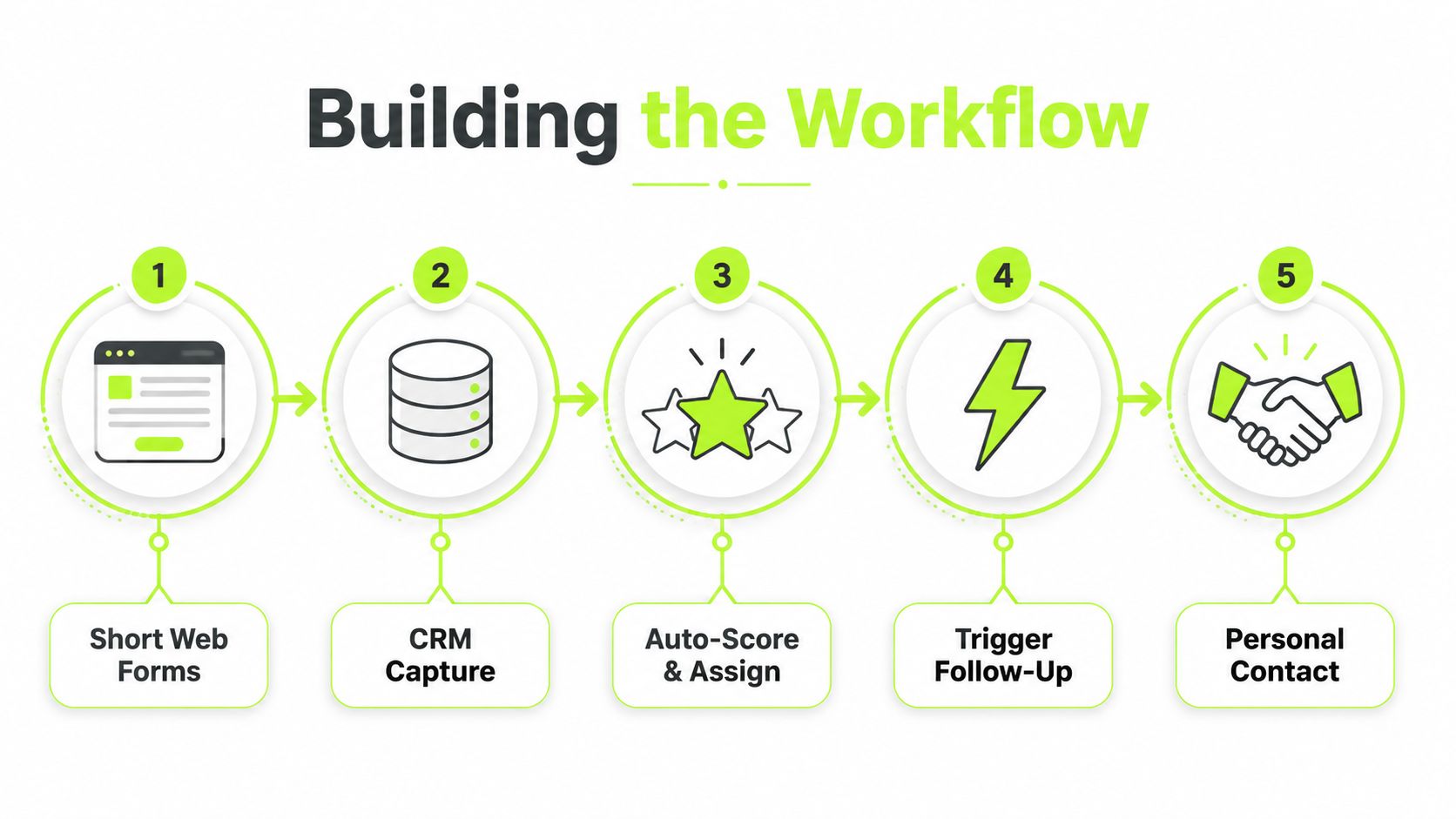
Most clubs lose enquiries between submission and ownership. A form sends a message to a shared inbox, somebody assumes somebody else will reply, and the prospect waits. The fix is to design the workflow around that failure point.
Capture only information the team can use
Membership, visitor-play, society and lesson pages should have forms that reflect the action the visitor wants to take. Useful fields can include contact details, home course, preferred starting time, household members, decision timeframe and relevant interest.
The form should then create or update a record in the club CRM. That record needs a source, an owner, a current stage and a complete activity history. Deduplication matters because duplicate contacts split context between records and make it harder for staff to see who has already replied.
A CRM also provides the visibility a shared inbox cannot. A manager can see whether an enquiry is new, assigned, contacted, booked, nurturing or awaiting a committee decision. GolfRep explains this operating model in its guide to golf club CRM.
Route the response immediately
Automation should acknowledge the enquiry, answer predictable questions and alert the correct person when high-intent criteria are present. A 24/7 workflow can collect details outside office hours, assess them against club rules, send relevant information and offer a tour or callback route.
This doesn't remove the need for personal contact. It protects the time before personal contact happens. A high-intent prospect can receive an immediate acknowledgement and booking option, while a lower-intent prospect can enter a nurture sequence containing course information, member stories and event invitations.
A club evaluating its wider systems may also find this overview of club membership management software useful when considering how membership records, communications and operational data should connect.
Keep people responsible for judgement
Some decisions shouldn't be automated. Pricing exceptions, joining-fee questions, corporate enquiries, eligibility issues, capacity constraints and committee approvals need a named human owner.
The workflow should therefore include explicit review points:
- Pricing review: A staff member checks unusual requests or special categories.
- Eligibility review: The club confirms that membership rules are met.
- Committee routing: A defined approver receives decisions that need governance.
- Capacity check: Staff confirm availability before offering a firm joining path.
- Escalation: A manager takes ownership when a high-intent enquiry has no response.
Integrate booking, membership and email systems so visits, calls and messages update the lead record without repeated data entry. Then test the complete route, from form submission to CRM entry, score, notification, follow-up and booking. A workflow only helps when it works reliably on a quiet weekday and during a busy weekend.
How Single Clubs and Multi-Site Operators Differ
The principles stay consistent across a single club and a multi-site operator, but ownership and routing can't be identical. A small club benefits from simplicity. A group needs central definitions without preventing local judgement.
A single club needs clear ownership
A single club can usually assign qualified membership enquiries to a membership secretary, general manager or designated sales coordinator. That person can use local knowledge to assess whether the prospect's location, playing preferences, household needs and timing fit the club.
The system should still record the fields consistently. Preferred day, playing frequency, course interest, accessibility questions and intended joining date can all influence the next step. If committee approval is required, the CRM should show the named approver and deadline rather than leaving the enquiry in an informal conversation.
A single club doesn't need a complicated distribution tree. It needs one visible queue, one accountable owner and a fallback when that person is unavailable.
A multi-site operator needs shared standards
A multi-site group has a different problem. Central marketing may generate the enquiry, a central team may score it, and a local venue may need to confirm availability, pricing, course format or visit arrangements.
Shared CRM fields and stage names make performance comparable across venues. Central teams can distribute enquiries by territory or stated preference, while local branches retain override controls for situations that automated rules can't understand.
| Operating area | Single club | Multi-site operator |
|---|---|---|
| Ownership | One named membership or sales owner | Central routing with local venue ownership |
| Qualification rules | Club-specific membership and capacity criteria | Shared essentials with venue-level variations |
| Follow-up | Direct call, tour or committee route | Central acknowledgement followed by local contact |
| Reporting | Enquiry-to-joining performance for one venue | Group-wide and individual-site performance |
| Escalation | Manager or named committee approver | Central operations, venue manager and escalation owner |
| Local judgement | Strongly embedded in one team | Preserved through local overrides |
Reporting must distinguish operator-wide conversion from individual-club performance. A venue with different pricing, lead volume, availability or local follow-up shouldn't be judged against another without context.
The risk for multi-site operators is stranded ownership. A high-intent family enquiry can sit between head office and a venue because each team assumes the other will respond. Service-level expectations, escalation routes and ownership rules prevent that gap. Standardise the essentials, then let local teams apply the judgement that makes the response credible.
Real Club Scenarios and a Simple Scoring Example
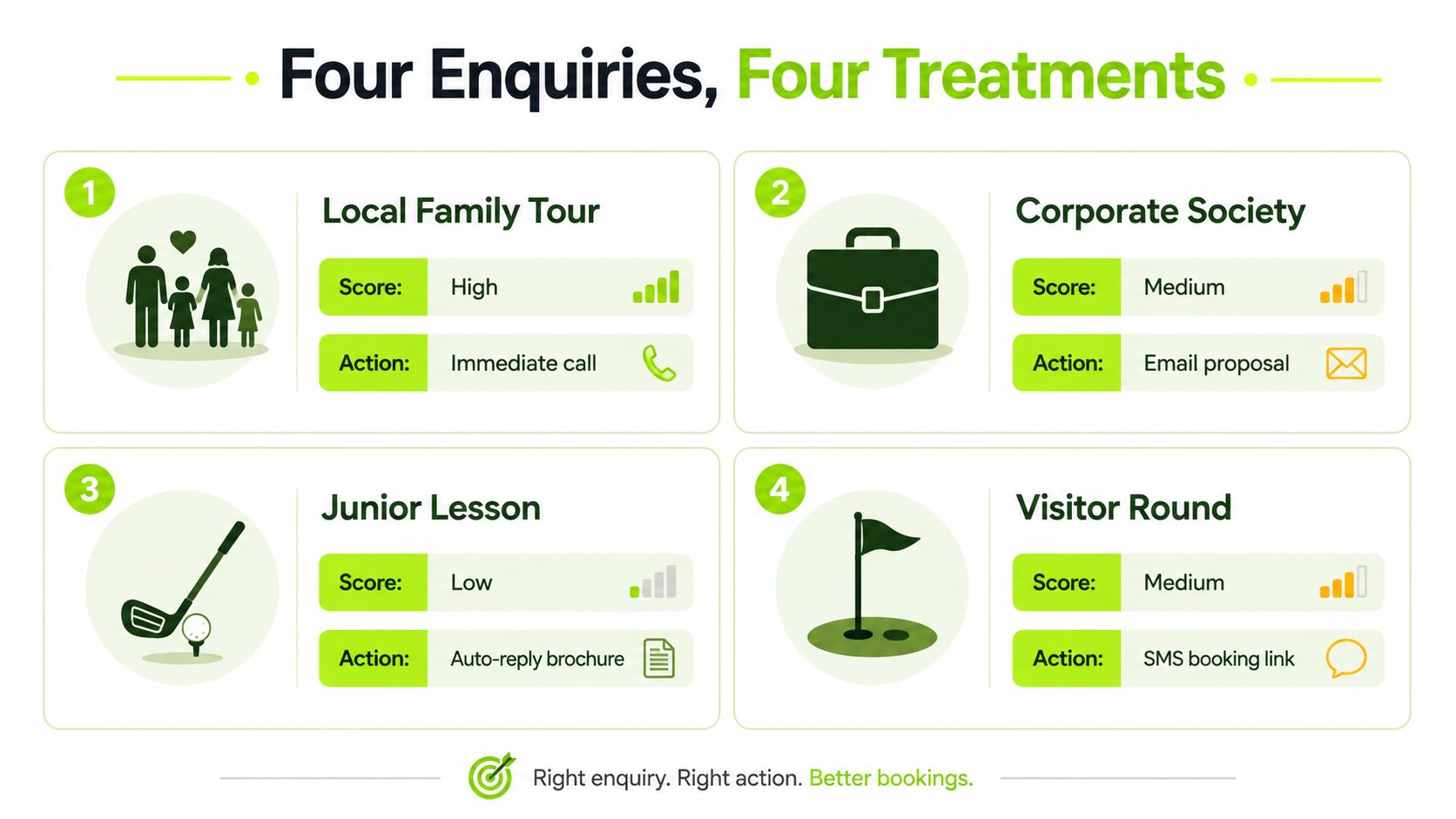
Four enquiries can arrive on the same day and look equally promising in a basic inbox. They shouldn't receive the same response.
A local couple asks for a family tour next Saturday, mentions two junior players and selects a membership category. This is a strong candidate for an immediate call because the household has declared fit, timing and a specific next action.
A visitor requests three tee times in six weeks. That person may not be a membership prospect at all, but the enquiry still has commercial value. Route it to the visitor booking path, with a clear link and a human response if the request needs availability checking.
A society organiser asks about 20 places next month. The club needs to provide group availability, package information and deposit details. The organiser may still be comparing venues, so an email proposal can be more appropriate than a membership call.
A nearby resident downloads a membership guide without selecting a visit date. That person may fit the club, but the available evidence points to education first. Send useful information and invite a low-friction conversation rather than treating the download as sales readiness.
A practical scoring illustration
A simple model might award:
- 20 points for a requested tour or visit.
- 15 points for a join date within 30 days.
- 10 points for selecting an appropriate membership category.
- 10 points for a valid postcode or sensible travel radius.
- 10 points for household or group relevance.
- 5 points for email engagement.
- Deductions where an overseas location makes local membership unsuitable or the timeline falls beyond the club's active sales window.
A total of 40 or more could trigger sales-qualified treatment, while 20 to 39 could trigger nurture. These are working thresholds for the example, not universal rules. The club should adjust them against its own conversion records and keep the score limited to observable behaviour and declared intent.
Human review still matters: Committee approval, joining eligibility and course capacity aren't points. They remain decisions for people with the right authority.
The household detail deserves particular attention. A membership decision may involve a spouse, children or another family member, so one form-fill doesn't always represent the whole buying group. Ask who will play, who needs to visit, and what the household wants from membership before assuming the individual contact is the sole decision-maker.
A reusable response can stay simple:
“You enquired about [interest] for [date]. Would you prefer a tour, a callback or an information pack?”
For clubs refining this approach, lead qualification marketing offers useful context on connecting qualification with the wider customer journey. GolfRep also explores how AI lead qualification can support golf clubs without replacing the personal decisions that matter.
Common Mistakes That Quietly Kill Conversion
Clubs rarely lose membership enquiries through one dramatic failure. More often, small informal habits create a series of delays and omissions.
Treating every enquiry identically is the first leak. A membership tour request, a visitor booking question and a generic guide download need different responses. When staff use one standard reply for all three, the highest-intent prospects wait while low-intent contacts receive attention they don't need.
Letting committee review delay the first response creates another problem. A committee may need to approve eligibility or an exception, but it doesn't need to delay an acknowledgement, a clarification question or a suitable booking option. A prospect shouldn't wait beyond the club's response window because the final decision requires governance.
Assigning follow-up to whoever has inbox capacity means nobody owns the opportunity. The responsible person should appear in the CRM, with a next action and an escalation route. Without that, the enquiry can be read by several people and acted on by none.
The data problems behind the visible delay
Skipping CRM logging leaves valuable context in individual memories. Another staff member then repeats questions, misses a previous promise or sends information that the prospect has already received. A visible record protects continuity when the secretary is away or a committee member changes.
Discounting can also distract clubs from the core problem. A relevant, timely answer often does more to move a prospect forward than an unplanned price reduction, especially when the enquiry failed because nobody responded or understood the request.
Finally, score thresholds shouldn't remain fixed forever. Membership categories, local demand, pricing, capacity and seasonal behaviour change. The club should review which signals lead to tours, visits and joining decisions, then adjust the rules when the evidence shows that the current model is sending the wrong people to staff.
Recent lead-conversion reporting identifies rapid follow-up as critical to 41% of companies, says only 39% use qualification criteria consistently, and lists collecting enough qualifying data as a leading challenge, according to the 2025 to 2026 State of Lead Conversion report. The lesson for a small club is practical: a simple, dependable response process can matter more than a complex scoring spreadsheet.
GolfRep helps clubs connect lead generation with structured follow-up, CRM visibility and automated nurture, so enquiries are captured, qualified and assigned instead of remaining in a shared inbox. Visit GolfRep to see how a golf-specific growth system can help your club build a more predictable pipeline from first enquiry to booked visit and membership conversation.
Ready to tap into our proven growth system?