Social media for golf clubs: A guide to predictable growth
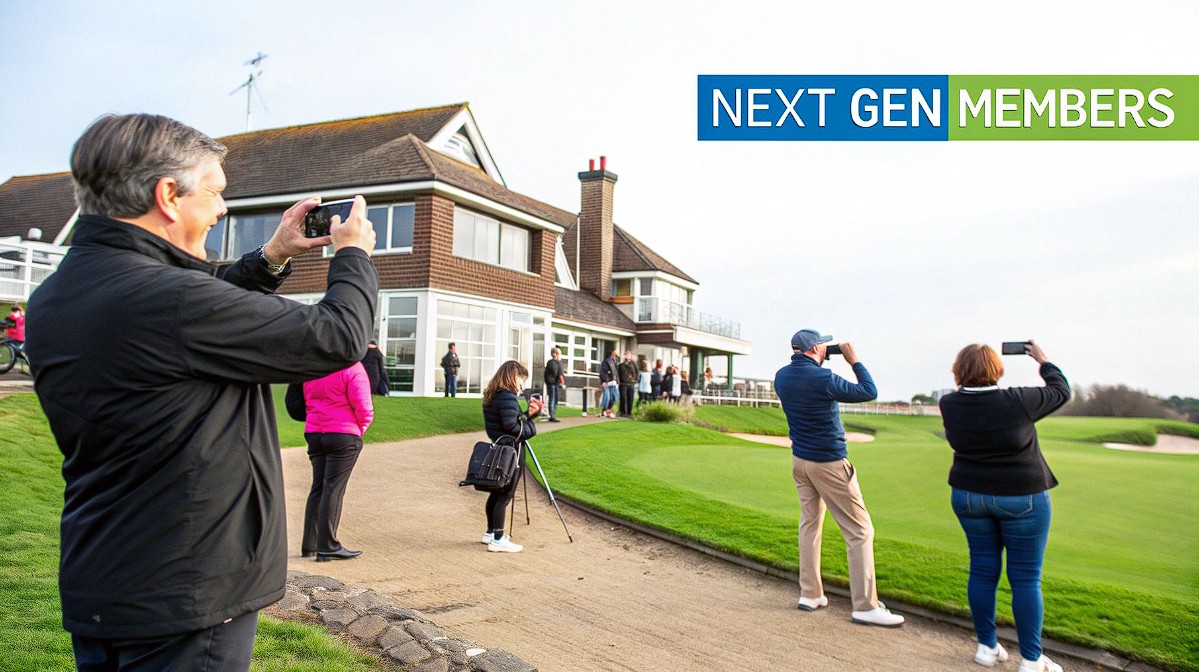
Social media is no longer a 'nice-to-have' for golf clubs; it has become a primary channel for connecting with the next generation of members. For decision-makers at UK golf clubs, a smart social media strategy is the first step towards building a predictable pipeline of enquiries and securing future revenue.
Why Social Media Is Essential for Golf Clubs
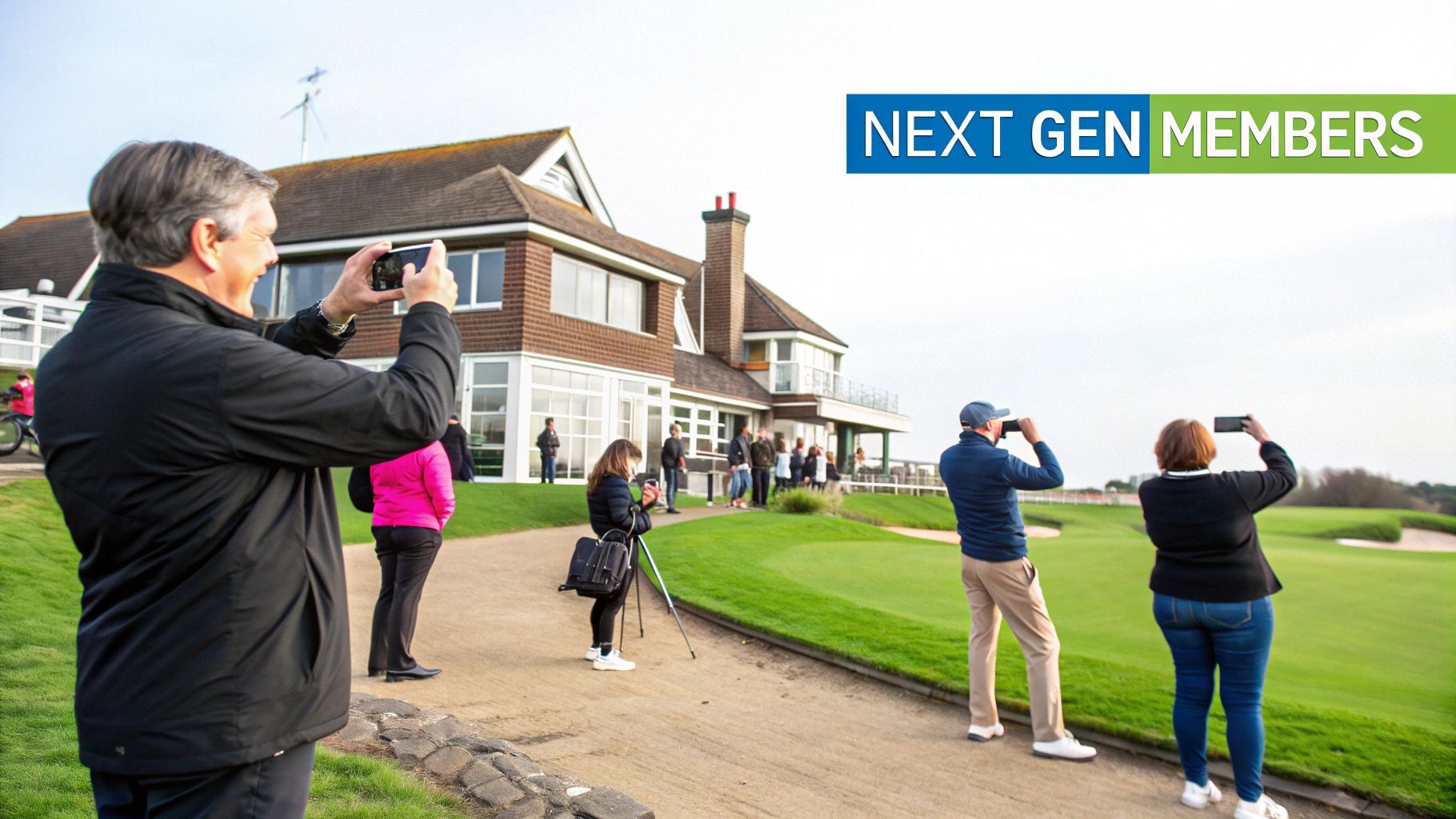
The conversation has shifted. It's no longer about simply ‘being online’. For golf clubs, social media now represents a direct, measurable line to your ideal members, societies, and corporate partners. Relying on traditional marketing or word-of-mouth is no longer sufficient.
Your future members are scrolling through Facebook and Instagram right now. If you’re not there to meet them, you are already falling behind clubs that are.
This isn't about chasing likes and followers. It’s about tapping into a significant and growing demand for golf content. The recent boom in golf participation was amplified by social media's influence. For example, Golf Monthly's video content generated 72.2 million views in a single year, proving there is a huge appetite for engaging digital content.
The Real Challenge Isn't Generating Enquiries
Many club managers believe the main goal of social media is to generate a high volume of enquiries. While getting attention is a good start, it's only the first piece of the puzzle. From our work with clubs across the UK, the biggest challenge is not a lack of interest; it's the struggle to handle, respond to, and convert that interest into new business effectively.
A powerful social media presence creates opportunities. But without a solid system to manage them, those leads often go cold.
Consider these common scenarios:
- Slow Response Times: A potential member messages your club on Facebook at 8 PM on a Friday. The message sits unread until Monday morning. By then, their initial excitement has faded, or worse, they've already contacted a rival club.
- Poor Lead Visibility: An enquiry from a social media ad lands in a cluttered general inbox and is quickly buried. It is effectively lost.
- No Follow-Up: Someone shows interest but isn't ready to join immediately. With no structured follow-up process, they are never contacted again.
These small operational gaps create major blockages in your membership pipeline.
The real power of social media is unlocked when it feeds a well-structured system. The goal is to create a predictable journey from a click on an ad to a new member, where every step is tracked and managed.
Ultimately, a strong social media presence is about more than posting attractive pictures of the 18th green. It is the fuel for a modern growth system that turns online interest into tangible revenue. You can learn more in our complete guide on developing a modern marketing strategy in golf.
Picking the Right Channels and Crafting Your Content
A common pitfall for golf clubs is trying to be everywhere at once on social media. Spreading efforts too thinly across multiple platforms results in a weak presence that fails to deliver. A successful social media strategy isn't about being on every channel; it's about making an impact in the right places.
For most UK golf clubs, the key platforms are Facebook, Instagram, and for specific purposes, LinkedIn. Each platform has a distinct audience and purpose. Simply copying and pasting the same content across all three is an inefficient use of time and resources.
Let Your Goals Dictate Your Platform
Before you post anything, you need to be clear on your objective. Are you looking for new members, trying to increase society bookings, or building relationships with local businesses for corporate events? Each goal points to a different platform and a different style of communication.
Facebook is your digital clubhouse. It's the ideal place to communicate with current members, share club news, and reach a broad local audience for open days or taster sessions. The events feature is particularly useful for promoting everything from the club championship to social functions.
Instagram is your visual portfolio. This is where you showcase the club's appeal. Use stunning photos of the course, videos of members enjoying the facilities, and behind-the-scenes content. It is your best platform for attracting a younger demographic and building an aspirational brand image.
LinkedIn is your corporate networking tool. It is not for daily updates but is incredibly valuable for connecting with decision-makers who book corporate golf days. It is the place to position your club as a premium venue for business and networking.
A smart content plan leverages each platform's strengths. A drone flyover of your 18th hole is perfect for an Instagram Reel. The detailed breakdown of a corporate membership package belongs on LinkedIn, targeted at local business owners.
The real aim isn't just to post content. It is to create a specific experience for a specific audience on the platform where they are most receptive. A one-size-fits-all approach is ineffective.
The Platform and Content Matrix for UK Golf Clubs
To simplify this, here’s a breakdown of which platform to use for what, who you'll reach, and what content works best. This is a strategic guide for getting the right message to the right people.
This matrix helps you focus your efforts where they will have the greatest impact, ensuring you are not just making noise but achieving your business goals.
Content That Connects
Once you know where you’re posting, the focus shifts to what you’re posting. Your social media feed cannot be a relentless sales pitch. It needs a balanced mix of posts that promote, educate, and build a sense of community.
We advise clubs to think in terms of content "pillars" that represent the best of what they offer:
The Course: This is your core product. Showcase it with professional photos, drone footage, and short clips of signature holes. Highlight its seasonal beauty and condition.
The People: Your club is defined by its people. Share member spotlights, interview your PGA pro, or post a "day in the life" of your greenkeeping team. This builds genuine community.
The Experience: It’s not just about the 18 holes. Show the quality of the food, the social events, and people enjoying the terrace. Showcase the full experience of being a member.
The Opportunity: This is your call to action. Promote membership packages, society deals, or open days. Always frame it around the benefits for the customer, not just a list of features.
This balanced approach creates an engaged following that is more receptive to promotional content. It is also how you tap into new markets. For instance, the surge in women's golf in the UK has been fuelled by social media making the game appear more welcoming. By actively featuring female members and promoting ladies' coaching clinics, you can appeal directly to this growing audience. You can find more detail by reading the full report on golf participation in the UK.
Ultimately, success comes down to planning and consistency. Posting randomly will get you nowhere. A content calendar is essential. It allows you to plan ahead, achieve the right mix of content, and maintain a steady presence that keeps your club front-of-mind. This is how you turn social media from a chore into a reliable source of new business.
Building Your Lead Generation Funnel
Organic social media is effective for community engagement and brand building, but when you need a predictable stream of new members, a more direct approach is required. This is where a proper lead generation funnel, driven by paid advertising, comes into play. It’s how you turn casual online interest into qualified, actionable enquiries.
A common mistake is simply ‘boosting’ posts. While this may increase visibility, it lacks the precision and control needed for consistent results. A well-structured paid campaign allows you to target specific segments of your local population with a tailored message.
Moving Beyond Boosting Posts
Effective social media advertising for a golf club is about precision. Platforms like Facebook and Instagram have powerful targeting tools that let you reach potential members based on specific criteria. This is not about broadcasting to the masses; it's about delivering the right offer to the right person at the right time.
For instance, you can build audiences based on:
- Location: Targeting people within a 10-15 mile radius of your club ensures your ad spend is focused on those who can realistically join.
- Interests: Reaching individuals who have shown an interest in golf, follow major brands like Titleist or TaylorMade, or engage with rival local courses.
- Demographics: Pinpointing specific age groups and income brackets that align with your ideal member profile.
This level of detail means you stop wasting money on people who will never visit your club. Every pound is invested in reaching those most likely to convert, which transforms your return on investment.
A simple yet effective process underpins any successful campaign, moving from initial strategy through to active community engagement.
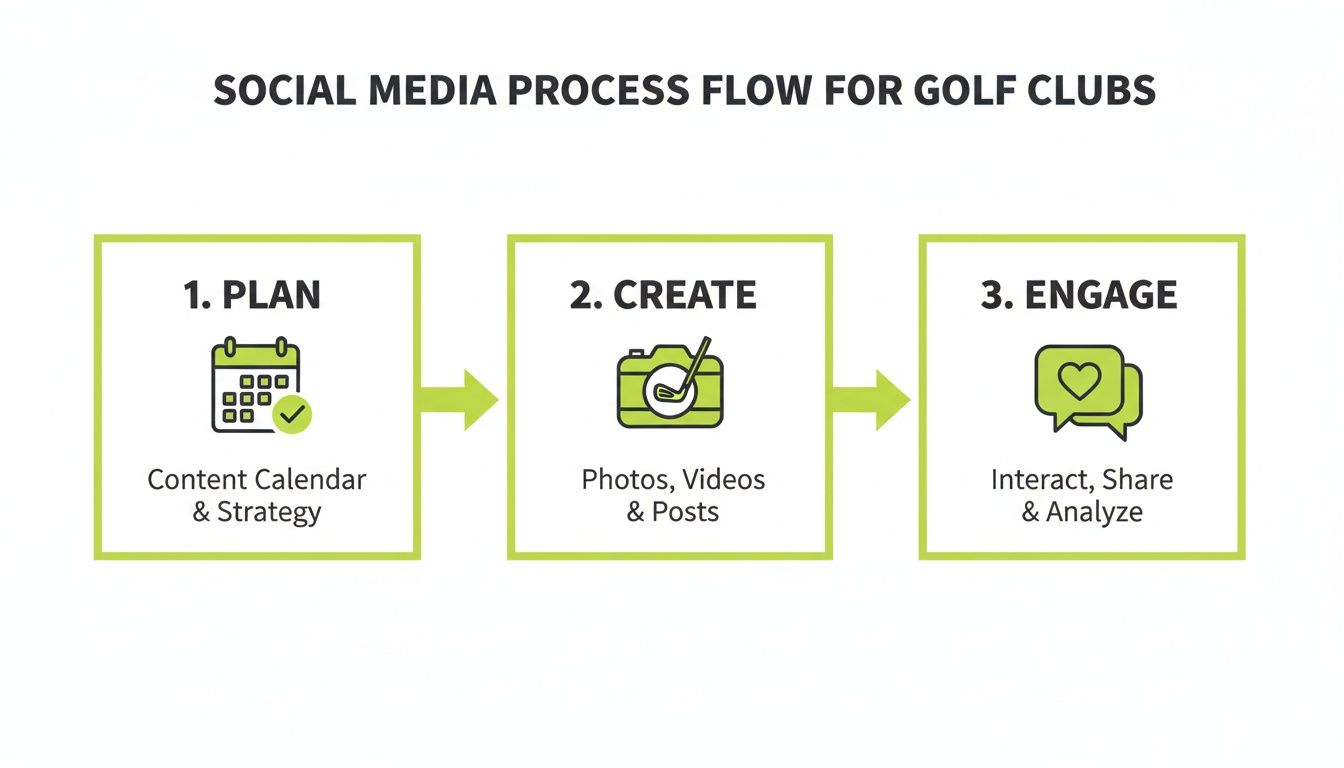
This flowchart highlights a key point: a great outcome always starts with a solid foundation of careful planning, high-quality content, and responsive management.
The Anatomy of a High-Performing Ad
A successful ad is a carefully constructed tool designed to stop someone scrolling and persuade them to act. Every element has a critical role.
The Image or Video: This is your hook. It must be high-quality and evocative, selling the experience of your club. A stunning drone shot, a short video of members on the terrace, or a professional photo of your practice facilities all work well.
The Headline: Be direct and focus on the benefit. Instead of a flat "Membership Available," try "Your Search for the Perfect Golf Membership Ends Here" or "Experience the Best Greens in Berkshire." You have seconds to grab attention.
The Ad Copy: Keep it concise and focused on what a potential member gains. Talk about the community, course conditions, or exclusive member events. Use bullet points to make key benefits easy to scan.
The Call to Action (CTA): This must be clear. Use strong, action-oriented phrases like "Download Our Membership Brochure," "Book a Club Tour," or "Discover Membership." The CTA tells them exactly what to do next.
The most crucial part of this process is what happens after the click. An ad that generates hundreds of leads is useless if those leads are not managed effectively. The purpose of the ad is to be the first step in a larger, systemised process.
This is where the real work begins. An enquiry needs to be captured instantly, not in a spreadsheet or a messy inbox, but directly into a CRM (Customer Relationship Management) system. This should trigger an immediate, automated response to confirm receipt of their details. This single step can be the difference between a warm lead and a lost opportunity.
While setting up a full campaign can seem complex, you can find more information on how different golf marketing services combine to build these kinds of systems.
Paid social media is the engine that fills the top of your funnel. It gives you control, predictability, and a direct line to your ideal future members. But it only works when plugged into a robust back-end system designed to handle and convert the interest it generates.
Connecting Enquiries to Conversions
Generating enquiries from a social media strategy is a positive first step. But this is where most clubs encounter problems. The real bottleneck holding back membership growth is not a lack of interest; it is the breakdown in process after someone expresses that interest.
An enquiry represents a moment of peak curiosity, but that moment is fragile.
Too many clubs still use manual methods to handle these opportunities. A potential member’s details might land in a general manager's inbox, sit unread over a weekend, or get lost in a spreadsheet. With every hour that passes, the chance of converting that person into a member decreases significantly.
This is the critical difference between getting leads and building a predictable pipeline for growth. Social media creates the opportunity; a solid system turns that opportunity into revenue.
The Real Cost of a Slow Response
Nothing damages a potential sale more than a slow response. When someone fills out a form after seeing a Facebook ad, they expect a quick reply. They have a problem they want to solve, whether that’s finding a new club or booking a society day.
If your club is the first to respond professionally, you immediately position yourself as the best solution. A delay of hours, let alone days, sends a clear message: their enquiry is not a priority.
Consider this common scenario:
- Friday, 7 PM: A keen golfer sees your Instagram ad and submits an enquiry for a flexible membership.
- The Weekend: The enquiry sits in a general inbox. The office is closed.
- Monday, 11 AM: Someone checks the emails and forwards it to the membership secretary.
- Monday, 3 PM: The secretary replies after catching up on other tasks.
Nearly 72 hours have passed. The prospect has either lost interest or has already booked a tour at a rival club that replied within minutes.
A lead that receives a response within five minutes is exponentially more likely to convert than one that waits even 30 minutes. Manual processes cannot consistently achieve this speed.
Swapping Manual Chaos for Systemised Control
The solution is to replace unreliable manual processes with an automated, systemised approach. This is not about removing the personal touch. It is about using technology to handle the initial, time-sensitive tasks, freeing up your team to focus on giving club tours and welcoming new members.
A modern system ensures every enquiry is handled perfectly, every time.
- Instant Acknowledgement: The moment an enquiry is submitted, it is captured in a central CRM. An automated email and SMS are sent instantly, thanking them and setting expectations.
- Internal Notification: Key staff get an immediate notification, providing full visibility without needing to monitor an inbox.
- Structured Nurturing: The system can then begin a sequence of automated, personalised follow-ups, keeping your club top-of-mind and encouraging the prospect to book a visit.
This is the systematic approach we used to help Addington Palace build a steady, predictable pipeline. By ensuring every lead was contacted instantly and nurtured correctly, we prevented enquiries from falling through the cracks, resulting in consistent growth.
Turning Independent Golfers into Members
Systematic follow-up is especially crucial for capturing the booming market of independent golfers. Reaching this group in the UK is all about smart digital engagement. According to England Golf, over 55,000 independent golfers in England now use iGolf. These players, all with official handicaps, represent about 7 percent of all golfers with a WHS index. They are a huge, untapped source of potential members for clubs that know how to connect with them. You can find more detail on this evolving market on the GCMA news site.
These golfers are digitally savvy and expect fast, professional communication. A slow, manual follow-up is ineffective. They are actively looking for a club but will not wait for a reply. An automated system that engages them instantly is the best tool for turning their interest into a club tour and a new membership.
Gaining Visibility from Click to Conversion
Perhaps the biggest flaw in a manual system is the complete lack of visibility. When enquiries are scattered across different inboxes and spreadsheets, it’s impossible to get a clear picture of what is working. You cannot answer basic questions:
- How many enquiries did our last Facebook campaign generate?
- How many of those booked a tour of the club?
- How many of those tours resulted in a new member?
- What is our true cost to acquire one new member?
Without that data, you are making decisions without full information. A CRM-based system solves this by tracking the entire journey, from the first click to the final conversion. You can see precisely which ads are bringing in the best leads and how well your team is converting them.
This conversion tracking provides the clarity needed to refine your strategy and allocate your budget effectively. For clubs like Bidston, this visibility was transformative, allowing us to double their membership by focusing on what we could prove was working.
Measuring Your Social Media ROI

Likes, comments, and follower counts are nice to see, but they do not contribute to the bottom line. For your social media strategy to be more than a branding exercise, it must deliver a measurable return on investment.
This means shifting focus from surface-level ‘vanity metrics’ to the numbers that actually impact your club’s revenue. A data-led approach is the only way to know precisely what it costs to generate an enquiry, book a tour, and sign up a new member. Without that clarity, you are simply guessing with your marketing budget.
From Vanity Metrics to Pipeline KPIs
To prove the value of your social media efforts, you must track the entire journey, from the moment a potential member clicks an ad through to their first membership payment. Trying to manage this with disconnected spreadsheets is inefficient and prone to error.
The only effective way to connect the dots is with a central CRM system.
When every lead flows into one place, you can finally track the key performance indicators (KPIs) that matter. These are not superficial social stats; they are hard commercial metrics that provide a clear picture of marketing performance.
Here’s what you should focus on:
- Cost Per Enquiry (CPE): Your total ad spend divided by the number of enquiries received. It tells you exactly how much you’re paying to start a conversation.
- Cost Per Tour Booked (CPT): This metric shows the cost to get a qualified prospect to visit your club. It is a great indicator of lead quality.
- Cost Per New Member (CPNM): This is the ultimate metric. It’s the total marketing cost to acquire one new paying member, giving you a definitive ROI figure.
Monitoring these KPIs helps you learn what is working. For example, an Instagram campaign might have a low CPE, but if the CPT is high, it is likely attracting the wrong audience. This insight allows you to adjust targeting for better results.
Measuring what matters transforms your marketing from a cost centre into a strategic investment. When you can show that every £1 spent on ads generates £10 in membership revenue, justifying the budget becomes a simple business case.
A Simple Reporting Framework for Club Managers
Data can be overwhelming. The goal is not to get lost in charts, but to have a clear, simple report that gives you an at-a-glance view of your membership pipeline. This enables quick, informed decision-making.
A practical report for a club manager or committee should focus on the conversion rates at each stage of the funnel. You can see how we've put this data-driven approach into action by exploring some of our golf club growth case studies.
To make it easy, here’s a breakdown of the essential metrics you need to track.
Key Performance Indicators for Social Media Success
This table outlines the core metrics that reveal the business impact of your social media marketing. It moves beyond vanity stats to focus on what drives revenue.
By consistently monitoring these four core numbers, you gain transparent visibility over your entire growth engine. This data proves the value of a systemised marketing approach and gives you the confidence to invest in strategies that deliver predictable, sustainable growth for your club.
Answering the Tough Questions
We’ve laid out the strategy, the systems, and the metrics. But there are still practical questions that club managers, committees, and owners often raise about time, money, and results.
Let’s address them directly.
What’s a Realistic Social Media Ad Budget for a Golf Club?
There is no single magic number, as it depends on your club’s goals and local competition. However, as a starting point, most private members' clubs should consider a budget in the range of £500 to £1,500 per month for paid advertising.
This figure allows you to consistently reach the right local audience, run enough tests to identify effective adverts, and gather meaningful data.
Think of it as a scalable investment. Once you can show a clear return by tracking your cost to acquire a new member, you can confidently increase that budget, knowing every pound spent is generating revenue.
How Much Time Will This Actually Take to Manage?
Time is a major concern for already busy club staff.
If you attempt to do everything manually, posting on the fly, replying to messages, and tracking leads in a spreadsheet, it can easily consume several hours a week with inconsistent results. This is not a sustainable approach.
The key is to systematise. By using tools to schedule content and, critically, having an automated system to capture and follow up with new enquiries, you invest the work upfront. Once that system is in place, daily management becomes highly efficient. The technology handles repetitive tasks, freeing up your team to focus on giving club tours and talking to potential members.
How Do I Prove This is Working to My Committee?
The only way to get buy-in is to shift the conversation from subjective metrics like "likes" and "shares" to clear commercial results. You need to present a simple report that draws a straight line from social media activity to the club's revenue.
Your report should focus on just three things:
- Cost Per Enquiry: How much did we spend to get someone to show interest?
- Cost Per Tour Booked: What did it cost to get an interested person to visit the club?
- Cost Per New Member: What was the final cost to sign up a new paying member?
When you can stand in front of the committee and say, "We spent £1,000 on Facebook ads last month, which directly led to three new full members and £4,500 in first-year revenue," the conversation changes. It is no longer about opinion; it is about undeniable, data-driven proof of success.
At GolfRep, we build these predictable growth systems for clubs across the UK, turning social media interest into long-term members. We combine targeted advertising with robust CRM and automation to ensure no lead is ever missed. Discover how our approach can deliver consistent, measurable growth for your club. Find out more at GolfRep.
Composed with the Outrank tool
Ready to tap into our proven growth system?