Modern Marketing in Golf: A Guide to Predictable Growth

Effective marketing in golf is not about drumming up more enquiries; it is about systematically converting the interest you already generate. For most UK golf clubs, the real bottleneck is not a lack of potential members. It is a slow, disjointed follow-up process that lets promising leads go cold and disappear.
The Real Challenge in Modern Golf Club Marketing

Does this sound familiar? Your club receives a steady stream of membership enquiries, but only a tiny fraction of those people ever become paying members. If so, you are not alone. This gap between initial interest and final conversion is the single biggest obstacle to growth for the majority of golf clubs today. Many clubs pour money into advertising or social media, celebrate the influx of leads, and then watch as that potential withers.
This is a classic case of the 'leaky bucket' syndrome. Your marketing efforts are doing a great job of pouring water (leads) into the bucket. The trouble is, holes in your follow-up process mean most of it leaks right back out before you have a chance to capture it. These 'holes' are almost always procedural weaknesses.
Where Potential Members Are Lost
The problem is rarely a lack of effort from your team. It is almost always a reliance on manual, inconsistent processes to manage something that demands speed, structure, and persistence. Potential members are typically lost for a few common reasons:
- Slow Enquiry Response Times: A prospect's excitement is at its peak the moment they reach out. A delay of just a few hours can kill that momentum as they start looking at other clubs or lose interest entirely.
- No Systematic Follow-Up: A single email or a missed phone call is not a sales process. Without a structured sequence of communications, leads are quickly forgotten amidst the day-to-day work of running a busy club.
- Poor Lead Visibility: When enquiries are scattered across different email inboxes, scribbled notes, and social media messages, it is impossible to get a clear picture of your pipeline. You cannot manage what you cannot see.
- Inconsistent Communication: Different staff members might give out slightly different information or follow up in completely different ways. This creates a disjointed and unprofessional experience that undermines a prospect's confidence.
The current boom in UK golf presents a monumental opportunity. But it will only be captured by clubs that have the operational systems in place to handle the demand effectively. Relying on outdated, manual methods during a period of high interest is a recipe for missed growth.
This guide is designed to move you beyond simple advertising tactics. It is a strategic framework for plugging the leaks in your membership process and building a predictable engine for growth. We will show you how to stop losing the leads you are already generating and turn fluctuating interest into a reliable pipeline of new members. The focus is on implementing robust systems, because sustainable growth is built on solid processes, not just hopeful campaigns.
From Getting Leads to Managing a Pipeline
If there is one fundamental shift every successful golf club needs to make in its marketing, it is this: stop thinking about just getting enquiries and start thinking about managing the entire journey. For years, the focus has been on that first step, but collecting names without a clear, repeatable path to turn them into members is like filling a bucket with a hole in it.
Think of it like an assembly line. Piling up raw materials (your leads) at the beginning is pointless if the machinery, your follow-up, sales, and onboarding process, is clunky or broken. The real goal is not just to have a big pile of enquiries; it is to build a smooth, predictable system that turns those enquiries into loyal, paying members.
This is where the concept of a sales pipeline comes in. It is not just jargon; it is a framework that forces you to map out every single step a potential member takes, from their first click to their first tee time.
Why Manual Processes Are Holding You Back
So many clubs are still trying to manage this critical process with tools that are just not up to the job. We have all seen it: a spreadsheet on the manager's laptop, a notepad behind the pro-shop counter, or a messy shared email inbox. In today's market, these methods are simply destined to fail.
Here is why those old habits are so damaging:
- No Centralised View: The information is everywhere and nowhere at the same time. This lack of lead visibility makes it impossible to see the big picture, and it is the number one reason promising enquiries get forgotten.
- Inconsistent Follow-Up: When everything depends on one person's memory, follow-up is erratic at best. What happens when they are swamped, on holiday, or leave the club? The entire system grinds to a halt.
- Zero Accountability: You cannot improve what you do not measure. Without proper conversion tracking, you have no idea how long it takes your team to respond, how many follow-up attempts are being made, or which of your marketing efforts are actually bringing in the best prospects.
A structured pipeline fixes this. It creates a defined, repeatable, and measurable process for every single person who shows an interest in your club.
A pipeline is not just a marketing buzzword; it is essential infrastructure for predictable revenue. It transforms your growth efforts from a game of chance based on manual effort into a structured system that delivers consistent results.
The table below breaks down the fundamental difference in mindset between old-school marketing and a modern pipeline approach.
Traditional Marketing vs. Pipeline Management
This shift from a simple "lead-gen" mentality to a full pipeline strategy is what separates clubs that struggle from those that achieve consistent, predictable growth.
Building a System That Actually Works
So, what does managing a pipeline look like in practice? It means breaking down the membership journey into clear, distinct stages. While your club's exact stages might vary, you will typically track a prospect as they move from an initial enquiry, to a tour, to a membership offer, and finally, to a fully onboarded member. The key is defining exactly what action needs to happen at each stage to push them to the next one.
This systematic approach also unlocks smarter financial decisions. Many clubs waste a significant chunk of their marketing budget simply because they cannot connect the dots between their spending and the results. For instance, recent analysis in our latest industry report found that many clubs struggle with high advertising costs for minimal return.
These numbers reveal a massive opportunity for clubs that adopt a more data-led strategy. By understanding which channels deliver prospects who actually move through your pipeline, you can eliminate wasted spend and dramatically improve your return on investment. If you are interested in the details, you can find out more by reading the full UK golf marketing benchmark report.
Ultimately, managing a pipeline is about taking control. It is the difference between crossing your fingers and hoping new members show up, and building a reliable engine that produces them, month in and month out. It is time to move away from the manual chaos and towards the clarity and efficiency that a well-oiled system provides.
The Four Pillars of a Predictable Growth System
Moving away from a reactive, 'hope for the best' marketing style is the first step toward predictable growth. A truly effective growth engine is not about doing one thing well; it is about having several interconnected parts working in harmony. For golf clubs, this entire system can be built on four essential pillars.
These pillars give you the framework to stop just generating random interest and start building a reliable pipeline of new members. Each one tackles a crucial stage of the member acquisition journey, making sure no lead ever slips through the cracks.
Pillar 1: Targeted Attraction
The first pillar is all about getting in front of the right people. Too many clubs waste their marketing budget by simply boosting social media posts, hoping that a potential member will see it. Targeted attraction is the opposite. It is a data-led strategy, using platforms like Google and Facebook to find and engage your ideal local golfer with precision.
This means you get specific about who you want to attract, their age, where they live, what they are interested in, and even their online habits. When you do this, every pound you spend on marketing is focused on prospects who are genuinely likely to be interested in what your club offers. This immediately boosts the quality of your enquiries.
Pillar 2: Instant Qualification
As soon as a potential member shows interest, the clock starts ticking. Pillar two is about engaging them in that exact moment. A delay of just a few hours can be the difference between signing up a new member and losing them to a competitor because their interest has faded.
This is where automation is a game-changer. Using tools like automated SMS responses means every single enquiry gets an immediate, professional reply. This first touchpoint can qualify their interest, answer basic questions, and guide them to the next step, all without a staff member having to constantly watch an inbox. It ensures your club looks responsive and professional, ready to capture interest at its peak.
The journey from initial lead to committed member involves several drop-off points, as this pipeline infographic shows.
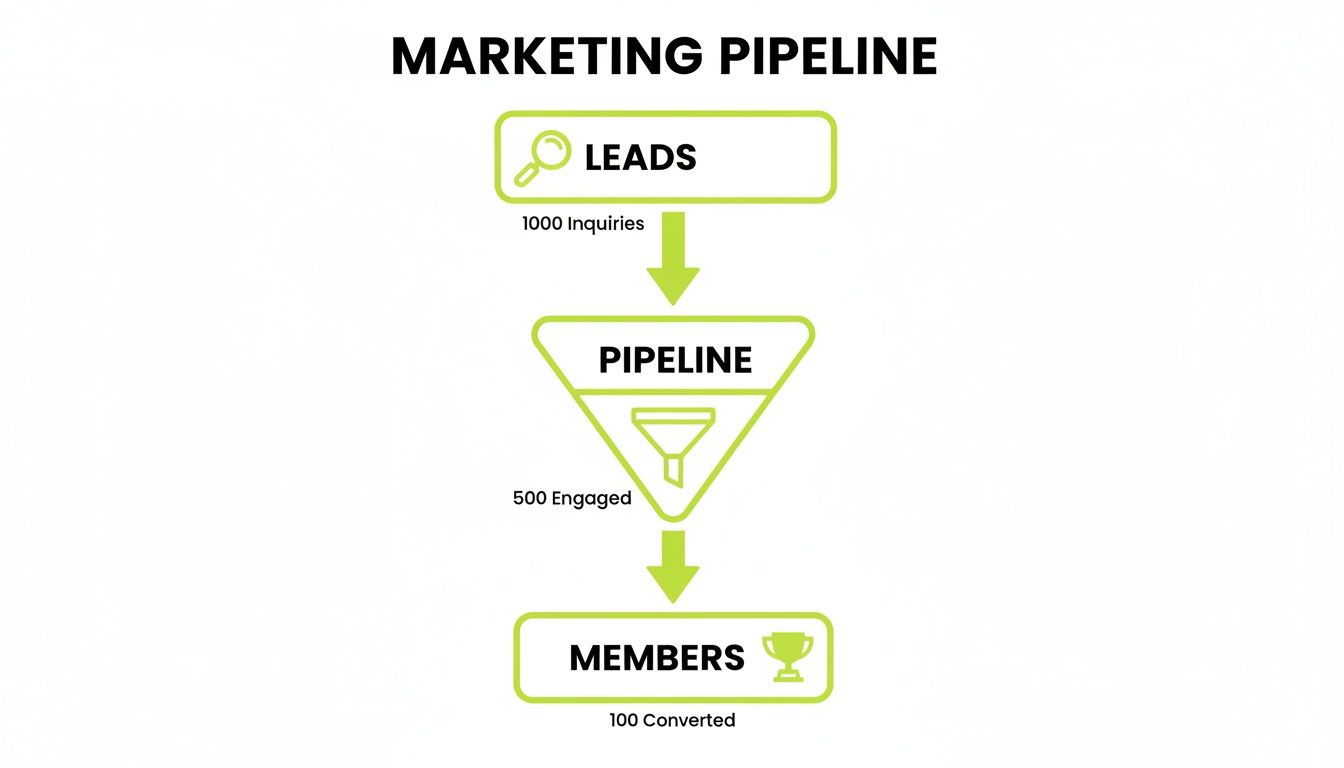
This flow highlights just how important it is to make each stage as efficient as possible to avoid losing valuable prospects along the way.
Pillar 3: Structured Nurturing
An initial enquiry is just the start of the conversation, not the end. The third pillar focuses on systematically nurturing that early interest over time. Think of a Customer Relationship Management (CRM) system as the central brain of your whole growth operation, making sure no lead is ever forgotten or left to go cold.
A good CRM allows you to track every interaction with a prospect and automate personalised follow-ups. Whether it is an email series showcasing the benefits of membership or an SMS reminder about an upcoming tour, the system handles the communication consistently. This frees up your team from endless manual chasing and ensures every potential member gets the right message at the right time, keeping your club top of mind. For a closer look at this in action, check out our guide on implementing 7-minute growth systems.
This kind of structured approach is essential right now. Participation in the sport is growing, creating a huge opportunity for clubs that have the right systems in place.
Pillar 4: Transparent Measurement
Finally, you cannot improve what you do not measure. The fourth pillar is about tracking every step of the journey, from the first ad click to the final membership payment. This gives you complete transparency into what is actually working.
A predictable system provides clear data on what is working and what is not. It replaces guesswork with evidence, allowing you to invest your time and budget where it will have the greatest impact on your club's growth.
With transparent measurement, you can finally answer those critical questions: Which marketing channels bring us the best leads? What is our true cost to acquire a new member? Where in our process are we losing the most people? This data-driven feedback loop is what turns a decent marketing strategy into a brilliant one, delivering a clear and undeniable return on your investment.
How to Capitalise on the Current Golf Boom
The frameworks we have been exploring are not just theory. They are the practical tools you need to grab the unprecedented opportunity in UK golf right now. The game is enjoying a massive, sustained surge in popularity, which means there is a huge pool of potential new members out there.
But this boom is a double-edged sword.
For clubs with efficient systems in place, this wave of interest is a golden ticket to building a predictable and profitable future. For those still stuck with manual processes and spreadsheets, it is a genuine threat. They risk being swamped by enquiries they simply cannot handle, leading to frustrated golfers, a bruised reputation, and a colossal missed opportunity.
An Opportunity Measured in Rounds Played
The numbers tell a compelling story. People are not just playing more golf; the growth is accelerating. This is not a fleeting trend but a clear sign of a deep and renewed passion for the game across Great Britain.
Recent data has shown a significant jump in rounds played compared to previous years. This translates directly into more traffic at your club. You can explore the latest golf participation statistics to see the full breakdown for yourself.
This constant flow of players means you have potential members walking through your doors or visiting your website daily. The real question is: is your club set up to turn that casual interest into a long-term commitment?
Turning Data into Members
Every online tee time booking and every score submitted is far more than just a record of play. It is a vital piece of data. Clubs that grasp this can finally move beyond generic, scattergun marketing and start building targeted campaigns that speak directly to what individual golfers actually do.
This data allows for some incredibly powerful segmentation. For instance, you can easily identify:
- Frequent Visitors: These are the players booking multiple green fees a month but who have not yet joined. They are, by far, your warmest leads for a membership conversation.
- Lapsed Players: Golfers who used to play regularly but have not booked a tee time in months. A well-timed, targeted re-engagement email could be all it takes to bring them back.
- Weekend Warriors: The players who stick exclusively to Saturdays and Sundays. They could be the perfect audience for a flexible or weekend-specific membership package.
By simply using the data you already collect, you can craft specific offers and messages that connect far more deeply than any one-size-fits-all approach ever could.
The current boom means the leads are already there. The challenge is no longer about finding golfers; it is about implementing a system that ensures you engage, nurture, and convert them before a competitor does.
The Real Cost of Inefficiency
Without a system to manage this flood of interest, the opposite of growth happens. Enquiries get missed. Follow-ups are forgotten. The potential member's initial excitement simply evaporates.
Remember, each lost lead is not just one missed membership fee. It is the loss of all potential secondary spend from that person and their entire network of friends and family for years to come.
A slow or non-existent response sends a clear message to a prospective member: your club is disorganised. In a competitive market, that first impression is everything. A structured system, driven by a CRM and smart automation, guarantees that every single enquiry gets a prompt, professional response, instantly setting your club apart from the rest. This is how you turn a temporary boom into a reliable pipeline that secures your club's financial health for the long term.
Your Practical Roadmap to a Better System

Understanding the theory behind a growth system is one thing. Putting it into practice is another challenge altogether. The good news? You do not need to rip up your entire operation and start from scratch overnight.
Instead, think of this as a series of deliberate, practical steps. This roadmap is designed to help busy club managers, secretaries, and committee members move from a manual, reactive model to one that is far more predictable and efficient, without getting lost in technical jargon. It all starts with a simple, honest look at what is really happening inside your club right now.
Step 1: Audit Your Current Process
Before you can build something better, you have to understand what you have now. The goal here is to map the complete journey of a membership enquiry, from the very first contact to the final decision. This exercise is often an eye-opener, revealing surprising bottlenecks and points of friction that are quietly costing you members.
Start by asking some straightforward questions:
- Who is the first point of contact? Is it the club manager, a receptionist, or the team in the pro shop? Crucially, is there a single person responsible for all enquiries?
- How quickly do we actually respond? Be honest. Time your team's response to an email or a form submission. Is it a matter of minutes, hours, or sometimes even days? This is your enquiry response time.
- How is the enquiry tracked? Is it logged in a spreadsheet, jotted on a notepad, or just left in an email inbox?
- What does the follow-up look like? Is there a defined sequence of emails or phone calls, or is it left entirely to individual initiative and memory?
Mapping this out exposes the weak spots. You will likely find that a lack of clear ownership and a reliance on memory are the main reasons that promising leads go cold. This audit gives you the blueprint for what needs fixing first.
Step 2: Choose the Right Technology
A spreadsheet is not a growth system. To build a reliable pipeline, you need technology that is actually designed for the job. A Customer Relationship Management (CRM) system is the engine that will power your entire process, providing the structure and automation needed to manage enquiries properly and at scale.
When you are looking at technology, do not get distracted by a long list of flashy features you will never use. For a golf club, the most critical functions are very specific.
A CRM is not just a digital address book. It is a system that ensures every single potential member gets prompt, professional, and persistent follow-up. It transforms your club’s ability to turn genuine interest into tangible revenue.
Your chosen system needs to excel at these core tasks:
- Centralised Lead Management: All enquiries, from your website, social media, and phone calls, should automatically feed into one central database. This gives you complete lead visibility.
- Automated Follow-Up: The system should trigger instant responses and schedule a sequence of follow-up emails and text messages automatically. This is a structured follow-up system.
- Clear Pipeline Tracking: It must let you see exactly where every prospect is in their journey, from 'New Enquiry' to 'Tour Booked' to 'Member'. This is conversion tracking.
Step 3: Define and Position Your Offer
The final piece of the puzzle is shifting your focus from price to value. So many clubs fall into the trap of using discounts as their main marketing tool. This not only devalues the membership but also tends to attract the wrong type of member, the one who will leave as soon as a cheaper offer appears elsewhere.
A robust system gives you the confidence to sell the experience.
Instead of leading with a discount, position your membership packages around the benefits and the community. Use your automated follow-up communications to tell stories about the club, highlight unique features, and showcase the social side of being a member. When a prospect feels a genuine connection to your club's culture and value, price becomes a much smaller part of their decision.
If you need guidance on structuring this approach, you can always schedule a call with our team to discuss a strategy that fits your club perfectly.
These three steps, audit, technology, and positioning, are the foundation of a modern, effective marketing strategy in golf. They move you away from guesswork and towards a predictable, reliable system for growth.
Building a Predictable Future for Your Club
If there is one clear takeaway from this guide, it is this: the road to sustainable growth for your golf club is paved with solid systems, not just occasional ad campaigns. The real challenge for most clubs is not a lack of interest from potential members. It is the struggle to properly handle, respond to, and convert that interest into new memberships.
Modern golf marketing has moved beyond simply finding leads. The new game is about building a well-oiled machine that expertly nurtures them from their first flicker of curiosity all the way to a signed membership agreement.
When you shift your club's focus from chasing individual enquiries to managing a complete pipeline, you create a predictable engine for growth. This is the crucial difference between clubs that just react to the market and those that confidently shape their own future. It is all about combining the right technology with a genuine understanding of the golfer's journey.
From Reactive to Proactive
A well-designed system gives your club the power to thrive, whether you are in the middle of a membership boom or a quiet spell. It takes the guesswork out of your marketing and replaces it with the confidence that comes from clear, data-driven decisions.
The key pieces of this puzzle are not complicated theories; they are practical tools for any forward-thinking club.
- Systematic Follow-Up: This ensures no potential member ever falls through the cracks.
- Centralised Tracking: Gives you a crystal-clear view of your entire sales pipeline.
- Automation: Guarantees you engage with prospects the moment their interest is at its peak.
Building a predictable future means moving away from a reliance on manual effort and hope. It is about implementing a growth framework that works tirelessly in the background, turning initial curiosity into long-term member loyalty and revenue.
The next step is to take an honest look at your own processes. Where are the leaks in your current approach? How could a more structured, system-driven strategy secure a more prosperous future for your club?
Seeing how other clubs have completely transformed their operations can provide a powerful blueprint. You can explore several real-world examples by reviewing our golf club growth case studies.
Answering Your Questions About a Modern Approach to Golf Marketing
Even with a solid plan, we know that shifting from traditional methods to a more systematic way of marketing can feel like a big leap. Over the years, we have had countless conversations with club managers, secretaries, and committees, and we have found the same practical questions tend to pop up. Let us tackle them head-on.
Is a CRM System Too Complex for Our Committee-Run Club?
This is probably the number one concern we hear, especially from clubs where a small team or a volunteer committee juggles everything. There is a common misconception that CRMs are huge, complicated corporate tools. In reality, the good ones built for clubs like yours are designed to be the opposite.
Think of it this way: the right system does not add complexity, it strips it away. It gets rid of the need for staff to remember who they promised to call back or to waste time digging through old email chains. Instead, you get a single, clear dashboard. Anyone on the committee can log in, see exactly where every enquiry stands, and pick up where someone else left off. It is all about saving admin time and making sure nothing falls through the cracks.
We Already Get Plenty of Enquiries. Why Do We Need a System for It?
It is a nice problem to have. Many clubs in popular spots feel this way. But the number of enquiries coming in can be a "vanity metric". It looks good, but it does not tell the whole story. The real question is, what is your conversion rate? How many of those enquiries actually turn into paying members? Without a system to track it, the honest answer is usually, "we are not entirely sure." And that is a risky place to be.
Investing in a proper system is not about getting more enquiries. It is about making the absolute most of the ones you are already getting. Every potential member who does not get a timely reply is lost revenue, plain and simple.
A structured process gives you conversion tracking, letting you see exactly where people are losing interest or dropping out of the process. It helps you find and plug the leaks in your bucket, turning the interest you already have into consistent, predictable income.
Is This Approach Only for Big Corporate Golf Resorts?
Absolutely not. While the big resorts definitely use these systems, we would argue it is even more important for private members' clubs. The corporate giants have massive marketing teams and budgets to throw at problems. A streamlined, automated system is what allows smaller clubs to punch well above their weight without needing a huge payroll.
The fundamentals, responding quickly, following up consistently, and measuring what works, are universal. They scale perfectly to fit any club. By letting technology handle the repetitive tasks, a good system allows a small team to manage a high volume of enquiries with the same polish and efficiency as a much bigger operation. It truly levels the playing field.
At GolfRep, we build the systems that turn interest into members. Our approach moves beyond simple marketing campaigns to create a predictable growth engine for your club, combining data-led advertising with automated follow-up to deliver measurable results.
Ready to see how a structured growth system can secure your club's future? Visit GolfRep to learn more about our partnerships.
Generated with Outrank tool
Ready to tap into our proven growth system?