A Modern Golf Club Marketing Strategy for Sustainable Growth
A successful marketing strategy for a modern golf club isn’t about chasing an endless stream of enquiries. It’s about building a robust system that turns genuine interest into long-term members. The real impact is made when you pair targeted lead generation with automated, immediate follow-up, ensuring no potential member ever slips through the cracks. This is how you create a predictable pipeline for sustainable growth.
The Problem with Traditional Golf Club Marketing

For too long, golf clubs have measured their marketing success with a single, flawed metric: the number of new membership enquiries. Many clubs operate on the assumption that if they just get more leads, they will automatically get more members. While it sounds logical, this approach usually creates a bigger headache, leaving staff swamped by a flood of enquiries they simply don’t have the time to manage properly.
The real challenge for most clubs isn't generating interest from potential golfers. The problem lies in that crucial gap between the initial enquiry and a signed-up member.
Shifting Focus from Enquiries to Conversions
A truly effective marketing strategy accepts that the hard work begins after someone asks about membership. This is where most clubs fall down. Manual follow-ups, inconsistent response times, and zero visibility into a prospect's journey are where brilliant opportunities are lost. A potential member who has to wait hours, or even days, for a reply is going to lose that initial spark of excitement fast.
The core issue isn't a lack of interest; it's the failure to capture and nurture that interest methodically. A predictable growth system puts effective lead handling and conversion first, rather than just piling up more enquiries.
This guide isn't about generic marketing theory. It is a practical, step-by-step playbook built specifically for UK golf clubs. Our focus is on creating a complete growth system, combining lead generation with the structured follow-up systems needed to convert them.
You will learn how to audit your current processes, pinpoint your ideal member, and build an acquisition funnel that blends smart advertising with structured, automated follow-up. We will show you how to set up systems for total lead visibility and use real data to make decisions that fuel predictable, long-term growth. If you would like to dive deeper, you can learn more about the role of a specialised golf marketing agency in our related article.
Adopting this systematic approach is essential for staying ahead. By building a solid foundation, your club can turn fluctuating interest into a reliable stream of new, engaged members.
Getting a True Picture of Your Current Marketing and Pinpointing Your Ideal Member
Before you even think about building a new marketing plan for your golf club, you need to take an honest look at what is happening right now. Where are you succeeding, and more importantly, where are you falling short? Auditing your current member acquisition process isn't about pointing fingers; it's about finding the cracks where potential members are slipping through.
Let's start with some simple, direct questions. What is your club's genuine average response time to a new enquiry? If someone reaches out at 7 pm on a Friday, when do they hear back from a real person? Can you actually trace the journey of a potential member from the moment they click on your advert to their first round of golf? Answering these questions often shines a harsh light on the weak spots in manual or inconsistent systems.
What's Really Happening to Your Enquiries?
For most clubs we work with, the problem isn't a lack of interest, it's a breakdown in how that interest is handled. A slow or disorganised response doesn't just make a poor first impression; it actively sends that person to a competitor.
Your audit needs to give you concrete answers to these questions:
- Where do your leads live? Can you see every single new enquiry in one central place? Or are they lost in a maze of different email inboxes, social media DMs, and scribbled notes?
- How fast are you, really? Forget what you think the response time is. What is the actual, measurable average time it takes for a potential member to get a personal reply after they enquire?
- Are you tracking what matters? What percentage of your enquiries lead to a booked club visit or tour? And of those who visit, how many actually sign up?
If you don't have solid data on these points, you are essentially guessing with your marketing budget. You have no real way of knowing if your money is actually working for you.
The whole point of this audit is to move from feelings ("we seem busy") to facts ("we convert 15% of our website enquiries into members"). This clarity is the bedrock of any predictable growth engine.
Moving Beyond Basic Demographics to Define Your Ideal Member
Once you have a clear view of your internal processes, it’s time to get laser-focused on who you're trying to attract. Too many clubs stop at superficial details like age and postcode. That is simply not enough to build a compelling message. An effective strategy gets inside the heads of potential members, targeting their motivations, lifestyles, and what they truly expect from a club.
Think about the different types of people your club could serve. Are you going after young professionals who need flexible booking and see golf as a networking tool? Or are you a hub for families who want a friendly social scene and top-notch junior programmes? Each of these groups has completely different needs and will respond to very different marketing.
For instance, a campaign targeting a 30-year-old professional should highlight the state-of-the-art online booking system and corporate event packages. A retiree, on the other hand, will be far more interested in hearing about the weekly social roll-ups and a full calendar of inter-club matches.
Getting this segmentation right is critical for another huge reason: keeping the members you win. The UK golf club scene is facing a tricky situation. While overall membership numbers look healthy, with the proportion of clubs with over 600 members climbing from 56% in 2023 to 59% in 2024, so too are the attrition rates. The average number of members leaving has crept up from 56 to 63 in that same timeframe. This tells us there's often a mismatch between what members expect and what clubs deliver. You can dig into the full findings on golf club membership trends in the latest industry report.
By building detailed profiles of your ideal members, you ensure that every part of your marketing, from the ad copy to the membership packages themselves, speaks directly to them. This precision doesn't just bring in better quality enquiries; it sets the stage for a more engaged and loyal membership for years to come.
Building Your Membership Acquisition Funnel
Right, you have audited your current setup and you know exactly who you want to attract. Now for the crucial part: building a system that turns genuine interest into new members. This is your membership acquisition funnel.
Think of it less as a marketing task and more as the engine of your club's growth. Too many clubs treat marketing as a series of one-off jobs, like a Facebook ad here or an email blast there. A proper funnel connects every single touchpoint into one seamless, automated journey. The goal isn't just to get a random batch of enquiries; it's to create a predictable flow of quality leads that are handled correctly.
Let's break down how to build this system, stage by stage.
Attract: Getting in Front of the Right Golfers
First, you need to get your club in front of the right people. This isn't about throwing money at a huge, generic advertising campaign and hoping for the best. It's about surgical precision.
This means running highly targeted local ads on platforms like Facebook, Instagram, and Google, where your ideal members are already spending their time. For example, you could run a campaign specifically targeting golfers who live within a 10-mile radius, have shown an interest in premium golf brands, and are within a certain age bracket.
This focused approach means your budget is spent reaching people who are actually likely to join, not just generating empty clicks. The aim here is simple: drive high-quality enquiries from the specific member profiles you identified earlier. To really nail this, have a read through our guide on improving your golf course's online presence for more detailed tips.
Qualify: The Make-or-Break First Response
This is where the process breaks down for most clubs. An enquiry lands in the inbox, but the general manager is in a meeting or the pro is out on the course. Hours, sometimes even a full day, can pass before anyone replies. By then, the initial spark of interest is gone. They have already started looking elsewhere.
The fix? A 24/7 automated qualification system.
The second someone fills out your enquiry form, your system should fire off an instant response via both email and SMS. This simple action achieves two critical things:
- It provides immediate acknowledgement. The person feels heard and valued from the get-go.
- It asks a simple qualifying question. Something like, "Thanks for your interest in a membership at Anytown Golf Club. Are you currently a member at another club?"
This instant, automated conversation ensures no lead ever goes cold. It confirms their interest and starts a dialogue without anyone on your team having to lift a finger. You're moving from a reactive, manual process to a proactive, system-driven one.
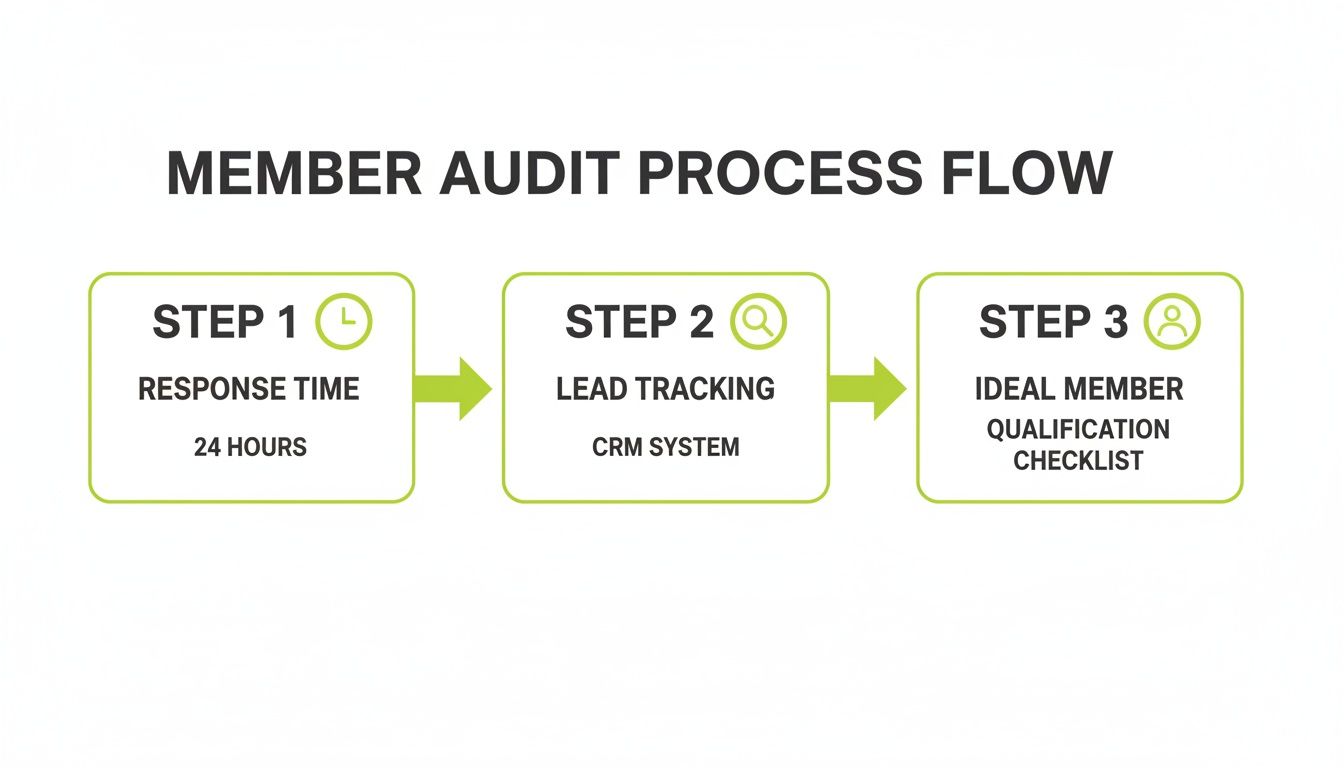
As this flowchart shows, understanding your current response times and how you track leads is fundamental. These insights directly inform how you build a funnel that actually works for your ideal member.
Let's look at the difference between the old way and the new way of handling these crucial first moments.
Manual vs. Automated Enquiry Handling
The contrast is stark. One approach relies on chance and available staff time, while the other guarantees a professional and engaging experience for every single prospect, every single time.
Nurture: Building Value and Earning Trust
Once a lead is qualified, the real work begins. This is the nurture stage, a carefully planned sequence of automated emails and texts sent over several days. The goal here isn't a hard sell. It's about building a relationship, answering questions before they're even asked, and gently guiding them towards booking a visit.
A typical nurture sequence could look something like this:
- Day 1: An email from the head professional with a video tour of the signature holes.
- Day 3: A message highlighting a unique club benefit, like the lively social calendar or exclusive member competitions.
- Day 5: A friendly SMS with a direct link to book a personal tour of the facilities.
- Day 7: An email with testimonials from current members who fit a similar profile to the prospect.
This consistent, professional follow-up keeps your club top of mind. It demonstrates that you're an organised, modern club and builds trust by providing value without any pressure.
A well-crafted nurture flow does the heavy lifting for you. It educates, engages, and persuades prospects, ensuring that by the time they speak to a member of your team, they are already warm, informed, and ready to take the next step.
Convert: The Seamless Handover to Your Team
This is where your system and your team come together perfectly. After the automated funnel has done its job of attracting, qualifying, and nurturing the prospect, it's time for the human touch. The ultimate goal of the nurture sequence is to get the prospect to book a club tour or a call.
When that booking happens, the system instantly notifies the right person on your team. It provides them with all the prospect's details and the entire communication history. It’s a completely seamless handover. Your staff aren't starting a cold conversation; they're picking up a warm one with someone who is already highly engaged and well-informed.
This frees up your people to focus on what they do best: providing a brilliant, personal experience during the tour and talking through the final details of membership. The system handles all the repetitive, time-consuming follow-up, allowing your team to put their energy where it has the most impact. By building your strategy around this funnel, you create a reliable, measurable, and scalable system for growth.
Integrating a CRM for Total Visibility and Control
A marketing strategy without a solid tracking system is just guesswork. You might be pouring money into advertising, but if you don't know exactly where every enquiry comes from and what happens to it, you're essentially filling a leaky bucket. This is where a Customer Relationship Management (CRM) system comes in, acting as the central nervous system for your entire member acquisition effort.
For a modern golf club, a CRM isn’t just a fancy digital address book. It’s the single source of truth for your sales and marketing, giving you a crystal-clear view of every potential member from their very first click to their first round. It’s time to ditch the scattered spreadsheets, messy inboxes, and forgotten sticky notes for a unified, transparent system.
Moving from Guesswork to Data
At its core, a CRM is all about capturing and organising data. The moment a new enquiry lands, whether from a Facebook ad, a Google search, or your website's contact form, it’s automatically logged in the system. This is the first, crucial step towards real accountability in your golf club marketing strategy.
Instantly, the system tracks the vital details:
- Lead Source: You know precisely which ad, social post, or search brought them to you.
- Contact Details: Name, email, and phone number are captured flawlessly, no manual entry required.
- Enquiry Time: The exact time and date are logged, so you know when your audience is most active.
- Communication History: Every email, text message, and phone call is logged against their record.
This immediate data capture is a game-changer. It puts an end to the "I think this is working" debates and gives you undeniable proof of what's driving results.
A Single View of Every Potential Member
Picture this: a prospective member calls the club. Instead of your staff asking them to repeat the same information they just filled out online, they can pull up a complete history in seconds. They can see the specific ad the person clicked, the automated emails they've already received, and any notes from previous conversations.
This is how you have meaningful, personal interactions. Your team isn't starting from scratch; they're picking up a conversation the system has already started. That level of organisation and professionalism makes a powerful first impression and gives your staff the tools they need to turn interest into revenue.
The real power of a CRM is in providing total lead visibility. It ensures that no potential member is ever forgotten, no follow-up is ever missed, and every conversation is informed by the prospect's complete journey with your club.
A disorganised approach is incredibly costly. In one case, a club that modernised its systems saw a 63% year-over-year increase in rounds and a 55% increase in total revenue. This was driven almost entirely by activating CRM-driven communication and simply managing their data better. The financial impact is real.
Tracking Progress and Optimising Performance
With a CRM, you can build a visual sales pipeline that perfectly mirrors your membership acquisition funnel. At a glance, you can see how many prospects are at each stage, from 'New Enquiry' and 'Contacted' to 'Tour Booked' and 'New Member'. This isn't just for reporting; it's a powerful diagnostic tool.
For instance, if you spot a bottleneck where leads are getting stuck at the 'Contacted' stage but aren't booking tours, it’s a clear red flag. It tells you something in your follow-up process or nurture sequence is off. You can start asking the right questions: Is our messaging compelling enough? Is the booking process too complicated?
This data-driven insight is what separates a static marketing plan from a dynamic growth engine. It allows you to constantly improve by showing you exactly where the weak spots are. For clubs wanting to dive deeper into this, we've written a detailed guide on the benefits of a dedicated golf CRM system.
By tracking everything, you finally gain the control needed to refine your approach, improve conversion rates, and build a truly predictable pipeline of new members for your club.
Know Your Numbers: Setting KPIs and Driving Real Growth
Your golf club’s marketing strategy shouldn't be a document you write once and then file away. It’s a living, breathing system. The whole reason for building a proper sales funnel and using a CRM is to get your hands on real, actionable data. This is what lets you stop guessing and start making smart decisions that lead to predictable, sustainable growth.
The trick is to track what actually matters. Forget vanity metrics like website traffic or a few extra likes on social media. A club that's serious about growth measures the tangible results that lead directly to new membership sales. You need to know your numbers inside and out. It’s the only way to spot the weak links in your process, double down on what’s working, and make sure every pound in your marketing budget is pulling its weight.
The KPIs That Really Count
Think of Key Performance Indicators (KPIs) as the vital signs for your member acquisition engine. They give you a clear, honest look at how each stage of your marketing and sales process is performing. For any club that wants to grow, there are a handful of metrics that are simply non-negotiable.
Here’s what you need to be tracking religiously:
- Cost Per Enquiry (CPE): How much does it cost in ad spend to get one potential member to raise their hand and show interest? This is your total advertising spend divided by the number of new enquiries you get.
- Enquiry-to-Visit Rate: What percentage of those new enquiries actually book a tour or visit the club? A low number here is a massive red flag, usually pointing to a problem with your follow-up process.
- Visit-to-Member Conversion Rate: Of all the prospects who make it to the club for a visit, what percentage sign on the dotted line? This metric tells you everything about the effectiveness of your in-person sales process.
- Cost Per Acquisition (CPA): This is the bottom line. It’s the total marketing cost to secure one brand new, paying member. This figure tells you your true return on investment.
By focusing on these core KPIs, you shift from a cost-based mindset to an investment-based one. The question changes from, "How much are we spending?" to, "What return are we getting for every pound invested in our growth?"
Using Data to Make Smarter Decisions
Once you have these numbers at your fingertips, you can start to diagnose and fine-tune your entire funnel. The data tells a story, pointing you directly to the areas that need your attention.
Let’s say your Cost Per Enquiry is fantastic, your ads are clearly working and generating a lot of interest. But you notice your Enquiry-to-Visit Rate is terrible. This immediately tells you the problem isn't with your advertising; it's in the handover from initial interest to taking action. Something is breaking down in that critical nurture stage.
Now you can ask the right questions:
- Is our automated email sequence compelling enough to get someone excited?
- Are the calls-to-action to book a visit clear and impossible to miss?
- Is there a technical glitch with the booking link on our landing page?
This data-led approach takes the guesswork and personal opinions out of the equation. You replace "I think we should..." with "The data shows us that...". This is how you constantly refine your campaigns, ensuring every part of your system is performing at its best.
Keeping a Pulse on the Market
Good data also helps you make sense of what's happening in the wider golf world. For instance, recent figures show the average green fee at the UK's Top 100 courses hit £237 in 2025, a 10.7% jump in just one year. At the same time, member subscriptions only went up by 4.8%.
This shows a clear trend of top clubs pushing visitor revenue hard, which can squeeze the perceived value of a full membership. By tracking your own conversion rates against your membership pricing, you can make informed decisions about your club's fee structure. You will be able to strike the right balance between profitability and offering genuine value to your members. You can learn more about the nuances of recent green fee pricing trends to see how your club stacks up.
Ultimately, this cycle of measuring, analysing, and iterating is what separates a truly successful growth strategy from a bunch of random marketing activities. It's the only way to build a predictable pipeline that delivers a steady stream of high-quality members, year after year.
Answering Your Questions About Golf Club Marketing Systems
Taking the leap from traditional methods to a structured, data-driven system for membership growth is a big step. It's completely natural for committees and managers to have questions. Let's tackle some of the most common ones we hear from clubs exploring a more modern approach.
"Our Committee Has Limited Marketing Experience."
This is something we hear all the time, particularly from member-owned clubs. The entire point of a proper growth system is to simplify your marketing efforts, not make them more complicated.
While the initial setup of building the funnels, dialling in the targeting, and setting up the automations requires specialist expertise, the day-to-day running of the system is designed to be straightforward. Your team's role actually becomes easier. They are freed from the grind of manually chasing every single enquiry. Instead, they can focus on what they do best: giving a fantastic, personal welcome to a prospective member who has already been warmed up and qualified by the system. The technical side is managed for you, with a simple dashboard showing you exactly what is working.
"We're Worried Digital Ads Will Attract the Wrong Sort of Member."
A perfectly valid concern, especially for clubs that have spent years cultivating a specific culture and atmosphere. This gets to the heart of what separates a targeted strategy from generic advertising. Good digital marketing isn't about casting a wide, hopeful net; it's about surgical precision.
We build campaigns that can target specific demographics, income brackets, and even postcodes. Every part of the campaign, from the imagery to the ad copy, is meticulously crafted to reflect your club's unique brand. The automated qualification process then acts as another crucial filter, making sure only the most suitable people are progressed. It’s a way to find more of your ideal members, not to dilute your brand.
An integrated system allows you to maintain your club's standards at scale. It uses precise targeting and qualification to ensure your marketing attracts prospects who align with your brand and are genuinely a good fit for your membership.
"What's a Realistic Budget for This?"
There is no one-size-fits-all answer here. The right budget depends entirely on your club's location, size, and how ambitious your growth targets are. A better way to think about it is as an investment with a measurable return, not just a cost.
The key metric to focus on is your 'Cost Per New Member Acquired'. When you track the entire journey from the first ad click to the final handshake, you can calculate exactly how much you're spending to bring in each new member. You can then weigh this against the lifetime value that member brings to the club. A good partner will help you model these numbers from the start, building a budget around clear growth targets and a predictable return on investment.
At GolfRep, we build predictable membership pipelines for UK golf clubs by combining targeted lead generation with structured follow-up systems. If you're ready to move beyond guesswork and implement a strategy that delivers measurable growth, we invite you to learn more about our approach.
Ready to tap into our proven growth system?