Turn Your Golf Course Online Presence Into a Revenue Engine

Having a website for your golf course is no longer enough. The objective is to build a predictable system that drives revenue. For most clubs, the challenge is not a lack of interest; it’s the struggle to effectively handle online enquiries and convert them into paid-up members and green fees.
A truly effective online presence connects every touchpoint, from social media to your booking system, creating a seamless engine for growth.
Beyond the Digital Brochure

Many golf clubs operate with a disconnected online strategy. Their website is separate from their social media, and membership enquiries funnel into a general inbox. These leads are often tracked on a messy spreadsheet, with someone trying to remember to follow up. This approach creates significant gaps where potential members and visitors fall through.
We must challenge the assumption that simply generating enquiries is the end goal. It is an important first step, but the real value is in what happens next. The speed of your response, the consistency of your follow-up, and your ability to see the entire journey from the first click to a confirmed payment; that is where the opportunity lies.
Shifting Focus From Enquiries to Conversions
A high-performing online strategy is about results, not just appearances. It means viewing your website, your advertising, and your follow-up process as interconnected parts of one system. This system should be designed for a single purpose: turning interest into income.
This requires a fundamental shift in thinking. Instead of asking, "How many hits did our website get last month?" the questions should be:
- How many of those visitors submitted an enquiry?
- How quickly did we respond to them?
- What percentage of those leads went on to book a tour or pay for a round?
Your club's online presence should work less like a static signpost and more like an automated sales pipeline. Its main job is to make it incredibly easy for a potential customer to take the next logical step, whether that's booking a tee time online or requesting membership details.
Building an Integrated Growth System
This guide provides a practical framework for building that exact pipeline. We will skip the generic marketing theory and focus on the operational side of running a golf club. While you can read more about our general philosophy in our article about marketing in golf, here we will break down the essential components you need.
We’ll cover how to turn your website from a simple brochure into a lead-generating machine and show you why structured systems are the key to converting the interest you already receive. The aim is to build a predictable, measurable, and efficient engine that drives real growth for your club.
Turn Your Website From a Brochure into a Booking Engine

For too many golf clubs, the website is little more than a digital noticeboard. It lists green fees, shows committee members, and perhaps has a gallery from the last captain’s day. This is fine, but it is not actively generating revenue or bringing in new members.
The first step to building a proper growth system is to rethink your website’s purpose. It needs to stop being a passive source of information and become the engine room of your commercial operation, built from the ground up to get visitors to take action.
A potential new member should not need a search party to find your enquiry form. Burying your most valuable links deep in a sub-menu only creates unnecessary friction. Your revenue-generating buttons need to be front and centre.
Design for Action, Not Just Information
Your next customer is likely on their phone right now, trying to book a last-minute round. If your site isn't built for mobile, you have already lost them. We call this a mobile-first approach. It simply means the text must be readable, the buttons easy to tap, and the entire booking process smooth on a small screen.
This isn't just about aesthetics; it's about making it easy for people to give you money. Here are the fundamentals to get right:
- Make Your CTAs Obvious: Buttons like ‘Book a Tee Time’ and ‘Membership Enquiries’ need to be "above the fold" on your homepage. This is the first thing people see without scrolling.
- Integrate Your Booking System Properly: Do not send people to a clunky, third-party booking site that looks completely different. It should feel like a seamless part of your own website experience.
- Keep Enquiry Forms Simple: When capturing a new membership lead, less is more. Ask for a name, email, and phone number. Get them in the system first; you can collect the rest of the details later.
Your website’s primary job is to remove friction. Every click should guide a visitor closer to paying you money or becoming a member, not send them on a wild goose chase. A great site makes booking a round feel effortless.
Build Clear Journeys for Different Visitors
You have two main types of visitors: potential members and pay-and-play golfers. Each one needs a clear, simple path to follow.
For visiting golfers, the journey should be a straight line to the booking engine. Show them available times, the cost, and let them pay online immediately. No fuss.
For someone considering membership, the journey is about building a relationship. Offer them something of value, like a downloadable membership pack in exchange for an email address. Or, even simpler, provide a clear form to request a call back from someone at the club.
By structuring your site around these crucial actions, you stop thinking of it as just a website. It becomes the first, most important piece of your revenue pipeline: a tool that works 24/7 to capture every lead and every booking.
Why Spreadsheets Are Costing You Memberships
Getting an enquiry through your website is a good start, but it is just a start. The real test, and where much potential revenue is lost, is what happens next. For too many clubs, that "what next" is a name and number being manually typed into a spreadsheet, with a follow-up call or email left entirely to chance.
That manual approach is no longer adequate.
When a potential member has to wait days for a response, or their message gets lost in a crowded inbox, you are not just offering a poor experience. You are actively pushing business towards clubs with better systems. A forgotten follow-up is a lost membership. It is that simple.
The solution is not to work harder or hire more people to chase leads. It is to put a system in place that guarantees nothing is ever missed.
Moving Beyond Manual Tracking
Relying on spreadsheets and memory creates massive holes in your conversion process. Consider a classic scenario: an enquiry lands on a Friday afternoon. The club manager is busy preparing for a weekend competition and makes a mental note to respond on Monday. By the time Monday arrives, the prospect's initial excitement has faded, or worse, they have already booked a tour at a more responsive club.
This is where a Customer Relationship Management (CRM) system becomes an essential tool. A CRM is a central hub for every interaction with prospects and members. It provides a complete picture of every lead, tracks every conversation, and, crucially, automates the follow-up so no enquiry falls through the cracks.
A CRM shifts your lead management from a reactive, manual chore into a structured, automated process. It ensures every potential member gets a prompt, professional, and consistent experience, no matter how busy your team gets.
The Power of a Structured System
Let’s look at two different journeys for a potential new member, Sarah, after she submits an enquiry on a club website.
- The Manual Way: Sarah’s details arrive in a shared inbox. The club secretary eventually adds her name to a spreadsheet. Two days later, someone sends her a generic price list. Sarah replies with a few questions, but her email gets buried. No one ever follows up.
- The System-Led Way: The moment Sarah hits 'submit', she receives an automated, personalised email thanking her for her interest and attaching the membership brochure. At the same time, the CRM creates a task for the club manager to call her within 24 hours. Every email and call is logged, creating a seamless and professional experience.
The difference is significant. One approach is built on hope and depends on individuals remembering tasks. The other guarantees a structured, timely response that nurtures initial interest and builds trust.
This systematic approach is becoming more critical as golfers increasingly expect digital convenience. Recent figures show visitor revenue at UK and Irish golf courses is soaring, with the average club generating £170,462 from green fees alone. A massive 68% of this income now comes from a golf course online booking system.
This shows a clear preference for digital channels. If clubs do not apply the same systematic efficiency to handling membership enquiries, they are leaving a huge amount of money on the table. You can dive deeper into these visitor revenue trends on Golfshake.com.
Automate Your Follow-Up and Watch Your Enquiries Convert
Having a central system to manage enquiries is a huge step forward, but the real impact comes from automating the initial follow-up. This is where you can transform your club’s conversion process from reactive to proactive, ensuring every lead receives an immediate and professional response, 24/7.
Automation is not about replacing your team. It is about taking repetitive, administrative tasks off their plate. This frees them to focus on high-value conversations that close deals, like hosting club tours or making personal phone calls to genuinely interested prospects.
Without a structured process, it is too easy for a promising lead to fall through the cracks. The enquiry comes in, staff get busy, and the opportunity is lost.
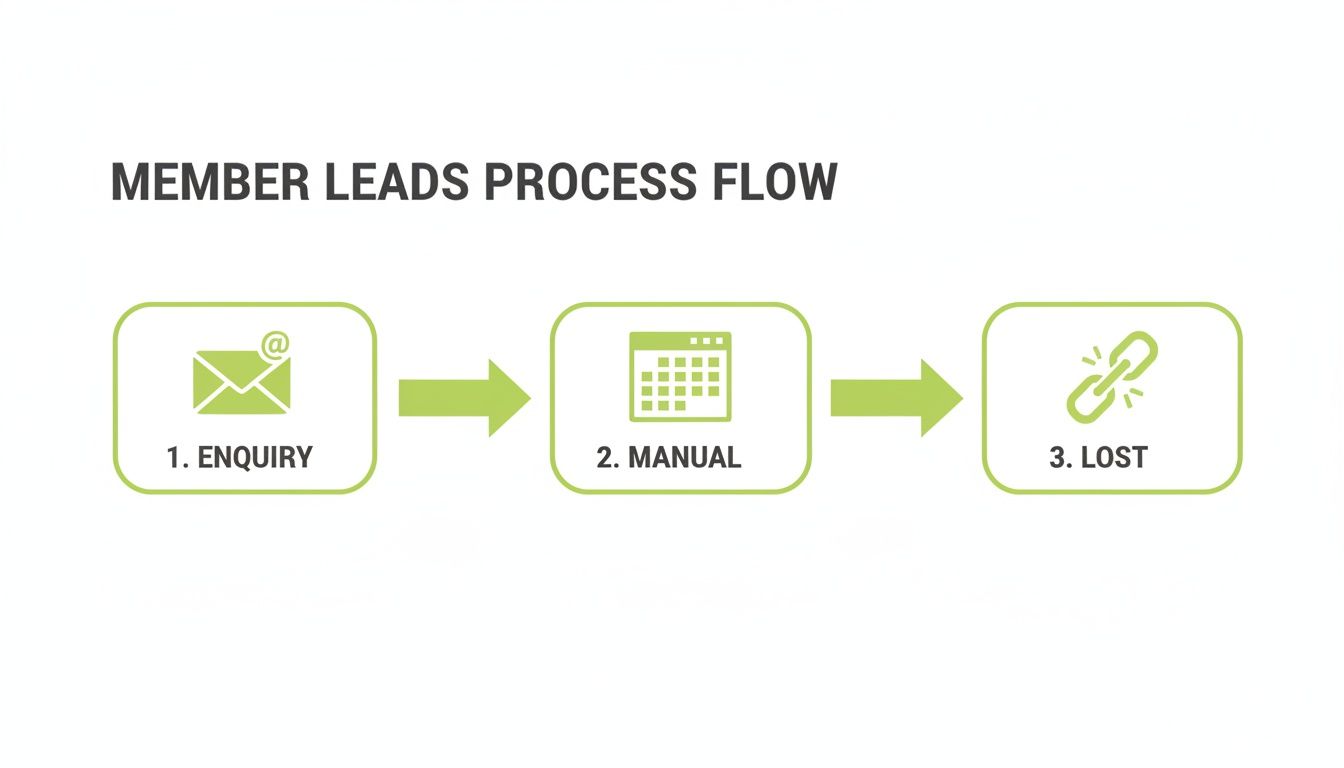
This diagram shows a story we have seen countless times: an enquiry comes in, manual handling fails, and a potential new member is lost forever.
What an Effective Nurture Sequence Looks Like
Think of a well-designed automated sequence (often called a 'nurture flow') as your club's perfect salesperson. It never forgets to follow up and delivers a consistent, compelling message every time. It engages prospects from the second they submit an enquiry, building momentum and keeping your club at the forefront of their minds.
A simple but highly effective flow could look like this:
- Email 1 (Instant): The moment they enquire, they receive a confirmation email thanking them and attaching your membership brochure. This provides instant value and shows professionalism.
- Email 2 (24-48 hours later): A follow-up email that highlights one or two key benefits of membership. Perhaps you link to a video tour of the course or a powerful member testimonial.
- Email 3 (3-4 days later): Now, you can send a friendly invitation to book a tour of the club, with a simple link to a calendar booking tool to remove any friction.
- Email 4 (7 days later): A final, personal-sounding check-in. Something as simple as, "Just wanted to see if you had any questions?" often prompts a response from those still considering their options.
This systematic approach is the safety net that ensures no lead is left behind. It is a world away from the old manual method, where follow-up is often inconsistent and completely dependent on staff availability.
To truly understand the difference, let’s look at how the same enquiry is handled in two different worlds.
Manual vs Automated Enquiry Handling
As you can see, the automated system isn't just more efficient; it creates a far better experience for the potential member and gives your team the best possible chance of success.
Automation provides the perfect foundation for a personal connection. It handles the initial administrative lift, freeing your team to step in when a prospect is warmed up and ready to talk, not bogged down chasing cold leads.
Meeting the Modern Golfer's Expectations
Today's golfers live online and expect seamless digital experiences. This is not just a hunch; the data supports it.
In the UK golf tourism market, online bookings are projected to capture a massive 70% share. Golfers are now accustomed to using platforms to compare packages and book tee times whenever it suits them. This digital shift has helped drive the average green fee income per club in the UK and Ireland to a record £189,240. You can dive deeper into these trends in the full UK golf tourism report.
This all points to one critical conclusion: if members and visitors expect to book and pay for a tee time online, they certainly expect a swift, digital-first response when they enquire about your club's most important product: membership.
An automated follow-up system meets this expectation. It delivers the speed and efficiency that golfers now take for granted. To see how these systems fit into a broader growth strategy, take a look at our guide on building 7-minute growth systems for your club.
Drive Targeted Traffic and Measure What Matters
With a system in place that can reliably convert enquiries into new members, the final piece is to fuel it with the right kind of traffic. This is where many clubs fall short, investing in generic advertising that casts a wide net but catches very little of genuine value.
The real goal is not just to get more clicks; it is to attract local golfers who are actively searching for what your club offers. It is time to move away from hopeful, scattergun marketing and adopt a data-led approach where every pound spent is tracked and justified. The aim is to get your golf course online in front of the right people at the right moment.
This means running highly targeted campaigns. Consider focusing on golfers within a specific radius of your club who have already shown an interest in the sport. It is all about being precise, not just loud.
Moving Beyond Vanity Metrics
One of the biggest mistakes we see is clubs focusing on vanity metrics. Things like website visitors, page views, or social media 'likes' might look impressive in a report, but they do not pay the bills. They tell you people are looking, but not whether they are the right people or if they are taking any meaningful action.
Instead, your focus needs to shift to the metrics that directly impact your bottom line.
- Cost Per Qualified Lead: How much are you spending to get an enquiry from someone genuinely in the market for a membership?
- Lead-to-Tour Rate: What percentage of those qualified leads book and attend a tour of your facilities?
- Lead-to-Member Conversion Rate: Of all the enquiries that come in, how many convert into paying members?
- Return on Ad Spend (ROAS): For every £1 invested in advertising, how much membership revenue is generated?
Keeping a close eye on these figures gives you true visibility into the health of your pipeline. It empowers you to make sharp, informed decisions about your marketing budget, doubling down on what works and cutting what does not. You can learn more about how we put these principles into practice in our guide to effective golf marketing services.
Measuring the entire journey, from the first ad click to the final sale, is non-negotiable. Without it, you’re just guessing with your marketing spend and hoping for the best.
This focus on measurable outcomes is more critical than ever, given the current health of the sport. Golf participation in Great Britain is booming. Rounds played surged 7% in the third quarter of a recent year, on top of an already massive 23% increase in the first half. The data points to a sustained post-Covid trend, with overall rounds played up 13% from two years prior. You can dive into the details in the full report on the UK’s surging golf participation.
With so much interest available, the challenge isn't finding golfers. The real challenge is efficiently attracting them and converting them into loyal members for your club. By driving targeted traffic and measuring what truly matters, you can build a predictable and profitable engine for growth.
Frequently Asked Questions
It's natural to have questions when considering a more structured way to grow your club online. Here are a few of the most common ones we hear from club managers, with some direct answers based on our experience.
Is This System Too Complex for a Small Team?
Quite the opposite. The purpose of a system like this is to make life simpler for your team, not more complicated. Think about all the time currently spent on repetitive tasks like sending the first follow-up email or manually tracking conversations.
By automating these administrative jobs, you free up your staff. They can then spend their valuable time on what really matters: giving personal tours of the club, making one-to-one phone calls, and building genuine relationships with prospective members.
We Already Get Plenty of Enquiries, So Why Bother?
This is a good position to be in, and a common point made by successful clubs. The real question is not about the number of enquiries you get, but how many of them you are converting into paying members. Without a proper system, knowing your true conversion rate is almost impossible.
A CRM gives you that crucial lead visibility. You can see exactly how many enquiries are followed up, how quickly your team responds, and the final outcome for each one.
Without this data, you're flying blind. You cannot spot the bottlenecks in your process, which almost always means potential revenue is slipping through the cracks.
Does Automation Feel Too Impersonal for Our Club?
That is a valid concern, especially for clubs that pride themselves on a personal touch. The key is to use automation for the right things. It is not about replacing human interaction; it is about enhancing it.
Automation should handle the initial, administrative side of things. It ensures every person who enquires gets a prompt, professional, and consistent response right away. No one is missed or forgotten. This frees up your team to provide that genuine, personal connection where it counts the most: in a real conversation, during a club tour, or when welcoming a new member.
At GolfRep, we build the systems that turn your online presence into a predictable revenue engine. If you're ready to move beyond spreadsheets and missed opportunities, let's talk about how a structured Growth System can work for your club.
Find out how we can help at https://www.golfrep.co.
Ready to tap into our proven growth system?