A Modern Guide to Golf Club Marketing and Growth
Effective golf club marketing is not about generating an endless stream of enquiries. It is about building a solid, reliable system that turns the interest you already have into predictable revenue. This means moving away from one-off advertising campaigns and towards a structured process for managing leads, tracking conversions, and following up consistently.
Moving Beyond Marketing Hype to Predictable Growth

For most golf clubs in the UK, the real challenge is not a lack of local interest. It is the operational gap between receiving an enquiry and signing up a new member. Relying on manual, ad-hoc marketing efforts no longer works in such a competitive market.
This reactive approach almost always results in missed opportunities. We see it all the time: slow response times to enquiries, no real visibility into the sales pipeline, and inconsistent follow-up. These are the issues that directly impact your revenue. The solution is not just "more marketing"; it is better systems.
The Problem with Traditional Marketing Efforts
Much of traditional golf club marketing happens in disconnected bursts. You might run a social media campaign one month, then place a local newspaper advert the next. While these might generate some initial interest, they do not provide the structure needed for steady, sustainable growth.
Without a solid process in place, club staff end up trying to manage enquiries from overloaded inboxes and messy spreadsheets. This inevitably causes delays and dropped leads, giving potential members a poor first impression when they expect a prompt, professional response.
The core principle is simple but powerful: your club's growth is not determined by how many enquiries you get, but by how efficiently you handle and convert them. A systematic approach ensures no lead is wasted.
Shifting to a Growth System Mindset
Adopting a 'Growth System' is a fundamental shift. You stop just ‘doing marketing’ and start building a predictable engine for membership growth. This involves combining targeted lead generation with structured follow-up and CRM systems, all managed through a central CRM system. This integrated approach gives you complete clarity, from the first click on an ad to the moment a new member makes their first payment.
The market data supports this. There is a clear upward trend in memberships, with the number of members’ clubs reporting over 600 playing members now at 59%. Furthermore, 48% of these clubs have waiting lists, proving that effective promotion can easily lead to oversubscription. These findings are from the latest Hillier Hopkins Golf Clubs Survey.
This guide provides the practical framework to build that system. We will skip the generic theory and focus on the details of how to create a reliable pipeline that turns local golfers into long-term, loyal members. If you are considering outside help, you can also learn more in our article about choosing a golf marketing agency.
Building Your Foundation With The Right Audience And Offer
Understanding who you want to reach and what they value is essential before any marketing campaign begins. Without this clarity, marketing becomes costly and unfocused guesswork.
Sustainable growth hinges on attracting the right type of member, not just any sign-up. That means moving past basic demographics to understand their deeper motivations.
Defining Your Ideal Member Profile
First, imagine your perfect member beyond the simple label of “local golfer”. Think about how often they play, why they choose golf, and the club experience they are looking for.
- Playing Habits: Are they weekend players, midweek retirees, or competitive golfers seeking tournaments?
- Primary Motivation: Are they looking for a challenging course, a vibrant social scene, or a family-friendly atmosphere?
- Preferred Channels: Do they respond to social media messages, SMS, or well-crafted emails?
With these insights, you can create messages and membership packages that connect from the very first interaction. This clarity guides every decision, from website copy to the onboarding process.
Embracing The Demographic Shift In UK Golf
Recent figures from England Golf show the average membership age has decreased from 56.18 to 54.99. Meanwhile, 51.58% of clubs report growth in junior memberships, and 41.59% see more female players joining.
This change presents fresh opportunities. Younger golfers often look for flexible options, modern communication, and a lively clubhouse rather than strict formalities.
Your outreach must evolve as your audience does. Using the same message for the same people will yield diminishing returns over time.
Crafting Offers That Communicate Value Not Discounts
Reducing prices might generate a short-term increase in enquiries, but it attracts bargain hunters and can damage your club’s reputation. Instead, build packages around benefits that align with member priorities.
Consider offers like these:
- Tiered Packages: Bronze, Silver, and Gold levels with perks such as guest passes, range credits, or coaching sessions.
- Flexible Memberships: Points-based or off-peak plans for golfers with busy schedules.
- Corporate Offerings: Bundles for local businesses that combine rounds of golf with meeting spaces and branding opportunities.
This approach shifts the conversation from “How cheap is it?” to “What value do I get?” It attracts members who appreciate more than just a low price.
Before we move on, let’s compare conventional discount tactics with a proactive, value-led strategy. This highlights how a strategic shift can boost long-term success.
Modern Membership Offer Strategy At a Glance
This comparison shows how focusing on genuine value and clear audience insight makes membership growth more predictable and sustainable. Use this as your blueprint.
Let’s keep this foundation strong. A solid audience profile and a compelling offer are your most valuable assets.
How to Get in Front of the Right Golfers, Consistently
Now that you know who you are trying to attract and what you will offer them, it is time to get their attention. Effective marketing for a golf club is not about shouting into the void and hoping for a response. It is about precision. It is about putting the right message in front of the right people, in the right place.
The goal is not just to get a flood of enquiries. It is to get the right kind of enquiries, from golfers who are a genuine fit for your club’s culture. This way, your team spends their time in meaningful conversations with people who are likely to join, not wasting it on casual browsers.
Precision Targeting with Data-Led Advertising
Forget placing an advert in the local paper and crossing your fingers. Platforms like Facebook, Instagram, and Google offer incredible tools to reach specific local golfers.
You can target people based on their postcode, age, their declared interest in golf, and even their online behaviour. The level of detail available is significant.
For instance, we have run campaigns for clubs promoting corporate membership packages, targeting people who work at local business parks within a 10-mile radius. For another club looking to attract younger members, we built a campaign for a flexible membership that only appeared to professionals aged 25-40 who had already shown an interest in golf-related pages online.
This is what turns a marketing budget from an expense into a predictable machine for generating qualified leads.
Stop thinking about your ads as simple promotions. See them as targeted invitations, sent directly to the people most likely to accept. One well-aimed shot is always more effective than a hundred random ones.
Crafting Ads That Actually Connect
Your advert is often a potential member’s first impression of your club. A stock photo of a fairway with "Join Our Club!" written over it will not cut it anymore. It gets ignored.
Your ad copy and images need to tell a story that resonates with the specific golfer you are trying to reach. What really matters to them?
- Looking for community? Show photos of members enjoying the terrace after a round or at a club social event. Your text should talk about the friendly atmosphere and the busy events calendar.
- The serious competitor? Use a striking image of your championship-standard greens. Perhaps feature a quote from a low-handicap member about the challenge of the course. The message here is all about quality and competition.
- The family? Get shots of your junior academy in action or families enjoying a Sunday lunch in the clubhouse. The copy needs to sell a welcoming, multi-generational atmosphere.
When you tailor your creative like this, your message does not just get seen; it gets felt. You are showing potential members that you understand what they are looking for. For more on this, our guide on how to get your golf course online dives deeper into building that strong first impression.
Building Trust with Organic Content and Local SEO
Paid ads are excellent for getting leads in the door right now, but your organic content is what builds long-term trust and makes you the obvious choice. This is all about what is on your website and ensuring people can find you when they are searching locally.
Put yourself in a potential member's shoes. What are they typing into Google? Probably things like "best golf memberships near Chesterfield" or "friendly golf clubs in Surrey". Your website needs to have pages and articles that directly answer those questions.
This is not about keyword stuffing. It is about creating genuinely useful content, such as:
- A well-photographed hole-by-hole course tour with playing tips.
- Short video testimonials from current members who fit your ideal profiles.
- A blog post highlighting the top 5 social events from last year's calendar.
This kind of content does two things at once. First, it gives prospective members a real taste of what your club is about, building value before they even speak to you. Second, it tells search engines like Google that you are the local authority on golf.
This is the core of local SEO. It is how you ensure your club appears at the very moment someone is actively looking to join. When you combine this powerful, long-term strategy with the immediacy of paid ads, you create a robust system that consistently brings high-quality enquiries through the door.
Systemising Your Follow-Up: From First Click to Club Visit
Getting a steady stream of high-quality membership enquiries is a huge win, but it is only half the battle. The moments that truly decide whether a prospect joins your club happen after they submit your enquiry form. This is where most clubs, still relying on manual follow-up, lose potential revenue.
People today expect an instant response and clear communication. If someone has to wait hours, or even days, for a reply, you have already sent a message that their interest is not a priority. This is why a systematic, automated approach to follow-up is not just helpful; it is the engine that drives predictable growth.
The Make-or-Break Moment: Instant Lead Qualification
When a potential member shows interest, the clock starts ticking immediately. A slow response is the quickest way to lose a promising lead, either to a competitor or simply because their initial excitement fades. A manual process that relies on someone remembering to check an inbox is broken from the start.
This is where automated lead qualification becomes invaluable. By setting up a 24/7 automated system, every single enquiry gets an immediate, professional reply. This first touchpoint, usually an email or SMS, should do three things:
- Confirm their enquiry was received, giving them instant peace of mind.
- Ask a simple qualifying question to understand their needs (e.g., “Thanks for your interest! Are you looking for a 7-day or 5-day membership?”).
- Provide a clear next step, like a link to book a call or schedule a club tour.
This first, automated interaction achieves so much. It captures vital information, sets a professional tone, and engages the prospect while their interest is at its peak. No one feels ignored, whether they enquire at 2 PM on a Tuesday or 10 PM on a Saturday.
As this flowchart shows, it does not matter if the lead came from an ad, a blog post, or a Google search. How you handle that first contact is what really counts.
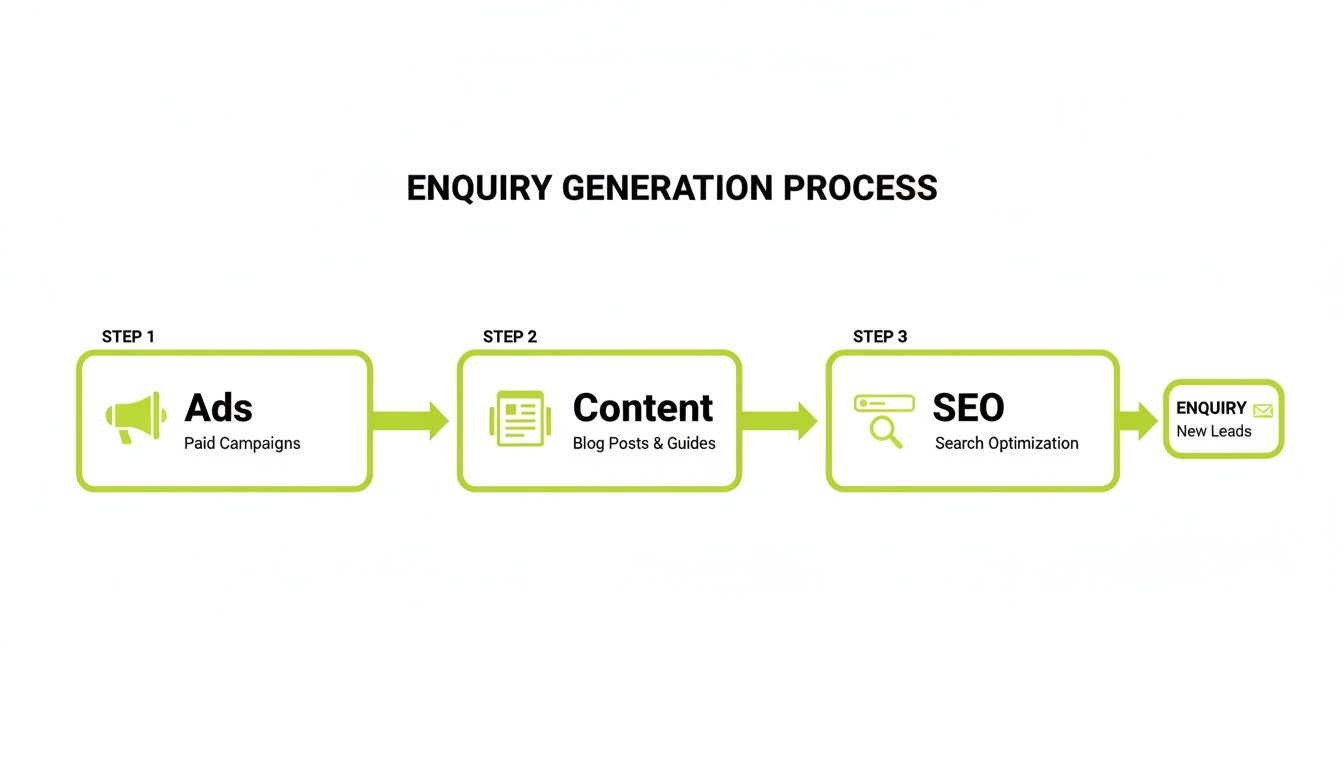
This initial handling is the most critical step in turning a curious golfer into a committed member.
Building a Relationship with Automated Nurture Sequences
Once you have made initial contact, the goal is to gently guide the prospect towards a decision. Simply waiting for them to call you is a recipe for a leaky pipeline. The solution is a structured nurture sequence, powered by your CRM, that uses a series of timed emails and text messages to educate, build rapport, and keep the conversation going.
A simple but effective nurture flow might look like this:
- Day 1 (Instant): The automated qualification message is sent.
- Day 2: An email from the Club Manager with a video tour of the course and clubhouse.
- Day 4: A quick text message with a link to testimonials from happy members.
- Day 6: An email highlighting a club feature relevant to their interest, like the practice facilities or social calendar.
- Day 8: A final, friendly nudge to book a tour and experience the club for themselves.
This multi-touch approach keeps your club top-of-mind without being pushy. Each message delivers genuine value, answering potential questions and showcasing what makes your club special. It is a guided journey, not a hard sell. You can learn more about how a golf CRM system is the backbone for managing these interactions effectively.
The real purpose of a nurture sequence is to build a relationship before the prospect even sets foot on the property. By the time they arrive for a tour, they should already feel informed, excited, and connected to what your club is all about.
Why Systems Beat Manual Effort, Every Single Time
We sometimes hear club managers worry that automation feels impersonal. In practice, the opposite is true. A well-designed system delivers a consistent, high-quality experience for every single person, which is nearly impossible to do manually. A busy team member can forget to follow up, send the wrong information, or be too swamped to respond quickly.
A manual process is prone to human error and inconsistency, while an automated system provides reliability and efficiency, allowing you to scale your efforts without dropping leads.
The table below breaks down the stark differences in outcomes between a typical manual approach and a structured, automated system.
Manual vs Automated Enquiry Handling
The results speak for themselves. A system ensures every enquiry is handled with the professionalism it deserves. It also frees up your staff to focus on what they do best: giving fantastic club tours and welcoming new members, instead of getting bogged down chasing cold leads in a spreadsheet. This structured approach is what turns your marketing from a series of random activities into a predictable growth engine.
Measuring What Matters to Optimise for Revenue

Effective golf club marketing is not about being busy; it is about being accountable. Too many clubs get bogged down in vanity metrics like website clicks, social media likes, or email open rates. These numbers might look good in a report, but they do not pay the bills.
To build a predictable growth engine, you must measure what actually matters. That means tracking the entire journey, from the moment someone first enquires to the day they become a paying member. Only then can you see what is working, what is not, and where to invest your budget for the best possible return.
Key Performance Indicators for Growth
The real shift happens when you start focusing on revenue-centric Key Performance Indicators (KPIs). These figures paint an honest picture of your marketing performance and operational effectiveness, giving you the clarity needed for smart, sustainable growth.
Here are the essential metrics every golf club should have on their dashboard:
- Cost Per Qualified Lead (CPQL): This shows you exactly what it costs to get an enquiry from a genuine membership prospect, filtering out casual browsers from serious contenders.
- Enquiry-to-Visit Rate: What percentage of those qualified leads book and attend a tour of the club? This directly reflects how well your follow-up and nurture processes are working.
- Visit-to-Member Conversion Rate: This is the ultimate test. Of all the prospects who visit your club, how many actually join? This KPI reveals the strength of your in-person experience and the overall appeal of your club.
Tracking these metrics is like having a powerful diagnostic tool. A low enquiry-to-visit rate, for instance, likely points to a weakness in your automated email sequence, not a fundamental problem with your advertising.
Gaining Complete Pipeline Visibility
The only way to track these critical KPIs accurately is with a centralised CRM system. Trying to piece this data together from different spreadsheets, email inboxes, and staff memories is a recipe for disaster. A good CRM acts as your single source of truth, giving you a crystal-clear view of your entire pipeline.
You can see exactly where every lead came from, what stage they are at in the process, and what the final outcome was. This transparency is the foundation of continuous improvement, allowing you to directly connect your marketing spend to the revenue it generates.
A CRM transforms your marketing from a collection of isolated activities into a cohesive, measurable system. It removes guesswork and replaces it with data-backed certainty, allowing you to see exactly which campaigns are delivering the most valuable new members.
Using Data to Continuously Optimise
With clean data and total pipeline visibility, you can start refining your strategy with real precision. This is where a growth system truly comes to life, constantly adapting and improving to deliver better results over time.
For example, you might look at your CRM and see that a specific Facebook ad campaign is bringing in leads at a great CPQL, but their visit-to-member conversion rate is poor. The ad is working, but it is attracting the wrong audience. With that knowledge, you can tweak the ad's targeting or messaging to appeal to prospects who are a much better fit for your club.
Conversely, you might find that leads from your local SEO efforts have an exceptionally high conversion rate. That is a clear signal to double down on creating more valuable content for your website to attract more of these high-quality prospects. This constant cycle of measuring, analysing, and refining is what drives profitable, long-term growth.
The financial stakes have never been higher. With rising operational costs hitting the industry, 87% of UK clubs have reported membership fee increases. The UK golf club market is projected to grow from USD 149.01 million to USD 196.93 million by 2032, so having an effective, revenue-focused marketing engine is crucial to capturing your share. You can discover more insights about these rising costs and their impact on clubs. This economic pressure makes a data-driven approach not just a good idea, but a necessity.
Frequently Asked Questions
When considering an overhaul of your club's approach to membership growth, a few questions often arise. Here are the answers to the ones we hear most frequently from club managers, secretaries, and committee members.
Our Club Is Run By a Committee. How Would This System Work?
This is a common concern, but a structured growth system is ideal for committee-run clubs because it brings clarity and consistency.
Instead of relying on one person’s efforts, the system provides clear, simple reporting. The committee can see what is working at a glance, with key numbers like cost per lead and conversion rates tracked automatically. This removes guesswork from your marketing and makes decision-making far easier for everyone.
Furthermore, when volunteers or committee members change, the system continues to run smoothly in the background. Your club’s growth engine remains stable and predictable year after year.
Will Marketing Automation Feel Robotic?
It is a fair question, but the answer is often the opposite. A smart automation system ensures every single enquiry gets an instant, professional, and helpful response. This is often impossible when handling everything manually.
Think about it: the system can instantly send information based on what a person enquired about, whether that is a 7-day or a 5-day membership. This feels far more personal and efficient than a delayed reply or no reply at all. It shows you are organised from the very first click.
The purpose of automation is not to replace your team's personal touch. It is to handle the repetitive administration flawlessly, freeing up your staff to focus on what they do best: giving fantastic club tours and welcoming new members in person.
We Already Get Plenty of Enquiries. Why Do We Need This?
That is a great position to be in, and it gets to the heart of the matter for many successful clubs. The challenge is not always about getting more enquiries; it is about what you do with the ones you already have.
A proper growth system is all about conversion. It ensures every hard-won enquiry is followed up, nurtured, and tracked all the way to a decision. You stop letting potential members fall through the cracks.
This systematic approach will boost your conversion rate, show you which of your marketing efforts are actually bringing in the most valuable leads, and ultimately, give you predictable revenue from the interest you are already generating. It is about turning a good flow of enquiries into a fantastic flow of new members.
At GolfRep, we build the systems that deliver predictable growth for UK golf clubs. If you are ready to move beyond ad-hoc marketing and create a reliable engine for membership revenue, find out how our Growth System can help. Learn more about our approach.
Ready to tap into our proven growth system?