Retention Marketing for Golf Clubs That Keeps Members

Renewal season often exposes a problem that's been building for months. Enquiries arrive through the website, social media, phone and reception desk, but nobody has a complete view of who replied, who booked a visit, who went quiet and who needs help before renewal. By the time the committee reviews the numbers, the club may be trying to replace members it could have retained with better follow-up.
Golf clubs rarely struggle because nobody is interested in joining. The harder problem is responding promptly, handling each enquiry consistently and giving members a reason to remain engaged throughout the year. Retention marketing addresses that operational gap. It connects member experience, enquiry handling, CRM visibility and timely communication into one system.
For GolfRep, sustainable club growth isn't about filling the pipeline and hoping the results appear. It means building a predictable journey from first enquiry to booked visit, from new member to active participant, and from possible churn to a well-timed intervention. The club's value comes from the relationship that continues after the initial join, not just from the first payment.
Introduction Why Retention Matters More Than New Enquiries
A club manager can spend a morning reviewing new membership leads, an afternoon chasing unanswered messages and an evening looking at upcoming renewals. The activity feels productive, but it may not reveal where revenue is being lost. One enquiry may have received an instant reply, another may still be sitting in an inbox and a third may have spoken to someone who left no record in the CRM.
That creates two risks. Interested golfers receive different experiences, while existing members receive attention only when renewal is close. Neither problem is solved by generating more enquiries.
The leaking-bucket problem
Acquisition brings people into the club's orbit. Retention keeps the relationship useful, active and commercially sustainable. If the club spends time attracting a golfer, then fails to answer quickly or follow up after a visit, it has created demand without building a path to membership.
The same applies after someone joins. A new member who doesn't understand how to use the club, meet other golfers or get help with a problem can become less engaged long before the renewal conversation begins. Retention marketing gives the club a way to notice those signals and respond while there's still time to improve the experience.
UK loyalty data illustrates why sign-ups alone aren't enough. One benchmark reports that 55% of consumers belong to at least four loyalty schemes, while 58% have actively used three or fewer in the past six months. The implication for golf clubs is clear: a membership record proves that someone joined, not that they're engaged or likely to renew. The UK customer loyalty benchmark supports a focus on post-join behaviour, timely follow-ups and lifecycle segmentation.
Practical rule: Treat every member record as the beginning of a relationship, not the end of an acquisition campaign.
What this means for a golf club
A useful retention system answers straightforward questions:
- Who needs a response? Every new enquiry should have a visible status and an accountable owner.
- Who has gone quiet? The club should identify stalled leads, inactive triallists and members whose engagement is falling.
- What should happen next? Each lifecycle stage needs a sensible message, task or service action.
- What produced the result? Managers need conversion tracking that connects communication to visits, joins and renewals.
This is the perspective GolfRep brings to club growth. Lead generation matters, but it works best when the club can handle the interest it creates. Retention marketing turns scattered activity into an organised pipeline that protects recurring revenue and improves the member experience.
What Retention Marketing Means for Golf Clubs
Retention marketing is the organised effort to keep members engaged, satisfied and willing to renew across the full membership lifecycle. It isn't sending a discount to someone who hasn't visited recently, and it isn't the same as running a points scheme. It's a coordinated set of messages, service actions and follow-up tasks based on what a golfer has done and what they may need next.
A simple analogy helps. Acquisition is opening the clubhouse door. Retention is making sure people know where to go once they're inside. A new golfer might need a welcome, an introduction to competitions, help booking tee times or an invitation to meet other members. Someone approaching renewal may need a reminder of the value they've received, a quick answer to a concern or a direct conversation with a named member of staff.
Acquisition and retention do different jobs
Acquisition asks, “How do we attract a suitable golfer?” Retention asks, “How do we help this golfer continue to see value in the club?”
The first question usually involves advertising, search visibility, partnerships and enquiry forms. The second involves onboarding, usage checks, relevant invitations, feedback collection, service recovery and renewal communication. Both matter, but they require different timing and different measures.
A loyalty scheme can support retention, but membership of the scheme isn't the outcome. The outcome is behaviour: visits, participation, replies, bookings, referrals and renewal conversations. That distinction matters because UK loyalty research shows that membership alone is a weak signal of active engagement. Clubs need CRM-triggered journeys that respond to what members do, rather than treating every person in the database as equally engaged.
The lifecycle is the operating model
A practical golf-club lifecycle might include:
- New enquiry, where the priority is speed and clarity.
- Contacted lead, where the club answers questions and confirms interest.
- Visit booked, where reminders and preparation reduce drop-off.
- Trial or prospective member, where staff help the golfer experience the club.
- New member, where onboarding establishes habits and confidence.
- Active member, where relevant engagement maintains value.
- At-risk member, where a change in behaviour prompts intervention.
- Renewal stage, where the club makes the next decision easy.
- Lapsed member, where a considered reactivation journey may reopen the relationship.
A CRM records these stages so staff don't have to rely on memory or separate spreadsheets. The system can then trigger a useful next step, such as a welcome message after joining, a check-in after limited activity or a personal call after a service complaint.
Retention becomes measurable when the club connects these actions to outcomes. UK program owners increasingly track loyalty economics. 91% of UK programme owners actively track loyalty ROI, and brands that track it report an average 5.4X ROI, according to UK loyalty statistics from Antavo. For a golf club, that means connecting automations and staff actions to repeat visits, recurring spend, reduced churn risk and renewals.
Why Members Leave and What Actually Keeps Them
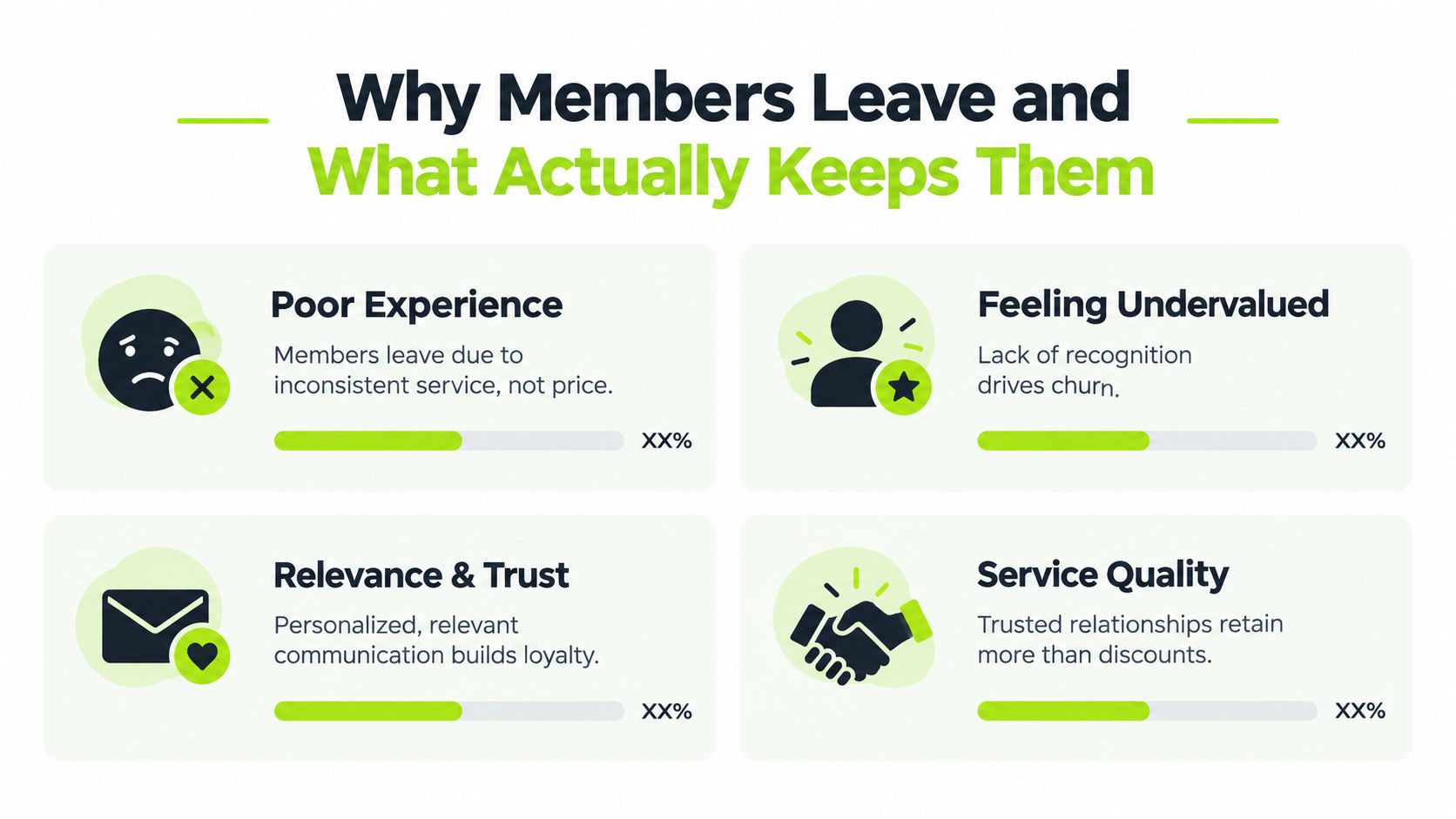
Golf clubs often assume that members leave because another club is cheaper. Price can matter, but it isn't a complete diagnosis. A golfer may tolerate an inconvenient process when the club communicates well, resolves problems quickly and makes membership feel personally relevant. The same golfer may leave a cheaper club if every interaction feels slow, anonymous or difficult.
Service failures expose the financial importance of this issue. The Institute of Customer Service reported that UK service failures cost organisations £7.3 billion per month in January 2025, while only 21% of customers said excellent service increased their spending. The Kerv experience decision-makers guide highlights a difficult gap for service businesses: fixing poor experiences protects revenue, but excellent service alone doesn't automatically create more spending.
Poor experience creates silent churn
A member doesn't always submit a formal complaint before leaving. They may stop entering competitions, book less often, ignore club communications or decide not to renew. If the club only watches renewal forms, it sees the final decision rather than the earlier signals.
Common warning signs include:
- Reduced participation: A formerly active golfer stops attending events or opens fewer messages.
- Unresolved friction: A complaint, missed callback or confusing booking process remains visible in the member's history.
- Weak onboarding: A new member joins but never develops a regular pattern of use.
- Unclear value: The member receives general newsletters but no communication connected to their interests.
- No personal recognition: The golfer feels like a payment record rather than part of the club.
These signals don't prove that someone will leave. They do tell the club when a human check-in may be appropriate.
Feeling undervalued matters
UK research from SAP Emarsys found that 83% of UK consumers felt undervalued by brands they remained loyal to, while emotional loyalty rose 26% from 2021 to 2024. The UK Customer Loyalty Index points towards a useful conclusion for local membership businesses: people may stay for a time without feeling committed, but relevance and trust determine whether the relationship becomes durable.
A golf club can make communication more relevant without building a complicated personalisation engine. It can separate new members from long-standing members, weekday golfers from weekend golfers, competition players from social members and inactive members from highly engaged ones. Each group can receive different prompts, invitations and support.
Members rarely need more messages. They need messages that make sense for where they are in the relationship.
Discounts can help in a carefully chosen situation, but they shouldn't compensate for slow answers or poor service recovery. A better sequence is to identify the friction, give someone ownership of the response, record the resolution and then check whether engagement returns.
That approach changes the retention question from “What offer can we send?” to “What prevented this member from getting value, and what should we do next?” The distinction is central to understanding golf-club churn rate, because churn is an outcome. The system must address the behaviours and experiences that precede it.
Key Components of a Retention System That Works
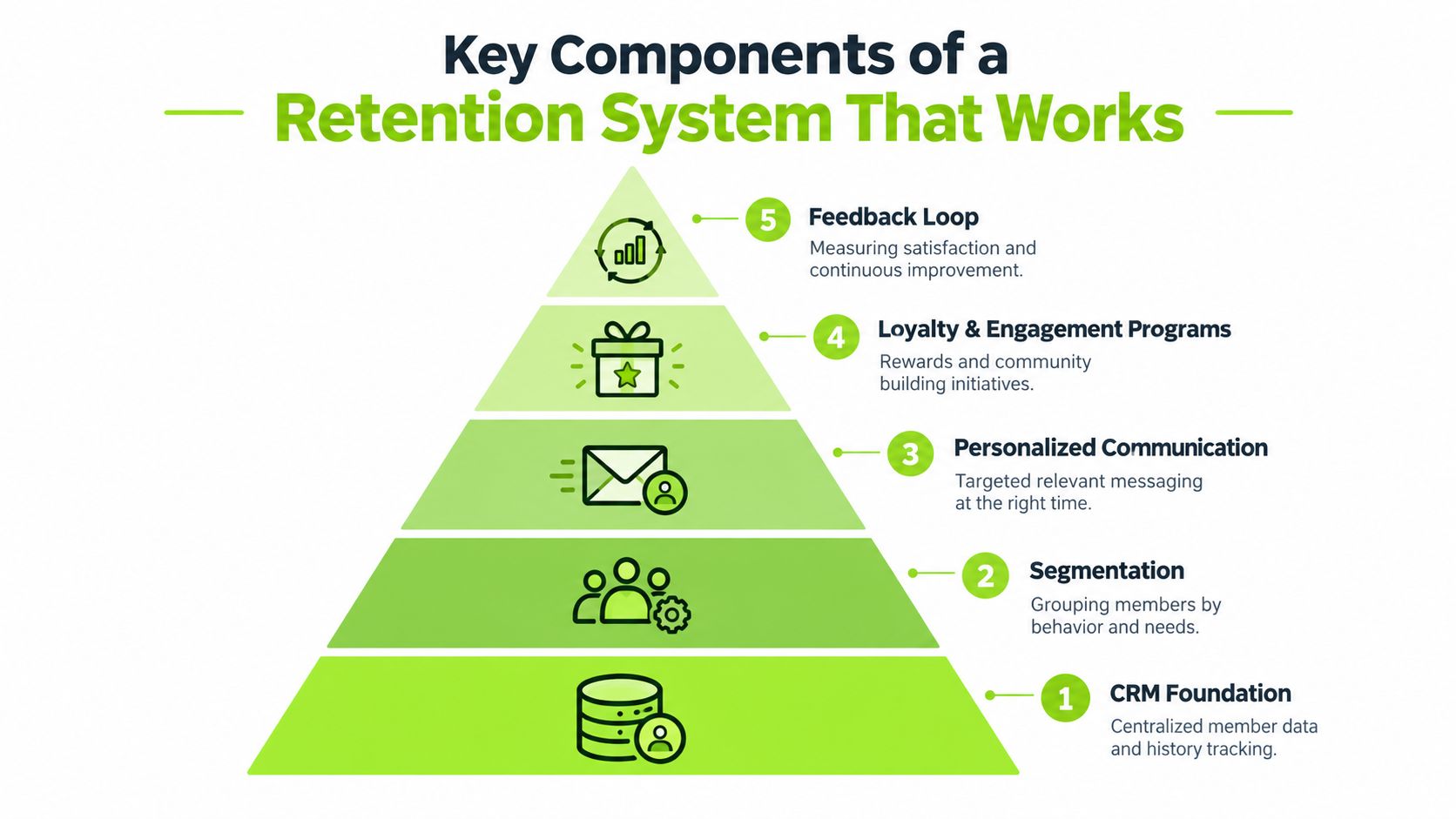
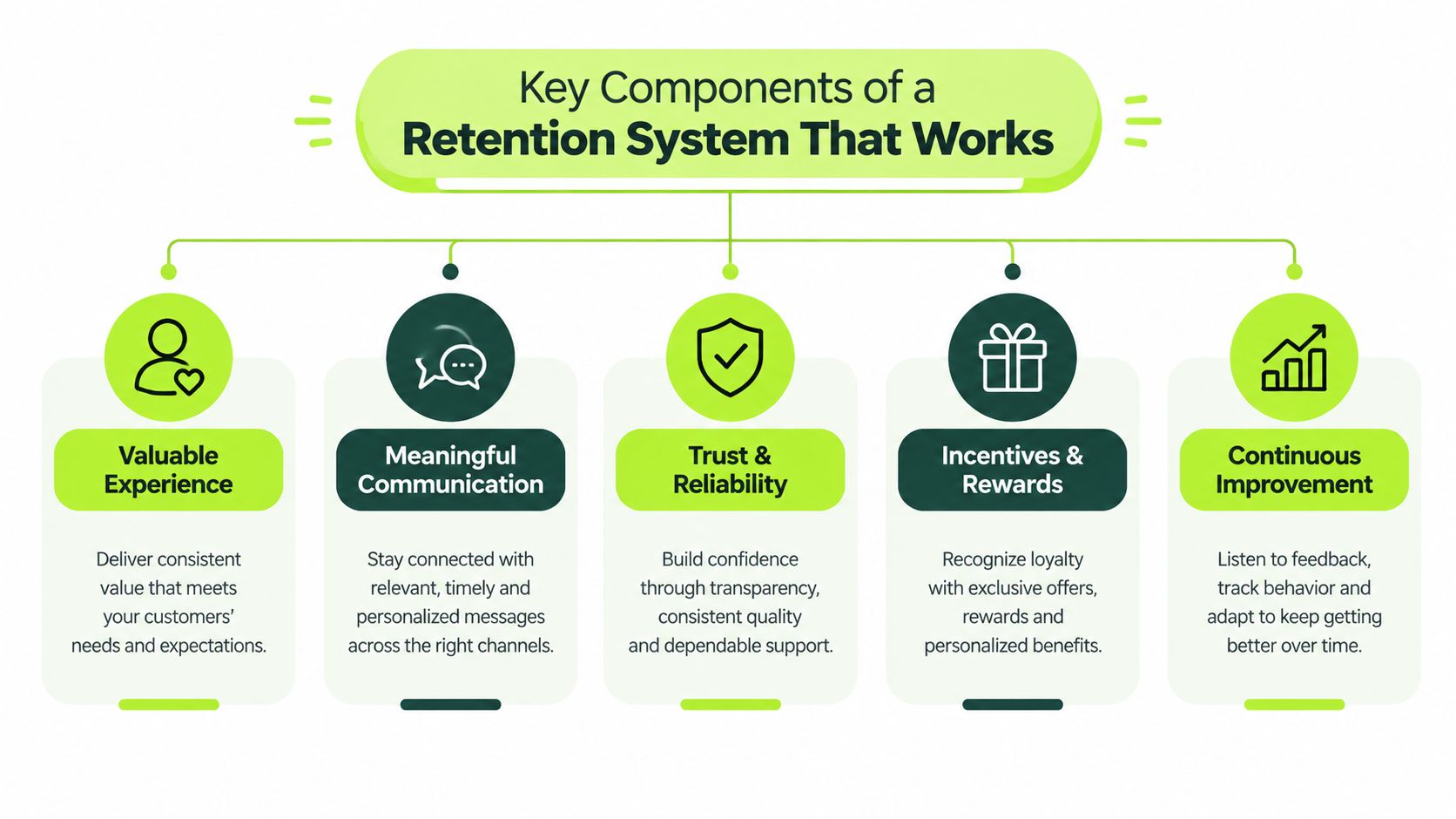
A retention system isn't one software feature. It's a connected operating process that helps the club recognise a person's stage, decide what matters and act consistently. If any part is missing, staff may still work hard, but the member journey remains unpredictable.
Start with a usable CRM foundation
The CRM should hold more than a name and an email address. It should show the source of the enquiry, contact attempts, visit history, membership status, relevant interests, complaints, feedback and the next action.
The data doesn't need to be perfect before the club starts. It does need to be consistent enough for staff to trust the record. A clear owner and a visible status are more useful than a large database nobody updates.
Segment by behaviour and need
Segmentation means grouping people in ways that change what the club does next. Useful groups might include:
- Prospective members who have enquired but haven't visited.
- Visitors who attended but haven't joined.
- New members who need guidance and early engagement.
- Active members who respond well to selected events or services.
- Quiet members whose activity has reduced.
- Renewal-stage members who need a clear conversation.
- Former members who may be open to returning.
This isn't about sending a different email to every golfer. It's about avoiding the mistake of sending the same message to people with different circumstances.
Map the lifecycle
Each stage needs a purpose. An enquiry journey should make contact easy. A visit journey should reduce uncertainty. An onboarding journey should help the new member use the club. An at-risk journey should prompt a helpful intervention rather than an automatic sales message.
A lifecycle map also clarifies team responsibilities. The membership manager may own the first call, the professional may handle a playing question and the secretary may resolve an account issue. The CRM should show who is responsible and when the next action is due.
Use timed nurture and measurement
Automated nurture protects important moments from being forgotten. It can acknowledge an enquiry, remind someone about a visit, ask for feedback after joining or flag a member who has stopped engaging. Automation should support judgement, not replace it.
Managers can find a clear explanation of lifecycle stages and message timing in the Breaker lifecycle email guide. The principles translate well to golf clubs, provided the messages reflect club life rather than generic retail behaviour.
Finally, measure the movement between stages. Track response time, contact rate, booked visits, attended visits, joins, engagement changes, renewal outcomes and reactivation. The purpose isn't to create reporting for its own sake. It's to show where the pipeline stalls and which intervention deserves improvement.
From Manual Follow Up to Structured Nurture Flows
Manual follow-up feels flexible, especially in a small club. A manager sees an enquiry, makes a note, sends an email and intends to call again. The problem starts when the reception desk gets busy, the manager takes leave or several enquiries arrive together. The process depends on memory, and memory doesn't provide reliable lead visibility.
The difference between the two approaches is operational rather than fashionable. A structured flow gives each enquiry a status, an owner, a response expectation and a defined next step. Staff can still personalise the conversation, but the system stops good intentions from disappearing.
| Approach | Response Time | Visibility and Tracking | Member Experience |
|---|---|---|---|
| Manual handling | Depends on who notices the enquiry and when | Notes may sit in inboxes, spreadsheets or personal reminders | Inconsistent, with repeated questions and missed callbacks |
| Structured retention follow-up | Immediate acknowledgement followed by timed actions | One record shows owner, stage, activity and next step | Clearer, faster and more personal because context is available |
Speed changes the first impression
GolfRep reports that UK golf clubs take an average of 47 hours and 32 minutes to respond to membership enquiries, while its analysis says an enquiry answered within one hour is five times more likely to convert than one left for 24 hours. The figures appear in GolfRep's enquiry management analysis, and they point to a practical weakness: the club may be attracting interest but losing momentum before a conversation begins.
A separate UK lead-response source says new enquiry leads are 10 times less likely to respond after five minutes, while conversion rates are 98% higher when follow-up happens within five minutes. The UK faster enquiry response study supports a simple operating principle: the first few minutes deserve a defined response process.
That doesn't mean a staff member must answer every message personally at once. An immediate acknowledgement can confirm receipt, provide useful information and state when a named person will respond. The CRM can then assign the lead and create the next task.
A practical flow for the club team
A workable journey can follow these stages:
- New lead: Capture the source, enquiry type and preferred contact method.
- Acknowledged: Send a clear confirmation and relevant next information.
- Contacted: Assign a named owner and record the conversation.
- Visit booked: Send preparation details and reminders.
- Nurture: Follow up after the visit with a relevant answer or invitation.
- Member: Start onboarding and monitor early engagement.
A UK enquiry-handling survey reports that nearly 10% of firms responded within five minutes, while more than 46% responded within an hour. The Survey Booker lead response study gives clubs a useful benchmark for examining their own performance without assuming that slow response is unavoidable.
The GolfRep guide to marketing automation offers further context on replacing scattered manual activity with structured workflows. The technology matters less than the discipline: every lead needs a visible stage, a responsible person and a reason for the next contact.
Retention Marketing in Action for Golf Clubs
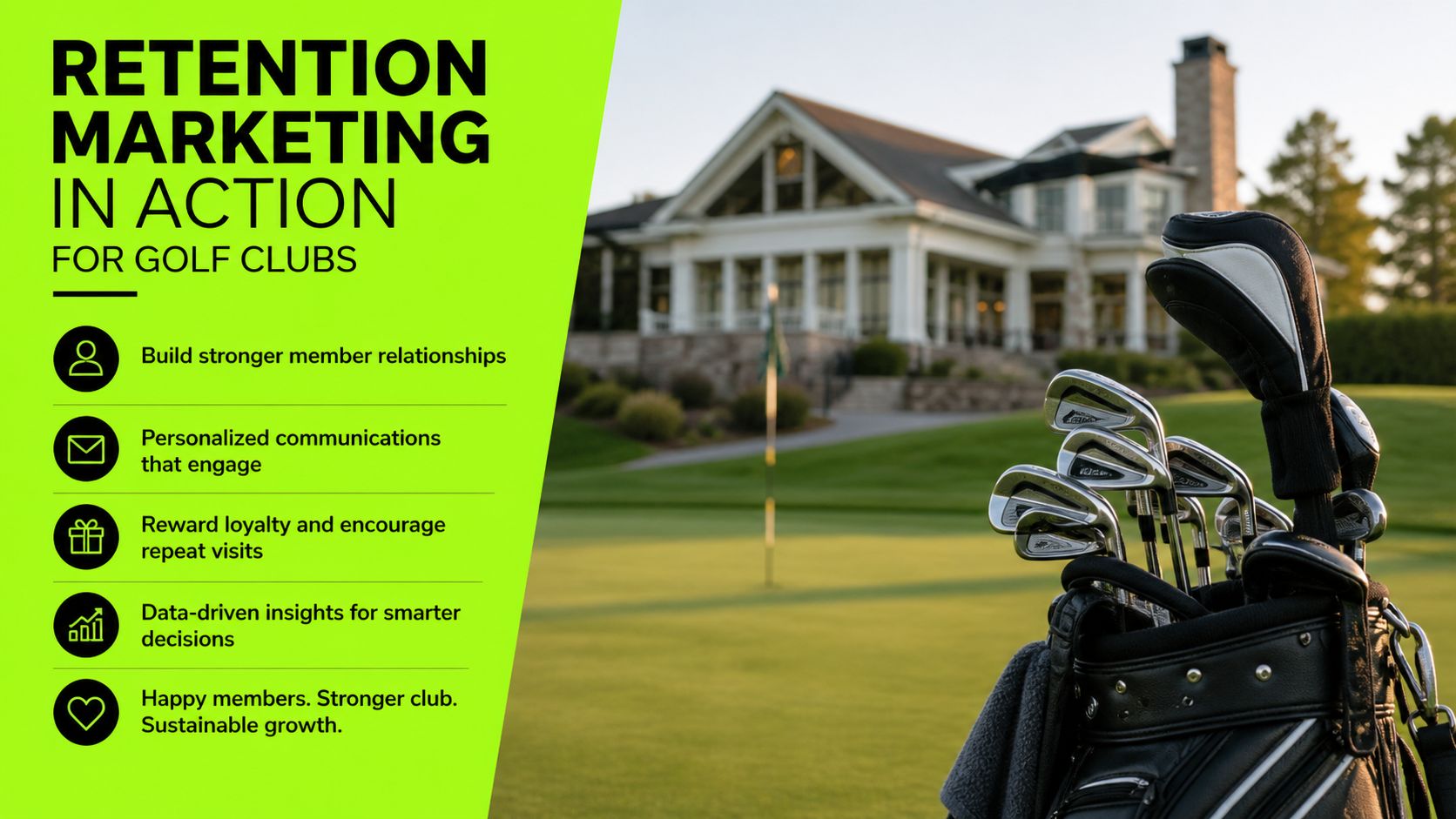
A retention system becomes easier to understand when the trigger and response are visible. The following examples aren't case studies or performance claims. They're practical scenarios a club can adapt to its own membership structure, staffing and tone of voice.
A triallist who stops replying
A golfer requests membership information and attends a tour, but doesn't respond to the follow-up. The trigger is a stalled opportunity, not proof that the golfer has rejected the club.
The first message should refer to the visit and answer a likely question, such as playing access, competition entry or payment options. A later task can prompt a personal call. If there's still no response, the club can move the person into a lighter nurture sequence rather than repeatedly sending the same sales email.
The record should show the original enquiry, the tour date, the communication history and the reason for the next message. That information helps the next staff member continue the conversation without making the golfer repeat themselves.
A new member who hasn't found a routine
New members often need practical help more than promotional content. The club can trigger an onboarding journey after joining, then check whether the member has attended an event, booked a round or engaged with a welcome message.
If activity is limited, the next communication might offer a low-pressure introduction, a suitable event or a short call with a member of staff. The club isn't trying to force a transaction. It's helping the golfer cross the gap between having access and feeling comfortable using it.
GolfRep's golf-club reactivation campaign guidance is also relevant when a member or former member has become quiet. The message should reflect the person's history and give them a straightforward next step.
A renewal at risk after poor service
Suppose a member raised a complaint about a booking problem and never received a clear resolution. The CRM should flag the issue, assign an owner and record the outcome. Before renewal communication begins, someone should check whether the member's concern has been addressed.
The retention message then becomes service-led. It can acknowledge the resolution, invite feedback and explain what has changed. A discount may be unnecessary, and in some situations it could make the club appear to be buying silence rather than fixing the problem.
A former member with a relevant reason to return
A lapsed member may have left because their circumstances changed, not because their relationship with the club ended permanently. A reactivation journey can use the former member's previous category, interests and last interaction to choose a suitable message.
The next step should be easy, such as a conversation, a visit or an update on a service they previously valued. The club should also make it simple to decline further contact. Respectful communication protects trust even when reactivation doesn't happen.
Building Predictable Renewals With Retention Marketing
Predictable renewals begin well before the renewal notice. They depend on a sequence of small, visible actions that help golfers receive value, resolve problems and remain connected to the club.
Golf club leaders can start with a practical audit:
- Review enquiry response time: Compare the time of each new enquiry with the first meaningful response.
- Check lead visibility: Confirm that every opportunity has a stage, owner and next action.
- Map the member lifecycle: Identify what happens after enquiry, visit, joining, reduced activity, complaint and renewal.
- Create useful segments: Separate members by behaviour and need, not only by membership category.
- Measure movement: Track visits, follow-up, engagement, renewal conversations and outcomes in one system.
- Improve one weak stage: Fix the point where people most often disappear before adding more campaigns.
The central lesson is simple. Retention marketing isn't a points scheme placed on top of an unreliable process. It's the system that helps the club respond quickly, recognise changing behaviour and give each member a relevant reason to continue.
GolfRep helps golf clubs combine lead generation with CRM visibility, structured follow-up and lifecycle nurture, so managers can see the path from enquiry to visit, membership and recurring revenue. Visit GolfRep to explore how a more organised growth system could support your club's retention and renewal work.
Ready to tap into our proven growth system?