Golf Club Reactivation Campaign: A Practical Playbook
Most advice on a golf club reactivation campaign is too simple to be useful. It usually comes down to one idea: send a discount, remind people you exist, and wait for old members or stale enquiries to come back.
That's why most reactivation campaigns disappoint.
The problem usually isn't the email itself. It's that the club has no reliable way to identify who has gone quiet, no clear segmentation between different types of lapsed contact, no timed follow-up, and no visibility on what happened after the first message went out. A one-off promotion might create a short spike in attention. It rarely creates a repeatable pipeline.
At GolfRep, we see the same pattern again and again. Clubs don't typically struggle because nobody is interested. They struggle because enquiries sit in inboxes, old prospects disappear into spreadsheets, and staff end up relying on memory instead of a system. Reactivation only works when the club can see the full journey from inactivity to response to booked visit to membership decision.
Why Most Reactivation Campaigns Disappoint
A lot of clubs still treat reactivation as a creative problem. They ask what offer to send, what wording to use, or whether to include a discount. Those questions matter, but they come too early.
The first issue is usually structural. If your database is messy, if your team can't quickly tell the difference between a former member and an old trial enquiry, and if nobody owns follow-up after a response comes in, the campaign is built on weak foundations.
Discounts don't fix the real problem
UK golf commentary keeps coming back to the same point. Clubs need to think more like new golfers and offer flexible membership models, not just push traditional membership harder, as discussed in this UK golf industry commentary on flexible models. That matters because many lapsed golfers haven't disappeared due to a lack of awareness. They've stepped away because the club no longer fits their routine, budget, or playing habits.
A blunt discount doesn't solve that. It can even create a different problem by training people to wait for the next offer.
What works better is a system that answers practical questions:
- Who has gone inactive: Not everyone in the database should receive the same message.
- Why did they disengage: Price, time, commitment level, confidence, and convenience all lead to different objections.
- What happens when they reply: If the club can't respond quickly and move them to the next step, the campaign leaks value.
A reactivation campaign fails long before launch if the club can't see who it's reactivating, why they've gone quiet, and who will handle the response.
The hidden issue is operational discipline
There's also a deliverability problem that many clubs miss. If you keep sending to stale or invalid records, your email performance gets weaker over time. Before launching any serious win-back sequence, it helps to clean the list and protect sender reputation, especially if the database has been sitting untouched for a while.
That's not glamorous. It is necessary.
A proper golf club reactivation campaign behaves more like a managed funnel than a newsletter blast. You need a clear inactivity trigger, a sequence rather than a single message, fast handling of replies, and a simple way to record outcomes. Otherwise the club learns nothing from the effort and has to start from scratch every time.
What usually goes wrong
Here's the pattern behind weak results:
- One message only: The club sends a single email and assumes silence means no interest.
- One audience bucket: Former members, visiting golfers, trial users, and old enquiries all get lumped together.
- One generic next step: “Let us know if you're interested” creates friction. Clear booking or reply actions work better.
- No ownership after response: A warm reply sits too long because nobody is assigned to act on it.
That's why reactivation should be treated as infrastructure. Creative sits on top of it. It doesn't replace it.
Foundations First Segmentation and Offer Framing
Most clubs have more usable data than they think. The issue is that it's rarely organised in a way that helps the team act on it.
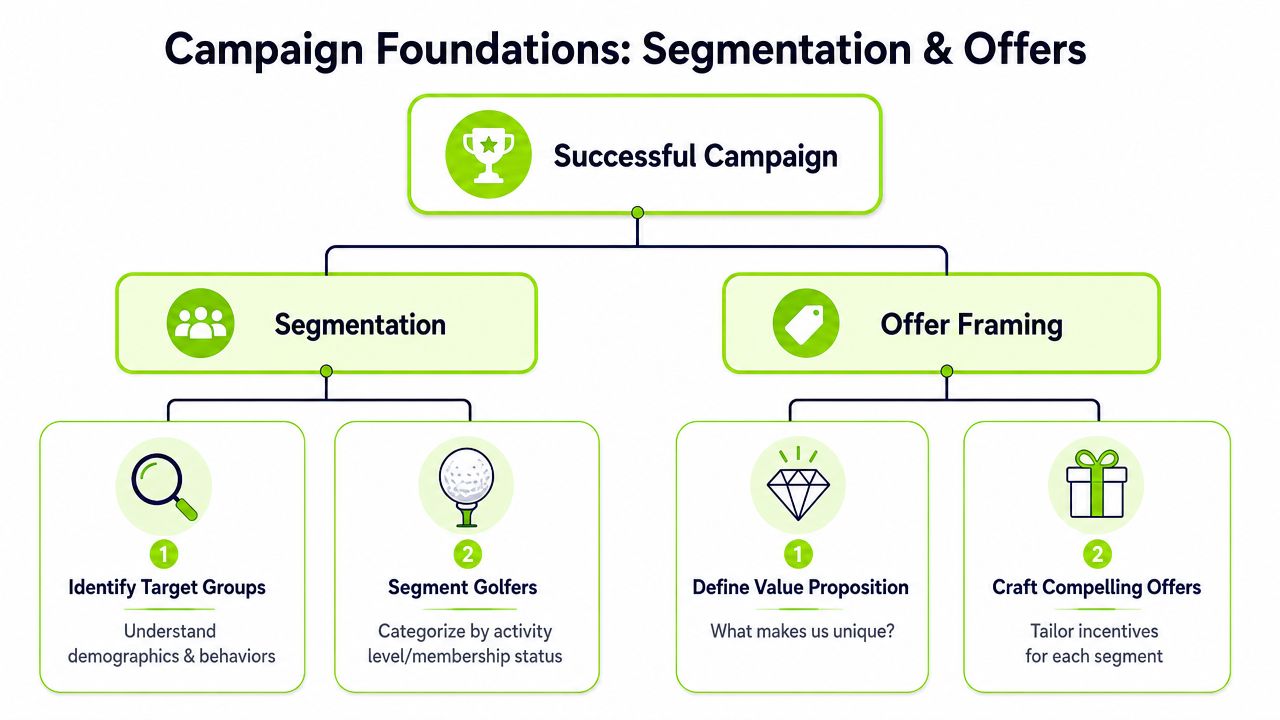
Before writing copy, separate the database by relationship history, not just by whether someone is “lapsed”. A former full member is not the same as a visitor who asked about joining last year. They need different framing, different timing, and often a different route back in.
Segment by real-world buying state
Start with groups that reflect how people disengage.
| Segment | What usually happened | What they need now |
|---|---|---|
| Former members | They knew the club, then left | A low-friction reason to revisit |
| Trial or introductory members | They sampled the club but didn't commit | Proof that the next step is worth it |
| Old membership enquiries | They asked, then went cold | A simple restart with less effort |
| Casual green fee players with joining intent | They engaged with the club but never crossed over | A bridge between visitor and member |
The point of segmentation isn't to be clever. It's to avoid tone-deaf messaging.
A former member might respond to “here's what's changed since you left.” An old enquiry might respond better to “if you still want to look around, booking a visit is straightforward.” Those are different conversations.
If your data is currently spread across inboxes, spreadsheets, and a booking system, fixing that first will save more time than rewriting your email three times. A clean, usable club database is the difference between a campaign and a guess. That's why building and maintaining a proper golf club database matters so much before reactivation starts.
Frame the offer around value, not panic
Consumer research cited by GolfNow found that 43% of surveyed golfers cited cost as the main barrier to playing, which is why value, access, and convenience often outperform discount-led messaging in practice for clubs trying to win people back, according to this GolfNow business research on golfer behaviour.
That doesn't mean price is irrelevant. It means “cheaper” isn't always the strongest message.
Practical rule: If your offer lowers the barrier but lowers the brand at the same time, it usually creates the wrong kind of response.
Better framing often looks like this:
- Access-led: Early booking access, quieter tee windows, or simpler ways to return to play.
- Experience-led: A welcome-back round, a hosted club introduction, or a paired re-entry experience with a professional.
- Flexibility-led: A route back for golfers who don't want full commitment immediately.
- Community-led: Rejoin the social side of the club, not just the competitive side.
Offers that protect the club's positioning
A useful test is to ask whether the offer would still make sense if the recipient weren't price-sensitive. If the answer is yes, it's probably a stronger campaign.
Good examples include:
- A hosted return visit: Invite former members to revisit the course and clubhouse with a specific booking slot.
- A “what's changed” reintroduction: Useful when facilities, programming, or atmosphere have improved.
- A flexible re-entry route: Especially relevant for golfers who found traditional membership too rigid.
- A social invitation: Open evening, mixed event, or beginner-friendly group setting for those who drifted away from the club environment.
Weak examples usually have one thing in common. They shout “special offer” but say very little about why returning would suit the golfer now.
Building Your Campaign Channels and Creative
Once the audience and offer are right, the channel mix becomes much easier. Most clubs don't need more channels. They need each channel to do one clear job.
Email usually carries the main message because it gives you room to explain the offer properly. SMS works best as a short nudge. Paid social can support the campaign by keeping the club visible to the same audience while they consider whether to act.

A simple three-message email arc
The messaging should feel like a conversation, not a broadcast. That means each email has a different purpose.
Email one: Reopen the door
This first message should be direct and easy to respond to.
Subject idea: Still thinking about golf at [Club Name]?
Body idea:
You showed interest in [Club Name] previously, and we wanted to get back in touch. If you're still looking for a club that fits your golf now, we'd be happy to help you take another look. We've made it easy to book a visit or reply with any questions.
This message shouldn't be overloaded. Its job is to restart attention.
Email two: Show what's relevant now
The second email should answer the quiet objection in the recipient's head. Why now?
Subject idea: What's changed at [Club Name]
Body idea:
Since you last looked at the club, we've continued to focus on making the member experience stronger. If flexibility, ease of booking, and a better fit for your playing habits matter, we can show you the options available and help you find the right route back in.
Many clubs go wrong by listing everything. Focus on what matters to that segment.
Email three: Close softly, not aggressively
The final message should create a clear point of decision without sounding desperate.
Subject idea: Shall we leave this open for you?
Body idea:
If returning to the club is something you'd still like to explore, this is a good time to book a visit or reply. If not, no problem. We only want to stay in touch if it's relevant.
That tone usually performs better than fake urgency.
SMS and paid social play a support role
SMS should be brief and specific. It isn't the place for a long pitch.
Examples:
- For former members: Hi [Name], if you'd like to take another look at [Club Name], you can book a visit here: [link]
- For old enquiries: Hi [Name], just checking whether joining a golf club is still on your list. If yes, reply and we'll help from there.
Paid social works differently. It isn't there to explain every detail. It's there to keep the club front of mind while the contact sees the email or SMS.
A practical setup often includes:
- Custom audience matching: Upload segmented contact lists where consent and platform rules allow
- Short reminder creative: Familiar course imagery, clear message, no clutter
- One action only: Book a visit, request a callback, or revisit membership options
Keep the tone consistent across channels. If the email says “welcome back” and the ad screams “limited offer”, the campaign feels disjointed.
Clubs often over-design reactivation creative. In practice, clarity wins. A recognisable club identity, a relevant message, and an obvious next step usually beat clever copy.
The Engine Room Automation and CRM Systems
This is the part most clubs skip, then wonder why the campaign becomes hard to repeat.
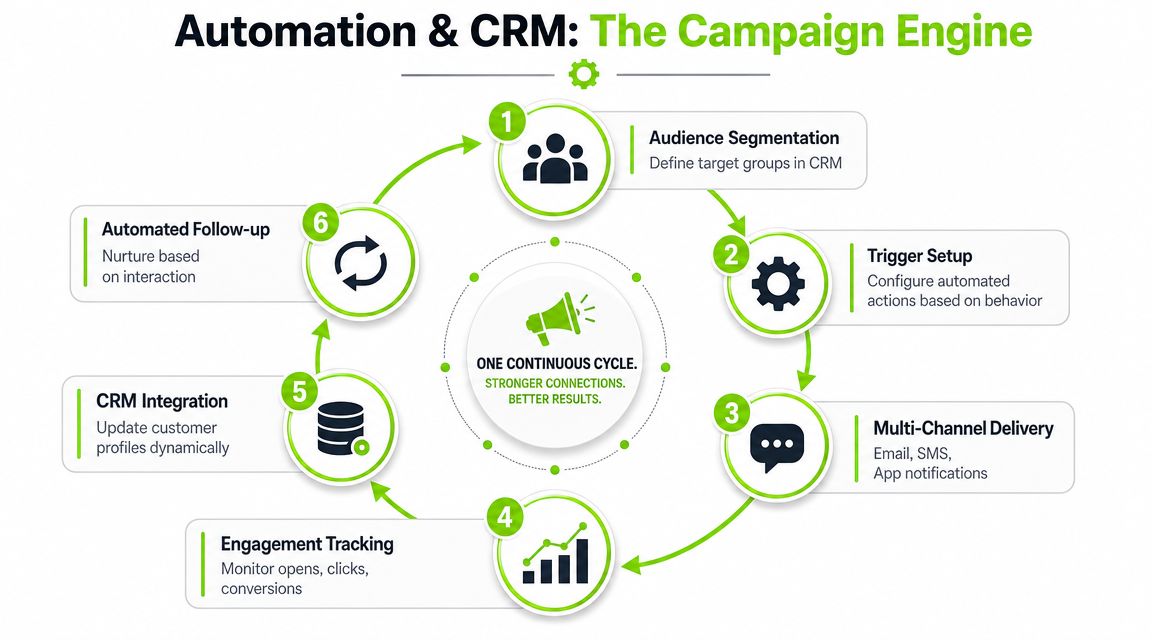
A golf club reactivation campaign only becomes reliable when it's built into a CRM and automation workflow. Otherwise every round of outreach depends on somebody remembering to export a list, write a message, send a follow-up, and log replies manually. That's not a system. It's an occasional effort.
A strong workflow uses at least three touches over about two weeks, triggered by a defined inactivity window such as 90 days, and this type of sequence can typically recover 5 to 15% of an inactive list, with strong campaigns reaching up to 25%, based on published reactivation guidance from Inbox Collective's reactivation workflow benchmark.
What the workflow needs to do
The CRM should handle three things without fail.
First, it needs to identify inactivity clearly. That might mean no round booked, no membership progress, no reply to an enquiry, or no engagement after a trial period. If the trigger is vague, the list will be weak.
Second, it needs to launch the sequence automatically. The campaign shouldn't rely on a staff member remembering to send message two on Friday afternoon.
Third, it needs to create visibility for the team. If someone clicks, replies, or books, the system should update the contact record and prompt the next action.
The manual process breaks in predictable places
Most clubs see the same failure points when this is handled by hand:
- Missed timing: The follow-up goes out too early, too late, or not at all.
- Lost responses: A reply lands in a shared inbox and sits there.
- No lead status clarity: Staff can't quickly tell whether someone is warm, inactive, booked, or closed.
- No reporting trail: The club knows messages were sent but can't tie activity back to visits or joins.
That's why a central CRM matters more than the email platform itself. The sending tool is only one layer. The core value is in status tracking, task creation, and conversion visibility.
A practical setup for clubs
For most clubs, the automation flow doesn't need to be complex.
A workable structure looks like this:
- Trigger: Contact reaches inactivity threshold.
- Sequence starts: Email one sends automatically.
- Timed follow-up: Email two and then email three follow if there's no action.
- Behaviour rules: Clicks, replies, and bookings move the contact into a different path.
- Staff task: Warm leads trigger a call, email, or invitation from the team.
- Outcome logging: Visit booked, membership discussion, no interest, or suppress from future sends.
A club can build this in several CRM and marketing automation platforms. Where clubs want a golf-specific approach, GolfRep's golf club automation systems are designed around timed follow-up, lead visibility, and conversion tracking rather than just mass communication.
If your team still asks, "Who is meant to call this person?", the system isn't finished.
The biggest benefit isn't just saving time. It's consistency. The campaign keeps working even when the office is busy, staff change, or membership admin gets pulled into other operational work.
Measuring What Matters KPIs and Optimisation
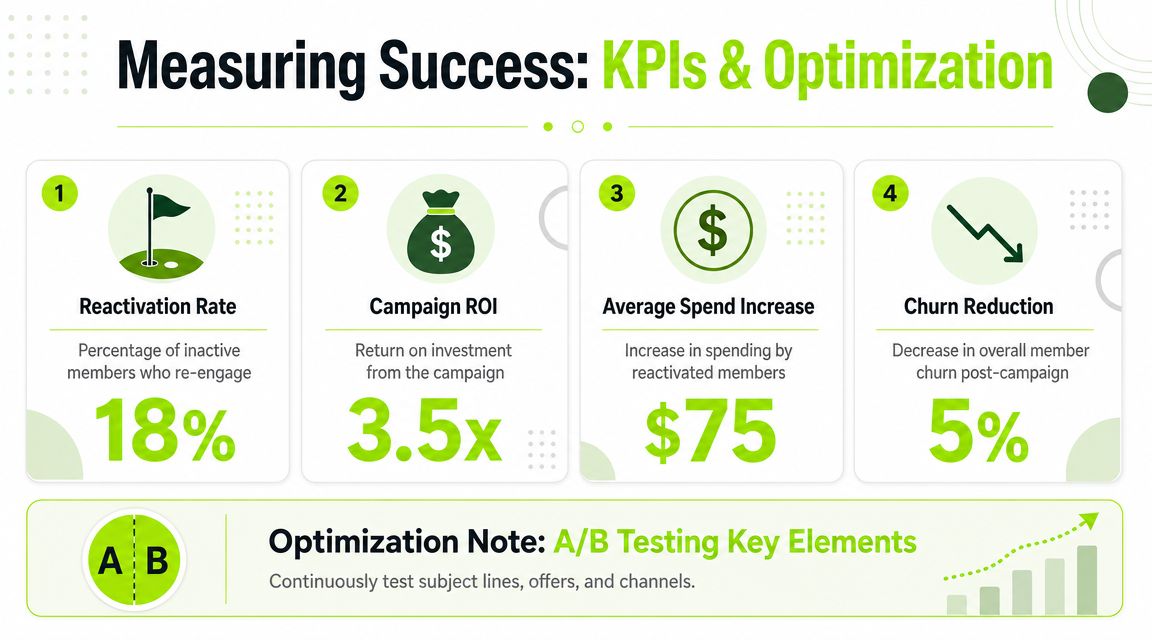
A reactivation campaign shouldn't be judged by whether people said the email looked good. It should be judged by whether inactive contacts moved back into meaningful action.
That sounds obvious, but clubs often stop at opens and clicks because they're easy to see. Those aren't useless metrics. They're just not the end point.
The KPIs that actually matter
The most useful measures are the ones tied to club activity and revenue movement.
| KPI | Why it matters |
|---|---|
| Click-through rate | Shows whether the message and call-to-action created intent |
| Reply rate | Useful for higher-consideration offers where people ask questions before booking |
| Booked visits or tours | Strong indicator that reactivation is turning into sales opportunity |
| Re-activated memberships | The clearest commercial outcome |
| Suppression or opt-out pattern | Tells you if the messaging is too broad, too frequent, or poorly matched |
Open rate still has value as a diagnostic signal, but it's not enough on its own. A campaign can generate opens and still produce very little pipeline.
Start small before scaling
One of the most practical benchmarks in reactivation is to pilot on 100 to 200 records first, validate the logic, and keep the SMS STOP rate under 2% before rolling the winning variant into the full list, based on this reactivation pilot guidance from RevSquared.
That's good discipline for clubs because it reduces the risk of a poor send damaging the list or frustrating contacts.
A small pilot tells you things your team can't guess in advance:
- Whether the audience was segmented correctly
- Whether the offer sounds relevant
- Whether links, forms, and reply paths work properly
- Whether one message angle clearly outperforms another
Test the campaign logic before you test scale. Most mistakes are operational, not creative.
What to test first
A/B testing at club level doesn't need to be complicated. Start with changes that affect response quality, not cosmetic details.
Good first tests include:
- Subject line angle: Curiosity versus clarity
- CTA wording: Book a visit versus reply to discuss
- Offer framing: Flexible return versus hosted welcome-back experience
- Channel order: Email first with SMS support, or SMS after clear email engagement
Avoid testing too many things at once. If subject line, offer, and call-to-action all change together, you won't know which variable mattered.
Tracking these outcomes also helps when you need to justify spend or system changes internally. For clubs under pressure to show commercial return, the discussion becomes much clearer when the team can connect campaign activity to booked visits and signed members. That's the thinking behind a more accountable view of the real ROI of golf club marketing.
Implementation Notes for Your Golf Club
The way you apply this playbook depends heavily on how the club is run. The principles stay the same. The operational pressure points don't.
Committee-run clubs need continuity
Committee-led clubs often have a predictable challenge. Decisions are shared, time is limited, and marketing activity can become fragmented because responsibility changes hands.
In that environment, reactivation should be presented as a continuity system rather than a campaign idea.
A practical committee conversation usually lands better when it focuses on:
- Process stability: The follow-up keeps running even when volunteer roles change.
- Lead visibility: Everyone can see status instead of relying on one person's inbox.
- Measured outcomes: The club can review booked visits and rejoin activity instead of debating opinions.
- Brand protection: Offers stay controlled rather than becoming a series of ad hoc discounts.
A common example is the club that has years of old enquiries sitting in spreadsheets and email folders. The committee assumes the leads are “cold”, but the problem is that nobody has reintroduced the club properly through a timed sequence and tracked the response.
Multi-site operators need central control with local relevance
Resort groups and operators face a different problem. They usually have more data, more locations, and more opportunity for inconsistency.
One site may follow up well. Another may leave warm leads sitting untouched. One manager may localise the offer intelligently. Another may improvise something that doesn't fit the wider brand.
The answer isn't to centralise every conversation so tightly that local teams lose flexibility. It's to centralise the system and localise the message.
That tends to mean:
- One CRM structure across sites
- Shared automation rules and reporting standards
- Local offer variants based on course, membership type, and audience
- Clear ownership rules for who handles each response
The club group doesn't need every site to say the same thing. It needs every site to follow the same process.
The larger point is simple. A golf club reactivation campaign shouldn't live as a one-off spreadsheet exercise. It should become part of the club's operating model. Once the triggers, segmentation, follow-up, and reporting are in place, the club stops relying on bursts of effort and starts building a repeatable growth asset.
If your club wants to turn reactivation into a reliable pipeline rather than another one-off send, GolfRep helps golf clubs put the CRM, automation, follow-up, and conversion tracking in place so every enquiry and lapsed contact has a clear next step.
Ready to tap into our proven growth system?