Golf Club Membership Fees: Pricing Structures Explained

UK private golf club membership fees typically sit between roughly £1,000 and £2,500 a year, with joining fees commonly adding £1,500 to £2,000 upfront. But the number itself is only half the picture, because clubs usually lose prospective members after the fee is presented, when slow replies, unclear categories and weak follow-up turn a considered enquiry into silence.
The popular advice is to lower the price whenever membership enquiries slow down. That advice is usually wrong. A fee protects value only when the club can explain what it includes, show which category fits the prospect, and follow up with the same confidence as the published schedule. Golf club membership fees are a conversion issue as much as a pricing issue.
From GolfRep's perspective as a UK growth partner for golf clubs, the committee's real problem is rarely a lack of interest. It's the gap between an enquiry booked, a fee discussed and a signed application returned. A club can generate a healthy flow of prospects and still struggle to grow if nobody owns the next conversation.
Why Most Clubs Lose on Follow-Up, Not on Price
Price is an obvious explanation for a lost enquiry, so committees reach for it first. A prospect asks about membership, hears the annual subscription and disappears. The conclusion seems simple: the fee is too high.
That conclusion often overlooks what happens around the figure. Clubs regularly take too long to respond, give different answers depending on which staff member or committee member handles the enquiry, or send a fee sheet with no explanation of playing rights, joining terms or payment options. The prospect isn't comparing a complete membership proposition. They're trying to decode an unexplained cost.
The commercial leak usually appears between the first fee conversation and the signed application. An enquiry can be qualified, interested and even willing to visit, yet still stall because the club has no defined follow-up cadence. One person assumes another person is calling. A committee member waits for the prospect to come back. The club records the initial enquiry but not the stage at which the prospect went quiet.
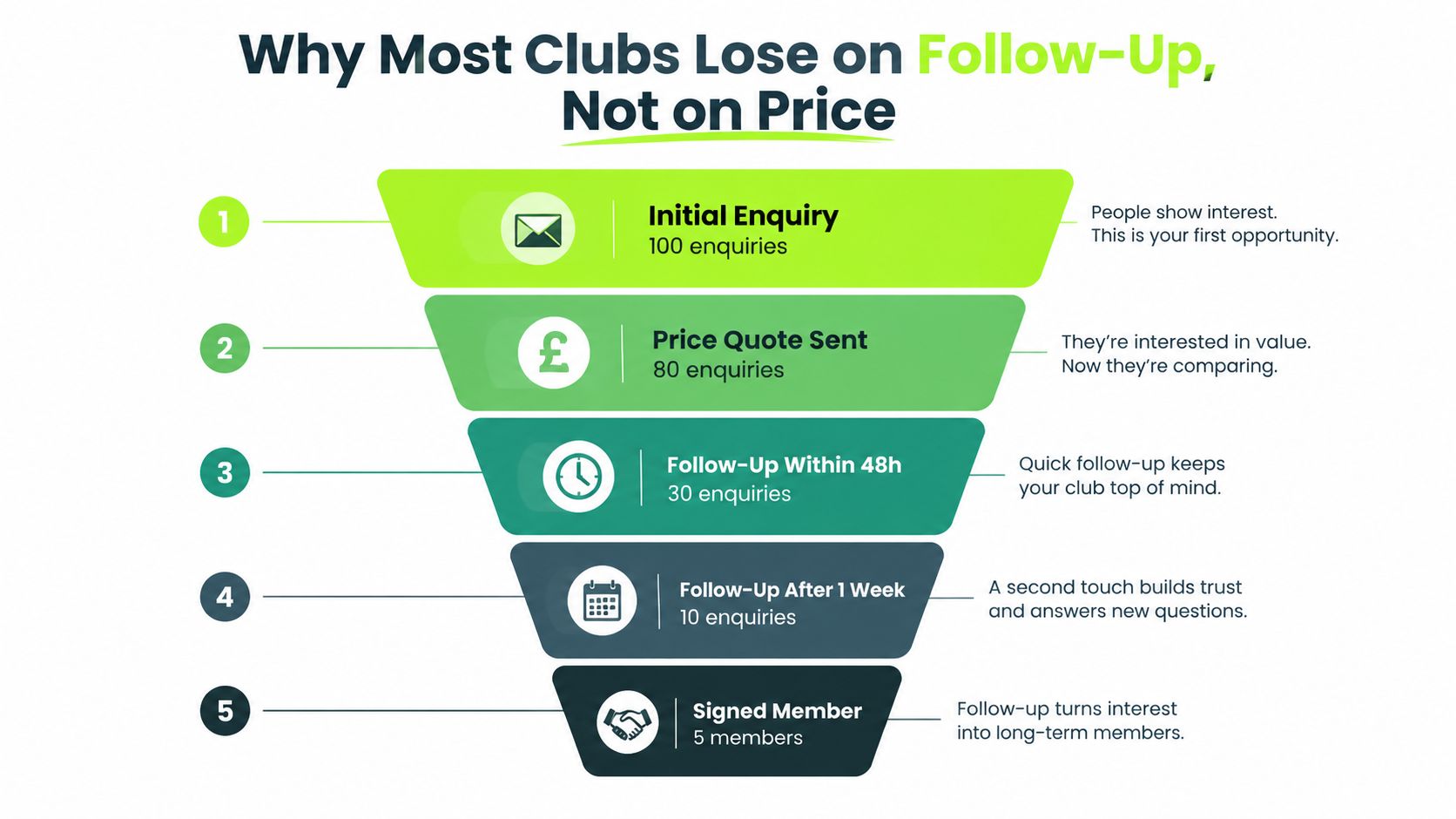
The operational causes behind the drop-off
A fee conversation needs an owner and a next action. At minimum, the club should know:
- Response time: How quickly did someone acknowledge the enquiry?
- Lead visibility: Can the general manager see every open prospect and its current stage?
- Category clarity: Was the prospect shown the right playing, age or social option?
- Conversion tracking: Does the club know whether the application was sent, viewed, discussed or signed?
- Follow-up responsibility: Is one named person accountable for the next contact?
This is why systems outperform goodwill. A CRM, structured reminders and consistent templates prevent an interested golfer from being forgotten when the club team gets busy. A practical overview of broader operational discipline is available in this Caddie Wheel course management guide, which is useful context for committees reviewing how administration affects member experience.
Clubs that protect their fees generally outperform clubs that discount them, but only when the enquiry process supports the confidence implied by the price. For a closer look at the wider leakage problem, see how most golf clubs lose enquiries without realising. The committee should audit the handover after every fee conversation before it debates a reduction.
The Three Building Blocks of a Membership Fee
A membership schedule isn't one price. It combines annual subscription, joining fee and category structure, and each element affects how a prospect judges the total commitment.
The annual subscription is the anchor. It signals the club's position and is usually the figure prospects remember. Recent Hillier Hopkins surveys found UK standard playing fees clustered around £1,000 to £1,612, with £1,612 described as the upper CASC threshold. In the 2022 survey, 74% of clubs charged more than £1,000, and the pattern remained broadly unchanged by 2023 (Hillier Hopkins Golf Clubs Report 2022/23).
The joining fee sits above that recurring cost. It can recover upfront investment, signal commitment and separate a serious applicant from someone casually collecting prices. In the 2024/25 Hillier Hopkins report, joining fees ranged from £75 to £6,200, with an average of £1,830, up from £1,770 in 2023 (Hillier Hopkins Golf Clubs Report 2024/25).
Categories change the buying decision
Categories adjust access and affordability without necessarily weakening the flagship offer. Age bands, mid-week access, flexible playing rights and social membership can all serve distinct needs, but the club must state the restrictions plainly.
A representative schedule might show a £1,450 annual subscription, a £1,750 joining fee and an intermediate or flexible category at £895. Those figures are illustrative, not a market statistic. The important point is that the prospect evaluates the first-year outlay, access rights and future progression together.
| Building Block | Typical UK Range | What It Signals |
|---|---|---|
| Annual subscription | Around £1,000 to £2,500 for many private clubs | Core positioning and access |
| Joining fee | £75 to £6,200 in the 2024/25 Hillier Hopkins survey | Commitment, entry status and capital contribution |
| Categories | Varies by age, access and usage | Flexibility without reducing the flagship anchor |
The schedule should therefore show first-year cost, recurring cost and the conditions attached to every category. A prospect shouldn't need a second call to discover that the cheaper option excludes weekend play or is unavailable to new joiners.
Benchmarking UK Club Membership Fees by Tier
Benchmarking should answer one question: does this fee make sense for the experience and access the club provides? It shouldn't trigger an automatic race to match the nearest competitor.
A 2026 UK guide places annual membership at about £500 at modest municipal courses and above £5,000 at prestigious private clubs, with mid-range private membership in England commonly budgeted at £1,200 to £2,500 (UK golf course membership costs guide). A separate 2026 survey reported fees collected from members' clubs ranging from £200 to £3,870, with an average of £1,760 (Golfshake membership fee survey).
These sources describe a broad market, not a single correct price. A member-owned club may compete through community, governance and accessibility. A traditional private club may justify more through course condition, service and controlled access. A municipal operator may win with convenience and a lower barrier to entry.
| Club Tier | Annual Subscription | Typical Joining Fee | Positioning Signal |
|---|---|---|---|
| Municipal or accessible local operation | About £500 upward | May be low or absent | Convenience and affordability |
| Member-owned or accessible private club | Often within the wider £1,000 to £1,612 survey band | Can be modest or substantial | Community, participation and member governance |
| Mid-range private club | Commonly £1,200 to £2,500 | Often meaningful, depending on demand | Service, course quality and controlled access |
| Prestigious private club | Can exceed £5,000 | Can reach several thousand pounds | Exclusivity, reputation and scarcity |
A 2026 local authority schedule illustrates how segmentation works in practice. It lists an adult annual charge of £581, a senior charge of £436 and a youth rate of £86 for under-22s, alongside a direct-debit option (SL Leisure and Culture golf price list). That isn't a direct comparator for a private members' club, but it demonstrates why a single “average membership fee” can mislead.
Use benchmarking as a sanity check, then apply your own capacity, retention and service data. The GolfRep guide to golf club pricing strategy is useful when the committee needs to move from competitor comparison to a defensible commercial decision.
Designing Categories That Protect Headline Value
Category design should widen access without weakening the club's main offer. The full seven-day adult category belongs at the top of the schedule, where it anchors the value of unrestricted play. Every lower tier should have a clear reason to exist and a restriction the club can enforce.
A strong structure separates genuine needs:
- Age-based categories: Use clear life-stage rules, such as early-career or intermediate membership, with published progression.
- Day-use categories: Limit access to weekday or defined five-day windows where capacity supports it.
- Residency categories: Consider overseas or county residency only when the club can verify eligibility and the access rules are easy to administer.
- Social categories: Offer clubhouse, dining or event access without presenting it as a cheaper substitute for playing membership.
One 2026 UK club schedule shows how several layers can sit together. It lists a £1,699 joining fee, full membership at £1,699, mid-week membership at £1,380, social membership at £150, and progressive age-band prices from £630 to £1,095 (2026/27 membership schedule). The schedule demonstrates the principle clearly: entry fees, recurring dues and age progression are separate decisions.
Where category structures fail
Clubs erode their headline value when categories overlap, when access limits are vague or when a discounted tier becomes the default answer to every objection. A five-day plan reserved for existing members, or an age-banded offer with sharply different prices, can create a second problem if the website doesn't explain availability to new joiners. Recent coverage has highlighted this access question, including returning waiting lists, joining fees and category limits (Golfshake coverage of waiting lists and joining fees).
The best categories are mutually exclusive, limited and tied to capacity. A weekday category should reflect available tee-time windows. A younger-member category should have a clear progression path. A social category should be sold as a different product, not as a bargain version of full golf.
International subscription businesses face a similar segmentation challenge, and this resource on segmentation for international growth offers useful thinking on how tiers can serve distinct users without making the core offer meaningless.
| Category | Eligibility Criteria | Typical Annual Fee (£) | Strategic Purpose |
|---|---|---|---|
| Full adult | Open to qualifying adult applicants | Highest published playing rate | Anchor unrestricted value |
| Intermediate | Defined age band | Below full rate | Capture younger members and create progression |
| Mid-week | Weekday access rules | Below full rate | Use off-peak capacity |
| Flexible or overseas | Verified usage or residency criteria | Variable | Serve lower-frequency players |
| Social | No standard playing rights | Lower than playing categories | Monetise clubhouse and community access |
Joining Fees, Instalments and How Fees Get Presented
Joining fees do work that annual subscriptions alone can't. They signal commitment, help fund capital improvements and make the entry decision feel like a meaningful membership rather than a casual purchase. But the same fee can create unnecessary friction when the club explains neither its purpose nor its payment options.
The 2024/25 Hillier Hopkins survey found that 62% of members' clubs allowed joining fees to be paid in instalments, down from 74% in 2023. The most typical social membership charge remained between £50 and £150 for 49% of members' clubs (Hillier Hopkins Golf Clubs Report 2024/25). These figures show why the payment structure deserves its own place in the fee conversation.
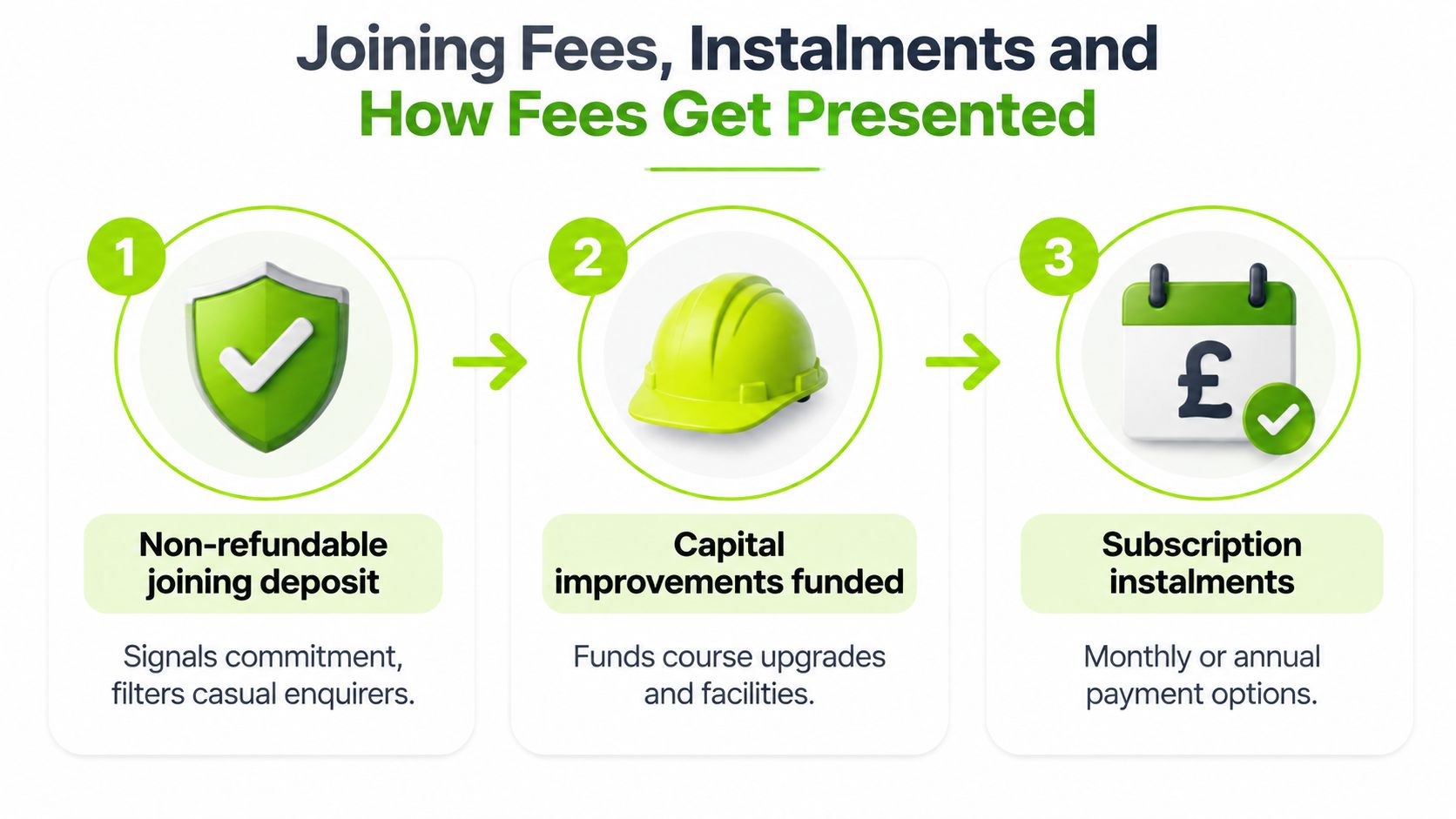
Keep payment flexibility separate from discounting
Monthly direct debit, quarterly billing or staged joining payments can improve affordability without changing the published price. That distinction matters. The club should present the annual subscription and joining fee first, then explain how the applicant can pay.
A clean fee page should show:
- Annual subscription: State the recurring amount and what access it provides.
- Joining fee: Itemise it separately and explain what it supports.
- Payment schedule: Show instalment timing, eligibility and any conditions.
- First-year total: Make the actual initial commitment easy to understand.
- Next step: Tell the prospect how to arrange a visit or submit an application.
The club shouldn't bundle a first-year reduction, a waived joining fee and delayed payment into a permanent “offer”. That teaches prospects to wait for the next concession and gives committee members no reliable baseline for measuring conversion.
Practical rule: Change the timing of payment before changing the value of the fee.
Follow-up must reflect the structure. After sending the schedule, the club should ask whether the prospect wants help comparing categories, not whether they've made a decision. A written explanation of capital spending, access rights and progression gives the prospect something concrete to discuss with their household or playing partners.
Converting Fee Conversations Without Discounting
The first 48 hours after a fee enquiry are the club's highest-value operating window. The objective isn't to pressure the prospect. It's to remove uncertainty while interest is still active.
Start with a prompt acknowledgement that confirms the enquiry has reached the right person. Then provide the relevant category, not a generic list of every membership type. If the prospect has explained that they play mostly during the week, the response should address mid-week access directly and identify any restrictions.
A practical response sequence
First, acknowledge and qualify. Confirm the prospect's playing pattern, age eligibility where relevant, location and preferred access. Don't send a price without knowing which category they might be considering.
Next, arrange a visit. A structured tour is more useful than an unframed free round. Show the course, clubhouse and relevant facilities, then provide a written summary of access, joining terms and the next application step.
Then, follow up deliberately. A call within 24 hours gives the prospect a chance to raise objections while the visit is fresh. A written summary within 48 hours prevents misunderstandings. A final check-in should follow any genuine application or category deadline.
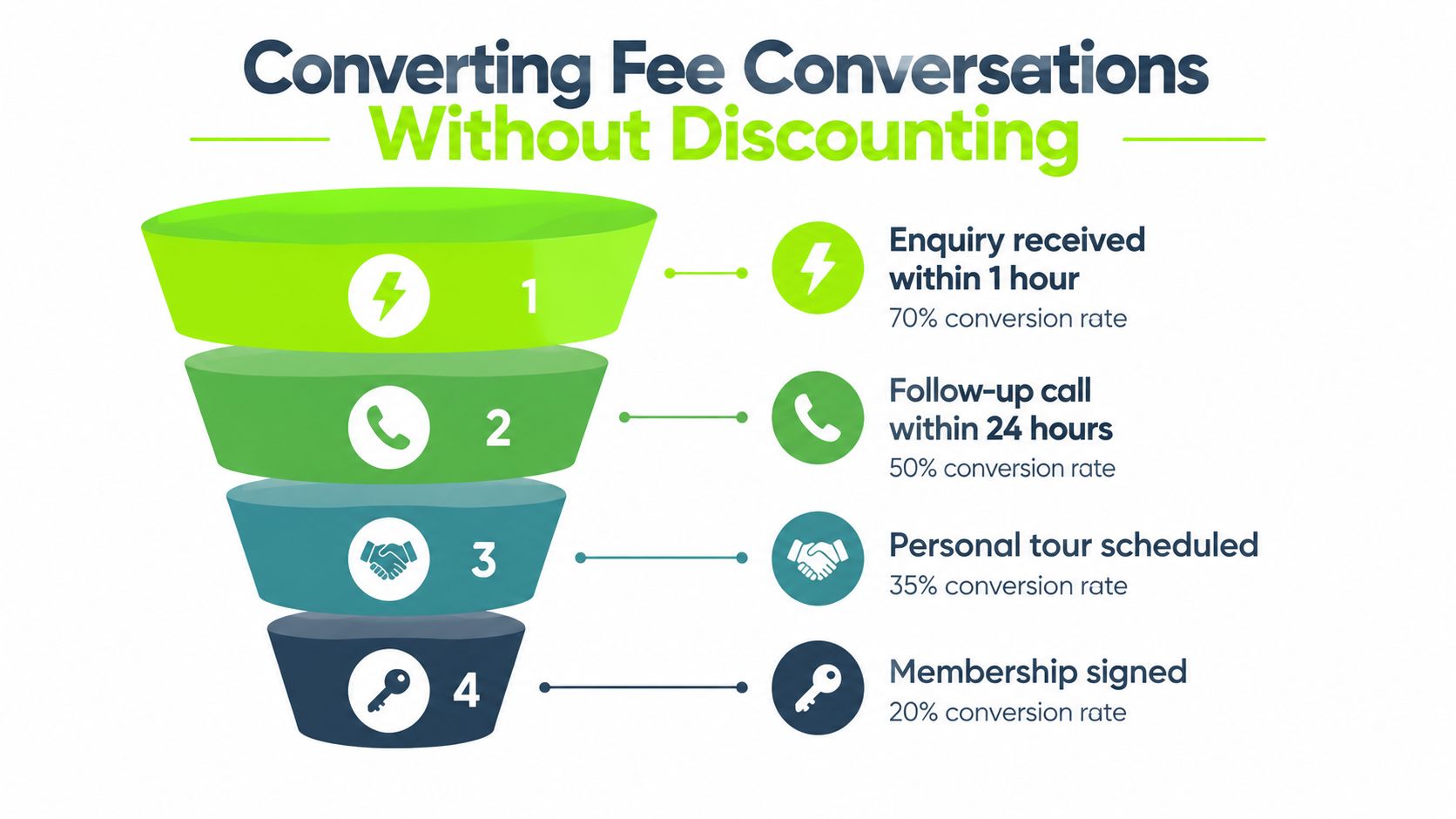
Use evidence of fit instead of a cheaper price
A club can create urgency without cutting the fee. A genuine category cap, a real tee-time limitation or a documented joining window gives the prospect a reason to act. A current member introduction can also help, provided it's relevant and doesn't feel staged.
Discounting weakens the entire sequence because it suggests the published figure was negotiable all along. When a prospect hesitates, the committee's instinct is often to “give them something”. The better move is to find out whether the objection concerns affordability, access, timing, spouse or family use, or a lack of confidence in the club's value.
Every stage should be recorded. A defined sales process makes that discipline easier, and the GolfRep golf club sales process guide provides relevant context for clubs reviewing how enquiries move from first contact to signed membership.
Building a Pipeline That Holds Fee Integrity
Predictable membership growth doesn't come from repeated price cuts. It comes from a pipeline where the club can see every enquiry, assign every next action and learn exactly where prospects stop progressing.
The committee needs a written pricing policy before the next enquiry spike. That policy should define the flagship category, permitted concessions if any, eligibility rules, joining fee treatment and who has authority to approve exceptions. If the rules are decided in the middle of a sales conversation, the prospect controls the negotiation.
Four behaviours for committee control
Follow up consistently. Set a clear standard for contact after the initial enquiry and after the visit. The club should be able to identify overdue actions without searching through personal inboxes.
Present fees transparently. Keep subscriptions, joining fees, categories and payment schedules separate. Explain the value of each component instead of hiding the total behind “contact us”.
Review the pipeline routinely. A weekly review should cover new enquiries, visits booked, applications issued, applications returned and stalled prospects. The purpose is to improve the process, not blame the person handling the lead.
Track enquiry-to-sign conversion. Lead volume alone doesn't tell the committee whether the fee structure works. Track source, category, response time, visit status and final outcome so the board can distinguish a pricing objection from an operational failure.
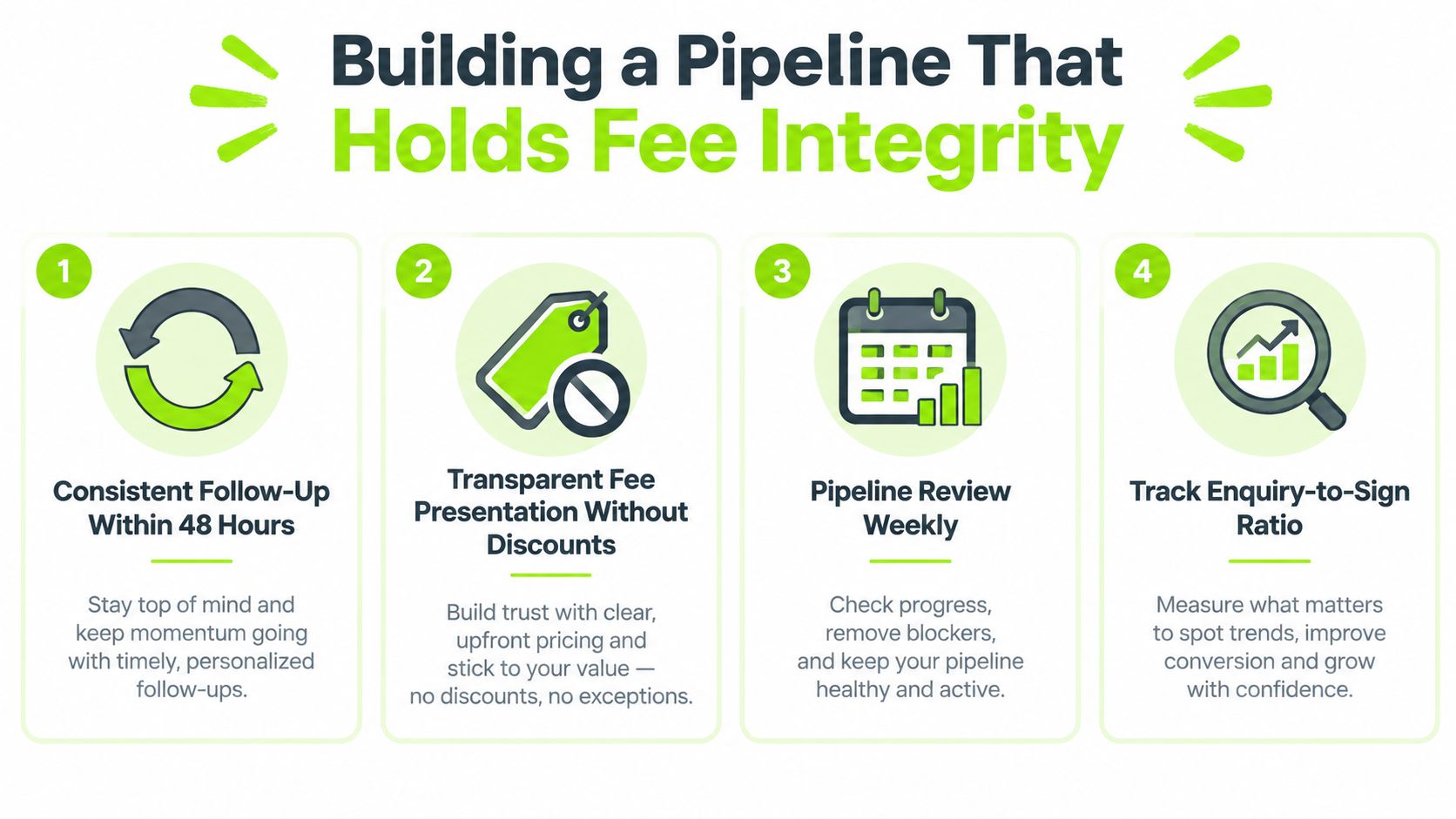
Put the right people around the decision
A small leadership group should be authorized to decline ad hoc discount requests. That doesn't mean refusing every payment arrangement. It means separating affordability support from a reduction in the club's stated value.
The club should also review pricing against usage, retention and category demand rather than competitor gossip. If a five-day category is full while full membership enquiries stall, the answer may be capacity design or weak presentation, not a lower headline rate. If prospects repeatedly ask what the joining fee funds, the answer is a communication gap.
At the next board meeting, ask:
- Can we identify every open enquiry?
- Who owns the next follow-up?
- How quickly do prospects receive a complete fee explanation?
- Which categories are available to new joiners?
- Where do applications stall?
- Are payment plans being used instead of discounts?
- Does our data support a pricing change, or does it point to follow-up failure?
GolfRep helps clubs combine lead generation with structured follow-up, CRM visibility and automated nurture so committees can see the path from first enquiry to signed membership without weakening the published fee structure. Visit GolfRep to discuss how a more organised membership pipeline could support your club's current pricing policy.
Ready to tap into our proven growth system?