10 Lead Management Best Practices for Golf Clubs in 2026
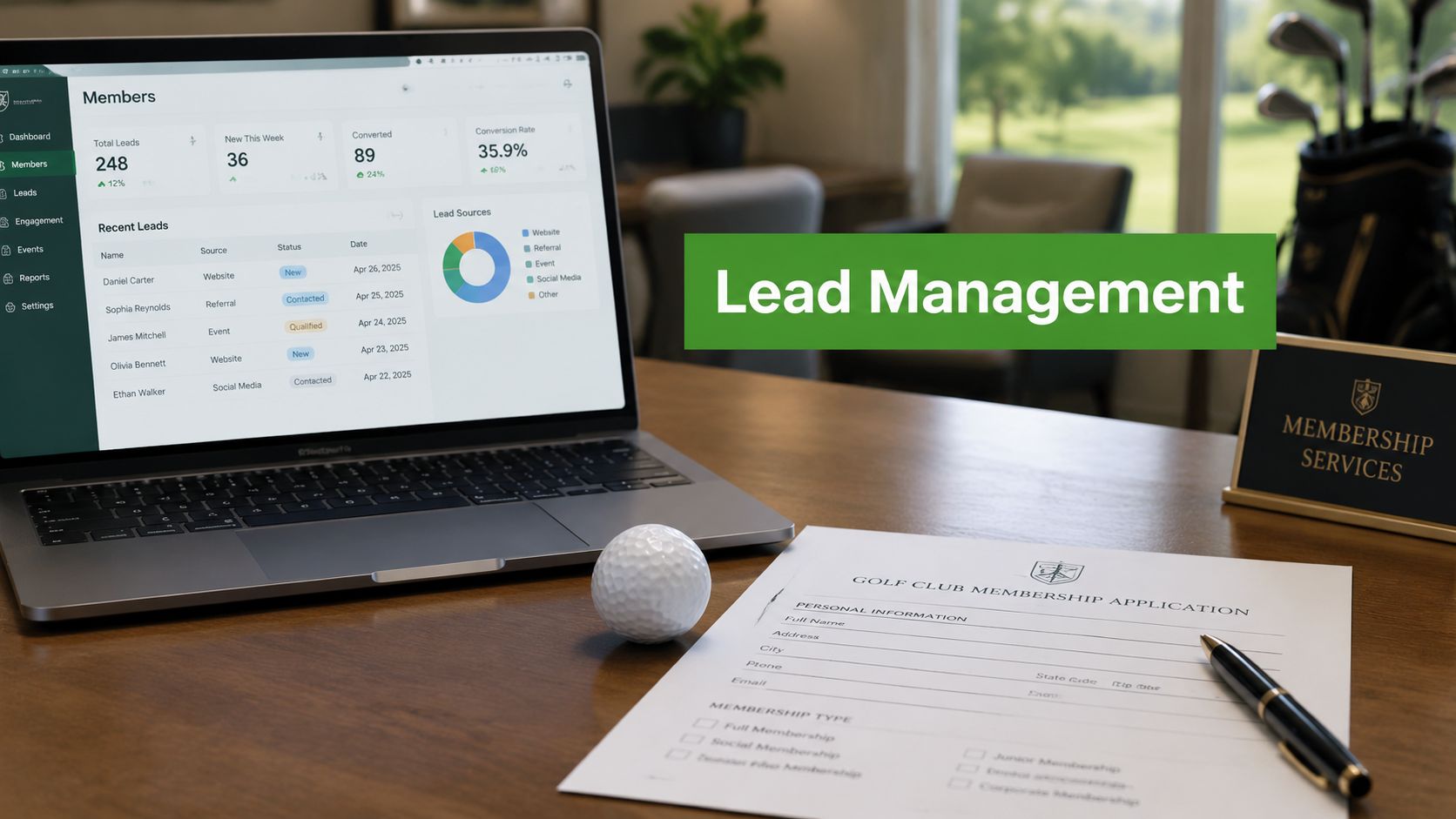
A membership enquiry arrives through the website while the secretary is on the course. Another reaches a shared inbox, a third appears as a missed call, and a fourth comes through social media. By evening, prospects may have received different answers, or none at all.
That is a lead management problem. Enquiry generation matters, but capturing, responding, qualifying and converting them consistently matters more. A prospective golfer does not see the club's CRM, inboxes or committee structure. They judge whether the club replies promptly, understands what they want and makes the next step straightforward.
Response speed deserves operational attention. UK response-time research found that 78% of customers buy from the first company to respond, while businesses averaged 47-hour response times and only 7% achieved a response within five minutes. For a golf club, that delay can determine whether an interested golfer books a visit, considers golf lesson vouchers, or moves on to another club.
This guide presents 10 lead management best practices for golf clubs, covering the complete route from enquiry capture to membership sign-up. The focus is practical: how clubs can handle interest consistently, qualify the right prospects, support those who are not ready, and make the move from first conversation to membership easier. It also examines visit bookings, attendance, post-visit follow-up and the quality of the eventual member.
1. Implement a Centralised Lead Management System
A centralised system gives every enquiry one visible record. Website forms, phone calls, emails, social messages, referrals, membership questions and event enquiries should all enter the same process.
A mixed setup of inboxes, spreadsheets and personal memory may cope with light demand and one responsible person. It becomes unreliable when the membership secretary is away, a volunteer changes, or several staff members contact the same prospect without seeing the conversation history. The result is duplicated work, missed follow-up and inconsistent answers.
UK golf clubs often separate routes for general enquiries, membership applications, competitions, lessons and social activities. A published golf-club membership application example shows why the source, enquiry category and next action should be recorded rather than passed informally between staff.

Start with the fields your team will use
Capture the details needed to make the next contact useful:
- Contact details: Record the name, preferred contact method and permission status.
- Enquiry type: Separate full membership, flexible membership, social membership, lessons and visitor questions.
- Source: Note whether the lead came from the website, phone, referral, event or campaign.
- Next action: Assign an owner and record the promised follow-up date.
A CRM should reduce administration, not create another task list. The GolfRep guide to choosing a golf club CRM explains why the platform must fit the club's working process. Check how it handles permissions, handovers and approval steps, using Boloforms' approval system selection as a useful reference when comparing workflow requirements.
Practical rule: If a lead cannot be found, understood and assigned within a few moments, the system still depends too heavily on manual handling.
Review data quality regularly, prepare templates for common questions and produce a monthly view of enquiry sources, response times and outcomes. The system earns its place when every team member can see what has happened and what must happen next.
2. Establish a Response Time Standard and Monitor It Closely
A membership enquiry received at 10am can lose momentum by lunchtime. The golfer may be comparing nearby clubs, checking visitor options or asking friends for recommendations. A prompt reply gives your team the first opportunity to build trust.
The GolfRep speed-to-lead guidance sets out why response speed matters for golf clubs. Agree a service standard that reflects your staffing, opening hours and enquiry volume. A smaller UK club may promise a same-day personal reply, while a larger club with reception cover can offer faster contact. The standard matters only if the team can deliver it consistently.
Separate acknowledgement from useful follow-up
An automated acknowledgement should confirm that the enquiry arrived and explain what happens next. Include a self-booking link, a phone option or a brief answer to the question asked. This prevents silence while the right person prepares a proper response.
The human follow-up should add context. Refer to the membership type, ask what prompted the enquiry and suggest a suitable visit time. A short, friendly message is usually more useful than sending a polished brochure before anyone understands the golfer's needs.
Track the time from enquiry to first meaningful response, not just the time an automated email was sent. Review delays by day, channel and staffing period. If weekend website enquiries wait until Monday, set weekend cover or provide a clear booking route. Discuss recurring gaps in a short weekly review, focusing on routing, availability and ownership rather than blame. Earlier UK research has also linked slow responses with lost commercial opportunities, as noted previously.
3. Qualify Leads Early and Consistently Using Structured Criteria
A membership enquiry form shouldn't interrogate people. It should help your team understand what kind of conversation to have.
Qualification is useful because golf clubs serve different audiences. A committed golfer looking for a full playing membership needs different information from a social member interested in dining, events and community. A junior parent, an experienced golfer moving into the area and a visitor considering membership may all use the same contact form.
Use a small set of questions that significantly changes the next action:
- Membership interest: Which category are they considering?
- Location: Are they local, relocating or travelling a significant distance?
- Motivation: What has prompted the enquiry now?
- Timing: Are they researching, planning a visit or ready to apply?
- Experience: Are they an established golfer, returning to the game or new to it?
The answers should guide treatment, not reject people automatically. An apparently weak fit may become a strong member after a conversation about access, playing preferences or the club's wider social offer.
Build a shared qualification language
Your secretary, reception team, PGA professional and membership committee should use the same definitions. Otherwise, one person's “hot lead” becomes another person's “send information”, and the CRM stops reflecting reality.
Use simple categories such as ready for a call, visit likely, researching and not currently suitable. Add a “maybe” group for prospects who need light follow-up rather than immediate sales attention.
The useful test is whether qualification improves the next conversation. If staff collect information that nobody uses, remove the question. If a response consistently reveals strong intent, make it part of the standard form or phone script.
A structured approach also protects staff time. It ensures the club gives immediate personal attention where it matters, while lower-intent prospects receive helpful information without being chased aggressively.
4. Automate Initial Follow-Up and Qualification Using 24/7 Workflows
Automation should remove waiting and administration, not remove the human relationship.
A golf club enquiry can arrive outside office hours, during a competition or while the membership team is dealing with visitors. A workflow can acknowledge the enquiry, answer basic questions, ask about membership interests and offer a booking link before anyone has opened the inbox.
That creates consistency without pretending that every prospect wants a chatbot conversation. The first message should sound like the club, use plain language and make it easy to speak with a person.
Automate the predictable steps
Useful automated actions include:
- Immediate confirmation: Tell the prospect the club has received their enquiry.
- Simple qualification: Ask only questions that help route the lead.
- Visit scheduling: Provide suitable appointment options without a long email exchange.
- Reminders: Confirm the booking and reduce the chance of a missed visit.
- Staff alerts: Notify the right person when a prospect shows strong intent.
The UK is already moving towards more automated marketing operations. A UK marketing AI and automation guide reports that 50% of UK businesses use AI in marketing, 94% of UK marketing leaders have allocated budget specifically for AI tools, and 35% of UK SMEs use AI in marketing, up from 12% in 2023. It also reports AI usage rising to 65% among mid-market firms with £10-30M in revenue.
Those figures don't mean every club needs complex AI. They do show that instant qualification, routing and nurture are becoming normal expectations.
Automation should make the club feel more available, not less personal.
Give every automated sequence a clear human handoff. When a prospect asks a detailed question, indicates they're ready to visit or raises a concern about membership, the system should create a task for a named member of staff.
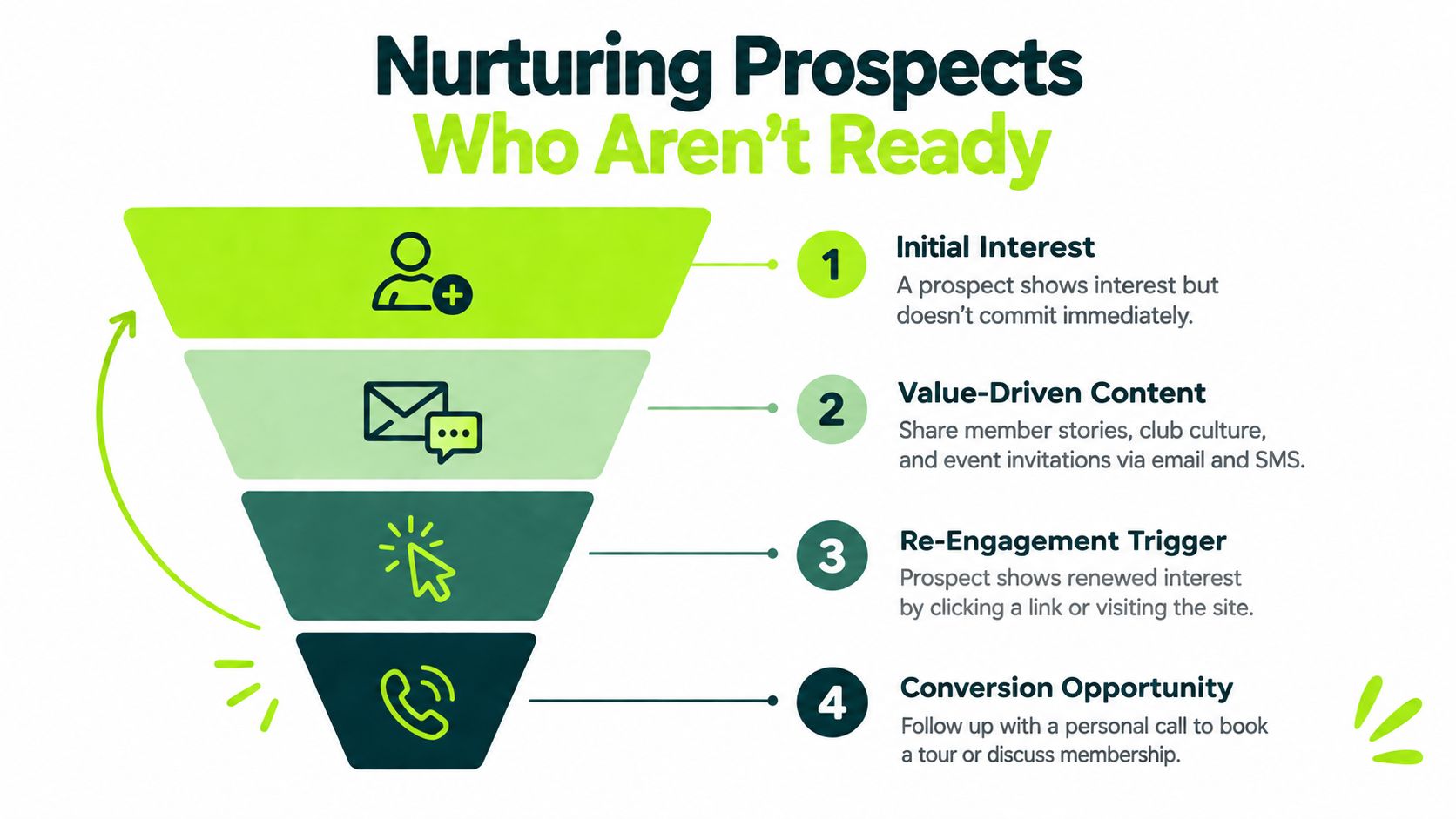
5. Create a Structured Nurture Sequence for Non-Ready Prospects
Not every enquiry is ready for a membership conversation today. Some golfers are comparing clubs, waiting for a move, checking finances or trying to understand whether the club suits their family. Treating every undecided prospect as lost wastes the work already done to earn their attention.
A nurture sequence keeps the relationship useful without creating pressure. It might include a welcome message, a course update, information about membership categories, an invitation to an open day and a straightforward route to book a visit.
The GolfRep guidance on lead nurturing best practices supports a structured approach rather than one-off follow-up. The sequence should reflect the prospect's interests, not send the same promotion to everyone.
Lead with evidence of the club experience
A premium club shouldn't rely on repeated price reminders. Show people what membership feels like:
- Club culture: Explain how new members are welcomed and introduced.
- Playing experience: Share relevant course and competition updates.
- Member life: Highlight social events, coaching and opportunities to meet people.
- Practical reassurance: Answer questions about access, categories and next steps.
- A clear invitation: Give prospects a simple way to book a visit when they're ready.
Segment the sequence for full golfers, flexible members, social prospects and lesson enquiries. Keep messages spaced far enough apart to feel considered, and include an obvious unsubscribe option. UK clubs must also handle consent and direct marketing carefully under PECR and GDPR, particularly when using email and SMS.
The club should review which messages create replies, visits and applications. Opens and clicks are useful signals, but they aren't the final outcome. A prospect who never clicks may still respond to a well-timed call, while a highly engaged reader may remain unsuitable for the club.
6. Track and Measure Conversion at Every Stage of the Pipeline
A fast first reply does not guarantee a new member. A prospect can receive an answer promptly, then disappear because no visit is booked, the visitor does not attend, follow-up is missed or an application remains unanswered.
Set pipeline stages around the actual membership journey at your club. A useful sequence runs from new enquiry to qualified, visit offered, visit booked, visit attended, application started, application received, membership approved and joined.
Measure the journey after the first reply
Golf-club guidance recommends monitoring response time, visit booking rate, attendance quality and time to decision. GolfRep's membership conversion guidance reports an average membership-enquiry response time of 47 hours and 32 minutes, and says replies within one hour are 5x more likely to convert.
Use the CRM to examine:
- Which sources produce visits: Do referrals, organic search, paid campaigns and events attract different levels of intent?
- Where prospects stall: Are delays occurring before booking, after attendance or during the application?
- Which categories convert: Does flexible membership require a different follow-up route from full membership?
- How long decisions take: Are prospects waiting for information or an internal approval?
- What becomes revenue: Can the original enquiry be connected to the eventual membership?
Keep data entry manageable with drop-down fields, automatic timestamps and clear ownership. Review results monthly, then change the process rather than blaming individuals. Low attendance may reflect weak reminders, inconvenient booking options or a poor match between the enquiry and the visit. A club that tracks each handover can identify the exact point where interest turns into lost membership.
7. Use Lead Scoring to Prioritise Sales Effort and Personalise Outreach
Lead scoring helps a small team decide who needs attention first. It doesn't replace judgement, and it shouldn't turn a relationship-led club into a points-based call centre.
A score can combine information and behaviour. For example, a local golfer asking about full membership and requesting a visit may deserve an immediate call. Someone downloading general information without identifying a timeframe may be better suited to a nurture sequence.
Keep the model understandable. Staff should know why a lead has been prioritised and what action the score triggers.
Build scores around the club's evidence
Start with a few factors:
- Fit: Location, membership category and playing requirements.
- Intent: A direct request for pricing, availability or a visit.
- Engagement: Replies, repeat visits to key pages or interaction with booking information.
- Timing: A clear joining window should increase priority.
- Conversation quality: Specific questions often reveal more than a generic form submission.
Create practical tiers rather than pretending the score is exact. A high-priority lead might receive a same-day personal call. A medium-priority lead might receive a personalized email and a booking option. A lower-priority lead can remain in nurture until their behaviour changes.
The UK B2B evidence supports structured scoring as a meaningful improvement over one-off follow-up. A UK study across more than 30 teams reported an average MQL-to-SQL conversion rate of 13%, while the top 10% reached 39–40% using behavioural lead scoring. The UK B2B lead-generation analysis also reports stronger results across other funnel stages for top-performing teams.
Golf clubs shouldn't copy B2B thresholds blindly. Use your own membership data to test whether a score predicts visits, applications and joins. Keep a manual override because a thoughtful staff member may spot intent the model can't see.
8. Build a Referral System and Incentivise Member Advocacy
Members are often the best people to explain why a club suits someone. They can describe the welcome, playing groups, competitions and social life in a way no advert can replicate.
A referral process makes that advocacy easier to act on. Give members a simple route to introduce a friend, record the referring member in the CRM and follow the prospect through the same stages as every other enquiry. Don't rely on a note in a committee folder or a verbal handoff at the bar.
The incentive doesn't have to be complicated. Some clubs may prefer a membership credit, while others might use a guest round, coaching experience, event invitation or recognition in club communications. The right choice depends on the club's rules, commercial structure and brand.
Ask at moments when members are already positive
Referral requests work best when they're relevant:
- After a successful welcome: Ask new members whether friends might enjoy the club.
- At renewal: Invite members to introduce someone considering membership.
- After a memorable experience: Use a hole-in-one, anniversary or club event as a natural prompt.
- During open days: Give members a shareable invitation and a clear booking route.
- In regular communications: Explain exactly how a referral works and what happens next.
A referral should never bypass consent or create awkward pressure. The member can introduce the prospect, but the club should communicate with that prospect appropriately and record the source accurately.
Measure referrals through to membership, not just the number of introductions. A small number of well-matched referrals may be more valuable than a large volume of casual names. Also check whether the incentive attracts the right member profile and whether the club can deliver a welcoming experience after the referral arrives.
9. Optimise the Tour Experience and Implement Post-Tour Follow-Up Protocol
The tour can turn an enquiry into a membership decision, or leave the prospect unsure about the next step. A golfer may enjoy the course and facilities, then leave without a clear route to joining.
Give hosts a consistent structure without making the conversation sound scripted. They should understand the course, membership categories, facilities, joining process and common objections. Before the visit, review the lead record, including the golfer's reason for enquiring, membership priorities and previous questions.
A tour at a UK golf club might involve a golfer comparing a full membership with a flexible category. The host should explain the practical differences, check how often the golfer expects to play and avoid presenting irrelevant information.
Make the follow-up specific
Record the questions, preferences and concerns raised during the visit. A generic “hope you enjoyed your visit” message misses the information that should shape the next contact.
A practical post-tour sequence includes:
- A personal call: Ask what stood out and clarify anything unresolved.
- A personalized email: Send the relevant membership information, rather than every document.
- A clear application route: Provide the correct link and explain the next step.
- A direct objection response: Address access, category, timing or social concerns plainly.
- A reminder task: Schedule a suitable follow-up if the prospect needs more time.
GolfRep's membership conversion guidance highlights time to decision as a useful stage metric. Track the interval between the tour and the next meaningful action, such as an application, further conversation or stated decision.
Follow up promptly, while the visit remains fresh, but give the golfer room to decide. The host's message should refer to the prospect's actual interests and make the joining process easy to understand. That combination preserves trust and gives staff a clear record of what to do next.
10. Create a Monthly Review Cycle to Analyse Performance and Adjust Tactics
Lead management improves when the team reviews the process routinely. Without a review rhythm, staff tend to remember the most recent conversation, the loudest complaint or the busiest week. That isn't enough to understand pipeline performance.
Hold a focused monthly meeting with the people who handle enquiries, visits and applications. Review the journey from source to sign-up, then identify one or two changes the team can implement.
Use a simple operating agenda
Bring a dashboard that shows:
- Enquiry volume by source: Include website, phone, email, social, referrals and events.
- Response performance: Review median response time and overdue enquiries.
- Stage movement: Check booking, attendance, application and joining activity.
- Reasons for loss: Record timing, price concerns, location, category mismatch or no response.
- Ownership gaps: Identify leads without a next action or named staff member.
- Experiments: Note what the team changed and whether the next month's data supports it.
The CRM and marketing automation gap in the UK remains significant. LOCALiQ's UK digital marketing statistics reports that 40.2% of UK businesses use a CRM and 25.9% use marketing automation or journey-management tools. It also reports that 25% want to implement marketing automation and 20% want CRM management but lack the resources or skills.
That's relevant to clubs because a monthly review can expose problems a spreadsheet hides. If staff discover that enquiries arrive from several channels but only one is being tracked, the first improvement may be visibility, not more advertising.
Assign an owner and deadline to every agreed change. Celebrate what worked, then deal with the bottleneck directly. A short, disciplined meeting is more valuable than a long discussion with no action.
Lead Management: 10 Best Practices Comparison
| Initiative | Implementation complexity | Resource requirements | Expected outcomes | Ideal use cases | Key advantages |
|---|---|---|---|---|---|
| Implement a Centralised Lead Management System | Medium–High (software + process change) | CRM platform, integration, staff training, data maintenance | Unified lead view; fewer lost enquiries; better analytics | Clubs with fragmented channels and manual spreadsheets | Consistency, accountability, data-driven decisions |
| Establish a Response Time Standard and Monitor It Closely | Low–Medium (policy + monitoring) | SLA, automation for acknowledgements, reporting tools, staff buy‑in | Faster first responses; improved conversion rates | Clubs losing leads to slow replies or competition | Competitive advantage; measurable performance |
| Qualify Leads Early and Consistently Using Structured Criteria | Low (criteria + intake updates) | Updated forms/scripts, CRM fields, staff training | Better prioritisation; less time on poor-fit prospects | Limited-staff clubs or mixed-interest enquiries | Efficient allocation of sales effort; objective decisions |
| Automate Initial Follow-Up and Qualification Using 24/7 Workflows | Medium (workflow design + testing) | Automation tool, scheduling integrations, copywriting, maintenance | 24/7 engagement; higher booking rates; less admin work | Clubs with after-hours enquiries or high volume | Scalability, timely responses, reduced manual workload |
| Create a Structured Nurture Sequence for Non-Ready Prospects | Medium (content + segmentation) | Email/SMS platform, content assets, segmentation rules | Sustained engagement; improved long‑term conversions | Long decision cycles; many “not ready” prospects | Low-cost scaling of touchpoints; builds trust |
| Track and Measure Conversion at Every Stage of the Pipeline | Medium (pipeline design + reporting) | CRM or analytics, disciplined data entry, dashboards | Identify bottlenecks; enable data-driven improvements | Clubs seeking to improve inefficient funnels | Accountability, targeted optimisation, forecasting |
| Use Lead Scoring to Prioritise Sales Effort and Personalise Outreach | Medium–High (model + integration) | Scoring rules in CRM, behavioural tracking, regular calibration | Prioritised outreach; higher close rates for hot leads | Small teams with high lead volume | Efficient prioritisation; faster contact for high-value prospects |
| Build a Referral System and Incentivise Member Advocacy | Low–Medium (process + incentives) | Referral tracking, referral links/codes, incentives, communications | Higher-quality leads; lower acquisition cost | Clubs with engaged membership communities | High conversion, cost-effective growth, stronger community |
| Optimise the Tour Experience and Implement Post-Tour Follow-Up Protocol | Medium (training + scripting) | Staff training, tour scripts/checklists, follow-up templates | Increased tour-to-application conversions | Clubs relying on in-person visits to close sales | Memorable experience, immediate objection handling |
| Create a Monthly Review Cycle to Analyse Performance and Adjust Tactics | Low (process + reporting) | Time from stakeholders, consistent dashboard preparation | Continuous improvement; aligned team priorities | Clubs needing regular performance governance | Rapid learning, accountability, focused action items |
Bringing It All Together
The strongest lead management best practices for golf clubs share one principle. They connect every stage of the member journey.
A centralised system captures the enquiry. A response standard prevents avoidable delay. Qualification helps the team understand intent and fit. Automation handles confirmation, booking and reminders, while human staff take over when the conversation requires trust, judgement or reassurance.
Nurture keeps the club relevant for prospects who aren't ready. Pipeline stages show whether the club is creating visits, attended visits, applications and memberships, rather than celebrating form fills alone. Lead scoring helps a busy team prioritise attention, but it should support professional judgement rather than replace it.
Referrals give members an easy way to advocate for the club. The tour turns digital interest into an experience, and post-tour follow-up keeps momentum alive. Monthly reviews make the whole system adaptable.
The most important shift is from asking, “How many enquiries did we generate?” to asking, “What happened to each enquiry?” A club should know which source produced the prospect, how quickly the team responded, whether a visit was offered, whether it was booked and attended, what questions were raised, whether an application followed and why the prospect ultimately joined or left.
That visibility matters especially for committee-led and volunteer-run clubs. Manual processes often depend on one person remembering what happened. A structured system gives the committee, office team and membership lead a shared view without requiring everyone to become a CRM specialist.
Automation also needs a sensible boundary. Use it to reduce response lag, administrative work and no-show risk. Don't use it to hide the club behind generic messages or make a premium membership experience feel transactional. A timely confirmation and a self-booking link are useful. A human conversation at the right moment remains essential.
Clubs don't need to implement everything at once. Start by mapping the current journey from enquiry to membership. Identify the most damaging gap, whether that's slow replies, missing source data, weak visit follow-up or applications with no owner. Fix that gap, measure the next stage and then build from the evidence.
GolfRep helps clubs combine lead generation with structured follow-up and CRM-enabled systems, so managers can see where enquiries sit and what should happen next. The purpose isn't to add technology for its own sake. It's to create a predictable pipeline that respects the club's brand, gives prospects a better experience and turns more suitable enquiries into long-term members.
GolfRep can help your club connect website forms, calls, referrals and campaign enquiries to a structured CRM with automated qualification, reminders and staff follow-up. Visit GolfRep to discuss how a clearer enquiry-to-membership system could work for your club.
Ready to tap into our proven growth system?