Padel Club Marketing: Attract Members & Boost Revenue
Most advice on padel club marketing gets the priority wrong.
It tells clubs to post more, boost more ads, chase more followers, and keep pouring effort into awareness. That's lazy advice. In a fast-growing market, interest usually isn't the first problem. Conversion is.
At GolfRep, we've seen this for years in golf. Clubs assume they need more leads when the problem is that existing enquiries sit in inboxes, get handled inconsistently, or disappear because nobody owns follow-up. Padel clubs are now heading into the same phase. The operators who win won't be the loudest. They'll be the ones with the clearest offer, the fastest response, and the best system for turning interest into booked play and recurring revenue.
The Real Problem with Padel Club Marketing
The standard playbook says your club needs more visibility. More social posts. More ad spend. More top-of-funnel activity.
That's backwards.
The UK padel market already has strong momentum. The country now has more than 800 courts across over 400 venues, which means clubs are competing in much denser local markets and need a more systematic approach to acquisition and retention, not just broad awareness (UK padel market growth and venue density).
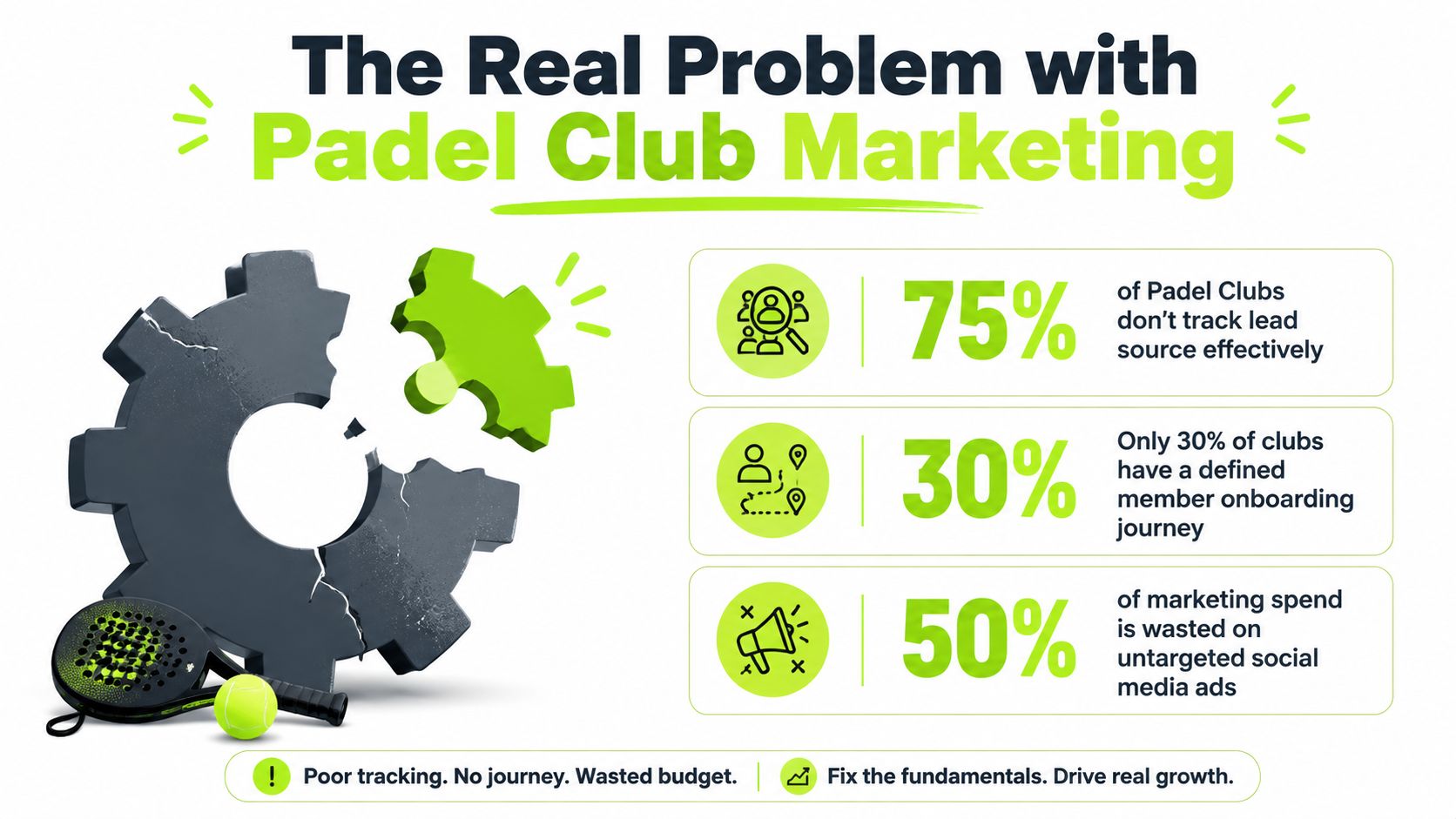
More enquiries won't fix a weak process
If a prospect asks about a beginner session, membership, or social league and waits too long for a reply, your campaign didn't fail. Your process failed.
That distinction matters. A club can generate plenty of interest and still underperform because nobody can answer basic questions consistently:
- What happens when a new enquiry comes in
- Who responds and how quickly
- How many follow-ups happen after the first contact
- Whether the person books a trial, a coaching session, or nothing at all
Most clubs don't lose growth because nobody's interested. They lose it because the handoff from marketing to operations is messy.
Practical rule: If you can't see every enquiry, its source, its status, and its next action, you don't have a marketing problem. You have a conversion problem.
Padel is moving from novelty to local competition
When a sport is new in a market, novelty does some of the work. Early adopters try it because it's fresh. That phase doesn't last.
Once catchments become crowded, clubs need a reason to be chosen. That reason usually isn't “we have courts”. Nearby clubs have courts too. Key differentiators are coaching quality, social programming, beginner friendliness, corporate access, family appeal, and how easy it is to become a regular.
Many padel club marketing efforts falter because operators chase reach before they've built a reliable path from enquiry to first visit to repeat booking. Golf clubs make the same mistake. We wrote about that pattern in why most golf club marketing fails, and the lesson applies directly here.
The bottleneck is usually internal
You don't need a bigger funnel if the bottom leaks.
Before increasing spend, inspect the basics:
| Area | What to check |
|---|---|
| Lead capture | Are enquiries going to one place, or scattered across forms, DMs, email and phone calls? |
| Response process | Does every new prospect get a prompt, structured reply? |
| Follow-up | Is there a sequence after the first contact, or does the club rely on memory? |
| Visibility | Can management see what converted and what stalled? |
Padel club marketing should start with operational discipline. That isn't glamorous, but it's what turns demand into revenue.
Building Your Predictable Conversion System
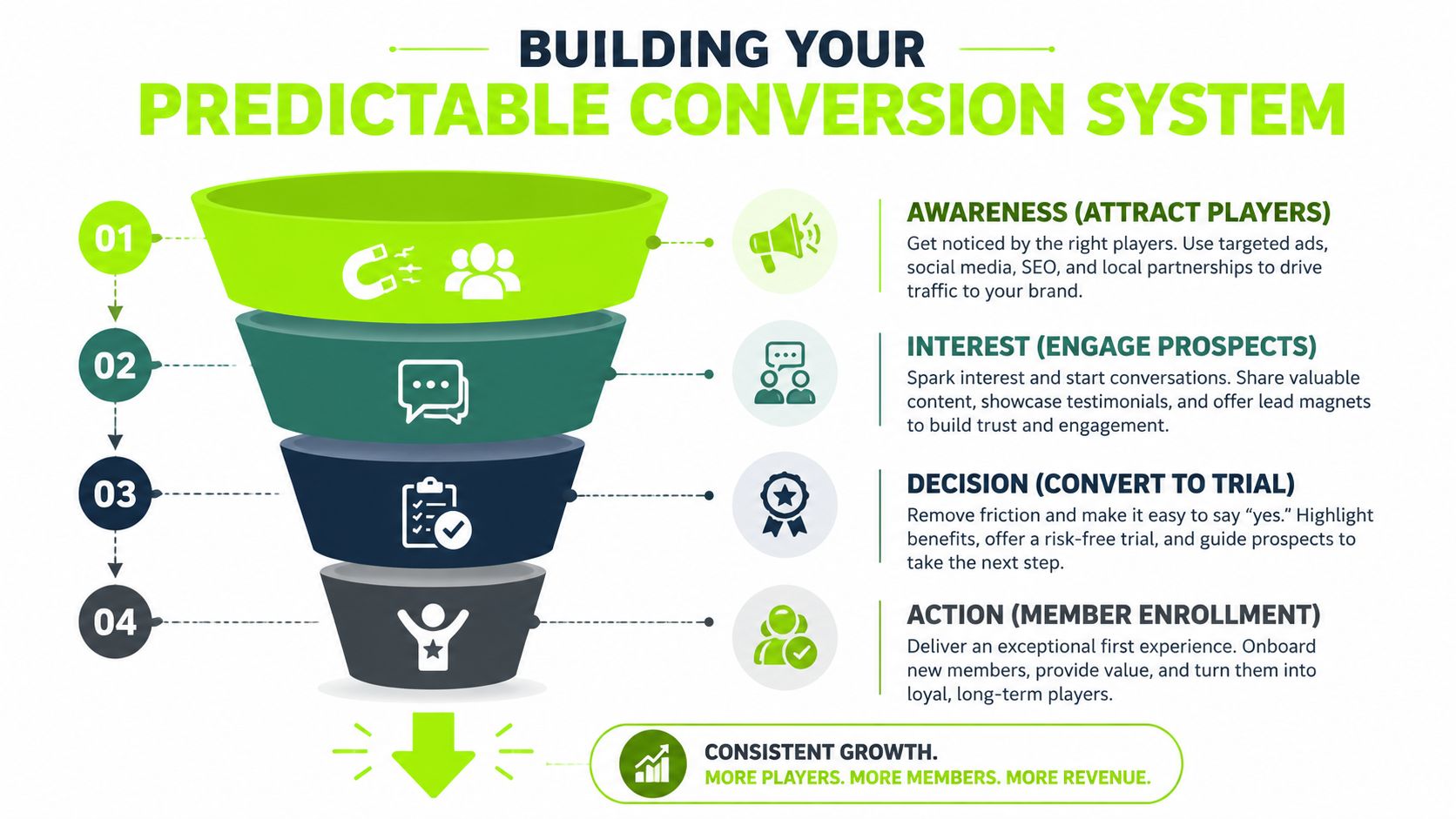
A padel club doesn't need complicated tech first. It needs a predictable conversion system that works like a digital front desk.
That means every enquiry gets captured, acknowledged, followed up, and moved towards a clear next step. Not eventually. Immediately. Not manually when someone remembers. Systematically.
Start with one destination for every lead
Most clubs create friction by accident. Website forms go to one inbox. Instagram messages sit in someone's app. A phone enquiry gets scribbled on paper. Then nobody has a full picture.
Fix that first.
Every lead source should feed into one central system. It doesn't matter whether you use a simple CRM, a booking-linked pipeline, or a structured spreadsheet at the beginning. What matters is that every enquiry lands in one place with these fields:
- Source such as Google search, Meta ad, referral, walk-in, or local partnership
- Intent such as beginner session, membership, court booking, junior coaching, or corporate event
- Status such as new, contacted, booked, no response, or lost
- Next action with a clear owner
If you want predictable growth, visibility comes before volume.
Build follow-up that doesn't depend on memory
Most prospects won't commit on the first touch. That's normal. What isn't acceptable is leaving follow-up to chance.
A practical system includes:
Instant acknowledgement
The prospect should know their enquiry has been received and what happens next.Fast personal contact
Someone from the club should answer the actual question and move the person towards a booking, visit, or intro offer.Structured nurture
If they don't book immediately, they should receive useful follow-up. That might include beginner options, league information, coaching routes, or membership details.
The club that follows up clearly and consistently often beats the club with the larger ad budget.
The process matters more than the software, but software makes consistency easier. A basic CRM with automation is often enough. For clubs that want a more structured setup, systems like HubSpot, GoHighLevel, or a sector-specific workflow can do the job. In golf, GolfRep builds these pipeline and follow-up systems around club enquiries, and the same logic applies cleanly to padel.
Give staff a simple playbook
Technology won't save a vague process. Staff need scripts, ownership, and clear next steps.
Use a short operating standard like this:
| Trigger | Required action | Purpose |
|---|---|---|
| New enquiry | Reply promptly and log source | Prevent missed leads |
| No reply after first contact | Send a second follow-up | Recover silent interest |
| Trial or intro booked | Confirm attendance and set post-visit follow-up | Reduce drop-off |
| Attended first session | Invite into the right membership or programme | Convert activity into revenue |
That's the backbone of a predictable pipeline. It's also the difference between random bookings and a repeatable sales process.
If you want a broader look at how this works in club environments, building a predictable revenue pipeline for golf clubs lays out the same systems-first principle from another participation sport.
Targeted Acquisition for High-Value Players
Once your conversion process works, paid and organic acquisition become useful. Before that, they're expensive distractions.
Too many clubs scale traffic into a weak system. They buy clicks, collect vague enquiries, and then wonder why revenue doesn't move. The answer is simple. You can't scale a process that doesn't convert cleanly.
Local intent beats broad reach
The highest-value traffic is usually local and specific. Not everyone who likes a social reel is a serious prospect. The people who matter are those who are ready to play, learn, join, or bring others with them.
For most padel clubs, three acquisition routes deserve attention.
First, local SEO. If someone searches for local courts, beginner padel, coaching, or social play in your area, that's high intent. Your Google Business Profile, location pages, review strategy, and local landing pages should all point towards one next step.
Second, geo-targeted paid social. Meta can work well for postcode-based demand generation if the message is focused. Don't advertise your club in generic terms. Promote a specific entry point such as beginner coaching, social mix-ins, intro packages, or off-peak memberships. If you want the underlying paid social logic from a club operator perspective, this piece on Meta ads for golf clubs is relevant because the targeting principles are almost identical.
Third, local partnerships. Corporate wellness teams, nearby residential developments, schools, universities, and hospitality businesses can all become acquisition channels if the offer is right.
Pre-qualify before they enquire
Not every lead is worth the same effort. Good padel club marketing filters for fit before the enquiry lands.
Use your creative and landing pages to answer three questions early:
Who is this for
Beginners, existing players, families, juniors, or corporate groupsWhat is the first step
Trial session, starter course, membership consultation, or social eventWhy choose this club
Coaching pathway, easier booking, stronger social scene, better peak access, or off-peak value
This improves lead quality without needing more spend.
Clubs shouldn't advertise “join now” to everyone. They should present the right first offer to the right local audience.
Match channel to commercial value
Some audiences book once. Others become regulars, buy coaching, join leagues, and bring friends. You want more of the second group.
A simple decision filter helps:
| Channel | Best use | Risk if mishandled |
|---|---|---|
| Google and local search | Capture ready-to-play demand | Weak pages waste high intent |
| Meta ads | Create demand around specific offers | Broad targeting brings low-quality enquiries |
| Partnerships | Reach groups with built-in trust | Poor onboarding means interest fades quickly |
Acquisition should feed your conversion system, not compensate for its absence.
Designing Memberships That Drive Retention
The membership model is part of the marketing.
That's where many padel clubs miss the point. They treat membership as an admin decision and marketing as a separate function. It isn't separate. Your pricing structure tells prospects how committed you expect them to be, what kind of community you run, and whether your revenue is built on one-off transactions or long-term relationships.
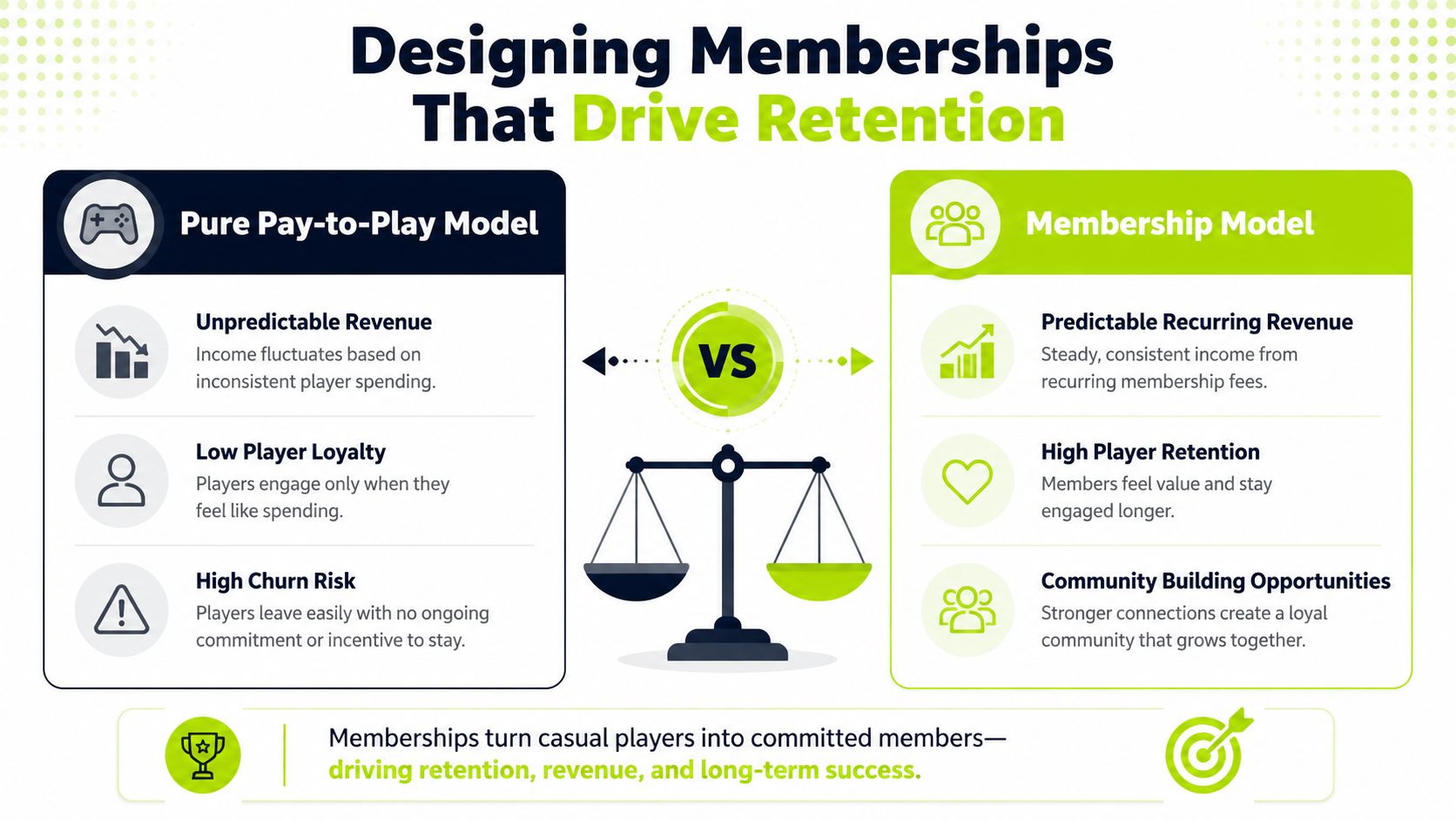
Pure pay-to-play is easy to sell and hard to stabilise
Pay-to-play has a role. It lowers the barrier to entry and helps casual players try the sport. But as a primary model, it leaves too much revenue exposed to weather, habit, convenience, and price comparison.
That's why I'd push most clubs towards tiered recurring memberships rather than relying heavily on ad hoc bookings.
Industry analysis notes that clubs using tiered monthly or quarterly memberships can reduce churn by 15% to 25% compared with pure pay-to-play models, because those packages create stronger loyalty and drive more spend on coaching and events (membership tiers and churn reduction in padel clubs).
The best packages combine access and habit
A useful membership isn't just discounted court time. It should make regular play easier and more rewarding.
The strongest structures usually include a mix of the following:
- Priority booking for peak slots, which matters to players with fixed weekly routines
- Programme access such as leagues, socials, club nights, and box ladders
- Coaching value through discounted sessions, training blocks, or member-only clinics
- Convenience benefits like rolling monthly billing or simple account management
That model works because it supports habit. Habit supports retention. Retention supports margin.
If you want a broader retention lens outside sport, this guide to strategies to prevent customer churn is worth reading because the same behavioural principles apply. Clear onboarding, regular engagement, and early warning signs matter in clubs too.
Build membership around utilisation, not just sign-ups
A smart offer does two jobs. It retains players and helps you fill inventory.
Off-peak access, weekday leagues, junior pathways, coaching blocks, and corporate packages all improve utilisation. That's far more commercially useful than collecting a list of names who rarely show up.
Compare the two models plainly:
| Model | Strength | Weakness |
|---|---|---|
| Pure pay-to-play | Low friction for first-time users | Revenue volatility and weaker loyalty |
| Tiered membership | Recurring income and better retention | Needs a clearer value proposition |
| Hybrid approach | Good for trial to membership progression | Can become confusing if badly structured |
A lot of clubs overuse discounts because they haven't built enough value into the proposition. Don't race to the cheapest offer. Build the easiest ongoing relationship.
Measuring What Matters for Sustainable Growth
If you can't measure the economics, you can't improve the marketing.
A lot of club reporting often becomes theatre. Teams celebrate website visits, social reach, and follower counts because they're visible and easy to discuss. None of that tells you whether the club is acquiring profitable members or filling court hours efficiently.

Track the numbers that change decisions
A serious padel club marketing plan is built on unit economics. The practical benchmark is tying each marketing channel to a Cost Per Acquisition target and a clear payback period, so you know whether campaigns are scalable and profitable rather than just generating empty enquiries (unit economics and CPA targets for padel club marketing plans).
The metrics that matter are operational:
Lead source by quality
Which channels produce booked visits, trials, and membershipsLead-to-booking conversion
How many enquiries become real activityRevenue per court hour
Whether your programming is improving inventory valueMembership conversion by offer
Which entry products produce recurring revenuePayback period
How quickly acquisition cost is recovered
These are management metrics, not vanity metrics. They tell you what to scale, what to cut, and what to fix.
Connect marketing data to real-world behaviour
Most clubs still separate digital activity from on-site activity. That creates blind spots. Someone may click an ad, visit the club, ask questions at reception, and convert later through a different route. If your tracking stops at the form fill, your data is incomplete.
That's why behavioural tools can be useful in venue environments. If your club wants stronger on-site visibility, Guest WiFi marketing analytics can help operators understand return visits, visit patterns, and engagement beyond the initial click.
Good reporting doesn't answer “did the ad get attention?” It answers “did the club make money from the campaign?”
Build a simple reporting rhythm
You don't need a huge dashboard to start. You need one version of the truth reviewed consistently.
A practical reporting rhythm looks like this:
Weekly checks
New enquiries, response status, booked trials, and stalled leadsMonthly review
Channel performance, conversion by offer, revenue by stream, and utilisation trendsQuarterly decisions
Budget reallocation, membership package refinement, and programming changes
Use a short scorecard. Keep it visible. Make someone accountable for each metric.
If a campaign produces attention but not bookings, change the offer or landing page. If it produces bookings but poor retention, change the onboarding or membership design. If off-peak remains empty, change the programme mix. Measurement should lead directly to action.
Your 90-Day Padel Club Growth Roadmap
Most clubs try to fix everything at once. That usually means nothing gets finished properly.
A better approach is sequence. Build the system first. Then activate acquisition. Then optimise based on actual performance.
Days 1 to 30
Start with the conversion foundation.
Audit every enquiry route. Website forms, email, phone calls, DMs, booking platform messages, and walk-ins should all feed one tracking process. Write simple response scripts for common enquiries such as beginner play, memberships, coaching, and social sessions.
Then review your offers. Most clubs need one obvious entry point for each audience rather than a vague list of options.
Focus on these jobs first:
- Create one lead log so every enquiry has a source, status, owner, and next action
- Set a response standard so staff know what good handling looks like
- Define entry offers for beginners, casual players, and high-intent joiners
Days 31 to 60
Launch targeted acquisition only after the process is stable.
Turn on local search improvements, postcode-based paid social, and one or two partnership routes. Don't spread yourself too thin. A focused campaign with a clear offer is easier to measure and fix.
At the same time, refine your recurring membership proposition. If you need inspiration from another participation category, these actionable gym marketing strategies are useful because gyms also sell habit, convenience, and recurring engagement rather than just one-off visits.
A useful checklist for this phase:
| Priority | Action |
|---|---|
| High | Launch one beginner or trial-focused campaign |
| High | Set up follow-up for non-bookers and no-shows |
| Medium | Add local partnership outreach |
| Medium | Clarify membership perks and booking benefits |
Days 61 to 90
Now you can optimise with confidence.
Review lead quality by channel, conversion by offer, and early retention signals from new joiners. Cut weak campaigns quickly. Expand what is bringing in players who show up, book again, and move into recurring products.
Add community mechanisms during this phase too. Leagues, socials, coaching series, junior pathways, and corporate events all deepen attachment to the club and reduce reliance on constant acquisition.
A club becomes easier to market when it becomes easier to join, easier to understand, and easier to return to.
Padel club marketing works best when it stops behaving like promotion and starts behaving like a system.
If your club wants a clearer pipeline from first enquiry to recurring revenue, GolfRep helps clubs build structured lead handling, follow-up, and CRM-enabled growth systems so marketing activity turns into measurable outcomes rather than missed opportunities.
Ready to tap into our proven growth system?