Golf Club Marketing Chester: 2026 Strategy Guide
The most common advice on golf club marketing in Chester is still wrong. It tells clubs to post more on social media, run the odd membership offer, and hope enquiry volume solves the problem.
In practice, many clubs don't have a traffic problem first. They have a conversion problem. Enquiries arrive through the website, Facebook, Google Business Profile, direct messages, phone calls, and passing interest after an event. Then they sit in an inbox, on a notepad, or with one staff member who's off the next day. By the time someone follows up, the golfer has moved on.
That's why effective golf club marketing in Chester isn't a pile of ideas. It's a connected system. Local visibility matters. Paid traffic can work. Open days still help. But none of it delivers properly if the club can't capture, track, and convert interest in a consistent way.
The Real Challenge for Chester Golf Clubs
A lot of clubs assume growth starts with more reach. More ads. More posts. More promotions.
That's only half the job, and often not the urgent half.
For clubs in Chester, a key challenge is converting demand from golfers who are already mobile-first and expect quick responses. The UK's communications regulator reported that 97% of adults owned a smartphone in 2024 in guidance referenced by this industry discussion on golf lead conversion and mobile-first demand. The practical issue is simple. People browse on the move, in the evening, over lunch, or between meetings. If the club responds slowly, that lead cools down fast.
Why more enquiries won't fix a weak process
A prospective member in Chester might find your club after work, visit the website on their phone, and fill in a membership form at 9pm. If nobody sees it until the next afternoon, the delay has already done damage. They may have contacted another club. They may have forgotten why they were interested. They may have been ready to book a visit and never got asked.
That's why the actual leak is usually operational.
Practical rule: If a club can't see every enquiry in one place and follow it through to visit, trial, or membership decision, it isn't really managing marketing. It's reacting to messages.
Strong club operations and strong marketing have always been linked. A useful read on the wider management side is this Caddie Wheel blog for golf clubs, because it reinforces a point many committees miss. Growth isn't created by promotion alone. It comes from how the club runs.
The problem often sits behind the enquiry form
The issue isn't usually effort. It's fragmentation.
- Website leads may go to a shared inbox that nobody owns.
- Facebook messages may stay on one person's phone.
- Phone enquiries may never get logged properly.
- Open day interest may sit on a spreadsheet and never receive structured follow-up.
That's where clubs lose people they were already close to converting.
This becomes even more important for clubs dealing with an older membership profile. If a club needs younger working adults, it can't rely on daytime call-backs and manual admin. The buying behaviour is different. We covered the membership pressure behind this shift in our piece on golf club aging membership.
What actually changes results
The clubs that improve tend to stop asking, “How do we get more attention?” and start asking better questions:
| Question | Better focus |
|---|---|
| Are we posting enough? | Are we capturing every enquiry? |
| Should we discount? | Are we following up fast enough? |
| Do we need more leads? | Do we know where current leads are dropping out? |
That change in thinking is what makes golf club marketing in Chester work. Not louder promotion. Better handling.
Mastering Your Digital Pro Shop Window
Before spending heavily on paid campaigns, get the basics right. Your digital presence is now the equivalent of the front entrance, reception desk, brochure stand, and first conversation combined.

For Chester clubs, this starts with local search, reviews, and mobile usability. According to GolfNow's 2024 research, 52% of all golfers check online ratings and reviews before booking a tee time, and 57% of online bookers use smartphones, as noted in GolfNow's golf-facility research. That means your online reputation and your mobile journey shape whether interest turns into action.
Audit what a local golfer actually sees
Search your club the way a non-member would. Then search the generic terms they're more likely to use:
- “Golf membership Chester”
- “Golf club near me”
- “Golf society day Chester”
- “Golf lessons Chester”
Look at what appears first. The club's Google Business Profile, review rating, imagery, booking path, website speed, and enquiry form all influence trust before anyone speaks to your team.
A practical digital audit should include:
Google Business Profile accuracy
Check categories, opening details, contact routes, photos, and current posts. If a golfer finds old imagery or outdated contact details, confidence drops immediately.Review management discipline
Ask for reviews after positive rounds, society days, lessons, and member events. Then reply to them properly. Not with generic thanks, but with context that shows the club is active and attentive.Mobile enquiry flow
Test every form on your phone. If it's fiddly, too long, or unclear on next steps, people won't complete it.
A website doesn't need to be flashy. It needs to make the next step obvious.
Build a site that captures, not just informs
Many golf club websites still behave like digital brochures. Nice imagery. Long history pages. Committee information. Competition results. All useful for current members, but not enough for someone considering a visit or joining.
A better structure is simpler:
| Website area | What it should do |
|---|---|
| Membership page | Explain options clearly and offer one clear enquiry action |
| Visitor golf page | Make tee-time or visitor enquiry steps easy |
| Society page | Show package relevance and give a fast route to request details |
| Contact page | Route messages into a tracked system, not a general inbox |
If you want a deeper look at the online side, our guide to golf course online growth breaks down how clubs should think about local digital presence and conversion paths.
Reviews are part of sales now
A lot of clubs still treat reviews as nice to have. They're not. They're part of the buying journey.
That doesn't mean chasing vanity ratings. It means creating a repeatable process:
- Ask after a strong member or visitor experience.
- Make the request easy to complete on mobile.
- Respond to every review in the club's tone of voice.
- Feed recurring feedback back into operations.
For broader context on where the game is moving commercially, this overview of 2025 golf trends is worth reading alongside your own local audit.
Attracting High-Value Local Golfers
Once the basics are strong, paid acquisition can do its job. But broad advertising is where clubs waste money fastest.
The target in Chester isn't “everyone who likes golf”. It's the right local golfers, with the right intent, seeing the right message, at the right stage.

Start with people, not platforms
A better campaign plan begins with segments. In Chester, that might include:
- Time-poor professionals working in and around local business areas who want flexible golf around work and family life
- Established golfers relocating locally who need a new club and want a smooth introduction
- Former members or lapsed visitors who know the club already but haven't been re-engaged properly
- Early retirees looking for a club with strong community, regular play, and good weekday access
Each of those groups needs a different message.
A vague ad saying “Join now” usually underperforms because it asks for too much too soon. A better approach is to match the offer to the buyer's actual hesitation. One person wants convenience. Another wants a club visit. Another wants clarity on membership fit without a hard sell.
What targeted campaigns look like
Use platforms such as Google Ads and Meta to focus on Chester and its surrounding catchment, then direct traffic to dedicated landing pages instead of the website homepage.
A practical campaign structure often looks like this:
| Audience | Angle | Better destination |
|---|---|---|
| Local professionals | Flexible golf that fits work life | Membership enquiry page |
| Lapsed visitors | Come back for a hosted club visit | Visitor follow-up page |
| Society organisers | Reliable planning and quality hospitality | Society enquiry page |
| Relocators | Find your golf home in Chester | Membership visit booking page |
The main trade-off is reach versus relevance. Broader campaigns may generate activity, but they often create poorer quality leads that staff then have to filter manually. Tighter campaigns usually create fewer but better enquiries.
Good golf club marketing in Chester should reduce admin as well as generate demand.
Creative matters more than clubs think
Most clubs default to generic course photography and a line about welcoming new members. That's fine as background. It rarely gives a local golfer a reason to act.
Stronger creative usually includes:
A clear local message
Reference convenience, location, weekday access, or the style of club experience being offered.A single next step
Book a visit, request membership details, or register for an open event. Don't ask people to work out the journey for themselves.Relevant proof
Show clubhouse atmosphere, practice facilities, hosted events, coaching, or the kind of golf day the target audience can picture themselves joining.
Clubs exploring more visual, lead-focused creative may find this guide to AI video for lead generation useful as a prompt for how short-form assets can support enquiry generation.
The key is discipline. Every advert should lead somewhere measurable, and every response should enter one follow-up system.
The Conversion Engine Your Club Needs
At this stage, most membership campaigns succeed or fail.
A club can have a polished website, strong local ads, and solid footfall. If enquiry handling still depends on inboxes, memory, and spreadsheets, conversion stays inconsistent. Staff do their best, but the process itself makes dropped leads almost inevitable.
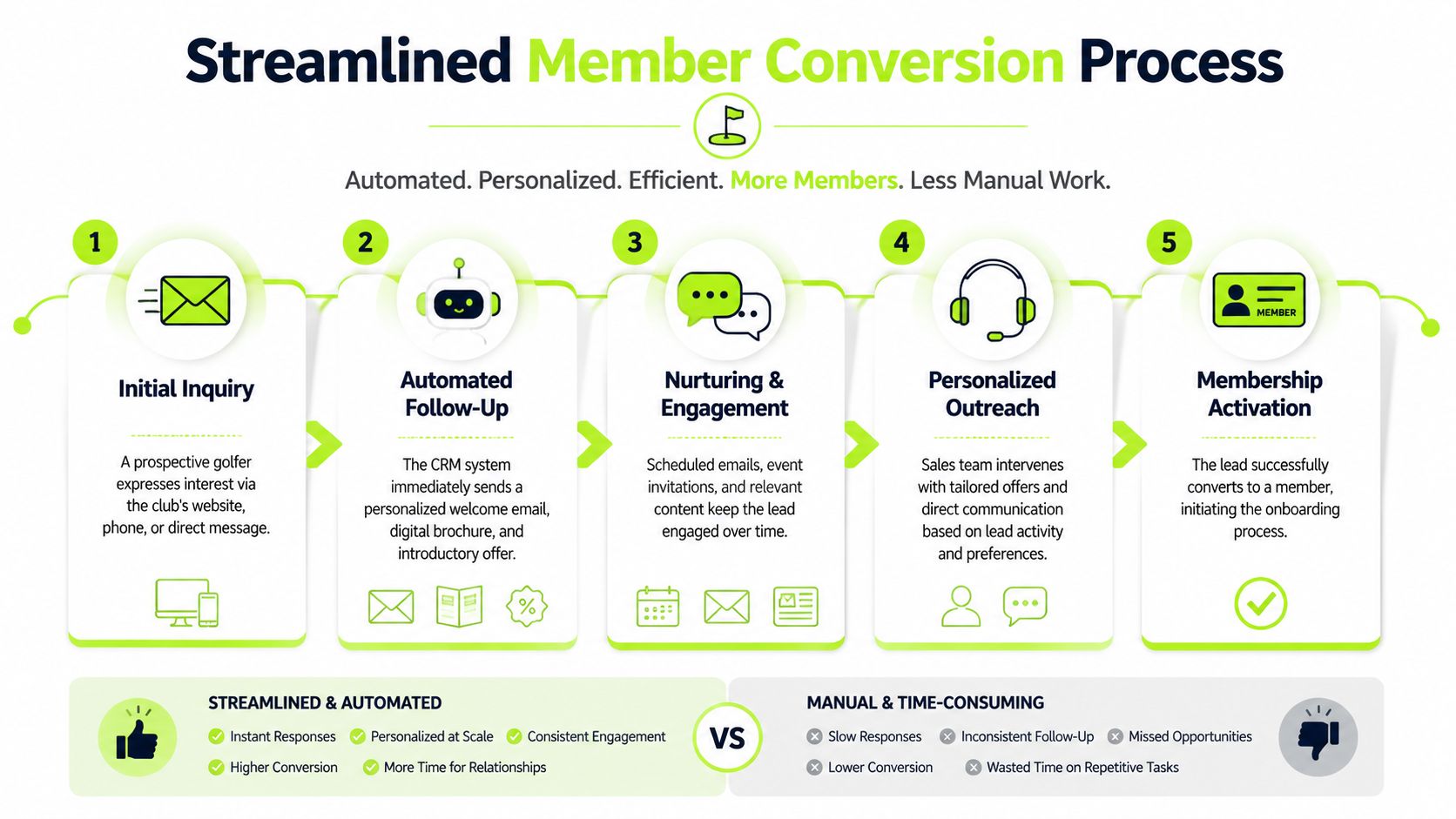
Historical golf club marketing guidance in the UK has pointed in the same direction for years. The most successful clubs moved away from one-off promotions and toward systematic, CRM-style lead capture. That includes saving the email address of every golfer who enquires, using targeted newsletters, and collecting visitor data consistently, as shown in this Scottish golf-club marketing and communications plan. The lesson still applies directly in Chester. Every enquiry should become a reusable contact record.
What manual handling looks like
Most clubs recognise this pattern:
- A lead arrives through the website.
- An email notification lands in a shared inbox.
- Somebody intends to reply later.
- The prospect receives a delayed, generic response.
- No next step is booked.
- Nobody tracks what happened after that.
That isn't poor effort. It's a weak system.
Manual handling creates three practical problems:
No lead visibility
Management can't see how many enquiries came in, where they came from, or who owns follow-up.No response consistency
One prospect gets a detailed message. Another gets a one-line reply. Another gets nothing for a day or two.No pipeline control
There's no clear status such as new enquiry, contacted, booked visit, attended, proposal sent, won, or lost.
What a proper conversion engine does
A modern setup doesn't remove the human side. It protects it.
The CRM should become the single place where every lead lands, regardless of source. Website forms, Meta lead forms, phone notes, event sign-ups, and visitor enquiries all need to flow into one pipeline.
Then the club can automate the early stages without sounding robotic:
Immediate acknowledgement
The prospect gets a prompt confirmation that their enquiry has been received.Useful first follow-up
Send the right information based on interest. Membership. Society. Corporate. Coaching. Not one generic PDF for everyone.Task ownership
A named person receives the follow-up task, with visibility for management if it isn't completed.
The best follow-up systems don't replace staff. They stop staff from having to remember everything.
A before and after view
Here's the difference in operational terms.
| Manual setup | Structured setup |
|---|---|
| Enquiries live in separate places | All leads enter one CRM |
| Response timing depends on staff availability | Initial contact happens immediately |
| Follow-up is ad hoc | Follow-up is sequenced and tracked |
| Reporting is unclear | Pipeline stages are visible |
| Leads go cold quietly | Stalled leads are obvious and recoverable |
That visibility changes decision-making. The club stops guessing whether “marketing is working” and starts seeing where conversion is slowing down.
Nurture is where many memberships are won
Not every prospect is ready on day one. Some want to compare clubs. Some need to visit first. Some are waiting for the right season, family routine, or work pattern.
That's why nurture matters.
A simple nurture flow can include:
- Initial response with relevant club information
- Invitation to visit or attend an open event
- Follow-up after non-response with a lighter prompt
- Useful social proof or club experience content
- Direct outreach when the lead shows intent
The point isn't volume. It's timing and relevance. A golfer who doesn't reply to the first message isn't necessarily uninterested. They may just be busy.
For golf club marketing in Chester, that distinction matters. The clubs that convert well usually aren't the clubs with the loudest promotion. They're the ones with the cleanest process after the click.
Grow with Local Partnerships and Packages
Not every membership lead should start online. Chester clubs can also create steady, better-qualified interest through local partnerships that fit the club's positioning.
The important word is fit.
A rushed partnership with the wrong business can attract enquiries that never convert. A well-matched one can put the club in front of people who already match the profile of a likely member.
The partnerships that tend to work
A private or semi-private club in the Chester area might build relationships with:
Estate agents serving premium movers
New homeowners often review lifestyle decisions quickly. Golf is part of that for some buyers, especially if the introduction feels personal rather than promotional.Local employers and professional firms
Legal, financial, property, and corporate teams can be strong sources of weekday golf demand, client entertainment, and eventual membership interest.Hospitality and leisure businesses
Boutique hotels, wellness operators, and high-end local venues can help the club reach people already buying into a quality leisure experience.
A club doesn't need dozens of partnerships. It needs a handful that are active, relevant, and owned by someone internally.
Package structure matters
Clubs can go wrong. They create packages that are easy to advertise but hard to justify operationally. Or they discount too heavily and weaken the value of full membership.
A better approach is to package access, experience, and progression.
For example:
| Audience | Better package logic |
|---|---|
| Busy working adults | A flexible entry route with a clear path into fuller membership |
| Corporate prospects | A hosted taster day or business golf package tied to relationship building |
| Returning golfers | An introductory option that lowers friction without cheapening the club |
| New local residents | A welcome experience centred on club fit, not price alone |
Clubs protect their brand when they package intelligently, not when they refuse to adapt.
The strongest packages also connect back to the follow-up system. If someone joins on an introductory route, the club should already know what the next conversation is. Upgrade path. Usage pattern. Visit frequency. Onboarding contact. Otherwise the package creates volume without long-term value.
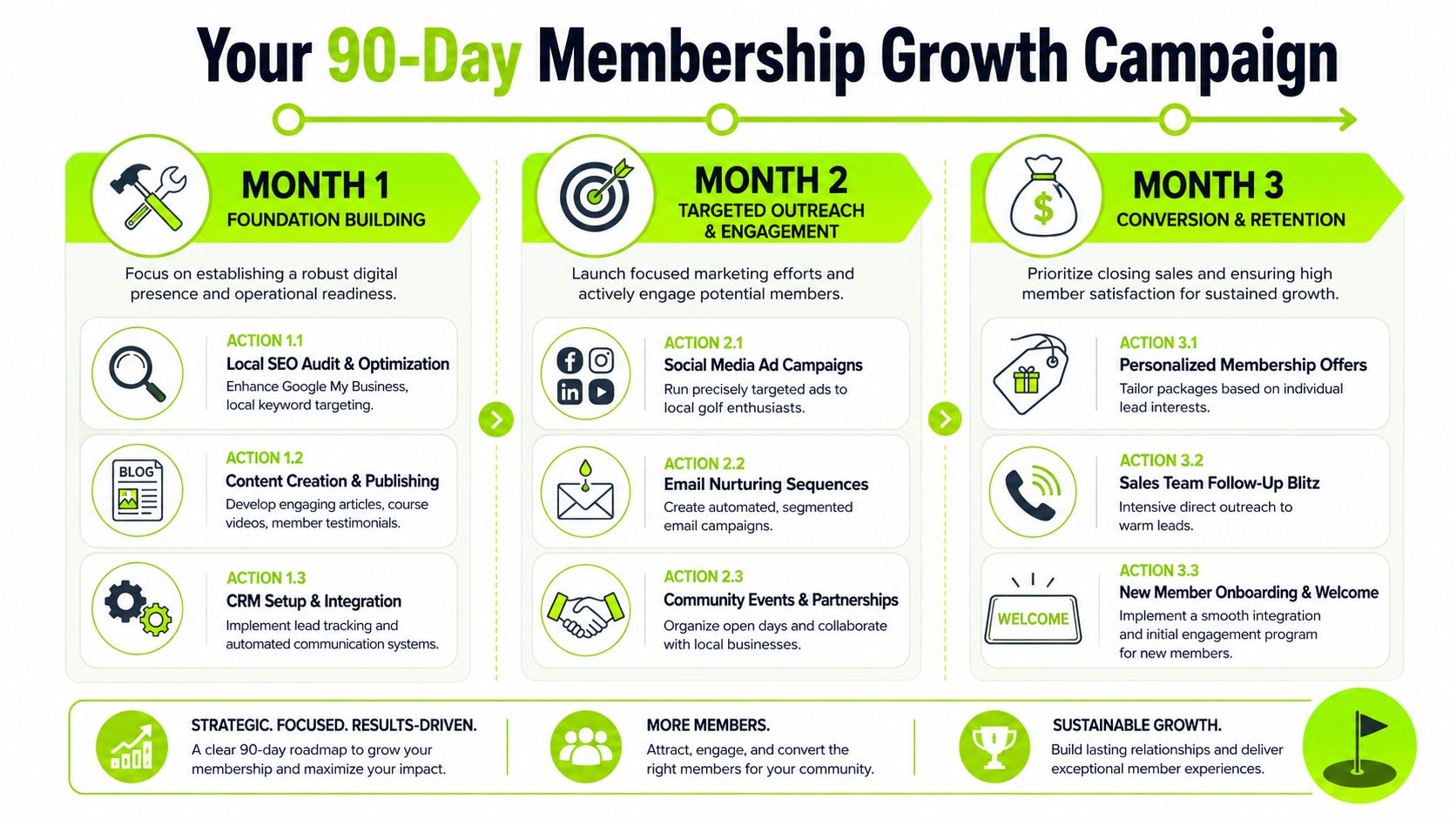
Your 90-Day Membership Growth Campaign
Most clubs don't need a twelve-month strategy document first. They need a working ninety-day plan with ownership, timing, and tracking.
Industry guidance suggests that clubs running a live digital marketing programme for 90–180 days saw a 4.3% increase in total sales, and that growth-focused clubs should typically budget 5%–7% of gross revenue for marketing, while major campaigns should be promoted 1–3 months in advance, as discussed in this golf marketing guidance on campaign timing, segmentation, and budget. That only works if the club tracks what happens after the enquiry.
Month one gets the foundations right
The first month is operational.
Clean up the Google Business Profile, review the website on mobile, tighten the membership page, and make sure every enquiry source feeds one system. Build stages for your pipeline so staff can see where each prospect sits.
The most important deliverables in this phase are:
- A single source of lead visibility
- Clear ownership for follow-up
- A mobile-friendly enquiry path
- Basic nurture messages for key enquiry types
If you want a more specific framework for campaign setup, this guide on how to generate 50 golf membership enquiries in 90 days gives useful context for planning activity around realistic operational capacity.
Month two launches targeted activity
Local campaigns, open-day promotion, and audience-specific offers go live. Don't launch broad traffic and hope for the best. Start with narrower targeting, a clear landing page, and one defined conversion action.
Use segmentation properly. Behaviour, preferences, and membership type matter more than one generic club newsletter.
Track practical metrics such as:
| Stage | What to monitor |
|---|---|
| Enquiry capture | Lead source and volume |
| Early follow-up | Response completion and booked visits |
| Sales activity | Tour attendance and proposal progression |
| Outcome | New member conversion by source |
Month three scales what's already working
By this point, some channels will be producing stronger enquiries than others. Some messages will prompt visits. Some won't. Reallocate effort based on actual response.
This is also the right time to increase campaign pressure around major events or membership windows, provided the club can handle the extra volume cleanly. There's no value in scaling traffic into a weak follow-up process.
The point of a ninety-day campaign isn't to run a burst of promotion and stop. It's to leave the club with a repeatable system. Better visibility. Better response handling. Better decision-making.
That's the difference between occasional marketing activity and a predictable membership pipeline.
GolfRep helps golf clubs build that kind of pipeline. Not by piling on more disconnected marketing, but by connecting lead generation, fast follow-up, CRM visibility, and structured nurture into one system. If you want to see how that could work for your club, visit GolfRep.
Ready to tap into our proven growth system?