How Golf Clubs Can Build a Predictable Revenue Pipeline

Most advice on golf club growth starts in the wrong place. It tells clubs to get more leads.
That sounds sensible, but it ignores what usually happens next. An enquiry lands through the website, someone means to call them back, the day gets busy, another member issue comes up, the lead sits in an inbox, and by the time anyone responds the golfer has cooled off or joined somewhere else.
A predictable revenue pipeline isn't built by generating interest alone. It's built by making sure every genuine enquiry is seen, handled quickly, qualified properly, and moved through a clear process until they either join or are marked as lost for a known reason.
That distinction matters because stable membership revenue gives clubs room to operate sensibly. Healthy UK private clubs generate 50-60% of total operating revenue from member dues, and clubs that fall below 40% face higher risk from relying too heavily on variable income, according to Bobby Jones Links on key golf club revenue KPIs.
The Real Bottleneck in Golf Club Growth

Most clubs don't have a lead generation problem first. They have a lead handling problem.
A manager or secretary may receive enough enquiries to hit membership targets, but the process behind those enquiries is often loose. Website forms go to a shared inbox. Calls are scribbled on paper. Follow-up depends on who is on shift. No one can say which enquiries were contacted, who booked a visit, or why someone didn't join.
That creates erratic results. One month looks strong because someone on the team happened to stay on top of follow-ups. The next month drops because operational work takes priority and sales activity slips.
Why manual follow-up breaks down
Golf clubs are busy, service-led operations. Staff are balancing tee sheets, events, member requests, visitors, competitions, admin, and committee communication. Sales work gets squeezed into spare moments.
Manual systems also hide problems. A club may think its campaign didn't work, when in reality the campaign produced interest and the follow-up failed. That's why the common reaction, "we need more enquiries", often sends clubs into the same cycle again.
A predictable pipeline changes the question from "how many leads did we get?" to:
- How fast did we respond
- How many enquiries booked a visit
- How many visits converted into members
- Why did lost opportunities drop out
Clubs rarely lose growth because nobody was interested. They lose it because nobody owned the next step.
What a predictable pipeline actually means
Predictable doesn't mean every lead joins. It means the club can see the full journey from first click to recurring revenue, and can manage it with discipline rather than hope.
That requires systems, not memory. The club needs a defined process for capture, response, qualification, nurture, visit booking, sign-up, and reporting. Once that exists, marketing becomes measurable and operationally useful instead of feeling like a gamble.
This is also why broad advice about "doing more marketing" often disappoints. If the handling side is weak, more spend increases the number of missed opportunities. That's the failure point we see most often, and it's explored further in why most golf club marketing fails.
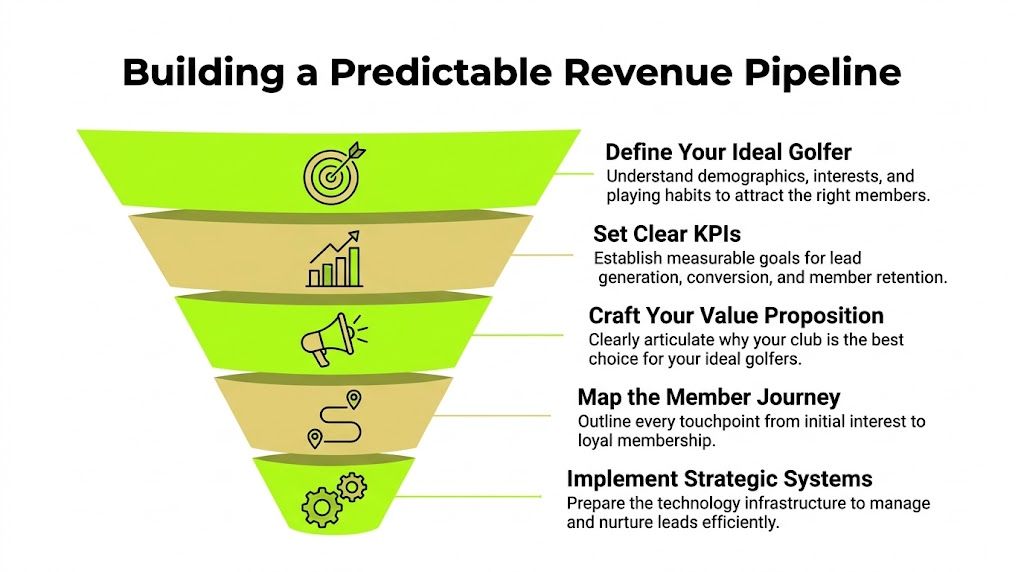
Laying the Foundation with Strategy and KPIs
Strong clubs don't start with ads. They start with clarity.
If you want to know how golf clubs can build a predictable revenue pipeline, the first job is deciding who you want, what outcome you need, and how you'll measure progress. Without that, even a decent campaign can fill the club with poorly matched enquiries, price shoppers, or prospects who were never likely to join on your terms.
Start with the ideal member profile
An Ideal Member Profile is practical, not theoretical. It answers simple questions your club should already know.
Who fits the culture of the club. How far are they willing to travel. What stage of life are they in. Are you trying to attract regular competitive golfers, younger working professionals, flexible lifestyle members, women new to club golf, or lapsed golfers returning to the game.
A club that wants long-term full members should not advertise in the same way as a club trying to fill a beginner pathway. The language, offer, creative, follow-up, and sales conversation all change.
A useful profile usually includes:
- Location fit: postcodes or travel zones the club can realistically pull from
- Playing intent: frequent golfer, returner to the game, social player, competitive member
- Financial fit: someone aligned with your pricing, not someone only looking for the cheapest route in
- Cultural fit: the type of member who is likely to stay, engage, and refer others
Set KPIs that connect to revenue
Many clubs still track the wrong things. Clicks, impressions, and general awareness might be interesting, but they don't tell you whether the club is building dependable income.
Track the points where value is created or lost. In practice, that means watching the handover from marketing into sales and then into membership.
A simple KPI structure looks like this:
| KPI | What it tells you | Why it matters |
|---|---|---|
| Lead response time | How quickly staff or automation replies to a new enquiry | Fast response protects intent |
| Enquiry-to-visit rate | How many leads move to a club visit or meeting | Shows lead quality and qualification quality |
| Visit-to-member conversion rate | How well your sales process works on site | Reveals whether tours actually sell |
| Won and lost reasons | Why people join or drop out | Improves future campaigns and offers |
| Member dues mix | Whether revenue is becoming more stable | Keeps strategy tied to club health |
Build around measurable systems
Technology matters because it makes these KPIs visible. Clubs using data-led dynamic pricing and CRM systems have seen an average 77% increase in online revenue, according to GCMA's coverage of golf's tech-driven revenue growth. The principle is broader than green fees. When the club tracks demand, behaviour, and follow-up properly, decision-making improves.
Practical rule: if a lead enters the business and you can't see its current status in a few seconds, you don't have a pipeline. You have an inbox.
Turn targets into operating numbers
Most clubs set targets in vague terms. "We need more members" isn't specific enough to manage. A better approach is to work backwards from the revenue outcome you need and translate that into pipeline activity.
For example:
- Set the membership goal based on financial needs, category mix, and retention pressure.
- Define required visits based on your actual close rate from visits.
- Define required qualified enquiries based on your booking rate.
- Check capacity so the club can deliver tours, callbacks, and onboarding properly.
Clubs often realise the gap isn't advertising spend but rather process capacity. If no one owns follow-up, the numbers won't hold.
Attracting the Right Golfers with Data-Led Advertising
More ad spend rarely fixes a golf club's pipeline. Poor targeting usually feeds the same operational problem with more noise.
A club can generate plenty of clicks and still miss its membership target if those enquiries come from the wrong postcodes, the wrong price expectations, or the wrong stage of intent. That creates extra follow-up work for the team and obscures the underlying problem. Lead handling breaks down faster when advertising sends in low-fit enquiries.

Why broad campaigns waste budget
Many clubs advertise to "golfers" as one audience. That is too wide to be useful.
The player who lives 12 minutes away, plays twice a week, and is frustrated with their current club is a strong prospect. The player who lives 45 minutes away and clicks on every discounted golf offer is not. If both people enter the same enquiry flow, the sales process gets clogged before anyone has qualified intent.
Good advertising should reduce that friction before the form is submitted. It should screen for fit at the top of the funnel, not leave the membership team to sort it out later.
Three filters matter most:
- Geography: focus spend on realistic driving distance, not broad regional reach
- Membership fit: align campaigns to categories such as full, flexible, beginner, or lifestyle-led joining paths
- Commercial intent: write ads for golfers considering a club change, not casual social engagement
What data-led advertising looks like in practice
The practical setup is simple, but it needs discipline. Use Meta or Google campaigns built around the club's actual catchment, then split audiences by membership proposition and likely motivation.
A private members' club with a strong competition calendar might run one campaign around fixtures, handicaps, and playing standards. A modern club trying to grow off-peak usage might run a separate campaign around flexibility, convenience, and a lower-commitment route in. Those are different buyers. They should not see the same message.
The mistake I see most often is using one generic "Join Our Club" advert and sending everyone to the same form. That usually creates weak conversations because the prospect has done none of the self-selection. Better campaigns do part of the qualification work upfront.
A solid campaign structure usually includes:
- A tightly defined radius based on where current members travel from
- Creative matched to one audience rather than one ad trying to speak to everyone
- A clear conversion action such as booking a tour, requesting membership options, or starting a beginner conversation
- Source tracking so the club can tie each enquiry back to campaign, audience, and message
Match the message to the golfer's buying decision
The advert should answer one practical question. Why should this person enquire now?
For some clubs, the right message is a guided visit with a membership manager. For others, it is a flexible pathway for time-poor golfers who have stopped seeing value in a traditional seven-day package. Beginner campaigns need a different entry point again. They work better when the club offers a clear first step instead of expecting a novice to ask for "membership information" with no context.
The actions clubs take determine whether they help the pipeline or make life harder for themselves. A vague ad creates vague enquiries. A specific ad creates cleaner handovers into the CRM, which gives the team a better chance of converting interest into booked visits and recurring revenue.
GolfRep applies this approach with geo-targeted campaigns built to feed a structured follow-up process, rather than just generate leads. For a practical example of how that works, see this guide on adding 50 to 100 new members with paid advertising.
Better advertising improves lead quality first. Volume comes second.
Automating Lead Qualification and Nurturing with a CRM
The biggest gap in most clubs sits between enquiry and conversation.
A golfer fills in a form while their interest is live. If the club responds quickly, asks the right qualifying questions, and offers a clear next step, that momentum can be converted. If the form drops into an inbox and waits until tomorrow, the lead starts fading immediately.
This is why a CRM is not optional if you're serious about predictable growth. It gives the club one place to capture enquiries, assign status, automate follow-up, and see where each opportunity stands.

Build the pipeline stages first
Before any automation goes live, define the pipeline itself. Tools such as HubSpot work well because they let clubs map visible stages from first contact to outcome.
A simple structure could include:
New lead
The enquiry has arrived and needs immediate acknowledgement.Contacted
The system or staff member has made first contact.Qualified
The lead fits your criteria and is worth progressing.Visit booked
A meeting, tour, or trial experience is scheduled.Decision pending
The prospect has visited and needs structured follow-up.Won or lost
The club records the outcome and the reason.
That may sound basic, but it forces discipline. Every lead must sit somewhere, and every stage needs an action owner.
Respond instantly, not when someone gets time
Automation solves the first-response problem better than good intentions ever will.
A new enquiry should trigger an immediate email or SMS acknowledgement, ideally with a simple next action. That might be a request to choose a call time, answer a qualifying question, or book a visit. The response doesn't need to be elaborate. It needs to be prompt, relevant, and connected to a clear path forward.
A structured CRM pipeline at one UK club generated 99 new members from 970 leads, a 10.2% conversion rate, with £16,369 in month-one revenue and a projected lifetime value of £147,321, according to this HubSpot sales pipeline case study for a golf club. The same source notes that manual follow-up often loses 70-80% of leads.
A simple nurture flow that clubs can actually use
Most clubs don't need a complicated automation stack to improve. They need a small sequence that runs every time and keeps enquiries warm until a staff member speaks to them.
A simple three-step nurture flow can work well:
- Step one, immediate acknowledgement: thank them for the enquiry, confirm the club has received it, and offer the next step.
- Step two, qualification follow-up: ask a small number of practical questions such as preferred membership type, current playing status, or when they'd like to visit.
- Step three, booking prompt: invite them to book a call or visit, with times available and a named contact.
Nurture isn't about sending more messages. Instead, it's about keeping the conversation moving without relying on someone to remember.
The best automation doesn't feel robotic. It feels organised.
Log what happened, including the lost reasons
A CRM only becomes useful when the club uses it fully. That means recording outcomes, not just sending messages.
Every lost lead should have a reason attached. Price. Timing. Distance. No suitable category. Weekend availability. Joined elsewhere. No response after repeated follow-up. These reasons tell you whether the issue sits in targeting, offer design, sales handling, or product fit.
Without lost reasons, clubs repeat the same mistakes. With them, clubs can tighten campaigns, adjust messaging, and stop assuming every failure was caused by lack of demand.
One route clubs consider is a dedicated system that combines advertising, CRM tracking, and AI-led qualification. For example, AI lead qualification for golf clubs shows how automated qualification can help staff focus on the enquiries most likely to convert.
Converting Enquiries into Members and Tracking Performance
A booked visit is not the finish line. It's where many clubs start losing deals in person.
The prospect arrives interested, but the club tour turns into a generic walk around the facilities. The staff member talks about the course, points out the clubhouse, hands over a leaflet, and waits. That isn't a sales process. It's an escorted browse.
Turn the club visit into a sales conversation
A good visit should answer one question clearly. Why is this the right club for this golfer?
That means the person hosting the visit needs context before the meeting. They should know where the enquiry came from, what membership category the prospect is considering, any concerns already raised, and what type of golf they want from club life.
A stronger visit usually includes:
- A personalized conversation first: ask about playing habits, schedule, previous club experience, and what matters most in a new home club
- A relevant route through the club: show the parts that support their reason for joining, not every room by default
- A clear next step: application, follow-up call, membership proposal, or another visit with a playing introduction
Remove friction from sign-up
Many clubs still create unnecessary drag at the point of decision. Paper forms, unclear joining instructions, delayed follow-up after the visit, or internal sign-off delays can all cool a warm prospect.
The easiest fix is to make sign-up simple and digital wherever possible. If someone wants to move forward, they shouldn't need to wait for a manual process to catch up.
A clean handover matters here. The salesperson, manager, or membership contact should update the CRM as soon as the meeting ends so the next action is visible.
If the prospect leaves interested but the club doesn't define the next step, the pipeline hasn't advanced. It has paused.
Review the numbers that tell the truth
Weekly reporting doesn't need to be complicated. It does need to be honest.
A useful dashboard for a club manager should show the volume of new enquiries, how many were contacted, how many qualified, how many booked visits, how many joined, and how many were lost with reasons attached. That creates operational visibility. It also makes staff support easier, because leaders can see where the blockage sits.
A simple review table might look like this:
| Area to review weekly | What to look for |
|---|---|
| New enquiries | Are enough right-fit leads entering the system |
| Uncontacted leads | Has any enquiry been left without response |
| Visit bookings | Are qualified leads moving to a real appointment |
| Won and lost outcomes | Are decisions being recorded consistently |
| Lost reasons trend | Is the same objection appearing repeatedly |
| At-risk members | Who may need re-engagement before they leave |
Don't ignore the back door
A predictable revenue pipeline is not only about acquisition. It also depends on protecting the members you already have.
That point is often missed. A returning customer spends 67% more than a new one, according to Lightspeed's analysis of golf POS and revenue growth. Clubs that focus only on new leads while existing members drift away are filling a bucket with a hole in the bottom.
Use CRM data to spot members who have gone quiet, changed usage patterns, or may be approaching cancellation. Then put simple re-engagement workflows in place. A timely personal message, a membership review conversation, or a relevant invitation can often reopen the relationship before the resignation lands.
Scaling Your Pipeline for Long-Term Growth
Once the pipeline works, the club's mindset has to change. Growth is no longer a campaign. It becomes an operating system.
That means budgeting for acquisition and follow-up as a measured commercial function, not treating marketing as an occasional expense when numbers look soft. Clubs that do this well don't ask whether they should market this month. They ask whether the current pipeline data supports the financial outcome they need.
Refine the system, not just the adverts
The clubs that improve steadily are rarely the ones chasing novelty. They're the ones reviewing data and fixing the weak point.
If enquiry quality is poor, tighten targeting and message. If response is slow, automate the first contact. If visits are happening but joins are low, retrain the on-site conversation. If members are lapsing, build a retention process.
This is more useful than debating abstract marketing ideas. The pipeline tells you where the fault sits if the club records the right information consistently.
A practical monthly review should ask:
- Which lead sources produced members, not just enquiries
- Which lost reasons appeared most often
- Where are leads stalling in the pipeline
- Which membership categories are converting cleanly
- Which retention signals need intervention
Budget with revenue visibility in mind
When clubs can see movement from lead to member, budgeting becomes less emotional. Spend can be judged against real outcomes rather than vague impressions of whether a campaign "felt busy".
That doesn't mean every month will look identical. Golf is seasonal, local competition shifts, and club priorities change. But a visible pipeline lets managers make earlier decisions. You can increase activity before a shortfall becomes a crisis. You can also avoid unnecessary discounting because you know what is coming through the system.
Multi-site groups need central control and local character
Portfolio operators face a different challenge. Efficiency pushes towards centralisation, but membership decisions still happen in local markets.
A group structure works best when the CRM, reporting standards, and automation logic are centralised, while the club-level messaging, tone, and commercial nuances remain local. That balance matters because a golfer isn't joining a portfolio. They're joining a specific club.
For multi-site operators, the strategic challenge is balancing centralised CRM automation with local brand identity. Automation can contribute over 50% of pipeline opportunities, but groups still need a framework for managing lead workflows and reporting without losing local market dynamics, as discussed in this guide to golf course revenue optimisation.
A sensible portfolio model usually separates responsibilities like this:
| Central function | Local club function |
|---|---|
| CRM architecture | Club positioning and tone |
| Reporting standards | Site-specific follow-up context |
| Automation rules | Tours, meetings, and close conversations |
| Data governance | Local knowledge of objections and member fit |
Protect predictability as you grow
Growth often breaks systems before it strengthens revenue. More enquiries create more admin. More clubs create more complexity. More staff create more variation in follow-up quality.
The answer isn't to go back to informal methods. It's to standardise what must be standardised and leave room for local judgement where it matters. Fast response, lead visibility, clear pipeline stages, outcome tracking, and re-engagement workflows should be consistent across the business.
That is how golf clubs can build a predictable revenue pipeline that lasts. Not by chasing more noise at the top, but by controlling the full process from first click to recurring revenue.
If your club wants a clearer way to turn enquiries into visible membership revenue, GolfRep helps clubs build systems around lead generation, automated follow-up, CRM tracking, and conversion visibility so managers can see what is working and where opportunities are being lost.
Ready to tap into our proven growth system?