What Is a Golf Marketing Specialist? a Guide for Clubs

Most advice about hiring a golf marketing specialist starts in the wrong place. It talks about websites, social posts, creative campaigns, and brand visibility. Those things matter, but they are rarely the main reason a club misses its membership targets.
The bigger problem is usually simpler. A golfer enquires, then waits. Or they get a generic reply. Or nobody can see where the lead came from, who followed up, whether a visit was booked, or why interest went cold. Clubs often assume they need more leads when what they really need is a better system for handling the leads they already generate.
That distinction is what separates a true specialist from a general marketer. A generalist creates activity. A specialist builds a conversion process that turns local interest into booked visits, member applications, and recurring revenue.
Beyond Brochures The Modern Golf Marketing Challenge
England alone has a large active golf audience. The Sports Marketing Surveys Golf Participation Report recorded 3.2 million adults playing golf at least once in 2024, with 1.0 million classed as core golfers who played more regularly, according to the National Golf Foundation marketing overview. For club managers, that isn't just an industry fact. It's a reminder that demand exists.
The question isn't whether people are interested in golf. The question is whether your club can convert that interest with enough speed, relevance, and consistency.
Why more enquiries often isn't the answer
Many clubs still treat growth as a top-of-funnel problem. They ask for more advertising, more Facebook posts, more reach, and more campaigns. That approach can increase visibility, but it doesn't fix weak follow-up.
If an enquiry arrives on a Sunday evening and nobody responds properly until Tuesday, the issue isn't lead generation. It's process. If one member of staff sends a detailed reply and another sends a one-line email with no next step, the issue isn't branding. It's inconsistency.
The fastest route to better results is often not more promotion. It's better handling of existing demand.
A golf marketing specialist should spot these gaps quickly. They don't just ask how many leads the club wants. They ask what happens after the form is submitted, who owns the lead, how visits are booked, and what reporting exists from first click to member sign-up.
The shift from reputation to conversion
Clubs used to rely more heavily on reputation, word of mouth, printed collateral, and seasonal campaigns. Some still do. The difficulty is that modern buyers behave differently.
They compare clubs online, enquire out of hours, and expect quick, relevant communication. They also don't all want the same thing. A new golfer looking for a welcoming entry point needs different messaging from an experienced player comparing membership value and course access.
That is why segmented messaging matters. A specialist looks at postcode reach, playing intent, membership type, family decision-making, and timing. Then they build a follow-up path that fits the club's sales reality, not a generic marketing template.
What club managers should really examine
Before increasing ad spend, look at the handover between marketing and operations.
- Enquiry ownership: Does one person clearly own first response and next action?
- Lead visibility: Can the club see every enquiry in one place?
- Visit conversion: Is there a defined path from initial interest to booked club visit?
- Follow-up discipline: Does every lead receive structured follow-up if they don't reply first time?
A golf marketing specialist solves this as a business problem, not a content problem. That's the actual job.
Defining the Specialist A Systems Builder Not a Marketer
A genuine golf marketing specialist shouldn't be judged by how busy the marketing calendar looks. They should be judged by whether the club has a repeatable system for attracting, qualifying, nurturing, and converting the right golfers.
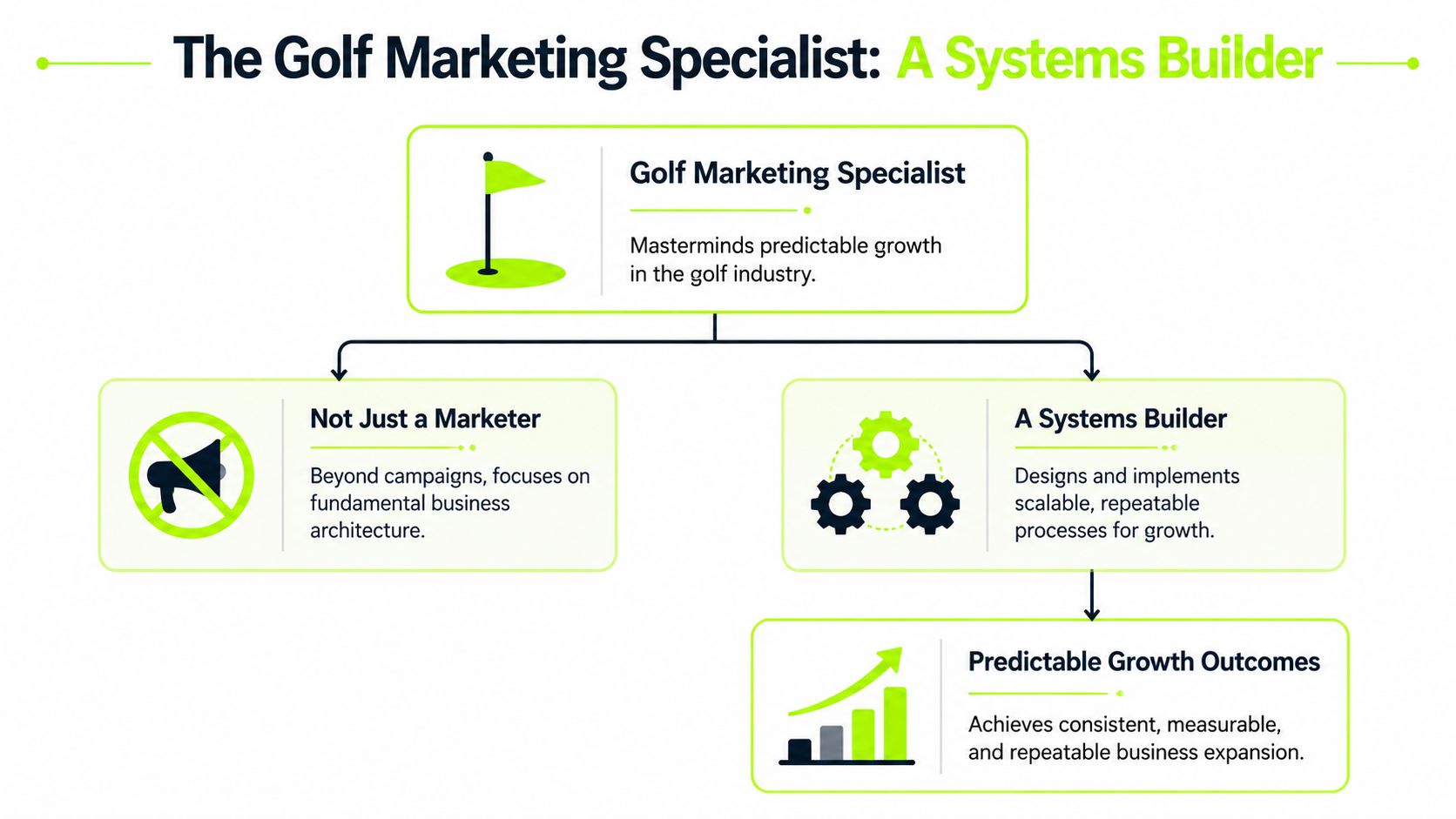
Job evidence points in this direction. Current golf-sector roles increasingly expect someone who can connect acquisition to pipeline and retention using tools such as HubSpot and Google Analytics, not just produce campaigns, as shown in this golf marketing role example from Lightspeed.
The generalist versus the specialist
A generalist usually works across disconnected tasks. They may post on social media, update the website, send an email newsletter, and design a flyer for open day. None of that is wrong. The problem is that these activities often sit in separate boxes with no clear link to pipeline.
A specialist thinks differently. They treat marketing as an operating system.
Instead of asking, "What should we post this week?", they ask:
- What source produced this lead
- How quickly did we respond
- Was the lead qualified
- Did they book a visit
- Did they become a member
- What happened if they didn't
That is a much more commercial role.
Think architect, not decorator
The easiest analogy is this. A general marketer often behaves like a decorator. They make things look better. A specialist behaves more like an architect. They design how the whole structure works.
That means owning the journey from first click to recurring payment, not just the creative assets at the top of the funnel. It also means caring about attribution, CRM hygiene, automation logic, reporting cadence, and handoffs between front office staff and membership sales.
Practical rule: If a candidate talks mainly about content but can't explain lead routing, CRM stages, and follow-up logic, you're not speaking to a systems builder.
Data discipline matters more than golf slogans
Many clubs overvalue "golf industry passion" and undervalue operating discipline. Sector familiarity helps, but it doesn't replace process control.
The stronger hires tend to understand:
- CRM structure: How leads are tagged, assigned, and tracked
- Attribution: Which campaigns produce qualified demand
- Automation: Which actions happen instantly versus manually
- Reporting: Which numbers matter to club management
If you want a broader frame for this kind of specialist thinking, some of the best guides for SEO professionals are useful because they focus on systems, measurement, and execution standards rather than vague creativity. The same mindset applies in golf.
A golf marketing specialist isn't there to "do some marketing". They're there to build a predictable growth engine the club can rely on.
The Toolkit Tactics and Systems That Drive Growth
The tools matter less than the sequence. Clubs get into trouble when they buy software or run ads without deciding what should happen next.

A proper golf marketing specialist usually builds three connected parts. Traffic generation, lead handling, and nurture. When these work together, the club stops relying on chance and staff memory.
Data-led advertising that finds local intent
The first part is targeted demand generation. In plain terms, that means showing the right message to the right golfers in the right catchment area.
This isn't just "run some Facebook ads". It means choosing offers and messages that fit real local demand. A club may need one message for flexible membership, another for complete beginners, and another for lapsed golfers considering a return. Postcode targeting and audience segmentation help, but only if the follow-up behind the ad is sound.
Even community activity can support this when it's tied to a clear local objective. For clubs planning promotional events, charity days, or family open days involving buggies, practical resources like Solana EV parade planning can help shape a more organised event experience. But events only become commercial assets when every attendee or enquiry enters a proper follow-up system.
What should happen after an enquiry
Here, most clubs leak value.
A lead should not sit in a shared inbox waiting for someone to notice it. It should enter a central system immediately, trigger an acknowledgement, assign an owner, and begin a structured next-step sequence. The club should know whether the person asked about membership, lessons, society golf, or a trial visit.
The strongest setups also reduce guesswork for staff. Instead of each person deciding how to reply from scratch, the system creates consistency.
A practical breakdown looks like this:
- Lead captured: Website form, paid ad, phone callback request, or event sign-up enters the CRM.
- Immediate response: The prospect receives a relevant first message confirming the enquiry and next step.
- Qualification: The system captures enough detail to route the lead properly.
- Task creation: A member of staff gets a clear action, not a vague reminder.
- Nurture begins: If the lead doesn't book straight away, follow-up continues automatically.
UK benchmark data shows that 24/7 automated CRM nurture flows produce a 35% higher conversion rate from enquiry to booked visit than manual outreach, and that AI-driven lead qualification can increase high-value membership sign-ups by 2.8x when clubs replace discount-led promotion with automated, data-led systems.
A specialist doesn't remove the human touch. They protect it by making sure no lead gets lost before a human conversation can happen.
Nurture flows that keep interest alive
Many individuals won't commit on first contact. That's normal. The mistake is assuming silence means no intent.
Good nurture flows do simple things well. They answer common objections, prompt visit booking, share relevant club information, and keep the club visible without staff chasing every lead manually. Over time, this creates a far steadier pipeline than one-off campaigns.
For clubs exploring this area, GolfRep's article on golf club automation is a useful reference point because it shows why systems usually outperform ad hoc admin once enquiry volume starts to grow.
Measuring Success KPIs and Expected Outcomes
The specialist role has become more professional because clubs can now measure the commercial impact of marketing more clearly. The function has shifted from seasonal brochure distribution to always-on demand generation, with metrics such as cost per lead, visit bookings, and conversion rates becoming central to growth strategy, as reflected in the BLS overview of marketing management trends and projections.
That shift changes what a club manager should ask for. "How many likes did we get?" is a weak question. "How many qualified enquiries became visits, and how many visits became members?" is a useful one.
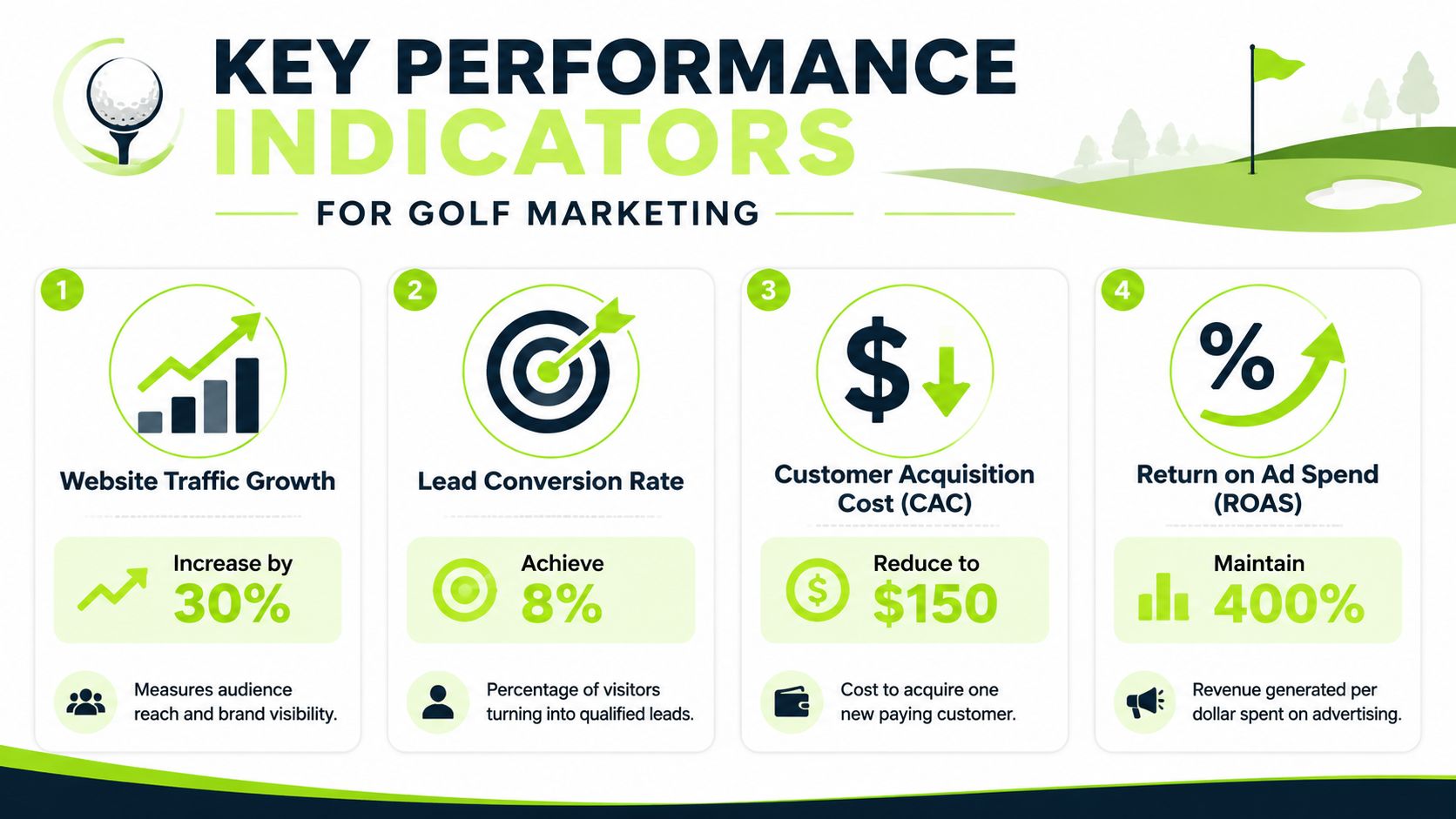
The numbers that actually matter
A club doesn't need a complicated dashboard full of noise. It needs a small set of commercial KPIs with clean definitions.
| KPI | What it tells you | Why it matters |
|---|---|---|
| Cost per enquiry | How much the club spends to generate one enquiry | Shows whether acquisition is efficient |
| Enquiry-to-visit rate | How many enquiries turn into booked visits | Reveals follow-up quality |
| Visit-to-member rate | How many visits become paying members | Shows whether the club's sales process is working |
| Cost per new member | Total acquisition cost divided by new members won | Connects marketing to real financial outcomes |
These measures expose the bottleneck. If cost per enquiry is acceptable but enquiry-to-visit rate is weak, the club doesn't have a traffic problem. It has a response and conversion problem.
Vanity metrics still distract clubs
Website sessions, impressions, post engagement, and email opens can all be useful diagnostics. They are not business outcomes on their own.
A club can have busy social channels and still underperform on memberships. It can also have a tidy-looking website and still lose leads because nobody follows up properly or nobody can see pipeline status.
If reporting stops at clicks, the club is still guessing.
Managers should expect visibility from first contact through to signed membership. That means one dashboard, one source of truth, and one agreed view of the pipeline. If the team can't explain where leads are sitting today, reporting isn't strong enough.
For a broader commercial lens on this, GolfRep's view of the real ROI of golf club marketing is useful because it keeps the conversation tied to revenue and retention rather than activity.
How to Hire and Evaluate a Golf Marketing Specialist
Clubs usually have three options. Hire in-house, use a freelancer, or work with a specialist growth partner. None is automatically right. The best choice depends on your internal capability, response capacity, and how much system ownership you want outside the club.
Three hiring models and the trade-offs
An in-house hire gives the club daily access and close alignment with operations. That can work well when the club already has clear processes and enough enquiry volume to justify dedicated ownership. The risk is that one person gets dragged into design requests, event admin, and general club communications instead of building pipeline.
A freelancer can bring channel expertise and flexibility. This suits clubs that need help with specific delivery, such as paid media or CRM setup. The downside is that freelancers often work within the process they're given. If the club's handoff and follow-up are weak, freelance execution won't solve the root issue.
A specialist growth partner is usually strongest when the club needs both demand generation and a working conversion structure. That model can be particularly useful for committee-led clubs, clubs with limited internal marketing resource, or operators managing more than one site. If you're weighing that route, this overview of choosing a golf marketing agency can help frame what to ask beyond creative output.
Some business owners also find it useful to read broader perspectives on the benefits of marketing specialists because the same principle applies in golf. Specialist expertise matters most when the work affects revenue, not just visibility.
What market pricing tells you
UK market data shows the average hourly pay for a Remote Golf Marketing Specialist is £32.69, with top-tier specialists commanding up to £45/hr. At the higher end, clubs should expect someone who understands centralised CRM management, automated follow-up, and measurable pipeline growth, not just campaign execution.
Price matters, but capability fit matters more. A lower-cost generalist who produces activity without tracking can be far more expensive than a higher-cost specialist who improves conversion visibility and operational discipline.
Interview questions that reveal the difference
Ask questions that force the candidate to explain systems, not just tactics.
| Weak Question (Focuses on Activity) | Strong Question (Focuses on Systems & Results) |
|---|---|
| What social platforms would you post on for our club? | How would you structure the path from enquiry to booked visit for our club? |
| How often would you send emails? | What should happen in the first few minutes after a membership enquiry arrives? |
| Can you redesign our membership page? | How would you track lead source, follow-up status, and conversion by campaign? |
| Have you worked in golf before? | How have you used CRM automation to improve lead handling and reporting? |
| What content ideas do you have for us? | What information would you need to diagnose whether our bottleneck is traffic, response time, or visit conversion? |
Red flags worth taking seriously
A few warning signs come up repeatedly.
- No CRM ownership: If they treat the CRM as someone else's job, they'll struggle to build pipeline discipline.
- Vague reporting: If they talk about awareness but not conversion stages, expect fuzzy accountability.
- Too much channel talk: Platform expertise matters, but not more than lead management.
- No operational questions: A strong candidate asks how your team handles enquiries today.
The best golf marketing specialists don't just bring marketing ideas. They bring control.
Your Next Step Towards Predictable Club Growth
A golf marketing specialist solves a commercial problem. They build the system that turns interest into revenue with less guesswork, less delay, and better visibility.
That is the main distinction. A generalist helps the club stay active. A specialist helps the club become predictable.
If your club already generates some level of interest, the first growth opportunity probably isn't another campaign. It's the journey that starts the moment someone raises a hand. How quickly they hear back, what they receive, whether anyone qualifies them, whether a visit is offered, and whether the club keeps nurturing them if they don't decide immediately.
Start with one honest check. Submit a test enquiry to your own club and review what happens next.
Look at the full path. Check the response time. Read the message quality. See whether anyone owns the lead. Ask whether the club can track that enquiry all the way to a membership decision. Most clubs learn more from that exercise than from another month of posting on social media.
When you understand that process clearly, the job of a golf marketing specialist becomes much easier to define. You're not looking for someone to keep the club busy. You're looking for someone to build a reliable growth system.
If you'd like a clearer view of where your club is leaking enquiries, GolfRep helps golf clubs assess lead handling, follow-up, CRM visibility, and conversion systems so growth becomes more predictable, not more dependent on guesswork.
Ready to tap into our proven growth system?