Nine Hole Golf Course Marketing: A Practical UK Guide

England's nine-hole scores submitted through the World Handicap System increased 28% year on year in 2025, compared with 14% growth for 18-hole scores, according to England Golf's 2025 participation report. That difference makes nine holes worth treating as a distinct commercial product, not just a discounted half-round.
For a club, the opportunity is to match that product to a specific golfer, time and reason to play. The right offer might be a regular after-work slot, a first round with a lesson or flexible access for an existing golfer. Good nine-hole golf course marketing makes those choices clear, then tracks whether the offer brings in new customers, fills quiet tee times and builds repeat play.
Who Plays Nine Holes and What They Need
England Golf participation figures show that 12.6 million adults, approximately one in four adults in England, played some form of golf in the previous twelve months. Of those, 7.3 million played on a nine- or eighteen-hole course, according to National Club Golfer's report on England Golf participation. That's a sizeable audience of existing course golfers as well as people who might be new to the game.
A nine-hole offer shouldn't be positioned only as a first step for beginners. It can suit golfers who want a shorter local round, parents working around family commitments, commuters fitting in a game after work, lapsed members who found a full round too demanding, and older players who prefer a shorter visit. Each group needs a different reason to book and different information before they commit.
| Audience | Time constraint | What they need to see | Lead offer |
|---|---|---|---|
| Existing golfers wanting a shorter local round | Limited weekday time | Handicap recognition and tee availability | Flexible nine-hole membership or points pack |
| Complete beginners | Want a low-commitment first visit | Equipment, pace of play and what's included | Introductory nine-hole round with a lesson |
| Parents and families | Fixed school-run and weekend windows | Junior access and family-friendly tee times | Family weekend nine-hole slot |
| Commuters | Can only play after work | Light-evening tee times and quick booking | Early-evening nine-hole membership |
| Lapsed members | Found a full round too long | A changed format and a clear return offer | Return visit with a nine-hole round |
| Older golfers | Prefer shorter, slower visits | Pace of play, buggy access and parking | Midweek morning nine-hole round |
The table should shape the first message on each page or advert. An existing golfer may want to know whether a round can count towards their handicap and whether there's a convenient tee time. A beginner is more likely to need reassurance about equipment, what to expect and whether someone can help them get started.
Use a booking form or enquiry conversation to find out what the player wants: occasional play, a handicap-eligible round, a regular after-work slot or a family-friendly visit. Then match the follow-up to that need. One membership leaflet won't answer the first question for all six audiences.
Positioning Nine Holes as a Mainstream Format
Try three clear messages on your website or local advertising: “Eighteen holes when you have the time, nine when you do not”; “A proper round of golf in the time you have”; and “Handicap-eligible golf in a lunch break”, if your course, rules and playing times support that claim.
Test two statements at a time on the same page or advertising set. Track how many people click through to the booking page and how many complete a booking, then keep the message that produces more bookings. A line that earns clicks but doesn't lead to rounds is not doing the commercial job.

Hole counts have varied across British golf for well over a century. In 1919, approximately half of Britain's golf courses were still nine-hole layouts, a historical point covered by Golfshake's account of nine-hole golf. Use that heritage as supporting context in the club's story, not as the main selling line.
The main promise is practical: a golfer can play a proper round within the time they have. Back it up with realistic round times, tee-time spacing and a clear description of what's included. If you advertise a ninety-minute round, the first visit will test whether the promise matches the experience.
Practical rule: Sell the time and experience the club can reliably deliver, not the shortest possible round in ideal conditions.
Explaining Handicap Eligibility Before the Visit
Under the World Handicap System in England, nine-hole scores can be submitted and used in the calculation of a Handicap Index. They aren't necessarily just informal practice rounds, as explained in this overview of the World Handicap System's move from CONGU to MyEG. That can matter to a golfer deciding whether a short visit or nine-hole membership supports their formal handicap journey.
It's also a detail clubs need to explain accurately. Don't imply that every nine-hole round automatically qualifies. The outcome depends on the course, the player's status and the applicable handicap requirements.
Publish the answer before the golfer books
Use this checklist on the course website, booking page and follow-up email:
- Course status: Say whether the course is rated and authorised for nine-hole scoring.
- Recording the score: Explain how players should record and submit their round.
- Player eligibility: State whether the player needs an affiliated club membership or an England Golf iGolf arrangement.
- Worked example: Show a short example of how an eligible nine-hole score can feed into a Handicap Index, using a case confirmed against current requirements.
- Follow-up: Repeat the same explanation in the automated email sent after an enquiry.
Before publishing, confirm the current rules and the course's status with England Golf. If a player needs an affiliated membership or an iGolf arrangement, say so in plain English rather than burying it in a general terms page.
This information should appear before the golfer arrives, not just in a conversation at the reception desk. A clear explanation helps a prospect understand the value of the visit and gives staff a consistent answer when questions come up. The commercial point is simple: a short round can still support a golfer's formal handicap journey when the relevant requirements are met.
Pricing Nine-Hole Access Without Discounting
A nine-hole membership doesn't have to be an 18-hole membership with a discount attached. Price it around the access and frequency it gives the golfer. Common options include a nine-hole-only membership, weekday-only membership, full seven-day membership and a pay-and-play points pack for people who want occasional visits rather than an annual commitment.
An Edinburgh Leisure membership example lists nine-hole-only membership covering Portobello and the Wee Braids at £397, compared with £671.50 for unlimited seven-day adult membership across six courses. It also lists a weekday-only option at £456. Those prices illustrate how access, course coverage and restrictions can define separate products. They're an example from one operator, not a UK-wide price benchmark.
Give a prospect a simple way to compare the annual fee with likely use:
- Write down the annual fee for the membership being considered.
- Note the visitor green fee for the same type of round.
- Divide the annual fee by the visitor fee to calculate the number of rounds needed to reach the same spend.
- List the restrictions beside the calculation, such as weekday access, named tee times, course coverage or nine-hole-only use.
| Annual fee | Visitor green fee | Rounds to break even |
|---|---|---|
| £300 | £25 | 12 |
| £400 | £30 | 14 |
| £450 | £25 | 18 |
| £600 | £30 | 20 |
Illustrative figures only, not market benchmarks. Rounds are rounded up to the next whole round. Replace them with your club's own prices.
For example, an annual fee of £400 divided by a £30 visitor green fee gives 13.33 rounds, so the table rounds up to 14 rounds. This is a simple comparison of fee with green-fee spend. It doesn't account for other benefits or the value a player places on regular access, so make those clear as well.
Explain each tier on the pricing page, including who it suits and what the golfer can book. For a more detailed framework on setting and presenting fees, see GolfRep's guide to golf club pricing strategy. Put the break-even figure and the restrictions side by side. Unclear terms can create friction before a sale and dissatisfaction after someone joins.
Where Nine-Hole Golfers Find a Round
Give each channel a specific job. Your club's own listings should tell a golfer what nine-hole play involves and how to book, while community channels can put a relevant offer in front of a particular local audience.
Start with your Google Business Profile. Name the nine-hole format in the description, state the realistic duration and price range, and include the booking route. Use photographs that show the course and the kind of tee time you're promoting. Keep those details consistent with your website, not just with a temporary advert.
Next, create a dedicated website page for each audience or search need. A page titled “nine-hole golf in [town]” answers a different question from “after-work golf in [town]”. Give each page a clear offer, the information needed to book and a direct booking link. For practical ideas on matching local messages to campaigns, see GolfRep's guide to golf course advertising.
Third-party tee-time sites and local listings should use the same wording as the club's own pages. If one listing promises a certain duration or says a round is handicap-eligible, the booking page should support that claim. Inconsistent details can leave golfers unsure about what they're buying.
For community outreach, match the channel to the audience. Parish newsletters, workplace notice boards and parents' groups may suit family or commuter offers. Existing members can also share the round with friends who've stopped playing.
Before launch, check that:
- The format is named in each listing.
- The duration is stated and realistic.
- Price and restrictions are visible.
- The handicap statement is accurate.
- The booking link works on a phone.
Tag bookings with their source in the booking system. That lets you compare completed rounds, not just clicks, across listings, adverts and community activity.
Measuring Campaigns Beyond Enquiries
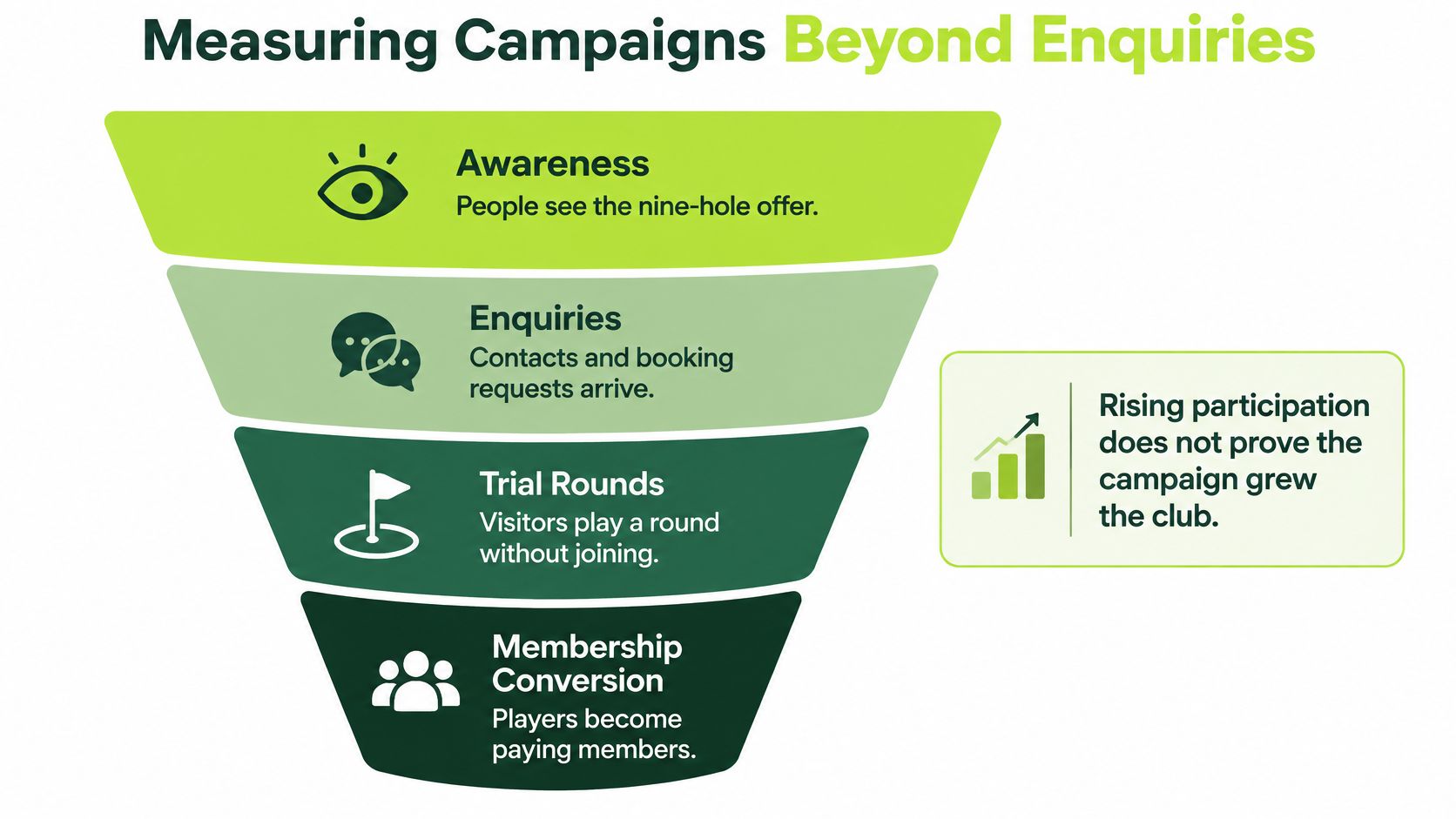
A rise in participation doesn't prove a nine-hole campaign has grown the club. The commercial question is whether the campaign brought in new golfers, encouraged repeat visits and produced members who stay, or shifted existing play into a shorter or cheaper product.
England recorded 11.83 million World Handicap System score submissions in 2025, up 16% year on year, and more than 9,600 iGolf players joined formal clubs during 2025, according to Glenmuir's account of the growth in golf. Those figures show that independent-golfer activity can be followed into formal club membership. For your own campaign, connect booking, CRM, handicap and payment records so you can see the journey from first visit to retained member.
| Metric | What it tells you | Where the data sits |
|---|---|---|
| Repeat visits | Whether a first round turns into a habit | Tee-sheet and booking records |
| Qualified enquiries | Whether the prospect fits the product and channel | CRM |
| Booked trials | Whether interest became a fixed commitment | Booking system |
| Trial attendance | Whether the booking became a round played | Tee-sheet check-in |
| Conversion to membership | Whether the trial became revenue | CRM and payment records |
| 90-day retention | Whether the new member stays | Membership and payment records |
| Cost per new member | Campaign spend divided by new members | Advertising platform and finance records |
Measure the whole journey
Count each stage separately. A booking isn't an attended round; an enquiry isn't a qualified prospect; a new member isn't necessarily a retained one. Reviewing those distinctions shows where the campaign is losing people and whether the offer attracts the audience it was designed for.
Calculate cost per new member by dividing campaign spend by the new members won in the same period. Then compare that acquisition cost with the expected annual recurring revenue from each member. That comparison is more useful than cost per enquiry alone, but it still needs the retention figure: a member who leaves quickly won't deliver the same ongoing value as one who stays.
Ask the committee whether the campaign filled historically quiet tee times or moved existing members into a cheaper or shorter product. Check booking histories and membership records before claiming incremental growth. The reporting should show both demand generated and the capacity it filled.
For a wider guide to choosing and reviewing performance measures, see GolfRep's guide to measuring marketing effectiveness. Keep the report simple: one line per stage, with the number of people at that point and the change from the previous month. Review it monthly so the club can spot a weak stage without confusing activity with revenue.
How to Run a Campaign for Quiet Tee Times
A useful campaign starts with one quiet slot, not a club-wide promotion. That keeps the offer focused and makes it easier to check whether new bookings came from the campaign or from golfers who would have played anyway.
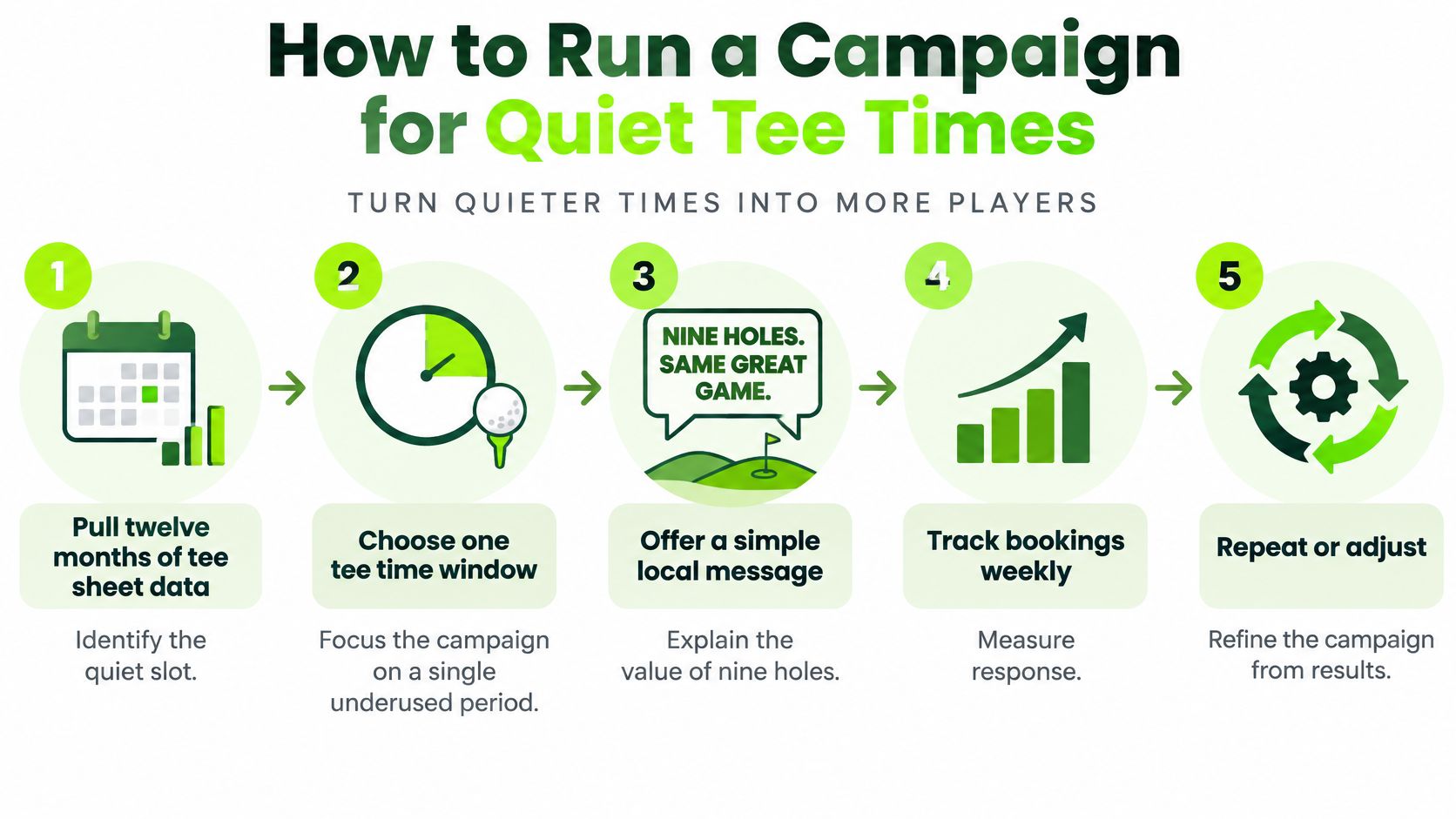
- Find the gap. Pull twelve months of tee-sheet data and identify the three weakest weekday slots. Use a real capacity problem, not a time that feels quiet.
- Choose one slot and one measure. Pick a single window to promote and set a measure such as the percentage of available tee times filled. Keeping the test narrow makes the result easier to interpret.
- Build the offer around the slot. State when the round is available, how long it's expected to take and what the golfer gets. Keep the price consistent with the club's wider rates so existing members aren't encouraged to move from a higher-value round into a cheaper offer.
- Select the audience. Consider lapsed members who haven't played recently, past visitors and local postcodes within a reasonable drive. Match the message to the people most likely to use that slot.
- Make booking straightforward. Send people to a page showing the available times, duration and accurate handicap statement. Check the full route on a phone before spending on advertising.
- Review the run, not just launch week. Run the campaign for four to six weeks and check bookings, attendance and second visits each week. Give the offer time to show whether it attracts new play.
- Keep, change or move it. Compare results against the original measure, then check whether existing members shifted into the promoted time. Continue only if the offer and audience are contributing to the club's commercial aims.
A useful check: A full tee sheet isn't enough if the campaign mainly relocates demand from another time or product.
For paid search, review search terms and exclude queries that aren't relevant to a local nine-hole offer. This guide to reducing wasted spend with negative keywords is a practical resource for keeping those adverts focused. After the campaign, use the booking and attendance results to decide whether to adjust the audience, message, price or slot. Change one part at a time so the next run gives you a clearer answer.
Choose the Constraint to Fix First
Use the figures your club already holds to identify the weak point. A low number of enquiries points to a different problem from plenty of trial rounds but few members joining. Don't assume that every shortfall needs more follow-up.
| Signal in your figures | Likely bottleneck | First action to test |
|---|---|---|
| Many visits, few members joining | Trial-to-membership conversion | Map each trial step and add a follow-up sequence |
| Few enquiries in quiet months | Demand generation | Run one targeted local campaign for a single slot |
| Enquiries arrive but few are booked | Booking friction | Shorten the booking path and show live availability |
| Members join but leave within 90 days | Onboarding and early retention | Review contact in the first 90 days |
| Quiet tee times stay quiet after promotion | Offer or audience mismatch | Test a different audience or format for the slot |
A club with many visits but few new members may need to make the step from trial round to membership clearer. A club with few enquiries needs to generate relevant local demand before it invests in improving a conversion process that has too few prospects to work with. If bookings aren't becoming visits, check whether the booking process and the information on the page are making it harder than necessary to commit.
Use a three-step decision rule:
- Choose one constraint that the figures point to most clearly.
- Change one thing and run it for a full campaign cycle, using the quiet-slot approach described above.
- Compare the result with the previous figures before moving on to another constraint.
GolfRep provides a system, strategy and partnership to help golf clubs grow membership, increase enquiries or stabilise retention. If a second view would help you decide which constraint comes first, we can review the pipeline using the figures your club already holds.
GolfRep works with golf clubs and facilities on customer acquisition, sales processes, CRM, follow-up, conversion and retention. If you'd like to assess how a nine-hole offer could attract local golfers and contribute to repeat revenue, visit GolfRep to book a call and see whether our proven growth system is a good fit.
Ready to tap into our proven growth system?