Nine Hole Golf Club Membership Marketing Playbook
Most advice on nine hole golf club membership marketing starts in the wrong place. It tells clubs to run more ads, post more often, or refresh the website banner as if enquiry volume is the whole problem.
It usually isn't.
A typical nine hole club already gets interest from local golfers. The primary failure occurs after that first touch. An email sits unanswered in a shared inbox. A voicemail gets picked up the next morning. A prospect asks about flexible membership, but nobody records what they wanted, who spoke to them, or whether they were invited in. The club thinks demand is weak, yet the situation is simpler. The follow-up is inconsistent.
That's why predictable growth comes from process, not noise. If your club can't see every enquiry, respond quickly, qualify interest properly, and move people towards a visit, more lead generation just creates more leakage. We see this repeatedly at GolfRep. Clubs often don't need more attention first. They need a better way to handle the attention they already create.
The Real Problem with Membership Growth
Most clubs don't have a lead generation problem. They have a lead handling problem.
A secretary, general manager, or pro shop team member is usually juggling member queries, visitor bookings, competitions, bar issues, and day-to-day operations. Membership enquiries arrive in the middle of that. Some come by email, some by phone, some through Facebook, and some through a website form that nobody checks until later. That isn't a marketing strategy. It's a patchwork.
The result is lost intent. Not because prospects weren't interested, but because the club had no system to capture and move them forward. This is why broad advice about “getting more exposure” often disappoints. Exposure without follow-up discipline just produces a longer list of missed opportunities.
Practical rule: Treat every membership enquiry as a live sales opportunity, not an admin message.
The clubs that improve membership growth usually fix three things first:
- Response speed: Someone acknowledges the enquiry quickly.
- Lead visibility: The club knows who the prospect is, where they came from, and what they asked for.
- Next step control: Every enquiry gets moved towards a call, a visit, or a trial round.
That's also why the usual thinking needs challenging. If your handling process is weak, buying more traffic won't solve the underlying issue. It just increases waste. We've written more on that in our piece on why most golf clubs struggle to attract new members.
Redefining Your Nine Hole Advantage
A nine hole club should never market itself as a reduced version of an 18-hole club. That frame puts you on the defensive before the prospect even asks a question.
The stronger position is to present nine holes as the right fit for a specific type of golfer. In the UK, the available market is already broad. The R&A's participation report found that 7.1 million people in Great Britain and Ireland played golf in 2023, across on-course and off-course formats, which gives clubs a much wider pool to target than traditional members alone, as noted in this summary of UK golf participation and membership opportunity.
That matters because many of those people are not looking for the same thing.

Sell fit, not length
A nine hole course suits golfers who want golf to fit around life. That sounds obvious, but many clubs still write membership copy that centres prestige, formality, or heritage instead of convenience and usability.
A better message is practical. You can play before work. You can get round after school pick-up. You can come back to golf without feeling you've joined an institution you need to decode. That's a different proposition entirely.
For many clubs, the strongest audience segments are:
- Busy professionals: They want shorter rounds and easier commitment.
- Beginners: They need a less intimidating environment and a simpler first step.
- Young families: They value flexibility and a club that feels manageable.
- Lapsed golfers: They often want to return without paying for a format they won't fully use.
- Social players: They enjoy golf, but don't want a high-friction membership path.
Write the offer around the member's day
When clubs describe nine hole membership properly, the message becomes easier to understand and easier to buy.
A weak version says:
- Traditional membership available: Contact us for details.
A stronger version says:
- Play in less time: Ideal for golfers who want regular golf without blocking out half a day.
- A simpler place to start: Friendly for beginners, returners, and families.
- Local and usable: A club you can use midweek, after work, or for quick practice.
Clubs that win with nine hole golf club membership marketing don't apologise for being shorter. They make shorter feel smarter.
Positioning before promotion
Before you spend anything on ads, your club should be able to answer one question clearly. Why is this membership the right choice for this type of golfer?
If you can't answer that in plain English, your advertising will be vague and your sales conversations will drift. Positioning sharpens everything that follows, from the landing page to the tour to the joining conversation.
If your club is smaller, this is often your biggest commercial advantage, not a limitation. We've covered that in more detail in our guide on how to grow a small golf club.
Designing Irresistible Membership Offers
Once the positioning is clear, the next mistake is offering only one rigid annual membership and expecting the market to sort itself out.
That approach creates unnecessary friction. It asks every prospect to make the same decision, at the same commitment level, regardless of their playing habits. For nine hole clubs, that's especially risky because price matters more. In a UK study on golf developments, 53.8% of nine-hole developers rated price as important versus 22.7% of 18-hole developers, which supports a marketing approach built around clear value and lower-friction entry points, as discussed in this UK golf development marketing study.
Why one membership tier often underperforms
A single full-fee package works best when demand is already strong, the club has a clear waiting list, or the brand can command a straightforward premium position.
That isn't the commercial reality for many nine hole clubs. Prospects often sit somewhere between visitor and full member. They're interested, but not fully ready. If the only option is a hard annual commitment, many will delay the decision rather than say yes.
A better structure gives people a path.
| Membership model | Best for | Main strength | Main risk |
|---|---|---|---|
| Full annual membership | Frequent local golfers | Simple and clear | Too big a leap for cautious prospects |
| Trial membership | Beginners and returners | Low-friction first step | Can attract low-commitment buyers if unmanaged |
| Points or credits model | Irregular players | Flexible usage | Needs clear explanation at sale |
| Pathway to full membership | Interested non-members | Creates progression | Requires follow-up discipline |
Offers that reduce hesitation
The most useful nine hole membership products usually do one of three jobs.
First, they remove fear of overcommitting. A short trial, limited-term starter package, or flexible points option helps a prospect start without feeling trapped.
Second, they create upgrade logic. A pathway product should lead naturally into fuller membership. If a prospect enjoys the club, the next step should feel obvious and easy.
Third, they make value visible. If a lower-cost option includes a defined benefit such as easier booking, member events, or an onboarding session, the conversation moves beyond headline price.
What doesn't work: vague discounts with no structure, no expiry, and no plan for what happens after someone takes them.
Practical offer ideas to test
A committee doesn't need a complex pricing overhaul to improve results. Start with a small menu of offers designed for different buying stages:
- Starter pathway membership: A limited introductory product for beginners or lapsed golfers, paired with a planned review conversation.
- Flexible weekday option: Useful for retirees, shift workers, and local golfers with off-peak habits.
- Trial plus welcome session: A low-friction way to get someone on-site and into the club's social environment quickly.
- Dual-stage joining route: Prospect starts on a smaller package, then upgrades into full membership with a clear transition process.
The key trade-off is simple. More flexibility can lift conversion, but it also demands tighter administration. If the club can't track who bought what, when they should be contacted, and when an upgrade conversation should happen, flexible offers become messy. If the process is organised, they become a reliable growth lever.
Building Your Local Digital Marketing Machine
Digital marketing for a nine hole club should be local, specific, and tied to a next step. Most wasted spend comes from broad targeting and vague creative.
The aim isn't to “build awareness” in the abstract. It's to put the right message in front of local golfers who are likely to value a shorter, easier membership proposition, then move them into a proper follow-up system.

Where local demand usually starts
For most clubs, the core channels are straightforward:
- Google Ads: Best for intent. People already searching for golf memberships, local golf, beginner golf, or golf clubs near them.
- Facebook and Instagram Ads: Strong for interruption-based attention, especially when the creative highlights convenience, community, or beginner-friendly entry.
- Google Business Profile: Often overlooked, but important for local discovery and trust signals.
If your club relies on word of mouth alone, digital activity doesn't replace that. It scales it.
What the adverts should actually say
The message should reflect the club's position, not generic golf language. “Join now” is weak on its own. “Play more often without giving up half your day” is clearer. “A friendly local club for beginners, returners, and busy golfers” gives the right person a reason to click.
Good creative for nine hole golf club membership marketing usually emphasises:
- Time efficiency: Quicker rounds and easier weekly play.
- Approachability: Less intimidating than many traditional club environments.
- Value clarity: Flexible ways to start, rather than one heavy commitment.
- Local lifestyle fit: The course works around work, family, and normal routines.
A simple landing page should continue that same message. If the ad promises flexibility but the page only shows a contact form and a generic photo, response quality drops.
Build the top of the funnel properly
Many clubs require greater discipline. The ad campaign should not dump leads into an inbox and hope for the best. It should feed into a visible process.
At a minimum, each campaign needs:
- A dedicated landing page for membership interest.
- A short enquiry form that asks enough to support follow-up.
- A tagged source field so the club knows which campaign generated the lead.
- A next-step promise such as a call, tour, or trial invitation.
Clubs should also tighten their local presence beyond paid ads. For practical insights for local businesses and AI visibility, a well-managed Google Business Profile can support discovery and improve the quality of local traffic.
We've covered the wider channel mix and campaign setup in our guide to golf club digital marketing.
Converting Enquiries into Bookings with a System
The most expensive lead in golf marketing is the one the club already paid for and then failed to convert.
That usually happens because the club relies on manual habits instead of a defined workflow. A website form sends an email. Someone means to call later. A Facebook message gets answered from a personal account. Notes live in different places, or nowhere at all. Nobody can tell which prospects booked a visit, which went cold, or which were never followed up properly.
Industry guidance for private clubs recommends tracking every lead through the full sales process and using automation for initial contact and data collection because without structured tracking and nurture, clubs lose visibility on where prospects stall and what drives conversion, as outlined in this private club membership sales guidance.
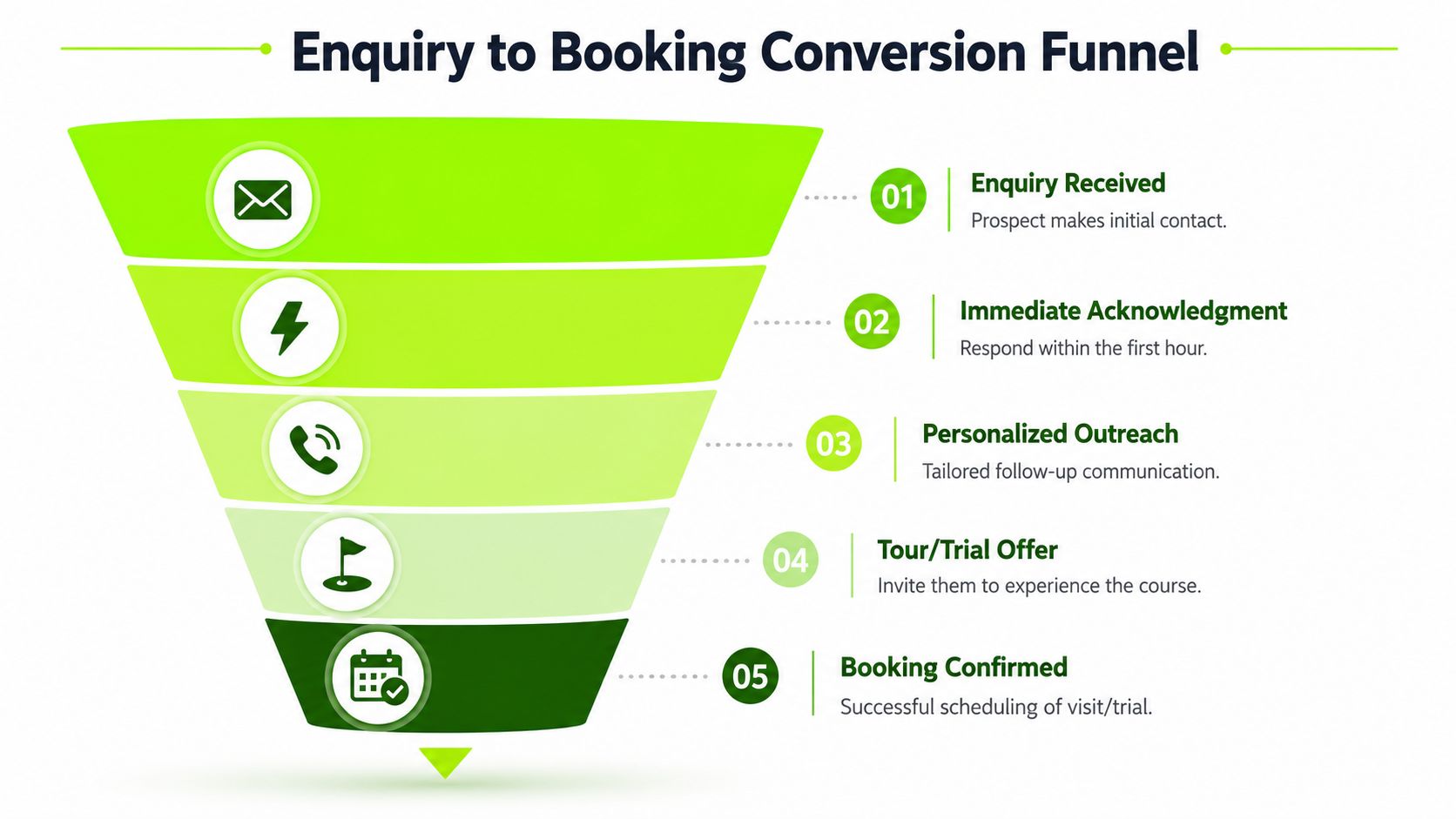
What the first hour should look like
The first hour after an enquiry matters because that's when intent is freshest. The prospect is still thinking about your club. They still remember the ad, the search, or the website page they saw. Delay kills momentum.
A sound workflow looks like this:
| Stage | What happens | Why it matters |
|---|---|---|
| Enquiry received | Form, call, message, or email enters one system | Stops leads being scattered |
| Immediate acknowledgement | Automated email or text confirms receipt | Reassures the prospect quickly |
| Lead capture | Source, contact details, and interest type are recorded | Gives the club visibility |
| Personal follow-up | Staff member calls or messages with context | Moves from enquiry to conversation |
| Booking attempt | Prospect is offered a clear visit or trial step | Creates momentum and accountability |
Systems beat effort
Most clubs don't need more people to do this well. They need fewer manual gaps.
A basic CRM, automated acknowledgement, and task-based follow-up process will outperform a shared inbox every time because the system remembers what staff forget. It records source, stage, notes, and next actions. It also makes handover easier when different team members are involved.
Clubs should be blunt with themselves at this point. If you can't answer these questions instantly, the system is too loose:
- Who enquired this week?
- Who has been contacted?
- Who has a booked visit?
- Who went cold after first contact?
- Which source produced the strongest enquiries?
The point of automation isn't to sound robotic. It's to make sure no genuine prospect gets ignored while the team is busy running the club.
Qualification without friction
Not every lead is ready to join. That doesn't mean the club should treat all enquiries the same.
Qualification should be light but useful. Ask what type of golf they play now, whether they're considering a membership soon, and what attracted them to the club. That gives your team context. A beginner needs a different conversation from a lapsed member of another club.
For clubs that want an all-in-one option, GolfRep is one example of a platform and service built around ad generation, CRM capture, and structured nurture for golf clubs. The important principle is the system itself, not the brand name on it.
Booking is the real conversion milestone
Many clubs treat an enquiry as a win. It isn't. The first meaningful milestone is the booked visit, trial, or membership call.
That's the point where interest becomes scheduled intent. Your process should push towards that outcome clearly and repeatedly. If a prospect doesn't book immediately, they should enter a follow-up sequence rather than disappear into silence.
Clubs can also support this process with better on-site data capture. Tools that improve guest engagement in hospitality settings can help venues collect cleaner visitor information and build more useful follow-up journeys, especially where clubhouse traffic is strong.
From Booking to Member The Nurture and Retention Flow
A booked visit is progress, not completion.
The gap between “I'll come and have a look” and “I've joined” is where many clubs go quiet again. They assume the course sells itself. Sometimes it does. Often it doesn't. Prospects still need context, reassurance, and a reason to take the final step.

What a good visit actually feels like
A prospect tour should feel personal and organised. Someone should be expecting them. The conversation should match what they originally asked about. If they enquired about flexible membership, don't walk them around the club and then hand them a generic price sheet.
The strongest visits usually include a few simple elements:
- A warm arrival: The prospect is greeted by name and doesn't need to explain themselves from scratch.
- A guided conversation: Staff connect the membership option to the person's actual playing habits.
- A practical experience: A short walk, a trial round, practice access, or a social touchpoint makes the club easier to imagine using.
- A clear next step: Nobody should leave without knowing what happens next.
A good membership visit doesn't feel like a sales pitch. It feels like the club has already made space for the person to belong there.
The follow-up sequence after the visit
Most clubs underuse post-visit follow-up. One polite email is sent, then nothing. That leaves too much to chance.
A better nurture flow is staged. Not aggressive, just organised.
A typical sequence might look like this:
- Same day acknowledgement thanking them for visiting and repeating the relevant membership route.
- Short follow-up message a little later, answering common questions and offering a call.
- Social proof through experience cues such as upcoming member roll-ups, beginner sessions, or quiet times to play.
- Decision prompt with a clear joining path or invitation back in.
The content should stay human. Reference what the person cared about. If they liked the shorter playing time, talk about that. If they asked about starting gently, reinforce the pathway rather than pushing full commitment immediately.
The first 90 days matter more than the join date
Too many clubs treat the signed form as the finish line. It isn't. Early retention starts the moment somebody joins.
The first months shape whether a new member feels they made the right decision. That requires intentional onboarding, especially at clubs that want to grow through referrals and long-term fit.
A practical onboarding flow includes:
| Phase | Club action | Purpose |
|---|---|---|
| First week | Welcome message and named contact | Reduces uncertainty |
| Early playing stage | Introductions to suitable groups or times | Helps them get on the course |
| Social integration | Invite to beginner-friendly or mixed events | Builds belonging |
| Check-in | Personal contact after initial use | Surfaces issues early |
| Ongoing nurture | Relevant updates, events, and reminders | Keeps engagement active |
Retention is part of marketing
Committee-led clubs often separate things that should stay connected. They think marketing gets the member in, then operations take over. In practice, retention starts inside the same system.
If you know why somebody joined, you can onboard them better. If you onboard them better, they use the club more confidently. If they use the club more confidently, they are more likely to stay and recommend it.
That loop is what creates a healthier membership base. Not one-off campaigns. Not random discounts. A connected journey from first enquiry to settled member.
Building a Predictable Membership Pipeline
Nine hole golf club membership marketing works when the club stops treating each enquiry as a one-off event.
The clubs that grow consistently usually do the same few things well. They position the nine hole offer properly. They design membership options that reduce hesitation. They run local campaigns that attract the right type of prospect. Then they put every lead into a visible follow-up process that moves people towards a visit, a decision, and a strong start as a member.
That's what creates predictability.
Without that system, marketing stays reactive. One month feels busy, the next feels quiet, and nobody can explain why. With the right process, the club can finally see the pipeline clearly. It can track where leads come from, where they stall, and which actions turn interest into revenue.
This doesn't require complicated technology for its own sake. It requires discipline, clarity, and a process the team will use. When those pieces are in place, membership growth becomes more manageable and far less dependent on guesswork.
If your club wants a clearer membership pipeline, GolfRep helps golf clubs combine lead generation, CRM visibility, and structured follow-up so enquiries don't get lost between first contact and sign-up.
Ready to tap into our proven growth system?