Why Most Golf Clubs Struggle to Attract New Members

It’s a strange time to be running a golf club. We see headlines celebrating a nationwide boom in golf participation, yet many club managers are looking at their own spreadsheets with a sinking feeling. If golf is so popular, why aren't the membership numbers reflecting that?
The uncomfortable truth is that for most clubs, the problem isn’t a lack of interest in the sport. The real issue is a broken internal process for converting genuine interest into paying members. The pipeline is leaking, and it’s happening right under your nose.
The Hidden Reason Your Golf Club Isn't Growing

This disconnect between industry-wide growth and individual club performance is something we see constantly. The instinct is to blame outside factors or, more commonly, to throw more money at marketing. But simply running more ads often makes the problem worse.
The single biggest growth opportunity for your club isn't finding more people who want to play golf. It's about properly managing the interest you're already getting.
Think of your club as a busy high-street shop. People are peering in the window and stepping inside, curious about what you offer. But when they go to ask a question or make a purchase, the counter is empty. That is precisely what happens every time a membership enquiry goes unanswered or is handled poorly.
The Membership Growth Paradox
The golf industry is sending conflicting signals. On one hand, participation is up. On the other, many clubs are treading water. This table breaks down why national success doesn't always trickle down.
| Positive Industry Signal | The Underlying Club-Level Problem |
|---|---|
| Record-high participation rates and media coverage. | This interest is fragmented. Potential members are exploring multiple clubs, and the one that responds first and best often wins. |
| Increased spending on club marketing and online ads. | More enquiries are generated, but they flood outdated, manual systems. Leads are lost, and the marketing spend is wasted. |
| A younger, more diverse demographic is entering the sport. | This new audience expects instant, digital communication. Slow, offline processes feel archaic and alienate them immediately. |
Ultimately, a rising tide doesn't lift all boats, especially those with holes in them. Fixing the internal systems is the only way to actually capture the opportunity.
Shifting Focus From More Marketing to Better Systems
Too many clubs rely on a fractured, manual process for handling new enquiries. A message lands in a general inbox, gets forwarded to a busy volunteer, or simply sits there for days. Every delay and every missed follow-up is lost revenue and another golfer likely joining your competitor down the road.
Pouring more money into the marketing budget is like trying to fill a leaking bucket by turning up the tap. Sure, more enquiries pour in, but just as many leak out through slow response times and non-existent follow-up. This is a fundamental reason why most golf club marketing fails to show any real return.
The answer isn't more generic advertising. It’s about putting a structured system in place that does three things exceptionally well:
- Respond Instantly: Acknowledge every single enquiry within minutes, not hours or days.
- Track Everything: Get a crystal-clear view of every potential member in your pipeline.
- Nurture Effectively: Use automated, yet personalised, communication to guide people toward a decision.
By fixing the systems that handle, nurture, and convert new leads, clubs can build a predictable and sustainable membership pipeline. This creates growth based on solid process and data, not hope and inconsistent effort.
The rest of this guide will break down each of these failure points and give you practical, actionable steps to fix them for good.
Debunking the Myth of the Waiting List
For many golf clubs, a waiting list is worn like a badge of honour. It's often seen as the ultimate proof of success, a clear signal that the club is in high demand. While that might feel reassuring, from a business perspective, a long, stagnant waiting list is rarely a healthy sign.
In reality, it's more likely an indicator of a broken conversion process.
A poorly managed waiting list isn't a predictable pipeline; it’s a holding pen for missed opportunities. It represents a collection of highly interested prospects whose initial enthusiasm is slowly being eroded by silence. This isn't just a minor administrative slip-up; it’s a fundamental misstep in how the club handles its most valuable leads.
Think about it from the prospect's point of view. When someone enquires about membership, they are at their peak level of interest. They are actively looking for a club and have chosen to engage with yours. If that enthusiasm is met with a vague "you're on the list" and nothing more, their excitement cools, and they start looking at your competitors.
From Static List to Dynamic Pipeline
The core problem with the traditional waiting list is its passivity. A prospect's name is added, and then… they wait. There’s rarely any structured communication, no regular updates, and no clear pathway to joining. This vacuum of information creates uncertainty and frustration, pushing good prospects toward clubs that are simply more organised and responsive.
Recent data from the UK golf industry paints a very clear picture of this challenge. Despite overall membership growth, individual club performance reveals a persistent struggle. The average waiting list across members' clubs in 2026 stood at 53 people, barely changed from 51 the previous year. More tellingly, only 59% of clubs even bother to keep those on the list informed about their status.
During 2026, an average of just 21 members per club actually progressed from these lists to full membership, even as England's total club membership grew to over 750,000. For a deeper dive into these numbers, you can explore the complete golf club report for 2024-25.
This data proves that just having a list is not enough. Without a proper system to manage it, a waiting list becomes a graveyard for good intentions, where potential members are lost due to poor communication and slow, manual processing.
A waiting list should be treated as a 'Dynamic Pipeline', an active and engaged group of future members who are consistently nurtured. The goal is to maintain their excitement and guide them toward a clear decision, not leave them in the dark.
This shift from a passive list to a dynamic pipeline requires a change in both mindset and systems. Instead of seeing these individuals as just names on a spreadsheet, you have to start viewing them as active sales leads.
The True Cost of a Passive Waiting List
Every single person on your waiting list represents significant potential revenue. When they lose interest and join another club down the road, you've lost far more than one member. You have lost their annual subscription fees, their secondary spend in the pro shop and clubhouse, and the huge potential for them to refer friends and family.
The cumulative effect of this quiet attrition can be enormous.
Consider this all-too-common scenario:
- A keen golfer enquires and is told there’s a waiting list.
- Their name is dutifully added to an Excel sheet, which is then promptly forgotten.
- Months go by. They hear nothing about their status or when a spot might open up.
- Frustrated, they join a competing club that had a clear, quick, and communicative process.
This happens far more often than committees realise, mainly because there are no systems in place to track it. The club simply assumes the person is still patiently waiting, when in reality, they became a paying member somewhere else months ago. Building a predictable membership pipeline means replacing this passive hope with proactive, structured engagement.
How Your Enquiry Process Is Leaking Revenue

Many golf clubs pour time and money into generating enquiries, only to see their efforts completely fall apart at the final hurdle. The moment a prospective member gets in touch, all that hard work can be undone by an enquiry process that simply isn't fit for purpose. In our experience, this is the single biggest, and most fixable, reason clubs can't fill their membership books.
Think about it from the prospect's perspective. When someone fills out your contact form, their interest and excitement are at an absolute peak. They are actively thinking about spending thousands of pounds at your club. But that excitement has a shelf life.
Every minute you delay, their enthusiasm cools. They start browsing other club websites. They get a call back from your competitor down the road. Before you know it, you've lost them. This isn't a failure of marketing; it's a breakdown in your basic business systems.
The Anatomy of a Failed Enquiry
For too many clubs, the way enquiries are handled is a masterclass in inefficiency. It’s often a messy, manual process that works directly against the goal of growing the membership. Does this sound at all familiar?
- An enquiry form sends an email to a generic address, like
info@orsecretary@. - This inbox is only checked sporadically by a busy staff member or a volunteer on the committee.
- The email gets buried, forgotten, or forwarded to someone else who assumes another person is dealing with it.
- Days later, a short, impersonal reply finally goes out, long after the prospect has either moved on or joined another club.
This manual chaos is the default setting for hundreds of clubs across the UK. There is no lead visibility, so nobody has a clear picture of the sales pipeline. There is no structured follow-up; if a prospect doesn’t reply to that first, late email, they are simply forgotten.
Worst of all, there is no conversion tracking. You have no idea if your marketing spend is actually generating members or just filling an unmonitored inbox. Without data, you can't improve. We delve deeper into this problem in our analysis on why golf club leads don't convert.
Your club isn't just competing against other clubs' golf courses. You're competing against their response times. The club that gets back to the prospect first, with the right information, almost always wins.
From Manual Chaos to a Predictable Pipeline
The answer isn't to hire more people to sit and watch an inbox. The real solution is to build a system that automates the crucial first steps, guaranteeing that every single lead is handled perfectly from the word go. This is how you stop leaking revenue and start building a predictable stream of new members.
A modern, systematic approach completely changes the game. Instead of an enquiry languishing in an inbox, it instantly triggers a series of automated but personalised actions that get the ball rolling.
What a Structured System Looks Like:
- Instant Acknowledgement: The prospect immediately receives an automated SMS and email confirming you've got their enquiry. This simple step reassures them and locks in that initial excitement.
- Internal Notification: The right people on your team are instantly notified about the new lead, complete with the prospect's details, so they can prepare for a personal follow-up.
- CRM Integration: The prospect is automatically added to a central Customer Relationship Management (CRM) system. This gives you total lead visibility, tracking every interaction from their first click to the day they join.
- Automated Nurture Sequence: The system kicks off a planned sequence of follow-up messages, sharing useful information about the club, membership options, and invitations to come in for a visit.
This systematic approach delivers speed, consistency, and complete visibility, removing human error and ensuring no lead is ever left behind. By putting a dedicated CRM and automation in place, you’re not just making your team more efficient, you are directly boosting your conversion rates. You start turning wasted leads into loyal, paying members. This is the foundation of predictable growth.
Removing Pricing and Access Barriers to Membership
Every club manager faces a classic tug-of-war. Do you crank up green fees to maximise visitor revenue today, or do you make it easier for people to join and secure the club's future? It's a tough balance. While bumping up visitor rates offers a quick cash injection, it often comes with a steep, hidden price: it can completely choke off your supply of new members.
Think about it from the prospect's point of view. Joining a golf club is a huge decision, both financially and as a lifestyle choice. Nobody signs on the dotted line without getting a feel for the place first. They need to 'try before they buy,' and for most, that means playing a round as a visitor.
If your green fees are sky-high or it's impossible for a visitor to get a decent tee time, you’ve slammed the door on your most important path to membership. A potential member could love your marketing, browse your website, and even pick up the phone to enquire. But if their first tangible experience is a price tag that feels unfair or out of touch, you've lost them.
The Rising Wall of High Green fees
This isn't just a hunch; we're seeing a worrying trend across the industry that gets right to the heart of why so many clubs are struggling to attract new blood. As operational costs climb, many clubs are passing the burden onto visitors at a much faster rate than they are to members.
The numbers don't lie. Between 2024 and 2025, we tracked 26 clubs where member subscriptions rose by a modest 4.8% on average. In that same period, visitor green fees at those clubs shot up by 11.8%. At the same time, the average green fee at a Top 100 UK course hit £237 in 2025, a massive 10.7% jump in just one year. You can read more about the trajectory of UK green fees and what it means for membership recruitment.
While this pricing strategy makes sense on a spreadsheet for this quarter's revenue, it sends a terrible message to potential members: "You're not our priority." It puts up a financial wall, making the club seem elitist or, even worse, just not worth the money. It puts off the very people you need to secure your club's future.
When a potential member sees a £100+ green fee, they're not just weighing up the cost of one round. They are subconsciously doing the maths on a membership that costs thousands. A high barrier to entry makes them question the value of the entire commitment.
Building Bridges to Membership
So, what's the alternative? Instead of building walls, the most successful clubs build bridges. They find smarter ways to balance today's revenue with tomorrow's growth by creating structured, low-risk ways for prospects to experience the club properly.
Here are a few practical ideas that genuinely work:
- Structured Trial Memberships: Offer a fixed-term trial, perhaps for three months. This gives someone a real taste of club life, letting them meet other members and see if it's the right fit. You’re not just selling them a round; you’re inviting them into the community.
- Targeted Open Days: Don't just open the doors and hope for the best. Dig into your CRM and send a personal invitation to everyone who has enquired over the last year. An exclusive event for a pre-qualified audience makes prospects feel valued and gives you a chance to shine.
- Visitor Rebate Programmes: This one is simple but incredibly effective. Offer to refund a visitor's green fee from their first year's subscription if they join within 30 days. It removes the sting of the initial cost and encourages them to make a decision while the positive experience is fresh in their mind.
Ultimately, you have to see every visitor as a potential member-in-waiting. By making your club more approachable and creating clear pathways to joining, you're not just selling tee times. You're actively investing in your club's future. It's a shift from short-term, transactional thinking to a long-term, relational strategy, and that’s what pays off in the end.
Capitalising On New Junior and Female Demographics
Sustainable growth isn’t just about converting today’s enquiries; it’s about securing the club's future for the next generation. Two of the most significant, yet consistently overlooked, markets for this are juniors and women. While you’ll hear plenty of talk in committee meetings about attracting these groups, very few clubs have a structured, proactive plan to turn that potential into a real, tangible revenue stream.
The hard truth is that most clubs struggling to attract these members aren't failing because of a lack of interest from the public. The failure is internal. It’s a combination of unstructured programmes, unwelcoming cultures, and a simple inability to see these golfers as a long-term strategic investment.
The Junior Membership Surge: A Missed Opportunity
There is an undeniable and growing demand for junior golf in the UK. The latest figures show that in 2025, junior membership in England shot up by over 34%, climbing from 46,028 to 61,483. A recent Golfshake survey backed this up, with 51.58% of respondents reporting growth in the junior section at their clubs, a huge jump from 41.06% the previous year. You can read more on the recent soaring golf club membership figures.
While these national trends look fantastic on paper, they often hide a story of failure at the individual club level. Dig into the same data, and you'll see that while an average of 17 juniors joined each members' club in 2024, only 59% of those clubs reported any overall membership growth. This gap proves a critical point: simply getting juniors to sign up is not a strategy.
Attracting junior members is not about 'filling a category' for a season. It is the first step in a long-term plan to create loyal, full-paying adult members. Failure to build a clear pathway from junior to adult membership is a fundamental strategic error.
Many clubs simply don’t have the basic framework to capitalise on this wave of interest. They might have no structured junior coaching, no clear progression path to adult membership, and a clubhouse atmosphere that feels anything but family-friendly. This creates a classic 'leaky bucket' scenario. Young golfers join for a season or two but drift away due to poor engagement, leaving the club right back where it started.
Why Clubs Fail to Attract and Retain Female Members
The struggle to attract female members follows a similar, predictable pattern. It's rarely one single issue but a collection of systemic problems that, when combined, create an environment that feels exclusive or unwelcoming. For a modern woman looking to join a golf club, these issues quickly become deal-breakers.
Common, club-level failures include:
- Poor Facilities: Outdated changing rooms or clubhouse facilities that are clearly an afterthought compared to the men's.
- Inflexible Tee Times: Traditional booking systems that ring-fence prime slots for men's competitions, leaving few desirable times for women, especially those juggling careers and family life.
- A Non-Inclusive Culture: A clubhouse atmosphere dominated by long-standing male cliques can be incredibly intimidating for new female members trying to find their place.
- Lack of Targeted Programmes: A complete absence of initiatives like 'women into golf' taster sessions, dedicated group coaching, or social events designed to build a sense of community.
Just as with the junior section, attracting more women requires far more than passive hope. It demands a proactive strategy that confronts these deep-rooted issues head-on. It means taking a hard, critical look at every single part of the club experience, from the first phone call to the clubhouse social scene, and asking a simple question: "Is this genuinely welcoming for everyone?"
For most clubs, if they're being honest, the answer is no. Overcoming these challenges is essential, as it unlocks a vast, motivated, and loyal market. Building a predictable pipeline of new members means actively creating an environment where these groups don't just join, but thrive, ensuring the club's health for decades to come.
Building A Predictable Membership Pipeline
We've talked about the common problems that stop clubs from growing. Now, let’s get to the good part: the solution. Securing your club's future isn't about guesswork or sporadic marketing flurries. It’s about building a reliable engine that consistently brings in new members. This is how you stop working harder and start working smarter.
A thriving club doesn’t just get lucky with enquiries; it has a solid system for turning interest into memberships. This is what building a predictable pipeline is all about. It’s the shift from passively hoping for new members to actively controlling your club's growth.
The Components of a Modern Growth System
So, what does this system actually look like? It’s not just one piece of software. Think of it as a set of connected tools and processes, all working in harmony to guide a potential member from their first click to their first round as a full member. For the prospect, it feels effortless. For you, it provides total clarity.
The essential building blocks are:
- Targeted Lead Generation: Finding and attracting the right local golfers, those who fit your club's culture and price point.
- Instant Automated Responses: Engaging every enquiry via SMS and email within minutes, right when their interest is at its peak.
- A Central CRM: A single, organised hub for all prospect information, giving you complete lead visibility at a glance.
- Structured Nurture Sequences: A series of automated, helpful communications that keep your club top-of-mind.
- Transparent Conversion Tracking: Measuring exactly how many enquiries become members, so you know what’s working and can finally calculate a real return on your efforts.
To make this work, you have to know who you're targeting. The market is changing, and a structured system is the only way to effectively capture interest from new and growing golfer demographics.
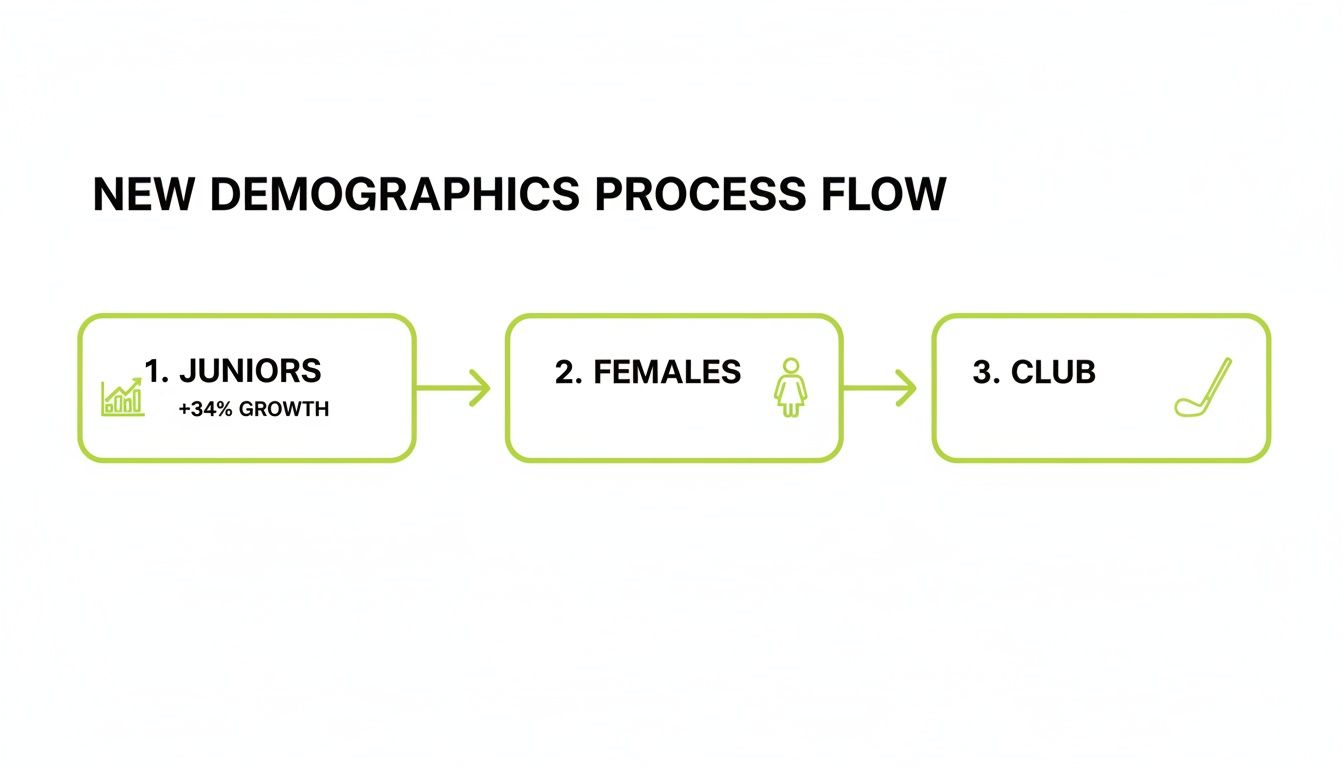
As the data shows, there’s huge potential in segments like juniors and women. But converting that potential into paid-up members requires a proper process.
Case Study: From Surviving to Thriving
Let me tell you about a club we worked with. They were just about keeping their head above water, relying on a dwindling, ageing membership. A well-meaning committee member handled enquiries when they could, but leads were often missed and follow-ups simply didn't happen. The club was in slow decline.
By putting a GolfRep growth system in place, we completely changed their trajectory. We started with targeted digital ads to attract local golfers. From day one, every single enquiry was met with an instant, automated SMS and email. All that information flowed directly into a central CRM, giving the manager a clear pipeline dashboard for the very first time.
A structured pipeline isn't about aggressive sales tactics. It's about building a predictable system that empowers managers with the tools and visibility to control their club's growth, turning guesswork into a reliable process.
The system then kicked in with a nurture sequence, inviting prospects to a taster day. The impact was immediate. With full visibility and a structured follow-up process, the club converted dozens of new members in just a few months. They generated predictable revenue and secured their future, all without resorting to desperate discounts.
This is the difference a true growth partnership makes. GolfRep doesn't just send you leads; we build the sustainable systems that turn them into lifelong members. It’s the combination of lead generation, structured follow-up, and a CRM that gives you a predictable pipeline, a crucial part of the 7 proven strategies to grow golf club membership.
Common Stumbling Blocks in Growing Your Membership
As we've worked with golf clubs across the UK, we've noticed the same questions and concerns pop up time and again. If you're a club manager, secretary, or part of the committee, some of these might sound familiar. Let's tackle them head-on.
"Our Club Is Run by Volunteers. Can We Realistically Manage This?"
This is probably the most common and completely understandable question we hear. Many clubs are the heart of their community precisely because they're powered by passionate volunteers or a small, dedicated team who already have their hands full.
The good news is that a proper system is designed to solve this exact problem, not add another task to the list. Think about where your time goes now, chasing down emails, logging enquiries on a spreadsheet, trying to remember who you need to call back. Automation handles all of that.
A well-built growth system gives your team back its most precious asset: time. It takes care of the repetitive, time-consuming admin with perfect consistency. This frees up your people to do what they do best, providing a warm welcome and a personal tour when a prospective member actually walks through the door.
"We've Already Got a Website and Social Media. Isn't That Enough?"
Having a website and a few social media profiles is a great start, but it's only one piece of the puzzle. It’s like having a fantastic signpost on the motorway pointing to your club. It gets people's attention, but it doesn't do the work of guiding them down the slip road, through the gates, and into the clubhouse.
This is exactly why so many clubs with a decent online presence still struggle to attract new members. A structured growth pipeline is what happens after someone shows interest. It’s the engine that grabs that initial enquiry, sends an immediate, professional reply, and keeps the conversation going until they're ready to join. Your website generates interest; a system converts that interest into members.
"What's the Real Return on Investment Here?"
When you're looking at a new expense, it’s easy to focus on the cost. But with membership growth, it’s far more important to frame the discussion around the cost of inaction.
Every single lead that gets lost or goes cold represents thousands of pounds in potential revenue. It's not just the lost annual subscription fee; it's the bar tab, the pro shop purchases, and the guest green fees that go with it.
A predictable pipeline delivers a clear return by converting the enquiries that, right now, are likely falling through the cracks. It turns membership growth from a game of hope and chance into a measurable, reliable process. This isn't just another cost on the balance sheet; it's a direct investment in the long-term financial health of your club.
At GolfRep, we do more than just generate leads; we build the sustainable systems that turn interest into predictable revenue. If you're ready to move from inconsistent efforts to a reliable growth engine, we can show you how.
Discover how our Growth System can build a predictable membership pipeline for your club at https://www.golfrep.co.
Ready to tap into our proven growth system?