Golf Club Wedding Revenue: Pricing, Packaging & Growth

Most golf clubs don't have a wedding demand problem, they have a conversion problem. Enquiries arrive, couples show interest, but revenue leaks away through slow replies, missed follow-ups, vague pricing, and a process that relies on whoever happens to check the inbox first.
That's why the usual advice falls short. Clubs are often told to “market weddings harder”, yet the bigger win is usually tighter handling of the enquiries they already have, with clearer packages, faster responses, and better tracking from first contact to confirmed booking. The clubs that turn wedding interest into reliable income treat it as an operational system, not a casual add-on to clubhouse trading.
Why Most Golf Clubs Leave Wedding Revenue on the Table
The most common mistake is assuming the issue is visibility. In practice, many clubs already get enough wedding interest, but they lose momentum in the handoff between enquiry and quote, then again between quote and site visit, then again before the booking is secured. A slow reply tells couples the venue is disorganised, even if the course, clubhouse, and setting are strong.
The hidden leak is usually inside the inbox
Shared mailboxes look efficient until a busy weekend arrives. One person assumes another person has replied, the enquiry sits unanswered, and the club loses a couple who were ready to compare dates. That is not a marketing failure. It is a process failure.
I see the same pattern across committee-led and privately managed clubs. The venue has a decent wedding product, but there's no consistent ownership of lead handling, no visibility of which enquiries are live, and no routine for chasing undecided couples. In the wedding market, where the guide for short-term rental hosts makes a similar point about structured revenue management, response discipline matters just as much as demand generation.
Practical rule: if an enquiry can sit in an inbox without an owner, it will eventually cost you revenue.
Speed matters more than extra promotion
Couples comparing venues rarely wait patiently. They move on to the club that answers clearly, sends the right information, and makes the next step obvious. A good enquiry can go cold because the response was generic, late, or incomplete.
Golf clubs also tend to under-estimate the value of follow-up. One email is rarely enough for a wedding decision, especially when the couple is still comparing dates, budgets, and guest-fit. A structured reminder sequence does more to protect income than another round of generic promotion.
The right mindset is simple. Demand is only valuable when the club can capture it, track it, and convert it. That means lead ownership, response standards, and a process that doesn't depend on memory.
Wedding Revenue Benchmarks and Margin Expectations
Wedding income becomes easier to judge when you look at how premium event days behave. One example reported by The Golf Business said a club turned over about £30,000 in a single day, and the article noted that repeating that weekly would be roughly £1.5 million a year. That figure isn't a promise for every venue, but it shows why a single well-sold event date can outstrip routine daily golf takings.
A club that understands this doesn't think of weddings as a side income. It treats them as a high-value use of scarce calendar space, especially on dates that couples want most. That is where margin discipline matters.
What healthy event income usually looks like
Industry guidance on private clubs says prime fall Saturdays and December corporate dates are often sold 6 to 12 months in advance, which means wedding dates can be pre-booked well ahead of delivery. That matters because it gives the club a visible income line instead of a last-minute scramble.
A useful benchmark for event activity is the level of bookings clubs can realistically secure across a year. Revenue modelling cited in golf-club profitability analysis suggests 10 to 20 event bookings per year, with each smaller business or community event contributing $5,000 to $15,000. Those numbers are not UK-specific, but they help frame the scale of incremental event income clubs pursue when they monetise function space well.
The profit target matters just as much as the gross sale. Bobby Jones Links says profit from special events should be 40% or more, and it places total dues at 50% or more of total revenue for a private club, which reinforces the strategic case for non-golf income. The practical reading is clear, wedding revenue should be measured on yield, not just fill rate.
Practical rule: a busy diary is not automatically a profitable diary.
Why these numbers change pricing decisions
If a club underprices a premium date, it can fill the room and still leave money behind. If it prices too aggressively without a tiered structure, it may scare off couples who would have bought a simpler package. The middle ground is a structured offer where the club captures value from strong dates and keeps quieter dates sellable.
That's the benchmark. Not just “do we host weddings”, but “are we selling the right dates at the right margin”. The clubs that answer yes are usually the ones that understand packaging, not just venue hire.
Building Tiered Wedding Packages That Protect Margin
A single wedding price sounds neat, but it usually gives away too much flexibility. Peak dates get sold too cheaply, quieter dates don't get enough of a push, and the club has no clear way to steer couples toward the package that fits their event. Tiered pricing solves that by separating the venue's core value from optional extras.
Start with the capacity, not the brochure
Every wedding consumes resources. Kitchen labour, service staff, room exclusivity, car park space, and management time all get tied up whether the club sells a simple reception or a full all-day package. That's why pricing needs to reflect operational strain, not just a nice round figure on a flyer.
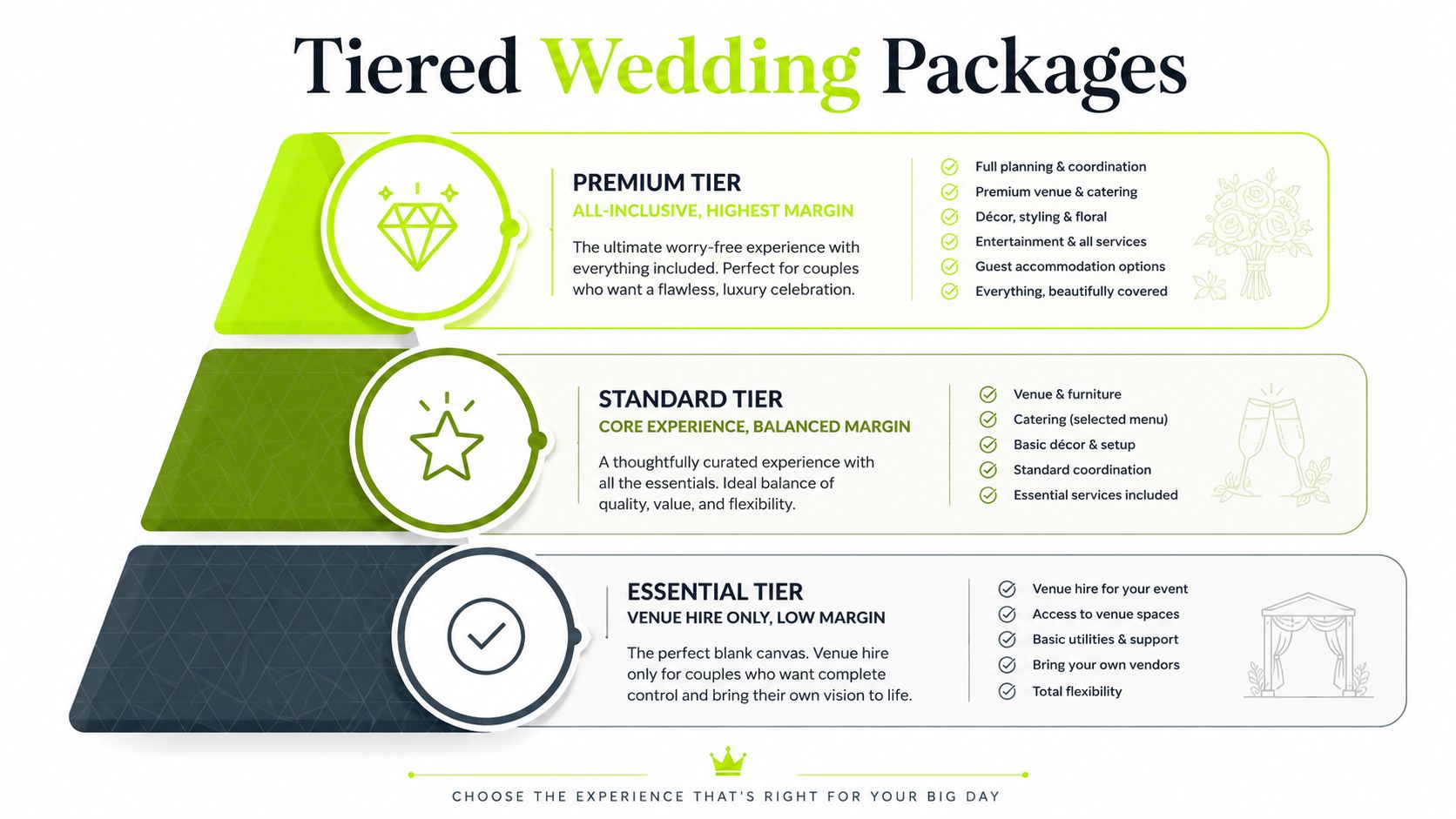
A good structure usually starts with three levels. A premium package should include all the high-touch elements and protect the strongest margin. A standard package should cover the core experience and remain easy to explain. An essential package can exist for tighter budgets or low-demand windows, but it should never become the default because it leaves too much value on the table.
If you want a practical way to frame bundle design and upsell logic, the club package guidance in this package deals article is a useful reference point.
Price by date quality, not just by guest count
Weekend peak dates deserve firmer minimums because demand is highest and operational disruption is greatest. Midweek or winter dates can be more flexible, but flexibility should come through package design, not blanket discounting. The aim is to move couples toward dates the club wants to fill without cheapening the whole offer.
Consider this perspective:
- Premium Tier: all-inclusive, strongest margin, ideal for high-demand dates and couples who want less hassle.
- Standard Tier: core ceremony and reception experience, balanced margin, suitable for the majority of bookings.
- Essential Tier: venue hire only, lower margin, useful for quieter periods or highly price-sensitive enquiries.
The point isn't to make every wedding expensive. It's to make every wedding intentional.
Key takeaway: tiered packages protect margin because they give the club control over both price and service load.
Add-ons should raise value, not create confusion
Extra drinks, enhanced room dressing, evening food, late access, and photography-friendly spaces can all lift booking value if they're easy to understand. What doesn't work is dumping every option into a long menu and expecting couples to build the package themselves. That creates choice fatigue, then delays.
The cleanest sales process is one where the package does most of the work, and the upsells are obvious rather than hidden. Clubs that package well usually close more confidently because the conversation is clearer from the start.
Aligning Operations and Staffing with Wedding Revenue Goals
Revenue targets only work if the club can deliver the day without damaging the rest of the business. A wedding that stretches the kitchen, overwhelms the bar team, or blocks member parking creates problems that show up long after the couple has gone home. Good pricing means nothing if the operation can't support it.
Accept bookings the venue can actually deliver
The first filter should be kitchen capacity. If the catering team can't comfortably handle plated service, late-night food, or a full turnaround between ceremony and reception, the club should not be chasing that format just because it sounds attractive. The same applies to service staffing and room changeover time.
Car park space matters more than many committees expect. Guests notice arrival friction immediately, and the wedding team gets blamed for it even when the issue is structural. If access is tight, the club should favour smaller or more contained formats that fit the site better.
Selective is better than maximal
The best wedding strategy is usually selective, not volume-driven. That means prioritising dates and formats that give the club strong yield without disrupting member use or stretching operational standards. A club does not need to chase every enquiry to build a healthy wedding line.
A useful outside perspective on venue control and risk is GM GROUP Services' event security guidance. The security angle matters because a wedding is not just a sales win, it's an operational takeover of part of the property, and that needs planning.
The club should never sell a booking that forces the team to improvise on the day.
Use the clubhouse around golf, not against it
The smartest clubs schedule weddings around quieter tee-time windows and choose formats that don't interfere with member traffic more than necessary. Some venues can support external caterers for specific parts of the offer, but only when that simplifies delivery rather than creating more handovers. The goal is to protect the golf product while still making the clubhouse work harder.
Weddings can be excellent business, but only when they fit the site. If they don't, the club ends up buying revenue with stress, complaints, and margin leakage.
CRM Workflows and Automation for Wedding Enquiry Conversion
The weakness in most clubs isn't lead generation, it's lead handling. Enquiries come in, then the club relies on manual memory, email threads, and whoever has the spare time to reply. That approach loses bookings because wedding couples expect momentum, clarity, and follow-through.
Build one owner for every enquiry
Every enquiry should enter one system, be assigned immediately, and trigger a standard first response. That first reply should confirm the enquiry, outline the next step, and make it easy for the couple to keep the conversation moving. If there's no ownership, there's no accountability.
A central CRM gives managers visibility that a shared inbox never will. You can see which lead is live, which quote is pending, and which couple needs a call rather than another email. That visibility is what turns scattered interest into a managed pipeline.
The operational logic behind this kind of automation is covered in GolfRep's automation article, and it aligns closely with how high-performing clubs reduce friction in the sales process.
Use follow-up to stay present during the long decision window
Wedding decisions take time. Industry guidance on private clubs says some prime dates are sold 6 to 12 months ahead, so clubs need nurture that keeps the venue in front of the couple across that window. Manual follow-up rarely does this well because staff are busy and memory is unreliable.
A useful workflow looks like this:
- Immediate confirmation: send a response as soon as the enquiry lands.
- Quoted follow-up: send the package, then prompt for a visit or call.
- Reminder sequence: keep the couple engaged if they haven't replied.
- Conversion checkpoint: mark the lead as booked, lost, or still active.
That structure does two things. It reduces missed opportunities, and it makes performance measurable.
Track conversion, not just activity
A club can send plenty of replies and still underperform if the quote-to-booking step is weak. That's why every stage needs tracking. Which source produced the lead, how quickly it was answered, whether it reached site visit, whether it converted, and what the final package value was all matter.
Practical rule: if the club can't see the pipeline, it can't improve it.
Manual processes often fail because they feel busy without producing clarity. Automation doesn't replace staff judgement, it protects it by making sure the right work gets done on time. That's how wedding revenue becomes predictable.
A UK Golf Club Wedding Revenue Transformation
A private UK club I worked with had a familiar problem. Wedding interest was steady, the venue was attractive, and committee members believed the issue was marketing reach. In reality, the club was losing couples between enquiry and quote, then again before the final decision.
The first change was operational, not promotional. Every enquiry was captured in one CRM, the first reply went out automatically, and staff could see which couples needed a call rather than a waiting game. That alone removed the worst delays.
The second change was the offer itself
The club replaced one blunt wedding price with tiered packages that made the premium option easier to sell and gave quieter dates a lower-friction alternative. That helped staff steer couples instead of starting every conversation from scratch. It also made the value of each booking clearer to the committee.
They then introduced simple KPI tracking for enquiry source, response handling, and booked value. Once the team could see the full path from lead to booking, they stopped guessing where the revenue was leaking.
The result was not a marketing miracle. It was a systems fix. The club sold better dates, handled enquiries faster, and stopped relying on one person's memory to keep bookings alive.
What changed most was confidence. Committee members could see the pipeline, staff knew who owned each enquiry, and the wedding operation no longer depended on chance.
Practical rule: when the process is visible, the revenue stops feeling random.
KPI Dashboard for Tracking Wedding Pipeline Health
If a club wants wedding revenue to behave like a real business line, it needs a simple dashboard. Not a spreadsheet that only one person understands, and not a reporting pack that arrives too late to matter. The goal is a clear weekly view of what's coming in, what's moving, and what's stuck.
The core metrics that matter
Track the source of each enquiry, the time taken to respond, the stage it reached, the value of the booking, and the margin on the event. Separate wedding income from general clubhouse trading so the numbers stay honest. If it's blended into wider F&B figures, the committee won't know whether weddings are genuinely performing.
| KPI | What It Measures | Target Benchmark |
|---|---|---|
| Enquiry volume by source | Where wedding leads are coming from | Consistent visibility across channels |
| Response time | How quickly the club replies to new leads | Fast enough to keep momentum |
| Stage conversion rate | Where enquiries drop out of the pipeline | Steady movement through each stage |
| Average booking value | The typical value of a confirmed wedding | Rising through better packaging |
| Revenue per event | What each wedding actually produces | Aligned with date quality and package mix |
| Profit margin per wedding | How much is left after event costs | Strong enough to justify the slot |
That table works because it keeps the team focused on behaviour, not guesswork. If response time slips, the dashboard shows it. If one source produces low-value bookings, the club can adjust. If quotes are getting sent but not closed, the bottleneck is obvious.
For clubs that want a broader view of return on effort, this ROI article is a useful companion to the pipeline approach.
Use the dashboard to make decisions
A useful dashboard doesn't just report. It tells the manager what to change. If bookings are coming in at the wrong margin, pricing needs review. If lots of enquiries are landing but few are converting, follow-up needs tightening. If the best dates are selling too early, the club may need to protect pricing on peak slots.
The clubs that do this well don't rely on instinct alone. They review the pipeline, adjust the offer, and keep the process disciplined. That's how wedding revenue stays visible, controllable, and worth the operational effort.
GolfRep helps golf clubs build predictable revenue pipelines by combining lead generation with structured follow-up and CRM systems that stop wedding enquiries falling through the cracks. If you want a clearer way to price, package, and convert wedding demand without adding more manual work, visit GolfRep and see how a more disciplined system can support your club's growth.
Ready to tap into our proven growth system?