Golf Club Event Revenue: The Practical Operator's Playbook
Most clubs still talk about event revenue as if the win comes from more enquiries. It doesn't. The money is made, or lost, in the first reply, the follow-up cadence, the proposal, and the way the booking is handled once it lands in the diary.
A wedding enquiry sitting in a shared inbox for two days is not a marketing problem. It's an operations problem. By the time someone finally gets back to the couple, they've already moved on, and the club has lost revenue it never had the discipline to convert.
That's why golf club event revenue should be managed as a pipeline, not a poster campaign. Clubs that treat events as a single hire fee leave money on the table. Clubs that manage the enquiry, package, follow-up, and delivery properly create a repeatable income line that supports the rest of the business.

Why Most Event Bookings Leak Before They Reach the Diary
The biggest leak in golf club event revenue usually isn't demand. It's handling. Clubs spend money getting enquiries in, then let them sit in a general inbox, a manager's phone, or a spreadsheet nobody trusts. That's where the booking dies.
A shared inbox creates a false sense of activity. The email arrived, so the club assumes the lead exists. In reality, if nobody owns the response, no one is following up, no one is qualifying the lead, and no one is moving it toward a visit or a signed agreement.
The first mistake is treating speed as optional
If a couple sends a wedding enquiry on Monday and hears nothing until Wednesday, you've already told them how you operate. They don't need to be told twice. They'll call the place that answered first, or the venue that made the process feel easy.
Practical rule: if a lead can sit unclaimed, it will sit unclaimed. The longer it sits, the less likely it is to convert.
That is why response time and lead visibility matter more than another leaflet, boosted post, or seasonal offer. The clubs that win don't just generate interest, they make it impossible for interest to go cold.
GolfRep's way of working is relevant in a practical sense, because the point is to combine lead generation with a visible follow-up process, not to stop at the enquiry. The same principle appears in strong event marketing guidance for clubs, including the structure set out in Golf club event marketing, which should only matter to you if the club can respond and convert.
The diary is the result, not the starting point
A booked event is the end of a chain. Before that, someone had to notice the lead, reply quickly, qualify it properly, arrange a visit, send a proposal, and keep chasing with a system rather than memory. If one of those links is weak, the whole thing breaks.
That's why the first practical job is plumbing, not promotion. Fix the enquiry-to-event pipeline first, then worry about generating more volume. Otherwise, you're just pouring more water into a leaking bucket.
Audit Your Current Event Revenue as a Portfolio
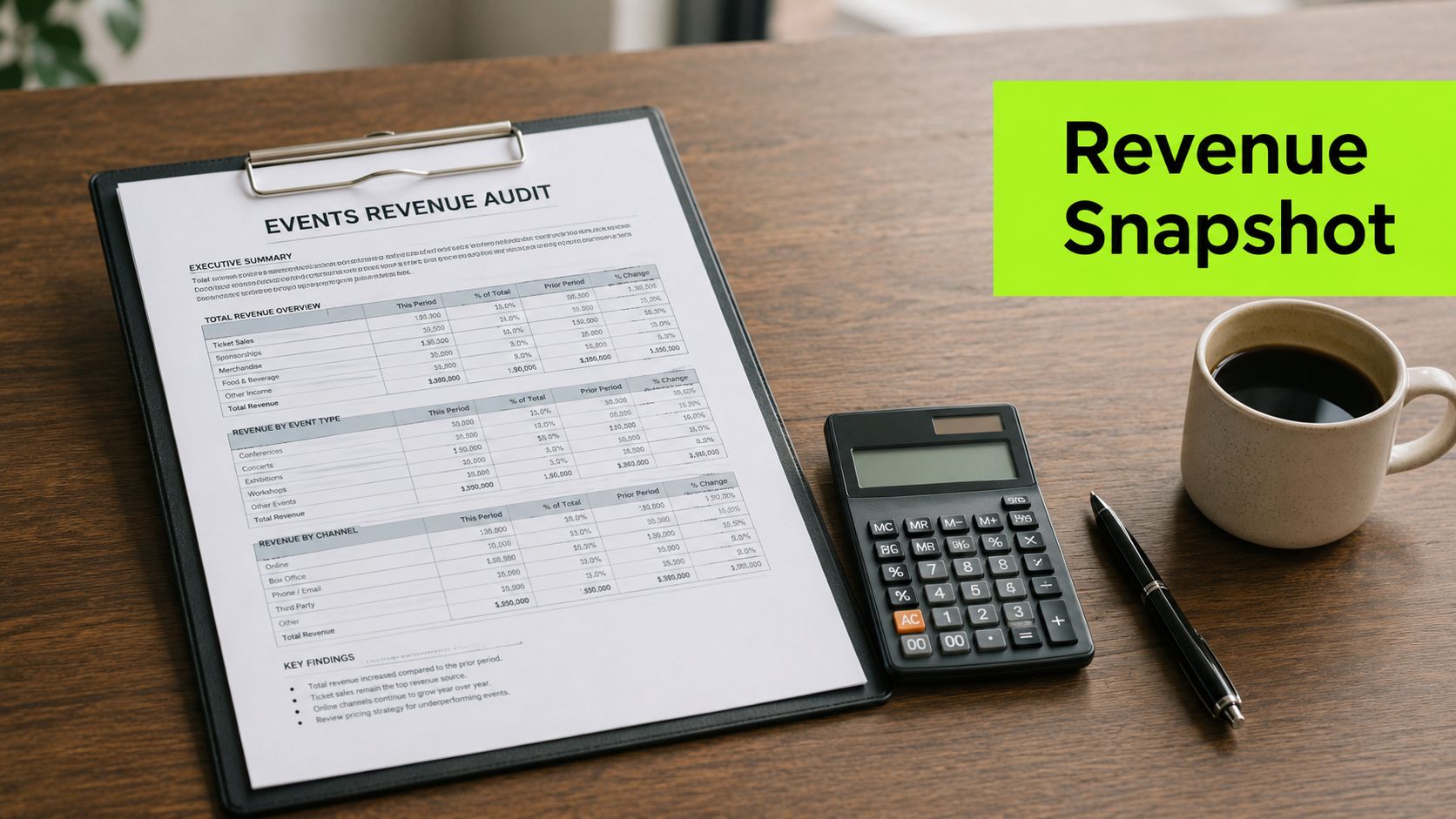
Before changing rates or redesigning packages, look at event income as a portfolio of streams. Most clubs already collect the data, they just don't join it up. The useful habit is to stop asking, “What did the event hire fee bring in?” and start asking, “What did the whole booking earn across the club?”
Pull the numbers that tell the truth
Start with the booking itself. Capture room hire or minimum spend, per-person food and beverage, bar packages, and any audio-visual, décor, or rental fees. Then add any downstream value you can trace, such as repeat dining, society interest, or membership enquiries that came from the event.
The point is not to build a perfect finance model. The point is to see which event types are profitable and which ones only look busy. UK venue guidance is clear that event income commonly comes from multiple streams, not one flat fee, and that clubs should track revenue per event hour, food-and-beverage margin by event type, repeat booking rate, and referral or lead-generation impact to understand what is working events and banquets drive golf course revenue.
Use a one-page view, not a spreadsheet swamp
A simple monthly sheet is enough if it shows the right things. Put each event type on one line, then include:
- Total revenue per booking, so you can see the full value, not just the hire fee.
- Margin by event type, so you know which formats quietly drain labour and stock.
- Repeat booking rate, so you can separate one-off noise from reliable income.
- Downstream contribution, meaning how often events feed dining, society play, or membership interest.
A club can look busy and still be under-earning. If the bar spends, catering margin, and follow-on bookings are weak, the diary is lying to you.
Pull the data in a week
Get the general manager, events lead, bar or catering manager, and whoever handles the diary in one room. Review the last set of event bookings, agree the revenue streams that count, and record the same fields for each event. Once the club can see the shape of the business, the weak spots become obvious.
Pricing, Packages and Add-On Levers That Move Total Value
Most clubs underprice events without realising it, then try to fix the problem with vague “premium” language. Buyers don't pay more because the brochure sounds polished. They pay more when the package makes sense, the choices are clear, and the upsell feels natural rather than forced.
A better pricing structure starts with the decision the buyer wants to make. For a wedding, that's not “Do I want hire fee plus extras?” It's “Which package gives us the right room, food, drinks, and support without making us rebuild the event from scratch?”
Build packages around decisions, not line items
A typical club still sells event space as if every detail is negotiable. That creates slow back-and-forth and makes the price feel bigger because the buyer has to assemble the event themselves. A stronger structure is to offer three clear tiers, one entry package, one core package, and one upgraded package.
For a 90-cover wedding, the better move is usually to bundle room use, a sensible food and beverage offer, and one or two practical upgrades into a package the couple can understand quickly. For a 40-guest corporate day, a simpler format with meeting space, lunch, refreshments, and a small AV add-on often sells better than a long menu of optional extras.
The internal logic matters. If a club gives away the room to win the headline booking, it has to make that up elsewhere. If it charges a fair minimum spend or hire fee and then layers in drinks, AV, or décor, the full booking value is usually healthier because the buyer sees a neat offer instead of a tug-of-war.
Use add-ons to protect margin, not to confuse people
Add-ons work when they're obvious. Think audio-visual, décor, accommodation, breakfast the next morning, and bar package upgrades. Those items shouldn't feel like afterthoughts. They should sit inside the decision path, so the buyer can say yes without re-opening the whole negotiation.
The right event pricing structure also makes marketing easier, which is why clubs should keep their event pages aligned with the package logic in marketing golf club weddings and events. If the website promises simplicity but the quotation process is messy, the sale slows down.
Discounting is rarely the answer. Clear packaging, stronger inclusions, and a cleaner upgrade path usually do more for total value than shaving a few pounds off the headline price.
Building an Enquiry-to-Event Pipeline That Actually Closes
Most event enquiries don't need more persuasion. They need structure. The best clubs treat every lead like a process with named stages, a visible owner, and a next action, because that's what stops enquiries slipping through the cracks.
Set the stages and own the next step
The pipeline should be simple enough that everyone uses it. Start with instant acknowledgement, then qualification, site visit, custom proposal, structured follow-up, and reactivation. If the club can't see where the lead is, it doesn't have a pipeline, it has a pile of emails.
The practical KPI set is small on purpose. A useful monthly review should focus on occupancy percentage, booking pace, day-of-week performance, seasonality, local events, response time, and conversion by lead source. A golf-club revenue workflow that uses a short KPI set like this is much easier to manage than a dashboard full of noise golf club visitor revenue.
Simple rule: if there is no named next action, there is no real lead management.
Follow-up wins where the proposal loses
The most common failure point is the gap after the proposal is sent. The enquiry looked warm, the visit went well, then nobody chased properly. That's where deals stall, and that's where a CRM or shared system earns its keep.
A decent cadence is straightforward. Send a quick reply within minutes, follow up at 24 hours, again at 5 days, and again at 14 days if the lead is still alive. Keep the tone useful, not needy. Ask one question, confirm one detail, or offer one practical next step.
For clubs looking for an outside view on process and lead handling, the Premier Marquee Hire event strategies piece is a useful reference point because it sits in the same world of event planning, buyer intent, and conversion discipline.
Hand over cleanly from source to sale
Marketing, referrals, society interest, and direct calls all need the same treatment. Log the source, record the date, capture the event type, assign an owner, and set the next action immediately. If the lead lands in a personal inbox and stays there, the club has already weakened its chance of conversion.
The process also needs a sales discipline that many clubs overlook. The essential guide for UK service business sales is relevant here because event bookings follow the same basic rhythm, enquiry, qualification, proposal, follow-up, close. The difference is that clubs often rely on memory instead of a shared system.
| Event Pipeline KPIs Worth Tracking | What it tells you | Target direction |
|---|---|---|
| Response time | How quickly leads get a usable reply | Faster |
| Conversion by lead source | Which channels produce actual bookings | Higher on the best sources |
| Proposal to close rate | Whether the sales step is working | Higher |
| Follow-up completion | Whether leads are being chased properly | Higher |
| Time to next action | Whether the enquiry is moving | Shorter |
Forecasting Demand and Filling the Slower Slots
Revenue management for events is not mysterious. It's about putting the right offer in front of the right buyer at the right time, then not wasting prime diary space on low-value bookings just because the calendar looks empty. Clubs that do this well stop chasing every event type and start specialising.
The monthly review should be disciplined. Look at occupancy percentage, booking pace, day-of-week performance, seasonality, and local events, then compare that with what the diary already tells you. If the club sees repeated weakness in midweek slots, that's not a sales failure, it's a scheduling opportunity.
Match event type to the slot, not the other way around
A good operator doesn't push the same offer into every gap. Corporate days belong in quieter midweek windows because they can fill space that is otherwise hard to monetise. Weddings can often sit comfortably in shoulder-season Saturdays if the value proposition is strong and the package removes friction.
The aim is to protect the most valuable inventory. If a club can fill a slower slot with a well-priced event, that is better than discounting a prime date to chase volume. Event demand forecasting and diary optimisation work together because the diary is the commercial asset, not just a booking sheet.
Specialise instead of chasing everything
Most clubs try to be all things to all buyers. That creates muddled pricing, inconsistent operations, and weak marketing. Better to pick two or three event formats the club can deliver properly, with margin and repeat potential, and push those hard.
A sensible filter is simple. Ask which formats need the least operational stress, produce the strongest margins, and are most likely to repeat or refer. Then build the offer around those formats, rather than keeping every possibility open and doing none of them well.
If you want a broader reference point for how clubs can think about the sales cycle itself, the cycle of sales framework is useful because it reinforces the same discipline, source, follow-up, conversion, repeat. Clubs that master that rhythm tend to stop treating the diary as an accident.
Operational Delivery That Protects the Promise
A signed booking is not the finish line. It's the moment the club proves whether its sales promise meant anything. If the event day feels disorganised, under-staffed, or badly communicated, the client remembers that longer than the proposal.
Keep the delivery checklist tight
The essentials are not complicated. Confirm staffing, lock supplier times, check setup requirements, brief the on-day coordinator, and make sure the handover includes dietary notes, timings, and contingency plans. If the team has to ask basic questions on the day, the pre-event process was weak.
A clean operational checklist should include:
- Staffing plan, with named responsibilities for set-up, service, and client contact.
- Supplier management, so external vendors know when and where to arrive.
- Setup confirmation, covering room layout, signage, and equipment.
- On-day coordination, with one person owning decisions.
- Post-event follow-up, so the relationship doesn't go quiet after departure.
The revenue link is direct. Poor delivery reduces repeat booking rate, weakens referral potential, and makes the next quotation harder to win.
Debrief while the details are still fresh
A short post-event review is one of the highest-value habits a club can build. Ask three questions. What worked, what lost margin, and would the client book again? Those answers tell you more than a glossy satisfaction form ever will.
The debrief should feed back into the audit you ran earlier. If a package is selling but labour is too heavy, adjust it. If a format produces repeat interest, push it harder. If the client had to chase for basics, fix the process before the next booking.
For clubs trying to tighten the food and beverage side of the business as part of event delivery, the maximising F&B revenue at your golf club guidance is relevant because event margins are often won or lost in the catering and bar operation.
Events that run well get repeated, referred, and reviewed. That's how event income stops being a one-off win and becomes a predictable line in the club's P&L.
If you want GolfRep to help your club tighten event enquiry handling, improve CRM visibility, and build a proper conversion process around your diary, visit GolfRep and see how we structure predictable pipelines for golf clubs that want more than just more enquiries.
Ready to tap into our proven growth system?