How to Grow a Small Golf Club: A 2026 Playbook
Most advice on how to grow a small golf club starts in the wrong place.
It says you need more visibility, more campaigns, more social posts, more leads. Sometimes that is true. Often it is not. In practice, many small clubs already have enough interest passing through their website, Facebook page, inbox, phone line, or visitor pathways. The main failure happens after that first signal of intent.
At GolfRep, we see the same pattern repeatedly in UK clubs. An enquiry arrives outside office hours. A member of staff means to call back later. The prospect hears nothing useful for too long, then books elsewhere, loses momentum, or goes cold. The club concludes it needs more marketing, when the actual issue is that it never built a reliable system to convert the demand it already had.
That is the shift that matters. Growth is not mainly a marketing problem. It is an operational problem. Small clubs grow when they handle enquiries quickly, qualify them properly, guide them towards a visit, and then turn that visit into a membership decision through a structured process.
Your Real Growth Problem Is Not a Lack of Enquiries
Most clubs overestimate the value of generating more interest and underestimate the cost of handling interest badly.
That sounds harsh, but it is usually the truth. If your club relies on a receptionist, a general email inbox, handwritten notes, or a committee member checking messages when they can, you do not have a pipeline. You have a collection of good intentions.
Slow response kills warm demand
A UK consumer study found that responding to a lead within 5 minutes made firms about 100 times more likely to contact and qualify the lead than waiting 30 minutes, and the odds fall sharply after the first few minutes, according to this lead response time study reference.
That matters more for golf clubs than many managers realise.
Membership is rarely a purely rational purchase. It is part lifestyle, part timing, part emotion. A golfer enquires when something prompts action: frustration with their current club, a desire to play more, a recommendation from a friend, a return to the game, a move to the area. If your club waits too long, that window closes.
Practical rule: Treat every membership enquiry like a same-day sales opportunity, not an admin task.
Many small clubs lose ground without seeing it. The diary still looks busy. The inbox still fills up. Staff still feel occupied. But activity is not the same as conversion.
A club can spend on advertising, sponsorship, social media, and open days, then waste the return through weak follow-up. That is why we often tell managers to inspect their process before they increase budget. If you want a deeper look at that hidden leakage, this breakdown on how most golf clubs lose enquiries without realising is worth reading.
Manual follow-up is not a system
Small clubs often say, "We always reply." The problem is that "always" does not mean "fast", "consistent", or "tracked".
A manual process usually creates four recurring problems:
- Enquiries arrive in different places and no one has complete visibility.
- Response times vary depending on who is on shift, who is off, and how busy the day is.
- No-shows and undecided prospects disappear because nobody owns the follow-up cadence.
- Management cannot see the funnel because there is no central record of who enquired, who booked, who visited, and who joined.
That is why adding more enquiries often makes performance worse. More volume does not fix a weak process. It exposes it.
The right question to ask
The question is not, "How do we get more people interested?"
It is, "What happens in the first hour after someone shows interest?"
If the answer is vague, delayed, or dependent on one person remembering to act, that is your bottleneck. Until that is fixed, every new campaign carries unnecessary waste.
Attracting High-Value Local Golfers
Once the handling problem is clear, the next job is to improve the quality of the enquiries entering the pipeline.
Small clubs do not need broad attention from everyone. They need the right local golfers. That means people who can realistically travel to the club, who fit the club's offer, and who are poised to make a membership decision.

Start with segments, not slogans
With around 740,000 affiliated club golfers in England and around 5% of adults participating annually, the market is substantial, but growth comes from segmenting that demand and converting the subset who are ready to join, not from blanket promotions to everyone, as noted in this England golf participation reference.
For a small club, that usually means building campaigns around local intent rather than generic brand awareness.
A practical segment list often looks like this:
- Lapsed club golfers who have fallen out of membership but still play occasionally
- Regular pay-and-play golfers who already spend enough to justify joining
- Beginners with commitment signals such as lessons, repeat range use, or trial rounds
- Lifestyle switchers who want a club community, not just a place to play competitions
Each of those groups needs different messaging. A single ad saying "Join now" is too blunt.
Offers that create movement without cheapening the club
Discount-led growth looks easy, but it often brings weak-fit prospects who ask for a deal before they understand the value.
A better route is a structured low-risk step into the club. That could be:
| Prospect type | Better first offer | Why it works |
|---|---|---|
| Curious local golfer | Hosted open day | Removes uncertainty |
| Returning golfer | Taster round plus membership chat | Rebuilds confidence |
| Beginner | Beginner pathway into membership | Reduces intimidation |
| Frequent visitor | Visitor-to-member review | Anchors the value in current spend |
The point is not to make the first step cheap. The point is to make it easy to say yes to.
Clubs usually don't need a louder message. They need a clearer next step.
That applies to creative as well. The strongest ads and landing pages for small clubs tend to answer ordinary objections clearly: How far is it? What kind of club is it? Will I fit in? What do I get? What happens if I enquire?
Show the local experience, not stock promises
Prospects join clubs they can imagine themselves using regularly. So your marketing should help them picture the rhythm of membership.
That means showing the actual environment, the atmosphere, the course condition, the social side, the booking convenience, and the practical value of being a member close to home. If you are improving practice facilities or thinking about how golfers use short-game spaces at home, this Austin custom putting greens guide is a useful example of how putting environments are framed around lifestyle use rather than pure technical features.
The same principle applies to club marketing. Sell the use case.
For clubs thinking more seriously about consistent top-of-funnel demand, this guide to golf lead generation in the UK is a useful next step. The important thing is to remember that better targeting only works when the handover into follow-up is tight.
Building Your 24/7 Enquiry Qualification System
At this stage, small-club growth stops being guesswork and starts becoming repeatable.
You do not need a complicated setup first. In fact, complexity is usually the mistake. The best systems start with one core journey, get measured, then expand only when the process works consistently.
Build one repeatable path first
The USGA advises starting data collection on one putting green because it is manageable and provides a "huge return", then expanding gradually once the routine is established, as explained in this USGA guide to starting small with measurement.
That principle transfers neatly to membership growth.
Do not launch five campaigns, three audiences, and a messy blend of forms, inboxes, and callbacks. Start with one acquisition route and one automated follow-up sequence. Measure it. Refine it. Then scale.
What the system needs to do
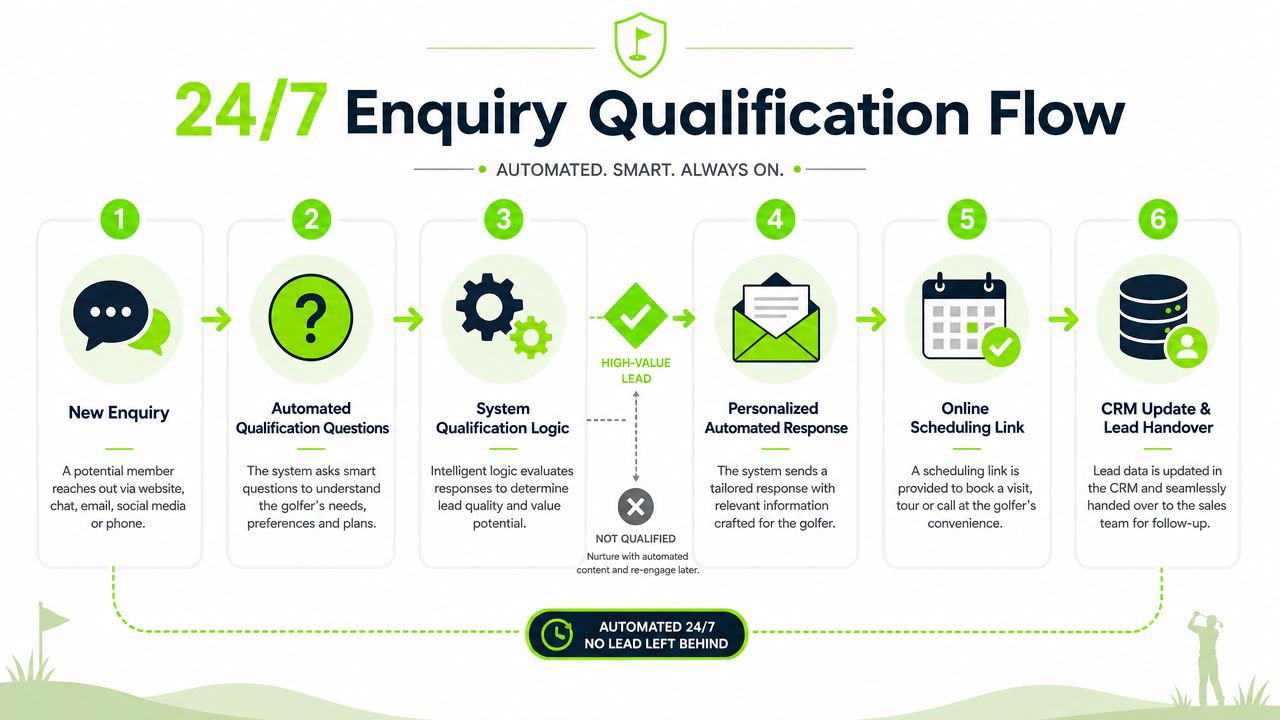
A workable 24/7 enquiry qualification system is not complicated in concept. It needs to do the jobs that manual admin cannot do consistently.
At minimum, the flow should cover:
Instant capture
Every enquiry from ads, forms, landing pages, or social channels should go into one place.Immediate acknowledgement
The prospect gets an instant confirmation so they know the club has received the enquiry.Basic qualification
Ask a few useful questions. Are they interested in full membership, beginner options, flexible access, a trial visit, or something else?Routing logic
Based on answers, the system sends the right information and alerts the right staff member.Booking step
Give qualified prospects a simple route to book a call, club visit, or taster round.CRM visibility
Staff should be able to see status, notes, next actions, and where each lead sits in the pipeline.
Qualification improves conversations
This is the part many clubs skip. They assume qualification is aggressive or impersonal. It is neither if done properly.
Qualification means you learn enough before the human conversation starts. A club secretary or membership manager can then speak to the prospect with context instead of starting cold. Good qualification questions are often simple. Travel distance, playing frequency, membership interest, current club status, preferred contact, and timescale all help. This practical guide to lead qualification for service businesses is useful because the logic is transferable even outside golf.
The aim of automation is not to remove people. It is to make sure people spend time on the right conversations.
In practical terms, clubs can build this with a CRM and automation layer, or use a specialist option such as AI lead qualification for golf clubs where the process is designed around golf enquiry flows specifically. The important part is not the brand name. It is that the system runs whether the office is open or not.
What does not work
Small clubs often drift into half-systems. Those are the dangerous ones because they feel organised, but they still leak.
Typical weak setups include:
- A contact form with no automation
- An autoresponder with no qualification
- A spreadsheet with no pipeline status
- A shared inbox with no ownership
- A phone-first process with no written follow-up
Each of those creates blind spots. You can still lose an enquiry even when someone thinks they handled it.
A proper system gives the club three things at once: speed, visibility, and consistency. That is the foundation of predictable growth.
A Simple Nurture Flow That Converts Leads Into Visits
Not every good prospect books on the first touch.
That is normal. Joining a golf club involves money, routine, identity, and often family or work considerations. Many prospects need a little time and a little structure before they commit to visiting. If the club goes silent after the first exchange, that lead often fades.
The wider golf market supports this approach. Grand View Research estimates the global golf club market at USD 4.05 billion in 2024, with the leisure segment accounting for over 80% of revenue, which reinforces that clubs are serving a large recreational audience rather than only highly committed competitive players, according to this global golf club market outlook.
A realistic lead journey
Think about a typical prospect.
They see an ad or hear about the club. They enquire on a Tuesday evening. They get a prompt response and answer a few questions. They mean to book a visit, but work gets busy, the weekend fills up, and they forget. That does not mean they are unqualified. It means they are human.
A nurture flow keeps the conversation moving without relying on staff to remember every follow-up manually.
A practical sequence clubs can use
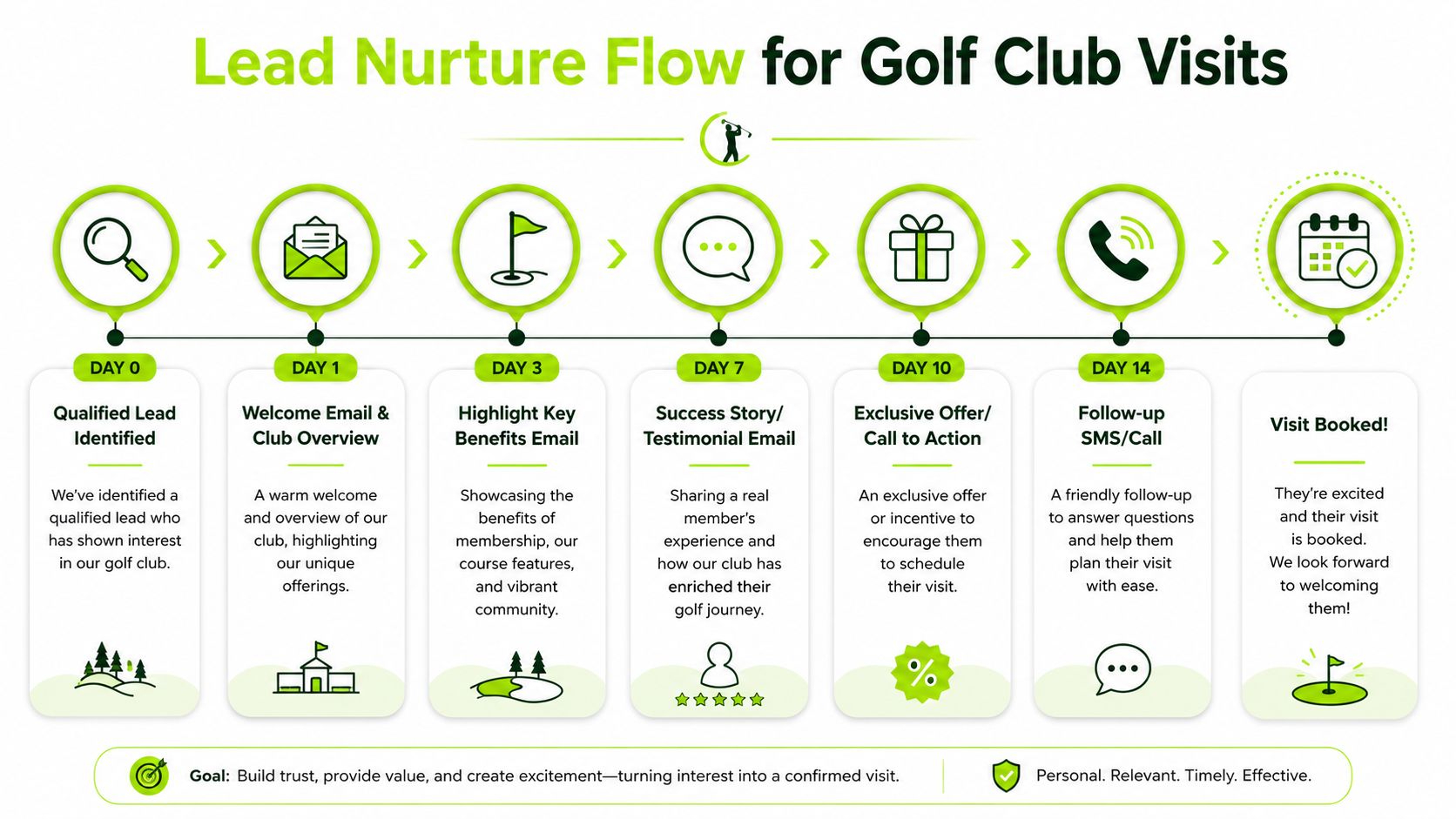
A simple flow over the next couple of weeks might look like this:
Day 0
Confirmation message. Thank them, confirm the enquiry, and explain what happens next.Day 1
Welcome email with a short club overview, who the club suits, and a clear link to book a visit.Day 3
Follow-up focused on the club experience. Course access, atmosphere, flexibility, beginner support, or community, depending on segment.Day 7
Member story or testimonial in plain language. Not polished marketing copy. Just a believable account of why someone joined and stayed.Day 10
Direct call to action. Invite them to a hosted visit, taster round, or membership conversation.Day 14
SMS or personal outreach for anyone still warm but undecided.
This works because each message has a job. One reassures. One explains. One reduces doubt. One creates action.
A nurture flow should move a prospect towards a visit, not bombard them with information.
What clubs usually get wrong
The first mistake is inconsistency. Someone gets one email, then nothing.
The second is overloading the prospect with club history, committee detail, competition formats, and pages of information before they have even set foot on site. That is internal thinking. Prospects care first about fit, ease, and value.
The third is using the same sequence for every lead. A beginner and a former member should not receive the same messages in the same order.
A good nurture flow feels timely and relevant. It makes the next step obvious. For a small club, booked visits are often the primary conversion point. That is why the nurture stage matters so much.
Optimising Packages and Onboarding for Long-Term Value
Growth does not become healthy just because a prospect joins.
A small club can work hard to acquire members and still create financial pressure if its packages are underpriced, confusing, or built around short-term incentives that are difficult to sustain. The stronger approach is to make the offer easy to understand, valuable at each level, and supported by an onboarding experience that helps new members settle in quickly.
Why discounting is the wrong default
With UK CPI inflation at 2.0% in May 2024 and golf club operating costs rising, relying on discounts is a dangerous strategy, especially for smaller clubs trying to protect recurring revenue, as noted in this UK golf pricing and inflation discussion.
The trade-off is simple.
Discounting may lift short-term response, but it can also train prospects to wait for offers, weaken price confidence, and attract members who joined for the deal rather than the club itself. That creates strain later when renewal comes around.
Build packages around fit and progression
Most clubs do better when packages reflect different stages of commitment rather than trying to force everyone into one headline product.
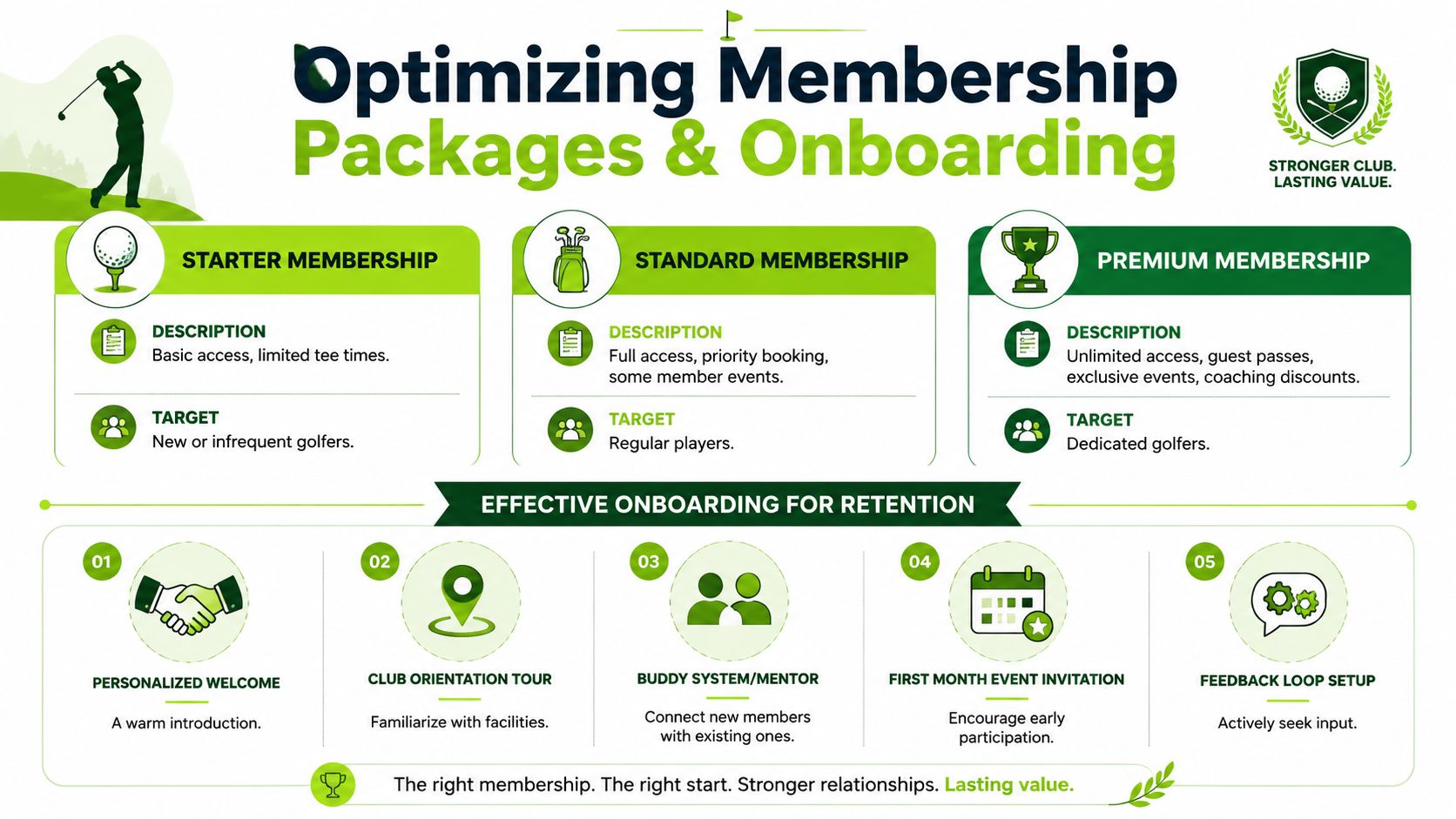
A sensible structure often includes:
| Package type | Best for | Key point |
|---|---|---|
| Starter option | New or hesitant golfers | Reduces decision friction |
| Standard membership | Regular players | Delivers the core club value |
| Premium tier | Highly engaged golfers | Adds margin through access and perks |
The mistake is not having tiers. The mistake is making those tiers unclear, poorly positioned, or too similar to one another.
Each package should answer a practical question. What level of use is this for? What access does it include? Why should someone move up later?
That same logic applies to capital improvements and add-on offers. If a club is assessing practice enhancements, entertainment upgrades, or year-round indoor use, it helps to model investment carefully. This guide on how to determine your golf simulator budget is useful because it frames spending decisions around use, setup, and return rather than impulse.
Onboarding is where retention begins
A new member is at greatest risk when the sale is done but the habit is not yet formed.
That first month matters. If the member does not meet people, does not understand how to use the club, or feels uncertain about where they fit, the relationship starts weak. That is why onboarding should be treated as part of the growth system, not an afterthought.
A practical onboarding checklist includes:
- Personal welcome from a named staff member or membership lead
- Clear first-visit guidance on booking, dress, competitions, and facilities
- Introductions to playing groups, coaches, or relevant member communities
- Early invitation to a suitable event or social touchpoint
- Check-in after the first few weeks to catch any friction early
Good onboarding reduces buyer's remorse before it has a chance to form.
That is especially important in a cost-sensitive market. If your pricing is value-led, your service and structure must support that position from day one.
From Guesswork to Growth The KPIs for Predictable Revenue
If a club wants predictable membership growth, it cannot run on anecdotes.
"Phones have been busy" is not a KPI. "We had a lot of interest last month" is not a KPI. Those are impressions. Clubs need a small dashboard that shows where the pipeline is strong and where it is leaking.
The good news is that this does not need to be complicated.
The core numbers to watch weekly
For most small clubs, the key operational measures are:
Enquiry response time
How quickly does the club respond after a lead arrives?Qualification rate
How many enquiries become genuine prospects with clear next steps?Visit booking rate
How many qualified leads book a club visit, taster round, or membership call?Visit-to-member conversion rate
How many of those visits become signed memberships?Follow-up completion
Are no-shows, undecided prospects, and warm leads being worked consistently?
A club that tracks those numbers weekly can diagnose problems fast. If enquiries are coming in but visits are low, the issue is likely qualification or nurture. If visits are happening but memberships are not, the problem may be offer structure, pricing, sales conversations, or onboarding confidence.
Why this changes everything
Measurement turns growth from opinion into management.
That is the answer to how to grow a small golf club. Not by doing everything at once, and not by chasing endless top-of-funnel volume, but by building a simple system, measuring it tightly, and improving each step until revenue becomes more predictable.
Small clubs do not need more chaos. They need clearer visibility, faster response, and a better route from first enquiry to long-term member.
If your club is generating interest but struggling to turn that interest into booked visits and memberships, GolfRep helps clubs build the operational side of growth: lead capture, fast follow-up, CRM visibility, and structured nurture that gives managers a clearer pipeline instead of another pile of admin.
Ready to tap into our proven growth system?