Mastering Golf Club Digital Marketing in 2026

Most advice on golf club digital marketing points in the wrong direction. It tells clubs to post more, spend more, and chase more leads.
That sounds sensible until you look at what happens after an enquiry arrives.
In practice, most clubs don't have a lead generation problem first. They have a lead handling problem. Enquiries sit in a shared inbox. A membership prospect gets a reply the next day, or next week, or only if the right person is on duty. Follow-up depends on memory. Visibility disappears the moment a committee member asks, "How many of those leads are still active?"
That isn't a marketing issue in the usual sense. It's a systems issue. And until it's fixed, more traffic just pours into a leaky bucket.
The Biggest Myth in Golf Club Marketing
The biggest myth is simple. More enquiries automatically mean more members.
They don't.
A club can run decent ads, attract local interest, and still see weak results if nobody knows who responded, when they were contacted, what they asked about, or whether they ever booked a visit. That gap between enquiry and conversion is where most growth is lost.
Recent UK data shows that only 28% of UK golf clubs measure digital campaign ROI, with average membership growth from digital at 4.2% year-on-year, compared with 12% for clubs using data-led automated systems, according to UK golf club digital marketing ROI findings. That gap matters because it shows the issue isn't whether clubs are doing any marketing. It's whether they're running a trackable process that turns interest into revenue.
Why the leaky bucket matters more than the ad budget
A membership enquiry is high intent. Someone has raised a hand and asked for more information, a visit, or a conversation.
If that lead lands in a general inbox and waits, the club has already created friction. If there is no structured follow-up, the club is relying on luck. If nobody can see pipeline status in one place, decisions get made on instinct instead of evidence.
Practical rule: Don't ask "How do we get more leads?" until you can answer "What happens to every lead within the first few minutes, first day, and first week?"
Much generic marketing advice falls short by treating campaigns as the main event and follow-up as an admin task. In reality, follow-up is the sales system. Clubs that understand that build a more predictable pipeline, because they stop relying on individual memory and start relying on process.
What clubs should question instead
A better set of questions looks like this:
- Response handling: Who sees a new enquiry immediately, and what happens if that person is off-site?
- Lead visibility: Can the committee or manager see every open opportunity in one place?
- Follow-up consistency: Is every prospect getting the same standard of communication?
- Attribution: Can the club connect a signed member back to the original campaign or channel?
- Decision quality: Are marketing decisions based on revenue outcomes or just activity?
Clubs that still market like it's a poster campaign and a few Facebook posts usually don't have reliable answers to those questions. That's one reason why golf marketing feels outdated for many clubs.
The hard truth is that more leads can make the problem worse. If the handling process is weak, volume just exposes the weakness faster.
Mapping the Modern Golf Member Journey
A prospective member doesn't move in a straight line. They rarely see one advert, fill in one form, and join on the spot. They move through stages, pause, compare, return, and often need reassurance before they commit.
That means golf club digital marketing has to be built as a connected journey, not a collection of tactics.
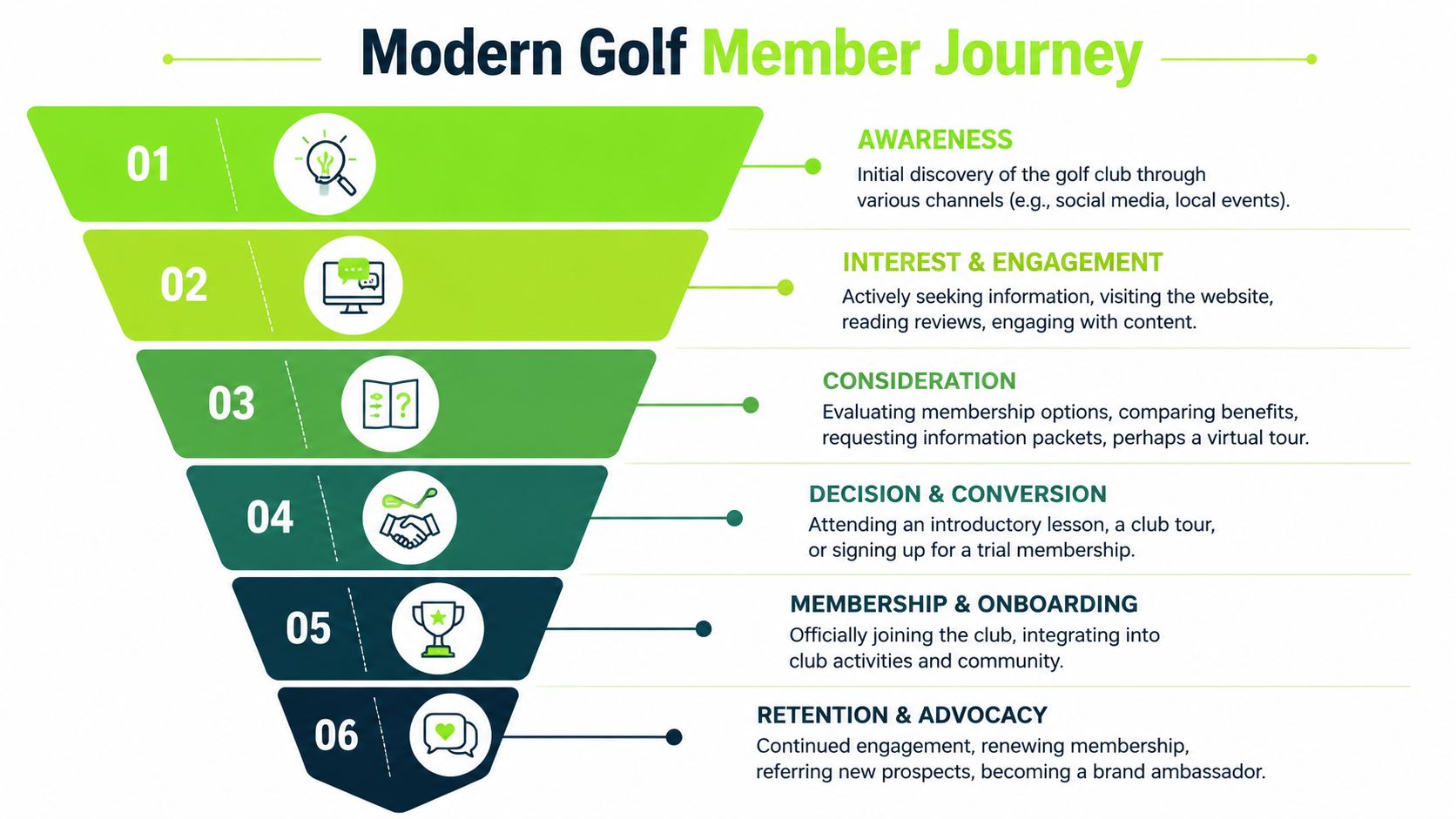
Awareness to interest
At the top of the funnel, a local golfer becomes aware of the club. That might happen through Instagram, Facebook, local search, a referral, or event content. At this stage, the prospect isn't asking for prices yet. They're deciding whether the club feels relevant.
Then comes interest. They visit the website, look at imagery, scan the membership page, check the location, and try to work out whether the club matches the kind of experience they want. If the site is unclear, dated, or difficult on mobile, the journey stalls before the club even knows that person existed.
A useful member journey framework should include:
- Awareness: The club gets in front of the right local audience.
- Interest: The prospect starts consuming information and judging fit.
- Consideration: They compare options, membership categories, and perceived value.
- Enquiry: They submit a form, request details, or ask to visit.
- Nurture: The club follows up with relevant communication and next steps.
- Conversion and retention: The golfer joins, gets onboarded well, and stays engaged.
The middle is where clubs lose momentum
Most clubs understand the top and bottom of the journey. They know they need visibility, and they know they want members. The middle is usually underbuilt.
That middle includes the database, form capture, qualification, contact history, reminders, and next actions. Without that, promising leads become invisible. A basic spreadsheet can hold names, but it won't create momentum. A proper golf club database system should show where each prospect sits, who owns the next step, and whether the club is moving them towards a visit.
A lead isn't "cold" just because they didn't join after the first reply. Most clubs stop too early.
Conversion doesn't end at sign-up
Signing the form isn't the finish line. Early member experience affects retention and referral behaviour.
A new member who receives clear onboarding, introductions, event prompts, and regular communication is more likely to settle in. A new member who feels forgotten after payment starts questioning the decision. That's why the journey should extend beyond acquisition.
A simple way to view it is this:
| Stage | What the prospect needs | What the club needs |
|---|---|---|
| Awareness | A reason to notice the club | Relevant reach |
| Consideration | Clear information and confidence | Strong presentation |
| Enquiry | Low friction contact options | Fast capture and alerts |
| Nurture | Helpful follow-up | Consistency and tracking |
| Conversion | Easy next steps | Visibility of pipeline |
| Retention | Belonging and engagement | Ongoing communication |
When clubs map the full journey properly, marketing becomes easier to manage. Weak points become visible. So do wasted steps.
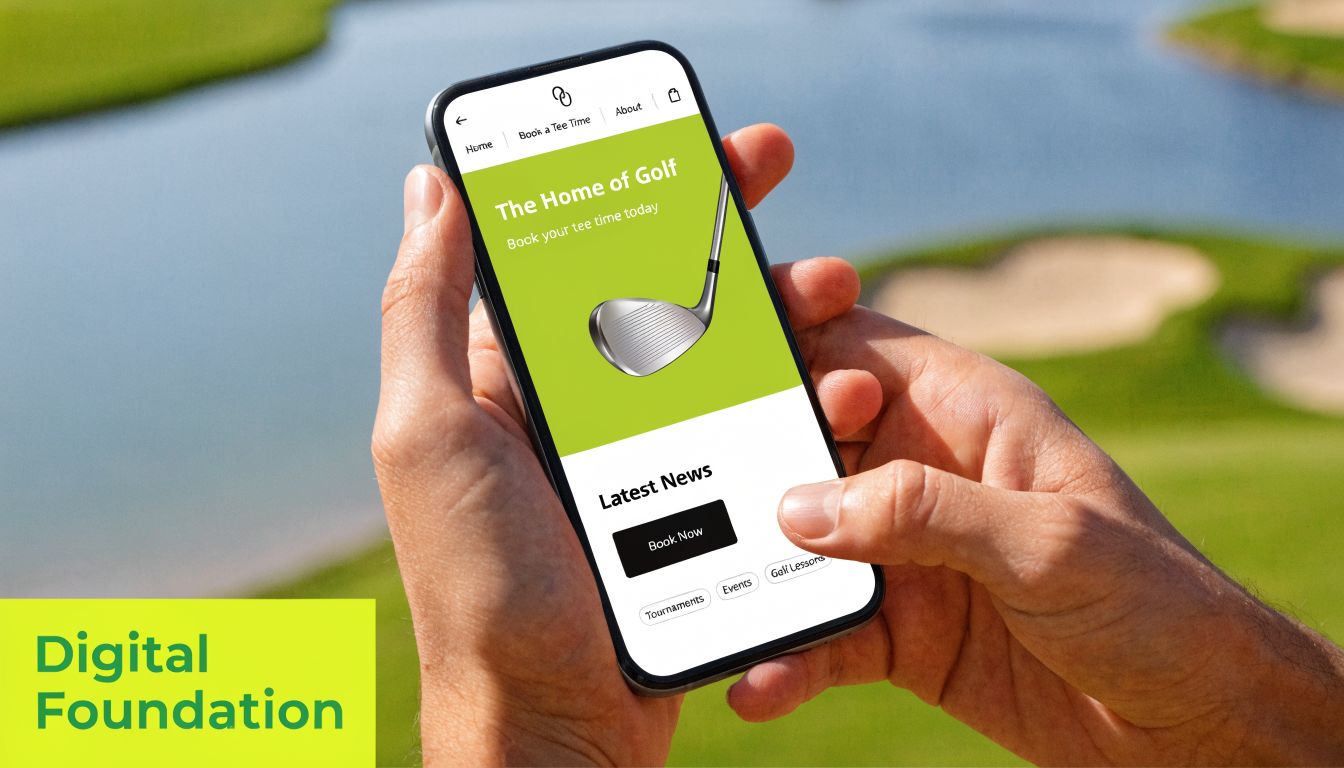
Building Your High-Performance Digital Foundation
Before a club spends on campaigns, it needs a digital base that can carry demand properly. For most clubs, that starts with the website, local search presence, and the booking or enquiry path.
Too many golf club websites still behave like brochures. They show a few nice photos, a welcome message, and a membership page with unclear next steps. That isn't enough. Your site should work like an active sales tool. It should guide people to enquire, book, or request a visit without confusion.
Why technical quality affects commercial results
This isn't just about appearance. Technical performance shapes whether prospects stay, click, and act.
According to Lightspeed's golf website optimisation benchmarks, UK golf clubs with SEO-optimised websites that comply with Core Web Vitals see Google search click-through rates increase by 22% for local searches, and integrating booking APIs can lead to a 30.5% year-over-year increase in organic tee-time bookings. That's a commercial argument for treating website performance as infrastructure, not decoration.
If a club wants to rank for local intent, it also needs a clear local search footprint. Searches for nearby golf options are often high intent. The club that appears clearly, loads quickly, and makes action easy usually gets the chance.
What a strong digital foundation actually includes
A sound setup usually includes a few essential elements:
- Mobile-first design: Most prospects will first view the club on a phone, not a desktop monitor in the office.
- Clear calls to action: "Book a visit", "Request membership details", and "Speak to the team" should be obvious.
- Simple forms: Ask for what's needed to continue the conversation, not every detail under the sun.
- Fast loading pages: Slow pages lose attention before trust is built.
- Accurate local search signals: Google Business Profile, consistent contact details, and strong local landing pages all matter.
A club's online presence has to support commercial action, not just brand perception.
Stop treating the website like a side project
A weak site creates hidden costs. It wastes paid traffic, lowers trust, and forces prospects to work too hard for basic information. Staff then spend time answering avoidable questions because the site didn't do its job.
The website should answer the first round of questions before a prospect ever picks up the phone.
The strongest setups aren't always the flashiest. They are the clearest. They reduce friction, direct attention, and connect cleanly into enquiry capture or booking.
If a club gets that foundation right, every other marketing activity performs better. If it doesn't, every campaign works harder than it should.
Activating Your Member Acquisition Engine
Once the foundation is in place, paid acquisition starts to make sense, allowing clubs to generate a steady flow of membership interest from the right local audience instead of waiting passively for demand.
The mistake is to treat advertising as a volume game. More clicks are not the goal. More low-quality leads are not the goal either. The primary job of paid campaigns is to produce qualified local enquiries that can move into a structured follow-up process.

What effective campaigns actually do
Meta platforms are often useful for this because they allow clubs to reach people by location, interest, and lifestyle fit. But the platform isn't the strategy. The offer, targeting, and post-click journey matter more.
A good membership campaign usually does three things well:
Targets the right local golfer
The audience should reflect the club's actual member profile, not everyone who has ever shown an interest in golf.
Presents a credible next step
That might be a membership guide, a club visit, an introductory experience, or a conversation with the membership team. It shouldn't rely on heavy discounting.
Sends the enquiry into a managed system
If the lead lands in a dead-end inbox, the campaign has done only half the job.
A recent UK example from Digital Caddie AI's golf club campaign results showed a targeted Meta campaign generating 87 membership enquiries in 8 weeks, and by combining ads with AI-powered email automation, the club achieved 278% ROI. The important point isn't just the lead count. It's that the campaign was connected to follow-up.
What doesn't work as well as clubs think
There are a few recurring problems in golf club digital marketing campaigns:
- Broad targeting: This fills the pipeline with curiosity rather than intent.
- Offer-led discounting: It can create short-term response while weakening the club's positioning.
- Single-touch follow-up: One email and one missed call won't convert much.
- Campaigns without tracking: If nobody can tie spend to membership outcomes, budget decisions become political.
Clubs often assume poor results mean the ads were wrong. Sometimes the ads were fine. The actual issue was that nobody handled the opportunities properly after they arrived.
Paid acquisition should feed a pipeline, not dump names into admin.
The right trade-off
A lower volume of better-fit leads is usually more useful than a larger pile of weak enquiries. Committee-led clubs especially need this because admin capacity is limited. It's better to create a controlled flow that the team can handle properly than to create bursts of demand that nobody follows through.
This is also where one integrated option can help. Systems such as GolfRep combine targeting, lead capture, and CRM-led follow-up so clubs can see where enquiries came from and what happened next. That's a systems decision, not just a media buying decision.
The System That Converts Enquiries into Members
This is the part most clubs underestimate.
A prospect submits an enquiry form at 8.15 pm on a Tuesday. What happens next? In many clubs, the honest answer is "someone will look tomorrow". That delay might sound minor internally. To the prospect, it feels like silence.
The clubs converting best don't depend on someone remembering to check an inbox. They use a system that reacts immediately, keeps the lead visible, and makes sure follow-up continues until the prospect either progresses or clearly drops out.

Why manual follow-up breaks under pressure
Manual processes usually fail in predictable ways. The manager is in meetings. The secretary is covering multiple tasks. A committee volunteer means well but doesn't have a consistent routine. Enquiries come in from different forms, social platforms, and email addresses. Nobody has a full picture.
A 2026 UK survey on golf resort growth barriers and AI automation found that 65% of golf resort groups cite manual follow-ups as their top barrier to growth, and pilot programmes show that implementing AI automation and a centralised CRM can boost membership conversion rates by up to 25%. That aligns with what operators see every day. The issue isn't effort. It's inconsistency.
What the conversion system needs to do
A reliable post-enquiry system should cover several jobs at once:
- Instant acknowledgement: The prospect should know their enquiry has been received.
- Internal alerting: The right staff member should be notified without delay.
- Lead capture into CRM: The enquiry should not disappear into email threads.
- Qualification: Basic intent and context should be recorded early.
- Structured nurture: Useful follow-up should continue even if staff are busy.
- Pipeline visibility: Management should be able to see status, bottlenecks, and outcomes.
AI and automation are practical tools rather than fashionable ones. They don't replace the club relationship. They protect it. They make sure every prospect gets a prompt, organised response instead of a patchy one.
What good nurture looks like
Most membership decisions aren't immediate. People compare clubs, discuss cost at home, look at travel distance, and think about how joining fits their week. That means a single reply is rarely enough.
A useful nurture flow might include:
| Stage | Purpose |
|---|---|
| First response | Confirm receipt and set expectations |
| Early follow-up | Answer common questions and offer next step |
| Visit prompt | Encourage a tour, round, or conversation |
| Social proof and value | Reinforce fit, culture, and membership experience |
| Re-engagement | Bring back prospects who went quiet |
A slow response doesn't just lose urgency. It signals how the club may communicate after someone joins.
The clubs that improve conversion aren't always the clubs with the most enquiries. They're usually the clubs with the clearest process after the enquiry.
Measuring What Matters From First Click to Revenue
A lot of clubs still judge marketing by the easiest numbers to see. Clicks. Likes. Reach. Form fills.
Those numbers can be useful, but they don't tell you whether the club is growing properly. Golf club digital marketing should be measured as a commercial system, not a content activity.
Track the points where value is created
The important questions sit further down the funnel:
- Cost per lead: What did it cost to generate a genuine membership enquiry?
- Member acquisition cost: What did it cost to create one signed member?
- Enquiry-to-visit conversion: How many leads progressed to a meaningful conversation or tour?
- Visit-to-member conversion: How many of those progressed into sign-up?
- Lifetime value: What is a member worth over time, not just on join date?
Without those figures, clubs often optimise the wrong thing. They cut spend because an ad "felt expensive" even though it produced strong members. Or they keep funding a busy campaign that creates admin but little revenue.
Build reporting around decisions, not dashboards
Good reporting should help a manager answer practical questions fast. Which channel produced the best-fit prospects? Where are leads stalling? Is the issue traffic, response handling, or closing? Which membership product creates the healthiest return?
That level of clarity matters even more in committee-led environments, where several people need confidence in the numbers before making budget decisions.
If you can't track an enquiry from first click to membership revenue, you don't yet know which part of the system needs fixing.
The point isn't to become obsessed with dashboards. It's to make better decisions with less guesswork. Once a club can see the whole pipeline, improvement becomes much simpler. You stop arguing about whether marketing is working and start seeing where it is, where it isn't, and why.
If your club is generating interest but struggling to turn enquiries into booked visits and members, GolfRep helps build the systems behind the marketing. That includes lead generation, CRM visibility, and structured follow-up so clubs can create a more predictable membership pipeline instead of relying on manual processes alone.
Ready to tap into our proven growth system?