Multi Site Golf Club Marketing: 2026 Revenue Guide
Most advice on multi site golf club marketing starts in the wrong place. It starts with channels. More ads, more social posts, more email sends, more content.
That's rarely the true bottleneck.
For golf groups, the harder problem is what happens after someone enquires. One club replies in ten minutes. Another waits until the next morning. One site logs the lead in a spreadsheet. Another leaves it in a personal inbox. Head office can see ad spend, but it can't see which venue followed up properly, which lead source produced actual visits, or which club let warm prospects go cold.
That's why the strongest operators don't treat marketing as a traffic problem alone. They treat it as a systems problem. They centralise data, standardise response rules, route leads properly, and give each venue enough local flexibility without allowing every club to run as its own island.
In the UK, that matters because the market is large and structured for segmentation. England Golf reported more than 680,000 affiliated players and 1,800+ affiliated clubs, and the same overview also notes Scottish Golf has reported roughly 200,000 members across Scotland, which underlines the scale available to operators who can organise marketing across multiple venues rather than one site at a time (golf industry overview referencing England Golf and Scottish Golf figures). If you want a broader view of how club growth systems fit together commercially, GolfRep has written more on the golf business.
The Real Challenge for Multi-Site Golf Groups
The popular assumption is simple. If membership is soft or visitor revenue is uneven, buy more traffic.
That sounds sensible until you look at how multi-site groups operate. Enquiries come in through separate websites, form formats differ by club, local teams answer in different ways, and nobody at group level has one clean view of pipeline performance. The result is predictable. Good leads disappear into local inboxes, follow-up quality depends on who happens to be on shift, and marketing gets blamed for a conversion problem it didn't create.
Why more leads usually expose weaker operations
Adding spend to a weak follow-up process doesn't fix the process. It amplifies its flaws.
A single-site club can get away with some manual handling for a while. A group can't. Once you're managing several venues, inconsistency becomes expensive. Different response standards create different outcomes, even when the same campaign is driving the same type of enquiry.
Practical rule: if head office can't see every enquiry, every response stage, and every outcome by venue, it can't manage marketing properly.
In such situations, many golf groups lose control. They think they're decentralised in a useful way, but in reality they're fragmented. Brand standards drift. Lead visibility disappears. Sales accountability becomes anecdotal.
What the real bottleneck looks like
The bottleneck usually sits in four places:
- Enquiry capture: forms ask different questions, some pages don't route submissions properly, and source tracking is patchy.
- Response speed: one club calls promptly, another sends a vague email later, another doesn't follow up at all.
- Lead ownership: nobody knows whether head office, the GM, membership staff, or reception owns the next action.
- Conversion reporting: spend is visible, but movement from enquiry to visit, booking, or membership isn't.
That's why structured systems beat extra activity. More channels can help, but they won't rescue poor lead handling.
What works instead
The practical answer is central control with local relevance. Not centralised creative for its own sake. Not generic group emails. A real operating system for demand.
That means:
- One place where all leads enter
- One set of definitions for stages and outcomes
- One response standard across all sites
- Local messaging and offers where needed
- Group-level reporting that ties marketing to revenue activity
Multi site golf club marketing works when each club still feels like itself to the customer, but the operating model behind the scenes is standardised. That is usually the difference between busy marketing and scalable growth.
Structuring for Success with a Clear Governance Model
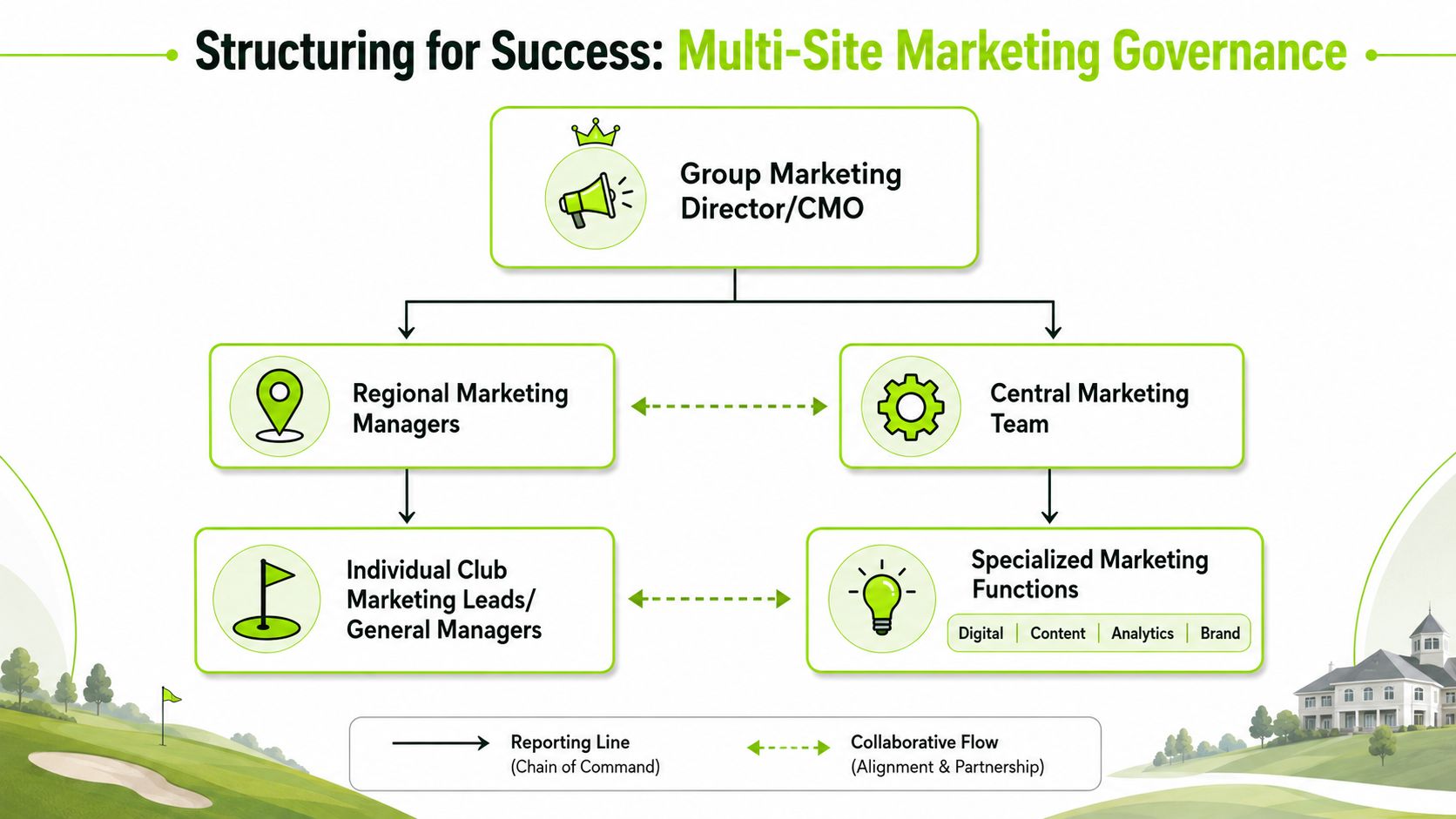
Before choosing platforms or campaigns, decide who controls what. Most problems in multi-site golf club marketing aren't caused by poor creative. They're caused by fuzzy authority.
A group needs a governance model that answers basic operational questions quickly. Who owns the budget? Who approves campaigns? Who responds to leads? Who can change offers locally? Who is accountable when one venue underperforms?
Published golf marketing advice still tends to focus on tactics, while the more important gap for multi-site operators is centralising first-party data and CRM follow-up across all locations rather than treating each club as a silo, a point highlighted in this discussion of golf club marketing trends.
Three governance models that actually exist
Here's the simplest way to view it.
| Model | Who controls marketing | Where it works | Main risk |
|---|---|---|---|
| Centralised | Head office controls budget, systems, campaigns, reporting | Groups that want consistency and tight performance management | Local teams feel disconnected |
| Decentralised | Each club manages its own activity | Loose portfolios with very different venues | Data fragmentation and uneven execution |
| Hybrid | Head office controls systems and standards, clubs shape local execution | Most serious multi-site operators | Confusion if roles aren't written down |
Fully centralised models work well when the clubs share similar goals, similar pricing logic, and similar commercial priorities. They also work when local teams are operationally strong but not equipped to run marketing.
Decentralised models can suit collections of very different venues. A city-adjacent members' club and a resort with heavy hospitality trade may need very different local calendars. The problem is that groups often call themselves decentralised when they're under-managed.
The hybrid model is usually the practical choice
Most golf groups need a hybrid model. Head office should own the infrastructure. Clubs should own local context.
That usually means the group team controls:
- Core systems: CRM, forms, tracking, reporting, automation rules
- Budget architecture: central brand spend, campaign budgets, approval limits
- Brand guardrails: templates, tone, data standards, offer rules
- Performance reviews: venue comparisons, lead handling audits, pipeline checks
Local clubs should control the parts they know best:
- On-site realities: course works, availability, diary pressures, local events
- Local partnerships: nearby businesses, societies, corporate contacts
- Venue-specific content: course updates, clubhouse activity, team personality
Centralise the process. Localise the message.
What to put in writing
Governance fails when it lives in verbal agreement. Put it in a one-page operating document.
Include these decisions:
- Lead assignment rules: which enquiries go to central sales, venue teams, or both
- Response standards: who must respond, by what method, and in what order
- Approval rules: what local teams can launch without sign-off
- Escalation paths: what happens when enquiries sit untouched
- Reporting cadence: weekly operational review, monthly group review
If a committee, GM, membership lead, and head office all think someone else is handling the enquiry, nobody is handling it.
That's the governance issue underneath most underperforming campaigns.
The Core Engine Designing Your Central CRM and Data Flow
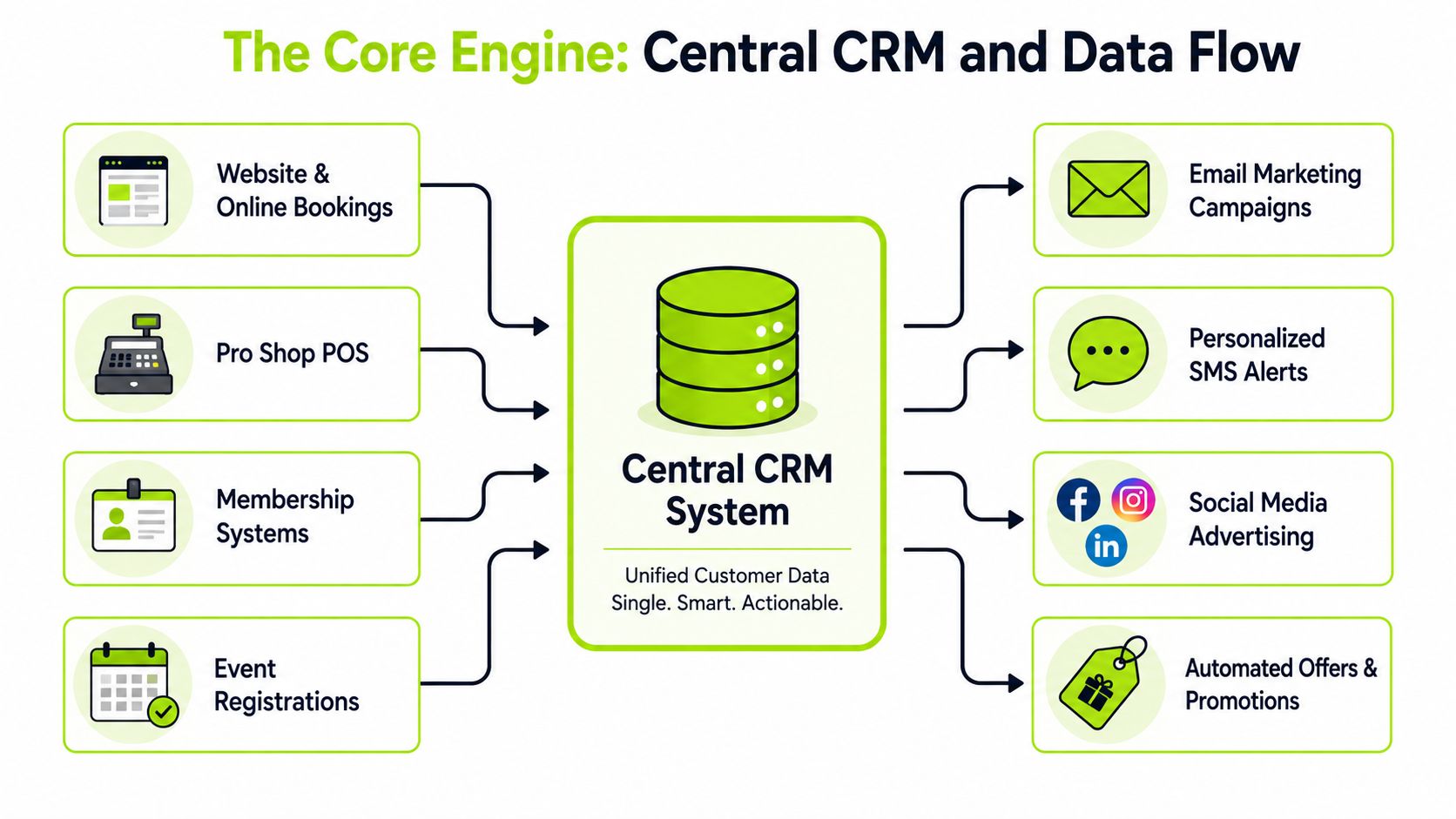
A multi-site golf group without a central CRM is trying to scale with partial eyesight. You can generate demand, but you can't manage it properly.
The CRM is the group's central nervous system. It collects lead data from every venue, tags it correctly, routes it to the right people, and records what happened next. Without that, response time becomes guesswork and attribution becomes politics.
Golf marketing guidance consistently points towards a practical model for operators: a centralised CRM plus segmented automation by site, with website-to-CRM data flow supporting faster response and better follow-up into bookings and memberships (golf marketing guidance on CRM-linked follow-up).
What one good data flow looks like
A lead journey should be boring in the best possible way. Predictable. Clean. Standardised.
A prospect clicks an ad for Club B's membership page. They land on a location-specific page, complete a form, and the system pushes that enquiry into the central CRM instantly. The lead is then tagged by venue, enquiry type, source, campaign, and date. A task or alert is created for the right team. The prospect receives an immediate confirmation. The nurture sequence starts if no manual contact happens first.
That's a system. Most clubs still operate fragments.
The fields you need to standardise
If each venue collects different information, group reporting breaks. Standard fields matter more than clever dashboards.
Use one form logic across all venues for:
- Club identifier: the specific site attached to the enquiry
- Enquiry type: membership, society, event, stay and play, restaurant, function
- Source data: campaign, channel, landing page
- Contact data: name, email, mobile, postcode if relevant
- Intent signals: preferred start date, playing frequency, interest area
Keep local forms relevant, but don't let every club invent its own structure.
If the data isn't collected in the same way, the report won't mean the same thing.
Routing, tagging, and handoff rules
Most losses happen after the form is submitted. Not before.
A central CRM should trigger three things immediately:
- Tagging so the group can report by venue and enquiry type
- Assignment so one named person owns the next action
- Automation so the lead hears back even outside working hours
This is also where connected tooling matters. If your stack includes chat, messaging, handoff, and workflow automation, resources on AI employee integrations are useful because they show how connected systems can pass information between platforms rather than forcing staff to re-enter everything manually.
GolfRep works on this kind of setup for clubs that need centralised CRM and automated follow-up, but the principle is broader than any one provider. The requirement is simple. Every enquiry from every site must enter one visible pipeline.
For a deeper look at how clubs should structure and use their records, GolfRep's guide to a golf club database is a useful companion.
Automating Growth with Nurture Sequences That Convert
A manual process sounds personal until volume arrives. Then it becomes selective. Staff answer the easiest leads first, the urgent ones interrupt the important ones, and anything that lands outside office hours waits.
Automation fixes that, not by replacing people, but by making sure no enquiry goes unattended.
A good nurture system doesn't blast everyone with the same email. It reacts to the enquiry type, the venue, and what the prospect does next. That's how multi site golf club marketing becomes operational rather than aspirational.
A Friday night membership enquiry
A prospect submits a membership form at 9pm on Friday for one of your clubs. In a manual setup, the form lands in a shared inbox. No one sees it until Saturday morning or Monday. By then the momentum has gone.
In a structured setup, the sequence starts immediately. The prospect gets a confirmation email that reflects the specific club they contacted. If mobile consent is in place, they may also receive a brief text confirming the enquiry and setting expectations for the next step. The CRM creates a task for the relevant venue team and flags the enquiry by type.
By the time staff pick it up, the lead already has context and confidence. The club hasn't gone silent.
Three sequences every group should build
The first is the new membership enquiry flow. This should acknowledge the enquiry straight away, introduce the club, and move the prospect towards a visit, call, or next conversation. It should stop or change once staff make contact.
The second is the slow-burn nurture flow. Not every prospect is ready now. Some are comparing clubs, waiting for renewal dates elsewhere, or discussing it with family. They still need structured follow-up over time, with useful prompts rather than repetitive sales language.
The third is the lapsed member re-engagement flow. This is different from new acquisition. The tone should recognise previous connection, update them on what's changed, and route any interest back into a personal conversation with the right club.
The purpose of automation isn't to send more messages. It's to preserve momentum until a person takes over.
What weak automation gets wrong
Weak setups usually fail in one of four ways:
- Generic messaging: every venue sends the same copy, even when club identity differs
- No stop conditions: prospects keep receiving automated emails after speaking to staff
- No ownership: automation fires, but nobody is responsible for the live conversation
- No stage logic: the system can't tell a fresh enquiry from a revisited one
That's why flow design matters. If you're looking at the underlying logic, even general resources on how to build sales funnels can help teams think more clearly about stages, triggers, and conversion paths before they start building campaigns inside a CRM.
For clubs considering automated follow-up in more detail, GolfRep has also written about golf club AI lead nurture.
The standard worth enforcing
Every group should define one baseline rule. Every enquiry receives an immediate acknowledgement, a clear internal owner, and a structured sequence if human contact doesn't happen quickly.
That standard is far more valuable than sending another newsletter.
Actionable Campaign Playbooks for Group-Level Marketing
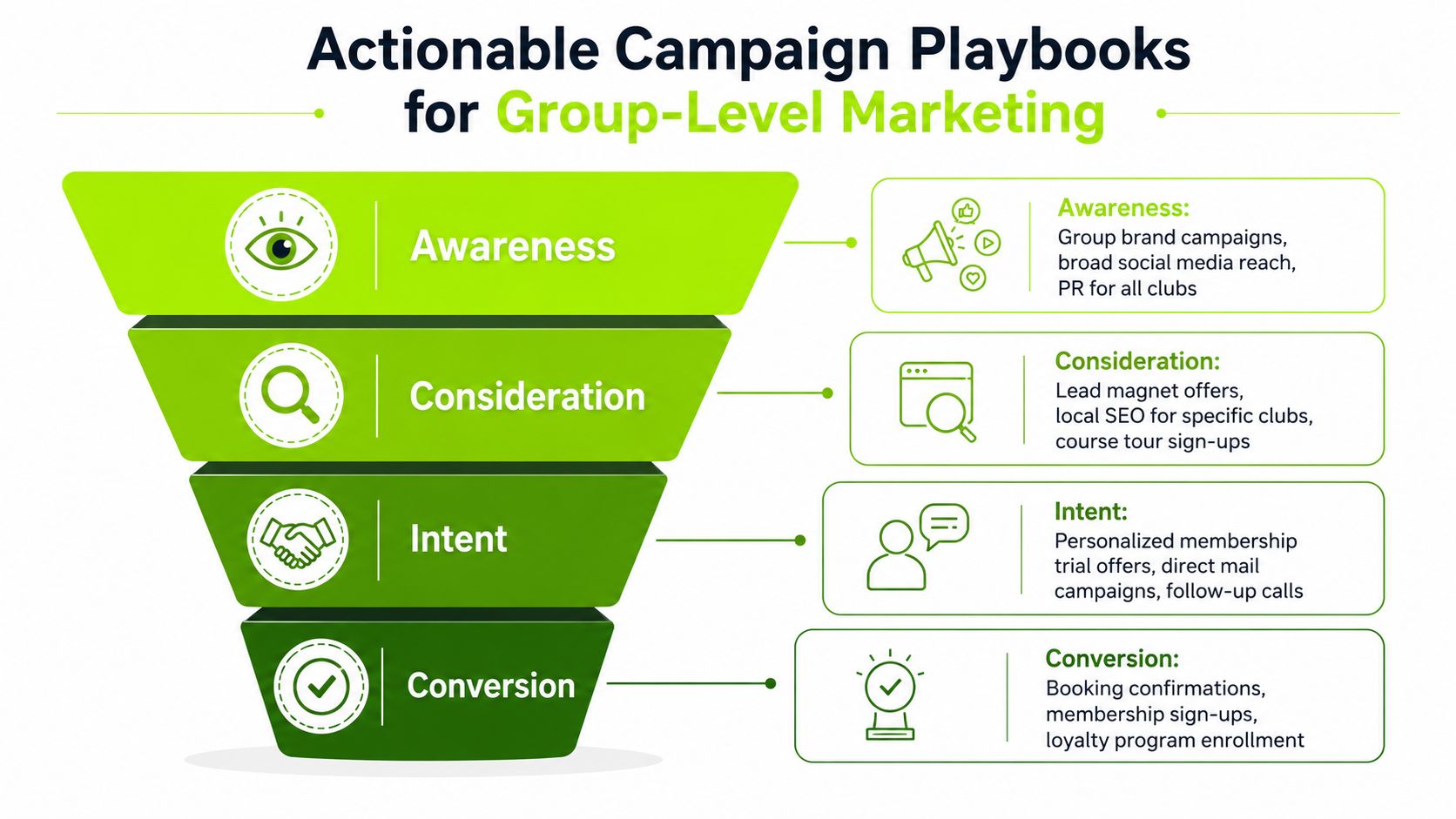
Campaign planning gets easier once the data structure is right. You stop asking, “What should we post this month?” and start asking, “Which audience segment are we moving, for which venue, with which next step?”
That distinction matters because golf groups don't just sell tee times or memberships. In many UK settings, operators also depend on restaurant, event, and hospitality revenue, which makes group-level audience segmentation beyond tee-time demand commercially important (golf course marketing ideas discussing non-member revenue opportunities).
Playbook one for membership acquisition
This is the evergreen engine for clubs that need a steady flow of prospective members.
Audience: local golfers, lapsed members, frequent visitors, and prospects who have previously enquired but not joined.
Core message: the club is a strong fit for a specific type of golfer. Not everyone. A commuter-friendly club should say that. A family-oriented club should say that. A premium private venue should avoid mass-market language.
Channels: paid social, search where relevant, email to first-party segments, and club-specific landing pages.
Trigger: a completed form, brochure request, or membership enquiry sends the lead into a venue-specific sequence and creates a follow-up task.
What usually fails here is broad messaging. “Join now” is not a strategy. A group needs one funnel architecture with different front-end positioning by venue.
Playbook two for stay and play demand
Resort-style groups often market this badly by treating it as a room offer with golf attached, or a golf offer with no accommodation logic. It needs a bundled journey.
Audience: travelling golfers, groups planning short breaks, and previous visitors who engaged with hospitality products.
Use a two-layer message. The group brand can create confidence and portfolio value. The individual venue page must sell the local experience. Course character, convenience, and booking simplicity matter more than vague lifestyle language.
A simple execution model looks like this:
- Top of funnel: group-level creative showing the range of venues
- Middle stage: venue-specific package pages
- Conversion step: enquiry or booking routed into the central CRM with club and package tags
For group operators, the brand may win the click, but the venue page wins the booking.
Playbook three for non-golf revenue
Many groups leave money on the table. They market golf to golfers and ignore the rest of the database.
Restaurants, functions, corporate days, private events, and seasonal hospitality offers should sit inside the same marketing system, but with separate audience logic. A member who ignores green fee emails may still book a Christmas event. A local resident who won't join may still become a restaurant customer or function lead.
Use segmentation that reflects actual buying behaviour:
| Audience | Likely offer | Best next step |
|---|---|---|
| Existing members | Dining events, guest days, family functions | Online booking or RSVP |
| Past visitors | Return golf break, seasonal package | Enquiry or package page |
| Local non-members | Restaurant, events, functions | Event enquiry or booking |
| Corporate contacts | Golf days, meetings, hospitality packages | Direct sales follow-up |
The mistake isn't promoting these products. The mistake is sending the same campaign to everybody.
Measuring What Matters Through Dashboards and Budgets
Marketing dashboards often become performance theatre. Plenty of colour. Plenty of charts. Not much control.
Golf groups don't need more reports. They need a steering wheel. The right dashboard shows whether enquiries are being created, handled, progressed, and converted by venue. If it can't do that, it isn't helping leadership make decisions.
A useful UK hospitality and golf case study showed that after increased marketing activity, web traffic grew by 43%, which is a reminder that top-of-funnel gains are possible, but they only matter if they're measured and linked to a conversion process (UK golf revenue management case study).
Stop judging success by visibility alone
Traffic matters. Reach matters. Clicks can matter. None of them tell you whether the commercial system is working.
For multi site golf club marketing, the questions that matter are operational:
- Are enquiries rising or falling by venue?
- Which clubs respond consistently?
- Which channels create qualified conversations rather than weak form fills?
- Where do prospects stall?
- Which parts of the budget are creating pipeline, not just attention?
That's why conversion-focused metrics are more useful than vanity metrics.
The dashboard fields worth reviewing every week
A central dashboard should make comparison easy. Not perfect. Useful.
Track measures such as:
- Enquiry volume by venue and type: so head office can see where demand is landing
- Response status: so untouched enquiries don't sit hidden in inboxes
- Stage progression: from enquiry to visit, call, booking, or membership conversation
- Source visibility: so paid, organic, referral, and direct channels can be compared
- Revenue attribution where possible: so campaign decisions reflect commercial outcomes
This doesn't need to be overly technical. It needs to be disciplined.
A dashboard should help you intervene early, not explain failure after the quarter has gone.
Budgeting across group and local activity
Budget arguments usually become unproductive when nobody separates central and local objectives.
A practical structure uses two pots. One supports group-level activity such as brand, shared creative, CRM infrastructure, and central campaigns. The other supports club-specific promotions, local partnerships, and venue-level demand shaping.
Review budgets against outcomes, not internal preference. A club that wants more local spend should be able to show enquiry handling quality and conversion discipline. A head office team that wants tighter central control should be able to show that standardisation is improving performance, not just reducing autonomy.
If your team needs a cleaner way to define outcomes rather than activity lists, this guide on marketing OKRs and outcomes is a helpful framework for connecting reporting to decisions.
Your Phased Rollout Plan and Implementation Checklist
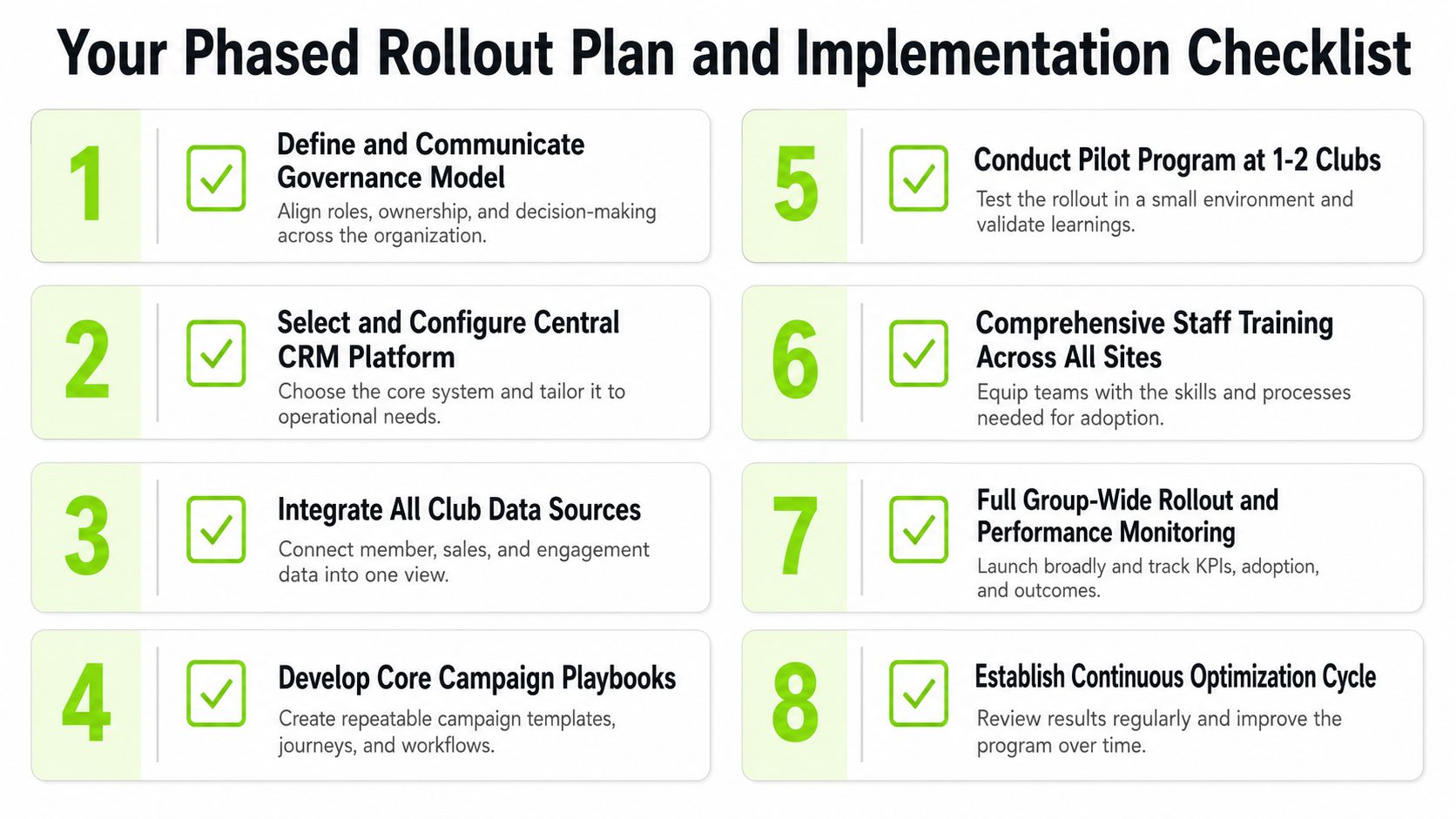
Most golf groups don't need a dramatic transformation. They need an orderly rollout.
Trying to replace websites, CRM, reporting, automations, and campaign logic across every venue at once usually creates confusion. A phased plan works better because it forces operational discipline. It also shows quickly where the core resistance lies. Usually not in the software, but in ownership and process.
Phase one for foundation
Start with decisions, not campaigns.
Agree the governance model. Choose the central CRM. Standardise lead stages and definitions. Decide what every venue must capture on forms and what happens after submission. If you skip this and jump into ads, you'll only create more noise inside a weak system.
A short checklist for this phase:
- Confirm ownership: who runs group marketing, who owns venue follow-up, who reviews performance
- Define pipeline stages: one shared language for all clubs
- Audit current entry points: websites, inboxes, booking forms, event pages
- Set minimum response rules: clear standards for all locations
Phase two for pilot
Don't roll out to every club first. Pick one pilot venue, or at most a small cluster with similar needs.
Use a membership enquiry flow as the first live use case. It's usually the clearest test due to its importance and the journey is easy to map. Route enquiries into the CRM, launch the acknowledgement and nurture logic, and monitor whether staff follow the handoff process.
What you're testing isn't only platform setup. You're testing human compliance.
Phase three for scale
Once the pilot proves the workflow, extend the model across the group in a controlled sequence.
Roll out common templates, tags, dashboards, and handoff rules site by site. Keep local messaging flexible, but keep process fixed. Many groups stumble by allowing clubs to customise core workflows until the reporting becomes unreliable again.
Phase four for optimisation
After the first system is stable, widen the revenue mix.
Add campaigns for hospitality, events, restaurant activity, corporate days, or lapsed-member reactivation. Review pipeline data regularly. Tighten weak forms. Remove duplicate tasks. Rewrite emails that create replies but not movement.
The point isn't to build more automation. It's to build a cleaner commercial machine.
A good rollout leaves you with one version of the truth across the estate. One pipeline. One set of standards. Local personality at the front. Central control underneath.
If your group is trying to bring enquiry capture, follow-up, and conversion into one system, GolfRep works with UK clubs and operators on the practical setup behind that process, including centralised CRM structure, lead routing, and automated nurture that supports each venue without turning every club into the same brand.
Ready to tap into our proven growth system?