Fixing The Golf Business Model for 2026 Growth
It's a strange time for the golf business. Here we are in 2026, with participation booming and tee times in high demand, yet so many UK clubs are finding it harder than ever to balance the books. They're grappling with unpredictable revenue streams and operational costs that just keep climbing.
The problem isn't a lack of interest in the game. The real issue, and the one we see holding clubs back time and again, is a fundamental failure to convert that enthusiasm into stable, long-term membership. The challenge is not generating enquiries, but handling, responding to, and converting them effectively.
Understanding The Modern Golf Business Landscape
As a growth partner for golf clubs across the UK, we get a front-row seat to this contradiction every single day. The demand is clearly there. But a surprising amount of revenue is simply being left on the table because clubs are stuck using outdated, manual methods for handling new member enquiries.
This guide is about more than just temporary fixes or generic marketing theory. It is a practical blueprint for building a more resilient financial future for your club. Our goal is to show you how to shift from putting out fires to implementing a proactive, data-led system for growth.
The Real Challenge Facing Clubs
Here is the point most people miss: the true challenge is not about getting the phone to ring more or driving more traffic to the website. In fact, many clubs are already fielding more enquiries than they can properly manage.
The problem lies in what happens after that first point of contact.
When a potential member's email gets buried in a busy inbox, a callback is delayed, or a follow-up is simply forgotten, a sale is lost. These are not huge, catastrophic failures. They are small slips that, when repeated day after day, carve significant holes in your revenue.
We have found the most common point of failure for a golf club is not its marketing. It is the internal system, or lack thereof, for responding to and converting the enquiries that marketing brings in. Success is decided by what happens after the phone rings.
Think about it. A hectic front desk, a part-time administrator juggling a dozen tasks, or a reliance on scribbled notes and memory all lead to a chaotic and inconsistent sales process. This approach makes it impossible to track where a prospect is, measure your conversion rates, or build any kind of predictable pipeline of new members.
Moving From Reactive to Proactive Growth
This guide will walk you through the steps to leave that reactive model behind for good. We will explore the key pillars you need to build a system that captures every single opportunity and secures predictable, sustainable growth for your club.
This means getting a real grip on:
- The financial levers that actually drive profitability.
- The bottleneck in your process that is really holding your club back.
- The systems and processes required to build a reliable growth engine.
By the time you are finished, you will have a clear framework for taking control of your club's future, turning fluctuating demand into a stable and measurable source of long-term revenue.
The Financial Anatomy of a Modern Golf Club
If you want to get to the heart of what makes a golf club tick, you have to look at the money. It is easy to see the course, the clubhouse, and the members, but the real story is in the balance sheet. Think of your club as a finely tuned engine; for it to run smoothly and predictably, you need a crystal-clear picture of what is coming in and what is going out.
We have seen it time and again: clubs get a distorted view of their financial health because they lump all their income together. A brilliant, sunny summer that brings in a flood of green fee income can feel like a massive win, but it often masks a deeper problem.
If that spike in visitor play is hiding a flat or even shrinking membership roll, the club is standing on much shakier ground than the top-line numbers suggest. Relying on unpredictable income like this is one of the riskiest positions a club can be in.
Differentiating Revenue and Costs
The long-term stability of any club depends entirely on how it balances its income streams against its major expenses. This is not just about making sure more money comes in than goes out each month; it is about understanding the quality and reliability of that income.
Let's break down the typical financial components. Looking at it this way often reveals a critical imbalance between what you can count on and what you cannot.
UK Golf Club Revenue & Cost Centres
The table below outlines the core financial pillars of a typical UK golf club. Pay close attention to the volatility column. It highlights the fundamental tension between stable costs and often unpredictable income.
This table makes the core challenge obvious: your biggest costs are almost entirely fixed and predictable, while a huge chunk of your potential income is anything but. This is precisely where financial pressure starts to build.
The Bedrock of Sustainable Profitability
The good news is that the UK golf market is incredibly robust. It supports thousands of businesses and is projected to have a market size of £2.8 billion by 2026, having grown at a compound rate of 2.2% from 2020 to 2025. With over a million registered golfers across the home nations, the demand is clearly there. You can dig deeper into the latest UK golf market trends to see the broader picture.
The ultimate goal for any club manager or committee should be to systematically shift this financial balance. This means turning volatile income opportunities, like visitor enquiries, into the predictable, recurring revenue of club membership.
Basing your financial strategy on a good weather forecast or a one-off local event is a recipe for anxiety, not long-term security. The only reliable fuel for sustainable profit is a steady, predictable pipeline of new members. This is what provides the stable foundation you need to invest in the course, improve your facilities, and plan for the future with confidence. It is how you transform your club from a weather-dependent business into a thriving, year-round success story.
Why High Demand Is Not a Long-Term Strategy
It has been a fantastic few years for golf. Courses across the UK have seen tee sheets brimming and short-term revenues climb, bringing a welcome wave of optimism. But here is the hard truth: treating this boom as the new normal is a dangerous mistake. Relying on this trend is like banking on a long, hot summer to see you through the winter. It is lovely while it lasts, but it is no substitute for a proper business plan.
The conditions that created this surge were a perfect storm, not a permanent change in the industry's climate. Think of this high demand not as a strategy, but as a massive, fleeting opportunity. Without a robust system to capture all this interest and turn it into loyal, paying members, clubs are quite literally watching future income walk out the door every single day.
The Double-Edged Sword of Rising Costs
While demand has soared, so have the costs of running a quality golf club. This is not just a feeling; the numbers paint a stark picture. We have all seen the invoices for greenkeeping labour, fertiliser, and essential machinery parts creep up. At the same time, energy costs for fundamentals like irrigation have gone through the roof. The financial pressure is real and it is not letting up.
Naturally, many clubs have responded by raising prices. Recent figures show green fees at UK courses have consistently outpaced inflation, with some premium venues pushing rates up by as much as 15-20% since 2023. This certainly helps cover some of the extra expense, but it also raises the stakes for the customer. You can see a full breakdown of the regional differences and cost pressures in this report on UK golf course pricing trends.
Complacency is the single biggest threat in a high-demand market. When the phone is ringing and the course is full, it is easy to believe your current methods are working perfectly. The real test comes when the market cools, and those who failed to build a proper sales pipeline are left exposed.
This puts clubs in a precarious position: charging more, but also spending more just to stand still. It is a cycle that cannot be sustained by passing trade alone. It highlights just how urgent the need is for a more reliable, predictable source of income.
This flowchart lays out the fundamental financial dynamic, separating the reliable income from the unpredictable.
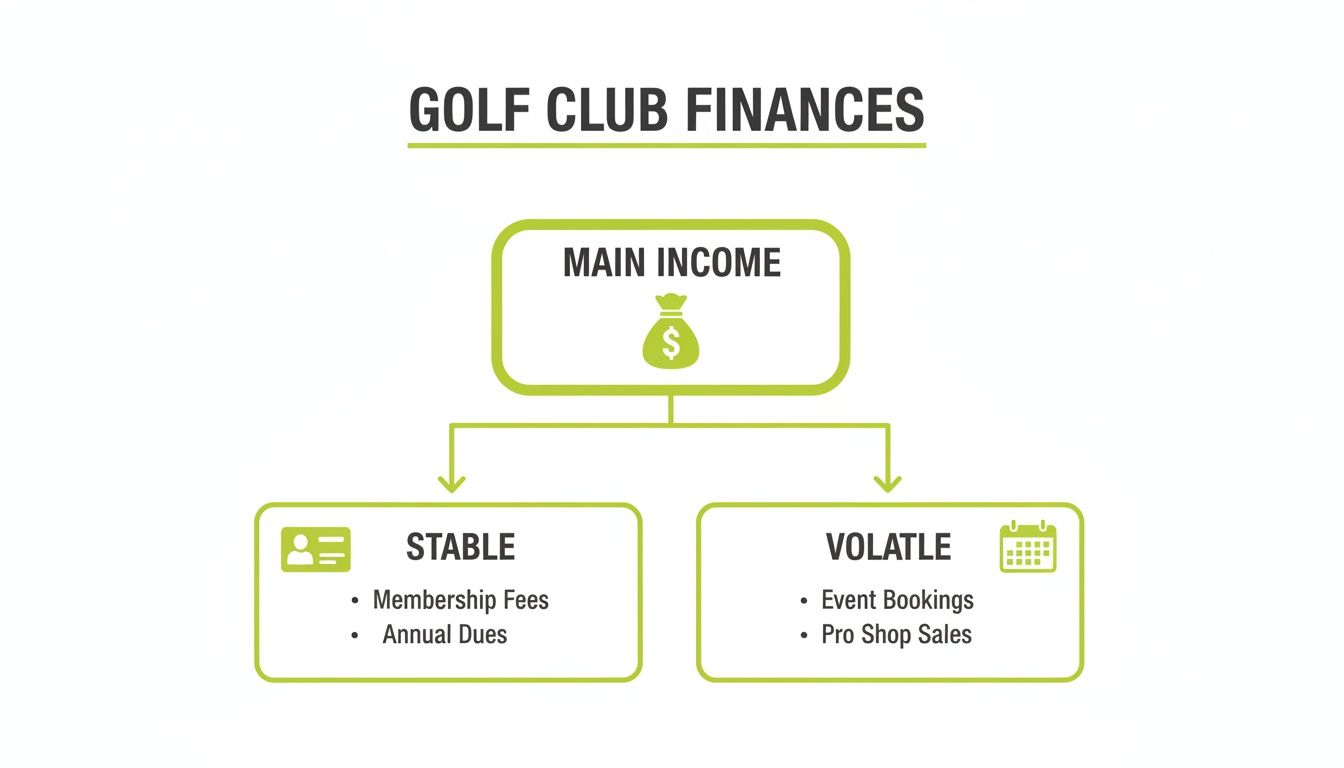
As you can see, while volatile income from visitors is a welcome bonus, it is the stable, recurring revenue from memberships that provides the true financial bedrock for any healthy club.
From Good Fortune to Smart Operations
The current high tide of interest offers a golden chance to secure your club's future, but only if you act decisively. Every visiting golfer who sends an enquiry is a potential long-term member. The way that enquiry is handled is what determines whether you capture that future revenue or let it slip through your fingers.
- The Risk: Mistaking a full tee sheet for a healthy membership pipeline. Visitor income is brilliant at masking a stagnant or even declining membership base.
- The Opportunity: Treating every visitor and every enquiry as a valuable sales lead. This requires a fundamental shift in mindset from passively taking orders to actively converting leads.
If your process for handling new enquiries still relies on a busy administrator’s memory or a notebook tucked behind the counter, you are simply not set up to capitalise on this moment. The high demand is a catalyst, forcing a much-needed evolution in how golf clubs operate. It is time to move on from hoping for the best and start building a smarter, more resilient business.
The clubs that use this period to install structured systems for lead management and conversion will be the ones that thrive long after the current boom subsides.
Pinpointing Your Real Growth Bottleneck
Most club committees and managers work from a common assumption: that the biggest barrier to growth is not getting enough new enquiries. After years of working closely with clubs all over the UK, we have found that is rarely the case. For the majority of clubs, the real problem is not a lack of interest.
The true bottleneck is the chaotic, slow, and manual way that interest is handled.
Think of your sales process as a bucket, with new enquiries being the water you pour in. Every missed phone call, slow email reply, or forgotten follow-up is a hole in that bucket. The more you spend on marketing to generate interest, the more water you pour in, but the leaks just get bigger. You are losing potential members not because of a lack of demand, but because your system for capturing it is broken.

The Cost of a Slow Response
In the golf business today, speed is everything. When a prospective member takes the time to fill out a form on your website or ring the club, their interest is at its absolute peak. With every minute that passes, that enthusiasm fades.
An ad-hoc approach, where enquiries land in a general inbox or rely on a busy staff member to remember to call back, is a recipe for lost revenue. The data is clear: the chances of converting a new lead drop dramatically after just the first hour. If your enquiry response time is measured in days, or if some enquiries are missed altogether, you are effectively turning away business you have already won.
The single biggest growth opportunity for most golf clubs is not a bigger marketing budget. It is building a system that guarantees every single enquiry gets a fast, professional, and consistent response.
This is not a criticism of club staff. We know that general managers, secretaries, and PGA professionals are juggling a dozen different jobs at once. It is simply an honest assessment that manual processes are not built to handle the pace and volume of modern enquiries. Without a dedicated system, crucial opportunities will always fall through the cracks.
From Ad-Hoc Chaos to Systematic Control
The alternative is to move away from a reactive, manual model and towards a structured, systematic one. This shift turns your leaky bucket into a secure pipeline, giving you complete lead visibility and making sure every potential member is nurtured properly.
A systematic approach brings several key advantages that a manual process just cannot match:
- Instant Engagement: The system can reply to every web enquiry within minutes, 24/7, confirming you have received their message and providing key details while the prospect is still thinking about your club.
- Complete Visibility: A centralised CRM shows you exactly where every prospect is in their journey, from their initial enquiry to a booked tour and their final decision. Nothing gets lost.
- Conversion Tracking: You can finally measure what actually works. By tracking enquiries from source to sale, you gain priceless data on which marketing channels are delivering new members.
- Structured Follow-up: Automated reminders and tasks ensure your team follows up with every prospect at the right time, maximising the chances of conversion.
Building this kind of structure is less about installing complex technology and more about a shift in mindset. It is about realising that the process for converting an enquiry is just as important as the one for generating it in the first place.
Our in-depth guide on why golf club leads don't convert explores these failure points in greater detail. By fixing these internal leaks, you stop losing the opportunities already in your hands and start building a predictable, reliable path to growth.
How to Build a Predictable Growth System
To secure a club's future, you have to move beyond reactive management and wishful thinking. The most successful clubs operate on a predictable growth system. This is a clear, operational blueprint for turning a glimmer of interest into a committed, long-term member. This is not about chasing every shiny new marketing trend. It is about installing a robust, measurable process that just works, month after month.

Think of it as fixing a leaky bucket. A solid system is built around three core ideas: attracting the right prospects, engaging them instantly, and nurturing them effectively. Get these three elements working together, and you transform your sales process into a secure pipeline, giving you the confidence that comes from data-driven decisions.
First, Attract High-Value Prospects
The first step is making sure you are attracting the right kind of attention. The goal is not simply more website traffic or a phone that will not stop ringing; it is to connect with people who have a genuine interest and the means to become a member.
This means getting smarter than generic advertising. A winning approach targets golfers within your club’s catchment area who are already showing signs they are looking for a new home course. By focusing your efforts here, you ensure your budget is spent connecting with high-intent prospects, not just casual browsers. Every pound invested works harder, filling the top of your pipeline with qualified leads instead of random noise.
Second, Engage Instantly with Automation
Once a prospect reaches out, the clock is ticking. We already know that speed is everything. A delay of just a few hours can mean the difference between gaining a new member and losing them to a faster-moving competitor down the road. This is precisely where automation becomes a game-changer for the modern golf business.
An automated system ensures every single web enquiry gets an immediate, professional response, 24 hours a day, 7 days a week. This first touch can confirm you have received their message, provide key information like your membership brochure, and set expectations for a personal follow-up. It guarantees no lead is ever left hanging, instantly elevating your club's professionalism while capturing interest at its peak.
By automating the initial response, you free up your staff to do what they do best: building personal relationships with warm, engaged prospects, rather than chasing cold leads or digging through a chaotic inbox.
At Bidston Golf Club, implementing this kind of instant engagement was the foundation of their revival. It ensured every enquiry from their targeted campaigns was handled perfectly, helping build a pipeline that more than doubled their membership and secured their financial future.
Third, Nurture Leads with a Structured System
Getting a prospect’s attention is just the start. The next crucial piece of the puzzle is the structured, long-term follow-up that guides them towards a final decision. This is where a Customer Relationship Management (CRM) system becomes absolutely essential.
A CRM acts as a single, central hub to track every interaction you have with every prospect. It takes the guesswork and faulty memories out of the equation and replaces them with a clear, systematic process.
- Total Visibility: See every prospect and their current status at a glance.
- Automated Reminders: Ensure your team follows up at the perfect moments.
- Data-Driven Insights: Understand your conversion rates and the true value of your pipeline.
This organised approach was the key to success for Downes Crediton Golf Club. By managing all new enquiries through a CRM, their team had complete clarity on who needed a call, who had a tour booked, and who was ready to sign up. This discipline allowed them to run a rapid and highly profitable membership campaign with total confidence. You can get more familiar with the benefits by reading our article on mastering golf club marketing automation.
The record-breaking weather of 2025 gave many clubs a false sense of security as green fee revenue hit an all-time high. A recent report highlighted a 17% increase in average green fee revenue for UK clubs, driven by a staggering 25% surge in online bookings. But those were exceptional conditions, and it is foolish to expect a repeat. Clubs that relied solely on that temporary boom are risking stagnation.
As you can discover in the full analysis of 2025's revenue trends, a structured system is the only real way to protect against market fluctuations and build long-term resilience. Combining proven strategy with the right technology is what creates a measurable pipeline, turning a first click into a loyal member and securing your club's future.
Taking Control of Your Club’s Financial Future
As we have explored the modern golf business, one thing has become crystal clear: lasting success is not about getting lucky with good weather or waiting for the phone to ring. Genuine stability comes from taking direct, intentional control over your club's growth.
The old way of thinking was that a lack of enquiries was the main problem. But for most clubs, the real issue is not a shortage of interest. The actual bottleneck is the messy, often manual, process of turning that interest into paying, committed members. This is the crucial moment where your future revenue is either secured or lost.
Shifting from Chance to System
This means taking the focus off simply trying to generate more leads and putting it where it belongs: on perfecting the system that handles the leads you already have. Relying on a busy general manager's memory or a chaotic inbox is a sure-fire way to let good prospects slip through the cracks.
What you need is a structured growth engine. It is about building something that gives you predictability. A solid system ensures every single person who shows interest gets a prompt, professional response and is guided along a clear path, from their first click to their first round as a new member.
The real aim is to build a club that is not at the mercy of things you cannot control. When you have a dependable system for turning interest into income, you finally get to steer your own financial ship.
The Power of a Predictable Pipeline
Just think for a moment what a predictable pipeline of new members would mean for your club. You could plan major investments, manage your costs with confidence, and make strategic decisions based on solid data, not just guesswork. It is the very foundation of a secure, prosperous future.
- Financial Stability: Forget the wild seasonal swings. A steady stream of membership income smooths out the peaks and valleys, giving you a reliable financial baseline.
- Confident Planning: You can finally budget for those course improvements or facility upgrades, knowing with confidence that the income will be there to support it.
- Measurable Growth: Start tracking your actual return on investment and make smart, informed decisions to drive your club forward.
By putting a systematic approach in place, you stop gambling with your membership acquisition and turn it into a reliable, measurable part of your operation. This proactive stance is what builds a resilient club that can thrive, no matter what the market throws at it. To see exactly how this impacts your bottom line, take a look at our breakdown of the real ROI of golf club marketing. This is how you take control.
Questions About Growing a Golf Business
Running a golf club means you are constantly juggling challenges and asking tough questions about the best path forward. Let's tackle some of the big ones we hear all the time from club managers, committees, and owners, with practical answers aimed at building a truly sustainable future.
What Is the First Step to Improve Membership Sales?
Before you even think about spending another pound on advertising, your first move should be to audit your current enquiry process. It is simple: send a test enquiry to your own club by email, then follow up with a phone call. See how long it takes to get a response.
If you are waiting longer than an hour, you have found your most urgent problem. A fast, professional, and organised response is the single highest-impact, lowest-cost improvement you can make. This is not about generating more leads; it is about converting the ones you already have. That is the real bottleneck in the golf business.
How Much Should We Budget for Marketing?
We get this question constantly, but it is often framed the wrong way. Your budget should not be some arbitrary percentage of revenue. A much smarter approach is to think in terms of cost per acquisition (CPA).
A predictable growth system allows you to calculate exactly how much it costs to acquire a new member. Once you know that number, your 'marketing budget' is no longer a cost centre; it becomes a predictable investment to hit specific growth targets.
Think about it this way: if you know it costs £200 to sign up a new member who will bring in £1,500 in their first year, the question completely changes. It is no longer "how much can we afford to spend?" but "how many new members do we want this year?" This shifts your entire mindset from speculative spending to confident, data-backed investment in your club's growth.
Is a CRM System Too Complicated for Our Club?
Many clubs worry that a Customer Relationship Management (CRM) system will be too complex or create more work for their staff. In reality, a good CRM does the exact opposite. It brings absolute clarity to your sales process.
Modern systems are built to be user-friendly. The goal is not to overwhelm your team with features, but to give them a clear, visible pipeline of every potential member. It ensures they know exactly who to follow up with and when, so valuable leads stop getting forgotten in a busy inbox. The right growth partner will not just hand you a piece of software; they will implement a system tailored to your club, turning a potential headache into your most powerful tool for organised, predictable growth.
Are you ready to stop guessing and start building a predictable pipeline of new members? GolfRep builds data-led growth systems that give clubs complete control over their financial future. Learn more about our process.
Ready to tap into our proven growth system?